The next time someone asks you to “go above and beyond” at work, or to “give 110%” in a game, just be thankful your boss or coach isn’t Nebuchadnezzar. Nebuchadnezzar, King of Babylon in Daniel 2, had a dream and wanted to know the meaning of the dream. But instead of telling his dream to his wise men, he expected, even demanded, that *they* tell *him* the dream. Notice what the wise guys say to the King. “There is not a man on earth who can meet the king’s demand.” (2:10) My friends, that’s *exactly* the point. Only “the gods” or more accurately, only God, can make know the contents of the dreams of the King. But the wise men of Babylon don’t know the God who knows all things, they don’t worship the God who sees everything, even into the hearts of people.
The King even asks Daniel “Are you able to make know to me the dream?” Daniel replies “No… no one can.” But “there is God in heaven who reveals mysteries… This mystery has been revealed to me, not because of any wisdom that I have more than all the living, but in order that the interpretation may be made known to the king.” Over the next few days we will try to understand what is going on with the Kingdoms of the world in Daniel and try to understand this vision better, but today I want to make this very practical.
Sometimes people tell us ideas that are not entirely Biblical because they are trying to be nice. One such idea is that “God will never give you more than you can handle.” It sounds good; we will never be overwhelmed and we will always succeed. However, as soon as our lives meet the real world, we find out that God consistently “gives us” situations that are overwhelming; try balancing getting good grades, doing extracurriculars, volunteering to pad our college applications, and then getting into and maintaining relationships, not to mention work! It’s overwhelming to write; how much more to live. But beyond the normal chaos of life, there are times when people we love are sick, when we need surgeries, when we have huge doubts about what is happening next. Just like the King demanding that the wise guys explain his dream, the world very often gives us far more than we can handle… *on our own*.
What God has promised is that we are never on our own. No one can handle this world with joy, hope, peace, and love *by themselves*. But there is a God in heaven who gives the joy, hope, peace and love we are looking for. There is a God in heaven who gives his spirit to his people, not because we are wise or smart, or pretty, or popular, or good. God gives because we trust him, and all of our faults doesn’t stop him from loving us, and he does not leave us on our own. The world often gives us more than we can handle; the world can NEVER give us something God can’t handle.
-Jake Ballard
Reflection Questions
What differences do you see between Daniel and Nebuchadnezzar? Are you ever more like Nebuchadnezzar than Daniel?
What characteristics of Daniel’s do you admire? Which would you like to work on growing in your own life? How would one go about that?
When has the world given you more than you could handle? In what ways did God provide what you needed? Thank Him!
Over the next two weeks, we are going to spend some time in the book of Daniel. Daniel is a book that has generated a lot of discussion: it has been the subject of at least TWO retellings by our favorite cast of talking vegetables and at least one cookbook based on mostly eating those vegetables. However, we might miss the mighty story of this man of the Almighty when we get too hung up on cucumbers, mushrooms, and other morsels. Is the story of the fiery furnace really about chocolate bunnies? (See “note” below.) Are the health benefits of a “Daniel-Diet” the point of the refusal to eat the King’s food? But, if not, then what is the point of Daniel?
To be clear, this book is one of the most discussed in scholarship from the Old Testament canon. Any statement made about date, authorship and the rest of the book has been discussed ad nauseum by Jewish rabbis and Christian thinkers since the pen was put to paper. The author, Daniel for our devotions, wrote in Hebrew but also in Aramaic; not common for the Old Testament. Moreover, the genre of the book is more similar in style to Revelation than anything else in the Biblical canon. These two books are full of big, bombastic images, metaphors, poetry, talk of beasts, monsters, dreams, the clash of Empires and the Kingdom of God. But, if we are ready to work, to interpret Daniel on his own terms, and to clearly see what he was writing about and what he was prophesying, we will get much more out of Daniel than we have before.
For example, in chapter one, Daniel, and his buddies Hananiah, Mishael, and Azariah (rather than Shadrach, Meshach and Abednego), who we will call “the boys” today, decide to not eat the king’s food. The boys decide that they are going to eat vegetables and water. They look better after ten days and they prove that this is the diet everyone should eat and life is good… right? Not quite. First, what are the boys giving up? “Meat and wine and choice foods”. In the ancient world, those who worked with the King were expected to be plump (“fat”) because of the wealth and excess of the King. The steward over the boys was *concerned* that they would lose weight, not hoping for it! At the end of ten days, by a miracle of God, though the boys ate only vegetables and water, they look good and FAT. Not a divine diet, not wisdom-based weight loss; it was a miracle of God to keep them healthy and plump!
But again, the weight and food was never the real point in the first place. Look back at verse 8, “Daniel resolved that he would not defile himself with the king’s food or with the wine that he drank.” Daniel, as a good Jewish boy, knew that the King’s meat was probably slaughtered in the honor of a god of Babylon (much like the meat in the marketplaces in Greece, see 1 Cor. 10:27) and the wine was probably prepared in much the same way. Daniel’s choice to avoid this food was to honor God. YHWH, the God of Abraham, Isaac and Jacob, would be the only God that Daniel would follow; his law the only commands Daniel would obey, food laws as well as moral laws. Daniel’s obedience is blessed by God. The boys were able to understand the administration of state and Daniel was able to understand dreams and visions from God.
Chapter one is not a weird story about the diet of Jewish kids in a strange land. It is the story of God’s people, God’s Kingdom, clashing against the Kingdom of this world. Daniel and his buddies had a choice to make, to follow the ways of this world’s Empire, to eat the way everyone else ate, to drink what everyone else drank, to *worship* what everyone else worshipped. The choice they made was to follow God even at personal cost and they realized that resulted in blessing they could not have expected.
That is a story worth working to understand.
It’s the story Bob and Larry were trying to tell us all along.
Reflection Questions
I’ve been a little harsh on “The Daniel Diet,” but it’s not just one diet or fast or book that makes this mistake. In fact, many have tried to take parts of Daniel to make a diet, or used Ezekiel 4:9 as a recipe for bread, without reading down to Ezekiel 4:12. Are you ready to use the Bible as it was intended? To work to interpret God’s word in a way that impacts you, not a small change but to lead a life of difference?
In light of the first question, are you willing to make the choices that might cost you personally, if it means you remain faithful to God? Are you willing to look different, act different, eat different, vote different, shop different, wear different, **be different** if it means you can be more like Jesus? What strikes you as the first change you can make today that may cost you sounding or appearing cool, just like everyone else, but will make you more like Jesus?
Are there other sections of scripture (beyond Daniel 1 and Ezekiel 4) where you think we may have missed the point? Talk to your mom, dad, grandparent, pastor, youth pastor, or Sunday School teacher about those ideas. What do they think about those harder sections that seem to be about more than surface level ideas?
Note: The author LOVES VeggieTales. In no way should his words be perceived as mocking or belittling the greatest show about talking vegetables ever made.
Today’s reading finishes up our time in the prophetic book of Ezekiel. A book that I’ve enjoyed studying a bit more- even if some days I’ve found myself with more questions than answers. Ultimately, it is nice to close in hope, and Ezekiel’s last chapters end with hope and a climax with God’s glory being restored to the temple. His words of prophecy were full of hope to those in exile even before the promised Messiah had surfaced. For us who have received the gift of the Messiah, and a personal relationship with God, the hope for a future restoration in the kingdom of God is something we still cling to in our days of exile.
The book of Ezekiel starts with a little less good news, and some warnings of destruction which certainly came to Jerusalem, but it ends with this detailed, beautiful prophetic description of a new temple yet to come. Historically, there has not yet been a temple meeting this description to fulfill this prophecy. And while some argue that this prophecy was solely fulfilled figuratively (in Jesus, in the church, etc.), others assert it is a future literal temple yet to come in the Millennium where believers reign with Christ. While I am certainly motivated to study it more after stumbling across the various ideas out there, because I am confident from scripture that there will be a literal return of Christ to earth, it appears to me these prophecies work well alongside that in describing a literal temple.
I appreciate the taste of restoration and return of God’s glory that Ezekiel gives us. In the United States, we have just finished another tiresome election cycle, and it seems like in these times we hear it all….. over and over again…..the self-proclaimed prophets, empty promises, whining and blaming, “pride, patriotism, and prejudice”…..the whole shebang. My hope and faith is not in America being great. Nor is it in world peace we know scripturally will not truly happen in this age- no matter who is president. My true identification or affiliation is not found in my national citizenship or any other political, demographic, or who-knows-what-now-label. My only sustaining hope is based in the promises given to Abraham and shared with me thousands of years later. I look forward to the world being great again, and pray Jesus will return soon, so that the meek will inherit it.
Ezekiel closes his prophecy telling us the name of the city he had described in such detail. It is called “The LORD is there”. In Hebrew, “YHWH sammah”. Two words that brought the most resonating image to my mind in all of the chapters in this book that I read. There will be a day when God and His son Jesus will dwell with us. Literally.
-Jennifer Hall
Questions:
What are your thoughts on how the prophecies from these chapters are/will be fulfilled?
What gives you hope in today’s reading?
How does the LORD “being there” impact a place? We know we’re invited!
Our psalm for today, Psalm 134, is one of the fifteen psalms labeled as “Psalm of Ascents” which in the Hebrew Bible are Psalms 120-134, so today’s reading finishes up this section of psalms. The author of this one is not known, but it is believed that these psalms were written during the 70 years of Judah being exiled in Babylon (same period from Ezekiel’s prophecies we are also reading right now).
Whether or not this was necessarily the intent of these psalms, they were used later by Jewish people who would sing them as they traveled to Jerusalem for the appointed “Pilgrimage festivals” according to the instructions they had been given in Deuteronomy 16. Looking back on this group of psalms, I can imagine they would be a wonderful source of encouragement on a long journey (heading uphill to Jerusalem!), and could also facilitate a spirit of giving praise and honor to the LORD.
I read some commentators noting how many phrases from these psalms were used in early/traditional hymns as well as how many continue to surface in contemporary worship songs. In fact, when I read today’s psalm, I had a song pop in my head using these words, and imagine others might have had the same happen but with completely different songs based on the many choices out there. Personally, I also had a scene surface from the Sound of Music when I read Psalm 121! These psalms are certainly jam-packed with lots of beautiful references, lyrics, and thoughts on which to meditate.
We do not have to make the pilgrimage to Jerusalem anymore, and we do not currently live in Babylonian captivity. But, we live in a world whose messages and words are far different than the ones we read in the Psalms of Ascent. Sometimes the messages are blatant screams, and sometimes they are subtle whispers, but as they bombard us, it is easy to forget who deserves our praise, honor, and obedience. It is also easy to mindlessly sing familiar songs, recite familiar psalms, or get caught up in the razzle dazzle displays of “worship music” sometimes. But, He deserves better.
“Come, bless the Lord, all you servants of the Lord. . .” (Psalm 134)
What does blessing the Lord mean though? Doesn’t He bless me? Ahh….well, to give us a picture of how we are to be blessing Him here…..this Hebrew word in this context means to “praise and adore”.
This week, I’m guessing many of us could likely amp it up in the praise and adoration of God and Jesus.
-Jennifer Hall
Questions:
How can psalms, hymns, verses, or worship songs encourage you on the difficult life journeys you face?
How did the Psalms of Ascents make you feel as you were reading them?
Consider some reasons God and His son Jesus are worthy of praise and adoration!
In today’s Ezekiel reading, we enter into Chapter 40 after a thirteen year gap of time since Ezekiel’s last vision described in the preceding chapters. A lot can happen in thirteen years. For Ezekiel….well…he was still in exile and oppressed under Babylonian rule. Though he had grown up in a priestly family, before he could even serve as priest, he was hauled out of Jerusalem in the first siege, and mentions being on the shores of the Kebar River when he receives his prophetic visions. In addition to Judah remaining in captivity in the hands of the Babylonians, by now the old temple in Jerusalem (you know, the super fancy and detailed one from Solomon’s era?) has been crumbled as well.
I can imagine how I might feel hearing my church building or house had been destroyed and taken over. But, it is hard for me to even imagine how it would feel to deal with all that Ezekiel and Judah were dealing with at this time….being in captivity in a foreign land, laden with guilt knowing that exile was related to their people’s own sinful choices, surrounded by those not worshiping the same God, and then hearing that their beautiful temple……that really big important place the LORD had told them in precise detail how to build and what to do in it……it was….gone. Destroyed.
Ezekiel tells us he sat among exiled people along the Kebar River, and Psalm 137 (coming up soon, written by the exiles living in this area) describes how these people felt
“By the rivers in Babylon, we sat and wept, when we remembered Zion.” (Psalm 137:1)
In those circumstances, I am confident I would long for something to look forward to and believe in, and that is what we are introduced to in these chapters.
Ezekiel’s vision in chapters 40-42 reference (again in amazing detail!) a new, future, restored temple. And while it is easy for a reader in the comforts of the modern western world, not in captivity, whose houses and churches are not physically crumbled, to find some of this reading a bit tedious perhaps. But, in the context of looking forward to something restored….something yet to come…..I find it a beautiful message of hope. Judah wasn’t in captivity forever. The Messiah finally did come. And he will come again. They were promised. We are promised.
The temple described in these chapters has not yet appeared, and there are all sorts of thoughts on this prophetic vision and how it is fulfilled. To me, it sounds like there will be quite a majestic temple when Jesus returns!
Until that day when we will live in true restoration, we will have seasons like those on the banks of the Kebar. Sometimes as a result of our own accord like Judah and Israel experienced. And sometimes just because we live in…. Babylon. But, we have a God who has not left us and will not leave us in exile.
“. . .be content with what you have, for He has said, “I will never leave you nor forsake you.” (Hebrews 13:5)
-Jennifer Hall
Questions:
What connections can you make between today’s readings?
What encouragement does God’s word provide for the days you find yourself feeling like the exiles along the shores of the Kebar?
Imagine your church building or house being completely destroyed. Now imagine it being completely restored, and way better then it was before. Think about what is coming!
Have you ever taken a sneak peak to the end of a book? I don’t do it often, but when I do, it may be just a quick glance to see if a character is still alive at the end. In today’s reading, we have some exciting, confusing stuff! Ezekiel 38 and 39 have it all…..new characters, epic battles, armed horsemen, plundering, hailstones and burning sulfur, crumbling cliffs, overturned mountains, and all people and creatures (even fish!) trembling. If you were to illustrate this section….you’d need quite the mural.
As one can imagine for such exciting material, there are many studies, teachings, commentaries, and beliefs associated with which modern day peoples/nations might be associated with Gog and Magog, how this prophecy ties in with end time prophecies, etc. I learned a lot studying it, and thought it was interesting that just a few weeks ago, in an adult Bible class I attend, the teacher asked us our thoughts on these chapters and Gog and Magog and what was going on in the world today. A question I had certainly never been asked before. I’m pretty sure I’ve been asked “what are your thoughts on God”….but “what are your thoughts on Gog?!”…that one was a new one for me! But, I’m confident that as things continue to unfold with devolving world relations, new alliances, political turmoil in so many places, these chapters will continue to prove interesting. And no matter our age or place in life, current events and awareness of Biblical prophecies and a worldview based in scripture matters.
I remember as a kid visiting my great-grandma in her nursing home (Pinecrest Manor in good old Mt. Morris, Illinois!) and being struck by how worked up she was when she (at the age of 100, legally blind and hard of hearing by then) was listening to my mother chat about the news at the time. The Berlin Wall had recently come down and the Soviet Union had just collapsed -which I realize makes me sound ancient to many of you reading this. But, I distinctly remember looking up from my book to watch her face as she said so emphatically to my Mom, “Why don’t they TELL us these things here?!” She was fascinated because she knew her Bible, she was interested in Biblical prophecy and how they relate to current events, and I’d imagine at the age of 100….she liked to consider the coming kingdom of God!
Regardless of precisely who all these characters are in these chapters, we see the purpose of the story clearly stated. Clearly stated numerous times. When I was reading through Ezekiel, I noticed that I had read the phrase “know that I am the LORD” a few times. Enough times that it caught my attention and I ran the phrase through Logos to see how many times it was used. Umm…..more than a few! More like that specific Hebrew phrase is found 88 times in scripture and 76 of them are in the book of Ezekiel. 76 times this prophet reminds us of the importance of knowing that He is the LORD!
When battles rage and we are persecuted, when landscapes crumble and fires burn, when enemies pursue and God’s name is profaned, He is the LORD!
We live in a world of increasing disrespect toward the LORD, but that doesn’t change the fact that He is who He is. If I ever need a reminder again of who He is, who will win and be alive in the end, and whose promises for a coming kingdom and eternal peace I need to rely on….I think these chapters will be great ones for me.
“So I will show my greatness and my holiness and make myself known in the eyes of many nations. Then they will know that I am the LORD.” (Ezekiel 38:23)
“ I will send fire on Magog and on those who dwell securely in the coastlands, and they shall know that I am the LORD.”
“And my holy name I will make known in the midst of my people Israel, and I will not let my holy name be profaned anymore. And the nations shall know that I am the LORD, the Holy One in Israel[1] (Ezekiel 39: 6-7)
-Jennifer Hall
Questions:
Make a mental list of ways God has shown you He is the LORD.
Are there ways you have seen the LORD’s name being profaned recently? How can you honor Him today? How do you picture Him being honored in the coming kingdom?
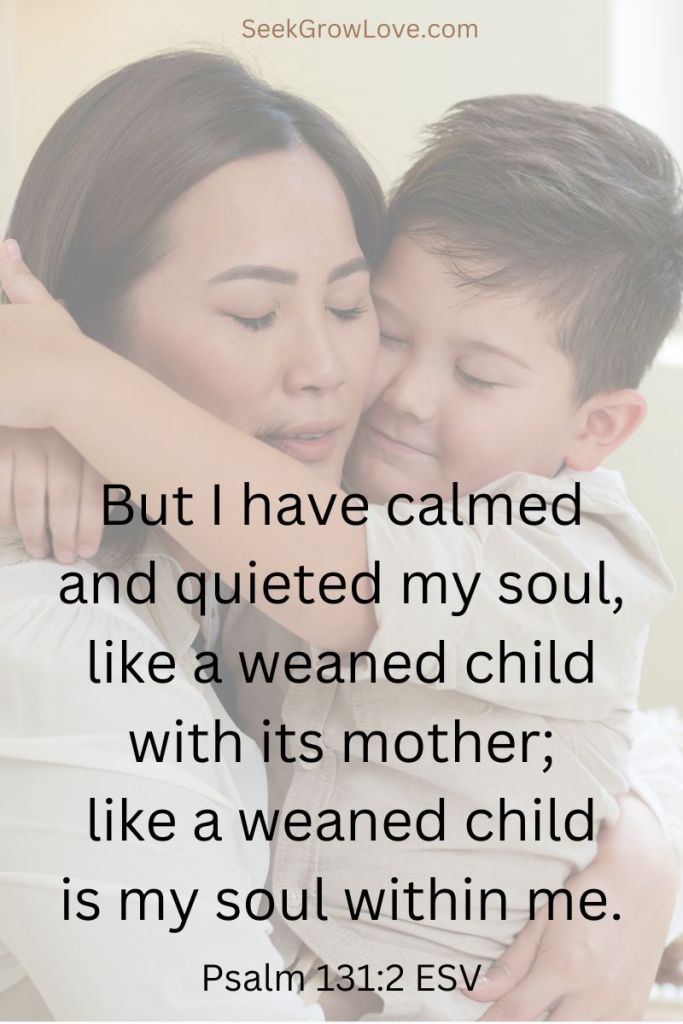
Psalm 131 is short, but jam-packed with great stuff. As a fan of minimalism, I like the power and value the words in this psalm hold, all while taking up such very little space! In a book that in all reality…..if we are going to overflow closets and shelves with…..it’s the one! How fortunate we are in fact to have paper, printing presses, free Bible apps, a free country in which to purchase and publish Bibles all we want, and easy and instant access to the word of God in so many formats. However you access Psalm 131, it is worth your time today.
When I first read this psalm, I got a little confused. Seeing the words “calm and quiet” near “child” and “mother”….basically….in my mental image at first, this was a comforted, calmed, quiet baby being nursed by its mother. Whoops. I mean….in my defense…..weaned, nursing…..they go together, right? And what have you seen that calms and quiets a child more than chugging it down? But, that word “weaned”….I even looked it up in Hebrew to make sure I was getting this image right this time…..yup, same as in English. It refers to a child who was no longer relying exclusively on milk from his or her mother. The total opposite to the picture in my mind upon my initial read.
We all know that babies and young children need assistance in being calmed and quieted. They simply do not have the cognitive, sensory processing, or emotional capabilities to do that independently, and it is why caregivers of young children are often bouncing, rocking, walking, shushing, white noising, swaddling, and most definitely….making sure that little person is sucking/drinking. Calm and quiet babies rely on external supports to get there, and that is the way God created them. However, children who are weaned are able to self soothe much more easily. In the Bible, children who were weaned were a big deal. Abraham held a big feast. Hannah took Samuel to the temple. It was an important step and one to be celebrated. In fact, I read that Jewish traditions today still often celebrate the weaning of a child including reading relevant scriptural verses. What a nice idea!
At work, I get the opportunity to help little, big, and grown up kids sometimes who need some more supports and coping or sensory strategies to help them get to the regulated or “content” state mentioned in this psalm. Of course, it is easier to help others sometimes than it is ourselves in this area, and when I did today’s reading, I was struck by the fact that we all need help with this. Many times a day sometimes in fact! The recipe to being truly calmed and quieted from the most important internal support is right in Psalm 131. I don’t see requirements to breathe lavender oil under a weighted blanket while listening to rushing waves. But, I do see some things that make me feel better just reading…..imagine how content and calmed life could be with David’s ingredients in Psalm 131:
-Verse 1: a yielded spirit to God’s will recognizing that His ways are higher than ours and we might not understand the “great matters” God does.
– Verse 2: a person who has moved from milk to meat. Someone with enough spiritual maturity to understand that contentment can be found in the LORD even when circumstances aren’t desirable.
-Verse 3: a person with hope in the LORD of yesterday, today, and tomorrow. Not a hope in a political party, nation, human relationship, wealth, or stockpiled food. A hope in the LORD whose promises for a future kingdom are beautifully depicted in our Ezekiel reading today as well.
“They will follow my laws and be careful to keep my decrees. 25 They will live in the land I gave to my servant Jacob, the land where your ancestors lived. They and their children and their children’s children will live there forever, and David my servant will be their prince forever. 26 I will make a covenant of peace with them; it will be an everlasting covenant. I will establish them and increase their numbers, and I will put my sanctuary among them forever. 27 My dwelling place will be with them; I will be their God, and they will be my people. 28 Then the nations will know that I the Lord make Israel holy, when my sanctuary is among them forever.” (Ezekiel 37: 24-28)
-Jennifer Hall
Questions:
Consider where you are in your weaning process today.
Do you know anyone not yet “weaned”who might benefit from your support and assistance? How could you use the hope of Ezekiel 37 and Psalm 131 to reach someone struggling with weaning?
What verses (from today’s reading or anywhere) can provide encouragement and assistance to you when your thoughts are not calmed and quieted within you?
I love petting zoos, seeing the animals at the 4H fair, and anytime I’ve been up close and personal with a sheep, I’ve been impressed! How soft and gentle, how amazing their wool coat really does feel, and for a non-farmer gal like me, how tricky it is to tell a sheep from a goat sometimes? How someone can tell a llama from an alpaca is also beyond me! I’ve never raised sheep or had a sheep of my own to care for. But, over the years, I’ve heard lots of sermons/teachings on sheep and shepherds, and a few takeaways I’ve learned are: sheep are mentioned a lot in the Bible!, sheep are reportedly dumb animals, and shepherds doing their dirty work were not considered the high class of society.
In today’s reading in Ezekiel 34 and 35, we encounter some Israelites being compared to shepherds though who perhaps thought they were the high class of society. And, they are being reproved harshly. In fact, even modern translations use a little “woe to” language in Ezekiel 34:2 ….”Woe to you shepherds of Israel who only take care of yourselves!
This verse caught my attention right away, making me think of a little phrase called “self care.” As an occupational therapist, these are words that for years were common in my “work language”, and it was a phrase referring to the self care tasks we need to do for basic daily living (dressing, toileting, hygiene, eating, etc.). Part of my job was to evaluate and work to help people with their self care tasks which can often be impacted by injuries, developmental disabilities, mental health challenges, etc. It wasn’t a phrase I heard out and about much in “non OT chit chat” for the first 10 years or so that I was working. And then it seemed to me that … kaboom….the phrase meant something new and was used all over social media, taught from preschool to college, and it was something emphasized as crucial for being able to function, be healthy, etc. But, it meant something different. It meant…..perhaps abstractly taking care of oneself…..but some of the examples I saw were more things like…..massages, vacations, get a degree, do a puzzle, prioritize “me time”, yoga, mindfulness breathing, and then maybe some camping weekends to “just relax” if your self care app found you lacking that week. I am kinda glad the term caught my attention because I became aware of some discrepancies that are out there on this subject.
Most definitely, it is beneficial for all aspects of our health to have adequate nutrition, sleep, cleanliness, time in nature, etc. And those of us who live in a free country, have a safe and comfortable place to sleep, the ability to look outside a window and see a tree and bird, the opportunity to be over-fed and clean should not take that for granted. But, it seems to me, these shepherds mentioned in Ezekiel would have loved the “self care” movement of today. A quick internet search regarding “self care” will lead you to terms emphasizing “self reliance”, “self defined”, “listening to you”, “self love”, “self esteem”, etc. Non of these terms are inherently bad if coupled with a Biblical world view, but combine them with some of the lists of things the internet tells me I should do daily for my self care , and my guard is up for a reason. I see some sneaky belief systems creeping in all over that I think are meant to destroy and not heal. The shepherds in Ezekiel were engaging in self care, but they were not doing anything for sheep care. Their job was to care for the sheep.
Should not shepherds take care of the flock? 3 You eat the curds, clothe yourselves with the wool and slaughter the choice animals, but you do not take care of the flock. 4 You have not strengthened the weak or healed the sick or bound up the injured. You have not brought back the strays or searched for the lost. (Ezekiel 34: 2-4)
In today’s world, there are so many pressing challenges negatively impacting every area of health, and the image Ezekiel 34 ends with provides a beautiful thought for both self care and sheep care. They are words revealing a hope beyond ourselves because my “self” isn’t going to get me through this alone. My mental health benefits from knowing that God cares for his sheep, that I am grafted into the vine through Jesus, and that as Christians, we are also heirs to the promises of Abraham.
They will no longer be plundered by the nations, nor will wild animals devour them. They will live in safety, and no one will make them afraid. 29 I will provide for them a land renowned for its crops, and they will no longer be victims of famine in the land or bear the scorn of the nations. 30 Then they will know that I, the Lord their God, am with them and that they, the Israelites, are my people, declares the Sovereign Lord. 31 You are my sheep, the sheep of my pasture, and I am your God, declares the Sovereign Lord.’” (Ezekiel 34: 28-31)
Interestingly, so many studies show that one of the best ways to improve mental health or physical health is by doing things to help others, so self care and sheep care really are aligned. On days we are struggling with our own baggage and carrying weights Jesus doesn’t want us to carry alone, one of the best ways to engage in true self care is by engaging in sheep care. Ironically, one of our therapy students at work recently told her supervising therapist that she couldn’t see the next patient yet because she had had a stressful day, could tell she needed some “me time”, and proceeded to sit down on a mat in the middle of a patient care area of the hospital and begin scrolling on her phone. I am not sure who needed a bubble bath or pursed lip breathing most at that moment, but I firmly believe asking for help from a shepherd and serving people instead of scrolling would have genuinely helped. However, the memory provides comical relief at work for the rest of us still, and we appreciate that.
Whatever we do to pursue physical, emotional, and spiritual health, let’s be careful it is rooted in scripture and the example we see in Jesus and his followers rather than the latest blog, book, or meme.
-Jennifer Hall
Questions:
Imagine you are home alone sick in bed. How can you participate in sheep care?
Imagine that you have been on a path too indulgent in self care and too lacking in sheep care. How could you improve things?
Imagine a restored earth under Jesus’ reign where all of God’s sheep are gathered in a perfect “pasture”. Take a few moments of prayer and reflection seeking first his kingdom.
Most of the Psalms were written by David, but there are a few that were written by others. For example, Psalm 90 was written by Moses and Psalm 127 was written by David’s son, Solomon.
Today’s reading, Psalm 127 is what we will reflect upon. It offers wisdom about the wise raising of a family. I find some parts of Solomon’s teaching a bit paradoxical. Solomon’s father, King David, had 19 sons by his wives. The year before his father David died Solomon’s first wife Naamah gave birth to his one and only son, Rehoboam. She also gave birth to two daughters Taphath and Basemath. As far as we know from the Bible these are the only three children Solomon fathered. This is odd considering Solomon had 700 wives and 300 concubines. Solomon valued children and saw them as a reward from God.
A Song of Ascents. Of Solomon.
Psalm 127
Unless the Lord builds the house, those who build it labor in vain. Unless the Lord watches over the city, the watchman stays awake in vain.
2
It is in vain that you rise up early and go late to rest, eating the bread of anxious toil; for he gives to his beloved sleep.
3
Behold, children are a heritage from the Lord, the fruit of the womb a reward.
4
Like arrows in the hand of a warrior are the children of one’s youth.
5
Blessed is the man who fills his quiver with them! He shall not be put to shame when he speaks with his enemies in the gate.
If Solomon valued children so much why didn’t he have more? The most likely answer is that Solomon’s next wife was the daughter of the Pharoah of Egypt. She worshipped idols and brought them into the royal palace. Many Biblical scholars believe that Solomon had no more children as punishment for allowing idolatry to enter his family.
Psalm 127 begins “Unless the Lord builds the house, those who build it labor in vain.” The house referred to here is not a physical house or palace but a family or a household.
That strikes me as a very wise teaching. And yet Solomon’s actions weren’t very wise when he had 700 wives and 300 concubines. Another paradox is that in 1 Kings 3 Solomon asked God for the gift of wisdom. Because Solomon’s request of wisdom was very unselfish (he didn’t ask for riches or a long life, God agreed to give him what he asked for, wisdom and what he didn’t ask for: wealth, honor, and long life as long Solomon followed God’s commands.
This begs the question… how did God give him wisdom? Did he open up Solomon’s head and pour in wisdom, or was wisdom acquired over time? Perhaps Solomon grew in wisdom over time, when he realized that he missed out on the blessings of a large and fruitful family because he allowed idolatry to enter his home?
Solomon doesn’t quantify a number of children that qualify one as blessed. David had 19 sons. Solomon’s 1 son Rehoboam had 28 sons and 60 daughters (wow, that’s a lot of weddings to pay for).
My wife Karen and I have been blessed with 7 sons and 4 daughters (JJ, Jon, Joshua, Karee Anne (Gregory), Joel, Kailyn, Katie Beth (Mattison), Kass, Jordan, Josiah, and James). We also have been blessed with 16 grandchildren (soon to be 17). We are greatly blessed. My children (and their spouses) and grandchildren are precious gifts from God and I’ve always appreciated this Psalm. Of course, having a large family is not the only sign of blessing from God. However God chooses to bless you, receive it with gratitude and joy.
Peace, Grow, Love
-Jeff Fletcher
Reflection Questions
How would you put in your own words and explain Psalm 127 verse 1? Compare what a house/family built by the Lord looks like versus one built in vain. Consider the home you were raised in – which was it more like? Which do you want for a home/family you will/are or have raised?
What are some of the current views towards children that you have witnessed? Which ones would God agree with, which ones would he not?
As a child one song I enjoyed singing in church was called Bringing In The Sheaves.
1 Sowing in the morning, sowing seeds of kindness,
Sowing in the noontide and the dewy eve;
Waiting for the harvest, and the time of reaping,
We shall come rejoicing, bringing in the sheaves.
Refrain:
Bringing in the sheaves,
Bringing in the sheaves,
We shall come rejoicing, bringing in the sheaves;
Bringing in the sheaves,
Bringing in the sheaves,
We shall come rejoicing, bringing in the sheaves.
2 Sowing in the sunshine, sowing in the shadows,
Fearing neither clouds nor winter’s chilling breeze;
By and by the harvest, and the labor ended,
We shall come rejoicing, bringing in the sheaves. [Refrain]
3 Going forth with weeping, sowing for the Master,
Though the loss sustained our spirit often grieves;
When our weeping’s over, He will bid us welcome,
We shall come rejoicing, bringing in the sheaves. [Refrain]
As a little child I really had no Idea what the song meant. What were sheaves? Why did people go out sowing with weeping. What made them so sad? Why were people rejoicing while bringing them in?
Fortunately, Psalm 126 answers a lot of those questions.
Psalm 126
A song of ascents.
1 When the Lord restored the fortunes ofZion, we were like those who dreamed. 2 Our mouths were filled with laughter, our tongues with songs of joy. Then it was said among the nations, “The Lord has done great things for them.” 3 The Lord has done great things for us, and we are filled with joy.
4 Restore our fortunes Lord, like streams in the Negev. 5 Those who sow with tears will reap with songs of joy. 6 Those who go out weeping, carrying seed to sow, will return with songs of joy, carrying sheaves with them.
The first half of the Psalm is a Song of Rejoicing. It likely refers to the time when Israel returned from their time in Exile. King Cyrus of Persia released the exiles in Israel and allowed them to return to Israel where they could live in freedom and rebuild the city of Jerusalem and the Temple. It was a time of rejoicing. It was a time of rejoicing, laughter, songs of joy. The surrounding nations could see how God did great things for them. Sadly over time Israel faced a whole new set of trials. So God’s people pray that once again God would step in and bless his people and restore their fortunes.
There was a time of drought that led to famine. The people were sad from their misfortune so they went out in faith with bags of seed to plant. It was an act of faith that God would supply abundant rain so that their seed would grow and be harvested so that they would carry back bundles… sheaves or grain. There would be laughter and shouts of joy in happy gratitude for God’s blessings.
Today, we go through times of great rejoicing at the blessings. November is a special time of celebrating God’s abundant blessings and rejoicing in God’s gifts. It can also be a time when we go through pain and loss. There’s a passage in Job that says “The Lord gives and the Lord takes away, blessed be the name of the Lord.” (Job 1:21) Some times we go out weeping and, in hope plant seeds believing that God will give blessings.
Is today a day that you are going out weeping with seeds to sow, or is today a day that you come back rejoicing at what God has provided, carrying those seeds of blessing?
Trust that God will give blessings if we faithfully sow, even with tears.
Pastor Jeff Fletcher
Reflection Questions
Is today a day that you are going out weeping with seeds to sow, or is today a day that you come back rejoicing at what God has provided, carrying those seeds of blessing?
What seasons of sowing in tears have you had? What seasons of rejoicing in reaping have you had? Where have you seen God’s faithfulness?





 Seek Grow Love