These two chapters read together continue a familiar pattern that we have run across several times this week already in Isaiah. We see rebuking of sin and rejection of the LORD followed by compassion and a plan of reconciliation to the LORD.
Chapter 59 starts with a good reminder too that sin separates us from God not because God doesn’t hear, cannot save, or we are beyond his reach. The separation comes from us through our wrongdoings. Verse seven uses the words destruction and devastation and I can’t think of any more accurate words to describe how a life without the LORD would be. Yet, so many people in this world live this way every day.
So often, I hear Christians in difficult times say, “I can’t imagine life without God”, and that is so true of how I feel as well. Even in the worst of circumstances and turmoil, if we are reconciled to God through Jesus, aware of the hope of His eternal kingdom and plan, and trusting Him, we feel a connection and peace that sustains us. Currently I have a dear friend I have worked with for years who is in her fourth year of a faithful battle with a rare cancer, her son-in-law was tragically murdered eight years ago in a random act of violence while he was on a prayer vigil walk, leaving behind her daughter and their newborn grandchild, and now that daughter is remarried with a 3 week old baby who is currently hospitalized having constant seizures, recently diagnosed with an incredibly rare genetic mutation which will lead to increasing seizures and tremendous danger if not stopped. This diagnosis has led to one of the few specialists in the country experienced in this diagnosis doing a pediatric neurosurgery in Washington DC which will leave her newborn daughter with half of a brain, obviously creating tremendous risk and unknowns for everyone involved. And yet, my friend and her daughter, in the darkest times or the lighthearted ones, sound so much more at peace, sustained, and reasonable than those I know with the smallest of stressors who lack a relationship with God. Isaiah 59 talks about the separation, growling, gloom, moaning, of those who are separated from the LORD due to sin, even “like the dead” verse 10 tells us. A life without the LORD and without His redemption and hope is not a life worth living. My heart goes out to those living that way at this moment, and my heart is sustained by Isaiah 59:21 and Isaiah 60 because it is not the way God has left us to live.
Thankfully, where Isaiah 59:16 mentions there was no one to intercede, we have an intercessor on our behalf now. Thankfully, where Jerusalem has seen its ups and downs and enemies from all around over the centuries, Isaiah 60 concludes with what appears to be reference to the New Jerusalem. One so bright with the glory of God we won’t need the sun or moon. One without devastation or destruction (remember Chapter 59?). One without violence. A land possessed forever. Isaiah 60:21 gives us one of my favorite promises about it too….”your people shall all be righteous“! A wonderful, sin-less, perfect, peaceful, joyful place.
1. Knowing you are never beyond God’s reach, when you are feeling separated from God, what from His word today might help you in your path of reconciliation?
2. What might help sustain you or others in your life through the difficult times as you wait for the New Jerusalem to descend in the LORD’s time?
3. What attribute of the New Jerusalem mentioned in Isaiah 60 comforts you most?
Are you in for a special treat today! Not just because we are discussing Song of Songs (otherwise known as Song of Songs), but also because I looked into the SeekGrowLove archives and found not one, not two, but three great devotions on Song of Solomon (and then I stopped looking). So, today is a bit of a compilation with pieces from three previous devotions. The full devotions are linked below and are all worthy of a read/re-read.
From Rick McClain:
“The visuals painted in these chapters about a bride and groom are very sexual in nature, but is that what this book is about? Some say it is an allegory of Jesus and his bride, the church. I doubt this is true because Jesus wasn’t even around in the Old Testament when this was written. I don’t think the concept of the church being the bride of Jesus was known back then so why would someone write an allegory about that? It is also believed by some that it could be an allegory about God and the people of Israel. There are no doubt similarities between the relationship of a bride and groom and the relationship between God and His people, but why would someone use such erotic sexual material to describe how God thinks about Israel and vice versa?
I believe it is love poetry and I am thrilled that the Bible has affirmed that the sexual desire I have for my wife is a good thing. I know that will make some of you squirm a bit because we don’t usually talk about this stuff, especially in church. However, I think one of the main points of this book is to show that the physical attraction between a bride and groom is a beautiful thing that God has created for them to enjoy.”
“But back to the song of all songs. I am not going to go in great detail here about this book because you should read it for yourself. I couldn’t stop thinking about how much in love these two seemed to be. It reminded me of when you see two young people in love, and their love is just oozing all over each other so much so that they don’t even notice anyone else is around. They can’t stop smiling at each other and they are on cloud nine. We usually roll our eyes at them and think they are being ridiculous, but this is exactly the kind of love that was on display in these eight chapters. Solomon gushed about her eyes, hair, neck, lips, and body parts that reminded him of fawns, but it didn’t stop there. I knew this was a story about real, intense, true love when he mentioned her teeth. He didn’t just say she had beautiful teeth, he said her teeth were like a flock of newly shorn ewes. Don’t picture dirty ewes that have been rolling around in the dirt, Solomon said the ewes had just come up from their washing. Moreover, all these ewes bore twins, and not one of them had lost their young. He said all of that about her teeth!?!? That dude was crazy in love! And she was just as ridiculous as him, which can be seen when she says her beloved is like a cluster of henna blossoms from the vineyards of Engedi.”
From Steve Mattison:
SoS 2:2 says, “Like a lily among thorns is my darling among the maidens.” Husbands and future husbands take note. Highlight what you appreciate about your wife, and make sure she knows it well and often. But the praise must be sincere. And if it’s appropriate and if she would appreciate it, make sure you extend this praise publicly. But don’t just stop with praise. Treat her like she is precious because she is.
SoS 2:4 contains part of the wife’s response, “His banner over me is love.” All by itself, this sounds pretty weird. I think this is saying that her husband is publicly proclaiming his love for her – sort of like writing it on a flag, and waving it around for everyone to see. He is not ashamed to acknowledge her publicly. Again, husbands take note.
In SoS 2:6, the wife goes on to say, “His left arm is under my head, and his right arm embraces me.” I’ll leave it to your imagination to consider their position and presumed activity. Husband’s again take note. If you shower your wife with love. If you make her a priority, and she knows it. If she knows you’re never ashamed of having her at your side. Things will go a lot better with your love life.
She goes on to say in SoS 2:7, “Do not arouse or awaken love until it so desires.” I would say that differently. I would say “save sex for marriage” – and then, it is a wonderful blessing from God for both husband and wife to enjoy to the fullest together.
In his reply, in SoS 2:15, the husband says, “Catch for us the foxes, the little foxes that ruin the vineyards, our vineyards that are in bloom”. I think the idea here is that there are always little things that can attack the relationship, and these things need to be caught and stopped. Some examples may include selfishness, pride, never admitting that you are wrong, finding fault, unforgiveness, mistrust, etc. All of these have to be dealt with and removed in order for the love to blossom and flourish.
And you have to love that part in verse 17 where she says, “until the day breaks and the shadows flee…”. It sounds like she is talking about being intimate all night long. So, husbands, if you want verse 17, you have to have to practice verses 2 and 4 and 7 and 15. In other words, if you want a great sex life in your marriage, adore your wife. Let that show in everything you do and in every way you treat her, and you will see results.
Oh yeah, and do the same with your relationship with God, and you’ll see great results there too – both now and forever.”
From Maria Knowlton:
“So how do you use SOS to make a difference in your life? How do you make this a part of your devotion? A friend of mine told me that her pastor recently preached a sermon on it and encouraged husbands to tell their wives they are beautiful. So there you go husbands! God wants you to complement your wives! Use lots of flowery words! (Check out youtube for examples on how to use King Solomon’s words to make your woman swoon!) Ok, that was a little facetious. Seriously, most woman do want to know her man desires her (but maybe not in the words of chapter 4) and God has provided an example of this along with His blessings. My friend thought of another take on SOS. She thought that since her husband was being encouraged to tell her she’s beautiful, she should make more of an effort to be beautiful. She looked at verse 1:6 when the Shulammite woman tries to hide from Solomon. So my friend decided that in addition to not wearing sweats all day, she would close the door while using the powder room and not burp or otherwise display gross behaviors in front of her husband. We all laughed when she told us that he didn’t notice but her point was that we shouldn’t take our husbands for granted and we should make an effort to be beautiful for our husbands. We also need to keep in mind verse 2:15, “ Catch for us the foxes, the little foxes that ruin the vineyards, our vineyards that are in bloom. The chorus talking here, saying not to allow anything to spoil the man and woman’s relationship. Good advice for all of us in any relationship. The world may have cheapened the physical relationship between a man and a woman, likening it to something as casual as a game of ping pong. SOS reminds us that it is truly a wedding gift from God that is to be treasured, embraced, and protected. So if you are married, read today’s reading with your spouse and have a great night! ; )”
God made sex. And He made it good. To be enjoyed by one man and one woman who are married – meaning they have committed their lives to one another til death do them part. There are a lot of verses in Song of Solomon that have never been made into refrigerator magnets or wedding invitations – but I do love 2:16a “My beloved is mine and I am his.” Such a beautiful declaration of a deep, mutual devotion to the love of your life. It is indeed perfect for a wedding invitation! But, how many couples can say the same thing 10, 20, 30, 50 or more years down the road. How do we keep the love from growing cold – which will happen when the fire isn’t tended? Marriage is complex and there is no one easy answer – but Song of Songs does have some useful tips for fanning that flame with your spouse.
If you aren’t married yet – what is the greatest take-away you found in Song of Solomon?
If you are married – what is the greatest take-away you found in Song of Solomon?
Why do you think God included Song of Solomon in the Bible?
Hebrews Introduction
The title of the book of Hebrews suggests it was written to Jewish Christians. We don’t know who wrote the book. Although some suggest the author may have been Paul, Hebrews 2:3 almost certainly refutes this. Whoever it was knew their Old Testament very well, and wrote persuasive arguments showing that Jesus is greater than everyone and everything in the Old Testament, including angels, priests, the law, Moses, sacrifices, etc.
The book of Hebrews points out that the law was only a shadow of the good things that are coming (Hebrews 10:1). Colossians 2:16-17 goes on to say that the reality is found in Christ. And Jesus became the ultimate high priest, who offered himself as the ultimate sacrifice once and for all.
The two main points of Hebrews are to encourage Christians to endure, and to warn Christians to remain faithful in following Christ.
Hebrews 11, the faith chapter, is probably the best well-known chapter in Hebrews. One of the most well-known verses is 11:4, “And without faith, it is impossible to please God, because anyone who comes to him must believe that he exists and that he rewards those who earnestly seek him.”
Have you ever been asked to guard something? If you’ve ever played a team sport it’s likely that you guarded someone or something. When you play defense in basketball or hockey you guard someone. In basketball and football, there are positions called guards. In baseball, the catcher is responsible for guarding home plate.
We encounter lots of guards in life- prison guards, security guards, the National Guard. Celebrities and politicians and other rich and powerful people often have bodyguards. If you’re out with a friend at a busy place and they go to buy food or use the restroom they might ask you to “guard my seat”.
To guard something means that you have been entrusted to protect someone or something that is valued by another. In today’s reading of 2 Timothy 1, the Apostle Paul has written to Timothy and reminded him about all of the goods that have been entrusted to him in his life. He speaks about the sincere faith that began in both Timothy’s grandmother and mother now in him. He describes this faith as something that has been entrusted to Timothy and must be guarded. I have the image of going to the bank and bringing my paycheck and giving it to the bank officer and asking her to guard my money until I needed it. I am entrusting my deposit with the bank. Here, Paul is entrusting his spiritual deposits to Timothy. Just as Timothy’s grandmother and mother made spiritual deposits in his life, Paul too made spiritual deposits. Now it’s up to Timothy to both guard those deposits and also put them to good use. Paul freely changes metaphors to that of fire. A fire that has started often needs to be fanned, given more air, until it grows enough to really burn. Protect the deposit and fan the flame. This is Paul’s counsel to Timothy.
You’ve undoubtedly had many people make faith deposits in your life. For some, like Timothy, it was a grandparent or parent or other spiritual teacher or mentor. Maybe it was a Sunday School teacher or youth leader, maybe it was a pastor or a counselor at Church camp. For many, it was likely a combination of many people who taught by words or actions what it means to know Jesus Christ and follow him as a disciple. I know in my nearly 60 years of life there have been countless people who have made faith deposits into my life, and who have helped me with my spiritual formation. These people have shared incredible gifts of faith with me. I feel a particular responsibility to not allow those gifts to go by the wayside, to be left unvalued, unused, and unguarded. I take the deposits of faith that have been entrusted to me and put them to work for Jesus Christ and for the Kingdom of God. This is an incredibly important responsibility and one that I do not take lightly. I owe a tremendous debt of gratitude to those who made faith deposits in my life and so I want to “pay it forward” by making faith deposits into the lives of others. This is why 45 years after I first attended Youth Camp (Now FUEL) I’m still trying to make faith deposits. I hope and pray that you guard what has been entrusted to you and fan into the flame the gifts that have been given to you so that God’s word will continue to spread like wildfire into a world that needs more faith.
Jeff Fletcher
Reflection Questions:
Take a moment to write down the names of people that you can think of who have made faith deposits into your life. Say a prayer of thanks for them, or send one of them a note and say “thank you” for the faith deposits they’ve made in your life.
What are some ways that you can fan into flame the gifts that have been given you? What specific things will you do to help spread the faith in Jesus Christ shared with you?
How can you best guard what has been deposited into your spiritual bank account by others?
Throughout the Bible, the phrases “do not be afraid” and “do not fear” are repeated over and over. This phrase is first used in Genesis 15:1, which says, “After these things the word of the Lord came to Abram in a vision, saying, ‘Do not fear, Abram, I am a shield to you; Your reward shall be very great.’” The last time the Bible says this is in Revelation 2:10, which says, “Do not fear what you are about to suffer. Behold, the devil is about to cast some of you into prison, so that you will be tested, and you will have tribulation for ten days. Be faithful until death, and I will give you the crown of life.”
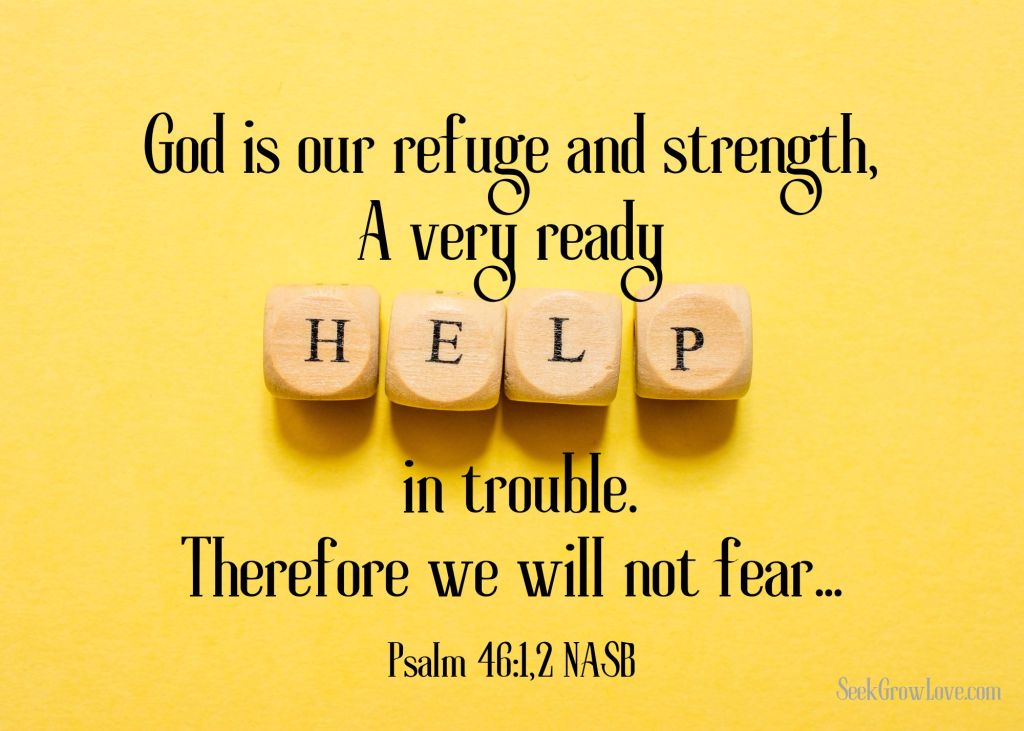
In Psalm 46, we are given the reason why we should not fear. Verse 1 says, “God is our refuge and strength, A very present help in trouble.” Psalm 46 says this is the reason we will not fear. When God is our refuge and strength, nothing can defeat us. As nothing is stronger than God, when our strength is God, nothing can overpower us. Therefore, we should not fear anything. Verses 2-3 continue to tell us that there is no reason to fear, even if the earth should change, the mountains fall into the sea, the oceans roar, and/or the mountains shake.
Further on in the psalm, it says, “The Lord of hosts is with us; The God of Jacob is our stronghold. Selah. Come, behold the works of the Lord, Who has wrought desolations in the earth. He makes wars to cease to the end of the earth; He breaks the bow and cuts the spear in two; He burns the chariots with fire.” If you didn’t have enough reason to not fear from verse 1, these 3 verses give you even more reasons. The God who is our stronghold has brought about desolations on the earth against those who have opposed Him. He has stopped wars and defeated men and their weapons over and over again. Therefore, there is no longer any reason to fear. We need to trust in God as our refuge, strength, and stronghold.
-Kaitlyn Hamilton
Reflection Questions
What are your top five fears?
How often does fear interfere with what you think God wants you to be doing or thinking?
It’s easy to say, “Do not fear.” But harder to do. What are some practical daily steps you can take to help your brain overcome fear?
How is God greater than all the things we fear?
Introduction to Philemon
The book of Philemon is Paul’s shortest letter that is included in our Bible. Paul wrote it while in prison to his dear friend and fellow Christian, Philemon.
Philemon’s slave, Onesimus, had run away, had come to Paul, and had helped Paul while he was in chains for the gospel. While there, Onesimus became a believer. This book is Paul’s letter to Philemon urging him to accept Onesimus back, not as a slave, but as a dear brother in Christ; asking that Philemon welcome Onesimus “as you would welcome me.”
This book shows Paul’s mastery of persuasion. He started by praising Philemon, then laid out a logical argument for kindly accepting Onesimus back, followed by an emotional argument. Ending with “Prepare a guest room for me, because I hope to be restored to you in answer to your prayers.” Not only was Paul an amazing missionary, he was a master strategist.
Have you ever played Hide and Seek before? In Hide and Seek, everyone tries to hide from one person, the seeker. These players try to choose a spot that they will be the least likely to be found in, which normally ends up being in a dark or shadowed place, where it is harder to see clearly. The seeker goes around trying to find everyone that is hiding. They don’t know where anybody is hiding, but they may have guesses as they hear noises, see movement, etc. But, have you ever considered playing Hide and Seek where the seeker just always knows exactly where you hid, no matter how creative it is?
Real life is like that many times. People choose to commit sins and try to hide them in the dark. Everyone has times in their lives that they try to hide in the darkness and keep their sins to themselves, hoping nobody will ever know. But, Job tells us that there is somebody who will always know. Job 34:21-22 says, “For His eyes are upon the ways of man, And He sees all his steps. There is no darkness or deep shadow Where the workers of iniquity may hide themselves.” There is no place we could ever hide our sins that God will not see. God can see into every dark and shadowed place that you try to play Hide and Seek in.
Isaiah 29:15 says, “Woe to those who deeply hide their plans from the Lord, And whose deeds are done in a dark place, And they say, ‘Who sees us?’ or ‘Who knows us?’” Hiding what you are doing in the dark will not lead to joy. In the end, these things will lead to destruction and despair if you do not turn away from them. Just like you cannot stay hidden forever in Hide and Seek, these deeds you do in the dark cannot stay hidden forever. If you are hiding your sins in the dark, turn away from them and come into the light. If you are not hiding anything in the dark, stand firm in the light and don’t let anything draw you into the darkness.
John 3:19-21: “This is the judgment, that the Light has come into the world, and men loved the darkness rather than the Light, for their deeds were evil. For everyone who does evil hates the Light, and does not come to the Light for fear that his deeds will be exposed. But he who practices the truth comes to the Light, so that his deeds may be manifested as having been wrought in God.”
-Kaitlyn Hamilton
Reflection Questions
How much light are you living in right now? How much darkness?
What steps/sins are you trying to hide from God? What works better?
What does it mean to you that God sees everything?
“As the deer pants for the water brooks, So my soul pants for You, O God. My soul thirsts for God, for the living God; When shall I come and appear before God;”
Psalm 42 starts off with a piece of beautiful imagery. The writer of the Psalm compares himself to a deer who is thirsting for water. Deer – like all living creatures – need water to survive. However, deer may use the plants they eat as a supplement to the water they need, in order to lessen the amount of times they need to find a water source. Most deer need to drink water daily, especially if they have been running around lots. By the time a deer chooses to look for water, it is extremely thirsty.
In the comparison of the desire for God and a deer panting for water, we see a deep longing. To want God as extremely as a deer wants water is incredible. The author, by writing this, admits that he cannot live without God, just as a deer cannot live without water. He is not saying that he would like to follow God some of the time when it is convenient, but instead is saying that he needs God every single day of his life. Do you realize and accept that you need God every moment of your life to survive? Are you looking for Him in your life as eagerly as a deer searching for a singular water source to get it through the day?
Further on in the Psalm, the author says, “Why are you in despair, O my soul? And why have you become disturbed within me? Hope in God, for I shall again praise Him For the help of His presence.” He explains that he thirsts for God because of the help of His presence. The author acknowledges that hoping in God is like a deer being refreshed with a drink of water. Are you seeking after God and hoping in Him like a deer panting for the water?
-Kaitlyn Hamilton
Reflection Questions
Do you find yourself longing for God everyday?
When you are thirsty for more of God what do you do, where do you go, what quenches your thirst?
What do you do when your soul is in despair? Where do you find hope?
How can you share God with someone who is thirsty?
Titus Introduction
Paul wrote the book of Titus to his mentee, Titus, Paul’s “true son in our common faith,” whom Paul had left in Crete to strengthen the new churches there and to appoint elders in every town. Paul detailed the qualifications of an elder in Titus 1:5-9.
Paul reminded all Christians to say “No” to ungodliness and worldly passions, and to live self-controlled, upright, and godly lives while we wait for Jesus’ return (which Paul also called our blessed hope). Paul also told Titus to remind the people to be subject to rulers and authorities, to be obedient, to be ready to do whatever is good, etc.
Finally, in Titus 3:9-11, Paul pointed out that Christians should have unity, where he said, “But avoid foolish controversies and genealogies and arguments and quarrels about the law, because these are unprofitable and useless. Warn a divisive person once, and then warn him a second time. After that, have nothing to do with him. You may be sure that such a man is warped and sinful; he is self-condemned.”
John 9 recounts a story of Jesus healing a man born blind, and how those in his community respond to his being healed. Through this account, we see not only the heart that Jesus had, but also areas for our own spiritual growth.
As he passed by, he saw a man blind from birth. 9:1
From the start, we can find assurance in the notion that Jesus notices the least of us. We’re later told that this man had been a beggar. He may have been begging as Jesus and the disciples passed by. For anyone who feels overlooked at times, isn’t it comforting to know that Jesus notices us?
So he went and washed and came back seeing. 9:7b
We also see in this man how obedience and faith work together. Believing that Jesus could heal him would not have sealed the deal, action was required. Results are nice. And most often they don’t come without some action on our part. This man could not have been healed without Jesus intervening. But even with Jesus’ intervention, his healing required his own participation.
Some of the Pharisees near him heard these things, and said to him, “Are we also blind?” Jesus said to them, “If you were blind, you would have no guilt; but now that you say, ‘We see,’ your guilt remains. 9:40
Self-righteousness blinds us. And these blind spots are roadblocks on our journey to spiritual maturity.
Have you ever been reading when the light outside is growing dim? You don’t need the lights inside the house on yet and so they are not on. But an hour later, the room is getting darker and darker and you do not even realize it. Someone may come in and ask if you need the light on. Suddenly you look around and realize how dark it is. You didn’t know you needed the light, you hadn’t recognized you were in the dark. This is the problem Jesus is identifying. The light of the world is here for those that know they need it/him. But many think they can see when actually they are sitting in the dark.
And if, when reading that, your mind immediately went to ‘those people’ who are in the dark…you’re missing the point. You’re ‘those people.’ We’re all ‘those people.’
What a great place to start today… asking for him to reveal blind spots we may have, trusting that he sees and cares for us, with a willingness to act on what he reveals in us.
-Susan Landry
Reflection Questions
How do faith and obedience work together? Why are both required? Do you feel stronger in one than the other? How can you work on growing the other?
When have you found yourself sitting in the dark? How can you draw closer to the light of the world to take advantage of the light he gives?
After reading John 9 how would you describe Jesus.
This devotion comes from Acts chapter ten. The Centurion of what was known as the Italian Cohort was a devout Christian man named Cornelius. Being known for the faith of all his house and his charitable actions toward the Jews, Cornelius is definitely the kind of guy you want around when change needs to be made. Now Cornelius has a vision, and in this vision he is instructed to seek out Simon Peter, afterwards he listens whole heartedly and dispatches a group to go find Peter and bring him to meet Cornelius. While the group is going to find Peter, Peter goes to a housetop to pray. On the housetop he becomes hungry and he is shown a vision. In this vision, a large sheet descends from the sky and in it are a multitude of unclean animals; birds, reptiles and all kinds of four footed animals. A voice instructs Peter to get up, kill and eat. But Peter is hesitant. He doesn’t want to, for he follows the tradition of the time and won’t eat anything considered unclean by tradition. The voice tells Peter “What GOD cleansed, no longer consider unholy” three times and the sheet is taken back up into the sky.
At this time, while Peter is thinking over what he witnessed, the men sent by Cornelius arrive at the house of Peter. The Spirit tells Peter to receive the men without misgivings and after they greet one another Peter invites them in to stay.
So finally the stage is set. These men have come to take Peter to meet a Gentile, as Peter is starting to rethink what GOD considers holy and unholy. Breaking down traditions.
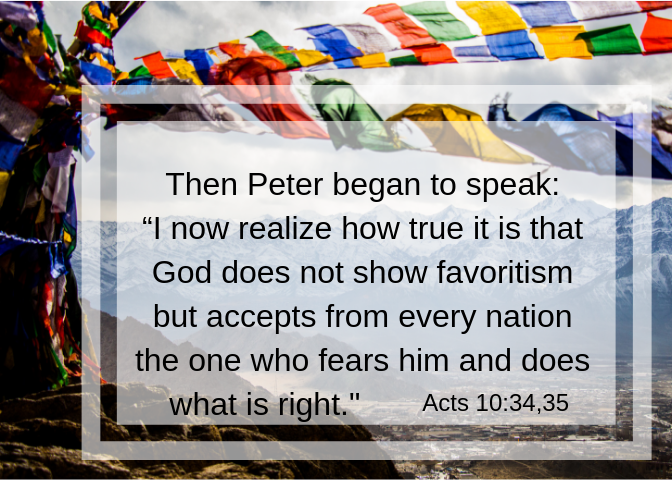
The group takes Peter and some others from Joppa to Caesarea to meet Cornelius and as he enters the house Cornelius bows to worship Peter. “Stand up” Peter says “for I too am just a man.” There with Cornelius were multiple other gentiles. Peter says “You yourselves know how unlawful it is for a man who is a Jew to associate with a foreigner or to visit him; and yet God has shown me that I should not call any man unholy or unclean. That is why I came without even raising any objection when I was sent for. So I ask for what reason you have sent for me.”
Cornelius gives the account of the vision he received and how he was instructed to reach out to Peter, and to hear the preaching of Peter.
So Peter begins to preach. Starting with the beginning of Jesus’ ministry and his anointing. Then to the death and resurrection of Jesus, ending with the fact that Jesus appeared to those who ate and drank with him before his crucifixion. And while Peter was still preaching to those gathered the Holy Spirit descended upon all those that were in the room, Jew and Gentile alike.
The believers that came with Peter were amazed that the gentiles also could understand the speaking of tongues.
Acts 10:47-48 reads “Surely no one can refuse the water for these to be baptized who have received the Holy Spirit just as we did, can he?” And he ordered them to be baptized in the name of Jesus Christ. Then they asked him to stay on for a few days.”
So that’s the story of Acts chapter ten, but what do we learn? Our preconceived notions of what “GOD wants” may not always be true, just because our traditions teach us something doesn’t mean it’s right. Even though everyone is doing something doesn’t make it right.
But this passage is beautiful in its own way. Just because we may not belong to the house of Israel, doesn’t mean GOD’s love isn’t for us. While it seems like a surface level idea, this passage plainly shows our adoption into the family of GOD.
-John Evans
Reflection Questions
Peter described to Cornelius who Jesus was. How would you describe Jesus?
Are there any areas in which perhaps your ideas of what “God wants” is actually different than what God truly wants? Explain.
What does it mean to you to be a part of the family of God?
Nehemiah Introduction
The book of Nehemiah was written by Nehemiah, the cupbearer to King Artaxerxes. This is the exciting sequel to the book of Ezra. Ezra oversaw the rebuilding of the temple. Nehemiah oversaw the rebuilding of the wall of Jerusalem in an amazing 52 days.
The two important themes of the book are: 1. The amazing way God protected and provided as the returned exiles rebuild the wall around Jerusalem with amazing speed 2. The importance of being loyal to God.
I particularly appreciate chapters 8 and 9 where Ezra read the law of Moses to all the people; the people listened attentively and worshiped God.
May we be able to say, like Nehemiah in 13:31, “… Remember me with favor, O my God.”
Peter has experienced so much with Jesus that it is difficult to wrap our minds around everything. Miracles, explanations of the Kingdom, who God is, how to live, even being resurrected to life are some of the actions and ideas that God accomplished and conveyed through His Son. Peter took it all in. Peter was undergoing a transformation through his relationship with Jesus.
Peter knew and stated that Jesus was the Messiah (the Christ), the Son of the Living God. (Matthew 16:16) This idea was revealed to him by God, but Peter stumbled when Jesus was on trial. He was terrified and rightly so. He saw the cruelty, the brutality released on Jesus so he denied him three times.
On the shore that morning, Jesus wants Peter to understand that he forgives him. After a miraculous catch of fish and eating a fish and bread breakfast, Jesus asks Peter if he loves him more than these? “Yes, Lord,” he said, “you know that I love you.” Jesus said, “Feed my lambs.” Again Jesus said, “Simon son of John, do you love me?” He answered, “Yes, Lord, you know that I love you.” Jesus said, “Take care of my sheep.” The third time he said to him, “Simon son of John, do you love me?” This time Peter was hurt because Jesus asked him the third time, “Do you love me?” Peter said, “Lord, you know all things; you know that I love you.” Jesus said, “Feed my sheep.”
Jesus is direct with Peter. He will express his love for Jesus by feeding, by taking care of his sheep. Of course, Jesus had taught them that his followers were his sheep. At that time, we were the ones that had not yet entered the sheep pen by the gate. But Praise God that Peter showed his love for Christ. He truly Followed Jesus. He became brave speaking to the crowds about believing and being baptized into Jesus. We are encouraged and challenged by what Peter said and did. He did feed the followers of Jesus then and we are still receiving that food and care today through the scriptures. Along with Peter, we have the chance to feed and care for the followers of Christ. We will faithfully follow the plan that God sets for our lives. We will follow Jesus Christ.
-Rebecca Dauksas
Reflection Questions
Do you love Jesus (even if you have failed him before)?
What job do you think Jesus has for you to do for him? How will you do it?
Today I want to break down a single verse in praise to God and consider what Paul was getting at:
“Now to the King eternal, immortal, invisible, the only God, be honor and glory forever and ever. Amen.” (1 Timothy 1:17)
We are quite ready to think of God as a king, since we are so familiar with the language of God’s kingdom from the Old Testament, but God is rarely called “king” in the New Testament. I see Matthew 5:35, here, 1 Timothy 6:15, and Revelation 15:3. The fact that Paul is choosing to use this language at all probably means he is doing something special, trying to point to attributes of God he feels the Ephesians should be dwelling on.
You may recall that New Testament Greek has no word meaning “eternity.” But that concept has been put into English translations where people thought it sounded right. It has been suggested that the history of these insertions was aided by some unhelpful translations of the Greek in Jerome’s Vulgate Latin (back in the fourth century), affecting how later versions were produced. (For example, Revelation 10:6 has a phrase which in the Vulgate is something like “there will be no more time” rather than “there will be no more delay”.) So, the first words of praise in 1 Timothy 1:17 are more like “Now to the King of the ages.”
It has been pointed out before that when the Bible begins it never tries to explain who God is, it assumes the existence of God. There is no great effort put in to describe God as “eternal” in the sense philosophy attaches to that word. It seems obvious that God is beyond the scope of the universe God created, and we accept that God is beyond our understanding. Romans 16:26 is a text with a similar sort of feel.
The next term used to describe God is given in the NASB as “immortal.” In 1 Corinthians 15:53 Paul uses two images to describe how our frail bodies will change with resurrection. In the NASB it says we need to “put on the imperishable” and “put on immortality”. Another way to express those ideas might be to put on “incorruption” (the inability to decay) and “immortality” (the inability to die). The term Paul used in 1 Timothy 1:17 was the one for incorruption or imperishability. Paul referred to God this way one other time, in Romans 1:23. When Paul returned to praising God in 1 Timothy 6:16 he used the other term from 1 Corinthians 15:53, and described God as “immortal,” so the letter does use both words. I guess the NASB put the wrong word in chapter one because they wanted to have a more commonly understood term.
The third term applied to God is “invisible.” The Greek term itself simply takes the word for “visible” and puts “a” at the start to negate it. This kind of word construction happens a lot with terms we are familiar with, like “amoral,” or “agnostic” (“not knowing”). With this word the meaning is a bit ambiguous, maybe saying “invisible,” maybe saying “unseen.” This is another case where Paul returns to the topic in 1 Timothy 6:16. The word is used just a few other places in the New Testament: Romans 1:20, Colossians 1:15 and 16, and Hebrews 11:27.
The fourth point Paul makes is that God is the only God. This is classic Jewish theology, basic day-one stuff. Abraham understood this, Moses stated this clearly in Deuteronomy 6:4. The language Paul uses to describe it I could transliterate in English letters as “mono Theo” – “one God,” close to how monotheism gets its name. For similar language elsewhere in the New Testament you could look at John 5:44, 17:3; Romans 16:27; Jude 4. Of course, other passages of scripture establish that God is the only God, just with different words.
By the way, if you are using a translation that has the phrase “only wise God” and wondered about that, I checked on it in my book that tries to track all the differences in the Greek manuscripts for the New Testament. The committee that produced the book figured that difference pretty certainly got into the text for the King James Version (and thus all the translations that follow from it) by way of a copyist who was remembering the phrasing in Romans 16:27. There are manuscripts from too many lines of transmission without the extra word to think that it was originally in 1 Timothy 1:17. But it is still obviously a legitimate way that Paul wrote about God so there is nothing wrong with the phrase.
The fact that Paul called for “honor” to be given to God brings up John 5:23, where we are told that those who do not honor the son do not honor the Father who sent him. It also brings up John 8:49, where Jesus says that he honors his Father.
That God receives “glory” brings up Romans 16:27, where Paul calls for God to receive glory – and that glory was to come to God through Jesus Christ. Also Philippians 2:11, “that every tongue will confess that Jesus Christ is Lord, to the glory of God the Father.”
The phrase given as “forever and ever” is more like “to the ages of the ages” – as there was no word for eternity to use so this is casting the intention far into the future.
“Amen” – “truly,” or “so be it.” Please be careful what you say Amen to, because it is supposed to mean you are agreeing, and that is supposed to matter.
I suspect that Paul thought his audience would be familiar with a lot of scripture, so it may be necessary to follow up on some of the references I listed to get all the meanings he intended them to see. Particularly it may be necessary to read part of chapter six before everything ties together, as I suspect Paul intentionally linked these two parts to each other.
The single verse we have examined is a prayer, seeking to exalt God. I can’t be sure whether breaking it down this way has caused you to gain insights, but I figure it was worth a try once. Now please put it back together again and take the time to pray Paul’s prayer. Give it time and heart. It’s short, you can say it more than once if you choose. You don’t have to use the words your Bible version offered, you have enough words to choose from now to put it in the terms that make sense to you. And if it strikes a chord with you, maybe you will even choose to memorize it. Amen.
Reflection Questions
Why do you think Paul put a prayer into the middle of his letter to Timothy?
Why do you think Paul emphasized, in his prayer, that God was the King?
How often do you pray to God with just praise? How often with prayers that are not your own words? Have you had experiences of prayer in the past that you look back on with great joy, but that you just haven’t taken the opportunity / effort / whatever to put back into your life recently?








 Seek Grow Love