Fruit over Frustration

Matthew 14, Mark 6, Luke 9:1-17

Devotion by J.J. Fletcher (Minnesota)

John the Baptist was a prominent figure in Judea in the time leading up to the ministry of Jesus. We see John as a forerunner to Jesus, preparing his hearers for the one who was to come, who was greater than him. John had a strong following and his own disciples that followed and supported him, not unlike Jesus. John’s following meant that on the day of Jesus’ baptism, there was likely a fair-sized crowd. While we don’t get much backstory on any interactions between  John and Jesus prior to the baptism, we know that they were cousins. John had his enemies as he was unafraid to speak truth to power, and this led to his demise at the hands of Herod. Perhaps Herod was paranoid after what was an unpopular execution of John, but we see a bit of a “conspiracy theory” as Herod attributes or considers the possibility that the power at work in Jesus’ ministry was potentially a resurrected John the Baptist.

We see throughout Jesus’ ministry a habit of going off to spend time in solitude. When Jesus hears the disappointing news of John’s death, this is where Jesus retreats. To solitude and time spent in communion with his father.

As we see Jesus dealing with this news in our reading today, we are shown a window into some of the grief and disappointment that Jesus experiences. Some time later, we’ll see Jesus’ grief and struggle as he begs God for another way to achieve God’s purposes, that doesn’t include his death and abuse. Here, we can see some more relatable moments.

John’s death probably puts a stark focus on the path before Jesus. As a prophet and teacher who will be walking a similar path, he becomes acutely aware of the reality that he is facing. He knows the path ahead, but knowing in theory and seeing in real-time are very different. 

We know through scripture that there will be those who hate us because of Jesus’ name, actually experiencing it or seeing others you know suffer for his name’s sake, stand in contrast to being aware of the possibility. Jesus sees the carnage of wicked men play out early on in his ministry. 

The death of John is not the only discouraging and disappointing thing that Jesus experiences. 

Jesus returns to his hometown of Nazareth. Now, when there are rumblings of a hometown kid making powerful impressions, there can often be a rallying of excitement. Local kid makes it to the big leagues or finds success in the music scene. There can be a sense of excitement, but that is not what is experienced by Jesus. While those who come to hear him in the synagogue recognize that there is wisdom in his words and that there have been powerful works done by his hands, they resent him rather than embrace him. It’s that son of Joseph and Mary… How is a tradesman going to come in here and teach us about the Law and Prophets? That line about a prophet having no honor among his people communicates a reality that I’m sure was stinging and disappointing. No support from your family or the community that helped raise you.

Jesus, I’d assume disappointed and discouraged, presses on and continues his ministry elsewhere, where people would receive him, and mighty works could be done.

Jesus does not allow discouragement and disappointment to stand in the way of his calling and ministry of the Gospel, and neither should we. When we are called, it is not to a life or ministry of ease. There will he highs and lows. There will be good times and bad times. There is a season for everything, as the Byrds sing (er, as Solomon writes). We need to recognize that the same power that Jesus relied on to support and sustain him (and that ultimately raised him from the grave) lives in us, and that that Spirit of God is capable of far more than we can imagine. Discouragement should not equal defeat, but rather create an opportunity to overcome difficulty and live lives of obedience in the face of discouragement or fear. Victory can be found through reliance on God when our own mettle runs low.

Reflection Questions

  1. What was a difficulty or discouragement that you have faced, and how did you respond? What lessons did you learn from the way that you handled the situation?
  2. How does a glimpse into Jesus’ responses help you? What can we glean from these small, yet powerful details?
  3. Are there things that we can do now to prepare ourselves to respond or cope with disappointment in the future?

Pursuing Jesus

Mark 2 

Devotion by Cayce Fletcher (SC)

Even so early in his ministry, the crowds had already begun to clamor for Jesus. They wanted to hear his words, to be close to him. In Mark 2, we read that there were so many people at a house where Jesus was teaching that there was simply no room left. 

My church has a fairly large sanctuary. Most weeks, it never gets more than ¾ of the way full. But, there are those special events (and Christmas and Easter) when most pews are full. 

It’s wonderful to go into a full church – not just because of the excitement – but also because we are bigger and grander when we’re together. We sing louder. We have better conversations. We are able to carry each other’s burdens more easily. 

But, even during the biggest service, there has never been a time where there was no room left. 

I wonder what it would have been like to be in this moment at the house with Jesus. What would it have been like to be a part of the growing excitement? To hear Jesus’ name in whispers through the countryside. To see people drop everything just for a chance to hear his teaching. 

What if you could experience this today? 

The truth is we have an even better opportunity to come and hear Jesus’ teachings. To meet with not only him, but also God our Father as well. But, all too often, we reject this opportunity.

How many times have you said the excuse that you were just too busy to pray? How many times have you moved through your days and weeks and just forgot to open your Bible? How many times have you said, ‘I just don’t feel like it,’ when Sunday morning rolls around? You hit snooze and go back to sleep. What about during weekly Bible study? How many times have you just said, ‘I just need some me-time, to relax.’ 

With recent national events, there have been several posts asking about churches to go to. People are searching for answers and trying to find them. 

We have an opportunity for revival in our community and nation if we can point them to the one who gives true life. Not only this, we can experience revival in our own hearts. We just have to commit to show up, be consistent, and be obedient. 

The young men who needed to get to Jesus climbed up on the roof, dug through it, and lowered their paralyzed friend down to Jesus to be healed. How are you pursuing Jesus today? 

Cayce Fletcher writes and podcasts at amorebeautifullifecollective.com. Check out the blog and other resources to help you create a life you love and cultivate your heart for God. This free resource here will help you take your Bible study one step further with a Bible reading tracker, Bible study reflection page, and more.  

Reflection Questions

  1. What are some excuses that you make concerning your quiet time? What about going to church? Do you consistently show up, or do you let things get in the way?
  2. Have you invited someone to church recently? How have you been sparking conversations that may lead to evangelism? 
  3. Several of the events we read about today are about Jesus’ authority. He has the authority to forgive sins, to choose his disciples, when to fast, and even over the Sabbath. Why is the question of Jesus’ authority focused on so much in the gospels?

SGL.2025.SeptemberFullPageDownload

Whoever Believes in Him

John 2-4 

Devotion by Cayce Fletcher (SC)

Our passage of scripture today is action-packed, as Jesus begins his ministry and starts to teach and gain followers as he moves through Judea and Galilee. The reading is bookended by two signs (of which there are 7 in the book of John): Jesus turning water into wine and healing the official’s son. 

It’s interesting to compare the beginning of Jesus’ ministry with the temptations he faced in the wilderness.  Jesus was tempted to exert his authority in a way that disregarded God. His obedience required humility. 

Today, we read about him walking humbly in obedience, doing the will of the Father at a wedding feast, in the temple, and even in a Samaritan village. As he was walking in obedience, he was being elevated. He was shown to have authority over nature, teachers, the temple, and even death. 

Like the actual signs themselves, the whole book of John is a book of witness. John is giving his eyewitness testimony, but he is also documenting how Jesus affected the lives of those around him. Each of these instances ends with “____ believed him.” I’ve heard it said that the book of John can be summed up with the phrase, ‘Come and See.’ 

As we read through the gospels, we are invited to ‘come and see’ the work of Jesus. Like the stories we read today, we can choose to believe in the words and signs of Jesus. 

What is the right response to this belief? 

John 3:21, “But whoever lives by the truth comes into the light, so that it may be seen plainly that what they have done has been done in the sight of God.”

When we believe in Jesus, we are stepping into the light. We are choosing to live righteous lives in obedience to God as we imitate Christ and are made more like him. Belief in Jesus is the first step in a life obedience. 

What is the outcome of this belief? The gospel of John is very clear about that. 

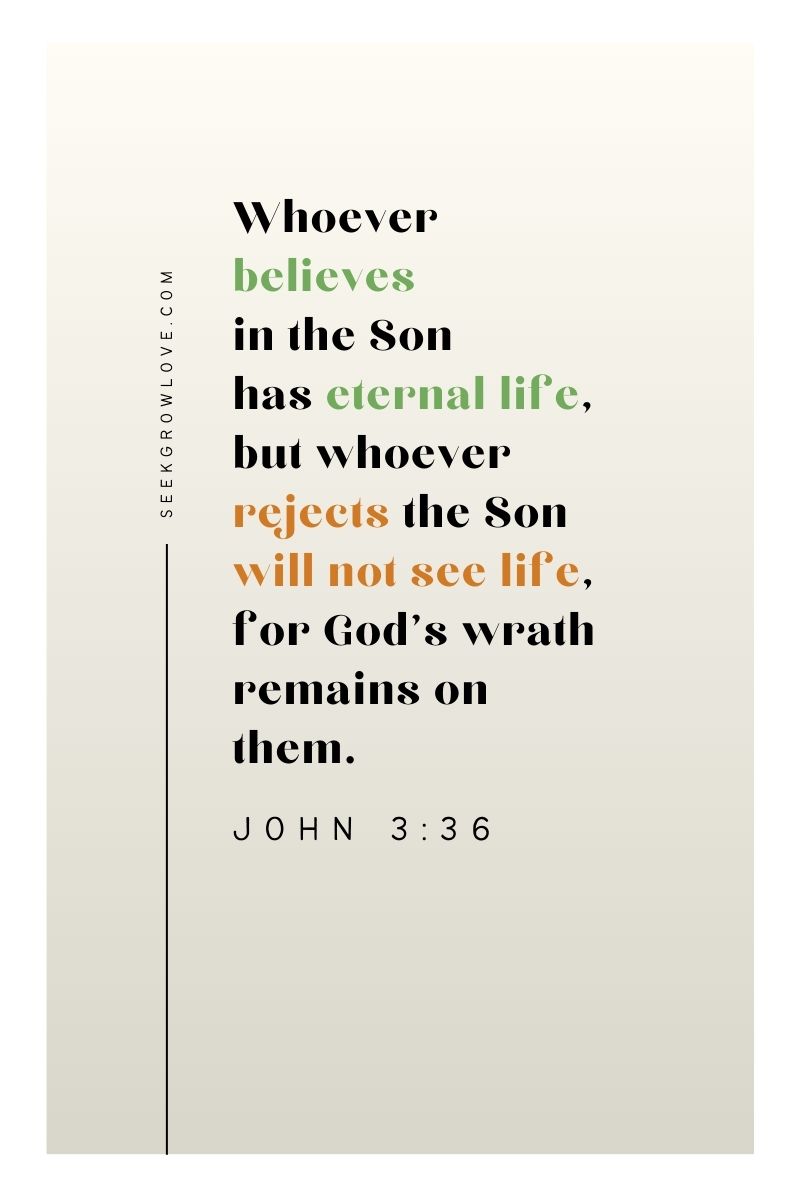
Belief in the Son brings eternal life. John the Baptist sums this up in John 3:35-36, “The Father loves the Son and has placed everything in his hands. Whoever believes in the Son has eternal life, but whoever rejects the Son will not see life, for God’s wrath remains on them.”

We must echo him when we choose to follow Christ: Jesus must increase, and I must increase. That is the true path of life. 

Cayce Fletcher writes and podcasts at amorebeautifullifecollective.com. Check out the blog and other resources to help you create a life you love and cultivate your heart for God. This free resource here will help you take your Bible study one step further with a Bible reading tracker, Bible study reflection page, and more.  

Reflection Questions

  1. How do the miracles and signs we read today show the authority that God has given Jesus? 
  2. What is so important about belief? Why is belief in Jesus the cornerstone of our faith (as opposed to action or other traditions)? 
  3. How are you choosing the path of belief and obedience in your life? Is your life bearing witness to Christ?

SGL.2025.SeptemberFullPageDownload

The Fight Against Temptation

Matthew 4 

Luke 4-5

John 1:15-51

Devotion by Cayce Fletcher (SC)

At the beginning of Jesus’ ministry, we read of his baptism. This is a special moment of God clearly anointing Jesus with his spirit as he says, “This is my son, with whom I am well pleased.” Jesus is anointed and commissioned in that moment to go and preach the gospel of the Kingdom – which is what he does in Matthew 4:17. 

In between the anointing and commencing of his ministry, we read of a curious episode in Jesus’ life. He is led by the Spirit into the wilderness to be tempted by the devil. 

The devil shows Jesus three things to entice him to reject God in disobedience. He tells Jesus to turn the stones to bread, to command the angels to come and rescue him, and to elevate himself physically and figuratively so that the world will bow down to him. 

Interestingly, these things aren’t necessarily the same struggles we may be tempted by. In one Bible Study I was teaching about this passage, one of my friends looked puzzled and mentioned that he would think that Jesus would have been tempted with ‘the lust of the eyes’ because that is such a ubiquitous struggle for our society. But, I think that this instance is more than Jesus staying strong against the seven deadly sins – though he does and remains sinless throughout his temptations. 

In each instance, the devil says, ‘Just show your power to do these things. Show yourself to be like God.’ The devil knows that Jesus has the authority to do the things that he is tempting Jesus with. Jesus also has the power to do those things. But, Jesus knows that he must remain obedient. Jesus is not God, and Jesus knows that the only reason he has the power and authority to do supernatural things is because God has granted him that authority. 

These temptations echo the first temptations in the garden. The ancient serpent also tempted Adam and Eve with the chance to become ‘like God.’ Instead of trusting in God and remaining obedient to his word, Adam and Eve trusted the serpent and grabbed at the chance for the knowledge of Good and Evil. Of course, the serpent’s promises were empty and brought death, not happiness. 

We are also tempted. Yes, temptations mean that we have to be sure to follow the law of God and live righteously. But, more than that, temptations mean that we have to trust that God knows what is best for our lives. Jesus could have looked at his situation in the wilderness (that he was led to by God) and decided that he knew best. In that moment, he could have rejected God, acted disobediently, and sinned. 

But, he didn’t. 

Instead, his obedience required him to humble himself and trust God. Ultimately, this proved to be a training ground for what would be required of him later on. Philippians 2:8 says, “He humbled himself by becoming obedient to the point of death — even to death on a cross.” 

We have to take the same path. We don’t know best. We have to trust God and his word. 

We can take comfort in the end of the story, too. Jesus wasn’t exalted by the devil, but we know that the thing the devil tempted him with will come true because Jesus was obedient. One day, every knee will bow and every tongue confess that Jesus Christ is Lord. 

We wait in hope for that day, and we live in obedience today. 

Cayce Fletcher writes and podcasts at amorebeautifullifecollective.com. Check out the blog and other resources to help you create a life you love and cultivate your heart for God. This free resource here will help you take your Bible study one step further with a Bible reading tracker, Bible study reflection page, and more.  

Reflection Questions

  1. How are the temptations of Jesus in the wilderness similar to and different from the temptations of Adam and Eve in the garden? 
  2. How does Jesus fight against temptation? How can you better equip yourself to fight against temptation? 
  3. Why did God lead Jesus to the wilderness? How was Jesus’ time in the wilderness preparation for the rest of his ministry? 

SGL.2025.SeptemberFullPageDownload

The Beginning of Ministry

Matthew 3

Mark 1

Luke 3

Devotion by Cayce Fletcher (SC)

The past year, I just celebrated the big 3-0. With every new decade, life speeds up, and the long stretch of the future that seems endless at 18 starts to look shorter and shorter. 

I remember when I graduated from high school, I – and all my friends – wrestled endlessly with what to make of our lives. What college? What major? What city? What guy? It seemed like we needed to have it all figured out as soon as we walked across the graduation stage. 

But, as anyone who has a little life experience knows, life rarely goes as planned. What we thought would make up our lives at 18 rarely fits with what our life actually looks like at 30, 40, or 50. 

It always seemed strange to me that Jesus, with such a short life, waited to begin his ministry until 30. Here are some reasons why that could be

Traditionally, 30 was the age in Jewish culture of full maturity. It matches up with the pattern of scripture: David was 30 years old when he became king, Joseph was 30 when he entered the service of Pharaoh, the Levitical priests were 30 when they started their service, and so on (Ezekiel, King Saul, and maybe even Paul the Apostle). 

Jesus needed to wait to gain the experience and wisdom that comes with age. His authority and testimony depended on it. 

When I was younger, it seemed like if I had not decided on a thing by age 22 that opportunity would have passed me by for the rest of my life. Whether that’s a career or a specific ministry, it seems like I’m already too set in my ways to be able to make a change and start doing the thing. 

But, I’ve realized that is not how life works. Our lives are long and full of twists and turns. Joseph probably could not have dreamed of the many changes that would take place between his time among his flocks and entering the service of Pharaoh, but God knew and had a plan. 

Sometimes, I find myself falling into this trap today. If someone has moved on from the church or a friendship is broken, I often give up. I feel as though this will be how this person, this relationship, or this work will be for the rest of my life. 

We need to remember this: As long as we are willing to walk in obedience, it is never too late to start the work. God uses the time waiting and praying as preparation to help to mature our faith and grow our wisdom. 

What can we do in the waiting? 

We can pray, prepare, and trust – as we look to all those who had to wait to begin their ministry. We can trust that God, ‘who started a good work in us, will see it through to completion.’ 

Cayce Fletcher writes and podcasts at amorebeautifullifecollective.com. Check out the blog and other resources to help you create a life you love and cultivate your heart for God. This free resource here will help you take your Bible study one step further with a Bible reading tracker, Bible study reflection page, and more.  

Reflection Questions

  1. Why do you think Age 30 was so significant in God’s plan? What is special about this age? 
  2. What thing do you feel is ‘too late to change’? It could be a job, a personality trait, a failed relationship, or a church ministry. How could you pray for change for this thing? 
  3. How can we ‘wait well’? What are some practical steps we can take to make the most of our time of preparation? 

SGL.2025.SeptemberFullPageDownload

And He Did So.

Isaiah 18-22

Isaiah 20 is an incredibly short though (at least for me) difficult chapter to read. And it is one I definitely don’t remember learning in Sunday School class growing up. We learned about Isaiah, the faithful servant of God who had a powerful calling from God. When he saw a vision of God’s majesty he crumbled in unworthiness and guilt, but then God cleansed him with a burning coal to his lips and Isaiah boldly declared, “Here am I. Send me!” (Isaiah 6:8). We knew Isaiah wrote lots of chapters with many warnings and some beautiful passages of the promised Messiah. But, we didn’t know about the humiliation of chapter 20.

Today we read, “At that time the Lord spoke through Isaiah son of Amoz. He said to him, ‘Take off the sackcloth from your body and the sandals from your feet.’ And he did so, going around stripped and barefoot.” (Isaiah 20:2 NIV). No, argument is recorded. Just obedience. “And he did so.” And, it wouldn’t just be for the day or even a week – but for three years! Commentaries kindly mention he would still have had a loin cloth (a.k.a – underwear). But that’s not too reassuring to Isaiah, his family, or his readers today.

It is natural to ask WHY, God? There has to be a reason why a loving God would ask His faithful servant to go through this embarrassing and painful object lesson for three long years. In this case I believe God was having Isaiah dramatically get the people’s attention to remind them just how degrading and dehumanizing their lives would be as prisoners of war (who were often marched around in such fashion). And, that is what they will become if they choose to forsake the Lord and put their trust instead in foreign ungodly allies like Egypt and Cush.

It makes me wonder – what am I willing to do for God? What amount of personal pain, sorrow, and humiliation am I willing to endure in order to be doing what God has asked of me? Am I more concerned about what men will think of my service to God, or what God would say? Certainly Isaiah would have never lasted for three nearly naked years if he held in greater regard the approval, understanding or encouragement of his peers over pleasing God.

Could I have done what Isaiah did? I think when faced with God’s awesome majesty I could say, “Here am I. Send me!”. After all, it sounds like pretty good resume material to be a messenger for God – I bet it’s a job that comes with some great benefits, too. I would even name my baby boy Maher-Shalal-Hash-Baz (meaning quick to the plunder, swift to the spoils) just as Isaiah did for God. That is an object lesson I feel I would willingly participate in, even though others might laugh and ridicule my choice. But, is there a cut off line where my loyalty and devotion to God would end? Is there a job He could ask of me that I would say ‘no’ to? I hope not.

Too often when we sign on for a position working for the Almighty, we try to choose what it will look like. “I will go here for God and do this for God.” And everyone will be amazed. But, sometimes, God has different plans. Bigger plans. Sometimes, more confusing plans. Sometimes, plans that will take you far out of your comfort zone and even into the midst of personal pain, loss, turmoil, and ridicule.

While the apostle Paul never faced the exact same jobs Isaiah endured, he also gained a lot of experience facing trials and difficulties, misunderstanding and persecution while following God, and His Son Jesus. He wrote in Colossians 3:17 “And whatever you do, whether in word or deed, do it all in the name of the Lord Jesus, giving thanks to God the Father through him.” We can learn a thing or two from both Paul and Isaiah about serving the Lord.

What would you do for God?

-Marcia Railton

(Originally posted for SeekGrowLove Sept 12, 2021. I apologize the devotion wasn’t emailed out earlier today.)

Reflection Questions

  1. What do you think God wanted the people of Isaiah’s day to know about Him and His plans?
  2. What do you think God wants people today to know about Him and His plans?
  3. What would you do for God?

What is Required?

Micah 4-7

After the heavy words of judgment in chapters 1–3, Micah shifts his tone in chapter 4. We are given a beautiful glimpse into a future when there is a godly rule from Zion, and nations will come to learn His ways (Micah 4:1–4). Peace replaces war. Oppression is overturned. God gathers the lame and makes them into a strong nation (4:6–7).

Micah chapter 5 reveals God’s answer to a broken world: a king born in Bethlehem (Micah 5:2). This prophecy clearly points to Jesus, the ruler who will bring security and peace to all of the Earth. Though God is serious about his judgement, He is also a gracious and merciful God who has offered redemption for us. 

Micah chapter 6 is home to my personal favorite verse. For some reason, Micah 6:8 constantly comes up in any messages I do. I believe it’s because it so broadly applies to many message themes and is an answer to the idea of sacrifice. First, Micah exaggerates the idea of a sacrifice that would be worthy to be in the presence before God in Micah 6:7:

“Will the Lord be pleased with thousands of rams, with ten thousand rivers of olive oil? Shall I offer my firstborn for my transgression, the fruit of my body for the sin of my soul?” (‭‭Micah‬ ‭6‬:‭7‬)

Afterwards, he amends by stating my favorite verse:

“He has shown you, O mortal, what is good. And what does the Lord require of you? To act justly and to love mercy and to walk humbly with your God.” (‭‭Micah‬ ‭6‬:‭8‬)

Sometimes, it may feel like a lot to read through the Bible, meditate on His words, and realize that there is a lot that we are called to do. However, we come almost full circle here with this idea of walking humbly with God. If we do this, and we put our faith in him and act justly, we are more worthy of our calling in his presence than any sacrifice ever could make us. 

Then, at the finale of this book, Micah laments. He laments the corruption and distrust in Israel, and he laments the misery in the nation. However, he does not end the book on a sour note. Instead, Micah presents words that should echo for us in times of darkness.

“But as for me, I watch in hope for the Lord, I wait for God my Savior; my God will hear me.” (‭‭Micah‬ ‭7‬:‭7‬)

Micah ends on a message of clear hope. Hope in God being with him. Hope in God redeeming the nation of Israel with the remnant of Jacob. Hope in God delivering on his promises. 

-Colby Leggitt

Discussion Questions:

  1. Why do you think the people offered sacrifices instead of obedience?
  2. What does it practically look like to “act justly, love mercy, and walk humbly with God” in your life or community?
  3. Micah 7:7 says, “My God will hear me.” Do you live with that same confidence? Why or why not?

Order Your Way

2 Chronicles 27, Isaiah 9-12

“Jotham grew powerful because he walked steadfastly before the Lord his God” (2 Chronicles 27:6). 

Jotham could be considered to be an overlooked person in the Bible, but his accomplishments and example were great. He was young when he ascended to his position as a king: only 25 years old! However, at that point he had the spiritual maturity to humble himself before God unlike those around him. Because of that, he made a quiet yet profound impact on Israel during his reign (not to mention conquering the Ammonites). 

We will take this example and then examine Isaiah 9-11. Here, we find once again that wrath will be upon the wicked in the form of judgement from God. The language in these chapters do not spare us from imagery of fire and death. These seem to allude to a judgement of the wicked that has not come completely to pass just yet. 

Speaking of not coming to pass yet, prophet Isaiah in Isaiah 11 makes allusions to the (then) coming messiah: Jesus Christ. “In that day the Root of Jesse will stand as a banner for the peoples; the nations will rally to him, and his resting place will be glorious” (Isaiah 11:10). The root of Jesse spoken in this chapter is Jesus as he is in fact a descendant of Jesse according to the genealogy found in Luke 3. Here, we have a much more hopeful note to look to after the judgement that must pass. Importantly, that remnant that he will gather up is foretold in Isaiah 10:20.

 “In that day the remnant of Israel,

    the survivors of Jacob,

will no longer rely on him

    who struck them down

but will truly rely on the Lord,

    the Holy One of Israel.”

This “remnant of Israel” speaks of those who truly rely and trust in the Lord.

This brings us back to Jotham from 2 Chronicles 27. He sets an example for us as he walked steadfastly before the Lord, humbled himself, and put his trust in Him. Jotham overcame the war with the Ammonites with God on his side. Furthermore, the “remnants of Israel” were relented of the judgement that passed on the wicked, as they also walked with the Lord. If trusting in the Lord and setting your spiritual anchor with him allows for you to weather a calamity that only God can create, imagine what else you weather in your life if you put your trust in him! 

Therefore, we must live like Jotham. Stay faithful, even when the world around you is falling apart. Order your life before God. Strength grows in obedience. Hold on to Isaiah’s vision. Jesus has come, and He’s coming again. In Him, we find light in our darkest moments. With that, we will only begin to understand the praise that adorns the short chapter of Isaiah 12:

“Surely God is my salvation;

    I will trust and not be afraid.

The Lord, the Lord himself, is my strength and my defense;

    he has become my salvation.” (Isaiah 12:2)

-Colby Leggitt

Discussion Questions

  1. What does it look like for you to “order your ways before the Lord” in your current season?
  2. Are there areas in your life where you’re tempted to compromise instead of staying faithful?
  3. What does it mean to be still before the Lord?

It’s Personal

1 Kings 17-19

I have appreciated the opportunity to read and share my thoughts with you across these seven days. We’ve traced the unfolding drama of the divided kings and kingdoms of Israel. We’ve watched the culture shift, the crowd move to and fro, and the pressure rise and fall, but through their stories, one truth rings clear: the faithful know that wisdom comes from God alone.

“How long will you waver between two opinions? If the Lord is God, follow him; but if Baal is God, follow him.” (1 Kings 18:21)

Looking momentarily at my own nation, America is a nation with deep Judeo-Christian roots, as many of our founding documents demonstrate a commitment to God as the architect of the law that governs us. Our motto makes mention of our trust in God, we proclaim His work in our patriotic songs, open government functions with prayer, and swear in our presidents with their hand on His Word. I am one of many who believe the blessings we enjoy as a nation—even in today’s troubling times—can be attributed to the enduring declaration that the God of Israel and the Father of Jesus Christ reigns here.  Sadly, more and more are living on borrowed blessings as the altars of moral revision, self-importance, and political convenience are being fashioned and raised.

Today, we look to the prophet Elijah, who lived as a lone voice for the Lord in a nation God had once richly blessed. Elijah wasn’t trendy or tribal. His conversations with God were authentic and intimate, and he took action as one who was swiftly obedient. His faith was so personal that he was often fully dependent on the Lord even for his next meal—fed by ravens and sustained by a jar of oil and flour that never ran dry. How ready would we be to fight off the enemies of God, to recite and rely on His promises, and even to expect miracles in His name, if we lived with this kind of faithfulness?

Each of us is called to that kind of personal, committed, lived-out faith. It may seem like faith is inherited—passed down through our nation’s heritage or through family and friends—but true faith is never proximal. Hanging with a spiritual crowd, attending high-energy worship services, or serving on a ministry team are not guarantors of a relationship with the Lord.  Personal faith is born in the discomfort of repentance, in the surrendering of fear, and in the offering up of our possessions. These are the intimate things God desires from us. In the abandonment of self, we begin to hear God’s call clearly—and are emboldened because we know our Creator personally.

“At the time of sacrifice, the prophet Elijah stepped forward and prayed: ‘Lord, the God of Abraham, Isaac and Israel, let it be known today that you are God in Israel and that I am your servant and have done all these things at your command. Answer me, Lord, answer me, so these people will know that you, Lord, are God, and that you are turning their hearts back again.” – 1 Kings 18:36–37

In this week’s reading, we’ve seen that change in a nation is inevitable. I pray that “In God We Trust” will continue to stand as a reminder of our nation’s steadfastness for the Lord. But however long it endures, let it always point us to something greater—our personal relationship with God, built through surrender, obedience, and faith. If the Lord is God, stand for Him—even if you stand alone. Because at the end of the day, it’s personal.

-Aaron Winner

Reflection Questions

  1. What character traits do you find in Elijah? Is there one you would like to have more of in your life? How would you go about adding more?
  2. What choices are before you today?
  3. Which one will you choose? Why?

Worthy of Worship

Ps 95, 97-99

Music has always been a huge part of my life. From singing along to Veggie Tales songs in the car to being dressed up in my Sunday Best doing a ‘special’ on Sunday Mornings, from an early age I was taught the importance and beauty of song sung in worship. 

I still like to sing and dance to ‘I Like Bananas’ around a campfire, but my understanding of worship has expanded and grown. Just singing doesn’t mean that we are worshipping God, and sometimes the most worshipful moments are done in silence. We all know the days where we are going through the motions in a Church service, singing familiar words without it ever truly reaching our hearts. 

What should a heart of worship look like?

In today’s reading, we see Psalm after Psalm of praise and worship. Importantly, the Psalms show the heart behind worshipping God. 

A heart of worship is: 

  • Based on the character of God, not the quality of our voices. We don’t sing praises because we ‘sound good.’ We sing praises because God is the ultimate thing that is worthy of praise. We sing because he has truly done ‘marvelous things.’
  • Grounded in the truth of scripture, not the beat of the song. The Psalms repeat the truth again and again: “The Lord reigns.” Why? Because the transformative power of worship is focused on repeating the truths of scripture to ourselves. We can praise God and weather difficult circumstances because God reigns. 
  • Focused on remembrance, not emotions. Our summer camps were always a highlight of the year because we loved the worship. But the truly quality of worship isn’t based on the quality of the band. It’s based on the way we remind ourselves of the goodness and faithfulness of God and praise him for it. 

Today, let’s cultivate a heart of worship.

-Cayce Fletcher

Cayce blogs at https://amorebeautifullifecollective.com about faith, family, and life. You’ll find encouragement for how to build intentional lives rooted in faith and beauty. Check out the latest post on the human nature of Jesus here. 

Reflection Questions

  1. How do you cultivate worship in your life? 
  2. What should characterize a ‘heart of worship’?
  3. Create a list of attributes about God that you can use while you worship. 

SGL.2025.MayFullPageDownload