Belt of Truth Buckled

Old Testament: 1 Kings 3 & 4

Poetry: Proverbs 10

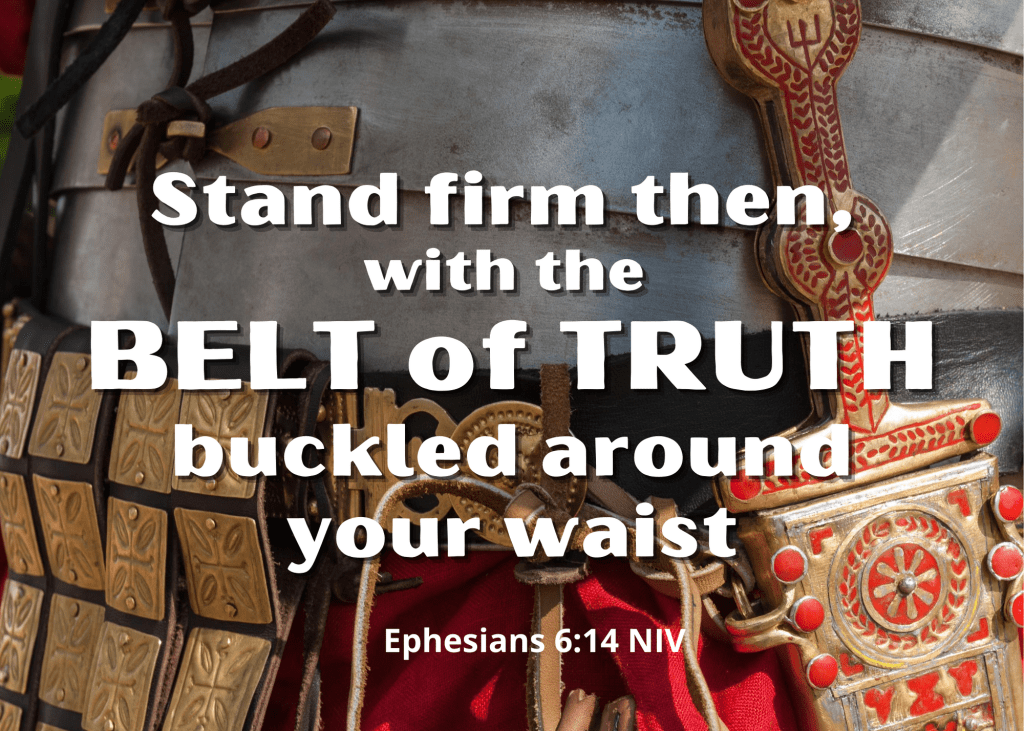
New Testament: Ephesians 6:14a

Heads up! This devotion is going to take you in a mini dive into the history of the buckle of all things! But first…

Many of us have read our key verse more than a handful of times in our lives. And we’ve even been taught about the belt of truth in our Sunday School lessons. It’s been explained that in ancient times, before a foot race or prior to battle, runners and warriors would tuck their long garments into their cloth belt, in order to provide free movement for the legs. 

As I considered this first half of this verse, the word buckle stuck out to me. My thoughts went a little something like this:

“Wait a minute…a buckle in ancient Roman times? This doesn’t make sense. The earliest I’ve ever seen buckles in history books is on the Pilgrims. Did Roman soldiers wear buckles?”

A few clicks in my web browser confirms that indeed, buckles were part of the Roman body armor. Depending on the type of armor, there could be one main buckle, or in segmented forms of armor, many mini buckles to hold all the pieces together. What’s more, the more elite soldiers had super fancy buckles, whereas those that served in the infantry had simpler and more practical buckles. 

Who knew???

With this new knowledge, our key verse today starts to take on an expanded meaning. Without the buckled belt of truth, the breastplate won’t stay in place and the protective plates on the shoulders wouldn’t be able to stay attached. Also, the tunic part of the armor which protected the groin wouldn’t have anything to attach to if it weren’t for the buckle. 

It all starts with the buckle on the belt. Just like it all starts with Truth. 

  • John 14:6 – “I am the way, the truth, and the life.”
  • John 8:32 – “Then you will know the truth, and the truth will set you free.”
  • 2 Timothy – “Do your best to present yourself to God as one approved, a worker who does not need to be ashamed and who correctly handles the word of truth.”
  • Psalm 25:5 – “Guide me in your truth and teach me, for you are God my Savior, and my hope is in you all day long.”
  • Ephesians 1:13 – “And you also were included in Christ when you heard the word of truth, the gospel of your salvation…”

The start of our key verse in Ephesians chapter 6 begins with “Stand firm then…”. If we are ignorant of the Truth, there is no way that we can stand firm. We must know the Truth of YAHWEH, and His Son, Jesus. We must know the Truth of salvation and the coming Kingdom. If we fail to know these truths, then our efforts to stand firm against the attacks of our opposition will be for nothing. 

So buckle up and stand firm in Truth.

-Bethany Ligon

Reflection Questions

  1. What would happen if you went into battle but couldn’t keep your pants up, or were restricted by your long garments? How important is truth? How do the other components of the armor rely on truth? What happens if we try to stand firm without truth?
  2. What truths do you believe about YAHWEH, His Son, Jesus, salvation and the coming Kingdom? Are there any that you are unsure about and need to study more? How do these specific truths affect other pieces of your armor: salvation, righteousness, faith, and gospel of peace?
  3. What can you do today to be better buckled into the truth?

Unity

Old Testament: 2 Samuel 20-21

Poetry: Proverbs 6

New Testament: Ephesians 4

After the attacks on September 11, 2001, President George W. Bush spoke to the emergency workers in Ground Zero through a megaphone, finding a response that resonated with the entire country and even more, the world, “I can hear you. The rest of the world hears you. And the people who knocked down these buildings will hear all of it soon.” A historical 92% of the country approved of the job he was doing, bringing together a country that was fraying at the seams in the previous election cycle. It is hard to imagine something similar happening today; no matter who is the president-elect in November, half of the country will be instantly dissatisfied with the results.  These are typical terms we accept in our government, but also this “majority rules” culture has historically found its way into boardrooms and even churches. Let me quickly lower the tension by stating that today’s devotion is not about politics or presidents.  It does not upend or chastise any church form of government. Its sole purpose is to examine the expectation of unity laid out for the church body, as it might be equally unimaginable. 

This spirit of unity was on the mind of Jesus before being arrested in the garden of Gethsemane. He prays for his disciples and all believers when he leaves us the following words, “Holy Father, protect them by the power of your name, the name you gave me, so that they may be one as we are one. (John 17:11b)” Jesus knew his departure to the cross would scatter His apostles, create infighting, and feed doubt. Fortunately, with the exception of Judas, each of them found their way back to a unified front. Having seen Jesus Christ raised to life, they each waited for the Holy Spirit at Pentecost.  They each dedicated their lives to sharing the Good News of the Kingdom of God. They each shared in martyrdom or exile for the sake of Christ.

In the same manner, I have seen churches unite during revival, when facing tragedy, or during persecution from the outside. It is easy for the dross to fall away when the metal is hot, but what about when the metal starts to cool? What does unity look like in maintenance mode? Within the day-to-day routine of uniting relationships, mulling through ministries, and discerning what is best for a body of believers? In Ephesians 4, Paul describes this as “walk[ing] in a manner worthy of the calling, with all humility and gentleness, with patience, bearing with one another in love, eager to maintain the unity of the Spirit in the bond of peace.”

While there could be a devotion on each of the elements of this verse, let’s quickly unpack the key points given to Ephesus. First, walking implies that it is not a quick process, but instead requires some dedication to go the distance (Eph 2:10). Next, humility is the acknowledgement that self-reflection should be the first step in the process, making adjustments and amendments when necessary (Matt 7:3-5; Phil 2:3), and gentleness is the grace that is extended to my brother and sisters during this same process, as imperfect people try to discern the will of God (Col 4:6). Additionally, we are required to commit to patience and love, easily spoken but in reality, conflict makes us more unbearable to one another (Col 3:12-14; Matt 18:15-20). In the body of believers, this is similar to taking the last rep of weight training, it burns the most, but it is the one that produces the result. Finally, eagerness to maintain unity means we stay focused on what unites us (Rom 14:19), defending against the six things the Lord hates (Prov. 6:16-19), and keep our mission far away from doctrinal nuances or extra-biblical preferences.

Unity takes far more work than building a majority.  It isn’t a compromise or consensus because there are no losers. We grow as one together. We move towards one another as we move towards our Heavenly Father. Today, let us be extra mindful in our prayer time to dwell on the topic of unity and ask God to reveal our vision and repair divisions that may exist.  May we live out the prayer of Jesus and the petitions of Paul to become one like our God and His Son, Jesus Christ.

-Aaron Winner

Reflection Questions

  1. Where and when have you experienced or seen the beauty of a united church body?
  2. Dedication, humility, gentleness/grace, patience, love, focused on what unites. How can you exhibit these qualities today? How can you use them to increase the unity of your church? What can happen when just one is missing?

Leading Through Hardship

Old Testament: 2 Samuel 18 & 19

Poetry: Proverbs 5

New Testament: Ephesians 3

As President of the United States, Abraham Lincoln is uniquely positioned in American history as the only leader of a broken country.  No matter who he chose to serve in his cabinet, how empathetic his staff was to his role, how much they helped to shoulder the load or strengthened his areas of weakness,  no one can truly understand the weight borne by the Commander-in-Chief, whose presidency was the bookends to rebellion. A great example of this can be seen in Vicksburg, a Union siege took out the Confederate stronghold on the Mississippi which was a key route for reinforcement and supplies.   While this battle represented a great public triumph for Lincoln’s side, it also held personal tragedy.  Lincoln received the report that his brother-in-law, a Confederate general, was killed in battle.  It was stated by those surrounding him they never saw the president more moved during the war than when he received this news.

Likewise, David’s emotions in victory are complex. Tens of thousands of men look to their king to champion their victory, no doubt hearing stories of how he famously danced in the streets as the Ark made its way into the city.  Instead, they see the lament of a father’s cry.  Great leaders, more than anything else, are human; however, the weight of leadership will undoubtedly tip the scales in favor of fostering commitment, vision, and hope for followers, rather than abandonment trials and tragedy. Joab’s words seem insensitive, “You love those who hate you and hate those who love you. You have made it clear today that the commanders and their men mean nothing to you. I see that you would be pleased if Absalom were alive today and all of us were dead. (2 Sam 19:6) ” but they are actually encouragement to a leader who has made a personal sacrifice to acknowledge that tens of thousands of others had done the same.

The words of Jesus could be thought equally cutting and unfeeling, “Let the dead bury their own dead, but you go and proclaim the kingdom of God. (Luke 9:60).” Our ministries do not stop because we face conflict or personal tragedy.  Conversely, I would say this is when our ministry and testimony are spotlighted. By the standards of the world, this conflict provides permission to act selfishly, but when we bear our burdens with the Kingdom of God at the forefront, we lean on God and lead others to the Good News.  Paul makes mention of this in Ephesians 3.  He tells the church at Ephesus not to worry about his suffering, because it is for their sake and to the glory of God.  The same circumstance is both a victory yet a personal hardship. Paul instead lifts those he leads in prayer, asking for the strength of the Holy Spirit to guide those for whom the letter was intended, and likewise, encourage us today.   No matter what scale Paul used, no matter what was placed in the balance, the weight of the Kingdom of God far outweighed any loss. This sentiment is again echoed from his prison cell to the church at Philippi when he states:

“What is more, I consider everything a loss because of the surpassing worth of knowing Christ Jesus my Lord, for whose sake I have lost all things.  I want to know Christ—yes, to know the power of his resurrection and participation in his sufferings, becoming like him in his death, and so, somehow, attaining to the resurrection from the dead.” –  Phil. 3:8,10

While we may not be ready to ask for suffering like Paul, tragic circumstances are the nature of this world. It may be an unfamiliar posture, but our grief, our battle, and our dire circumstance is an opportunity to demonstrate the assurances we have, to revel in the joy and love of God. We must look for opportunities to pray for and encourage others who may be participating in the same battle, asking God to give them the strength to see the victory too.  Yes, we must bear, and even welcome, hardship for the sake of the Kingdom of God because, with the help of God, we can lead within it, bringing others to the saving knowledge of Christ Jesus.

-Aaron Winner

Reflection Questions

  1. What do you learn about leadership from David? From Paul?
  2. What do you think of the statement: “No matter what scale Paul used, no matter what was placed in the balance, the weight of the Kingdom of God far outweighed any loss.” Do you see this in Paul’s life? Do you see this in your own life?
  3. Who will you pray for strength to see the victory?

Ramifications & Restorations

Old Testament: 2 Samuel 13 & 14

Poetry: Proverbs 2

New Testament: Galatians 6

The second day of school has traditionally been my rule day. In the midst of hearing about respect, responsibility and best efforts, students are surprisingly invited to leave the classroom.  “Did you know you don’t have to sit here and listen to me speak another word? In fact, you can leave. You can walk out right now…” Typically someone who I will get to know better as my class clown playfully walks to the door, and then I say, “but you have to deal with the consequences.” Then I lead students down the timeline of possible outcomes that lead to suspension, loss of friendships, poorer relationships at home, less opportunity in the future, and finally, on their deathbed alone, all because they chose to walk out of my class.  Thankfully, no one has ever walked out.

Amnon’s actions are far more sinister than walking out on his teacher.  Acting on his lust, he rapes his half-sister, both a violation and grievous sin against God’s law.  This comes with its own un-hyperbolic chain of tragic ramifications. For two years, his half-brother, Absalom, becomes consumed with calculating revenge. There is discord in the family tree designed after God’s own heart. Ultimately, Amnon’s disregard for divine laws leads to an untimely death. This is the havoc that sin can wreak, even in a single choice.

It is safe to say that most of our choices fall between leaving a classroom without permission and Amnon’s sin. Likewise, the vast majority of time, the immediate consequence lies somewhere between a phone call home and death (although, quick note: all sin leads to death. Rom 3:23)  So how do we stay away from the edge of the slippery slope? Proverbs 2:1-5 gives us an insight:

“My son, if you receive my words and treasure up my commandments with you, making your ear attentive to wisdom and inclining your heart to understanding; yes, if you call out for insight and raise your voice for understanding, if you seek it like silver and search for it as for hidden treasures, then you will understand the fear of the Lord and find the knowledge of God.” 

The pursuit of wisdom from God is portrayed as a protective measure against the consequence of sin, serving as a shield and guide against temptation. It leads us far and away from destructive patterns or downfalls and moves us closer to our good intentions, but better yet, our good God.  

Furthermore, we do not have to fight sin or seek wisdom alone.  Paul beckons the family of God to be on the watch for one another. In Galatian 6 he states, “Brothers, if anyone is caught in any transgression, you who are spiritual should restore him in a spirit of gentleness. Keep watch on yourself, lest you too be tempted.” This means that offering wisdom to one another in the form of correction and accountability may halt the tragic dominos from falling or make a path forward to clean up the mess, “bearing one another’s burden.” In this way, Joab advises Absalom to deal with his own ramifications, temporarily restoring the rift in the line of David.

We must be diligent to seek God’s wisdom, especially when navigating temptation.  If the chips have already fallen, let the consequence be a sobering reminder that there is opportunity for restoration in God through Jesus Christ. Though it may still hurt in the present, be reminded that the sting and tears are conditions of mortality and not life eternal.  Likewise, let us pull alongside others who are battling, being gracious because of our own shortcomings, running to their defense and offering correction. In this way, we may avoid the siege that comes with a breached wall of will and choose the power of restoration through God’s wisdom and grace.

-Aaron Winner

Reflection Questions

  1. Are you more intent upon seeking after wisdom or your own will? What can you do to pursue wisdom more?
  2. How can you be a part of someone else’s battle against temptation and their own will? How can you help, offering restoration with God, to one who is caught in their sin? Give specifics – name who, and your actions to free them from their deadly trap.

In the Spirit – OR – in the Flesh

Old Testament: 2 Samuel 12

Poetry: Proverbs 1

New Testament: Galatians 5:24-26

In 2 Samuel 12 we read all about how King David is rebuked for his sinful ways and the real consequences he would suffer as a result of his sin. 

9 Why have you despised the word of the Lord by doing evil in His sight? You have struck down Uriah the Hittite with the sword, have taken his wife to be your wife, and have killed him with the sword of the sons of Ammon. 10 Now therefore, the sword shall never depart from your house, because you have despised Me and have taken the wife of Uriah the Hittite to be your wife.’ 11 Thus says the Lord, ‘Behold, I will raise up evil against you from your own household; I will even take your wives before your eyes and give them to your companion, and he will lie with your wives in broad daylight. 

Proverbs 1:31 from today’s reading gives us a sobering reminder of what happens when we choose to be ruled by the flesh rather than by the Spirit.


“So they shall eat of the fruit of their own way

And be satiated with their own devices. (NASB 1995)

If we want to avoid disastrous consequences brought on by sin, Galatians 5 gives us some sound advice:

24 Now those who belong to Christ Jesus have crucified the flesh with its passions and desires. 25 If we live by the Spirit, let us also walk by the Spirit. 

Proverbs 1:7 further instructs us on how to live wisely:

The fear of the Lord is the beginning of knowledge;

Fools despise wisdom and instruction. (NASB 1995)

The Bible is full of examples from which we can learn. Sometimes I read the story of David and think how on earth could he do those things, but then I quickly remember that saying, “As soon as you point a finger at someone, you have four fingers pointing right back at you.” God’s word is a mirror for our hearts. If we are left to our own devices and follow the ways of our flesh, disastrous consequences inevitably ensue. We must make a conscious choice to live and walk by the Spirit. The good news is that we are not irredeemable if we have been led astray by our flesh at one point. The story wasn’t over for David and it doesn’t have to be over for us. We can make that choice to reconcile with God and we can be assured by the parables of the prodigal son and the lost sheep that He will welcome us with open arms. Your story is not over while you still have breath. If you’ve walked away from God, please know His heart yearns for you to return to Him and He will welcome you back with loving arms. The choice is up to you.

Romans 8:37 No, in all these things we are more than conquerors through him who loved us. 38 For I am convinced that neither death nor life, neither angels nor demons, neither the present nor the future, nor any powers, 39 neither height nor depth, nor anything else in all creation, will be able to separate us from the love of God that is in Christ Jesus our Lord.

Did you notice that nothing can cause God not to love us? God forgave King David and He can certainly forgive you.

-Kristy Cisneros

Reflection Questions

  1. What consequences for sin have you experienced or are you still experiencing? What would you recommend to someone (including yourself) contemplating the sin which brought the consequences?
  2. What role did Nathan play in 2 Samuel 12? Who sent him to David and why? As uncomfortable as it may seem, is there someone God wants to send you to?
  3. Living by the flesh or living by the Spirit – what are the pros and cons of each? Which will win in your life?
  4. What does reconciliation with God look like in your life? What blessings did David receive after his sin and reconciliation? What blessings have you received after sin and reconciliation? How would you describe God’s love?

God’s Amazing Character

Old Testament: 2 Samuel 9 & 10

Poetry: Psalm 72

New Testament: Galatians 5:22

We previously read the Seek.Grow.Love year’s readings with the objective of focusing on what we could discover and celebrate about God’s character. Today’s reading in Psalm 72 paints a beautiful picture of the kingdom and highlights wonderful attributes of God’s amazing character. We read in verses 4 and 12-14 about His heart for the afflicted, the crushed and the needy.

Give the king Your judgments, O God,

And Your righteousness to the king’s son.

May he vindicate the afflicted of the people,

Save the children of the needy

And crush the oppressor.

12 

For he will deliver the needy when he cries for help,

The afflicted also, and him who has no helper.

13 

He will have compassion on the poor and needy,

And the lives of the needy he will save.

14 

He will rescue their life from oppression and violence,

And their blood will be precious in his sight;

I am always blown away that we are blessed enough to have a Heavenly Father with such compassion and unconditional love for us. Let that sink in for a minute. This passage actually made me think of a few other passages. One was from the story of Ruth and Naomi and we read how they were able to glean the fields per the provision of God’s law. Those harvesting the land were not to clear the grounds of the crops that had fallen or clear all the way to the edges so that the needy could glean the field. 

We can read about this law in Leviticus 19:9 “‘When you reap the harvest of your land, do not reap to the very edges of your field or gather the gleanings of your harvest. 10 Do not go over your vineyard a second time or pick up the grapes that have fallen. Leave them for the poor and the foreigner. I am the Lord your God.

Here are a couple of other passages that came to mind:

James 1:27 Religion that God our Father accepts as pure and faultless is this: to look after orphans and widows in their distress and to keep oneself from being polluted by the world.

Isaiah 1:17: learn to do good; seek justice, correct oppression; bring justice to the fatherless, plead the widow’s cause.

If reading these passages doesn’t give you pause, it really should. Take a moment to really think about God’s heart and what that means for you. Take time to deeply celebrate and appreciate who He is! May we seek to imitate His character by looking after the needy, the fatherless and the widow.

-Kristy Cisneros

ReFLection Questions

  1. Where have you seen evidence of God’s amazing character?
  2. How would you describe God’s heart?
  3. How can you pass on God’s compassion and helping hand to others?
  4. Can the fruits of the Spirit of love, kindness and goodness be seen in you?

Peace & Joy – Even in Trials

Old Testament: 2 Samuel 7 & 8

Poetry: Psalm 71

New Testament: Galatians 5:22

“And the Lord helped David wherever he went.”

This phrase shows up twice in chapter eight of 2 Samuel. The repetition of this phrase  tells me that it must be an especially important message that God wants us to hear. Reading this sentence calls to mind the passage in Deuteronomy 31:6: “Be strong and courageous. Do not be afraid or terrified because of them, for the Lord your God goes with you; he will never leave you nor forsake you.” (NIV) We know this promise was not just reserved for the Israelites because this promise is referenced again in Hebrews 13 in a message to all believers: 5 Keep your lives free from the love of money and be content with what you have, because God has said,

“Never will I leave you;
    never will I forsake you.”

I also want to throw in verse 6 for good measure since it really helps drive home the point.

6 So we say with confidence,

“The Lord is my helper; I will not be afraid.
    What can mere mortals do to me?”

I love that the passage in Psalm 71 is coupled with today’s reading. We can see that David is ever mindful of his source of help and strength and this whole passage reads like a recipe for having joy in the midst of suffering.

From birth I have relied on you;

    you brought me forth from my mother’s womb.

    I will ever praise you.

I have become a sign to many;

    you are my strong refuge.

My mouth is filled with your praise,

    declaring your splendor all day long. (NIV)

19 

Your righteousness, God, reaches to the heavens,

    you who have done great things.

    Who is like you, God?

20 

Though you have made me see troubles,

    many and bitter,

    you will restore my life again;

from the depths of the earth

    you will again bring me up.

21 

You will increase my honor

    and comfort me once more. (NIV)

Psalm 71 reminds us that we are not promised a trouble-free life. In fact, Jesus promises us just the opposite in John 16:33: “I have told you these things, so that in me you may have peace. In this world you will have trouble. But take heart! I have overcome the world.”

Notice the promise that we can have peace in spite of suffering and trouble. Peace is even a fruit of the Spirit listed in today’s passage of Galatians 5:22: But the fruit of the Spirit is love, joy, peace, patience, kindness, goodness, faithfulness, (NASB 1995). 

What is the key to having this peace? Abiding in Christ and holding fast to our hope that Jesus has overcome the world is key! 

We are further reminded of this promise in today’s passage of 2 Samuel 7 that unfolds God’s covenant with David that will be fulfilled through Jesus Christ:

12 When your days are complete and you lie down with your fathers, I will raise up your descendant after you, who will come forth from you, and I will establish his kingdom. 13 He shall build a house for My name, and I will establish the throne of his kingdom forever. 14 I will be a father to him and he will be a son to Me; when he commits iniquity, I will correct him with the rod of men and the strokes of the sons of men, 15 but My lovingkindness shall not depart from him, as I took it away from Saul, whom I removed from before you. 16 Your house and your kingdom shall endure before Me forever; your throne shall be established forever.” (NASB 1995)

No matter what life throws our way, we can have peace and joy by abiding in Christ and holding fast to the hope we have in him thanks to the loving plan of our Heavenly Father. May we be especially comforted by God’s promise that He will never leave us or forsake us. We are not alone in this journey and God—the maker of the universe—cherishes us and is with us every step of the way! Wow!

Luke 12:7 Indeed, the very hairs of your head are all numbered. Do not fear; you are more valuable than many sparrows. (NASB 1995)

-Kristy Cisneros

Reflection Questions

  1. When have you needed to hear Psalm 71? How can you relate to David and his words?
  2. If you were to make a poster, memory card or bumper sticker of one or two verses from Psalm 71 which verses would you choose and why?
  3. Where would you rate your peace – even in the midst of trials? Where would you rate your joy? What can you do to increase your peace and joy? How can you abide more closely to Jesus, how can you trust more fully in His Father and yours?

Recognized by Your Fruit

Old Testament: 2 Samuel 5 & 6

Poetry: Psalm 71

New Testament: Galatians 5:22

Matthew 7:15-20:

15 “Watch out for false prophets. They come to you in sheep’s clothing, but inwardly they are ferocious wolves. 16 By their fruit you will recognize them. Do people pick grapes from thornbushes, or figs from thistles? 17 Likewise, every good tree bears good fruit, but a bad tree bears bad fruit. 18 A good tree cannot bear bad fruit, and a bad tree cannot bear good fruit. 19 Every tree that does not bear good fruit is cut down and thrown into the fire. 20 Thus, by their fruit you will recognize them. (NIV)

“By their fruit, you will recognize them.” The fruit we bear in our lives is a litmus test for our spiritual health and the strength of our relationship with our Heavenly Father and His son Jesus Christ. We just read yesterday how apart from Christ we can do nothing. So our ability to bear good fruit depends on our willingness to abide in Christ. Take an inventory of your life. Do you see evidence of love, joy, peace, patience, kindness, goodness, faithfulness, gentleness and self-control? Taking this inventory of my life highlights areas where I need to repent of sin and abide more deeply in Christ. It is also important not to just take a cursory, shallow glance at that list of fruits, but to dig deeper and investigate more in depth what the scriptures have to say about the various fruits. For example, with the fruit of love, Jesus tells us in Matthew 5:44, “But I tell you, love your enemies and pray for those who persecute you.” Does my life show evidence of loving my enemies? Whew, I’m going to be real here, that is a tough one! To actually pray for someone who might be actively working against you or for your demise seems so counterintuitive to our human nature and our survival instinct. God, you want me to give my enemy a salt shaker so that they can rub it into my raw wound even more? Doesn’t that leave me vulnerable and unprotected? Do the scriptures support that God leaves us vulnerable and unprotected? In a couple of weeks you will be reading in Ephesians 6:10-17 about the spiritual suit of armor that God provides us. I won’t go too in depth with it since there are devotions coming that week, but that passage shows us that God protects us from head to toe. Also, remember we are talking about the fruit of the Spirit and John 15 reminds us that we are not alone in this battle.

John 15

26 “When the Helper comes, whom I will send to you from the Father, that is the Spirit of truth who proceeds from the Father, He will testify about Me, 27 and you will testify also, because you have been with Me from the beginning. (NASB 1995)

The scriptures also have something to say about who fights our battles. Let’s take a close look at Romans 12:19-21: 

19 Do not take revenge, my dear friends, but leave room for God’s wrath, for it is written: “It is mine to avenge; I will repay,” says the Lord. 20 On the contrary:

“If your enemy is hungry, feed him;
    if he is thirsty, give him something to drink.
In doing this, you will heap burning coals on his head.”

21 Do not be overcome by evil, but overcome evil with good. (NIV)

Did you catch that part about putting that love of our enemies into action by feeding them if they are hungry, giving them something to drink if they are thirsty? That’s taking that command to love your enemies to the next level, isn’t it?!?!  Are you prepared to do that? Am I? It’s time for a heart check.

It really boils down to trusting God, doesn’t it? Do we believe Him when He says that He’s got it handled? If we find our faith lacking in this area, this is something we can pray about. It brings to mind the passage in Mark 9:

17 A man in the crowd answered, “Teacher, I brought you my son, who is possessed by a spirit that has robbed him of speech. 18 Whenever it seizes him, it throws him to the ground. He foams at the mouth, gnashes his teeth and becomes rigid. I asked your disciples to drive out the spirit, but they could not.” (NIV)

Later we read in verses 21-24:

21 Jesus asked the boy’s father, “How long has he been like this?”

“From childhood,” he answered. 22 “It has often thrown him into fire or water to kill him. But if you can do anything, take pity on us and help us.”

23 “‘If you can’?” said Jesus. “Everything is possible for one who believes.”

24 Immediately the boy’s father exclaimed, “I do believe; help me overcome my unbelief!” (NIV)

That verse always touches my heart because I can relate to it so well. I know what the scriptures tell us, but sometimes my trust and faith are lacking. Sometimes my prayers sound something like this, “Father, I know that Your word tells me that I am to love my enemies, but it’s so hard, God. It hurts so much. I need Your strength to show them the love Your word says I should show them. Father, I know that Your word says that You will work all things together for the good of those who love Him. Help me to love You more deeply and fully and to trust that promise so that my fear does not hold me back from being obedient to Your word to love my enemies. Help my lack of faith in this area. Help my unbelief.”

In today’s passage in Psalm 71 we read how God handled David’s enemies:

24 My tongue will tell of your righteous acts

    all day long,

for those who wanted to harm me

    have been put to shame and confusion. (NIV)

Our only job in regards to our enemies is to love them and to follow through with loving action that helps meet their needs. God’s got the rest of it.

-Kristy Cisneros

Reflection Questions

  1. If a stranger watched you for an hour yesterday, would they have seen good fruit or bad? Would they guess that you abide in Christ? Do you? How can you do so more and more?
  2. Who might you consider as your enemy? How do you typically treat them? What is Jesus asking you to do for them? Will you? When and how?

Spirit Grown

Old Testament: 2 Samuel 3 & 4

Poetry: Psalm 70

New Testament: Galatians 5:22

My understanding of the fruits of the Spirit has evolved quite a bit over time. I used to think that I needed to strive to demonstrate that fruit in my life and I would get so frustrated every time I would inevitably fall short. I felt like such a disappointment to God. It was actually an egotistical way to approach the matter. John 15:1-8 gives us insight into how we can bear good fruit in our lives:

1 “I am the true vine, and my Father is the gardener. 2 He cuts off every branch in me that bears no fruit, while every branch that does bear fruit he prunes so that it will be even more fruitful. 3 You are already clean because of the word I have spoken to you. 4 Remain in me, as I also remain in you. No branch can bear fruit by itself; it must remain in the vine. Neither can you bear fruit unless you remain in me.

5 “I am the vine; you are the branches. If you remain in me and I in you, you will bear much fruit; apart from me you can do nothing. 6 If you do not remain in me, you are like a branch that is thrown away and withers; such branches are picked up, thrown into the fire and burned. 7 If you remain in me and my words remain in you, ask whatever you wish, and it will be done for you. 8 This is to my Father’s glory, that you bear much fruit, showing yourselves to be my disciples. (NIV)

The critical missing component of my approach was that if it’s a fruit of the Spirit, the fruit produced is a result of the Spirit—not our own efforts. So our effort should not be put into displaying those qualities, but rather drawing closer to the source of that Spirit so that those qualities naturally spring forth. “Apart from me you can do nothing” (verse 5). We are to abide in Jesus since he is the vine and we are the branches. Our Heavenly Father is the gardener and He prunes us in order to increase our fruitfulness.

I find the aforementioned passage to be very encouraging. Our human nature is often inclined to do the very opposite of the fruits of the Spirit, so if we try to master them by our own merit, we are destined to fail. However, God’s word clearly just told us that we cannot bear any fruit apart from Christ. The key is to draw closer to him and to let God prune away the bad stuff in us.

I think David is a great role model in today’s passage in Psalm 70. He is not looking inward and trying to pull from his own strength. In verses 1 and 3 we see where he recognizes his true source of strength.

1 Hasten, O God, to save me;

    come quickly, Lord, to help me.

3 But as for me, I am poor and needy;

    come quickly to me, O God.

You are my help and my deliverer;

    Lord, do not delay.

-Kristy Cisneros

Reflection Questions

  1. Contrast the fruit of the Spirit with human nature? What does each look like and sound like?
  2. Does your life display more human nature (living by the flesh) or evidence/fruit of the Spirit? When do you slip into more human nature characteristics? (when you are worried, stressed, hurried, selfish, etc…)
  3. How can you stay attached to Jesus? How can you make sure his words remain in you? How can you draw closer to the source of this good fruit?
  4. What can you learn from David and apply to your life today?

Preaching about the Privy

Old Testament: 1 Samuel 23-25

Poetry: Psalm 69

New Testament: Galatians 3

1 Samuel 24 contains one of my most favorite stories in all of scripture. 

David, the prophesied King of Israel, the chosen, warrior king whom Saul rejected but whom a number of people adored, is living in a cave. And, speak of the devil, Saul walks right into that self-same cave to relieve himself. 

… Saul goes out to hunt David and goes into a cave to sit upon his “throne”.

David had Saul dead to rights.

He had caught Saul with his pants down (or his robe up) and was close enough and stealthy enough to cut his robe.

Is there any more humiliating, powerless position to be in?

So the question is : why didn’t he kill Saul and end it?

Saul has tried to pin David to the wall. 

Saul is currently tracking David’s whereabouts with 3000 men. 

Saul is doing this though all David ever did was to honor his king. 

Still, David does not end the pursuit; he allows God to be the one who brings justice. 

“May the Lord judge between you and me, and may the Lord avenge me on you; but my hand shall not be against you.” (1 Sam. 24:12)

David did not rebel against Saul, David did not hate Saul. 

David gave Saul pity on the potty,

Mercy in the men’s room,

Compassion on the commode.

You probably won’t have a king chasing you through the wilderness, but you may have enemies. People who hate you. People who want the worst for you. 

Jesus, however, teaches us to be compassionate in the way David is compassionate. 

“You have heard that it was said, ‘An eye for an eye and a tooth for a tooth.’ But I say to you, Do not resist the one who is evil. But if anyone slaps you on the right cheek, turn to him the other also. And if anyone would sue you and take your tunic, let him have your cloak as well. And if anyone forces you to go one mile, go with him two miles. Give to the one who begs from you, and do not refuse the one who would borrow from you.” (Matt. 5:38-42)

Jesus gives us this command because there are times when we are being chased and we need to cut the robe… and there are times when we are the ones on the toilet. 

The times when we are the hero doing right by another and the times where we are the villain who looks like a madman. 

Jesus forgives us in all of these situations and desires that we live and love better. 

We are called to do to others what we desire done for us. (Matt. 7:12)

We are called to desire *and work for* the good, even the best, of the other. (Matt. 5:43-48) 

“Be perfect,” Jesus says after speaking of loving your enemies, “as your Heavenly Father is perfect.”

God has spared us, even as we were his enemies.  

God gave us pity, mercy, and compassion. 

God, through Jesus, teaches us to forgive ostentatiously and go beyond what is “necessary,” to not just show love but be love to our enemies. 

So the next time you find your enemy in the cave where you are hiding and they are in your hands, 

Give them the love of God… while they are in the loo. 

-Jake Ballard

Reflection Questions

  1. Grace, Grace, God’s Grace: Have you given your heart to the Lord, to trust in his grace, mercy, and love? God loves you, he wants to forgive your sins, and give you eternal life in his presence. However, his love calls to us rather than demanding from us. Will you trust in the God who desires the best for you, even when you were his enemy?
  2. Your own Saul: Do you have an enemy chasing you down? What does that look like in your life? Jesus asked for forgiveness for the people currently involved in killing him (Lk. 23:34); so he calls you to forgive those who are “seeking your life”. If that feels impossible, ask for the strength of the God who does the “impossible,” and he will make the impossible possible. 
  3. Be David, Not Saul: Are *you* chasing someone else down? Are you seeking someone’s life; bent on revenge, or “justice”, or “fairness”, or “making them feel like I felt”? You are called to let it go. Saul is the bad guy, the madman, and God judges against him because he is so focused on his own glory, rather than focused on what God was doing through his people and his anointed. Be David, not Saul, and let the Lord bring about his will.