True Love

Old Testament: Judges 6-7

Poetry: Psalm 54

New Testament: 1 Corinthians 13:4

            Hello, Happy Tuesday!

            Yesterday we saw that Paul is not interested in talking about love as an abstract concept. Abstract love is worthless.  True love is only proven to be of value by concrete actions. In today’s reading, 1 Corinthians 13:4 Paul starts giving concrete examples.

                  Love is patient and kind; love does not envy or boast; it is not arrogant or rude.

            We could pick out any one of those examples and do a deep dive into what patience looks like versus impatience or what kindness looks like versus cruelty.  But I think we could place them under one major subheading.  If love is the main theme of this chapter, the subheading over these 6 things is humility.  Humble people will tend to be more patient.  Think about it.  If I think I’m better or more important than the other person, I’m going to demand that my needs take priority and so I’m going to be impatient with the server in a restaurant, or the cashier at checkout, or the secretary at the doctor’s office.  Impatient people tend to think that their time is more valuable than anyone else’s so their needs should be met now.  And of course, if they are impatiently placing demands on other people they are not likely to be expressing them with kindness.  Patience and kindness are concrete examples of love in the form of humility. 

            The other four examples Paul gives, envy, boasting, arrogance, and rudeness are all the antithesis of humility.  They are all driven by pride.  “Why should my coworker get the promotion, she doesn’t deserve it.  I’m a far better employee than she is and I have several examples I’d like to give you about why I’m much better than she is.”

            I read a story earlier this week about a famous basketball player.  The NBA gives out individual accolades to players and they announced the top three finalists for defensive player of the year.  The reporter asked this player how he felt about not being one of the finalists for that award.  He proceeded to rant about how “The NBA just doesn’t like me.  I deserve that award more than any of them, I’m the best defensive player in the league.”  When I read his response I felt disgusted about his arrogance put on such vulgar display with his rude and demeaning words about literally everyone in the league. But this is how things are in the world.  We’ve come to reward boastful, rude, and arrogant people.

            Narcissism is no longer considered a character flaw but makes one a popular candidate seeking high political office. Have you seen how rude certain candidates are as they call others rude names like children on a playground?  Humility is seen by many in the world’s eyes as weakness.  But not in God’s eyes. James 4:6 says “God resists the proud, but gives grace to the humble.”

            Jesus taught the importance of humility so clearly when he said “Blessed are the meek (humble) for they shall inherit the earth.” Matthew 5:5

            He told a very vivid story comparing and contrasting a proud person and a humble person in Luke 18:9-14:  He also told this parable to some who trusted in themselves that they were righteous, and treated others with contempt:   “Two men went up into the temple to pray, one a Pharisee and the other a tax collector.   The Pharisee, standing by himself, prayed thus: ‘God, I thank you that I am not like other men, extortioners, unjust, adulterers, or even like this tax collector.   I fast twice a week; I give tithes of all that I get.’   But the tax collector, standing far off, would not even lift up his eyes to heaven, but beat his breast, saying, ‘God, be merciful to me, a sinner!’   I tell you, this man went down to his house justified, rather than the other. For everyone who exalts himself will be humbled, but the one who humbles himself will be exalted.”

            The world rewards the proud and arrogant boasters who brag about how great they are.  True love is evidenced by the humble who don’t think too much of themselves but rather show patience and kindness to others.  As the character Forrest Gump said: “I’m not a smart man, but I know what love is.”

Pastor Jeff Fletcher

Reflection Questions

  1. Can you think of someone who you would describe as humble?  What behaviors make you think of them as humble?
  2. Why does our culture seem to reward arrogance in places like sports or politics?
  3. CS Lewis said that “Humility is not thinking less of yourself but of thinking of yourself less.”   How can thinking of yourself less help you to love others more?

Concrete Love

Old Testament: Judges 4 & 5

Poetry: Psalm 53

New Testament: 1 Corinthians 13:1-3

For the rest of this week, we are going to be looking each day at small sections of one chapter in the Bible- 1 Corinthians 13. When I was a kid I was taught that 1 Corinthians 15 is the Resurrection chapter, Hebrews 11 is the Hope chapter, and 1 Corinthians 13 is the Love chapter.  If you’ve ever been to a wedding ceremony there is a good chance that you’ve heard all or at least a portion of this read as part of the ceremony.  Today we will look at verses 1-3:

            If I speak in the tongues of men and of angels, but have not love, I am a noisy gong or a clanging cymbal. And if I have prophetic powers, and understand all mysteries and all knowledge, and if I have all faith, so as to remove mountains, but have not love, I am nothing. If I give away all I have, and if I deliver up my body to be burned, but have not love, I gain nothing.

            This is such a timely reading for me to consider.  For the past 3 years, I’ve been working toward receiving my Doctorate of Ministry from Vanderbilt Divinity School in Nashville.  It’s been a lot of hard work.  For my project I read hundreds of articles and books, conducted interviews, presented ideas to colleagues, tested ideas on various groups, and wrote, edited, re-wrote, and re-edited until I had a project to present to my committee.  Then after my committee read it, we met and I had to defend my project thesis orally.  Finally, on April 9 I passed.  On May 10 I’ll graduate and receive my official title D.Min, Doctor of Ministry in Integrative Mental Health Chaplaincy.  The afternoon I passed my wife Karen said “Hello, Dr. Fletcher.”  I said, “That’s the only time you’re ever going to call me that, right?”  She said, “Absolutely, I hope you enjoyed it.” 

            So, I’ve been feeling relieved, accomplished, grateful, and good about having achieved this milestone in my academic and professional career. 

            But God had a lot more to teach me.  And Brother Paul put his finger on it.  In 1 Corinthians 13:1-3 Paul is saying a lifetime of accomplishments, being a gifted speaker, full of knowledge, or being spiritually gifted with miraculous powers, in the absence of concrete acts of love, is just a bunch of noise.  You can get all the degrees and accolades and knowledge, but if you don’t put love into practice, it’s a bunch of noise and worthless.

            It reminds me of a story I once heard: There was a child psychologist who was famous and had written many best-selling books on parenting and how to raise children.  Recently, he had spent many hours constructing a new driveway at his home. Just after he smoothed the surface of the freshly poured concrete, his neighbors’ small children chased a ball across the driveway, leaving deep footprints. The man yelled after them with a torrent of angry words. His shocked neighbor heard these words and said to him, “You’re a psychologist who’s supposed to love children.” The fuming man shouted, “I love children in the abstract, not in the concrete!”

            Paul is saying in I Corinthians 13:1-3 that love in the abstract is worthless.

            A few days later, God showed me what love in the concrete looks like. I shared the following story on my Facebook page recently.  It resonated with a lot of people because it’s been shared hundreds of times and I’ve heard more responses to it than anything else I’ve ever posted on social media.  It illustrates to me what Love in the Concrete looks like:

I met Jesus yesterday.  Face to face.

He’s a cashier at a grocery store in Front Royal, Virginia.

I was on my way home from work after a busy Monday visiting sick patients at the hospital, supporting families as their loved ones face the end of life, helping people struggling with addiction and staff cope with the challenges of being full-time caregivers. I’m a chaplain and a pastor, that’s what I do all day. It’s what I’ve trained to do, studied, practiced. 

But then, yesterday, out of the blue, with no warning I met Jesus working the register at a grocery store.

First, I saw him patiently help the customer ahead of me.  The one who only had 3 items in her cart, was very confused trying to figure out how much she could spend because she needed to have enough left over.  He was gentle and patient with her.  He couldn’t be more than his late teens, maybe early 20s, but he was attentive and caring.  No eye rolls or looks of frustration, just caring for this confused and frustrated woman. (I was the one who was frustrated at how long it was taking).

Then it was finally my turn to check out.  He was a thin young man, wearing a cross made of horseshoe nails and wire.  He smiled and asked gently, “May I pray for you?”

That was unexpected and caught me completely off guard.  I said, “Yes, please.”   I was so moved that this young man would take the time to notice me and ask if he could pray for me.  This was more than a transactional relationship for him.  He was there to do more than simply earn his paycheck and go home.  He saw me as more than an object, a thing to help pay his bills, he saw me as a person, a human being made in the image of God, who has a life outside of this 5-minute transaction and has needs that can be helped by God’s intervention.  I was deeply moved. 

But he wasn’t finished.

“What would you like me to pray for?”  What should I say?  How specific should I be?  Should I say, “I’m currently under treatment for 2 types of advanced cancer and trying my best to keep going?”  Should I tell him about my concerns about family members that I love, my desire to help my Church grow, and all the needs of the people I visit and staff I serve in the hospital? 

There wasn’t time to go into all of that, so I simply said “My health.”

He stopped and said, “So you are having health problems.  I’ll pray for that.”

By then the tears were starting to well up in me and I hurriedly helped him bag my groceries so I could get out of there before I started ugly crying in the grocery store check-out line.

But he wasn’t done yet.

“What’s your name?”   That about finished me off.  He wasn’t just making conversation or using spiritual cliches like “I’ll pray for you” as well-intentioned people often do, but sometimes forget to actually do.  I knew that he really meant it.  He was and is praying for me, Jeff, who has health needs.  And based on what I saw, he’s already pretty close to God.  So I have a feeling God will listen attentively to his prayers.

As I sat in my car afterward waiting for the tears to subside, I had the overwhelming sense that I had just spent time with Jesus.

I met Jesus yesterday.

He works as a cashier at a grocery store in Front Royal, Virginia.

Since I shared this on Facebook I’ve had dozens of people who live locally write to me or tell me in the hospital that this same young man has left others equally in tears when he prayed for them and they, too, equally felt touched by Jesus.

This young man probably doesn’t have a doctorate in spiritual care, but you don’t need one of those to show people concrete love in the name of Jesus.  Go and be Jesus wherever you are today.

Pastor Jeff Fletcher

Reflection Questions

  1. Name a time when you were surprised by God’s love revealed to you in unexpected places.
  2. How would you describe the difference between abstract love and concrete love?
  3. The young man showed Jesus’ love while checking people out at the grocery store. Where can you show the love of Jesus today?

Steadfast

Old Testament: Joshua 15 & 16

Poetry: Psalm 51

New Testament: 1 Corinthians 7

In today’s readings, again we find ourselves in Psalm 51, and while I’m not going to write about it all 6 days we will be reading it, based on some commentaries I’ve read, there are definitely those who could!

It’s hard for me to read Psalm 51:10-11 and not find myself humming the chorus you may also know, “Create in me a clean hea-a-art, o-o-o, God, and renew a right spirit within me. . .”  What I thought was interesting though was that reading along in my ESV, the words matched up exactly to the song I knew so I was absolutely stuck with the music running through my head.  The next time I read it I must have used NASB when I stumbled into “renew a steadfast spirit within me” which is when I realized Keith Green apparently didn’t use that version, it added a syllable, and threw me off! Different versions use different words, fine and dandy. But, I realized I just didn’t equate “steadfast” with “right” in my use of the words. It makes sense reading either one in the Psalm, but it led me to do a bit more of a word study I found interesting.

The word “steadfast” (or “right”) in verse 10 is used approximately 217 times in the Bible, but the only place it is translated steadfast is 6 times in the book of Psalms. Other translations of this word throughout scripture include: made ready, established, set, formed, reliable, trustworthy.  This helped me get a better grasp on the desirable type of spirit David was asking God to renew in him.

I also really liked how David wished to use his experiences of sin/guilt/repentance to help others and bring God glory as we see in verses 13-14. I am grateful David’s testimony lasted the centuries, and grateful for the testimonies I have heard in people throughout my life as well. We know as a society even from a more medical/psychological perspective that guilt and shame are two incredibly destructive emotions for mental and physical health for those of any age. Top of the list kind of emotions selected for those struggling with severe depression, suicidal thoughts, and other health problems. When we are stuck in a pattern of guilt and shame or know others stuck in that pattern, we need a sovereign God with a perfect plan of forgiveness and reconciliation to help just like David did. As we experience life including its mistakes and wrongs, like David, we want to share the mercy and hope we have been given with others in our lives.

As Psalm 51 ends, we see reference to Zion and the walls of Jerusalem prospering. It seems historically there have been some varying interpretations from theologians/commentators on these last two verses. Some hold the belief that just these two verses were added later during the time in exile after Jerusalem had been destroyed, and others suggest they were more prophetic words of David. Regardless of who wrote them and when they were written, I like that the Psalm ends with a tie to Jerusalem. A city that will continue to be in our news it seems throughout our lifetimes, and a hope of a New Jerusalem one day where there will not be sin, tears, pain, sorrow.  Until then, may we seek to be restored and upheld like Psalm 51 so beautifully describes.

Create in me a clean heart, O God,

and renew a right spirit within me.

                Cast me not away from your presence,

and take not your Holy Spirit from me.

                Restore to me the joy of your salvation,

and uphold me with a willing spirit.

 The Holy Bible: English Standard Version (Wheaton, IL: Crossway Bibles, 2016), Ps 51:10

-Jennifer Hall

Reflection Questions

  1. What can you learn from David’s Psalm 51 about sin, confession and repentance?
  2. What effects have you seen, including in your own life, of guilt and shame?
  3. How has David’s example helped you? How can you be an example to others in the way you respond to sin in your own life?

Unleavened

Old Testament: Joshua 11 & 12

Poetry: Psalm 50

New Testament: 1 Corinthians 5

As is frequent with God’s word, we see connections, themes, and promises fulfilled which transcend centuries, and today’s readings are an example of this. From our Old Testament reading of Joshua we see a thorough purging and annihilation of pagan people who were not followers of God in the land God wanted inhabited by his chosen people. Terms like “captured”, “struck every person”, “no survivor”, and “utterly destroyed” used more than once paint a pretty clear picture of what Joshua and the Israelites were busy doing. But, why? That is also repeated throughout, and while it could be summed up as “God said so”, it seems more beautifully stated in Joshua 11:15,

“Just as the Lord had commanded His servant Moses, so Moses commanded Joshua, and so Joshua did; he left nothing undone of all that the Lord had commanded Moses.” New American Standard Bible (La Habra, CA: The Lockman Foundation, 2020), Jos 11:15.

Over a thousand years later, our New Testament reading in 1 Corinthians written to the church in Corinth also references instructions on purging out the evil. And just like the pagan people and cultures surrounding and within the promised land in the time of Joshua, Corinth was certainly a place full of evil. A city known for immorality (not immortality as I just accidentally typed!), for all varieties of sexual sins and deviance, statues and idols of lovely false gods like Aphrodite and none other than a thousand prostitutes kept busy at the temple. One could imagine as new converts came out of this culture to Christianity, and for the existing church functioning within that society, there were some things that needed cleaned up. And then there were some things that just straight up needed called out, purged, and done away with. Finding ourselves progressed another couple thousand years from there, I think we can relate.

Tomorrow, the Jewish people and those celebrating Passover will be starting their remembrances and celebrations. I really like that the Jewish holidays have Biblical and spiritual meanings, and Passover is directly mentioned in our New Testament reading today. One instruction the Hebrews were given for the Passover was to remove the yeast/leaven from their homes on the first day. Today, there are all sorts of traditions on how to do this for Passover including varieties of special cutlery and cleaning to remove every speck of potential leaven from  cookware to corners of homes and cabinets. Even the kids are apparently often helpful at finding those hard to reach remnants. As Christians according to 1 Corinthians 5, we know Jesus is our Passover lamb, which brought about a huge culture change, and one I am incredibly thankful for because I absolutely do not want to be doing anything with the blood of lambs or goats! But, while Jesus’s sacrificial life and death is a tremendous gift and blessing that reconciles us with God, scripture also tells us we can’t just be thankful for Jesus and leave whatever filth we have in our lives, homes, and churches.  Leaven is often correlated to sin in scripture, and today’s reading is very clear. Leaven is not good in this case. It will creep into every corner of the loaf. It contaminates. If we tolerate evil, we will contaminate ourselves and the body of Christ if we are a member of it. If we ignore it and don’t even look for the small hidden pieces of leaven in our lives, the leaven is very efficient at growing, attracting bugs, and all the rest.

We are forgiven and cleansed through our Messiah who took the place of the Old Testament sacrifices. We also know we are human beings living in another Corinth, and it is easy to be deceived when society is screaming “that’s not leaven, that’s just fine”.  May we all prayerfully consider the internal, spiritual leaven within ourselves along with any other things we might be cleaning up this spring. While smudges on windows, crumbs under the stove, and dead leaves in landscaping simply do not matter in the big picture, the spiritual stuff is a life and death matter. I love these verses in Psalm 19: 12-14 which talk about intently looking for the hidden pieces of leaven in our hearts.

But who can discern their own errors?

Forgive my hidden faults.

Keep your servant also from willful sins;

may they not rule over me.

Then I will be blameless,

innocent of great transgression.

May these words of my mouth and this meditation of my heart

be pleasing in your sight,

Lord, my Rock and my Redeemer.

-Jennifer Hall

Questions:

1. What similarities do you see between the culture in Joshua’s day, the city of Corinth, and today?

2. Have you ever seen someone’s sin in the body of Christ negatively impact others in the church family?

3. What challenges do you and the church face in identifying sin and right/pure actions from a Biblical worldview in today’s society?

A Good Leader

*Old Testament: Joshua 1

Poetry: Psalm 43

New Testament: Romans 14

Ahh, don’t you just love the political campaign season?! The mud-slinging ads, heated debates, and unwelcome solicitation of political literature are so refreshing to the soul! (Can you detect any sarcasm?) While I care deeply about this world in which my children are growing up and will always be grateful for the brave men and women who paved the way for freedom and suffrage, all the negativity and animosity around the primary and general elections, especially in a presidential election year, wear on my spirit. 

Speaking of elections and leaders, did you know that George Washington never wanted to be President? The great military general was relieved when the Revolutionary War ended so he could continue living simply on his Virginia farm, Mount Vernon. The only president to be voted in unanimously by the Electoral College, Washington spent exactly zero dollars on his campaign. He took his role as President very seriously, but feeling the weight of the country on his shoulders, he set the precedent for serving only two terms because he was more than ready to retire. One could argue that it was his humility that made him a great leader; others had grievances against him, claiming that many of his actions were quite negative. Though we can be prone to consider him a flawless leader, George Washington definitely had his share of critics by the time he left office. 

Biblical leader Moses had been a great guide for his people (the Israelites) and Joshua became leader of Israel following the death of Moses. He had been an assistant to Moses and, like Washington, seemed to have unanimous support. The theme of Joshua chapter one could be COURAGE. God knew that the tasks ahead seemed impossible, from crossing the flooded River Jordan to fighting all of the established cities that stood between the Israelites and their Promised Land. God reminded them that He would be present every step of the way. It wouldn’t be easy, but they only needed to obey, and He would fight with them. The people rallied around Joshua, promising in verse 16 to do whatever he commanded. 

Did you notice the directive (Joshua 1:7b-8) sandwiched between the reminders to “be strong and courageous”? The LORD reminds his people to follow all the commands given to Moses and to “meditate on the Book of the Law day and night, so that you may be careful to do everything written in it. Then you will be prosperous and successful.” God wants His people to have success and to enter their Promised Land, but it is conditional; they must stay true to Him, not straying from His ways and His laws.

Though these words were spoken to a distinct group of people at a specific time in history, I think they are still applicable to us today. God wants us to be strong and courageous to do the work He has called us to do for Him, but it is important that we are careful to follow His ways and stay in the Word. While you and I will most likely never be in charge of a country or even millions of people, we all lead in some ways. As a parent, I lead my children so they can become responsible, God-fearing adults. As a tutor, I lead my students in understanding math and reading concepts. In my church family, I try to encourage and help other people, both tall and small, learn more about God. In all of these areas, if I did not depend on God’s wisdom and strength to help me, I would fail. I could say that my leadership doesn’t matter all that much compared to being a President or a famous leader from the Bible, but in reality, the small steps you and I take as leaders can have eternal influence, especially when we are investing in the spiritual lives of others in the family of God. Lead with God as your Guide. Keep focused on His Word as you do His work. 

-Rachel Cain

Reflection questions: 

– Make a list of all the big and small ways you lead – at home, at your job, at church. How do you (or should you) rely on God’s strength to lead? 

– Where might God be calling you to step up as a leader, or back down so you can pursue other things he has for you? 

God is Trustworthy

*Old Testament Reading:  Deuteronomy 31

Poetry Reading:  Psalm 42

New Testament Reading:  Romans 11 

“The Lord has said to me, ‘You shall not go over this Jordan.’“  – Deuteronomy 31:2b (ESV)

Deuteronomy 31 begins with Moses acknowledging his advanced age (120 years) and telling the Israelites that he will no longer be their leader.  Deuteronomy 31:2b says, “The Lord has said to me, ‘You shall not go over this Jordan.’“  Moses does not get to enter the promised land because he broke faith with God – but he does get to see it from a mountain before he dies (Deuteronomy 32). We learn in this brief statement that God’s word WILL hold true, He had told Moses he wouldn’t get to enter (Numbers 20:12) and His stated consequences will apply (helpful parenting tip).

This might seem overly harsh, but it helps us trust that what God says will happen, will happen.  Moses accepted this consequence from God and went on to give the Israelites some parting words.  He begins with telling them to be strong and courageous (verse 6) and reminds them that God will never leave them.  Then he commissions Joshua to lead the people and tells him to be strong and courageous and that God will never leave him.  He tells the Levites to read the law every seven years, specifically so that the next generation will hear it and fear God (verses 12-13). 

After God reminds Moses that he’s going to die soon, He tells him that the Israelites will break His covenant.  How sad that must have made Moses!   God then has a final instruction for Moses.  In verse 19a God says to Moses, “Now therefore write this song and teach it to the people of Israel” and verse 22 says, “So Moses wrote this song the same day and taught it to the people of Israel.”

What was so important that it was one of the last things God wanted Moses to do for Him?  You can read the song itself in chapter 32, but basically it was a warning to the Israelites.  The song Moses was instructed to write begins with a reminder of God’s faithfulness, then moves to their future failures and turning away from God and then of God’s punishment that will follow. 

So what can we learn from this passage that was directed very specifically at the Israelites of that day? 

First, can people trust us when we speak?  Do we do what we say we will?  It is important to know that we can trust God.  It is also important that we are trustworthy.

Second, it’s easy to look at the Israelites and think, “What was wrong with them?  God told them how they would fail Him and they didn’t stop it from happening!”  However, if we are honest with ourselves, we do the same thing.  God has told us in Romans 3:23 that, “all have sinned and fall short of the glory of God”.  We all sin.  We all turn away from God.  But the good news is that God is there, waiting for us to turn back to Him!

Amy Blanchard

Reflection Questions

  1. It is important that we are trustworthy.  Do your actions line up with your words? 
  2. Just like the Israelites needed to not get stuck in the place of accepting and acknowledging their sin but doing nothing about it, we are not to sit there, either.  God tells them in verse 21 that, “this song shall confront them as a witness”.  What confronts you when you reject God’s plan for you?  Do you heed the warning?

Surviving a Deadly Plague of Snakes

Numbers 21:9 NIV for SGL

Old Testament: Numbers 21 & 22

Poetry: Job 17

New Testament: Mark 3

In today’s reading, the Israelites needed a spiritual “blood transfusion.” Their sinful and rebellious attitude had shown itself in impatience, complaints about hardships, ingratitude for manna, and a lack of faith in God’s leader, Moses. This faithlessness resulted in a deadly plague of snakes that were killing the people.

The Israelites repented and asked Moses to intercede for them. God’s response required them to show their repentance by a simple act of faith. Moses made a bronze serpent and lifted it up on a pole. To be healed, people had to look at the serpent. If they didn’t believe God’s words, they wouldn’t look up and would therefore die. Only through faith could they be saved.

Homeopathic medicine is the practice of curing likes with likes. The patient receives diluted doses of substances that, at full strength, cause the same symptoms the patient already has. This type of medicine is used in many parts of the world, though it remains controversial among medical experts. In this instance, God prescribed a similar remedy for Israel, treating snake bites with a replica of a snake. Going a step further, God undid the effects of the plague through an image of the curse itself.

Today’s story begins with the people grumbling … again. It was the same old story: we’re dying, we’re starving, we don’t like the miraculous food, and we’re sorry we ever left Egypt. But this incident is unique; this time, the people repented.

In past events, Moses had asked God for mercy on behalf of the Israelites, but on this occasion, his prayers were prompted by a recognition of their sin that Israel hadn’t shown before. They realized on their own why the snakes were sent, and they confessed their sin. In that way, this was a spiritual breakthrough for Israel!

If God had followed the formula we’ve seen so far, we might expect Him to demand a sacrifice of some kind, like a lamb without defect. But the Lord told Moses to put a bronze snake, a picture of judgment, on a pole for all to see. He directed the people’s eyes, not to an image of purity, but to a symbol of wrath.

For healing to take place, the people had to close the loop of repentance. They sinned, confessed, and asked for mercy. The last step was to accept God’s remedy by faith and follow His instructions.

We often picture Christ as the perfect sacrifice, and that he is. But He also took upon Himself the shame of sin and the full penalty of wrath. In His conversation with Nicodemus, Jesus compared His upcoming crucifixion to the lifting up of the serpent in the desert. Let’s confess our sins, seek His mercy and turn our eyes to him, who not only gave his life but also received our punishment. Thank Him in word and in deed today.

Andy Cisneros

(Originally posted on March 3, 2020 for SeekGrowLove)

Reflection Questions

  1. What have you most recently complained about? Do you often complain? Is there a problem with complaining and grumbling? How do you think others view your complaining? How do you think God views it?
  2. What role does confession and repentance play in your relationship with God and others? How has God shown His mercy to you when you have repented? Is there anything you need to confess and repent of?
  3. After the Israelites confessed and repented what did they have to do next? What does God expect from us after confession and repentance?

Bring Your Friends to Jesus

Old Testament: Numbers 19 & 20

Poetry: Job 16

New Testament: Mark 2

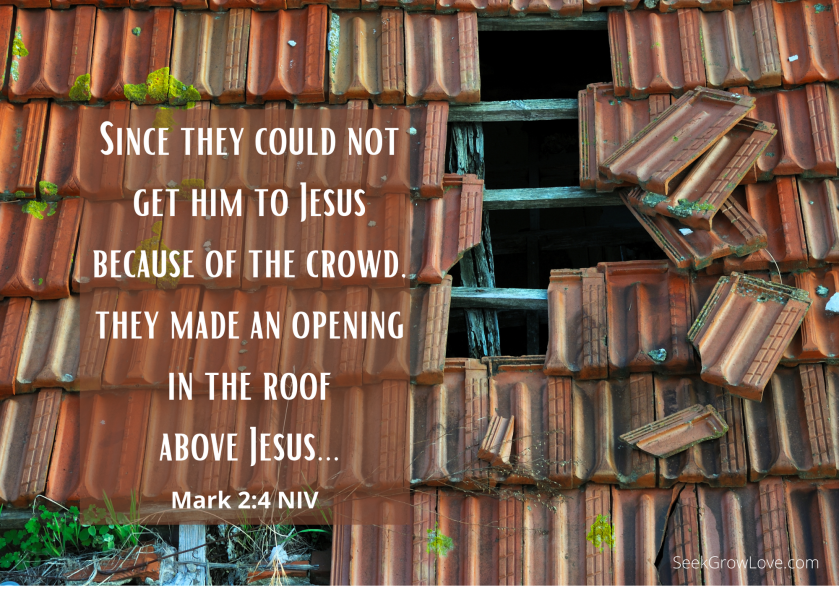
In Mark 2, we find the story of Jesus healing a paralyzed man.  Jesus was becoming more well known, and more popular.  He was inside a house, and some men brought their friend to Jesus so Jesus could heal him.  But because such a big crowd had gathered, there wasn’t room to bring him to Jesus, not even outside the door.  So the friends took the man onto the roof, dug through the roof, and let him down in front of Jesus.

I have to admire these friends.  They were very concerned about their friend, and wanted to see him healed.  They believed Jesus could and would heal him, if they could just get him to Jesus.  They didn’t just “pray about it”, they stepped out on faith and did something about it.  They dug through the roof, and let their friend get close to Jesus – and Jesus rewarded their efforts.

Mark 2:5 tells us, “When Jesus saw their faith, he said to the paralytic, “Son, your sins are forgiven.”  Jesus obviously saw that the man was crippled, but Jesus saw what wouldn’t have been nearly as obvious to us.  The man’s biggest problem was his sin – so Jesus healed him of that first.  This is the greatest miracle Jesus performed (and still performs).  

The teachers of the law said that Jesus was blaspheming, believing only God can forgive sin.  I’m guessing they were thinking, “it’s easy to tell someone their sins are forgiven, since you can’t prove they are really forgiven.”  Jesus then told them, “But that you may know that the Son of Man has authority on earth to forgive sins…”  He said to the paralytic, “I tell you, get up, take up your mat, and go home.”  So the man got up, took his mat, and walked out.

I love this story, not only because I love reading about all of Jesus’ miracles, but specifically because this is the only story I can think of where someone is healed because of the faith of his friends.  We’re not told, maybe the paralyzed man asked to be taken to Jesus.  But any way about it, Jesus saw the faith of the friends, forgave the man’s sins, and ultimately healed him.

This story puts me to shame.  I invite you to ask yourself some questions…

Am I this concerned about my friends?  

Am I willing to be uncomfortable – maybe even make a scene – to bring someone to Jesus?  

Am I willing to not just “pray for” someone, but actually “do something” for someone?  

Would Jesus see my faith and forgive and even heal someone I care deeply about?

Finally, do I need Jesus’ ultimate miracle for myself – to have him forgive me of my sins?  This miracle meets the greatest need.  It costs the most.  It brings the greatest blessing.  It has the longest lasting results.  And Jesus is still doing it daily.

–Steve Mattison

(Originally posted for SeekGrowLove on October 6, 2020)

Questions – See Above

Citizen Rights and Privileges

Acts 25 11 NIV for SGL

Old Testament: Numbers 12

Poetry: Job 11

New Testament: Acts 25

In chapter 16, we found out that Paul was a Roman citizen. Being a citizen of this vast empire was a great privilege. There were only two ways to gain Roman citizenship; you could either purchase it (something only the rich could afford to do), or be lucky enough to inherit it from your parents when you were born. Paul was born a Roman citizen.

The reason why you would want to be a Roman citizen in the first century is that they were given rights others were not guaranteed. The rights to marry another Roman citizen, to sue and to be sued, to have a legal trial, and to not be crucified were just some of the benefits offered to those privileged enough to be Roman citizens.

As we saw in chapter 21, Paul had already used his citizenship to get out of being flogged (Romans, legally, could not be tortured or whipped). In chapter 25 Paul exercised another of his rights–the right to appeal to Caesar. Paul knew that if he was brought back to Jerusalem, the men that had pledged to kill him would probably succeed. He also knew that he had to get to Rome to testify there. Thus Paul used his privilege to get to where he needed to go, so he could do what he was required to do (though, as we shall see in the coming chapters, this journey would not be an easy one).

If you were born in the West (especially the United States), you, like Paul, are privileged. You have rights like freedom of speech, freedom of religion, and freedom of the press. But there are many parts of the world today where these rights that are taken for granted here are only the ideals of dreamers. There are Christians throughout the world who have to look over their shoulder as they travel to church (if a public place of worship is even allowed) and others who are worshiping with the knowledge that every gathering may easily be their last.

There is another privilege you share with Paul: you are a citizen of Heaven. This citizenship cannot be purchased or inherited. It is not exclusive. The Kingdom of Heaven (or, Kingdom of God) is open to anyone. The poor and the rich, the weak and the strong, the lost and the found are all welcome. The cost of this privilege was paid for by God with the blood of His Son. It is offered to any who will receive it.

Paul was first and foremost a citizen of Heaven. He lived his life devoted to advancing the Kingdom and the One who will establish it in its fullness. The rights his Roman citizenship granted him were nothing compared to those his Lord did. That being said, Paul exercised his privilege as a Roman in order to promote God’s Kingdom as a Christian. He wanted to make sure as many people as possible would become citizens of the Kingdom. You also can use your rights as a citizen of your country to further the cause of the Kingdom. Exercise your earthly privileges in a way that leads others to receive heavenly ones.

-Joel Fletcher

(originally posted March 6, 2019 for SeekGrowLove)

Reflection Questions

  1. Do you think of yourself first as a citizen of the country you were born in/live in – or a citizen of heaven (where God dwells)? What are the differences?
  2. How can you use your rights and privileges to promote God’s Kingdom?
  3. Who do you know who needs to know more about how to become a citizen of the Kingdom of God? How can you share with them?

Handling Hardship

Numbers 11:23 NIV for SGL

Old Testament: Numbers 11

Poetry: Job 10

New Testament: Acts 24

Ok, we know that things are not going to go well when we read, Now the people complained about their hardships in the hearing of the Lord, … (Numbers 11:1)

Why would they do that? The Israelites grumbled, argued and complained, but this never works out for them. Honestly, if we look at our own lives, are we guilty of this too?  Do we show God that we are thankful for our life and the provisions that He gives us?  If I may quote Madame Blueberry: “A thankful heart is a happy heart.”  But, the Israelites are not thankful, and they are not happy.  In Numbers 11, they complained about their hardships in the hearing of the Lord, and when he heard them his anger was aroused. Then fire from the Lord burned among them and consumed some of the outskirts of the camp.

So, surely they adopted a new way of doing things, a new way to react to the situations that arose. Nope.

“The rabble with them began to crave other food, and again the Israelites started wailing and said, “If only we had meat to eat!  We remember the fish we ate in Egypt at no cost—also the cucumbers, melons, leeks, onions and garlic. But now we have lost our appetite; we never see anything but this manna!” (verses 4-6)

Wow. Yep that slavery, that was the good life. Sure, they lived lives of servitude, but they had cucumbers.

Unfortunately, this complaining spread until Moses heard the people of every family wailing at the entrance to their tents. The LORD became angry and Moses was troubled. This is where I think we can learn from the way Moses responds.  He asked the LORD.  He is troubled because he is in a situation that is impossible for him to handle alone.  He just has an honest conversation with the LORD. We see him react in the same way that he did in chapter 9 when he is asked a question about the Passover feast.  He told the people to wait until he found out what the LORD commanded concerning them. I think that is how all of us should handle hardships.  We should talk with God about what ever is troubling us. If we are in a continual conversation with the LORD, we bring him our praises and requests continually too.

Moses told Him that he could not carry all those people by himself; the burden was too heavy. The LORD had a solution for him. The LORD would take some of the power of the Spirit that was on Moses and put it on seventy of Israel’s elders.  They shared the burden of the people so Moses did not have to carry it alone. As far as the request for meat, the quail arrived when the LORD said it would.  Even Moses did not know how God could do it, but again he talks with God about it. I wonder how things would have gone for the Israelites if they had humbly thanked God for their manna and asked for meat.  The LORD could even have thrown in cucumbers if He wanted to.  From today’s reading lets be encouraged to pray continually sharing our hardships and praises with God.

-Rebecca Dauksas

(first posted for SeekGrowLove on September 3, 2016)

Reflection Questions

  1. When hardships hit do you spend more time complaining or praying?
  2. If you were a pastor/youth leader or spiritual counselor for the Israelites what issues or problems would you address with them? Which of these problems do you have as well? What could they – and what can you – do to work towards fixing these problems?
  3. What do you learn about the Lord God in Numbers 11?