Independence or Dependence?

Isaiah 37-39
Psalm 76

Isaiah 38:2 – “Remember, O LORD, how I have walked before you faithfully and with wholehearted devotion and have done what is good in your eyes.”

My 21-month old nephew is already practicing his independence. Just the other day, my brother shared in our family chat a video of the little guy outside on their patio, in his diapers, figuring out how to make the sprayer on the lawn hose work. It was amazing to see him inspect the sprayer as he held it in his hands. He eventually discovered that if he applied enough pressure on the handle, water would come out. And then he went to town spraying everything on the patio, including the arcadia door where my brother was on the other side capturing the moment. 

As amazing as it is to watch a child grow and develop, they are still very much dependent on the adults in their lives for providing for all of their basic needs. And if those needs are not met in a timely manner…cries and tears are bound to surface.

As an adult, I’d like to think that I’m more mature than a child, but in all reality, I’m not. I am independent to a fault until something doesn’t go my way or I need help. And even then, I’m reluctant to admit as much. Life is great…until I’m criticized…until my supervisor decides to take an alternative course of action after I have spent hours preparing for something different…until money that I’ve saved up for a vacation has to be spent on expensive AC repairs…until I cut my foot by dropping a plate on it and the ability to walk or drive inhibits my mobility. It’s only then do I pout and admit that I can’t do everything on my own; I need assistance, from my family, from friends, from my heavenly Father. 

As I read through Isaiah chapters 37-38, I couldn’t help but notice that when King Hezekiah was in dire straits, he immediately turned to God and worshiped Him, and made his case for why God should show His mercy and grace. This is exactly what God desires from His children. He longs for us to depend on Him for all of our needs, from daily and minor inconveniences to the major and potentially life changing circumstances. 

However in Isaiah chapter 39, King Hezekiah’s attitude is much different. Life is good; in fact he gets a bonus of 15 more years to live! He’s so confident in his situation that he becomes arrogant and shows off all of the kingdom’s wealth and prosperity to mere strangers. Where has his dependence on Almighty God gone? And for the king’s actions, the prophet Isaiah gives him a heads up that trouble will indeed come. But does Hezekiah care? Nope. He’ll be dead by then and it will be someone else’s problem. Whaaaat??? How is this even the same guy?

But before I become too critical, I have to remember that my human tendencies can easily do the same thing. 

So how can we avoid the temptation to rely on our own wits and wisdom? Jesus gives us a clue in Luke 9. “Then he said to them all: If anyone would come after me, he must deny himself and take up his cross daily and follow me. For whoever wants to save his life will lose it, but whoever loses his life for me will save it.” (v. 23-24)

It’s this daily submission that keeps us humble and dependent upon our heavenly Father for all of our needs. So whether it is a dire diagnosis, threats from an enemy, or even on the best of days when everything is running smoothly, we would do well to remember that it is God who is to be remembered, praised and given all the glory. 

Reflection Questions:

When faced with unexpected hardship or crisis, what is your first instinct – independence or dependence?

When life is going smoothly, what helps you stay grounded in humility and gratitude rather than slipping into self-reliance?

What does “taking up your cross daily” look like for you right now? What small act of surrender can you practice today that will remind you of your dependence on God?

-Bethany Ligon

God Won’t Give You Anything Beyond…

OLD TESTAMENT: Isaiah 36-37

POETRY: Song of Songs 8

*NEW TESTAMENT: James 1:1-18

Do you feel joy when you go through trials/temptations? I would guess not as it is opposed to our natural inclinations.

But when we go through hard times, we can come out on the other side stronger. 

Have you heard Christians say that God won’t give us anything beyond what we can handle?  That is a perversion of the truth. 

We weren’t created to be able to handle this life on our own.  We were made with a need for God.  The trouble comes when we recognize our need for something beyond ourselves but turn to something or someone besides God and become dependent on that.  That is when idols are created.

God won’t put things in our life that can’t be handled with His help.  But there likely will be things in your life that you can’t handle on your own.  That is your reminder, if you aren’t already, to depend on God.

1 Corinthians 10:13 is where people get the wrong idea.  But they just read part of it.  They read “he will not let you be tempted beyond what you can bear.”  The verse continues though to say “But when you are tempted, he will also provide a way out so that you can stand up under it.”  He will provide a way!

When we try to do things on our own, we can quickly become prideful – thinking we are great, or, become depressed because we can’t do what we tried to. 

We can come out of the other side of trials and temptations with a stronger faith if we leaned into God during this time.  It should allow us to become more mature in our faith and deepen our relationship with God.

~Stephanie Fletcher

Reflection Questions

  1. What is a past trial you have gone through with God’s help? How did He help you? How did your perseverance grow during this experience? How did you mature through the process? What joys can you take away from that past trial?
  2. What joy can you find in your present trial?
  3. Consider some of the Christians that you most look up to. Have you ever met a really strong Christian who has had a really “easy” life?
  4. What will you say the next time you hear someone say, “God won’t give us anything beyond what we can handle?”

Trusting in God

Psalm 5, 38, 41-42

psalm 5 11 NIV sgl


I have always connected with David’s ability to cry out to the LORD. He isn’t afraid to depend upon him. He is willing to ask God directly to be delivered from his enemies. Even though David clearly expresses his weaknesses, he holds so much confidence in God that he is still willing to come before him and pray. 


When we think about the faith that David had, I think it’s easy for us to say, “Well, of course, we should ask God to conquer our battles.” And that is true, we serve a God who wants us to come to him. Through the sacrifice of his Son, we have the ability to come to God and ask him to intercede for us.


But when reality sets in, we have a tendency to become overwhelmed and ultimately rely on ourselves. We forget to turn to the one who created us for help. I think this is because it’s easier for us to fathom solutions to our problems that we can come up with on our own. 


It’s difficult to trust in someone to fight for us that we can’t even fathom. 


And yet, David still decides to trust God. So much so that he is praying that others follow suit. 


I find all of this relevant with the struggles that are currently overtaking the world. With hunger, disease, unemployment, and fear continuing to rise, it is natural to become overwhelmed. We want to fight for some sort of solution. We have to find some way to cope. But in all of this fighting, we likely end up crippled by fear. 


If our first action is to trust in God, our result is very different. We serve a God who will place a hedge of protection over us. He will provide healing for us. Because he loves us that much. A God who can move mountains is the same God who will make you stronger if you choose to come to him. 


David saw the glory and mercy that could come from following a path that would lead him to the LORD- a path of righteousness. Imagine what the world would look like if all of us stopped allowing the noise of society to consume us and rested in God. 


So, in the fear, in the hunger, in the waiting, let’s choose to take all of that emotion and let it drive us closer to our creator. Let us become a people who are willing to unapologetically depend upon God to fight our battles. 


Ironically, if we take refuge in our Almighty, we will see Victory. 


-Leslie Jones


Today’s reading can be read or listened at https://www.biblegateway.com/passage/?search=Psalm+5%2C+38%2C+41-42&version=NIV

Tomorrow’s reading will be 2 Samuel 22-23 & Psalm 57 as we continue the 2020 Chronological Bible Reading Plan


Learning in Peru

peru19 glasses and Bible
Earlier this year I was asked to be a part of the LHI Peru trip, which I gladly accepted after much prayer and consideration.  I was not sure what to expect while on the trip, but I was so excited to see how God was going to use me and in what ways I was going to be able to touch the lives of the Peruvians, little did I know just how much God was going to work in my heart and all the things he would teach me throughout the week.
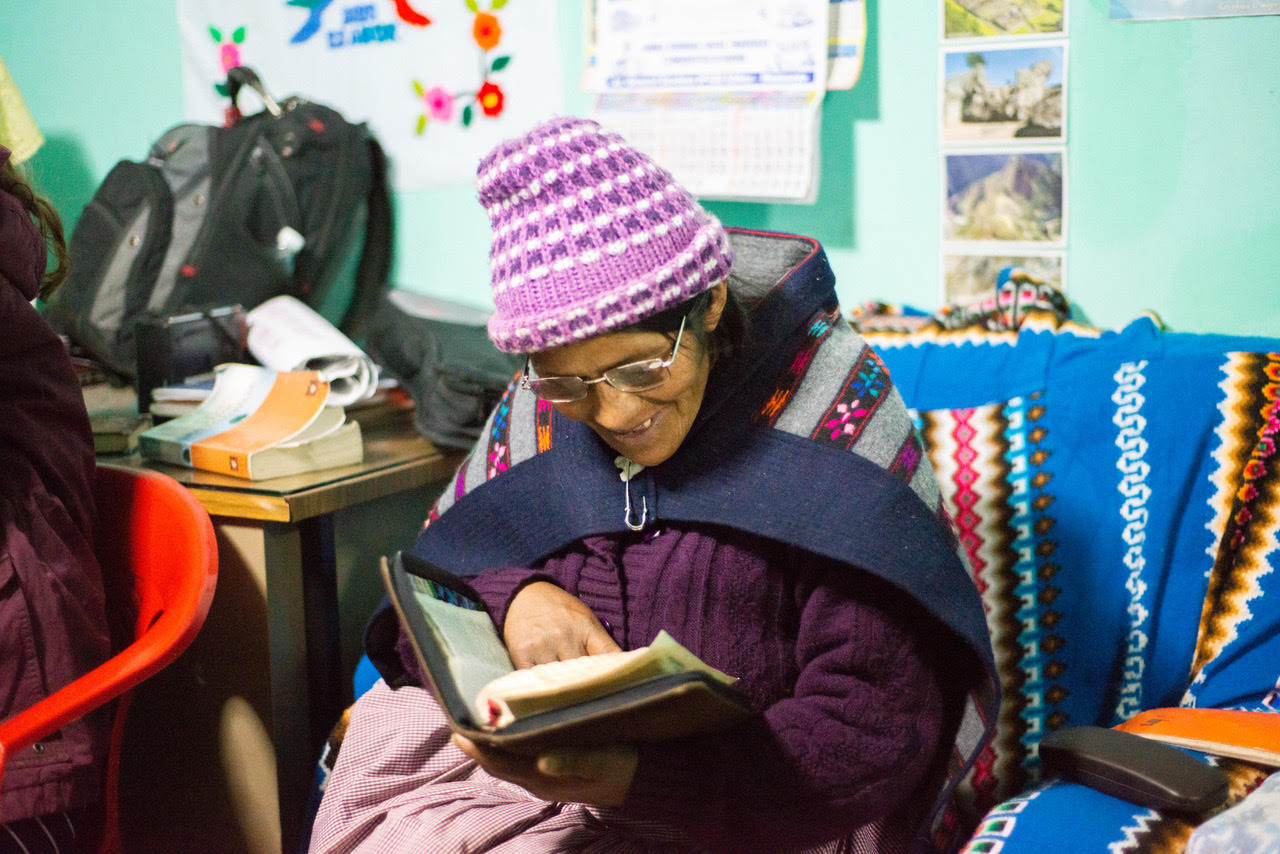
The Peruvian people do not take God’s word for granted.  They sit and listen to Bible studies and sermons for hours on end, and until late into the night.  When one of the ladies within the church heard that her translation of the Bible was not the original version that the early Church read, she wanted to learn Greek so that she would be able to read the Bible in the original language.  This was also the same woman who was excited when she received new reading glasses, and the first thing she chose to read was her Bible. The excitement in her eyes and smile hit me hard, why do I not see this kind of attitude within my own community?  What is it that could make us lack this same kind of excitement within our Christian lives?
What I noticed while in Peru was how dependent on God the whole community was.  This was due to the amount of poverty they lived in and the fact that they have all of their trust in God to provide for them and protect them. I find that the reason we lack this is because we rely on ourselves more than we rely on God.  We each need to examine our hearts and find this same excitement within. Even amongst the days where we think we need God the least, those are generally the days that we need him the most. We cannot forget about God during the good times because we need him just as much as we did in the bad times.  He is the reason for those good times because he always provides for us and takes care of our many needs. When we forget to let God in, that is when the enemy comes in and distracts us away from our Father.
So I want to challenge you to search for that excitement within yourself.  Remember that God wants us to follow him every day of the year, not just on the days that are convenient for us. Allow him to be a part of your everyday and continue to grow stronger in your faith.
Katie-Beth Fletcher

1 Timothy 6

Sat Devo

“Instruct them to do what is good, to be rich in good works, to be generous, willing to share, storing up for themselves a good reserve for the age to come, so that they may take hold of life that is real.” ~ 1 Timothy 6:18-19

What is the purpose of life? What really matters in life? These age-old questions have numerous answers, but Paul tries to point us to the true answer in 1 Timothy 6. In this chapter, we see two different kinds of people: those who love money and those who love God. In Paul’s words, those two things can’t exist together. Paul says, “But those who want to be rich fall into temptation, a trap, and many foolish and harmful desires, which plunge people into ruin and destruction. For the love of money is a root of all kinds of evil, and by craving it, some have wandered away from the faith and pierced themselves with many pains” (1 Timothy 6:9-10). Paul doesn’t necessarily call money evil in this passage, but he definitely states that loving money, or making it an idol in your life, will lead you down a dark path. In fact, Paul urges Timothy in the next verse (v. 11) to run from these things and to pursue, instead, “righteousness, godliness, faith, love, endurance, and gentleness.” It would seem from these verses that the love of money and God are mutually exclusive. Jesus confirms this when he says in Matt. 6:24, “No one can be a slave of two masters, since he will hate one and love the other, or be devoted to one and despise the other. You cannot be slaves of God and of money.” 

Our culture today encourages us to make ourselves slaves of money. Our lives are dictated by pursuing jobs that will provide enough money to pay our bills and other living expenses until we can get the next paycheck. If we have the chance to work more to get money to buy some more nice things for ourselves, many of us will jump on the opportunity. And, that lifestyle is applauded by those around us. But, we have to always ask ourselves when get sucked into a cycle of living: is this godly or worldly? According to 1 Timothy 6, our purpose in life shouldn’t be to become rich and get all of the material goods that wealth entails. 

So what should our purpose be? Paul answers that in 1 Timothy 6:17-19: 

“Instruct those who are rich in the present age not to be arrogant or to set their hope on the uncertainty of wealth, but on God, who richly provides us with all things to enjoy. Instruct them to do what is good, to be rich in good works, to be generous, willing to share, storing up for themselves a good reserve for the age to come, so that they may take hold of a life that is real.” 

When we set our hope on God, it changes what we think is important. Instead of pursuing a life of riches on earth, we begin to “collect for [our]selves treasures in heaven, where neither moth nor rust destroys, and where thieves don’t break in and steal. For where [our] treasure is, there [our] heart[s] will be also” (Matt. 6:20-21).

~ Cayce Fletcher

The Weight of Sorrow

Matthew 11

Matthew 11 28.png


There is a destiny that makes us brothers:

None goes his way alone;

All that we send into the lives of others

Comes back into our own. —Markham


Today’s chapter is a solemn one for me. Jesus just finished the send-off of the 12 disciples out into the proving grounds and I imagine was watchful about the results. As word of the disciples broaden, John the Baptist hears about the Messiah’s latest turn of events and sends a question to Jesus in (verse 3): “Are you the one who is to come, or should we expect someone else?”


This question intrigues me because of what it doesn’t ask. “Why won’t you help me? Do you not care that I sit suffering in this prison cell?” John the Baptist was the cousin, a dear friend, and a mentor of sorts who baptized Christ himself. He knew Jesus and Jesus knew John. They most likely grew up together. Jesus simply replied, (verse 4-6)  “Go back and report to John what you hear and see: The blind receive sight, the lame walk, those who have leprosy are cleansed, the deaf hear, the dead are raised, and the good news is proclaimed to the poor. Blessed is anyone who does not stumble on account of me.


While this is a message of good report for the current gospel cause, what strikes me is what isn’t said to his friend. John would surely have known by this response that Jesus was referring to Old Testament prophecies like Isaiah 29:18-19, 35:5-6, or 61. These were the credentials of sorts that the coming Messiah would fulfill. Isaiah 61 is one of the most famous passages using phrases of comfort  like “ bind up the brokenhearted,” “proclaim freedom for captives,” and “release prisoners from darkness.” Yet, Jesus doesn’t convey any of THOSE phrases in the reply to John because he knew they couldn’t be upheld. Silence often speaks louder than words.


Have you ever had a friend or family member truly in sorrow and are unable to comfort them due in part to the schedule you must maintain? Maybe they were grieving a death, consequence, job loss, betrayal, or abandonment. You want nothing more than to stop everything and sit with them in their sorrow and to share the load. I have to believe this is what Christ wanted more than anything with John the Baptist, but his circumstances made this impossible and he ultimately knew that freeing John from prison was not the will of the Father. John was soon to die. Jesus sent a loving message of “omittance,” perhaps suggesting that he had not forgotten John, nor his sufferings. The tribute upon which Jesus bestows upon John in the next 14 verses following this makes me believe he was hurting for his brother. He wanted nothing more than to comfort, but his schedule and AGENDA would not allow.    


Jesus models a very important lesson here and later in Matthew 14 upon reaction to the terrible death of John the Baptist. SOMEtimes the best way to ease heartache is by getting back to work. Use your grief to empower your ministry. Rather than turning in on yourself and thinking “woe is me,” turn outward to serve and to love the crowds. It is ok to cry. It is ok to mourn for lost people or situations, but we must not let our emotions turn inward for long, lest it becomes pity. In our brokenness God is able to use us mightily. In desperation our dependence on Him will serve as a powerful testimony to a lost and dying world.


Is your heart broken today? Does life seem empty? Do you feel like giving up? Take hope in the example of Jesus. Take up whatever duties lie before you and dedicate them to God. Refuse the luxury of self-pity. Do something to lift the burdens of others and Jesus will strengthen you.

The final verses (28 – 30) of Matthew 11 confirm this truth. “Come to me, all you who are weary and burdened, and I will give you rest. Take my yoke upon you and learn from me, for I am gentle and humble in heart, and you will find rest for your souls. For my yoke is easy and my burden is light.”


When you serve others you will find yourself.


-Julie Driskill


matthew 11 29

Greener Grass or Selflessness

Gen 13 9

In Genesis 13 Abram and Lot had trouble. Their servants were quarreling about the feed for their animals. Abram suggested that as Brothers they shouldn’t do this. So, it would be better to separate. He asked Lot to choose which part of the land he would get. Lot chose the plain where the feed for the animals was better. It was near the city because everybody wants greener grass. Read until chapter 19 then ask yourself, am I doing like Lot and looking for greener grass, a better life now? Or am I wiser like Abram staying where I depend on God to take care of me. Abram was wiser. Are we?

-Larry Rankin