Unfaithful

Hosea 1-4

There’s no doubt that adultery is one of the most talked-about sins in the Bible. Even King David, a man after God’s own heart, fell into this sin. Earlier in Scripture, we see God destroy an entire city because of its sexual immorality. In the book of Hosea, God uses adultery as a metaphor for the unfaithfulness of Israel. Hosea doesn’t just speak God’s message, he lives it out, through his marriage and even the names of his children.

Right off the bat in Hosea 1:2, we see what God asks of him, “When Yahweh began to speak with Hosea, Yahweh said to Hosea, ‘Go, take for yourself a wife of prostitution and have children of prostitution; for the land commits great adultery, forsaking Yahweh.’” (REV) God’s people were a promiscuous bunch, chasing idols and worldly desires they believed would fulfill them.

Hosea and his wife Gomer have three children, each with a symbolic name. First is Jezreel, representing God’s judgment and the scattering of Israel. Then comes Lo-Ruhamah, meaning “no mercy,” because God was withdrawing his compassion. Finally, there’s Lo-Ammi, meaning “not my people,” a symbol of God’s rejection after Israel broke their covenant with Him.

Gomer, like Israel, is unfaithful. She cheated on Hosea and eventually fell into prostitution, chasing after other men. This would have been enough for most people to get a divorce over. But God had other plans for their relationship. Hosea doesn’t give up, rather he pursues her. When she’s at a point of desperation he buys her back – “So I bought her for myself for 15 pieces of silver and a homer and a half of barley.” (Hosea 3:2, REV)

God rejected Israel because they had turned from Him and started following other gods like Baal. I thought it was interesting how even small things like loving raisin cakes can symbolize where our hearts are drifting –  “Yahweh said to me, ‘Go again, love a woman loved by another, and an adulteress, even as Yahweh loves the children of Israel, though they turn to other gods and love cakes of raisins.’” (Hosea 3:1 REV) It’s not about the cake, but rather what it represents. The misplaced love and devotion.

Despite everything, God promises restoration. He doesn’t stop loving His people and we can have security in knowing he will not stop.

“Afterward the children of Israel will return and seek Yahweh their God, and David their king, and will come with trembling to Yahweh and to his blessings in the last days.” (Hosea 3:5 REV)

-Bridger Grable

Reflection Questions

  1. In what ways was Israel unfaithful to God?
  2. In what ways have you been unfaithful to God?
  3. What is God’s response to unfaithfulness?

Excited about Church

Old Testament: Micah 5

Poetry: Psalm 84 (day 2)

New Testament: Luke 18:9-14

How excited are you about going to church?  You might think church is boring, the singing doesn’t inspire you, the sermon puts you to sleep, the building is nothing to write home about, etc.  If you think like this, you are probably also thinking, “Why even bother going to church when there are so many more exciting things I could be doing?”

If you think church is bad now, just imagine how bad it was when they used a tent as a church (called the Tabernacle), and slaughtered animals to cover sins.  How well would you have liked going to church then?!  (Can you imagine the smell?)

Our reading today is from Psalm 84, which starts out, “How lovely is your dwelling place, O Lord Almighty!”  The writer wasn’t talking about the throne room of God in heaven, he was talking about the Tabernacle (tent) where he went to worship God.

Psalm 84 continues, “My soul yearns, even faints, for the courts of the Lord; my heart and my flesh cry out for the living God.”

The writer wasn’t getting excited about visiting a tent, he was getting excited about being able to be in the presence of God.  He was yearning, fainting, crying out to be near God.

Verse 4 goes on to say, “Blessed are those who dwell in your house; they are ever praising you.”

I’m guessing the writer is referring to the singers whose job was to stay at church and sing praises to God all day long. He was envious they didn’t even have to leave there to go to work (they were at work) – they were so lucky!  They got to be near God all the time.

Verse 10 says, “Better is one day in your courts than a thousand elsewhere; I would rather be a doorkeeper in the house of my God than dwell in the tents of the wicked.”

You may dread going to church.  The writer of Psalm 84 dreaded having to leave church.  He’d rather spend one day at church than almost 3 years anywhere else.  He’d rather be a doorstop at church than party all the time with his wicked friends.

Why did the author crave going to church so much?  The answer is: because he loved God, and he associated being at church with being in God’s presence – so he couldn’t get enough of it.  

Today, as a result of Jesus’ sacrifice on the cross, we have far greater access to God than the people in the Old Testament (including the writer of Psalm 84) had.  We’re told in Hebrews 4:16, “Let us then approach God’s throne of grace with confidence, so that we may receive mercy and find grace to help us in our time of need.”

God didn’t just send Jesus to die for our sins, God also wants to adopt us as His children.  And there’s an inheritance involved – the Kingdom of God.

1 Corinthians 2:9 says, “… No eye has seen, no ear has heard, no mind has conceived what God has prepared for those who love him.”

I don’t know about you, but I have a pretty vivid imagination, and can imagine some amazing things.  But, according to this verse, I can’t imagine how great the Kingdom will be.  Start with no more death or mourning or crying or pain, add in a little euphoria in the presence of God forever, and you’re just scratching the surface for what God has prepared for those who love him.

I want that!

God wants to adopt us as His children, but there’s a catch.  He will only adopt us if we accept Jesus as our Lord and Savor, are baptized, and live our lives for Him.  Only then will we get to live with Him forever.

Maybe, our level of excitement in going to church is related to our level of excitement for God.  Once we recognize how much God has already done for us, and what He has planned for those who love him, we’ll get more excited about God.  And once we do, I suspect we’ll get more excited about going to church too. 

-Steve Mattison

Reflection Questions

  1. What are your thoughts and feelings right now about going to church? Where do you think they come from?
  2. How excited for God are you? What has He done for you already? What do you know about – and what can you imagine – about being in the Kingdom of God? Have you already been adopted into God’s family? Are there steps you need to do in this adoption process?
  3. Is there anything about your perception and understanding about going to church that you think God wants you to change?

Your Longing

Old Testament: Malachi 4

Poetry: Psalm 84

New Testament: Luke 18:1-8

Close your eyes with me and replay in your mind the best day of your life so far. Try to recall all the vivid details – the sights, sounds, and smells, the intense feelings! (Then open your eyes so you can continue reading!)

Want to hear about one of the best days of my life? There are obvious ones not to be downplayed, such as my wedding day and holding each of my children outside the womb for the first time, but one of the most special days of my life was the day I swam with the manatees. 

Perhaps it sounds silly to you, but I adore manatees. I have spent copious amounts of time gazing at them through the massive glass aquariums at our two local zoos, both of which have manatee rehabilitation centers. So you can imagine my excitement a few years ago when my husband agreed that on our trip to Florida that year, we could splurge on an excursion to swim with the manatees in the Crystal River! I’ll never forget floating on the water while observing my beloved sea cows in a submerged, restful state ten feet away, surfacing every few minutes for air. It was an incredible experience to watch the momma manatee with her calf coasting through the shallow river beside us, the small herds interacting peacefully just under the surface, the chubby mermaids living their best (slow) life soaking in the warmth of the underwater spring. The tranquil experience was very healing for me, as one prone to anxiety who had to overcome many anxious thoughts to even pursue this swim-with-manatees dream. My mind still wanders in wishes… Why can’t life just be as peaceful for us as it is for our manatee friends? I’ve relived that day in my mind many times, and it always brings a smile to my face. 

“How lovely is your dwelling place, O LORD Almighty. I long, yes, I faint with longing, to enter the courts of the LORD. With my whole being, body and soul, I will shout joyfully to the living God… A single day in your courts is better than a thousand anywhere else! I would rather be a gatekeeper in the house of my God than live the good life in the homes of the wicked.” (Psalm 84:1-2,10, NLT). 

Psalm 84 is generally considered a song of pilgrimage, one that was recited or sung when God’s people would journey to the Temple to worship. The writer was longing to be in God’s presence again. Now that Jesus has made a way for us to connect to God again even without a temple, this song could apply to coming into His presence anytime, anywhere, describing our longing just to be near him. Though I am so grateful that we can come into His presence all the time now through prayer and worship, I have always thought of this Psalm as more of a hope of the coming Kingdom. Perhaps we take for granted that we can approach God at any time with our praise and concerns. (I know I do.) And perhaps we don’t really wholeheartedly perceive the amazing promise of the Kingdom. (I know I don’t.)  

This world claims to have it all: fame, fortune, fun. But it will never truly satisfy. C.S. Lewis once said, “It would seem that Our Lord finds our desires not too strong, but too weak. We are half-hearted creatures, fooling about with drink and sex and ambition when infinite joy is offered us, like an ignorant child who wants to go on making mud pies in a slum because he cannot imagine what is meant by the offer of a holiday at the sea. We are far too easily pleased.”

Sometimes I feel so overwhelmed with my never-ending to-do list and difficult, anxiety-provoking decisions that I lose focus of the eternal perspective. And other times, I think that everything is awesome and couldn’t possibly get better! For good or bad, it’s easy to get lost in the chaos of each day, isn’t it? It is important to focus on our purpose as followers of Christ and on the amazing hope of the Kingdom, which will be better than anything we can imagine. Even your best day in this life is nothing compared to the Kingdom experience, in which we will live with God and Jesus forever and where there will be no more sickness or crying or pain (see Revelation 21:4). 

Even just one day in God’s Kingdom will be better than a thousand of your best days in this lifetime. What a fantastic hope we have! 

-Rachel Cain

Reflections:

Close your eyes and imagine what the Kingdom will be like. Now, multiply that by a bazillion and you still won’t even be close to envisioning the peace and beauty of the Kingdom! 

Approach God in prayer and worship this week with a similar longing as expressed in this Psalm. Thank Him for the ability to enter His presence. Pray for a deepening desire to experience His presence during this life, as we await the coming Kingdom.

Lost

Old Testament: Hosea 6-8

Poetry: Psalm 78

New Testament: Luke 15:8-10

It is fairly maddening how quickly I can lose an object. I will set down car keys to load a child into the car and they are gone.  I can be in the middle of a text conversation, get up for a drink, and my phone disappears. Parking passes, debit cards, proof of insurance, checks, grade verifications, etc – there is no limit to what I can lose. My students will even tell you that I don’t collect work directly into my hands because if I touch it, I’ll subconsciously place it near my next conversation. It is infuriating to lose items so important, but each time, I rise to the occasion to search with determination that matches the importance of what is missing.

When we consider those who have not yet heard the Good News of Jesus Christ, what responsibility do we have to recover the lost?  If it is gauged upon the importance of the object, and we are searching for those who were paid for with the blood of Christ, then it requires all the strength we can muster.  We do not sit patiently in our homes and churches, waiting for our doors to be darkened by their presence. If we do this, then the searching is being done by the wrong party. We are to turn on the light, get our butts moving, and carefully search each room where our feet land.

Fallen out and forgotten, lost in the shuffle, moved out of place, and never properly cared for are the people of God we are looking for. They are every bit as equal in value, but they need to be found with the Gospel in hand. It is possible that they choose to remain wherever they are.  Unlike lost coins and keys, there very well may be a struggle. Like a teenager who slips back under the covers on a school morning, they too may crawl back into the couch cushion or make a home with the dust bunnies.  No matter, our role is the same in the search, to find them and expose them to the Light.

God remains steadfast in his desire to continue the search despite Israel’s determination to commit to being unfaithful. While Israel acknowledges guilt and recognizes revival is needed, their actions do not yet match their lips,“Come, let us return to the LORD. He has torn us to pieces but he will heal us; he has injured us but he will bind up our wounds.” They continue to reject what is good and are forced to deal with the consequences of a rebelling nation.

“We will not hide them from their descendants; we will tell the next generation the praiseworthy deeds of the LORD, his power, and the wonders he has done” – Psalm 78:4

Whether it is with a coworker, an acquaintance, a straying brother or sister in Christ, or our own children, we do not simply wait patiently, but continue to pursue the lost coin.  We share our own experiences of feeling lost.  We share the consequences of our own rebellion against God.  We share our testimony and the promises of God, not hiding our faith for the sake of relationship.  We cannot simply pick them up and place them in our pocket, but we can surround them in love and prayer.  We extend the love of God to them determinedly and unconditionally. No one is less valuable in the eyes of God. Ultimately, we hope to rejoice and reap a return, giving praise to our gracious God who has searched for all of us with salvation’s plan.

-Aaron Winner

Reflection Questions

  1. What does Hosea, the woman searching for her lost coin, the writer of Psalm 78, and the heart of God have in common?
  2. Do you most often sit and wait for the lost to come find you and the gospel message – or do you spend time and effort seeking out the lost?
  3. “No one is less valuable in the eyes of God.” Do you believe this? Can you find Scriptural evidence to support it? Do you live like this is true?
  4. What lost coin can you pursue this week? Why? When, where and how? Pray for God’s heart, guidance, wisdom, words, and love.

Seeking Shepherd

Old Testament: Hosea 3-5

Poetry: Psalm 77

New Testament: Luke 15:1-7

I have a free pizza awaiting me today. I couldn’t be more excited. Every year around my birthday, as a reward for not dying, I redeem a voucher for an entire pie of my choosing at my favorite pizzeria. There is something more satisfying about good food when you haven’t paid for it, although I’m not advocating for dining and dashing, simply making friends with chefs, restaurant owners, or in this case, signing up for an email newsletter.  As I read for today, and I think about greasy-cupped pepperonis, I can’t help but think deeper about redemption. 

Befriend a realist, and it won’t be long before you hear the wisdom, “nothing is free.” Redemption rings true to this adage because by definition it means that the price or obligation has already been fulfilled. Therefore, you receive the reward without the typical settling of debt.  The dough, the cheese, the sauce, and the toppings have already been purchased, but I wasn’t the buyer. In a more significant example, enslaved men and women could be released of bondage, receive paperwork, and be transported to the North due to the fundraising efforts of American abolitionists.  In the Old Testament, God’s laws command redemption of property, or giving back land, houses, animals, and freedom, to the impoverished when they sell as a last resort to make ends meet, with the buyer gaining nothing in their return (Lev. 25:25-55). But in a much greater way than any of these examples, we have redemption through Christ.

There is absolutely nothing we can do to deserve the Love of God, yet it is poured out upon us as an abundant gift. God demonstrates His love and redemption in Hosea’s actions in redeeming Gomer in the midst of adultery, “The LORD said to me, ‘Go, show your love to your wife again, though she is loved by another man and is an adulteress. Love her as the LORD loves the Israelites, though they turn to other gods’” These words tell us that God does not simply pine for relationship with us while we are in sin, but that He actively pursues in the midst of our fall. God hates sin, but He is unrelenting.  His grace goes farther than the guilt, and hopefully, guides us back to Him.


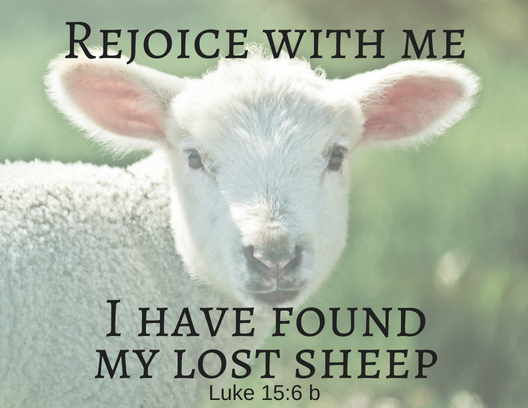
In the same manner, Jesus demonstrates this as the Good Shepherd watching over His flock. “Suppose one of you has a hundred sheep and loses one of them. Doesn’t he leave the ninety-nine in the open country and go after the lost sheep until he finds it? And when he finds it, he joyfully puts it on his shoulders and goes home.” Again, Jesus illustrates the commitment of the Father and His love for all within the body. It says heaven rejoices, but aren’t we too supposed to rejoice in the redemption?  As those who already know Christ, we should not be lining up for apologies, but instead extending the hands of grace.  If we were robbed by the redeemed of our possessions, our time, or our emotions, they have all become forfeit for the sake of redemption.

Despite our own unfaithfulness and wandering, God’s love has found us and refuses to let go.  He has already executed the campaign to offer you an eternal reward far greater than we could ever imagine (and I can imagine quite a bit of pizza).  Therefore it is our job to continue the work of Jesus, tending to His sheep.  We search the fields for the lost one, giving constant and enduring love to those failing to be victorious over temptation. It is simply put, but the practice is daunting. It is having an awkward conversation at the gas station with someone who hasn’t been to church in a few years.  It is  offering a listening ear to someone in distress, possibly never knowing if you have heard the truth.  It is showing kindness and compassion at business close when all you wanted was to get home to relax. Every act of love is a step toward spiritual restoration, not only for others, but ourselves, because we too have hope in life eternal at the expense of the Creator through His Seeking Shepherd.

-Aaron Winner

Reflection Questions

  1. What similarities do you find between the lives of Hosea and Gomer and the parable of the lost sheep?
  2. What lost sheep have you seen restored?
  3. What sheep do you know who are still lost? What acts of love can you be a part of to demonstrate the Father’s love to them?

Astronomical Measures

Old Testament: Joshua 9-10

Poetry: Psalm 49

New Testament: 1 Corinthians 4

My inner science nerd was more excited than a kid in a free candy store last week as I donned my (un)fashionable cardboard glasses in preparation for a once-in-a-lifetime event: for the first time in over 200 years, my Midwest residence would be within the path of totality for a total solar eclipse – an alignment promised to not reoccur in this area for three quarters of a century. Seven years ago, we watched a partial eclipse (around 90% totality) from our home, which was very… underwhelming. However, after learning that there is a vast difference between even 99 and 100% totality, I bought into the hype and prepared for amazement. We hosted a watch party on our church property and our friends even flew in from Alaska to experience it with us! The weather was abnormally lovely for April. As the coverage increased, we detected a cool wind breaking through the warm air, and then street lights began to light up. Then, the millisecond that it reached total coverage, a wave of deep twilight blanketed the field and an evening chill washed over us; I could instantly sense the distinct change in my peripheral vision from behind the safety of my glasses. For about 3 minutes, we eschewed our disposable spectacles as we stared into the void of the sun, soaking in the uniqueness of a mid-afternoon that felt like a near-midnight. We were awed by the surreal experience and applauded the workmanship of our Creator! And then, as suddenly as it had been hidden, the sun again commenced its glorious shine, changing the temporary night back into day. 

Our reading in Joshua today tells of another rare astronomical event – “the sun stopped in the middle of the sky and delayed going down about a full day” while Joshua fought the Amorites. There are many theories about what actually went down on the day the sun didn’t, from an annular eclipse (which even secular scientists agree did occur in Canaan around that time) to a variation in rotation speed and everything in between (you can start your rabbit hole dive here), but what is most important is that God did something very miraculous to help Joshua win the battle. God was on Joshua’s side, and he took “astronomical” measures to help Joshua do what God had called him to do. Joshua and his men put forth the effort as wise and persistent soldiers, but they called on God for a miracle to help them win the battle – and He did, in an awesome display of His power. “There has never been a day like it before or since, a day when the LORD listened to a man. Surely the LORD was fighting for Israel!” (Joshua 10:14, NIV)

God fought for His people, and God fights for us. God is on our side, and He loves to show up in mighty ways. BUT… God usually expects us to be actively involved as well. Joshua had to go out and fight the battle – many of them, actually – and God showed up, often miraculously. This is a good reminder for our own lives. God has given us gifts and abilities, and He wants us to be engaged and active in this life. (For example, we don’t really have a legitimate reason to complain about not having a job if we’ve never submitted any applications, right?) Sometimes the best and only thing we can do is pray and let God work, but often, we will pray while we fight right there on the battlefield, trusting in God’s supernatural provision. He still performs miracles! 

In whatever battles you will face, remember that God is with you and still works in miraculous ways. Keep your eyes open to see His handwork in your life! 

-Rachel Cain

Reflection: 

– Watch for God moments in your day and thank him for them. It might be something as small as a daffodil field to bring a smile to your face as you drive to work, or as large as seeing God’s might during a solar eclipse. Either way, praise Him in all those moments! 

– How can you depend on God more to fight your battles? How might God be calling you to be more engaged in the battles yourself?

Keep Walking

OT – Joshua 5-6

Poetry – Psalm 47

NT – 1 Corinthians 2

Keep walking, but you won’t knock down our wall. 

Keep walking, but she isn’t gonna fall! 

It’s plain to see your brains are very small 

to think walking will be knocking down our wall.

– the Pea soldiers, from Veggie Tales “Josh and the Big Wall”

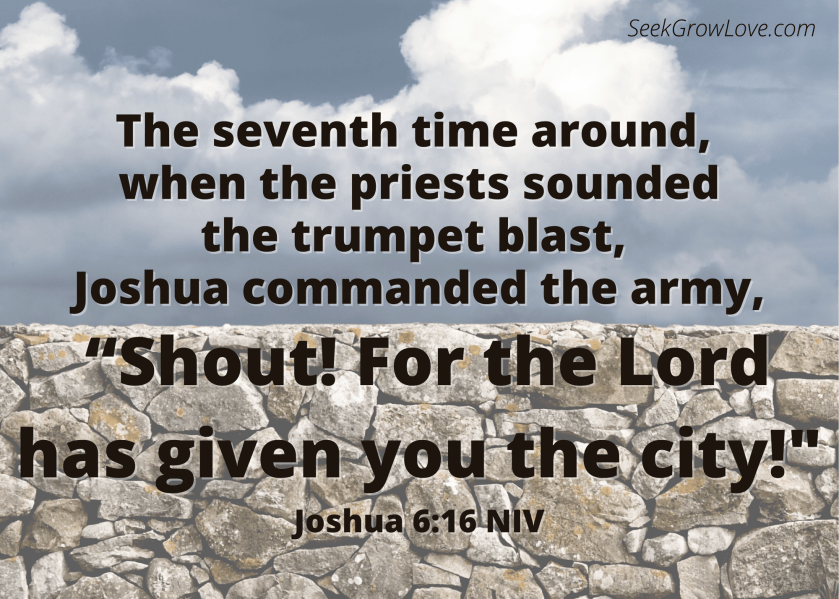
I’ve never been in the military (even preschool gymnastics was beyond my capabilities, and let’s just say I was usually a last pick in gym class), but even I can imagine that the mighty Israelite soldiers felt mighty silly walking around the city once a day for six days. Just walking behind the ark. And blowing some trumpets. Wow, fierce. I wonder if they wondered what God was thinking? Had they accidentally signed up for the (mostly-silent) marching band instead of the military? But on the seventh day – seven is the biblical number of completion – they marched around the city seven times, and then, a different kind of trumpet blast sounded, and Joshua ordered everyone to shout. And then, the wall collapsed. The mighty, impenetrable wall of the great city of Jericho, along with everything inside (save Rahab and her family), became a pile of rubble. Yet again, the people obeyed what seemed like ridiculous commands for an impossible task, and God worked through it all. I don’t know why God chose to take over Jericho in such a strange way, but I bet part of the reason was to display His awesome power and make sure everyone knew that He was the One True God. 

Psalm 47 even sounds like a song of praise that might have been shared after conquering Jericho: “He subdued the nations under us… He chose our inheritance for us… God has ascended amid shouts of joy, the LORD amid the sounding of trumpets…”

All of our lives should reflect back to the power of God. In our New Testament reading today, Paul also says, “My message and my preaching were not with wise and persuasive words, but with a demonstration of the Spirit’s power, so that your faith might rest not on men’s wisdom, but on God’s power” (I Cor 2:4-5) Just like when God made it clear that it was only by His power – not the marches and shouts – that the walls fell down, God likes to use ordinary, untrained people to do His biggest work, so His might is evident through their humility. 


God displays His power by working in big ways through us. He doesn’t NEED us; after all, God created the whole world without any input from mankind! But He wants to use us as part of HisStory, to help tell the world the greater message of His saving power. Will you join in the Greatest Mission of all time? 

-Rachel Cain

Reflection Questions

  1. How will you join in the Greatest Mission of all time?
  2. How/when have you seen God at work doing what seemed impossible in a way that you wouldn’t have expected? Who did He use in the mission?

Rahab – Used by God

Old Testament: Joshua 2

Poetry: Psalm 44

New Testament: Romans 15

Isn’t it funny how you can read the same passage of scripture numerous times and still find new nuggets within it? I know the story of Rahab quite well, and since I love studying strong women of the Bible, I even read a historical fiction novella about her (“Unashamed” by Francine Rivers, if you’re interested). Still, I discovered a rabbit trail of new insight into Rahab through an oft-overlooked Bible feature: the footnote. 

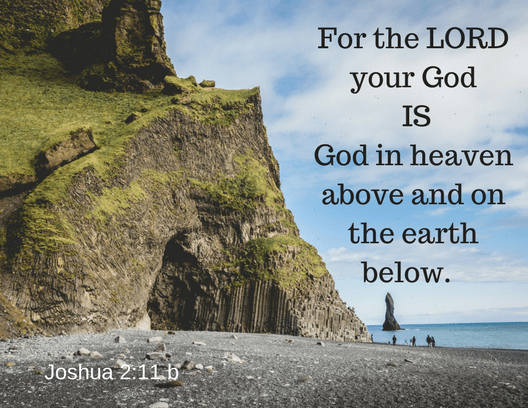
In the first verse of Joshua 2 (NIV), upon noticing a footnote following the word “prostitute,” I glanced to the bottom of the page to find this clarification: “or possibly, an innkeeper.” Excuse me? “Innkeeper” and “prostitute” are very different occupations! As I dug deeper, I found respectable commentaries arguing on both sides of the fence why one interpretation was definitely more likely than the other, and some even suggested that she operated both an inn and a brothel. In either case, Rahab was a Gentile who, because she met many travelers, was privy to a lot of information about the happenings outside her city walls, including the miraculous power of the God of Israel. When the king’s men came to inquire about the spies, she not only hid them, but committed treason by leading the guards astray to chase after the spies, knowing full well they were hiding on her roof. Rahab risked her life to protect the spies, and the spies honored her request to spare her life (and the lives of her family) when they would later take over Jericho. Not only was her physical life spared, but Rahab married Salmon (who was perhaps one of the spies), became grafted into God’s chosen people, and is mentioned as an ancestor to Jesus. 

Let’s assume that she was a prostitute, as many interpretations of the Bible seem to imply. This woman was super important to the success of God’s people. Though we think she had a dark past, Rahab feared and trusted God perhaps even more than the Israelites did. How cool is it that God used not only a Gentile, but a promiscuous one at that, to help His people gain their Promised Land! It really gives us all hope that God can use us no matter our histories. In Romans 15, Paul reminds his readers that he is preaching not only to his fellow Jews, but also to help the Gentiles know about the saving power of Jesus. Thank God that his grace is for all of us! 

Psalm 44 ties well into this storyline of conquering Jericho, confirming over and over again that it is only by God’s power that people throughout history have conquered their enemies: “They did not conquer the lands with their swords; it was not their own strength that gave them victory. It was by your mighty power that they succeeded… only by your power can we push back our enemies; only in your name can we trample our foes… it is you who gives us victory over our enemies.” (Psalm 44:3,5,7)

I’ll close with this blessing for your day from Romans 15:13 (NIV): “May the God of hope fill you with all joy and peace as you trust in him, so that you may overflow with hope by the power of the Holy Spirit.” 

-Rachel Cain

Reflections: 

– God has a history of using “unworthy” people (like Rahab) for His glory. Reflect on your life, your unworthiness. How has God used your story for His glory? In what ways can you allow Him to do that even more in the coming years? 

– Can you think of anyone in your life whom you would have judged as unworthy, whom God has saved for his glory? Praise God for His faithfulness to all of us! 

– For further reading about Rahab, check out this article: https://tidings.org/articles/her-name-is-rahab/

Feelings

Old Testament Reading:  Deuteronomy 33-34 

*Poetry Reading:  Psalm 42

New Testament Reading:  Romans 13

You’ve had the opportunity to read Psalm 42 for the last few days and maybe you have some ideas of why God included this in His Word to us. 

One commentary titled this Psalm as “Honest prayer from a discouraged saint” (Enduring Word).  You can see that the Psalmist was discouraged when writing these verses:  “My tears have been my food day and night, while they say to me all the day long, ‘Where is your God?’” (3).  “Why are you cast down, O my soul, and why are you in turmoil within me?” (5a).  “As with a deadly wound in my bones, my adversaries taunt me, while they say to me all the day long, ‘Where is your God?’” (10).

Satan taunts us, trying to make us doubt God’s goodness and His omnipresence.  His ploy works far too often.  We look at this world and see the sorrow, stress, and sinfulness that is everywhere and it is easy to become discouraged and to doubt. 

The Psalmist recognizes that he is feeling cast down and in turmoil.  He brings those feelings to God in verse 9a, “I say to God, my rock: ‘Why have you forgotten me?’”.  While he honestly tells God he’s feeling forgotten by Him, he still has confidence in Him and shows that in calling him “God, my rock”.  God can handle our honest outpouring of emotions – even the really big, overwhelming ones! 

The Psalmist responds to these feelings by remembering a time of praising God (4), telling himself he will praise Him again (5, 11), recalling God’s love (8), and telling himself to hope in God (5, 11).  Rather than dwelling on what is wrong, he chooses to believe what he knows to be true and to hope in that.  He knows God is trustworthy and able to save.  Even when he doesn’t feel it. 

Feelings are fickle.  They come and go; swing up and down.  Feelings are not dependable.  But they are real.  The evil in this world is also real.  And we can become discouraged just like the Psalmist did.  God wanted us to have an example of how to handle these feelings.  And to ultimately choose to hope in Him.

Amy Blanchard

Reflection Questions

  1. Are you discouraged?  Why – what is making you feel that way?  Tell God about it.  Then take some time to counter that feeling with a reminder that God is always with you and will always love you.   There is hope!
  2. For all living things, water means life or death.  This Psalm begins with a word picture of a deer panting for water.  It brings to mind a desperation – in this picture, a desperation of being thirsty and needing water to survive.  Then he says that just like that deer, his soul thirsts for God and he asks when he shall appear before God.  Again, reflecting a desperation, this time not for water, but for fellowship with God.  Have you ever been desperate for a closeness with God?  I find that the more time I spend with Him, the more I crave that connection.  If God seems distant to you, try spending some quality time with Him. 

Overtaken!

*Old Testament Reading:  Deuteronomy 27-28

*Poetry Reading:  Job 41

New Testament Reading:  Romans 9

To keep up with our reading in Job, starting back in chapter 38, God began His rebuttal to Job.  God is still giving Job examples of his greatness and Job’s lowliness.  He’s still responding in chapter 41.  God could go on so much longer with His “Were you there when…”, “Who determined…”, “Do you know…”, “Can you….” questions.  After a brief allowance for Job to respond in chapter 40, God jumps right back in with his proclamations.  It certainly explains why God told Job to put on his big boy pants before he began (“Who is this that darkens counsel by words without knowledge?  Dress for action like a man; I will question you, and you make it known to me.” Job 38:2-3)!  More to come tomorrow….

Back in Deuteronomy 11, God tells the Israelites about the events that are now taking place in chapters 27 & 28.  Deut. 11:29: “And when the Lord your God brings you into the land that you are entering to take possession of it, you shall set the blessing on Mount Gerizim and the curse on Mount Ebal.”  Can you imagine?  Two groups of men standing on different mountains shouting the blessings and curses which God will send based on their choices?  Clearly God takes accountability seriously! 

After reading the curses in 27:6 (and there are some pretty odd and icky ones), it wraps up with a very broad umbrella, “Cursed be anyone who does not confirm the words of this law by doing them”.  God wasn’t going to allow any loopholes here!

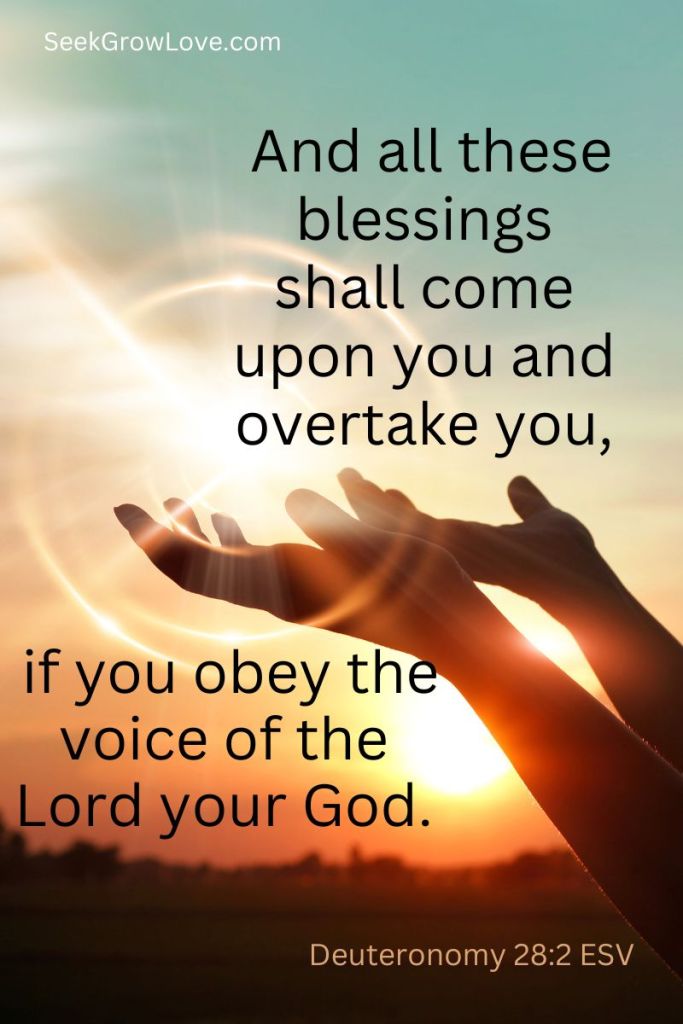
Chapter 28 begins with the blessings they will receive IF they “faithfully obey the voice of the Lord”.  These are really nice.  This is where we want to pause and feel good about our loving God.  28:2 says, And all these blessings shall come upon you and overtake you, if you obey the voice of the Lord your God.”

Sadly, we don’t get to sit with this image of a loving, blessing-giving God for long.  They jump right back into more curses.  And in verse 45 he uses the same phrasing, “All these curses shall come upon you and pursue you and overtake you till you are destroyed, because you did not obey the voice of the Lord…”.   

Remember, the Levites are proclaiming these loudly from facing mountains.  Participating in the yelling or just listening to it, I imagine you would feel like the matter of us choosing to obey God or not is very important to God.  They were obviously making a big deal out of it.  Our choices matter. 

Deuteronomy 27:9-10 says, Then Moses and the Levitical priests said to all Israel, “Keep silence and hear, O Israel: this day you have become the people of the Lord your God. 10 You shall therefore obey the voice of the Lord your God, keeping his commandments and his statutes, which I command you today.”  Moses commands the Israelites to obey.  We have a choice – God gave us a free will to choose to obey or not.  Moses simply tells the Israelites that since they are God’s people, they shall obey Him.  If it were only that simple to do!  But, isn’t it?  Well, it should be. 

Amy Blanchard

Reflection Questions

  1. I read this beautiful definition of being overtaken by blessings, “the blessings of the Lord will be so abundant, that they will chase us down.”  Have you ever felt overtaken by blessings? 
  2. Listening to the voice of the Lord your God will change you – your thoughts and behaviors and attitudes.  If you are not seeing that change, first honestly look at if you are really listening to God’s voice.  Read the curses.  Read the blessings.  And make your choice.