
Beware of the Buttkissers

1 Kings 22 & 2 Chronicles 18
1 Kings 22 5 NIV sgl

Yes, I know, a bit of a sensational title. In fact, I can hear my mom reaching for the Irish Spring to place in my mouth because “butt” is not a church word. Please give me grace just a few sentences longer as I am someone who spends a great deal of time at school with 11 and 12-year olds. I often use a bit of high-brow potty humor for the connection and to make sure that I have your attention.  From here on out, I promise <crossing heart> I will use yes-men, suck-ups, sycophants, or something similar, but we’ll both know that I truly mean <in a whisper> “the ones who kiss b-u-t-t.”

Scattered throughout the last couple of weeks, we have read about the life of King Ahab. Today we will finish off Ahab [spoilers ahead] in more ways than one.  Ahab has grown unhappy that a previously Israeli owned-city, Ramoth Gilead, is now occupied by the Syrian (Aram) people, the very nation that was given over to him by God (1 Kings 20).  No doubt that Ahab’s misintentioned mercy to the Syrian nation (Again 1 Kings 20) has become less than advantageous, contemptuous, or is now, simply biting him in the…rear.  Ahab forms an alliance with Judah’s king, Jehoshaphat, who says he will fight with Ahab to take back Ramoth Gilead if he consults the LORD first.  Ahab thinks, “No problem; I have plenty of prophets.”. Enter the yes-men.

‘So the king of Israel brought together the prophets—about four hundred men—and asked them, “Shall I go to war against Ramoth Gilead, or shall I refrain?”  “Go,” they answered, “for the Lord will give it into the king’s hand.” – 1 Kings 22:6

Jehoshaphat isn’t convinced by the mass of soothsaying suck-ups for a simple reason: they do not mention God, YHWH, which prompts his head-scratching statement “Is there no longer a prophet of the LORD here whom we can inquire of?” “But didn’t the prophets say ‘the Lord will give <Ramoth Gilead> into the king’s hand?’” You may have heard it before, but it is worth reminding, that not all “lords” are equal in most English translations of the Old Testament.  L-o-r-d means master, which is often used for God, but L-O-R-D is the indisputable proper name of God, the Father, YHWH.  The sycophantic seers have not consulted with the Almighty, but have most likely consulted one another, telling the king whatever they think he wanted to hear.    Ahab confesses there is still ONE prophet of the LORD, Micaiah, but he doesn’t like to use him because he doesn’t like to kiss-up like the others. In fact, Ahab’s reluctance shows that he most likely already knew the truth. Micaiah lives up to his reputation, delivering a Word from the LORD that was unfavorable to what Ahab had already set upon his heart to do.

Is Ahab’s folly not our own? As I read about his fatal flaw, I can feel my own groan, lurch, and tumult described by Paul in Romans 7:15-20, between what I have intentioned in my heart and what the LORD wants of me.  What makes it worse is the body of booty smoochers ready to tell me that fulfilling my desires are what will ultimately make me happy.  In 2020, it doesn’t take much searching to find 400 people that agree with you.  Just because a crowd has formed in agreement with you, it doesn’t mean they (or you) know what’s best.  There are well-established organizations, conferences, websites, movements, forums, etc. that have opposing views to God’s desire for your life.  No matter how convincing the mob, there is only one way to get the truth: The Word of the LORD.  Yet the fact of the matter is as I wrestle with my desire, my pride, and my sin, I’d rather hear comforting, confirming, justifying lies from hundreds than hear a truth from a single person that would convict me and cause me to change. This would mean that the problem doesn’t externally exist in the world I live in, but within me, which is the hardest thing to hear (and the reason why we don’t invite challenging scriptures or a truth-telling Christian friend to the party, i.e. Micaiah)

“The word of God is quick, and powerful, and sharper than any two edged sword, piercing even to the dividing asunder of soul and spirit, and of the joints and marrow, and is a discerner of the thoughts and intents of the heart.” – Hebrew 4:12

There is great advice in the word of Jehoshaphat, “First seek the counsel of the LORD.”  Before taking any course of action, no matter how great or small, let me stop consulting my social circle of “yes people” and search the Word of the LORD for discernment.  Almost always, our only reluctance is because we already know the answer that is buried not-so-deep within our heart. Let’s pray that God will bring his convicting truth to our aspirations and challenge us to listen to His voice only as He guides us to His way.


Aaron Winner


Today’s Bible passage can be read or listened to at https://www.biblegateway.com/passage/?search=1+Kings+22%2C+2+Chronicles+18&version=NIV

Tomorrow’s reading will be 2 Chronicles 19-23 as we continue the 2020 Chronological Bible Reading Plan

Still Not Alone

1 Kings 20-21

1 Kings 20 13 NIV sgl

I neglected to mention at the end of yesterday’s “You are Not Alone” devotion that one excellent way to battle the weary, lonely depression that sometimes falls upon those who speak for God is to find a partner in ministry – work together with one you can mentor.  At the end of chapter 19 Elijah found Elisha.  Some Bible scholars suggest they worked together about 6 years, but I found another that thought it could have been closer to 23 years.  Regardless of the length of time, I believe it is safe to say the apprenticeship was a mutual blessing to both Elijah and Elisha – and likely multiplied the work that either one could have done on their own.  Elisha will have a very long and powerful ministry for the LORD, but what would it have looked like if he had not had the opportunity to serve under Elijah?  Who are you serving under?  Who are you mentoring?

It is interesting that in the next chapter neither Elijah nor Elisha are mentioned, but at least twice a prophet or son of a prophet speaks to evil King Ahab – once to tell him how to be victorious over the attacking Ben-Hadad of Aram, and once to reprimand him for being too leniant on Ben-Hadad when God delivered him into Ahab’s hand.  This is further proof that Elijah was indeed not the only one left to stand for and speak for God.  And proof, that while Elijah had very faithfully performed many deeds and sermons for God – God did not need Elijah.  The Almighty can call any man or woman – or rock – to work for Him.  I do believe when the city walls fall down on 27,000 fleeing enemy soldiers God’s rocks were at work – perhaps others would have merely called it a coincidence or an earthquake (1 Kings 20:30).

It can truly be amazing who and what God uses – even the evilest king who had ever lived.  Sure, enough, when God wanted to show HIS strength against the advancing foreign army – He tells Ahab the winning battle plans through a prophet and Ahab somewhat surprisingly listens and follows along – to a point.  And, in the last chapter of today’s reading we will even see Ahab repentant – for a time.  There is no heart God can’t soften and change or use for His glory.

But, you are just asking for trouble if you choose to hang out with the bad girls (or in Ahab’s case, his wicked wife).   They have done a lot of evil things but how many commandments do they manage to break when Ahab decides he would love to have a vegetable garden for his second palace?  Once, again, sin snowballs.  One leads to another and it grows larger and larger. With serious consequences.

Following the violent murder of innocent Naboth and the stealing of his property, Elijah is sent to condemn Ahab and Jezebel and foretell their own violent deaths – only partially put on hold by Ahab’s repentant spirit.  Isn’t it good to know that God still sees the  cruelty and injustice of the world today and His timeline is put in place to make all things right.  There will be a time when all humanity meets their judge and will be held accountable for all their deeds and the condition of their hearts.  Until that day may we faithfully carry His word – knowing that we are not alone!

Marcia Railton


Today’s Bible reading can be read or listened to at https://www.biblegateway.com/passage/?search=1+Kings+20-21&version=NIV

Tomorrow’s Bible reading will be 1 Kings 22 & 2 Chronicles 18 as we continue the seekgrowlove.com 2020 Chronological Bible Reading Plan

You are Not Alone

1 Kings 17-19

1 Kings 19 14 NIV sgl

Don’t you love Elijah!  The showdown at Mount Carmel is one of my all-time favorite Old Testament stories!  Elijah makes a bold, strong, fast, quick-witted hero for the LORD.  We love to see how he repeatedly stands firmly for God and how God takes care of him, over and over again.  Even though his king (Ahab), his queen (Jezebel) and his nation (Israel) are making some really bad decisions following a man-made god (Baal), Elijah doesn’t back down and his deep faith in God allows him to display God’s power in amazing and miraculous ways.  He prays and God holds back the rain for 3 and a half years. During the drought he is fed by ravens.  (Don’t worry, there are no sanitation problems when God provides the birds to bring you your daily breakfast and supper). He is the first person recorded in Scripture through which God raises the dead!  Never-before seen miracles – at the hand of Elijah!  He prays and God sends fire from heaven to burn up the absolutely drenched sacrifice, wood, stones and soil.  With God’s power he outruns Ahab’s chariot – I bet that was fun to do.  Can you imagine the face and heart of Ahab who had just been bested on Mount Carmel by his enemy Elijah, and then here comes Elijah running past his royal chariot that is trying to outrun the storm clouds that Elijah predicted?  Triple whammy!  It is like Elijah is untouchable!   A super-human spokesman and miracle maker for God.

But no, he was not super-human.  In case anyone was wondering, James sets the record straight many years later in the New Testament that, “Elijah was a man just like us.  He prayed earnestly…”  (James 5:17).  He was a regular man like us.  But he sure knew how to pray!

But being a regular man like us, he grew tired, too.  And fearful sometimes as well.  Ministry can be exciting and exhilarating.  And, tiring and scary.  Sometimes the results aren’t quite what you were hoping for.  Instead of a dramatic conversion – now the ones you were trying to convince of God’s majesty are trying to hunt you down to destroy you!

When Elijah hears that Jezebel has vowed to take his life he is so ready to give up.  Maybe you have been there too, sitting under a broom tree telling God you are done.  But God provides for him again and sustains his long journey (40 days) to a safer (and holy) spot and then reveals himself in a gentle whisper.  Elijah knows he has had a special, one-of-a kind moment with God.  God asks, “What are you doing here, Elijah” (1 Kings 19:13).  Elijah answers, saying he has done so much for God, but the people still won’t listen, and now he is the only one left who speaks for God and they are trying to kill him, too.  It is a little bit of a pity party perhaps – that’s where we go when we are tired and worn out and fearful for the future.

God could be angry.  After all that God has done for Elijah, how dare he mope?  But God doesn’t respond with anger and condemnation; instead, the loving, compassionate, faithful God gives Elijah specific action steps as well as correction.   He says – “Go Back”.  You have had your 40 day sabbatical – you have encountered me in a gentle whisper – I have provided for you – now return, your work isn’t done.

God knows the world is broken and rough and a difficult place to speak for God.  But He says don’t give up.  Keep at it.  He still has more people for you to influence – more people for you to anoint with God’s words and purpose.  The evil king (Satan) may not be brought down in your lifetime.  That’s okay, God will still take care of him, God’s rule will prevail, and He is lining up the people (including His Son the Messiah) and the events to bring it to be.  In the meantime, it is still your job to pass along the good news and the words and power of the Almighty.  And in this way the faithful chain continues through the generations – each one doing their part to proclaim the greatness of our Heavenly Father and prepare the way for His ultimate Kingdom rule.

And, no, Elijah – you are not alone.  Yes, you felt alone.  But you were never alone.  We know that Obadiah (a God-believer in charge of Ahab’s palace) had risked his life by saving the lives of 100 prophets of God in caves (1 Kings 18:2-4).  And God himself corrects Elijah by telling him He had personally reserved 7,000 in Israel who had not worshipped Baal.  It was far from a majority – you don’t need to be a majority to continue speaking God’s word.  But know that you are not a lonely army of one.  God sees you – and He sees all those He has given the most important task of speaking for Him.  Don’t bend your knee to evil.  Don’t give up.  God sees and provides.  Keep speaking for Him.

Marcia Railton


Today’s Bible passage can be read or listened to at https://www.biblegateway.com/passage/?search=1+Kings+17-19&version=NIV

Tomorrow’s reading will be 1 Kings 20-21 as we continue the 2020 Chronological Bible Reading Plan

Sin Snowballs

1 Kings 15:25-16:34 & 2 Chronicles 17

1 Kings 16 25 NIV sgl

In our chronological journey through the Bible we took nearly 7 weeks to read and discuss the life and writings of David.  But in today’s reading in 1st Kings (15:25-16:34) we will cover 6 kings of the Northern Kingdom Israel and in 2 Chronicles (17) we will be introduced to a king in the Southern Kingdom of Judah.  Hold on to your hat – here we go!

THE NORTHERN KINGDOM – ISRAEL (10 tribes) – will have 9 different family dynasties reign (with 19 kings) over a period of 208 years

Jeroboam – rebelled against Solomon’s son Rehoboam – reigned 22 years – evil – set up golden calves for worship so the people wouldn’t return to the temple in Jerusalem – succeeded by his son….

Nadab – 2 years – evil – overthrown by…

Baasha – 24 years – evil – Jehu prophesied Baasha’s family would be ruined – succeeded by his son….

Elah – 2 years – evil – drunk – overthrown by…

Zimri – 7 DAYS – (next time you think you’ve had a tough week – remember Zimri) – long enough to kill all of Baasha/Elah’s family, as prophesied – but he too was evil and when their army (and Omri, its commander) heard Zimri killed Elah and made himself king they marched against the palace – rather than be captured, Zimri burned the palace down around him as he was overthrown by…

Omri – 12 years – evil – moved capital city to Samaria – “sinned more than all those before him” (I Kings 16:25)

Ahab – 22 years – evil – “did more evil in the eyes of the LORD than any of those before him.” (1 Kings 16:30)


Well, that’s where our reading will leave the nation of Israel today – so far that is 4 of the 9 dynasties – not bad for a quick history lesson.  Do you see a pattern developing for the Northern Kingdom of Israel?  Not a very pretty one I am afraid.  Spoiler alert – NONE of their 19 kings are going to be deemed good and upright by God.   You would think with all the rebellions and overthrowing of the old nasty king, someone better would come along at some point.  But, no.   Can you imagine living in a country with one after another dirty, rotten, scoundrel, violent, unfaithful leaders?  I wonder if the people thought back to Samuel’s words about the wisdom of being led by God rather than a man?  They already had God, why did they think they needed a king?  Over and over again we read, “(He) did evil in the eyes of the LORD, walking in the ways of Jeroboam and in his sin, which he had caused Israel to commit.” (1 Kings 15: 34).  Even when it is no longer Jeroboam’s family line,  the sin continues to snowball.  Unfaithfulness breeds unfaithfulness.  Tomorrow we get to read a ray of hope and inspiration as we watch  a man of faith witnessing in the midst of this evil and tumultuous world.  Never give up -even when evil is on the rise!

The rest of 1st & 2nd Kings will focus on the rest of the evil kings of Israel (from Ahab on) as well as the prophets who spoke for God and worked to turn the hearts of the people to God.

Meanwhile, 2nd Chronicles will continue their retelling of the house of David – what has become the Southern Kingdom of Judah.  Quite in contrast to their northern neighbors, Judah will remain under the leadership of ONE family – the line of King David!  And, while there will be a fair number of kings judged to be evil – we will also meet some who seek God and strive to lead their country to do what is right as well.  Here’s the start of our chart for Judah

SOUTHERN KINGDOM – JUDAH – (2 tribes) – from the split to the exile 20 kings in the line of David

Rehoboam – 17 years – evil – David’s grandson – but heart not set on seeking God

Abijah – 3 years – gave a great speech about God as the leader – but didn’t continue to live it out – evil

Asa – 41 years – called good and upright – commanded Judah to seek the LORD – but then at the end of his life put his trust (& treasuries) in men rather than turning to God in his troubles

Jehoshaphat – 25 years  – “the LORD was with Jehoshaphat because in his early years he walked in the ways his father David had followed.  He did not consult the Baals but sought the God of his father and followed his commands rather than the practices of Israel” (2 Chronicles 17:3)
We will get to know Jehoshaphat better in our coming readings, but today I am most impressed with his deep desire to seek God rather than doing whatever is politically/religiously “correct” at the time (following the neighbors).   And, he knew it wasn’t enough for him to do it alone – his desire was to see his whole country following the LORD.  I see great wisdom in his act of sending out godly teachers throughout Judah with the Book of the Law.

You may be feeling surrounded by evil and bad examples.  Don’t give up.  The world needs your light and example and godly teaching just as much as it did back in the day of Jehoshaphat.  How will you shine and spread the word of God today?

Marcia Railton


Today’s Bible passage can be read or listened to at https://www.biblegateway.com/passage/?search=1+Kings+15%3A25-16%3A34%2C+2+Chronicles+17&version=NIV

Tomorrow we get to read several events from the life of Elijah as we cover 1 Kings 17-19 in our 2020 Chronological Bible Reading Plan
His Story

1 Kings 15:1-24 & 2 Chronicles 13-16

2 Chronicles 15 15b NIV sgl

History is a curious thing.  Today’s reading covers two different kings of Judah, Abijah and Asa, from the perspective of two different writers.  It is quite interesting to see what is remembered and omitted and concluded from the lives of these two kings from the two different authors writing at different time periods for different purposes.

Let’s look at Abijah, King David’s great grandson.  It is easy to love the Abijah recorded in 2 Chronicles 13.  King Jeroboam of Israel is closing in with an army twice the size of King Abijah’s of Judah.  But Abijah responds with courage, faith in God and a rousing speech.  He speaks of Israel’s united history under David and God and then records the sins of Jeroboam (& Israel) in breaking with God, the God-ordained priests, and the house of David.  He concludes that, “As for us (Judah), the LORD is our God, and we have not forsaken him….God is with us, he is our leader.” (2 Chronicles 13:10,12). And then, even though an army twice their size is before and behind them, God gives the victory and Abijah’s army wipes out over half of Jeroboam’s fleeing and destroyed army.  It’s exciting to see how God shows His strength through Abijah.

And then we read the account of King Abijah as recorded in 1 Kings 15.  The details of his life agree completely with what is recorded in 2 Chronicles: reigned 3 years, son of Rehoboam and Maacah, there was war between him and Jeroboam, and his son Asa would rule after his death.  But, absolutely nothing is said of the moving speech or victorious battle or God as his leader.  Instead, the writer of Kings sums up Abijah’s life by saying, “He committed all the sins his father had done before him; his heart was not fully devoted to the LORD his God, as the heart of David his forefather had been.” (1 Kings 15:3).

Oh, Abijah, we had such hope for you from that one outstanding snapshot of your life.  Your sermon that day was so full of convicting truth – that you forgot?  What went wrong?  How was your heart divided that sin won out?  Didn’t you daily recall how God fought for you?  Did you think you did that on your own?  It is discouraging to see what could have been, or once was, a strong testimony for God crumble and cave to sin and a divided heart.

But, it is also encouraging to see what God can do for His purposes – even when He’s working with and through sinful, broken people.  He can use the Joshua’s, the David’s and the Abijah’s and you and me.  He has and can and will have the victory any time He wants – and He can do it using any one He wants.

It is also interesting to see what one chooses to remember when looking back on history.  How do we portray and ultimately judge the heroes and the villains?  Which statues do we decide to pull down, if any, or why not all?  Everyone is certainly a mix of wise and foolish choices.  Some of our forefathers had some really good, faithful days (like Abijah’s) and these can still be celebrated today.  Remember the Chronicles were written long after these events took place and were written to encourage the returning exiles.  They needed to remember the faithful God who worked through the house of David and the priestly line.  They were being prepared for the coming arrival of a Messiah from the house of David who would be a priest like none before.  It would be helpful for them to remember their history as they prepared for their future.  It was time to bolster their courage and faith and remind them that God is their leader.  They needed the story of Abijah’s Really Good Day and the God who supplied it.

And, it is also valuable to consider the bigger picture of someone’s life to see what to avoid in order to get us where we want to go.  Rather than using our own flawed measuring stick to judge (popularity, wealth, good speaker, etc…), whenever possible it is helpful to know what God thought of the man.  That is going to be what really counts, so that is what I want to pay attention to so I am not setting up heroes for my life that God would disapprove of.

All that and we finally get to Asa – one of the few kings recorded as, “good and right in the eyes of the Lord his God” (2 Chronicles 14:2).  And the writer of Kings agrees completely.  There are some beautiful passages you won’t want to miss about God’s provision and Asa’s seeking and working for God wholeheartedly, even when it meant going against some of his family.  Although, for all his wise and courageous decisions, he still had a rough spot towards the end of his reign when he chose to rely on man instead of God – and there was a price to pay for that error.  But it would be a mistake for us to judge and remember Asa only for that sin that sadly would affect him and many others for years to come.

History is interesting, as is our record of it, and our judgement of those who have come before.  But first and foremost lets learn to us it to grow closer and closer to living a life seeking and serving with an undivided heart the God who created all history and present and future.  What would He have you learn from His Story today in order to live better today and prepare yourself for His Future?

Keep Reading His Word and Seeking Him

Marcia Railton


Today’s Bible passage can be read or listened to at https://www.biblegateway.com/passage/?search=1+Kings+15%3A1-24%2C+2+Chronicles+13-16&version=NIV

Tomorrow’s Bible reading will be 1 Kings 15:26-16:34 & 2 Chronicles 17 as we continue on the 2020 Chronological Bible Reading Plan


So Many Choices to Make

2 Chronicles 12 6 NIV sgl

2 Chronicles 10-12

Today’s reading (from 2 Chronicles) begins where yesterday’s reading began (in 1 Kings) – Solomon has just died and his son Rehoboam has been made king of all Israel.  It is a good time to use a lot of wisdom, especially since there are discontented citizens and a prophecy has been made that the kingdom (or 10 of the 12 tribes) would be torn out of the hand of Solomon’s son and given to Jeroboam (1 Kings 11:9-13 & 26-40).

When the potential revolters knock on the palace door asking Rehoboam how he will rule them, Rehoboam responds first with wisdom.  Rather than giving a rash answer he might regret later he asks them to return in 3 days – and he consults with his elders.  Well done, Rehoboam.  The wise elders advise the new king to be a servant leader and his countrymen would always be faithful to him (1 Kings 12:7, 2 Chronicles 10:7).  It wasn’t the answer Rehoboam was looking for.  He was looking forward to having great power, authority and fame – perhaps even greater than that of his dad Solomon or his grandpa David.  He didn’t see how a kind “servant” fit into the picture of leadership.

So, he goes to his young buddies he grew up with (perhaps about 40 years old 🙂 – 2 Chronicles 12:13) and asks them how he should proceed.  They are inexperienced, power hungry, arrogant, foolish “young” men.  But Rehoboam rejects the wisdom of the elders he asked first and follows the foolish advice of his friends and tells the people he will be a harsh and firm ruler.  Not too wise, Rehoboam.

Rather than submitting to these fear tactics, Israel revolts and 10 tribes go with Jeroboam, leaving just Judah (and parts of Benjamin) loyal to the house of David and his grandson Rehoboam.  This is exactly what God told Solomon would happen, as a result of his turning away from the Lord (1 Kings 11:9).  Like father, like son – it’s not enough to start out wise – you must stay the course and firmly resist the easy, enticing, foolish way that the worldly friends would lead you down.

In the next couple chapters we see Rehoboam, continue to yo-yo between good choices and bad choices.  He wisely listens to the word of the Lord and abandons plans to attack Israel and start an all-out bloody civil war with their dissenting brothers (2 Chronicles 11:4).  But then, “After Rehoboam’s position as king was established and he had become strong, he and all Israel with him abandoned the law of the LORD.” (Chronicles 12:1).   Too often when we are feeling strong, comfortable and sure of ourselves…our pride makes us think we don’t need God anymore.  And that is a dangerous place to be – for Rehoboam and the country of Judah as well as for you and me and our country.  In God we trust.  Or, we did once?  How sad and hauntingly eerie to read God’s proclamation against the nation that rejects God: “This is what the LORD says, ‘You have abandoned me; therefore, I now abandon you to …’ ” (2 Chronicles 12:5b).  And in came the invaders from Egypt.

The good news is, the story doesn’t always have to end there – and it doesn’t for Rehoboam!   He still had a bounce back left in his up/down/repeat journey.  Rehoboam’s pride had brought him down, turning from God, and leading to punishment.  Now, at the bottom, faced with a foreboding enemy he gets another chance to choose his response –  wise or foolish, humble or proud, repentant or heard-hearted?  Rehoboam and his countrymen chose wisely this time – they, “humbled themselves and said, ‘The LORD is just.’ ” (2 Chronicles 12:6).   God still sent the invaders from Egypt – to shake them up a little and teach them a lesson they needed to learn – there is a price to pay for turning from God and proudly putting your trust in yourself instead.   But, because of their humble response, God did not let the Egyptians annihilate them.

That would not be the end of Rehoboam.  He would reign in Jerusalem 12 more years.  But sadly the few wise choices we saw in Rehoboam were not enough.  In the end, it was recorded, “He did evil because he had not set his heart on seeking the LORD.” (2 Chronicles 12:14).

In reality, we are all a mix of wise and foolish choices.   There are consequences for the foolish ones and rewards for the wise.  But which will you be known for in the end?  Let us each work hard to make wise choices everyday.  Daily seek the LORD with humility – acknowledging our need for Him, our desire to follow His wise and right way, our willingness to set aside the selfish, prideful desire for power and and instead offer ourselves as a servant.

Seek Him!

Marcia Railton

Today’s Bible passage can be read or listened to at https://www.biblegateway.com/passage/?search=2+Chronicles+10-12&version=NIV

Tomorrow’s reading will be 1 Kings 15:1-24 and 2 Chronicles 13-16 as we continue the 2020 Chronological Bible Reading Plan
Following God not Man

Don’t Be Deceived!

1 Kings 12 28c NIV sgl

1 Kings 12-14

Perhaps we will be able to learn a thing or two about unity and peace and not being deceived and the supreme importance of following God’s purpose and plan as we read the historical accounts of the break-up of the Old Testament country of Israel.  What a sad and difficult time it must have been.

Remember back to those who had insisted that they wanted to have a king in order to be a real nation like all the neighboring tribes and countries.  Samuel told them they didn’t need a king if they had God, but they didn’t listen.  They wanted to be just like everybody else.  So, sure enough, they got themselves a king – and all the heartache and turmoil that comes with trying to follow man instead of God.

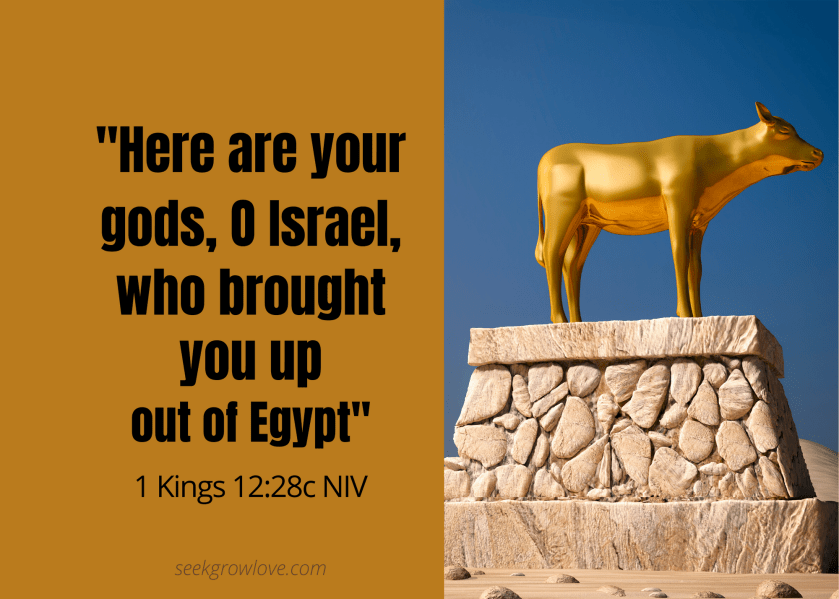
As we begin our reading today Israel had survived almost 100 years under 3 kings (Saul, David and Solomon).  And, as Solomon’s son Rehoboam is poised to take the reigns, the split comes and Jeroboam takes control of most of the country.  The land previously given to the tribe of Judah (home to Jerusalem and the beautiful temple Solomon built for the whole nation to worship the one true God in) remains as Rehoboam’s territory.  Jeroboam quickly decides he must build something for all the rest of Israel to worship, so that they don’t return to Jerusalem.  Two golden calves were created.  If the people knew God and their history a little better this should have sent all sorts of red flags.

God sent one new, large, red flag for the people.  A man of God came from Judah to speak God’s Word and reveal God’s power against this new idol worship.  He turns down King Jeroboam’s invitation to dinner because the word of the Lord said he must return home without eating or drinking in this land he was speaking against.  However, when an old prophet lies and says that an angel appeared to him and told him to have the man of God come to his house….the man of God goes.  But that same day judgement is prophesied against this man of God (from God through the previously lying prophet of God).  And sure enough while traveling home the man of God is killed by a lion (who “strangely” enough, does not eat him, just kills him).

I must say I have had some trouble with this story.  Here’s the man of God on special assignment from God – and doing it quite faithfully.  Speaking God’s word, showing God’s power, turning down even the King’s attempt to wine and dine him.  He seems totally devoted to what God wants him to do.  And, then, someone lies to him.  Someone who calls themself a prophet – should be a good person to listen to, right?

Not always!

Don’t believe every word from one who says they speak for God — without consulting what GOD has to say about it!  God had not changed what He had said to the man of God.  And, so that is what the man of God was responsible to be listening to and following.  The man of God was deceived because he listened to the lie – and it cost him his life.  God is serious about people following Him and His Word, rather than what man says about God.

So, too, today I fear there are many who, like the man of God in 1 Kings 13, are trying to speak God’s word – who are at the same time being deceived – and it just might cost them their lives – as it did for the man of God.   2 Timothy 3:13 lumps both the deceivers and those who are being deceived together in one sad group.   It seems harsh.  But, God has revealed himself as a jealous God who requires obedience to Him, and not to man and man’s ideas.  There is a price to pay for turning from His life-giving words of truth to the lies man (and even kings or “prophets”) have said about God and what He requires.

There are countless voices speaking today.  It can be hard to know what to believe and listen to.  The truth is not always spoken by the one who speaks loudest or longest or believed by the largest crowd.  But the truth is always in God’s Word.  Seek It!   And ask yourself – is it actually GOD’s Word you are following, or just someone who says they are speaking for God?  Are you following man-made traditions that have been handed down about God – or are you following GOD?  Do a little research and find out where the religious traditions you believe come from.  Do they come from God’s Word or from human traditions?  Did we get the idea of going to heaven when we die from the Bible or from Plato?  Did God, Moses, Jesus, the disciples and Paul teach about One God or about a triune God theory that developed centuries after Jesus’ life on earth?

How will you make sure you are not following a man-made religion – perhaps one just as dangerous as the golden calves Jeroboam set up in his country?  Not all lies and false gods are as blatantly obvious as a golden calf crafted by the king.  Sometimes it may come in the form of a seemingly harmless new word from the prophet, a slight contradiction or addition to God’s eternal Word.  Remember God is the perfect teacher – His words do not need to be added upon to be enhanced or explained better.   You are responsible for not listening to the lies.  God gave us the Bible – His Word that is full of truth.  Let’s dig in deep and find what it says and follow it with our whole being so we will not be led astray with a lie like the people who followed a golden calf built by a king or like the man of God who listened to the lie of the prophet rather than the word given to him by God.  There are consequences for what you believe and who you listen to and follow.  Take it seriously.  God does.

Marcia Railton


Today’s Bible passage can be read or listened to at https://www.biblegateway.com/passage/?search=1+Kings+12-14&version=NIV

Tomorrow we will read 2 Chronicles 10-12 as we continue seeking God’s truth and how it affects our lives today in the 2020 Chronological Bible Reading Plan

Dad!

Proverbs 30-31

Proverbs 30 4c NIV sgl

I doubt there are too many devotions over the last two chapters of Proverbs that are mostly aimed at the topic of Fathers, but for whatever reason or coincidence, here we are on Father’s Day – and our assigned Bible reading includes the Proverbs 31 superhero – the Wife of Noble Character.  But, I was surprised to see how many passages popped out to me regarding dear old dad and our relationship with him.

First of all, we run into an interesting passage of rhetorical questions about who can control the wind and water and established the ends of the earth?  “What is his name, and the name of his son?  Tell me if you know!”  (Proverbs 30:4 NIV)  I read some very differing commentaries on this passage and I feel a lot like the writer of this proverb, Agur, who confessed, “I am the most ignorant of men,” (Proverbs 30:2 NIV).  I do not have a full understanding of the Almighty God.  I can’t grasp His eternal greatness and power and all the deeds He has done  – and will do.  But, I am thankful that I DO know who created this spinning world we call home, the sun that warms it just right, the water cycle that refreshes it, the plants and animals that provide beauty, nourishment, and joy, and the families that inhabit it.  I marvel at the power, ingenuity and love of my Heavenly Father and the chance to be called His child.  And, I love, love, love, that He has a Son and I know his name is Jesus.  And this son Jesus would display his family resemblance to His dad by exerting power over the wind and the waves.  He would be given the most difficult but beautiful task of drawing us sinful creatures to His perfect Dad.

Poor Agur lived at a time when this plan of God was not yet revealed, but only hinted at here and there.  So, he was left asking – “Tell me if you know?”  If you know your Heavenly Father and what His Son has done so that YOU can be called a Child of God – who will you tell today?  Make it a Father’s Day that counts by telling someone about your Heavenly Father and His Only Begotten Son and the opportunity opened for them to have a perfect Dad, too.

I am so blessed that my father (and mother and grandparents and church family) on Earth did tell me – and many others.   Thanks, Dad!  It has been an honor to respect and try to live up to my dad.  I had a good one (and doubly blessed with a good father-in-law, too!).

There is a depressing passage of those who are haughty, disdainful, teeth for swords (heard any of that lately), devouring the poor.  And the FIRST description of these evil and hurtful people are, “There are those who curse their fathers…” (Proverbs 30:11 NIV) Can you think of any ways our society may have unknowingly become quite expert in cursing our fathers.  In so many sitcoms the father figure is stripped of all respect and is a bumbling goofball.  In giving women their “rights” we have neglected the responsibility and rights of dad.  And, then it sadly happens on a personal level, too.  Even in good Christian homes, sometimes.  How can we guard against cursing our fathers?  How will we show dad the respect God designed them to receive?  (Notice I did not say the respect that they have earned).

It appears there is even punishment in store for those who mock dad.  Oh be careful little tongue what you say.  AND – Agur seems to take it even a step further – be careful little eyes how you roll.  You know, the classic eye roll when you don’t agree with dad?  Guilty.  Proverbs 30:17 says “The eye that mocks a father, that scorns obedience to a mother, will be pecked out by the ravens of the valley, will be eaten by the vultures.”  Ouch.  This is serious stuff – regardless of what the “funny” sitcoms would have you believe.

Look at your own attitudes, words, actions, and eye rolls.  How are you showing respect for your father (and Christian father figures) not cursing or mocking?  Thankfulness not disdain?

Thanks Agur for the Father’s Day devotion.

Marcia Railton


Today’s passage can be read or listened to at https://www.biblegateway.com/passage/?search=Proverbs+30-31&version=NIV

Tomorrow’s reading will be 1 Kings 12-14 as we continue the 2020 Chronological Bible Reading Plan (1) (1)


The Queen of Sheba and Jesus

1 Kings 10-11 & 2 Chronicles 9

2 Chronicles 9 23 NIV

Who is the wisest person to ever live?
Let me tell you why you’re wrong. (Just kidding!)
Most of us answer Solomon, right? We are told that many times in Sunday School, and our teachers weren’t wrong. He was wise… to a point. We look at what he did at the beginning of his life and we see a man who was so dedicated to God that he asked for wisdom instead of riches, power, wealth or fame. For that, God gave him all wisdom and all the other things as well. Solomon was “wise enough to know that we are not wise enough on our own.” But, is Solomon the wisest person to ever live?
I believe our reading today disabuses of that notion quickly. Solomon starts off great, but in the end, his rule falls apart. His wisdom allowed his fame to increase. But as his fame increased, his wealth increased; as his wealth increased, his political connections, in the form of marriages, increased; as his number of marriages increased, the amount of gods he worshipped increased. And there’s our problem, but it doesn’t start there. Solomon, for all his wisdom, lost sight of the end goal. Wisdom is not meant for wealth. Wisdom is not meant for fame.
Wisdom is meant for godliness.
If we want to find the wisest person to ever live, we should look to the man who knew and had insight into the hearts of men and women, the one who even knew “all things.” Jesus, of course, is the wisest man to ever live. He unpacks the wisdom of God found in the Torah Law and applies it in a way that changes more than just behavior, but changes the heart. Jesus knew how to perfectly interpret scripture in wisdom. Most importantly, Jesus lived a life of wisdom by being Godly, doing what God wanted, all day, every day.
When we read about the Queen of Sheba and the wisdom of Solomon in 1 Kings 10 and 2 Chronicles 9, we need to remember that her praise was not only directed at Solomon. 1 Kings 10:9 reads “Blessed be the Lord your God who delighted in you to set you on the throne of Israel; because the Lord loved Israel forever, therefore He made you king, to do justice and righteousness.” The Queen of Sheba was wowed at the power of YHWH to give wisdom to people. The wisdom that Solomon imparted was that God was the giver of wisdom and that God was the blesser of his people; this, sadly, was a lesson Solomon forgot. It should be no surprise that Jesus said “The Queen of the South will rise up with this generation at the judgment and will condemn it, because she came from the ends of the earth to hear the wisdom of Solomon; and behold, something greater than Solomon is here.” (Matthew 12:42, Luke 11:31) Jesus knew that if the Queen of the South, the Queen of Sheba, were alive in his day, she would travel from the ends of the earth to hear the message of wisdom that he preached, because his teaching, his power, his wisdom far exceeds all that Solomon had.
May we my brothers and sisters, stand on the day of judgement found in the wisdom of Jesus, the wisdom that leads to godliness. May we recognize the wisdom of Christ over the wisdom of this world, and choose Christ every time. May you be blessed because you choose to trust and to live your days in the saving grace of the wisest person who ever lived.
Jacob (Jake) Ballard
——————-
Jake Ballard is Pastor at Timberland Bible Church. You can hear more of his thoughts and worship along with the TBC Family on Facebook, live streaming every Sunday at 10am. Reach out to Jake on Facebook, Twitter, or Instagram.
Tomorrow’s reading will be the end of the Proverbs (30-31) as we continue the 2020 Chronological Bible Reading Plan

Your Life is Not Meaningless

But it is Fleeting – so Live Wisely!

Ecclesiastes 12 13 NIV sgl

Ecclesiastes 7-12

In Ecclesiastes 7-12 the author, the Teacher, continues to discuss things that are “havel”, vain, futile, fleeting and temporary. (If you haven’t yet, go ahead and read yesterday’s devotion on Ecclesiastes 1-6 for a deeper understanding of “havel”.)
The author accepts that death is the end of every person and it is important to accept that fate and live with one’s face toward death. Much of the last half of this book is the reality righteous and wise people suffer the same fate as those who are wicked and foolish. However, we must not let this reality change how we read the entire book of Ecclesiastes. The author writes in 8:12-13 “Although a sinner does evil a hundred times and may lengthen his life, still I know that it will be well for those who fear God, who fear Him openly. But it will not be well for the evil man and he will not lengthen his days like a shadow, because he does not fear God.” While it is TRUE that the wicked and the righteous both end their lives in death, the author holds that there is good for a righteous person. Still, seek righteousness and wisdom because even a little foolishness can ruin one’s life. (10:1)
For you younger readers, the author commends that you seek out wisdom and that you remember God today! At this point in your life (12:1) There will be days of difficulty as life goes on, but in our days of joy, remember God. God is the one who gives comfort, joy, happiness, and strength on the days when the world is dark, the clouds are gray, and the pains of life are crowding in. Because the childhood and the prime of life are fleeting, temporary and transitory, enjoy them now. (11:10)
We are nearing the end of the book. We have been asking the question : “what lasts? What do people REALLY gain for all they do?” The last two verses of the book tell us what lasts : How we have lived, whether we kept the commands of God and feared him. All this in our life will be judged. Of course, this has been hinted before; now it is explicitly and clearly stated. If we believe, as some have, that the Teacher is a cynical, morose, or even godless man, then the last two verses are a radical departure. However, if this is a man who loves God and understands the futility, vanity, temporariness, FLEETING nature of life, then the final verses in Ecclesiastes are an understandable conclusion.
This of course effects how we read many passages. The author says “eat, drink, enjoy your labor, be merry!” (5:18, 8:15, 9:7) These passage show us that our labor, what we do, are not meaningless, but they are precious because of their very fleeting nature. The teacher says in 9:9, “Enjoy life with the woman you love all the days of your fleeting life…” You know you are precious to God. Your life is not meaningless, but it is havel, transitory, temporary. What we have in this life is not meaningless drudgery of existence, but the temporary good things are to be enjoyed, and to seek the eternal good things, doing the will of God and fearing him.
In the short time of our discussion we missed many interesting passages, some that are difficult (about death and sorrow) and some that are encouraging (about enjoying pleasure on the earth). But, my friends, remember : The entire duty for all people is to do the commands of God. We know that since Christ has come into the world “This is His commandment, that we believe in the name of His Son Jesus Christ, and love one another, just as He commanded us.” (1 John 3:23) As you continue to believe in the name of Jesus, may you love one another as you seek how to live wisely today!
Jake Ballard
Today’s Bible passage can be read or listened to at https://www.biblegateway.com/passage/?search=Ecclesiastes+7-12&version=NIV
Tomorrow’s reading will be 1 Kings 10-11 and 2 Chronicles 9 as we continue the 2020 Chronological Bible Reading Plan