“Now” that David’s living in Jerusalem. He wanted to return the ark of the covenant there. He said to all the assembly of Israel, “If it seems good to you, and if it is of the LORD our God, … let us bring back the ark of our God back to us.” (13:2,3) David had good intentions of bringing the ark back, but he did not actually inquire of God or do it according to His instructions. He gathered all Israel together to bring the ark of God up from Kirjath Jearim. He had it put on a new cart. “All Israel played music before God with all their might with singing, on harps, stringed instruments, tambourines, cymbals, and trumpets.” (13:8) He had such good intentions, but once Uzza held the ark when the oxen stumbled and he died, David became angry and was afraid. He took it aside to the house of Obed-Edom and left it.
We lived in the village right behind Kirjath Jearim. In fact, for 20 years we could look out our living room/kitchen windows and see it! Also, one can see in the picture modern houses built around the ancient site. There is a Catholic church over the ruins, which is the case for other sites in Israel. And one can see the main road, which is still the modern-day ridge route they would have traveled on to avoid the deep cutting valleys.
Even though David had good intentions, afterwards he sought God for instruction, which encourages us to do the same. Not long after the Philistines attacked near Jerusalem, it says, “David inquired of God” if he should go against them. (14:10) Again, he inquired of God if to attack them, and God told him to send an ambush around them and succeeded. (14:16) “So David did as God commanded him, and they drove back the army of the Philistines from Gibeon as far as Gezer (could include pictures of them too😉). Then the fame of David went out into all lands, and the LORD brought the fear of him upon all the nations.” (14:16,17) This account of David is so encouraging though he had good intentions and yet failed to seek God, he corrected himself immediately and sought God’s counsel if he should attack the Philistines. We can learn from David and do likewise! “Be zealous for the fear of the LORD all the day.” (Proverbs 23:17) In wrap up, it is interesting to note once again another Proverbs that talks about a child, which has a Hebrew word meaning more “youth.” “Do not withhold corrections from a child (YOUTH), for if you beat him with a rod, he will not die.” (Proverbs 23:13) Children and youth both need lots of training and correction, but the end results are so rewarding. Reach out to children nearby you or related to you and encourage and lovingly correct them. Many may be going back to camp this summer, which is a special time for them. Many times, they have good intentions and yet need directed in God’s ways. 😊
After the death of King Saul, Israel came together at Hebron to anoint David king. God took him from being a shepherd of sheep to shepherd people. “You shall shepherd My people Israel and be ruler over My people Israel.” (11:2) Think about that, now adays it is a matter of degrees one has from LOTS of insidestudy. With David it was after LOTS of outside hours of watching the sheep (and years on the run from King Saul). For the first 7 years he reigned as king from Hebron. Then he wanted to move to Jerusalem, but the people rejected him there, so he fought against them. After David built the city up, and still to this day it is called, “The City of David” in that area by the temple. “So David went on and became great, and the LORD of hosts was with him.” (11:9) Below is a picture our son took with a drone of the City of David. (My husband knew what shots he wanted, but our son knew how to get them as a teenage tech). 😊 They made a great team, while it was still possible to fly in Jerusalem.
My biblical geography teacher of a husband likes to point out the parallels with David, anointed as messiah and king of Israel with Jesus, also anointed as messiah by God and king of Israel. Both lived lowly lives in the beginning though they were kings! Some of David’s mighty men even hid themselves in the cave of Adullam. And guess what?! Those caves are still there today and called by the same name! The students that came for our semester program would sometimes camp out there or have a bonfire there depending on our schedule. (Drone shot from our son😉) “The LORD brought about a great victory.” (11:14) God caused David and his men to prosper against their enemies. “By humility and the fear of the LORD are riches and honor and life.” (Prov. 22:4)
Further looking into Proverbs, it is interesting to note that the popular verse, “Train up a child (youth) in the way he should go, and when he is old, he will not depart from it,” (22:6) means more “youth” in Hebrew, like David was this age when he killed Goliath. Also, “Foolishness is bound up in the heart of a child (YOUTH); the rod of discipline will drive it far from him.” (22:15) So, to end on a happy note this “youth” son that took many of our drone pictures in Israel was granted permission today from the Israeli army to come and visit us for a month!! So exciting! 😊
The Philistines fought against Israel on Mount Gilboa. King Saul and his sons were also fighting against them. They fell slain in battle there. It says that “Saul died for his unfaithfulness which he had committed against the LORD, because he didn’t keep the word of the LORD.” (10:13) He consulted a medium for guidance, “but he did not inquire of the LORD; therefore, He killed him, and turned the kingdom over to David.” (10:14) It is so important to ask God for guidance, first and foremost. We so often ask others or search online for answers, which can be okay, but mainly we need to seek and ask God. It had been almost 9 years since Saul’s disobedience and rejection by God as king, yet he was still ruling for years, until it says that God killed him through the Philistines, and FINALLY the kingdom was turned over to David… as they mourn for King Saul.
Here is a modern aerial (drone) view of Mount Gilboa taken by our homeschooled high school son that was with my husband on a field trip. It is a mountain range, not one individual mountain. And guess what? It still has the same name today! In fact, by it you can see a manmade “snow” slope to go sledding on throughout the year. 😊
Proverbs 21:1 follows the two chapters in Chronicles perfectly! “The king’s heart is in the hand of the LORD, like the rivers of water, He turns it wherever He wishes.” And not just his heart but his whole life, as we just read that He can even kill the king. “To do righteousness and justice is more acceptable to the LORD than sacrifice.” (21:3) “There is no wisdom or understanding or counsel against the LORD.” (21:30)
Another Proverbs I wrote “sp” for speech by it helped me a lot during a rough time in my life. “Whoever guards his mouth and tongue keeps his soul from troubles.” (21:23) There were troubles brewing in my life, but it really helped to GUARD my mouth and tongue like a security guard standing by the opening of my mouth watching what I was going to say. In Israel, there are security guards everywhere. Most malls have a grocery store in them, but before buying milk in the mall’s grocery store, I would need to pass by three security guards! Thus, it is good for our words to be guarded at the exit of our mouth to make sure they are fitting! It is a good exercise today to picture a security guard by our mouths and tongues to make sure what we say is appropriate and pleasing to God.
Shalom y’all. 😊 I was born and raised in small town Indiana, then lived in Israel for 25 years, now I am back in the States in the South. So, I will add some pictures and thoughts about Israel in each devotional this week to help give you a taste of it over there. This year I have been reading through the Chronological Bible for my personal Bible reading and really enjoying it. In various ways, reading through the Bible is a great experience even though some parts are slower. 😊 It is interesting to note that the Hebrew Old Testament is arranged in a slightly different order than in English. In my Hebrew/English Bible the Old Testament ends with 1 and 2 Chronicles as a final summary of the Old Testament.
Although 1 Chronicles 7 & 8 are FILLED with Hebrew names and cities, it is amazing how familiar those names are to native Israelis. Many people are still called those names today, especially religious Jews. AND many of those cities are STILL called that TODAY. At some places, the ancient ruins of the city are beside the modern one, sharing the SAME NAME! Also, amazing that we still have this record of people and places from about 2,800 years ago. God’s Word has been preserved through all these years and one can still see the numerous same locations in Israel today. Israel is a wonderful country and testifies of real places and a real God and Messiah Jesus. See the green patch towards the bottom of our picture, that’s ancient Shechem with the modern city built around it. It is listed among the many cities in 1 Chronicles 7 and 8 and is STILL an actual city in Israel today! Some ancient cities are only in ruins, but the name remains the same.
Over the years, it has been a great benefit to read the book of Proverbs and focus on a certain topic while reading it and marking that topic with a few letters, like shown in picture. So many good nuggets of wisdom to meditate on! Something interesting is that many times a “child” is mentioned it’s often referring to a “youth” in Hebrew. “Even a youth is known by his actions” (Proverbs 20:11) is how it translates into English, same word used for David when he killed Goliath. I encourage you the next time when you read the book of Proverbs to pick a topic that interests you or that you would like more wisdom in and initial each verse that applies. Sometimes I have even made a list in a notebook of those verses and then meditated on them, and it has really helped me in that area that I needed more wisdom about. “The hearing ear and the seeing eye, the LORD has made them both.” (Proverbs 20:12)
Life is fleeting. We’re all passing through this age like the grass of the field. Today we live. God holds tomorrow.
As I’ve finished the last three chapters of the book of 2nd Kings and read another chapter in Proverbs, I’ve thought about our time in this age. This age is short compared to eternity. What we do in it matters.
The lives of the final kings of Judah mattered and were recorded for us all to see. We know what each of those last 5 kings was forever known for. They can be summed up into two basic categories. A good king and evil kings.
All but one of the last 5 kings of Judah were known for doing evil in the sight of Yahweh. If we included the whole lot of the kings of Judah and Israel to this list, there wouldn’t be a significant pendulum swing in the opposing direction towards Yahweh God.
When we come to the end of our earthly lives, what will we be known for? Will we be known for doing good or evil in the sight of God through Jesus Messiah?
The good kings, like Josiah were known for their hearts and humility, practicing obedience to God’s Law. Good kings did stumble but when they repented, they renewed their status with God.
If we want to be known for doing good in our day and age, similar qualifications apply. Good disciples of Jesus will be known for their hearts and humility, practicing obedience to the Law of Christ (aka producing fruit).
The whole law can be summed up with one word. Love. Our “goodness” can be measured to the extent that we love as Christ loved. How did he love? He loved his God and served him alone with all of his heart, with all of his soul, with all of his mind, and with all of his strength. He loved his neighbor to the point of death on the cross.
When I come to the end of my life, I want to be known as a good disciple of Jesus Messiah. I want to hear my master say, “Well done, good and faithful servant!” If this is my heart, my life will reflect that.
-Juliet Taylor
Today’s Bible reading passage can be read or listened to at BibleGateway here – 2 Kings 23-25 and Proverbs 16
As a child, I was always told to be a leader, not a follower. The importance of leading with wisdom and godliness was engrained in my mind; it was repeatedly being taught by parents, teachers, mentors, and of course, leaders. I’m sure most of us grew up with similar advise. We all know the impact a good leader can have, as well as the impact a bad leader can have. That’s why if we know what it means to be a good leader, we must take it upon ourselves to be one.
The thing is, most of us do know what it means to be a good leader. We all have it within us to lead as God instructs us to lead, because He gave us this whole enormous book full of leaders to read about and learn from. Jesus Christ was obviously the top dog when it comes to leaders…and everything else, but there are so many others we can look at too, including the not so great leaders.
Throughout the Old Testament, the importance of a strong leader is stressed over and over again. We see these amazing, capable, resilient, faithful leaders bringing God’s people into the light, guiding them in the direction God laid out for them, like Jesus someday would. But we also see weak leaders, lacking in faith and abounding in pride. When leaders like that are in charge, they normally can be observed dragging their followers down with them. The readings of the past week have been absolutely full of leaders who could not leave behind the sins of their predecessors, which “made Israel to sin.” When you have been blessed with the knowledge of the truth, and you know the commands God has given us, it is your duty to be a leader. It is your duty to point others to God in everything you do, not to continually lead others in sin.
When Israel had weak kings who did evil in the eyes of the LORD, the whole nation was brought down as a result. On the other hand, when Israel had strong kings who did what was right in the eyes of the LORD, the entire nation would be lifted up. You can see when God favored Israel and its king, because He would lead them to victory in battle, and bless them with prosperity. When the king and Israel failed, however, they would often be delivered into the hands of their enemies.
It is clear how much of an impact a leader can have in the Bible, and that hasn’t changed at all today. We are so blessed to have the knowledge of the truth, and to know that we are loved by the Almighty. To have this knowledge, and to have a real relationship with God, we also have to accept our responsibility on this earth to be leaders. Not the kind that will lead others into sin, but the kind of leader God can count on to be a light, just as His son was. The kind of leader that has unwavering faith, because they know who holds the future. The kind of leader that obeys the words of the LORD in every circumstance. The kind of leader that shows the unconditional love of God to each and every one of His children, everyday.
Let it be our prayer that we become the leaders God made us to be, to be a bright light that guides others to Him even in this dark world.
-Isabella Osborn
Today’s Bible reading passages can be read or listened to at BibleGateway here – 2 Kings 15-16 and Proverbs 12
You know that feeling when things are going so well that you question if you’re dreaming? Maybe you ask someone nearby to pinch you or maybe you pinch yourself. Either way, this is the feeling I imagine Peter had the night before Herod was going to bring Peter to trial. I’d encourage you to listen to Acts 12. As you listen, visualize what this could have looked like. Go ahead and use a little bit of imagination, as we’re not given pictures to accompany the stories in the Bible. If I’m being honest, I sometimes forget that the Bible is a literary text, but this chapter allows me to pick out some details and things that make me consider the (historical) story, and smile.
I’ll mention a couple parts that I really like about this chapter, but other parts might jump out at you.
v. 7 – Peter must’ve been a heavy sleeper! First the angel appeared, with a light. That didn’t wake Peter, so the angel struck (or smote) him. A gentle, “Hey Peter, time to wake up” with a rub on the shoulder didn’t cut it…
v. 9 – Peter didn’t know what was happening. He thought it was a vision. I like how he follows the angel’s instructions though. I think this is a good example for us to follow. Even when we may be a little confused about what God wants us to do, we should still obey and follow through with whatever it is.
v. 11 – “Now I know without a doubt”. I like how confident Peter is at this point. Before he thought it could be a vision. Now he knows that this is real life, and this is all part of God’s plan.
v.14-16 – I understand Rhoda was excited, but it makes me giggle how she didn’t even open the door for Peter. She was so excited that Peter had to keep knocking! 🙂
I like this chapter a lot. I will be working at being confident while following God’s plan for me and I will work at being as excited as Rhoda about what God is doing in my (and others’) lives!
-Moriah Railton
Today’s Bible reading passages can be read or listened to at BibleGateway here – 2 Samuel 5-6 and Acts 12
When I was a kid in public school back in the dark ages, we used to begin each school day by standing at our desks, placing our hand over our heart, facing the United States flag and pledging our allegiance to that flag. We did it day after day, year after year. I never thought much about it, it was just something you did. In music classes we sang “God bless America, land that I love…” Then in 6th grade we had a new kid in the class named John. I didn’t like John very much- as an early bloomer I had actually been the tallest kid in the class for the previous couple of years (with the exception of Linda, a freakishly tall girl). But among the boys I was the tallest which was a great help on the basketball court where I ruled during recess and after school. But tall, lanky John was a good 2-3 inches taller than me. Fortunately, his height did not translate into coordination and he wasn’t any good at basketball, so I still ruled supreme there, but it was still annoying that my height domination had been superceded. (Fun fact, I stopped growing after 6th grade, so while I was a massively tall presence on the basketball court at 5’10” in sixth grade, by the time I hit 9th grade, still 5’10” I was too short, not quick enough and didn’t have a good enough outside jump shot so I didn’t bother to try out for the high school team. Post-up skills don’t go very well with being NOT the tallest kid on the team).
But I digress, back to lanky, uncoordinated taller John who wore clothes that looked outdated and never seemed to comb his hair, and was just a weird kid. What really set this weird kid, John, apart was that when the rest of us stood by our desks to pledge allegiance to the flag every morning, John didn’t stand. What is with this strange outlier among us? Eventually, I discovered the reason for this. John said he didn’t stand for the pledge of allegiance because he was a Jehovah’s Witness and it was against his religion. His parent also didn’t vote, and they didn’t celebrate their birthdays or Christmas. I was quite relieved that I wasn’t a Jehovah’s Witness. I got to celebrate my birthday and Christmas, I didn’t have to be the odd-ball sitting during the pledge, and my parents got to vote for Richard Nixon as President. (that didn’t age well, now, did it?).
It was at that time that I first became aware that for some religious people there was a connection between their religious faith, how they worshipped God on Sunday, and other parts of their life like politics. It’s been nearly 50 years since I learned that Jehovah’s Witnesses like John didn’t pledge allegiance to the flag, but I still remember that day I learned it.
What do we mean by allegiance? Webster’s dictionary defines allegiance as:
That’s a lot to unpack but for our purposes look at some of those synonyms like commitment, devotion, faith etc… those are all clearly religious words. For many people their flag represents their nation, their family, their people, their way of life, all that matters to them. Particularly those who serve in the military often have a ferocious loyalty and allegiance. The Marine Core motto is Semper Fi, Latin for Always Faithful.
What does any of this have to do with today’s readings? In his books Salvation by Allegiance Alone and Gospel Allegiance, Matthew Bates makes the case that the Greek word “pistis”, which is often translated “faith” into most English translations of the Bible should more accurately be translated “allegiance.” Salvation, then is transformed from simply faith in Jesus Christ to Allegiance to Jesus as Christ, or more precisely, Allegiance to Jesus as God’s anointed King. What does it look like to place your allegiance in Jesus as God’s anointed King over the whole earth?
In today’s readings in 1 Samuel and John’s Gospel the concept of king and allegiance come to the forefront of both narratives. During the time of Samuel Israel transitioned from being led by various judges: Gideon, Deborah, Samson and others to a place where they demanded to be led by a king. Their stated reason for wanting a king was interesting as they wanted “to be like all of the other nations.” Think of the teenager who makes a request to a parent and when rebuked comes back with “but all the other kids are doing it.” Samuel took the people’s request for a king as a personal rejection of his leadership, but God pointed out that HE had been their king since they left Egypt and that this constituted a rejection of Him, not Samuel. God told Samuel to go ahead and give the people what they wanted, a king, along with a word of warning- kings require those in their kingdom to show them a high level of Allegiance, and if you get a narcissistic, proud man as king you will regret it as he will use his power to enrich and empower himself still more. “Yeah, but we still want to be like everybody else.”
So begins the next phase of Israel’s history in the time of the kings and in coming weeks you will read about those king’s like Saul, David, Solomon and many others. You will see how even the bravest and godliest, like David and the wisest, like Solomon, misused their power and privilege and eventually the kingdom split, then was taken into captivity and constantly battled the empires and kingdoms around them. Having a sinful king was no better than a judge. How much better it would have been if they had simply given their full allegiance to God as their king.
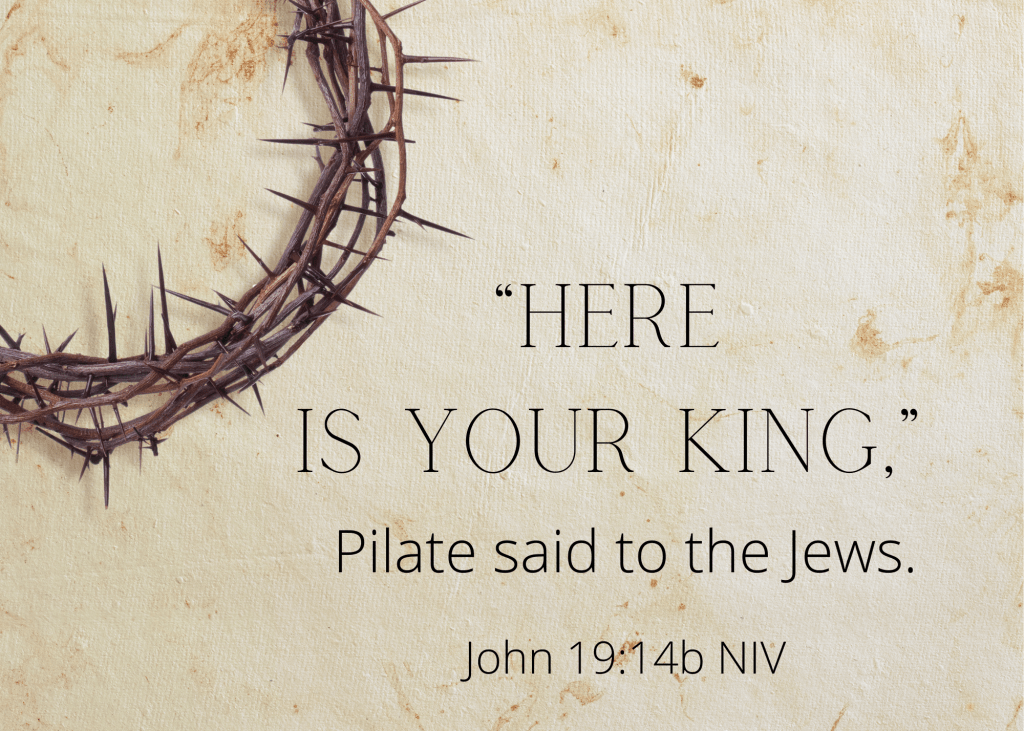
In the Gospel of John Israel gets a do over. God has given them His own son, Jesus, the sinless human representative of God to be their king. After Jesus is arrested and brought before Pilate to be judged and sentenced Pilate looks to persuade the Jewish people to change their minds about Jesus. “Here is your king,” Pilate said to the Jews. But they shouted, “Take him away! Take him away! Crucify him!” “Shall I crucify your king?” Pilate asked. “We have no king but Caesar” the chief priests answered. Finally Pilate handed him over to them to be crucified.”
In the account in Samuel, Israel rejects God as their king so that they can be like everybody else. He gives them that choice. In the Gospel of John, a thousand years after they rejected God as king, God’s son, Jesus, is presented to them as their king, and once again they decisively reject God’s anointed King. Instead, they demanded that he be crucified. They declared their allegiance that day to Caesar, I guess because they wanted to be like everybody else. Not much changed in 1000 years in Israel.
2000 years and half a world a way we still have the same choice. To whom will we give our allegiance? Will we give our allegiance to the principalities and powers of this age. Will we give our loyalty to trying to be like everybody else, going along with the crowd, whatever direction the crowd decides we should be going? Or will we give our allegiance to God’s anointed king, Jesus?
If you are a Christian living in this world you are a resident alien living in exile. Your body may be in Ohio or Indiana or Virginia or India, but your citizenship is in Heaven because that’s where your King is currently living. One day King Jesus will return from heaven to earth and reign right here on earth during the renewal of all things (See 1 Corinthians 15:20-24). But for now, you and I are living in exile and while living in exile we should strive to be respectful and law abiding in areas that don’t conflict with our primary allegiance to King Jesus (See Romans 13). You can be a good citizen in many ways, but never forget that if you are a follower of Jesus, your allegiance is to him first and foremost, not to your country, or your family, or your friends, or your culture or fashion or whatever seeks to define you. Your allegiance must be to Jesus.
Can you be a Christian and still pledge allegiance to the US flag? My childhood classmate John thought, “No, you can’t” and Christians may not always agree on these kinds of questions, but there should be no doubt in your mind as to whom your ultimate allegiance is due, Jesus Christ the King, and God our Father.
-Jeff Fletcher
Today’s Bible reading passages can be read or listened to at BibleGateway here –1 Samuel 7-8 and John 19.
We’re going to take a little break from discussing Joshua today to look at Psalm 69. This is one of the Psalms which is most often quoted or referenced in the New Testament (probably coming in 3rd after Psalm 110 and Psalm 22). Similar to Psalm 22, it is a portrait of a suffering servant. In the New Testament these verses will be used to describe Jesus, the ultimate suffering servant. But most likely, there have been a time or two when you thought theses verses could have been describing you, too.
Have you ever felt like you were sinking? Your troubles choking out your breath? The saddest picture I find is from verse 3 “I am worn out calling for help, my throat is parched, my eyes fail, looking for my God.” You can tell someone needs a hug! They are feeling so desperate. Their suffering is so great!
But this is not the cry of someone who has just had a couple bad days in a row – flat tire, sickness, general stress mounting. No, this is David, Jesus, or you surrounded by enemies. You know you aren’t perfect, certainly God knows that (verse 5) but these enemies don’t want to destroy you for something evil you have done, but for the very God you serve. They don’t understand you or your God so they hate you without reason and seek to bring you down for who and what you stand for. “For I endure scorn for your sake…zeal for your house consumes me, and the insults of those who insult you fall on me…people make sport of me. Those who sit at the gate (the town elders, ie – politicians, city councils, professors and principals) mock me” (Psalm 69:7a, 9, 11b, 12a).
Just this week I heard of the 3rd grader in trouble for wearing her favorite mask to school. It said Jesus Loves Me and the principal didn’t like that. Or the college student who was told he had to reserve a small “free speech zone” on campus from which to speak to others about his Christian beliefs and excitement. And when he complied with their rules he was once again told by campus police that he had to stop because some of the students were still complaining. Luckily the Supreme Court had something to say about that one recently.
Surrounded by enemies. We, in America, are watching our nation slip (or free-fall nosedive) from being a nation of “In God we Trust” where the large majority claimed Christianity to a foreign feeling country where our rights are being restricted at every turn. Suddenly “Dare to be a Daniel” means something to us. As new laws and policies develop, we have a new-found appreciation for what our brothers and sisters in Pakistan and other Christian hostile nations have endured for generations. Surrounded by enemies – for our faith? It feels so strange to us – but we are not the first to feel this way. Remember Paul, repeatedly thrown in jail for the crime of speaking the name of Jesus? David, Daniel, Jeremiah, Jesus, Paul and the disciples, the list goes on and on and includes many modern and Biblical role models and even martyrs. Hopefully you didn’t sign up to be a follower of Christ because you thought it was always going to be easy and pleasant. Surrounded by enemies – for our faith! Christians unite, and take up our armor of God (but that takes us into another devotion for another day).
Back to Psalm 69 – After saying his eyes fail looking for God, and all he does see is enemies who insult God surrounding him, he says, “But I pray to you, O LORD”. He is NOT throwing in the towel. Even though it is sometimes hard to see God in the suffering, we keep on praying to Him, knowing He is the Creator, the Sustainer, our Loving and Powerful Rock. Even when it looks bleak, we know the war is far from over. And, we know who does indeed win the war. And, that is why we don’t give up and don’t give in. We are not swayed by the town elders or those who mock us or try to destroy us because of our God. Our God is bigger.
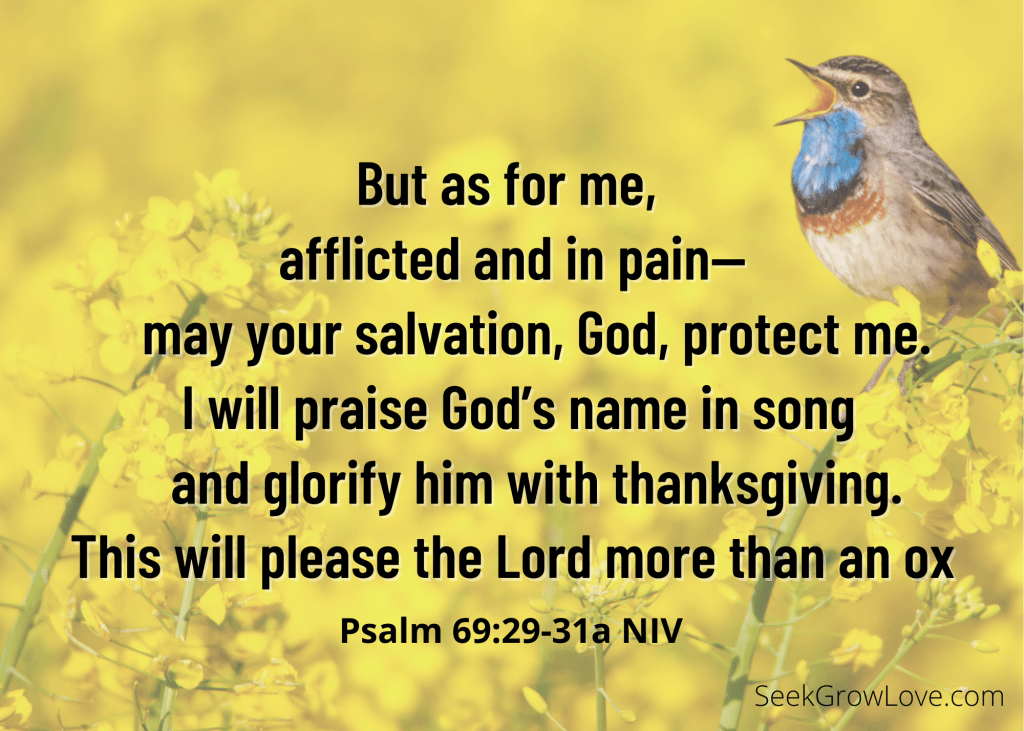
There is one verse towards the end of the psalm that says, “I will praise God’s name in song and glorify him with thanksgiving.” (Psalm 69:30). Doesn’t that sound like he is having a good, sunny, easy day! It’s almost like this verse landed smack dab in the wrong Psalm. Singing, praising, glorifying, thanking. What happened to the enemy surrounds and I am scared and suffering? Oh, it’s still there. In fact, the verse IMMEDIATELY proceeding the praising, singing, glorifying, thanking says, “I am in pain and distress; may your salvation, O God, protect me.” (Psalm 69:29). The trouble isn’t over, but David is still praising. It reminds me of Julie Andrews/ Maria (yes, The Sound of Music was my favorite growing up). Anytime she needed a confidence boost, when she was scared in a thunderstorm, or when the dog bit or the bee stung – she burst into song. We have something much better to sing about than girls in white dresses with blue satin sashes. We have a God who saves, even though we suffer. When we are caught in the storm we have a God who saves. And even while the winds blow and our enemies surround we can pray and lift our voice in song. Jesus did, too. After the Last Supper, before going to the Mount of Olives knowing that is where he would be physically surrounded by his enemies, he sang a hymn.
My young cousin got a bag of sour gummy worms for Christmas this past year. The following week, he carried the bag along everywhere he went, proudly savoring each lick. He loved those sour gummy worms! At the end of the week, he tried to give me his precious worms; of course, I declined because I don’t delight in stealing candy from children. As he was leaving my house, he hid the candy in my bedroom because he wanted me to have them. He didn’t have much to give, but he gave all he had and did so sincerely.
Luke describes a similar encounter Jesus had with a poor widow at the temple:
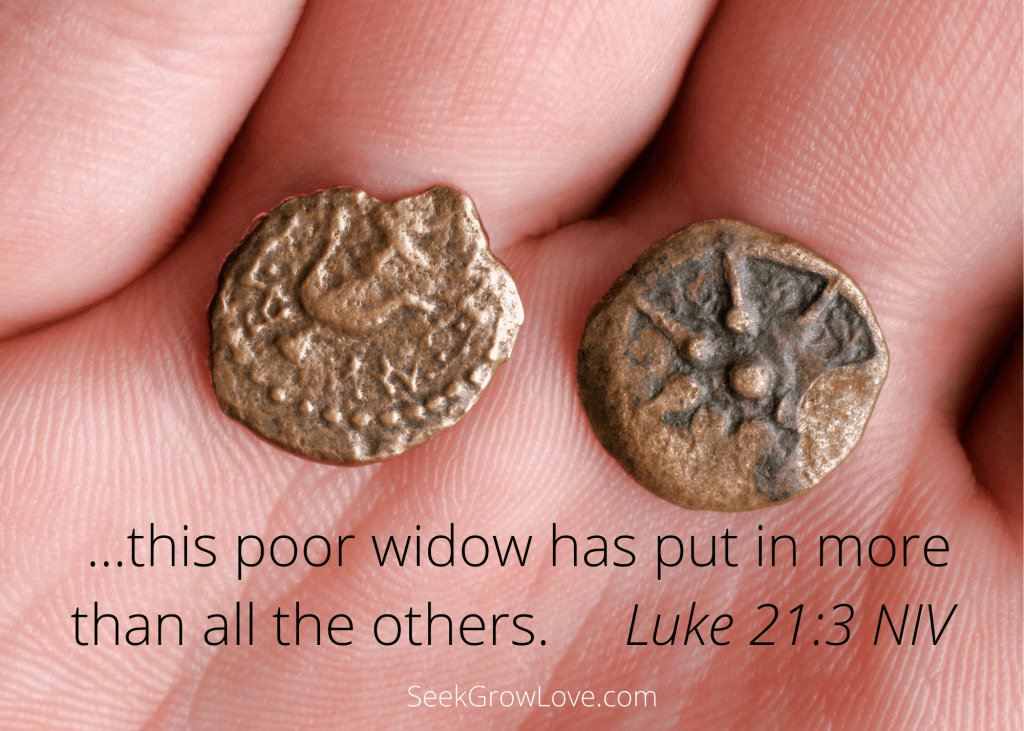
As Jesus looked up, he saw the rich putting their gifts into the temple treasury. He also saw a poor widow put in two very small copper coins. “Truly I tell you,” he said, “this poor widow has put in more than all the others. All these people gave their gifts out of their wealth; but she out of her poverty put in all she had to live on.” (Luke 21:1-4)
We know three things about the woman mentioned: she was poor, she was a widow, and she gave a small amount of money to the church. Her story isn’t flashy and her name isn’t even mentioned. Yet, she honored God by giving the little she had. And you know what? Jesus said her gift was greater than all the others.
Jesus had spent the past day discussing the intricate details of religious rules and hypothetical situations. They were concerned with religion, but perhaps not the conditions of their hearts. Their attitudes are juxtaposed by the poor widow whose heart was generous and faithful. By the world’s standards, the poor widow’s actions were foolish. She should have used the money to feed her family and allowed the Jews with more money to support the church. In God’s eyes, her giving was a reflection of her faith, and I am sure her family didn’t go hungry that night.
To be clear, God doesn’t need your money—neither your time nor gifts.
I could have bought my own bag of sour gummy worms at the gas station down the street. In the same way, God can accomplish anything and everything by his own accord. However, He still wants your sour gummy worms, copper coins, and anything you have to give.
God wants your trust.
God wants you to participate in the mission of the Church.
God wants to bless you.
-Mackenzie McClain
Today’s Bible reading passages can be read or listened to at BibleGateway here – Deuteronomy 25-26 and Luke 21








 Seek Grow Love