God Provides Miracles

2 Kings 1-4

In Second Kings chapter 4 we find the account of four miracles.  These miracles impacted people in big ways and in small ways.  The first miracle is of replenishing oil that a woman used to sell and pay off debts and live on the remainder.  The second miracle is the healing of the Shunammite’s son.  The third miracle is the poison removal from a bad stew.  The fourth miracle is the feeding of a hundred people with an amount of food that does not seem sufficient.  Where each of these miracles is different from the others, I see from the four miracles combined how God provides for His people in their times of need and typically in ways that seem unexpected.

Some of these miracles may sound familiar to other miraculous events.  The replenishing oil reminds me of the widow of Zarephath in First Kings 17, whose oil and flour did not run out throughout an extended famine.  The healing of the Shunammite son reminds me of the healing of the son of the widow of Nain in Luke 7.  The feeding of the hundred reminds me of the feeding of the 5,000 in Matthew 14.  Each of these miracles is similar to other times in the Bible in which God provided miraculously.  However, I’m stumped to find another account quite like the poisonous stew.  The closest I can come up with is the water to wine from John 2.  However, that miracle does not change the undrinkable to the drinkable.

Therefore, I’d love to consider this miracle of the poisonous stew for a moment and consider a couple things we can learn from it.  One that may go without saying is the public service announcement to not eat unfamiliar items we scavenge from outside.  There are many healthy food products in nature, but there are some that are inedible or even poisonous.  Unless we are certain of their edibility, we should stay away from mushrooms, berries, seeds, and plants.

A spiritual lesson to consider is the lesson of dependence on God and His provision in ways we might not expect.  Proverbs 3:5 says, “Trust in the LORD with all your heart and lean not on your own understanding”.  There are times God provides a miracle that would seem to align with what we are most hoping.  I think of a mass or tumor found which miraculously shrinks in size.  However, there are also times in which God provides the miraculous when things do not align with what we are most hoping.  I think of a person who dies, but their spouse, in their mourning, responds with honor and dignity, pointing people to the God who gives strength, peace, and salvation.  This can be truly miraculous.  It is God providing far beyond the strength or understanding of a person.  God’s provision is so personal and so specific.  He meets our needs in ways that go beyond our understanding, even when it is not the outcome we want or expect.  This is why our proactive approach to life ought to be to trust in the LORD with all our hearts!

It is a blessing that God reveals in the Bible how He consistently works personally in the lives of His people.  He even uses the often-forgotten miracles like restored poisonous stew to show His graciousness to us personally.  He is a God we can trust!

-Michael Cisler

Reflection Questions

What are some of the ways you have seen God work in your life?

What is a way in which you have experienced a miracle?

How are you trusting God today?

What is something you can trust God with today?

Family Isn’t Everything

Genesis 20-23

I have never seen a beautiful piece of wall art with the words “Family Isn’t Everything”.  I’ve never seen it on a Mother’s Day mug or bookmark, t-shirt, keyring or tombstone.  Rather, we are all very familiar with the motto “Family IS Everything”.  Whether it’s from the Walmart aisles, Etsy and Pinterest sites or President Biden’s farewell address, we’ve seen it, we’ve heard it, we’ve lived it.  It’s a societal norm or expectation.  Those who can’t say Family Is Everything might have really really bad families or really screwed up priorities.  OR – they just might be listening to and obeying God and working hard at keeping God and God alone first place in their life.  I have a feeling we wouldn’t find Abraham wearing the “Family is Everything” t-shirt.  And God blessed him for it. 

No doubt Abraham loved and cherished the family that God gave to him.  Can you imagine waiting 100 years for the child you could keep?  Today’s reading also describes his heartache over losing/sending away his firstborn son Ishmael.  Being a parent is hard.  Being a godly parent is also not easy.  But I am reminded, perhaps as Abraham was, of the purpose God had in giving Abraham a child which was recorded in yesterday’s reading.  In Genesis 18:19 God said, “For I have chosen him, that he may command his children and his household after him to keep the way of the Lord by doing righteousness and justice, so that the Lord may bring to Abraham what he has promised him.”  In teaching Isaac to keep the way of the Lord, Abraham needed to live it out himself – not by doing what the world says is right (“family first”), but listening to and following through with what God says, even when we don’t understand why. 

And Abraham did.  When God said “Take your son, your only son Isaac, whom you love, and go to the land of Moriah, and offer him there as a burnt offering on one of the mountains of which I shall tell you” – Abraham did – “and he rose early in the morning” and got moving. (Genesis 22:2,3 ESV).  I admire not only his actions but his speed and timing in listening and obeying.  He got going and followed through.  He also had a three day journey in which he could have changed his mind, turned around and decided family is everything.  But he didn’t.  He continued onward to the exact place that God told him to go.  At the start he knew he was heading toward the region of Moriah and God would tell him which mountain to go to.  I read online that some say the mountain God sent Abraham to was Golgatha, in case you are looking for more foreshadowing and similarities between what God was asking Abraham to do and what He Himself (the loving, righteous and just God) would do for us with His only son whom He loved.  Thankfully God did not let His perfect love for His perfect Son keep Him from offering Jesus up to save the guilty condemned, you and I.  God’s t-shirt would not say “Family is Everything” but maybe more along the lines of, “I gave everything for my adopted family”. 

But, one more point about this mountain that God sent Abraham to…for it was there that God had a great surprise hiding – a ram caught in the thicket by his horns.  And it was there that God provided for Abraham and Isaac in a very big way. If you haven’t read Genesis 22 yet today, please do. I am guessing God didn’t place a ram stuck on every mountain nearby just in case Abraham decided to end up at a different mountain than the one God told him to go to.  Similarly, if we are looking for God to provide – let’s show up on the mountain He tells us to go to. 

-Marcia Railton

Reflection Questions

  1. What does it look like when we live by “Family is Everything” and put family before God? What does it look like when we love the family God gave us dearly and set an example for them of being righteous before God and putting God first?
  2. Is there anything you have tried to withhold from God? What does it mean to you that God did not withhold His Son?
  3. Have you ever been upset God didn’t provide as you wanted Him to – and then realized you were in the wrong place to receive what He had all prepared and ready to give? Does it count to do most of what God says if you aren’t prepared to do all of what God says?
  4. What do you think of Abraham? How do you think he earned the title “Friend of God”? Would you like to be known as a friend of God – could you honestly wear the “Friend of God” t-shirt? What specifically can you do today, this week, month and year to grow more and more like a true friend of God?

God Provides in Times of Testing

Old Testament: Genesis 21 & 22

Poetry: Psalm 8

New Testament: Matthew 8

God had promised Abraham, in Genesis 17:19, “Your wife Sarah will bear you a son, and you will call him Isaac.  I will establish my covenant with him as an everlasting covenant for his descendants after him.”

At this point, Abraham was over 100 years old, and had faithfully followed God.  In Genesis 12, Abraham obeyed when God told him to leave his country and family.  Abraham allowed Lot to take the lush land around Sodom in Genesis 13, and trusted God to provide for his own flocks and herds on barren mountains.  In Genesis 15, Abraham trusted God’s promise that he would have a son in his old age, and God counted that faith as righteousness.

In Genesis 22:2, we find God commanding Abraham, “Take your son, your only son, Isaac, whom you love and go to the region of Moriah.  Sacrifice him there as a burnt offering on one of the mountains I will tell you about.”

This doesn’t make sense.  God had explicitly promised that God’s promises to Abraham would be passed down through Isaac’s descendants, and now God was commanding Abraham to sacrifice him – apparently destroying the promise He had made to Abraham.

By this point, Abraham had developed a very close relationship with God.  In fact, we’re told 3 times in the Bible that Abraham was God’s friend (2 Chron 20:7, Isaiah 41:8, James 2:23) – and as far as I know, Abraham is the only person in the Bible of whom this is said.

We’re told in Hebrews 11:19 that Abraham reasoned that God was able to raise the dead, and that He was going to keep His promise.

So early the next morning, Abraham took Isaac and 2 servants and left for the place God told him to go.  When they got close, Abraham told the servants, “Stay here with the donkey while I and the boy go over there.  We will worship and we (emphasis added) will come back to you.”

As they got even closer, Isaac asked his dad, “The fire and wood are here, but where is the lamb for the burnt offering?”

Can you imagine how this must have broken Abraham’s heart, looking down into his son’s questioning face, knowing that in a few minutes he would be killing his beloved son, who would be the offering?  Abraham answered, “God himself will provide the lamb.”  (Actually, God had provided Isaac – as a miracle baby in his parent’s old age.)  When they reached the place God had told him about, Abraham built an altar, arranged the wood, tied up Isaac, and laid him on the altar.  

As he was getting ready to kill Isaac, the angel of the Lord called to him from heaven and stopped him.  Abraham then saw a ram caught in the brush by its horns, and sacrificed it instead.  God then promised Abraham, as recorded in Genesis 22:16-18, “I swear by myself, declared the Lord, that because you have done this and have not withheld your son, your only son, I will surely bless you and make your descendants as numerous as the stars in the sky and as the sand on the seashore… and through your offspring, all nations on earth will be blessed, because you have obeyed me.”

I could point out all the similarities of Abraham’s being willing to sacrifice his son Isaac, and God being willing to sacrifice His Son, Jesus.  I could point out the significance of another quote from this chapter, “Jehovah Jireh – on the mountain of the Lord it will be provided.”  (This was the mountain where Soloman’s temple was built hundreds of years later.)  I could point out the importance of obeying God, and the benefits that result.

Instead, I want to comment on who, when, where, how, and why of God’s provision.  

Who:  God tested Abraham with a very difficult test even after a life of serving God.  We see that God provided the ram in this case only after Abraham trusted and obeyed God – even though it didn’t make sense.  Assertion:  God provides for those who trust Him and obey Him.  

When:  God provided for Abraham at the very last minute, not before.  We’re told in Hebrews 4:16 that we will “receive mercy and find grace to help us in our time of need.”  Assertion:  God provides precisely when we need something, not when we think we need it.  (i.e.  according to God’s timing.)

Where:  God provided for Abraham only after Abraham went where God told him to go, and after he obeyed everything God told him to do.  Assertion:  God will provide if we are where He wants us to be.  We should have no expectation of receiving God’s provision if we aren’t where He wants us to be. 

How:  God didn’t send an angel from heaven with an offering for Abraham to sacrifice, God provided a normal ram, caught in a normal thicket, by it’s normal horns.  And God didn’t send a whole flock of sheep, just one ram, because that was all that was needed.   Assertion:  God will usually provide in ways that are very natural – don’t look for miracles.

Why:  In times of testing, it’s easy to only think about our problems, and focus on, “why is this happening to me?”  I think there may be two general reasons why trials come.  First, we are told in Romans 8:28, “And we know that in all things God works for the good of those who love Him, who have been called according to His purpose.”  Note that this only applies if we are living according to His purpose.  Also note that trials are by definition difficult, and won’t seem to be beneficial at the time.  Second, ultimately, everything is for God’s glory.  Isaiah 43:7 says, “everyone who is called by my name, whom I created for my glory…”  We see an example of this with God destroying Pharaoh and his army for God’s glory in Ex 14:4, 17.  Assertion:  God allows trials and gives provision for our good and for His glory.

The bottom line is, if we are faithfully following God, times of testing will come.  If we remain true to God, if we are where He wants us to be, and if we are obedient to Him, he will provide what we need (not necessarily what we want), at the very last minute, usually through normal means – and this is for our good.  If we aren’t following God, the times of testing may just be to bring Glory to Him.  I’d rather be in that first group.  How about you?

–Steve Mattison

(originally posted January 11, 2021 for SeekGrowLove)

I am sorry this was not posted this morning – I thought it was – and then was surprised to see it still sitting here this evening. We are enjoying a weekend of reFuel North, a youth retreat in northern Indiana and haven’t been on the computer today. 

Reflection Questions

  1. In what times of testing have you seen God provide for you? How?
  2. Are you where God wants you to be now so that He can provide for you?
  3. What do you learn from Abraham in Genesis 21 & 22?

The Lord be with You

*Old Testament: Ruth 1 & 2

Poetry: Psalm 118

New Testament: Luke 18

Today we begin reading the book of Ruth, which is both enjoyable and easy to read; a book without heavy theology to parse. The importance of the book is made plain at its end (for a preview, look to Ruth 4:17), in that it identifies a certain history of the family of the later King David. In that sense, it serves the Old Testament purpose of remembrance. In this case, it establishes a back story for the royal family (which ultimately leads to Jesus himself), but it also shows the providential role of God in that family. Like the passages in the Book of Judges, an important purpose of the text is to remind Israel how God established a relationship with the nation and then provides, cares for, and protects the nation.

Chapter 1 of Ruth provides the context for the remainder of the book: a family’s migration to Moab, and Naomi’s return to Bethlehem with the unexpected companion, Ruth. Chapter 2 is where the action of this story is established, with Ruth going to glean in Boaz’s fields and the repeated acts of kindness that he shows to her. We must also recognize the extent of his kindness as well: Boaz is obligated to leave some of his unharvested crops for the poor (see Leviticus 23:22), but he goes above and beyond this in his instructions to his servants to purposely leave grains for Ruth. She must have been confused, perhaps embarrassed by the kindness of Boaz, but it all leads to Naomi recognizing Boaz:

“The man is our relative, he is one of our closest relatives.” (Ruth 2:20 NASB)

Unfortunately, the depth of the term “closest relative” is not adequately captured in translation. The Hebrew term means “kinsman redeemer” – a family member that satisfies an obligation or vengeance of another in the extended family. Specific examples are the man that, following the Torah, marries his brother’s widow to preserve land inheritance, but also one who redeems a family member from slavery. This usage takes us to a second purpose of the Old Testament: prefiguring. Boaz, as a “kinsman redeemer” for the family of Naomi, prefigures Jesus as the one that redeems his family: Israel and (as we now know) Gentiles grafted in.

One aspect of Ruth that I greatly enjoy is the ordinariness of the spiritual expression of its characters. Without being ostentatious, the characters of the book recognize the providential role of God repeatedly and reflect it back to others to further recognize God’s role in their daily lives. Consider the statement of Ruth and Orpah in 1:8,9:

“May the LORD deal kindly with you as you have dealt with the dead and with me. May the LORD grant that you may find rest, each in the house of her husband.”

It is not enough for Naomi to wish her daughters-in-law success in their presumed departure; she specifically calls on God to give them that success in their new lives.

Then consider the dialogue between Boaz and his servants in 2:4:

Boaz to his servants: “May the LORD be with you.”

Servants’ response: “May the LORD bless you.”

I think the implication is that Boaz and his servants lived lives suffused in the presumption that God would be with them in every action, in every step along every path. Think about it further: Boaz and his servants were not going to war or going on a trip; they were simply going to the fields for the ordinary work of the day. Yet, he begins the day with a blessing on his servants.

In today’s culture, we increasingly compartmentalize our lives, even our spiritual lives. We work for some hours of the day, we take care of our daily obligations, and, hopefully, we set aside time to relax. More than likely prayer is a “carved out” time and time reading scripture may have to be scheduled. The alternative is to suffuse the entire day with the recognition that God is with us at every moment, and that prayer can and should be spontaneous and simple – ordinary. That we can take any moment to request God’s blessing on another.

This reminds me of an experience from childhood that might be odd to some. One summer, sometime in my teenage years, I had taken my youngest sister on a bike ride to the post office ostensibly for an errand, but mostly to be outside. At the post office, we encountered two nuns in the waiting area. (This was not out of the ordinary, there was a very active convent in my hometown.) One of the nuns leaned down, laid her hand on my sister’s head, and spoke a very simple blessing on her. Then she went back to her business, without skipping a beat. For that woman, living a life devoted to serving others in the name of God, speaking a blessing on a young child was utterly ordinary – she simply wanted to express God’s love to a child.

One of the messages of the Book of Ruth is that God is present in all parts of our lives. We can endeavor to purposefully include our appreciation for God for who He is and to share His love for all people in every moment of our day.

-Dan Siderius

Dan Siderius is a member of the Fair Oaks Community Church of God in Virginia. He lives in central Maryland with his wife and daughter and works as a research scientist for a government laboratory. Apart from work and parenting, he enjoys studying history, gardening, and all varieties of cooking.

Reflection Questions

  1. How can you break your spiritual life out of its compartment this week and mix it with your ordinary every day life? What are the benefits to doing so?
  2. How and to whom can you share remembrances of God providing, caring for and protecting? How can you seek to more regularly and often request God’s blessings on others?
  3. In what ways are Boaz and Jesus similar? In what ways are they different?
  4. What do we learn of God, and His Son Jesus, in our Bible readings today?

Your Longing

Old Testament Reading: Deuteronomy 15 & 16

* Psalms Reading: Psalm 84

New Testament: Galatians Intro below

We are currently looking for a new house.  We love where we are now, but we’re outgrowing our space and ready to raise our family with more room!  We have toured SEVERAL houses, put in offers for a few, and yet still have nothing to show.  I’m looking for a house that fits my needs, or at least one that I can alter (without too much cost) that will give me happiness in a home.  I would say right now, I am yearning for a house.  There have been moments where I have even shed a tear of disappointment, frustration, and sadness over ‘losing’ a house that was never mine.  There are times where there is intense emotion behind my desire for a dwelling place.

God sure has a funny way of teaching me lessons… He really likes to teach me especially while I am trying to teach others.  When I signed up for this week of devotions, I hadn’t even met with a realtor.  Now, as I type up this message, I just spent three days stressing over what amount to offer on a house only to be rejected without a counter within hours and I opened up my Bible to “Longing for God’s House”… ironic, huh? So now, here I am reminding you but reminding me that the house I should be longing for is the house of God (Psalm 84:2).  My heart is aching for a space to call home, and yet I am ignoring the promise of a dwelling place of the LORD of Hosts (v. 1).  I’m out here struggling to feel “happy” with my current circumstance, but I have forgotten that I can reside in the house of an Almighty God and I should be praising Him CONTINUALLY (v.4)! 

We are told God gives grace and glory; that he doesn’t withhold the good from those who live with integrity (v.11).  I have been so focused on seeking out something for myself rather than focusing on how I am living and trusting God to show me the good He is providing.

Maybe you aren’t looking for a physical home right now, but I bet you are searching and yearning for ­something.  Maybe it’s a promotion at work, a hand to hold, a new car, to finish school, peace for your mental health, anything.  Everyone in some capacity is seeking “happiness”.  Are you looking in the right place?

-Sarah Johnson

Hello!  I am Sarah (Blanchard) Johnson.  My husband and I just welcomed little Eli in August of 2022 and we are LOVING being parents, although we miss some sleep too… We live in Minnesota and attend Pine Grove Bible Church; I have a heart for missions and would love to talk to you about it!

Questions for Reflection:

This Psalm gives us four ways to be happy:

1.       Reside in God’s house

2.       Praise God continually

3.       Get your Strength from God

4.       Trust in the LORD of Hosts

Which area do you need to focus on to feel happy?  Is there more than one?

I found one verse especially that caught my eye in how God reveals Himself… Which verses did you find?

Prayer:

LORD of Hosts, I pray today for myself and others, that we put our energy into longing for your house.  I pray that we live our lives with integrity so we can experience your good things.  I pray those seeking happiness find it through trusting in you.  God, thank you for all you are and all that you do in our lives each day.  We praise you for the promise of a perfect dwelling place to come.  In your son’s name, Amen.

And, in preparation for starting the book/letter of Galatians tomorrow in our New Testament reading, here’s Steve with our…

Introduction to Galatians

Paul wrote the book of Galatians to the churches in Galatia.  Paul was very direct in addressing their turning away from the gospel.  In 1:6, Paul says, “I am astonished that you are so quickly deserting the one who called you by the grace of Christ and are turning to a different gospel…”  This was obviously a serious problem, since Paul then went on to say in 1:8, “But even if we or an angel from heaven should preach a gospel other than the one we preached to you, let him be eternally condemned!”

You’ll find out in Chapter 3 that their problem was that they were trying to be justified by observing the law.  Paul argued that justification comes through faith in Jesus alone, not by works performed according to the law.

Paul also pointed out that as far as Christ is concerned, there is no distinction between Jew or Gentile, slave or free, male or female – all are one in Christ.  Paul then went on to say that if they belong to Christ, then they are Abraham’s descendants, and heirs according to the promises to Abraham.  This applies to us today, as well.

Paul defined the fruits of the Spirit: love, joy, peace, patience, kindness, goodness, faithfulness, gentleness, and self-control.  He also pointed out that they (and we) should live by the Spirit, and not gratify the desires of the sinful nature.

In 6:7-8, Paul wrote, “Do not be deceived: God cannot be mocked.  A man reaps what he sows.  The one who sows to please his sinful nature, from that nature will reap destruction; the one who sows to please the Spirit, from the Spirit will reap eternal life.”

The book of Galatians is just as relevant to us today as it was to the original audience when it was written.  As you read it, consider how this letter applies to you today.

-Steve Mattison

Will He Provide?

Old Testament Reading: Genesis 21 & 22

Psalms Reading: Psalm 13

New Testament Reading: Matthew 12

God had promised Abraham, in Genesis 17:19, “Your wife Sarah will bear you a son, and you will call him Isaac.  I will establish my covenant with him as an everlasting covenant for his descendants after him.”

At this point, Abraham was over 100 years old, and had faithfully followed God.  In Genesis 12, Abraham obeyed when God told him to leave his country and family.  Abraham allowed Lot to take the lush land around Sodom in Genesis 13, and trusted God to provide for his own flocks and herds on barren mountains.  In Genesis 15, Abraham trusted God’s promise that he would have a son in his old age, and God counted that faith as righteousness.

In Genesis 22:2, we find God commanding Abraham, “Take your son, your only son, Isaac, whom you love and go to the region of Moriah.  Sacrifice him there as a burnt offering on one of the mountains I will tell you about.”

This doesn’t make sense.  God had explicitly promised that God’s promises to Abraham would be passed down through Isaac’s descendants, and now God was commanding Abraham to sacrifice him – apparently destroying the promise He had made to Abraham.

By this point, Abraham had developed a very close relationship with God.  In fact, we’re told 3 times in the Bible that Abraham was God’s friend (2 Chron 20:7, Isaiah 41:8, James 2:23) – and as far as I know, Abraham is the only person in the Bible of whom this is said.

We’re told in Hebrews 11:19 that Abraham reasoned that God was able to raise the dead, and that He was going to keep His promise.

So early the next morning, Abraham took Isaac and 2 servants and left for the place God told him to go.  When they got close, Abraham told the servants, “Stay here with the donkey while I and the boy go over there.  We will worship and we (emphasis added) will come back to you.”

As they got even closer, Isaac asked his dad, “The fire and wood are here, but where is the lamb for the burnt offering?”

Can you imagine how this must have broken Abraham’s heart, looking down into his son’s questioning face, knowing that in a few minutes he would be killing his beloved son, who would be the offering?  Abraham answered, “God himself will provide the lamb.”  (Actually, God had provided Isaac – as a miracle baby in his parent’s old age.)  When they reached the place God had told him about, Abraham built an altar, arranged the wood, tied up Isaac, and laid him on the altar.  

As he was getting ready to kill Isaac, the angel of the Lord called to him from heaven and stopped him.  Abraham then saw a ram caught in the brush by its horns, and sacrificed it instead.  God then promised Abraham, as recorded in Genesis 22:16-18, “I swear by myself, declared the Lord, that because you have done this and have not withheld your son, your only son, I will surely bless you and make your descendants as numerous as the stars in the sky and as the sand on the seashore… and through your offspring, all nations on earth will be blessed, because you have obeyed me.”

I could point out all the similarities of Abraham’s being willing to sacrifice his son Isaac, and God being willing to sacrifice His Son, Jesus.  I could point out the significance of another quote from this chapter, “Jehovah Jireh – on the mountain of the Lord it will be provided.”  (This was the mountain where Soloman’s temple was built hundreds of years later.)  I could point out the importance of obeying God, and the benefits that result.

Instead, I want to comment on who, when, where, how, and why of God’s provision.  

Who:  God tested Abraham with a very difficult test even after a life of serving God.  We see that God provided the ram in this case only after Abraham trusted and obeyed God – even though it didn’t make sense.  Assertion:  God provides for those who trust Him and obey Him.  

When:  God provided for Abraham at the very last minute, not before.  We’re told in Hebrews 4:16 that we will “receive mercy and find grace to help us in our time of need.”  Assertion:  God provides precisely when we need something, not when we think we need it.  (i.e.  according to God’s timing.)

Where:  God provided for Abraham only after Abraham went where God told him to go, and after he obeyed everything God told him to do.  Assertion:  God will provide if we are where He wants us to be.  We should have no expectation of receiving God’s provision if we aren’t where He wants us to be. 

How:  God didn’t send an angel from heaven with an offering for Abraham to sacrifice, God provided a normal ram, caught in a normal thicket, by it’s normal horns.  And God didn’t send a whole flock of sheep, just one ram, because that was all that was needed.   Assertion:  God will usually provide in ways that are very natural – don’t look for miracles.

Why:  In times of testing, it’s easy to only think about our problems, and focus on, “why is this happening to me?”  I think there may be two general reasons why trials come.  First, we are told in Romans 8:28, “And we know that in all things God works for the good of those who love Him, who have been called according to His purpose.”  Note that this only applies if we are living according to His purpose.  Also note that trials are by definition difficult, and won’t seem to be beneficial at the time.  Second, ultimately, everything is for God’s glory.  Isaiah 43:7 says, “everyone who is called by my name, whom I created for my glory…”  We see an example of this with God destroying Pharaoh and his army for God’s glory in Ex 14:4, 17.  Assertion:  God allows trials and gives provision for our good and for His glory.

The bottom line is, if we are faithfully following God, times of testing will come.  If we remain true to God, if we are where He wants us to be, and if we are obedient to Him, he will provide what we need (not necessarily what we want), at the very last minute, usually through normal means – and this is for our good.  If we aren’t following God, the times of testing may just be to bring Glory to Him.  I’d rather be in that first group.  How about you?

–Steve Mattison

Reflection Questions

  1. Abraham’s thoughts and feelings aren’t recorded much in Genesis, what do you think he may have been thinking and feeling on that 3 day trip to where God wanted him – and after? What similarities do you find in Psalm 11?
  2. How and when has God provided what you needed? What did you learn about God from that experience?
  3. Is there anything that you may be holding onto too tightly, loving more than God? How can you practice trusting and obeying God and not withholding from Him?
  4. What did God reveal about Himself to you in your reading of His words today?

Freewill in the Vineyard

Isaiah 5

Sunday, October 23, 2022

Editor: For the next three weeks we will be spending some time looking at the books of prophecy from the Old Testament – with at least one devotion for every book. Then, mid-November we will be ready to start Revelation, one chapter a day. And we will finish off the year with the last gospel we have not yet read this year: Luke. Keep Seeking God in His Word! SeekGrow(good fruit)Love!

We have all desired to be the plant lady/man at some point in our lives. We go to the store and get a cute little house plant, and then we put it on our windowsill and water it once or twice a week, depending on the type of plant.

            But, if you are anything like me, you do not have the greenest thumb, and most of the time your plant ends up looking… well, dead.

            My point is, that even though we may water that plant, and provide it with the best soil. If the plant were to cover itself up under a blanket and hide, it will never grow, and will eventually die.

            That is what Isaiah 5 talks about in the song of the vineyard.

            Isaiah 5:1-2

I will sing about the one I love, a song about my loved one’s vineyard: the one I love had a vineyard on a very fertile hill. He broke up the soil, cleared it of stones, and planted it with the finest of vines. He built a tower in the middle of it and even dug out a winepress there. He expected it to yield good grapes, but it yielded worthless grapes.”

            In this passage we are depicted as the vineyard, and God is the tender of us. He provides us with everything we need, and pursues a relationship with us, for us to live for him, and spread his word.

            It is because he gives us freewill that we can choose him and grow healthy fruit that can be shared. It is we who decide what kind of fruit we are going to grow in the vineyard with our actions, and what we focus on.

Jerusalem at this time was not following God’s commands. They were pursuing drunkenness, compound sinfulness (denying your sin), and amalgamation of land (combining of land together with small properties). Today we aren’t necessarily combining land, but we may be pursuing other things that are not what God wants us to pursue.

God wants us to consider this, just as he wanted Jerusalem to consider it.  Who was to blame for the worthless grapes? What caused the worthless grapes? And how can we produce healthy grapes?  We have the free will to choose what we want to produce.  Be the change.

-Hannah Eldred

Reflection Questions

  1. In what way/ways have you noticed your garden producing worthless fruit?
  2. How can you trust and grow closer to God, while letting him work your vineyard?
  3. How can you produce positive fruit and influence change?

How can we feed 5 thousand with so little?

Mark 6

Thursday, July 28, 2022

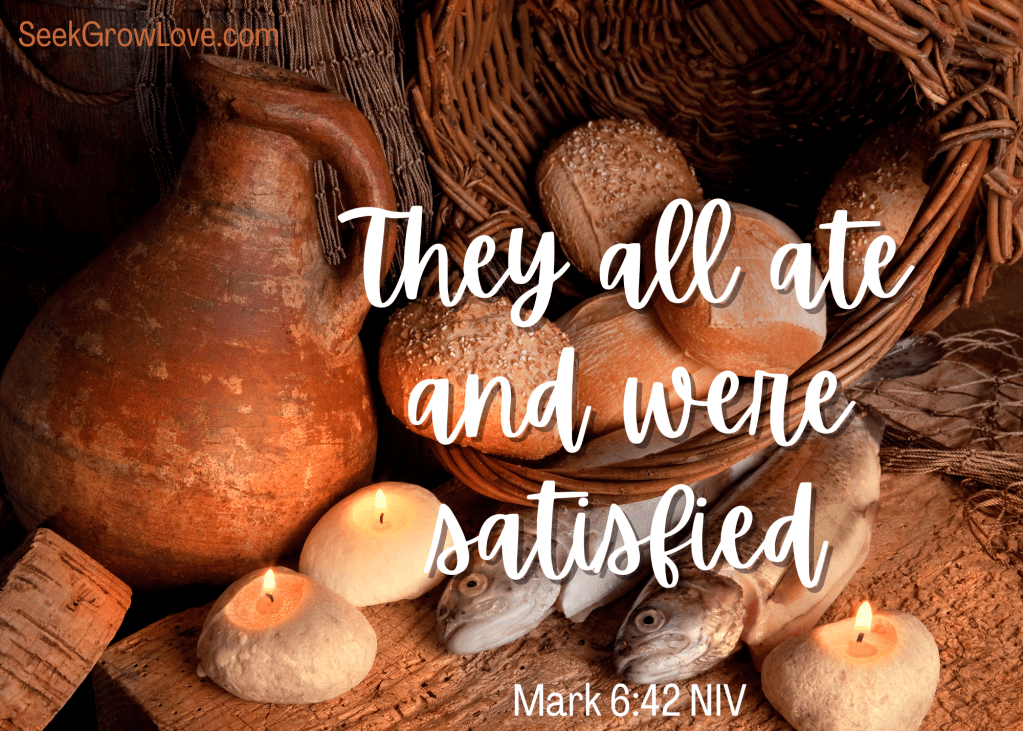
Everyone knows the story of Jesus feeding the five thousand. It is one of the classic stories that we first learn in bible school! While it is a very simple story, there is hidden meaning in the words. Yes, it is a story of how incredible Jesus was, and it showed how faithful people were to him, but what else does it mean?

Mark 6:34, is where Jesus first notices the people gathered on the shore. He says they were like, “Sheep without a shepherd”, and he has compassion for them. He sees people who are lost and makes sure to go and guide them towards life and hope.

But the thing I want to focus on is when he talks with the disciples and feeds the people.

Mark 6:35-44.

Once it was late, the disciples went to Jesus and told him that he should send the people away so they could eat. Jesus responded and told the disciples to feed the crowd of people. I can only imagine the looks on their faces! They responded, asking Jesus if they should go buy 200 denarii worth of bread. Finally, Jesus tells them to go and see how many loaves of bread are in the crowd – five loaves and two fish.

            Now imagine being a disciple at this point. They have seen Jesus do miracles, but this must seem nuts! They have nothing close to being enough to feed these people, but they knew he would somehow do it. This is what God wants us to be like with our faith. We may feel like we are standing in front of a mountain, but God wants us to trust him and know that with his strength, we can do anything. Whether that’s feeding five thousand or climbing a mountain.

Jesus then looks to the heavens while breaking the loaves and dividing the fish, and there was enough to feed and satisfy everyone, and there was extra.

This story touches my heart because it describes how we can do so much with only a little. We do not start with everything we think we need, but God provides abundantly more than we could ever imagine as we work to reach his people. No matter what our purpose is, God provides everything we need, we just must have faith and be patient, knowing that whatever we are called to, God will provide.

-Hannah Eldred

Application Questions

  1. When have you felt there was no way you would have enough (resources, finances, companionship, wisdom, or faith)? How did it work out for you? In what ways do lean times help grow your faith?
  2. In what ways has God shown Himself to be faithful in your own life, in His word, and in the lives of others?

The Size of Her Miracle

2 Kings 4

March 16

In Steve Mattison’s devotion this past Sunday on 1 Kings 17 he pointed out the difference between God providing for the needs of those who love and serve Him compared to God providing an easy life to those who love and serve Him. One can be counted on, but not the other. We can always count on God to provide what we need, but that is not the same as never being in need. In fact, it is during the more difficult times in our lives that we have the opportunity to put all our faith – and our deeds – into His hands to see how He will provide once again. Those difficult times are faith building opportunities.

2 Kings 4 includes two women with impressive stories of how God provided for them in their time of need through the prophet Elisha.

The first account is of a God-fearing widow with two sons and demanding bill-collectors. She has already lost her husband but now if she can’t pay her debts the bill collectors will take her sons to pay off her debts. Her life has been far from easy. But I love how God would show Himself faithful – working with her and her generous community. God could have just supplied all the coins she needed in the mouth of a fish or something – guess He was saving that “trick” for later. When God provides, it doesn’t mean we just sit and watch, often there is a job for us to do to get things rolling. Sometimes it might mean going out to catch the fish with the coin in its mouth (Matthew 17:24-27). For the widow, Elisha asked her what she DID have. God can use the little bit we are thankful for and recognize we DO have to then multiply our blessings.

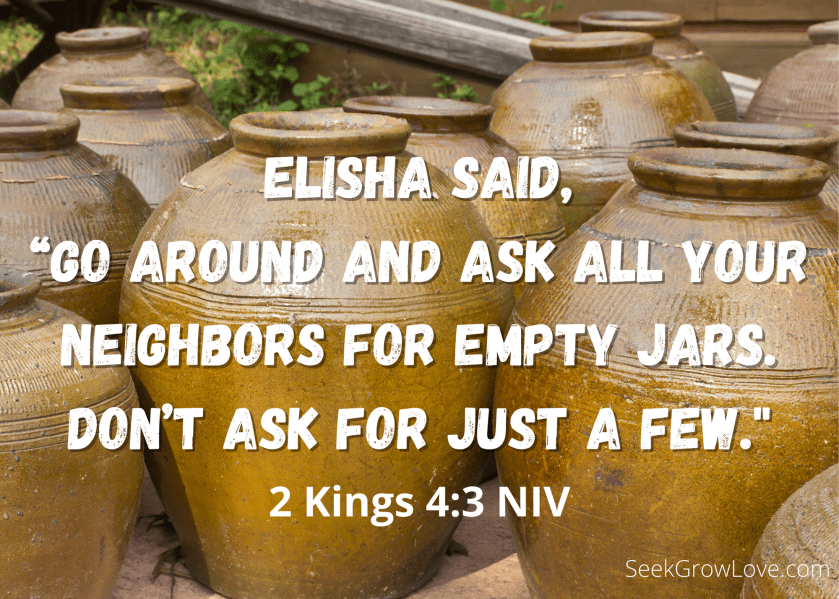
In this case, the widow was also to ask her neighbors for help – she needed their empty jars. Her community had the opportunity to play a part in supporting her. They weren’t going to be the ones paying the debt for her, but they were providing part of what she needed in order for her to faithfully fulfill her role so God could pour out the blessings like only He can do. Elisha told her, “Don’t ask for just a few (jars).” (2 Kings 4:3). If she would have had a bad attitude and said, “This is stupid, I don’t want to ask my neighbors for jars, I don’t like relying on others, how is this going to help? I will just get a handful of jars” then she would have just experienced a tiny miracle and she wouldn’t have had enough to pay off the full debt. God doesn’t need to bless the bad attitudes. Watch your attitude. When the man of God says, “Don’t ask for just a few”, then go out and ask for a lot! The size of her miracle was going to depend on how faithful she was, and how big her view of God was. If she thought God could only help a little, only a few jars would be collected and only that much oil would have poured from her little jar of oil. Thankfully, it appears she collected quite a few, so that so much oil poured from her little jar she would be able to not only sell the new full jars to pay off the debt but then also live off of the rest. God supplied even more than what she needed at that time – because she was faithful to do her part and had a big view of what God could do – and so she listened to and obeyed the man of God.

The second woman in 2 Kings 4 is a well-off woman with a husband but no sons. She recognizes Elisha as a man of God and practices hospitality (first inviting him several times for supper, and then even creating an addition on their house – a small room on their roof – so he could stay overnight.) Their town of Shunem was about half-way between Elisha’s hometown and Mount Carmel, which Elisha still visited regularly, so Elisha would come and go – and was always well provided for when he was with them. So, Elisha promises her a son, a miracle from God as her husband is old and she had resigned herself to a life without children.

The baby is indeed born, but a few years later he dies in her arms, struck with some sudden severe ailment. She carries her dead son to Elisha’s room and lays him on the bed, and then tells her husband in the field that she will need a servant and donkey as she is going to travel to find Elisha. A commentary suggested she didn’t tell her husband of the death of their son for fear that he would have him buried right away as it was hot harvest season. Instead, her faith spurs her on to action. She needs to speak to the man of God. It’s a great story that I can’t tell as well as the writer of 2 Kings – so make sure you read it to see how the story ends…

God provides. He doesn’t just hand out the easy life. Be prepared for difficulties. They don’t mean God is not there, or He doesn’t care. Even in the trials, God provides. He calls you (sometimes through the men and women of God) to step out in faith – still believing even when you are in pain. When you feel at a loss, keep your big view of God and all He can do. God provides.

Questions for Reflection and Discussion

  1. How have you seen God provide for you? What might He have asked of you in order to receive the blessings He wanted to give to you? How did others play a part?
  2. How can you help those in your community who are in the midst of difficult times?
  3. How would you rate your hospitality? What blessings have you (or might you) receive from welcoming others? How can you show hospitality this month?
  4. Why did God allow the death of the Shunammite’s son? Look ahead to 2 Kings 8:1-6 for even more insight. How does God provide even when the dead are not raised – right away?

Elijah – the Lord Jehovah is my God

1 Kings 17

March 13

1 Kings 17 has so much in it, it’s almost impossible to cover it all in one devotion.  It starts with Elijah standing before King Ahab and declaring that there wouldn’t be rain for the next few years, except at Elijah’s command.  We need a little context for this.  King Ahab’s wife was Jezebel, a foreigner, who worshiped Baal.  Baal was the Phoenician fertility god that supposedly sent rain.  Jezebel was actively trying to cause Israel to worship Baal, and was trying to eliminate the worship of Jehovah, the one true God.

God had made promises to Moses long before in Deuteronomy 11:13-14, “If you faithfully obey the commands I am giving you today – to love the Lord your God and to serve him with all your heart and with all your soul – then I will send rain on your land in its season, both autumn and spring rains, so that you may gather in your grain, new wine, and oil.”  In Deuteronomy 28, we find the curses for turning away from God.  In verses 23-24, we find, “the sky over your head will be bronze, the ground beneath you iron.  The Lord will turn the rain of your country into dust and powder; it will come down from the skies until you are destroyed.”

Remember that God always keeps his word, whether it is the promise of blessing for obedience, or of cursing for disobedience.  And in Israel, at that time, the country had already been worshiping the two calf idols that Jeroboam had made many generations before.  Now, the Israelites were increasing their rebellion by completely turning away from God, so God sent Elijah to Ahab to punish the country, and to set up a showdown three and a half years later to prove once and for all who was the real God.

Once Elijah had delivered his message, God sent him to a ravine, where ravens brought him food twice a day, and he drank from a brook – until it dried up.

Then, God sent Elijah to a poor widow in a foreign country.  Elijah asked her for some water and food.  The widow told him (1 Kings 17:12), “I don’t have any bread – only a handful of flour in a jar and a little oil in a jug.  I’m gathering a few sticks to take home and make a meal for myself and my son, so that we may eat it – and die.”

Elijah told her that if she baked that bread for him, after that, she could bake some for herself and for her son – because God would cause the flour and oil not to run out until the famine was over.  If you were that widow, would you have given your last meal to a stranger?  She did, and as a result of her faith and God’s blessing, her flour and oil did not run out – just like Elijah had said.

Eventually, the widow’s son got sick and died.  Elijah prayed, “O Lord my God, let this boy’s life return to him!”  And in verse 22, we read, “The Lord heard Elijah’s cry, and the boy’s life returned to him, and he lived.”  Incredible!

I see several applications in this chapter to us today.  

Elijah was a godly man.  His name meant “the Lord (Jehovah) is my God”, and his name fits.  And this was at a time when virtually everyone else had forsaken God.  It’s only because Elijah was a godly man that his prayers were so powerfully answered, and that God protected him.  We too need to be godly if we want good things from God.

Elijah went where God told him to go, and when God told him to go there.  Presumably, God sent Elijah to Ahab.  We know that God sent him to the Kerith Ravine – and because of his obedience, God provided for him.  Then, after the brook dried up, Elijah didn’t go anywhere until God told him to go to Zarephath and meet up with the widow God had arranged.  Again Elijah obeyed, and God provided.  We need to be willing to do what God says, when he says it, if we expect God to provide for us.

Elijah experienced hardship, even though he was obviously doing God’s will.  He certainly didn’t have a life of ease, but God did provide for his needs.  We can expect the same.

Elijah could pray!  He prayed that there would be a drought, and it happened.  He prayed that the boy would be resurrected, and he was.  We’re told in James 5:17-18, “Elijah was a man just like us.  He prayed earnestly that it would not rain, and it did not rain on the land for three and a half years.  Again he prayed, and the heavens gave rain, and the earth produced its crops.”  Yes, these were incredible miracles, but God did the miracles, not Elijah.  Elijah was a person just like us, but he was close to God, and God answered his prayers.  If we want our prayers to be answered, we too need to be close to God.

Everything Elijah was able to do was because of his obedience to God.  How do you compare?  

-Steve Mattison

Questions for Reflection and Discussion

  1. God has a way of creatively providing for those who obey Him. How did God provide for Elijah’s needs? How have you experienced God’s providence?
  2. What was the widow asked to do to help provide for the man of God? Why do you think she did it? How can God use you to help provide for His faithful people in hard times? What are you willing to sacrifice to be used by God in this way? What do you think would have happened to her if she had declined helping and fed herself and her son first? What would have happened to Elijah?
  3. What do you think of Elijah’s prayer life? What do you think of yours? What do you think contributed to Elijah’s prayer life? If you want to see your prayer life deepen and expand, what steps should you take? How serious are you about it?