Seeker Sensitive?

1 Corinthians 14

i Corinthians 14 25

Any Princess Bride fans out there?  There’s a scene in the movie where one character keeps using a word and another character says to him, “You keep using that word.  I do not think it means what you think it means.”

There’s a lot of talk about whether churches should make their services more ‘seeker sensitive’ or ‘seeker friendly’.  Believe it or not, Paul actually addresses this issue in 1 Corinthians chapter 14.  And I believe his view is a resounding ‘YES’ to the question of seeker friendly churches.

However, I think our definition of seeker sensitive and Paul’s definition are vastly different.

Typically, a seeker friendly church service does anything possible to avoid causing guests to feel uncomfortable.  We want them to come back, after all.

Here’s what Paul thought,

“If an unbeliever or someone who does not understand comes in…he will be convinced by all that he is a sinner and will be judged…So he will fall down and worship God, exclaiming, ‘God is really among you!’” (1 Corinthians 14:24-25)

Understand that this teaching comes in a section of Paul’s letter in which he’s digging in to exactly how the Corinthian church should ‘do’ church services.  He talks about speaking in tongues, sharing prophecies, and what an orderly service might look like.  While specifics of church services may have changed over the years, I believe the principles that Paul is teaching remain true.

I’ve heard the opinion that in order to be more seeker friendly, churches should not mention the names of God or Jesus.  The Bible may be referenced, but only generally because giving verse references may cause outsiders to feel…well, like outsiders.

How can God convict someone that they are a ‘sinner and will be judged’ if we aren’t clearly and boldly preaching the Bible?

Churches should be the most loving, welcoming, friendly places in a community.  But there should be no doubt when entering that one is in a Christian environment, surrounded by people who live their lives by the instruction of God’s word.

Wouldn’t it be cool if we could master the art of boldly yet kindly speaking truth?  Maybe if we did, we’d have more visitors fall down and worship God, exclaiming, “God is really among you!”

-Susan Landry


But how do I know what my Spiritual Gift is?

1 Corinthians 12

1 Cor 12 27

Do you ever think God sits up in heaven, listening to us, and just smacks his forehead?  I do.

Think about this:  He is so amazingly gracious and wonderful that He supernaturally equips believers with gifts to make life better for all of us.  But instead of doing that…we sit around and take Spiritual gift inventories.

Head smack.

1 Corinthians 12: 4-7

There are different kinds of gifts, but the same Spirit.  There are different kinds of service, but the same Lord.  There are different kinds of working, but the same God works all of them in all men.  Now to each one the manifestation of the Spirit is given for the common good.

Want to know how God has gifted you?  Here’s the super-complicated, algorithm-created, surefire way to find out.  Ready?

Try stuff.

Ta-da!

Seriously.  Try stuff.  See what fills your bucket.  What makes you light up.  What energizes, instead of drains you?

All believers are called to serve in lots of ways.  We’re all expected to demonstrate some amount of wisdom, knowledge, faith and discernment.  We are all supposed to serve through giving, helping, teaching, and working.

While I can serve by mowing the lawn or doing dishes, I don’t feel particularly pumped after doing so.  But my friend Cheryl does.  Serving others in these ways invigorates her and motivates her to do more.

Cheryl will step in and lead a class if needed, but she doesn’t love it.  I love (insert many hearts here) it.  Teaching fills my bucket, it drains hers.

So put down the Spiritual gift inventory and start doing.  Ask God to help you find your sweet spot.  I’ll bet He won’t say no.

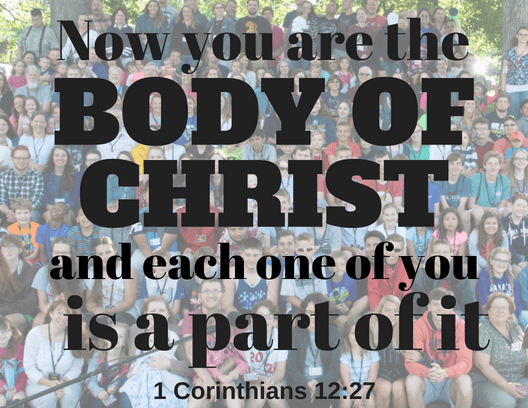
“you are the body of Christ, and each one of you is a part of it.”


-Susan Landry

Baby Spit-Up – Really?

1 Corinthians 11

1 Corinthians 11 26

Transubstantiation.  It’s a big word that means the belief that when communion bread and wine are taken, they literally become the body and blood of Christ.  The Catholic church holds this view.

A friend of mine was sharing a story recently of a visit to a Catholic church in which he discussed this with the priest.  The priest explained how it was because of this belief that the Catholic church began the tradition of priests placing the communion wafers directly into the mouths of parishioners.

You see, if the bread literally is the body of Christ, how awful if it were to fall and break on the floor.  The lay people of the church did not want to bear this responsibility.  They felt more secure in only having priests handle such a precious treasure.  And thus began this now common tradition.

My friend went on to share how he had asked the priest how this played out when they administer the tiny morsel of communion bread to babies upon baptism.  What if the baby spits the bread up?

The priest has to eat it.

Yup.  Let’s just leave that there and read a couple of verses from our chapter in Corinthians.

1 Corinthians 11: 27-28

Therefore, whoever eats the bread or drinks the cup of the Lord in an unworthy manner will be guilty of sinning against the body and blood of the Lord.  A man ought to examine himself before he eats of the bread and drinks of the cup.

Have you ever felt that taking communion can become rote?  Something you do without really thinking?

Clearly God cares that we take this exercise seriously.  But can we agree that we should find a happy medium between mindlessly consuming the bread and the cup and having to eat baby spit-up?

What this passage encourages me to do, and I encourage you to do, is to be mindful during the communion service.  How?

  • Always always always take a moment to pray and examine your heart before the Great God of the universe.
  • Humble yourself.
  • Be quiet.
  • Look around your church and ask God how you can build unity among the body (this instruction from Paul comes, after all, in a section of his letter instructing the Corinthian church on getting along at church).
  • Think about the fact that the last time Jesus participated in this it was the night before he died for you. Maybe thank him for that.
  • Realize that the next time Jesus participates in this he will have come again. Wow!  Maybe ask him how you can get ready for that.


-Susan Landry

Remember the Snakes

1 Corinthians 10

1 corinthians 10 10

Even though chapter 10 of 1 Corinthians is titled by Bible editors as ‘Warnings from Israel’s History’, I still didn’t expect the likes of this:

We should not test the Lord, as some of them did – and were killed by snakes. (verse 9)

Not getting eaten by snakes sounds like an outcome I’d like.  Don’t test the Lord–check.

But let’s take a minute here, what does that mean—don’t test the Lord?  In Malachi 3:10 God invites the people to test him and see if He’s faithful in what He’s promised.  Must be a different kind of testing.

What Paul is referring to here is recorded in Numbers 21:4-6.  The events took place while the Israelites were wandering in the desert.  We’re told that the people grew impatient and complained.

“Why did you…”

“We don’t have…”

“And we don’t like the food.”

So, like any good parent, God sent snakes.  hahaha   Seriously, though, he got their attention and the rest of the people repented.  Definitely good parenting.

Paul gives another example of the kind of testing that we’re not to do when he goes on to say,

And do not grumble, as some of them did – and were killed by the destroying angel. (verse 10)

Grumbling.  Complaining.  Apparently God doesn’t like these things.

Paul goes on to tell us why he’s bringing these examples up:

These things happened to them as examples and were written down as warnings for us… (verse 11)

The people of Israel had seen far larger acts of God than most of us can claim.  They had walked through a sea and eaten bread that appeared spontaneously.  And yet they questioned God’s care for them.  We can look at that and shake our heads at how fickle they were.  But how different are we?

Because we don’t have a map of the future, it can be frustrating to not see things lining up or happening as we think they should.  It can also become easy to question God’s care for us.

“Why did you…”

“I don’t have…”

“And I don’t like…”

Please remember today that God is big enough to handle our questions.  He invites us to test Him so we can be assured of His faithfulness.  But be intentional to catch yourself if you start to feel that God owes you something and is not coming through the way that He ought.

Remember the snakes.


-Susan Landry

The Best Construction Project

1 Corinthians 3

1 Corinthians 3 19 a

For the Corinthians and Greek culture in general, wisdom and knowledge were extremely important.  This is why Paul spends 1 Corinthians 1 emphasizing that it is through faith in Christ that we are saved, not through the wisdom they have worked towards their whole lives.  Then in 1 Corinthians 2 Paul says that wisdom is important for the Christian, but it is Godly wisdom that is very different from what they have learned, and it cannot be taught, but is given by the holy spirit.  Now in chapter 3 Paul is clearing up any last confusion in case they were not understanding up until now. He very clearly says that they need this Godly wisdom, but do not have it at all. They have been seeking an elevated status in their congregation because of their high learning and deep understandings.  Paul wants to set the record straight, living a Christian life is not about sitting in your plush study and writing treatises and books and musings, and becoming revered for your knowledge. It is about getting your hands dirty. He likens the Christians to farmers and builders who have work to do, and he is a worker right there with them.  This would have been a very shocking thing to the aristocratically minded members of the Corinthian Church who would have read this.


So let me be as clear as Paul was.  If you decide to follow Jesus and serve him, then you will be a servant.  Your life will not be a vacation, but a construction project. It will take work, but in the end you will hopefully do something valuable with your life and “the fire will test the quality of each person’s work.  If what has been built survives, the builder will receive a reward.” 1 Corinthians 3:13-14.  That reward is everlasting life in God’s kingdom, and is worth so much more than a high position in society, or being revered for your earthly wisdom.


Your fellow servant

Chris Mattison

Do You Believe Jesus is Alive?

FREE THEME DAYS: Evidence for the Risen Jesus

Acts 1

Acts 1 3

Over the next few days, I have been given free reign to focus on any portion of scripture. However, I am going to hop around a bit, focusing on a theme: evidence for the risen Jesus.   (And on Sunday our devotions will continue our chapter-by-chapter walk through the New Testament with the book of 1st Corinthians.)
We just celebrated Easter/Resurrection Sunday. This is the most important, most key and most crucial story to what it means to be a believer in Jesus. If Jesus is not raised from the dead: Christmas is little more than a nice story, his teachings are little more than nice words, and his death is little more than a sad story of injustice. BUT, if Jesus was raised to life, never more to die, it means that God put his seal of approval on Christ. Christmas becomes the birth of the Savior, his teachings are divinely given mandates from the best of all possible prophets, and his death is a sacrifice for sin and a ransom from evil/Evil.
Many people in our world today doubt all sorts of miracles. They question the Exodus story due to the “outlandish” claims about the Nile turning to blood or the parting of the sea. They question the stories of creation: was the Earth created in six literal 24 hour days six thousand years ago or through a gradual process involving billions of years? Did Jesus REALLY feed 5,000 people with some fish and some bread, or did they share with one another and no one was left hungry? All of these are interesting questions, and different theological beliefs and convictions lead to various answers.* However, as noted above, CHRIST’S RESURRECTION  is not incidental to the story of the Bible; the Bible IS THE STORY OF THE LIFE, DEATH AND NEW LIFE OF CHRIST. That is God’s Central theme in the pages of Scripture. It gets us to Jesus or points back to him. Jesus, then, connects us to God. Therefore, whatever we believe about other miracles, the resurrection of Jesus from the dead is essential.
Which is why Acts 1 was included in Scripture.
READ ACTS 1!
What is so interesting about it is that Christ doesn’t appear to one guy in a room with the door closed (we could chalk that up to lying or insanity). He doesn’t even appear to just the twelve. There are anywhere from 120 (Acts 1:15) to 500 (1 Cor. 15:6) witnesses who saw Jesus resurrected, walking around preaching and teaching and convincing them that He was real and not a figment of their imagination.
Were the disciples crazy? Scripture shows their flaws but none of them would have been delusional.
Were the disciples lying? That could have been refuted easily and wouldn’t they have quickly given up the story and admitted the lie. (We are getting ahead of ourselves, stay tuned.)
The important point to make is pretty clear. Jesus began a movement. The movement didn’t end with his death, but continued on far afterwards, presumably with him coming back to life. Over and over, this has been confirmed in the pages of Scripture and in the lives of believers. When I ask, “Do you believe Jesus is alive?” I am really asking three question.
Is scripture trustworthy about its claims? If yes, then we must believe Jesus is alive.
Are believers trustworthy about their claims? If yes, then we should trust scripture, and should believe that Jesus is alive.
Have you experienced Jesus? If yes, then tell others that Jesus is alive.
So, do you believe Jesus is alive?
-Jake Ballard
_____________________________________________________________________________
*For my part, I think when the Bible tells a narrative, we should trust the narrative to be historically accurate, and when it tells poetry and myths, we don’t hold poetry and myths to that same standard. That discussion takes a lot to unpack… if you are intrigued, be on the lookout for a Young Adult Class coming to FUEL this Summer!

Epilogue of John

John 21

John 21 17 b

The twenty first chapter of the Gospel of John is a fascinating chapter.

Far be it from me to correct the story-telling ability of the author, but why end here? It feels like the story was wrapped up with a nice bow when the author wrote the words we looked at yesterday. Then, almost as if the author forgot a couple stories, he tags on these last couple bits. My fascination with the narration, however, does not diminish what it teaches. Of course, there is both an author and an Author, and so much is given to us in this last chapter.

What I want to focus in on, though, is what happens with Peter? Peter, Peter, Peter. He walks on water, but he doubts. He asks Jesus to wash his whole body when he only needs his feet taken care of. He says “I’ll die for you” but denies him three times. What are we gonna do with Peter?

Of course, you and I are JUST LIKE Peter.

I’ve denied Jesus.

Haven’t you?

I had my doubts after a huge moment of success, when I “walked on water.”

Haven’t you?

I put my foot so far in my mouth my toe tickled by tonsils.

Haven’t you?

So the question is not, “What are we gonna do with Peter?” The question is, “What is Jesus gonna do with Peter?” because that will let us know what Jesus is gonna do with us.

And the answer is exciting.

He makes us better.

He finds Peter and the other disciples fishing, and after helping them perform a miracle, Peter swims to shore. While ashore, Jesus asks Peter, “Do you love me?”

Every time, Peter says “Yes!”

And Jesus responds with “Feed my lambs.” “Shepherd my sheep.” “Feed my sheep.”

When a person fails to live up to the standard Jesus sets, Jesus forgives and works with us. We look at one of the most flawed characters in the New Testament and see, time and again, his failures, his misunderstandings, his sins. But because Peter trusted Jesus and wanted to follow him, Jesus doesn’t give up on Peter. Jesus lets him know that he will be with him, even in the difficult days ahead. He gives him the power and ability to lead, and Peter becomes one of the leaders in the church. He expands the mission of the church beyond Jews and to the Gentiles. He trains other Pastors/Shepherds in how to care for the people of God. (See 1 Peter 5.)

The next time you wonder “Am I useless? What can God do with me?” look to the life of Peter. Take encouragement in the beautiful truth that, if we trust and love Jesus, or even WANT to trust and love him, he will not let us go. He will fight for us, care for us, and ultimately, he will change us into the kind of person God wants us to be.

-Jake Ballard

Between the Darkness and the Dawn

John 19

John 19 30 b

Last night, Christians worldwide, celebrated and lamented Good Friday. We do not call it Good because we are happy or rejoice at what took place with Jesus on the cross, but because in the crucifixion of Jesus, we are bought and redeemed. Jesus went to the hill of Calvary, in the area known as the Place of the Skull, carrying a cross down the Via Dolorosa for us; Jesus knew that if he did not walk that path, to that place, and march up that hill, all people would be stuck in darkness. We would be forever covering our sins, and never removing them. We would be forever wishing to be better, but never having a Counselor to teach us truths and transform our hearts.
Can you imagine what it was like that first Good Friday and Holy Saturday? Jesus hangs limply from a cross; his disciples had abandoned him, denied him, betrayed him. On either side, two criminals, now with two fates, both die laboriously. Women, who followed this man they called Messiah, crowned with thorns, now lifeless. All creation waits with baited breath for what comes next. Sitting in cosmic darkness, existence waits for Light to dawn.
In our area, sister churches gathered together to commemorate this moment. One thing we tried to experience together was silence. Silence and solitude are twin spiritual disciplines; tragically, they are both neglected in modern Christianity. As you today, sit in the space between Crucifixion and Resurrection, find some space for silence and solitude.
Turn off the phone
Power down the computer
Turn off the background Netflix
Enter into silence, find a place of solitude.
We may find we are sitting in darkness. Don’t be afraid to admit that. Darkness comes, and after that, the Dawn.
Silence can be awkward and uncomfortable. Most of us run from it at the first chance. But when we calm ourselves, when we take a moment to appreciate the silence and the stillness, we come to find that our souls have more to say than we previously thought. Our souls may weep at a chance to speak, having been pent up for so long. As Nicodemus and Joseph leaped at the opportunity to serve the rabbi they followed from a distance, so our souls, in silence and solitude, leap up to tell us their deepest desires. But we must allow them.
And when they speak, we will find that they desire the one who died on the cross, the one who will set them free.
In this time of cosmic twilight, we are betwixt our darkest moment and the brightest day, let us do well to remember the words of Christ.
It
Is
Finished.
-Jake Ballard

Quid est veritas?

John 18

John 18 37 38

There is a phrase floating around in culture. “My truth.”
Being a philosophy nerd, the phrase “my truth” hurts my brain. What does it mean for YOU to have truth that is yours? Is it yours alone? Can other people share your truth? If you share your truth and I disagree, am I disagreeing with reality, or with what you think about reality? What is “my truth?”
I was thinking about these questions and many more beside them, because of what Pilate asks Jesus.
Jesus has just been arrested, drug around the city of Jerusalem, falsely accused, and more. He is speaking to Pilate and declares “I was born for this, and I have come into the world for this: to testify to the truth. Everyone who is of the truth listens to My voice.” (John 18:37)
After hearing this, Pilate asks what I am asking…”What is truth?” (vs. 38)
But there is a different heart here. Jesus says his followers will know the truth. All through the teachings we have just read (chapters 13-17) we see Jesus telling his disciples that the Holy Spirit, whom Jesus calls the Spirit of Truth, will be with them. We are also told by Jesus this famous passage: “I am the way, and the truth, and the life. No person comes to the father but through me.”(John 14:6) Jesus makes this bold claim because he knew that he is exclusively the gate to the Father and to eternal life.
In our world, we may look around us and see many people selling us their version of the truth. Whether it is “fake news” or biased media on either side of the political spectrum, whether it is communities of people denying biology or denying differences between men and women, or whether it is hate-filled people implying those differences make men or women better than the other, or that there are racial differences that make certain races better or worse, whatever the messages are that we are given, we MUST run all claims to truth through the filter of Truth, the Spirit of God and the person of Jesus Christ. Jesus prays that God would sanctify us, his followers in His Truth, and says “Your word is truth.”(John 17:17) The Logos of God (John 1:1) is truth, and we know that the Logos has put on flesh and blood and moved into the neighborhood in Jesus Christ. When someone says “I am speaking my truth”, we should be asking “is this the truth of Jesus?”
He is not a way, one path among many, with all leading to God or salvation.
Jesus is THE way.
He is not a truth, one truth among many, with all being equally valid and connected to the world.
Jesus is THE truth.
He is not a life, one life among many, with all being filled to overflowing.
Jesus is THE life.
Pilate, you asked “What is truth?”
Truth was standing right in front of you. His name is Jesus.
-Jake Ballard

Don’t be Mutton

John 10

John 10 14

In John chapter 10, we find Jesus telling a story about shepherds and sheep.  A person who is hired to protect the sheep will run away when his own life is in danger (like when a wolf comes), and abandons the sheep.  The true shepherd will put his life in harm’s way to defend his sheep.  Then we find this gem in verses 14 through 18:

14 “I am the good shepherd; I know my sheep and my sheep know me—15 just as the Father knows me and I know the Father—and I lay down my life for the sheep. 16 I have other sheep that are not of this sheep pen. I must bring them also. They too will listen to my voice, and there shall be one flock and one shepherd. 17 The reason my Father loves me is that I lay down my life—only to take it up again. 18 No one takes it from me, but I lay it down of my own accord. I have authority to lay it down and authority to take it up again. This command I received from my Father.”

I see a couple of things in these verses that I’d like to comment on.

We all know that we are his sheep, and that Jesus laid down his life for his sheep.  We may be less focused on Jesus’ comment that he has other sheep not of this sheep pen that will listen to his voice and be part of the same flock.  In Jesus’ day, he was talking with the Jews, who thought they were the exclusive people who could have a relationship with God.  Jesus was pointing out that non-Jews would also come to God through Jesus.

Then we see this phrase in verse 17 that says God loves Jesus because Jesus is going to lay down his life.  I believe Jesus was saying that it was his decision whether or not to completely obey God.  He had the authority to obey, and lose his life.  He also had the authority to disobey, and retain his life.  My interpretation for all of this is:  Jesus had complete free will to do whatever he chose to do, just like we have free will.  It’s just that Jesus always chose to do God’s will.  This is exemplified in Jesus’ willingness to follow God’s will, no matter what, even to the point of suffering and dying.  And God loves that fact about Jesus.  (As an aside, this attribute of Jesus is undoubtedly why God said, “This is my son in whom I am well pleased, listen to him.”)

You might be thinking, “This is a nice story, but how does it apply to me?”

I’m glad you asked.

First, I want God to be pleased with me.  And I project from this story that if I am obedient to God like Jesus was obedient to God, I will please God.  So, I’d like to challenge you to be completely obedient to God as well.

Second, I might tend to think, like the Jews, that I, or my church, or my denomination have an exclusive relationship with God.  I need to remember that Jesus is the Good Shepherd, not me, and he (not me) gets to decide who are and who are not his sheep.

Finally, we see from this passage that Jesus knows his sheep, and his sheep know him.  Wolves are prowling around outside the sheep pen.  If you’re not in the protection of the pen, being protected by the Shepherd, you’re going to be mutton.  So if you don’t know Jesus, there’s no time like today.

-Steve Mattison