
The Noise

Deuteronomy 31-32

Psalm 31

Mark 15

-Devotion by Aaron Winner (SC)

As a new parent, there is little you are truly prepared for. You are not prepared for the noise—the deafening cry of a child who is wet, hungry, or simply needs to be held in the middle of the night. In those moments, exhaustion sets in, emotions wear thin, and clear thinking feels out of reach. No one expects a sleep-deprived, emotionally fatigued parent to make calm, selfless decisions; yet, this is exactly where trust is formed. In the noise, in the uncertainty, in moments where no clear solution seems apparent, you respond in faith, in commitment to your child.

“I will be glad and rejoice in your love, for you saw my affliction and knew the anguish of my soul.  You have not given me into the hands of the enemy, but have set my feet in a spacious place.” Psalm 31:5-8

“I will proclaim the name of the Lord. Oh, praise the greatness of our God! He is the Rock, his works are perfect. and all his ways are just. A faithful God who does no wrong, upright and just is he.” Deuteronomy 32:3-5

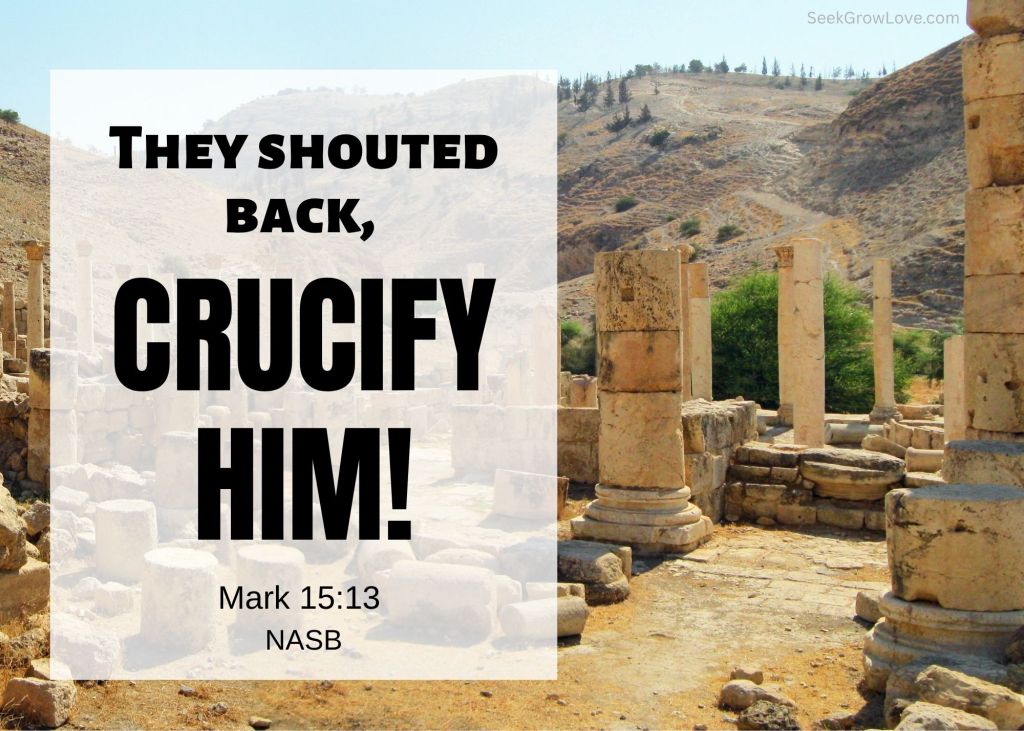
In Mark 15, the noise reaches a deafening level. Jesus stands before Pilate as accusations are hurled and expectations rise. The crowd grows louder, more insistent, crying out for crucifixion. The pressure is relentless. There is no reasonable path forward that leads to life. Yet in the pulling undertow, as the hope of exoneration moves further and further away from the shore, Jesus trusts his Heavenly Father to deliver him. In the piercing, the crushing, the beating, the bruising, and the relentless barrage of physical and emotional punishment, Jesus still quenches the requirement of His offering, trusting God will not only deliver Him, but is acting divinely, doing no wrong, and showing an infinite love.

Reflecting on this model of Jesus, when tensions are high or we watch life unravel around us, are we ready to stand firm, trusting our Heavenly Father’s nature?

This is the God who rescued mankind on the darkest day of human history. The day that each of us condemned Christ, the only innocent life to walk on earth, is the day we call Good.

Reflect on this: God can redeem ANY day and call it good.

The loud, life-altering noise can be victory if we are obedient.

What I realized in our second go around with an infant is that the cry that was disconcerting and dissonant can also confirm that a child is alive and well.  Often we pray that God will take away the noise so we have a moment to catch our breath, to think, to sleep, to figure out a plan.  The Creator of the universe needs no assurances from us other than assured obedience: to act in love for those who despise us and to feed his sheep.  Who we are as parents or followers of Christ is defined in the presence of pressure, not in the absence

Jesus trusted his Father even when none of what was happening made sense, or the outrage and consequences felt unmerited and unjust.  That same faithfulness is cutting through the noise and calling us today.

Reflection Questions

  1. What noise, pressure, fear, or frustration tempts your faithfulness?
  2. What is the Good of Good Friday? How can God redeem ANY day and call it good? What good have you seen come from noise, pressure, fear or frustration in the life of others? What about in your own life?
  3. Aaron wrote Jesus is “trusting God will not only deliver Him, but is acting divinely, doing no wrong, and showing an infinite love.” What do you trust about God and His character, even on the noisiest, hardest day?

Prayer


In the noise of life—when everything feels loud, overwhelming, and uncertain—teach me to trust You. When exhaustion sets in and my thoughts are unclear, help me respond not out of fear or frustration, but out of faith and commitment. Thank You for Jesus, who stood in the noise of accusation and suffering and chose to trust You. When the pressure was relentless and the path forward made no sense, He remained faithful.


Help me to see that even the noise has purpose. Just as a child’s cry is a sign of life, remind me that You are still working in the tension, still present in the uncertainty, still faithful in every moment. Teach me to follow Jesus—to trust You when I do not understand, to stand firm when life feels overwhelming, and to believe that You are redeeming even what feels broken.

In The name of Your Son who poured out Himself as a sacrifice, Amen.
Preparing Your Conscience: Seeking Forgiveness

*Theme Week – Jesus: Matthew 27

Old Testament: Joshua 3 & 4

Psalms Reading: Psalm 96

Let’s face it. We’ve all done things we have felt guilt over. Accepting responsibility for our actions is one of the most difficult lessons to learn. 

We see in this account of Jesus’ arrest and subsequent torture and death a few different takes on acknowledging wrong done and accepting, or denying, blame. 

Judas’ guilt is overwhelming. So much so, that he no longer knows how he can go on living. We don’t know what Judas said to God in his final moments or whether he sought forgiveness. But rather than trying to find repentance in living a Godly life, he decides to take his own. 

The Jewish leaders who paid Judas to betray his rabbi and Christ acknowledged that the money Judas returned to them was blood money. If that isn’t a confession of some form of guilt, I’m not sure what is. And yet they, too, choose not to repent. Instead they continue on with their mission. 

Pilate, warned by his wife, knows that the man before him is not guilty of any crime worthy of death. He gives the people several outs, including offering over a known, terrible criminal. But rather than stand up to the crowd, he proclaims himself guiltless and allows them to take away to torture and kill a man he knows is innocent. 

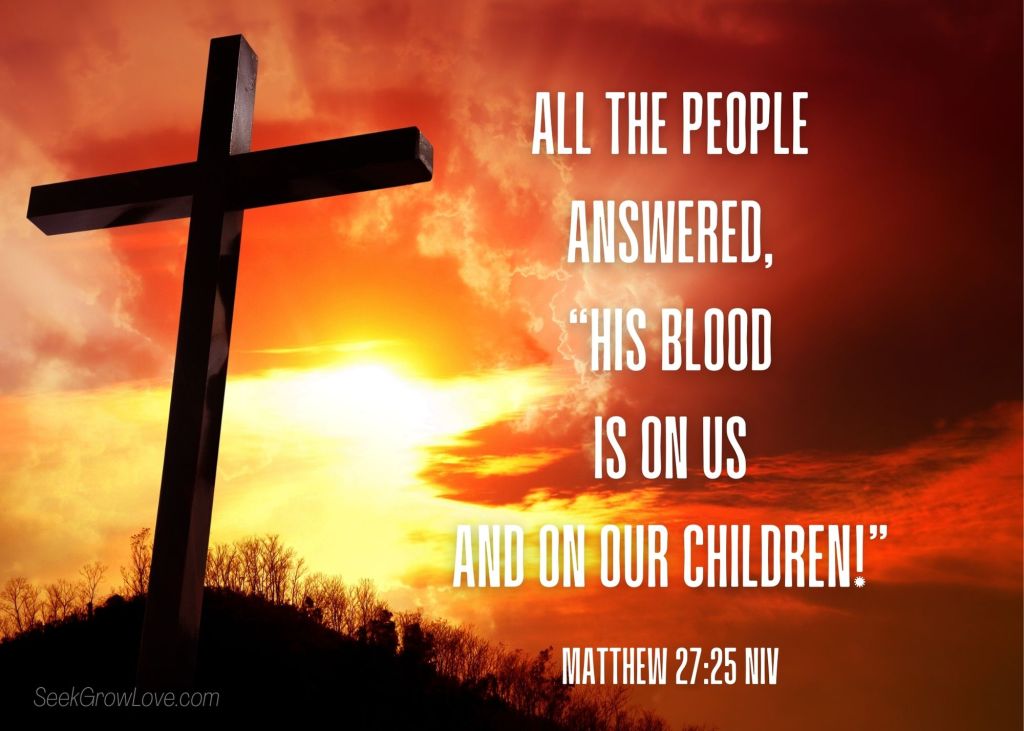
And the Jewish crowd. This one hurts me most of all, because in true mob mentality, they flippantly ignore their consciences, ignore God’s presence, and accept all guilt of Jesus’ death. And they do it without second thought, it seems. They accept the blame not only on themselves, but on their children as well! 

Our savior stood before all these people, blameless and betrayed, and said not a word of condemnation or defense. How many sins have we committed that have been laid upon his shoulders? 

Isaiah 53:6-8 says: 

We all, like sheep, have gone astray,
    each of us has turned to our own way;
and the Lord has laid on him
    the iniquity of us all.

He was oppressed and afflicted,
    yet he did not open his mouth;
he was led like a lamb to the slaughter,
    and as a sheep before its shearers is silent,
    so he did not open his mouth.

By oppression and judgment he was taken away.
    Yet who of his generation protested?
For he was cut off from the land of the living;
    for the transgression of my people he was punished.

For our transgressions, to take care of our guilt, he was punished and died. 

Today is Good Friday, the day we remember Christ’s sacrifice. Take some time with me today to prepare yourself by seeking forgiveness. Ask yourself:

What sins have I committed that I have laid on my Messiah’s shoulders? There are so many, but which have I not sought forgiveness for? 

Are there sins that I’m not sure how to handle, and that seem hopeless, like Judas’? How can I turn them over?

Are there sins that I’m choosing to ignore, like the Jewish leaders? How can I repent and turn the other way?

Are there sins that I could avoid or turn a blind eye to like Pilate? How can I call them out for what they are and act against them?

Are there sins that I’m willingly accepting blame for but I’m determining them inconsequential so I can continue doing them like the angry mob? How can I fully realize and accept how they are affecting my life in a negative way?

I pray that today as you meditate with me and observe Jesus’ sacrifice for all our sins, we are able to call out our sins for what they are and spend time with God seeking forgiveness and redemption. His son suffered and died for us, to cleanse us of those sins. Today is a day for reflection and repentance, so please take the opportunity for it. 

We mourn the suffering of our savior today and the fact that we, and our sins, are the cause of it. But because our God is good, we know that our sin and that cross are not the end of the story. 

Jenn Haynes

Between the Darkness and the Dawn

John 19

John 19 30 b

Last night, Christians worldwide, celebrated and lamented Good Friday. We do not call it Good because we are happy or rejoice at what took place with Jesus on the cross, but because in the crucifixion of Jesus, we are bought and redeemed. Jesus went to the hill of Calvary, in the area known as the Place of the Skull, carrying a cross down the Via Dolorosa for us; Jesus knew that if he did not walk that path, to that place, and march up that hill, all people would be stuck in darkness. We would be forever covering our sins, and never removing them. We would be forever wishing to be better, but never having a Counselor to teach us truths and transform our hearts.
Can you imagine what it was like that first Good Friday and Holy Saturday? Jesus hangs limply from a cross; his disciples had abandoned him, denied him, betrayed him. On either side, two criminals, now with two fates, both die laboriously. Women, who followed this man they called Messiah, crowned with thorns, now lifeless. All creation waits with baited breath for what comes next. Sitting in cosmic darkness, existence waits for Light to dawn.
In our area, sister churches gathered together to commemorate this moment. One thing we tried to experience together was silence. Silence and solitude are twin spiritual disciplines; tragically, they are both neglected in modern Christianity. As you today, sit in the space between Crucifixion and Resurrection, find some space for silence and solitude.
Turn off the phone
Power down the computer
Turn off the background Netflix
Enter into silence, find a place of solitude.
We may find we are sitting in darkness. Don’t be afraid to admit that. Darkness comes, and after that, the Dawn.
Silence can be awkward and uncomfortable. Most of us run from it at the first chance. But when we calm ourselves, when we take a moment to appreciate the silence and the stillness, we come to find that our souls have more to say than we previously thought. Our souls may weep at a chance to speak, having been pent up for so long. As Nicodemus and Joseph leaped at the opportunity to serve the rabbi they followed from a distance, so our souls, in silence and solitude, leap up to tell us their deepest desires. But we must allow them.
And when they speak, we will find that they desire the one who died on the cross, the one who will set them free.
In this time of cosmic twilight, we are betwixt our darkest moment and the brightest day, let us do well to remember the words of Christ.
It
Is
Finished.
-Jake Ballard