A Good Day

1 Samuel 28-31

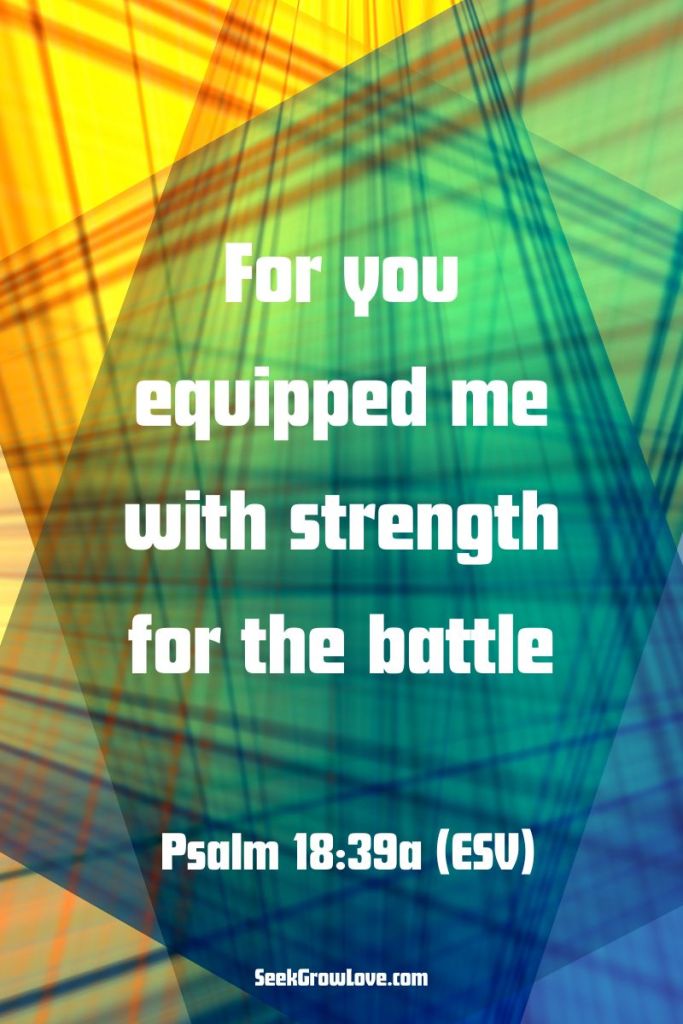
Psalm 18

Do you have good days?  Days when you feel God’s hand moving in your life.  Days when you feel protected.  Days when you feel good about doing what is right.

David wrote this Psalm on a good day.  On a day that God delivered him from his enemies.  Here is a small sample of what David faced:

Vs 4 – the cords of death encompassed me

Vs 16 – he drew me out of many waters

Vs 17 – rescued me from my strong enemy, from those who hated me

Vs 18 – they confronted me in the day of my calamity

Vs 48 – my enemies, the man of violence

I’m guessing most of us don’t face literal enemies who are trying to kill us.  However, we do face the enemy every day.  Does that sound crazy to you?  Do you consider that Satan is attacking you on every front every day? 

Here are some ways Satan attacks each one of us:  temptations, deception & lies, discouragement, fear, doubt, and the list goes on.  But, as I often ask, what does that look/sound like?   I believe it’s different, specifically, for each of us.  What tempts me might not tempt you at all.   Here are some examples:    

  • A group of friends or co-workers are talking about someone you know.  They are suggesting this person is doing some really bad things.  You feel included when you are part of the conversation and you like that feeling.  You feel important being “in the know” when you see others later and share the details discussed.  Information is power and you like holding that power. 
  • Things haven’t been going well for you.  Maybe it’s being overlooked for a job promotion.  Maybe it’s relationships falling apart.  Maybe it’s an illness.  You begin to be discouraged.  You start to doubt God’s goodness and love for you.  You listen to the voice telling you that you will always be a failure, you won’t ever get well, God doesn’t care, nobody cares….

So what did David do when he faced all of these enemies?  He called out to God (vs 6 “In my distress I called upon the Lord; to my God I cried for help”).  That should be our first response to any attack by the enemy. 

In verses 20-24 David tells us how he made the right choices, followed God’s rules, and was blameless before him.  I know I can’t say that about myself.  But, looking at what we know of all people, and what we know about David later in his life, we know no one always does what is right (except Jesus, but this was long before his time…).  David wanted to do what was right.  I want to do what is right.  David expresses in this Psalm that his strength to be blameless (forgiven?) comes from God; that his support comes from God; that God rescues him from his enemies.  We, having the same God as David, can trust in God’s strength, in His support and in His deliverance. 

Amy Blanchard

Reflection Questions

  1. Do you call out to God FIRST when your enemies attack?   Think of a time you called out to God for his help (even if it was as a last resort) and you saw His deliverance.  Share that with someone who is struggling (maybe that’s you). 
  2. Cross check your thoughts against God’s Word.  We often “hear” what we want to hear when it is really the enemy speaking, not God.  God will never tell you something or lead you somewhere that contradicts Scripture.
  3. On your good days, don’t forget to thank God.  Did you call out to God for help, clarity, protection, strength, etc. today?  What can you thank Him for, even while you wait for other answers?
A Just Cause

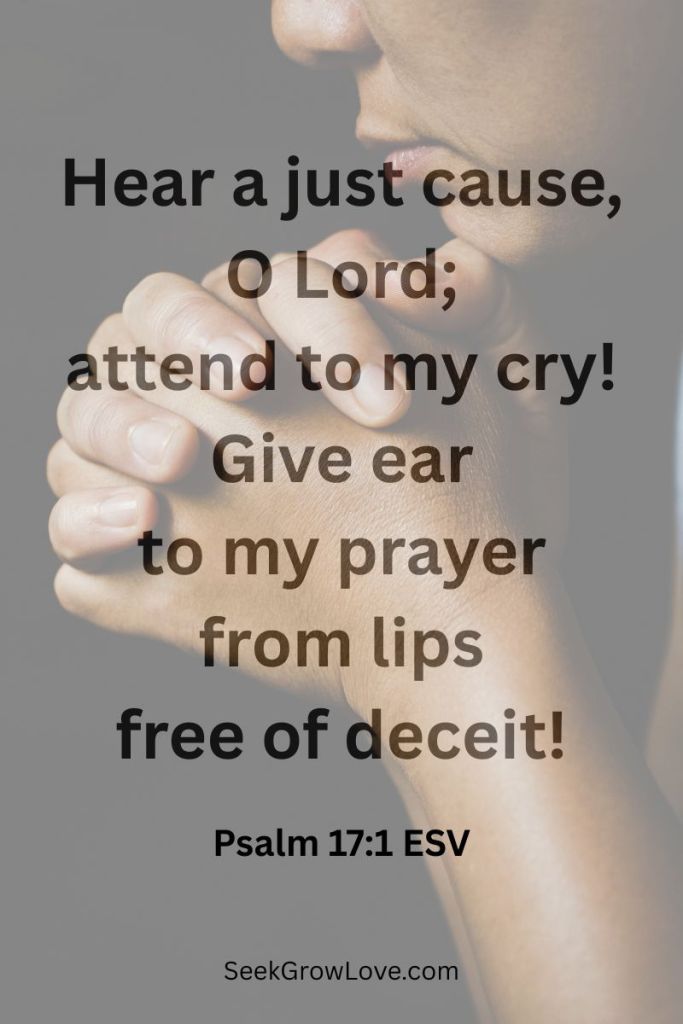
Psalm 17, 35, 54, 63

We all think that what we want, the way we think something should be, is a just cause.  But is it, really?  Lots of things can sound like noble causes, but would they be in God’s eyes?  I have been known to think I’m right about something when I’m actually wrong.  For example, because texts & emails don’t allow for any verbal cues or body language to help with interpreting the message, they are often misunderstood.  I have made the mistake of assuming someone’s intent based on a few words I read on my phone.  I have made the mistake of responding unbecomingly – by responding directly to the person with a bad attitude, or worse yet, talking to others about what they sent to me, pleading my “just cause”.  I have found myself in the position of having to humble myself and apologize.  Maybe you’ve been there, too. 

David considered his cause to be just and he wanted God to be the one to vindicate him. 

In Psalm 17, David calls on God

  • To hear him – verse 6b:  incline your ear to me; hear my words.”
  • To show him His love – verse 7a: “Wondrously show your steadfast love,”
  • To protect him – verse 8: “Keep me as the apple of your eye; hide me in the shadow of your wings,”

David also takes a look at himself

  • Verse 3b:  I have purposed that my mouth will not transgress.” 
  • Verse 4b: “I have avoided the ways of the violent.”
  • Verse 5:  My steps have held fast to your paths; my feet have not slipped.”

David tells God what his enemies are doing

  • Verse 9a: “the wicked who do me violence”
  • Verse 10: “they close their hearts to pity; with their mouths they speak arrogantly.”
  • Verse 12: “…like a lion eager to tear”

David asks God to stop the wicked

  • Verses 13: “Arise, O Lord!  Confront him, subdue him!  Deliver my soul from the wicked by your sword,”

David raises his just cause before God.  He fully trusts God will see the good and right as well as the ugly and evil.  He believes God will respond justly, because that is His character.

Amy Blanchard

Reflection Questions

  1. Taking time to do a self-evaluation can help us see our “causes” (desires) in a more accurate light.  When faced with a negative situation, before responding or reacting ask yourself some important questions:
    • Are my priorities what I want them to be?
    • Am I being self-centered?
    • Do I need to right a wrong?
  2. Are you confident in your choices to welcome God’s testing of your heart?  If not, what can you do to move in that direction?

A Pattern to Follow for Faith over Fear

Psalm 56, 120, 140-142

Like Psalm 34, which we highlighted yesterday, Psalm 56 for today was also written when the Philistines had seized David in Gath.  And just like yesterday’s psalm, this one starts with David begging God for help.

Then, in verses 3 and 4, David says this, “When I am afraid, I will trust in you.  In God, whose word I praise, in God I trust; I will not be afraid. What can mortal man do to me?”

I see a pattern here that David liked to repeat:

  1. He acknowledged his fear, “When I am afraid.”  Fear is a natural reaction when in danger – either real or perceived.
  2. David then made a deliberate decision to trust God.  This is not a normal reaction, it is an intentional decision, flying in the face of the natural fear.
  3. David praised God for delivering him – before he had been delivered.  (In this case, David praised God’s word, but often, he just praised God.)  When David did this, he was stepping out on faith, believing God would answer his prayers.
  4. Finally, in the assurance God would help him, David banished his fear, “I will not be afraid.”.  Notice he chose to not fear what mortal man could do to him.

This reminds me of Jesus’ words in Matthew 10:28, “Don’t be afraid of those who want to kill your body; they cannot touch your soul.  Fear only God, who can destroy both soul and body in hell.”

This is a pattern I have also tried to follow in my own life.  Many times, I have cried out to God, confessing my fear. I have then made a deliberate decision to trust that whatever God has for me is best, whether I know it (or like it) or not.  Then praise God for his promise that all things work together for my good – because I love God. Finally, with God’s help, I let Him lift my burden off my shoulders, whether it is fear, or whatever else it is.

With the fears swirling around now, whether Covid-19, or unemployment, or difficulty finding what you want at the grocery store, or …  You have a choice. You can succumb to fear, or you can follow David’s example.

I challenge you to try this pattern with whatever makes you fearful today.  Then you can say, like David wrote in yesterday’s reading from Psalm 34:8, “Taste and see that the Lord is good; blessed is the man who takes refuge in him.” And from today’s reading in 56:11, “In God I trust; I will not be afraid.  What can man do to me?”

–Steve Mattison

(originally posted April 15, 2020 for SeekGrowLove)

Reflection Questions

  1. What have you been afraid about in the past? What has God already successfully brought you through?
  2. When is fear helpful? Do you have a healthy fear of God? Do you fear only God?
  3. What makes you fearful today (besides God)? Would you like to conquer this fear? Write out David’s steps to replace fear with faith and keep them in a place you will see often and practice working through the steps – over and over again.

Is Now a Great Time for Revenge?

1 Samuel 21-24

1 Samuel 24 12 NIV

In today’s reading, we see more examples of Saul’s rebellion against God and his hatred of David.  Ahimelech the priest had inquired of the Lord for David. In his rage, Saul ordered that not only Ahimelech, but all the priests must be killed – so Doeg the Edomite, one of Saul’s goons, killed 85 priests, then went to their town and killed every man, woman, and child (and its cattle, donkeys, and sheep).  In chapter 23, Saul chased David and tried to kill him multiple times.

In chapter 24, David finally has his opportunity for revenge.  Saul was again chasing David. David and his men were hiding in the Desert of En Gedi.  Saul and 3000 chosen troops were in hot pursuit. Along the way, Saul needed to go to the bathroom.  He wanted a little privacy, so he stepped into a cave to relieve himself. Little did he know that David and his men were hiding further back in that very cave.

If you were David, what would you have done?  Would you have eliminated the threat to your life, and ushered in your reign as king?  To be perfectly honest, I think that’s exactly what I would have done. David’s men encouraged David to kill Saul, but instead, David crept up to Saul, and cut off the corner of Saul’s robe.

Afterward, David was conscience stricken and said, “The Lord forbid that I should do such a thing to my master, the Lord’s anointed, or lift my hand against him; for he is the anointed of the Lord.”

Wow!  Clearly Saul was a scoundrel, but David spared his life because God had made him king.  I think we can learn a lesson or two from David’s respect for the office of authority, even when the man in the office wasn’t worthy of respect.

This is exactly what we’re told to do in 1 Peter 2:13-14 – “For the Lord’s sake, submit to all human authority—whether the king as head of state, or the officials he has appointed. For the king has sent them to punish those who do wrong and to honor those who do right.”

David’s actions also remind me of Romans 12:17-18 – “Never pay back evil with more evil. Do things in such a way that everyone can see you are honorable. Do all that you can to live in peace with everyone.”

So too, we need to submit to authority, even when we don’t like the person in authority, or what they are doing.  Also, we need to be intentional about never repaying evil for evil.

To finish today’s story, because David had spared Saul’s life, Saul promised to leave David alone, and returned home (for now).  David and his men went up to their stronghold. God had protected David yet again.

Steve Mattison

(originally posted April 13, 2020 for SeekGrowLove)

Reflection Questions

  1. What do you admire about David?
  2. When have you found it difficult to pass when given the opportunity for revenge, a cutting comment, or having the last word? What is the world’s position on paying back evil for evil? What is God’s? What is the advantage to leaving it up to God to be the judge, rather than taking out revenge for wrongs done against us?
  3. In what ways do you think God wants to see Christians submit to authority today?

Faith During Difficulties

1 Samuel 18-20
Psalm 11 & 59

Today’s reading, found in 1 Samuel chapters 18 through 20, highlights how far Saul has fallen from his successes of chapter 14.  (Remember from chapter 15, that Saul had deliberately disobeyed a direct command from God, and things have been going from bad to worse for him since.)

In 18:10-11, we read, “The very next day a tormenting spirit from God overwhelmed Saul, and he began to rave in his house like a madman.  David was playing the harp, as he did each day. But Saul had a spear in his hand, and he suddenly hurled it at David, intending to pin him to the wall.  But David escaped him twice.”

Once Saul decided to abandon God, God not only abandoned Saul, God tormented Saul.  This should be a lesson to us – never disobey God – there are always negative consequences.

Saul became jealous of David, after David had killed Goliath, because the women of Israel sang this song, “Saul has killed his thousands, and David his ten thousands.”  As a result of his jealousy, Saul tried to kill David with his spear in 18:11 and again in 19:10. Saul also tried to kill David by having the Philistines kill him in 18:17, 21, 25.   In 19:1, Saul urged his servants and his son Jonathan to assassinate David. In 19:15, Saul ordered his men to bring David (and his bed) to Saul to be killed, when Saul thought David was sick in bed.  In 19:20, 21 and 22 Saul unsuccessfully sent troops to get David three times.

In 20:30, Saul boiled with rage at his own son, Jonathan, who was friends with David, and in 20:33, Saul hurled his spear at Jonathan, intending to kill him.

So much for Saul, what about David?

If you were David, how would you react?  What would you do?

Remember that Samuel had anointed David in chapter 16, and declared that David would be the next king over Israel.  So what did David do? He wrote some songs about this. Let’s see what he said in those songs…

David wrote Psalm 59 when Saul sent his soldiers to watch David’s house in order to kill him.  This psalm starts out, “Rescue me from my enemies, O God. Protect me from those who have come to destroy me.  Rescue me from these criminals; save me from these murderers. They have set an ambush for me…”. This makes sense.  David was in trouble, so he cried out to God for help. David continues in verse 9, “You are my strength; I wait for you to rescue me, for you, O God, are my fortress.”

Then an astounding thing happens.  David starts praising God – in advance of God’s rescuing him.  Psalm 59 ends with, “But as for me, I will sing about your power.  Each morning, I will sing with joy about your unfailing love. For you have been my refuge, a place of safety when I am in distress.  O my strength, to you I sing praises, for you, O God, are my refuge, the God who shows me unfailing love.”

David, the man after God’s own heart was actually praising God when he was literally afraid for his life.  This shows his great faith that God will indeed rescue him. Maybe this is one of the reasons he was called a “man after God’s own heart.”

Psalm 11, the other chapter from today’s reading also shows David’s faith through difficulty.  It starts out, “I trust in the Lord for protection…”, and ends with “For the righteous Lord loves justice.  The virtuous will see his face.”

I believe David’s response is a good example for us.  When times are tough, it’s natural to cry out to God for help.  We need to move on from just asking for help, and follow David’s example to also have faith and praise God, even before the answer comes.  And in the process, we, too, may become people after God’s own heart.

–Steve Mattison

(originally posted April 12, 2020 for SeekGrowLove.com)

Reflection Questions

  1. Compare and contrast Saul and David based upon what we know from 1 Samuel.
  2. What do you see in your own life that is similar to Saul? And David?
  3. What does it look like to show faith in God during the difficulty?
  4. What difficulty (big or small) have you recently found yourself in, in which you can practice giving God praise even before the answer comes?

A Relationship

1 Samuel 15-17

Being raised as a pastor’s kid, I probably took for granted the accessibility of all things church related. Being a Christian was something that was easily practiced because of the environment I was constantly in. I asked Jesus to come into my heart when I was 5 years old. I was baptized the summer before my eighth grade. But it wasn’t until I went off to college that I really realized that my faith was my own responsibility. If I was going to have Christian friends, I needed to find them on my own. If I was going to attend a mid-week Bible study, I needed to find it on my own. If I was going to attend a Sunday morning service, I needed to find it on my own. Mom and Dad weren’t there to guide and direct me. If I wanted to continue to build up my faith, it was now up to me.

As we read through King Saul’s life, we see that he was hand selected and groomed to take on the role of leading Israel – everything was handed to him. And as a result, he never really owned the responsibility of the position he was put in. He never connected the dots of being the leader of God’s people and having a relationship with God himself.

This is particularly evident in 1 Samuel 15. Saul has carried out God’s instructions of taking up arms against the Amalekites. Once Israel wins the battle, they were supposed to destroy everything: man, woman, child, cattle, sheep, camels and donkeys. Nothing was to be spared. But…that’s not what Saul did. He kept the best of the spoils. He claims that he was going to use the prime plunder as a sacrifice.

Here’s how I know that Saul didn’t own his relationship with God: in verses 21 and 30 of chapter 15, Saul refers to the LORD as Samuel’s God.

“…the best of what was devoted to God, in order to sacrifice them to the LORD your God at Gilgal.” (v 21)

“…come back with me, so that I may worship the LORD your God.” (v 30)

Saul didn’t understand his disobedience because he hadn’t bothered to grow a relationship with the One who made him king of Israel.

More than anything God desires to have a relationship with us. He wants us to seek Him more than any other person or pursue any other passion. When we grow our relationship with Him, we come to know the things that please Him as well as the things that displease Him. As we grow our relationship with God, our hearts swell with love for Him, His word, and His people. And when our hearts are full of love, obedience comes naturally.

Bethany Ligon

(originally posted for SeekGrowLove April 11, 2020)

Reflection Questions

  1. Why is obeying Him important to God?
  2. Have you ever felt like God is just someone else’s God?
  3. How can you grow your relationship with God?

Waiting

1 Samuel 13-14

What do you do when you think God is taking too long to answer your prayer?

If you are King Saul, you tell the priest to “withdraw your hand” (1 Sam 13:19) – meaning that God is taking too much time responding to a prayer request. King Saul believed that he had some sort of advantage over the enemy and didn’t want that advantage to slip away. So he took matters into his own hands, assembled his men, and went into battle. The outcome wasn’t too good.

Have you ever prayed for something so long, that you become impatient waiting for God to give you directions and end up rushing the timeline just to pursue your own desires, wishes, or dreams? Any time we read a Bible study about an individual doing something for him/herself rather than waiting on God, it never ends well; it’s always a disaster.  Why do you think that is?

After some careful self-reflection, I think that I’ve got it figured out for myself: It’s because I like being in charge – to be independent – to not have to rely on someone else’s timing. And even as I type these words, I know it’s ludicrous because my decisions are based on a very limited perspective; whereas, God has a completely different view of my life. His reasons for delaying an answer to prayer, is all about the timing that will give him the most credit.

So the next time you are tempted to move on without God’s response to your prayers, just remember that Saul  ended up making some outlandish ultimatums and in so doing, ended up discrediting himself and losing God’s favor.

Stay persistent in your prayers. Do not give up. Keep waiting for an answer to your prayers. At the proper time, God will provide an answer or solution for your need. And in the meantime, always remember that God is by your side – he has not abandoned you.

Bethany Ligon

Reflection Questions

  1. From above: “Any time we read a Bible study about an individual doing something for him/herself rather than waiting on God, it never ends well; it’s always a disaster.  Why do you think that is?”
  2. And: “Have you ever prayed for something so long, that you become impatient waiting for God to give you directions and end up rushing the timeline just to pursue your own desires, wishes, or dreams?” What was the outcome?
  3. What are some reasons God works on His time schedule not ours?

Called, Changed, Qualified

1 Samuel 9-12

Have you ever found yourself in a position totally unprepared or unqualified? When I was in college for my bachelor’s degree, I took Cellular & Molecular Biology as part of my program to become a secondary science teacher. It just so happened that this was the same course that was required for pre-med students. Somehow, I ended up getting an invitation to join a study group with these pre-med students. After 5 minutes with these people, I realized that they were a completely different caliber of student – I was so out of my depth.

There have been other times in my life when my own inexperience and inadequacies seemed to cast a blinding glare onto the responsibilities that I had to carry out. Even now, after 23 years of experience in education, there are times when I have no clue on how to handle a given situation.

This is how I relate to Saul being approached by Samuel to become king of Israel. His response is that he’s a nobody, from the smallest tribe and his clan is the least of all. How is it that he has been selected to rule over an entire nation?

But isn’t that just like God to do something like that? God seems to select those who are the most unlikely to be successful. Why does He do this? What I have learned, is that it makes me more dependent on God and less likely to take the credit.

Being part of the FUEL leadership team for many years, I have seen time and time again when a situation developed that was bigger than our resources and everything ended up working out because we depended on God. Anyone out there remember the year that we stopped going to Taylor University and started going to Manchester University? Yeah, we weren’t sure if FUEL was going to happen that year. But with a lot of prayer (and hard work by the directors) we were able to gather again because God pointed us in the direction we needed to go. God provided us with exactly the right site, to work with the best conference staff, to continue to return for many years.

I recently read a phrase that I think is appropriate here: “God doesn’t call the qualified; God qualifies the called.” If you’re willing to be used by God, you will find yourself in circumstances that seem way out of your league. While you may not be so confident in your abilities, know that God is more than able to see you through. After all, it’s His reputation on the line and God never fails.

Bethany Ligon

(originally posted for SeekGrowLove on April 9. 2020)

Reflection Questions

  1. How did God prepare and qualify Saul? What do you think was included in God’s “heart change” for Saul (10:9) and the role of the Spirit of the Lord?
  2. From above: “God seems to select those who are the most unlikely to be successful. Why does He do this?”
  3. When have you felt unqualified for a job God sent you to? Did you do it? Did you have a “Samuel” who spoke God’s word to you? How did God change/prepare/qualify you for the job?
  4. How can you be a Samuel for someone else?

Why You Want What You Want

1 Samuel 4-8

Key verse: 1 Samuel 8:6-7

Somewhere between 2013-2014 my middle school classmates and I saw the appeal of smartphones. We weren’t familiar with all the “modern technology” or the iPhone 5. All we desired was a way to have something everyone else had, play games online with our friends anywhere we went (even though the cellphone towers were much less effective “back then”), access the internet, and message our friends with a few clicks. Unlike many friends and classmates, I didn’t receive a smartphone until I was a junior in 2018. Thanks to modern technology, I had a few other devices to keep me updated and occupied, but it was a blessing in disguise to not have a phone till later on in my life. 

While I witnessed my classmates retract from social situations and face-to-face conversations, I could participate more frequently in social circles and conversations (thanks to what I and many others would’ve called “being bored”). When I finally received my own smartphone, I had been so accustomed to a life without it that I felt like I almost didn’t need it. It didn’t feel necessary to have something everyone else had but I felt the social pressures of my friends and everyone around me. I wanted a smartphone because everyone had one and this wasn’t the only thing I wanted. New shoes, new cleats and spikes for soccer and track, new clothes, a better-looking physique, and more were just a few things I desired because I felt like everyone else had them. However, I’ve learned that what I want (especially because everyone else seemed to have them) is not necessarily what I need. I didn’t need the things I wanted and I’m glad my parents and God didn’t give me everything I wanted.

The LORD had provided for Israel time and time again. However, Israel (like many other people in today’s world and in my school environment) wanted more. The Israelites wanted a king and wouldn’t listen to the warnings from Samuel and the LORD (8:19). Why? Why would they desire someone other than God to lead them, go before them, and fight their battles? The answer is simple, they were trying to compare themselves and “keep up with the Joneses.” It was difficult to avoid comparisons back then, and thanks to social media and smartphones I think it’s even more difficult today. Samuel knew the cost of this decision, but the Israelites wanted a king and they wanted one NOW! So, Samuel went back to the LORD, repeated their wish and desire to the LORD, and the LORD told him to listen to them (v.22). Samuel was given a taste of what God experienced when they asked for a king (v.8). He was displeased and I’m sure he had some questions. Was he not good enough to keep them satisfied? Was he not doing enough to serve on Israel’s behalf (7:9)? However, when Samuel prayed to God, God allowed him to see that it wasn’t him they were rejecting (8:7). The Israelites had everything they needed, but they didn’t have everything they thought they needed. Looking back at my situation, the LORD blessed me and my family with everything we needed, but He also blessed us by not providing everything we thought we needed. They had God, but they wanted a king too. The LORD will provide, but be careful what you wish, pray, and ask for.

-Jeffrey Seiders

REFLECTION Q’s

  1. The Israelites wanted more and desired something other than God. Is there a past or present situation where you want more and desire something other than God? If so, how can you work to return God to His rightful place?
  2. Samuel felt rejected because Israel rejected God. Have you ever felt rejected because someone rejected your faith or beliefs? 
  3. Samuel went to God and prayed when he was displeased with their desires. How do you respond when you feel displeased with the decisions and desires of others? Is that the way you should react? Why or why not?
  4. Unlike many of my friends and classmates, I felt my first smartphone was delayed and withheld from me. How has God delayed/withheld your wants, and why might He keep you from receiving them? What blessing(s) might He be providing to you instead?

“Flowers Grow in the Valley”

Ruth 1-4

In my life, I’ve seen many people deal with troubling times and grief in various ways. Most of them initially take the path of least resistance, which often leads them further from God, but those with a strong support system are guided on pathways that lead them closer to God than they’ve ever been. I’ve had my fair share of troubles, and without the help of my school teachers, professors, friends, and family, I wouldn’t have been as close to God as I am today. I heard a song recently called Flowers by Samantha Ebert that contained the lyrics, “I’m a good God and I have a good plan, so trust that I’m holding a watering can, and someday you’ll see, that flowers grow in the valley.” Ruth’s story is a fantastic illustration of the beauty that God can bring to fruition in life’s valleys. 

The book of Ruth takes place during a time of trouble and famine. Naomi lost her husband Elimelek and her two sons Mahlon and Kilion. Ruth and Orpah became widows. However, a glimmer of hope came to Naomi as she heard what the LORD had done for His people (aiding and providing for them in this tough time). She urges her daughters-in-law to return to their mother’s house (because it would be a much easier route for them), but the unexpected happens. Instead of going home, Ruth decides to go with her, stay with her, make Naomi’s people her own, and remain alongside her in death/burial (1:16-17). Naomi tried to “talk some sense” into Ruth but failed to convince her to choose a different path. This resulted in an interesting and intriguing turn of events.

Shortly after arriving in Bethlehem, Naomi and Ruth’s tragic story spreads around town, and the overseer of Boaz’s harvesters and Boaz (who “just so happens” to be one of their kinsman-redeemers) hears of it. Boaz blesses Ruth with protection, provides her with the opportunity to earn an abundance of food, works diligently to ensure she is cared for, and continues the line of David through Obed. This information makes me believe that the “coincidences” along the way were more of a God thing than a perchance thing. As a result, Ruth and Naomi went from two widowed women in one of the biggest valleys of life put in their way to two well-off women blessed with the beauty of God’s providence.

Pain, suffering, and troubled times often bring forth heightened emotions, illogical judgments, and tough decisions. If we’re not careful to keep ourselves in check, we can go down a dangerous path towards death and destruction. In Matthew 7:13-14 we find Jesus urging others in his sermon on the mount to, “Enter through the narrow gate. For wide is the gate and broad is the road that leads to destruction, and many enter through it. But small is the gate and narrow the road that leads to life, and only a few find it.” We are presented with a choice, take the easy route and go back to what’s familiar, or choose the path with a few more hills and valleys that God can use to show us more than we could ever hope for.

-Jeffrey Seiders

REFLECTION Q’s

  1. Ruth took the harder path, went with Naomi, and God provided for her. What paths in your life have you taken that were difficult but God blessed you through them?
  2. Naomi tried to convince Ruth and Orpah to take the easier route, and only Orpah went. When did you take the easy route and how did God work through your decision? 
  3. What valleys are you going through now, and how can you see God’s beauty in them?