What do you find in every one of the four chapters of Jonah?
Not a great fish – but prayers.
And, chapter 2 is just about all a prayer from the prophet Jonah to his great big God – while he waits, inside the belly of a fish sent by God.
What might you pray if you ever were to find yourself in such a predicament, or an equally stuck and potentially stinky one? What predicaments have you found yourself in that shared some characteristics, even though there were several differences, too? What did you pray for in those instances? I am guessing my prayer would include a whole lot of “Get me outta here, God!” If there is one type of prayer that most of us seem to have mastered, perhaps it is the prayer for deliverance. Lord, deliver us from sickness, from unemployment, from stress and anxiety, from dysfunctional families, from bad grades, from disgrace, and yes, from evil, and the list goes on. Turns out there are a lot of places we do not want to be – including inside the belly of a great fish.
But I find the prophet who was trying to run away from God in chapter 1 has a lot to teach me about prayer in Jonah chapter 2.
I am guessing that given 3 whole days and nights Jonah had the perfect opportunity to say a lot of things to God. He might have very well included some prayers for deliverance. But, that is not what is recorded in the 8 verse prayer of Jonah 2. Jonah sees and recognizes and gives God thanks for taking care of him, thus far. He sees the belly of the great fish not as a trap but as one more step of God’s merciful path toward salvation. And he thanks God. It could have been so much worse. He would have been at the bottom of the ocean, lifeless. But God has sent salvation. (Maybe that was the name of the fish?) He delivered from the deep. He provided a spiritual time-out for Jonah. He helped Jonah put his life and his death into perspective to see again God’s greatness and the privilege we have to follow Him, to fulfill our vows to Him, even into the scary land of the Ninevites (but more on that tomorrow.)
-Marcia Railton
Reflection Questions
What conversations could you have with God for three days and three nights if you removed all distractions around you except those that could be found inside the deep dark belly of a great fish? How could you create and take advantage of a spiritual time-out to meet with God for an extended time?
In the midst of your big fish, or when you felt you were sinking, what have you/can you thank God for?
When did you need a reminder that “Salvation is from the Lord.” How did Jonah know that to be true? How do you?
(You will notice we are not done with 2 Kings yet, but we are taking a pause to add in the book of Jonah at this point. Through the rest of 2nd Kings and 1st and 2nd Chronicles we will be inserting the 17 books of prophecy and the rest of the books of history – Ezra, Nehemiah and Esther – in a chronological fashion. However, when we start a book of prophecy we will read the whole book even though the events might span a good chunk of history throughout Kings/Chronicles. Thank you to Robert Jones of Atlanta Bible College for his help in ordering these books amongst the Kings and Chronicles.)
The story of Jonah is one of the most well-known stories in the Bible. However, the book of Jonah is one of the least read books in the Bible! Let this devotion serve as a challenge to read this book with fresh eyes this week.
Jonah is perhaps the most unique prophet in the Bible. Isaiah, Daniel, Elijah, and so many others serve as intensely righteous men who carry about the Lord’s message with great zeal. Habakkuk shows shocking honesty and transparency in his prayer life. Amos shows us that the most humble people– yes, even the shepherds– are called into ministry of some kind. But what about Jonah?
Jonah shows that rebellious streak that runs within all of us at some time or another. God has called him to preach to the city of Nineveh, the capital of Assyria, and Jonah does not listen. It’s understandable; Nineveh is nearly 700 miles away from Jerusalem. That would take well over a month to travel there in his time! But wait– Jonah doesn’t just say no to God. He actually runs away in the opposite direction!
So Jonah runs away and God lets him know that there’s no running from God. In fact, throughout Jonah’s refusal to minister to the Assyrians, it still brings glory to God. The sailors he’s traveling with tremble with fear when they discover who Jonah’s God is. Notice that, in 1:11, the sailors want to please Jonah’s God, and instead of saying, “Let’s turn this ship around and head to Nineveh,” he says, “Just throw me overboard.”
But God wasn’t done with Jonah. Jonah’s saved. But more importantly, Jonah experiences a spiritual reckoning: (Sneak peak into tomorrow’s reading of Chapter 2…) Jonah has a moment of complete clarity and offers up a remorseful, prayerful praise to God. He recognizes that God is the one in control (2:3). And he recognizes that salvation comes only from the LORD.
So here are a few questions for us to consider in all this:
Do we listen for God’s voice like Jonah does?
Do we reject God’s call like Jonah did? Probably more than we realize.
Do we expect God to call us to the “Nineveh” of our lives?
Do we learn from our mistakes like Jonah did, and pray about it?
Will Jonah learn from these events, and change his ways? We’ll have to find out this week.
-Levi Salyers
(originally posted for SeekGrowLove December 15, 2021)
As Marcia mentioned in yesterday’s devotion, many of us were at Midwest Family Camp last week, where the theme was “Stand Firm”. In a nutshell, if we don’t have a relationship with the Lord, it is critical that we repent and come into a relationship with Him. If we already have a relationship with the Lord, we need to strengthen that relationship, and stand firm in the faith – no matter what.
In today’s reading in Proverbs 28, there are a few verses that jumped out at me which reinforced that message. The first is found in Proverbs 28: 9, “If anyone turns a deaf ear to the law, even his prayers are detestable.” This proverb tells us that if we’re not doing everything to live the life God called us to live, if we’re not following His rules, then He won’t listen to our prayers. Since many of our prayers are about asking for God’s help with various things, if we selfishly want Him to answer our prayers, then we need to obey His rules, and live for Him. As we grow in relationship with Him, we come to long for an even deeper relationship with the Lord. Then we learn that prayer is powerful, and we don’t waste it just asking for superfluous things.
Proverbs 28:13 goes on to say, “He who conceals his sins does not prosper, but whoever confesses and renounces them finds mercy.” This is saying if we pretend to be Christians, we won’t prosper (you can’t fool God). But if we confess and renounce our sins, and turn completely to God, we will receive God’s mercy. I don’t know about you, but I would much rather have His mercy than to have Him holding me back from prospering.
As we continue to read through this chapter, we get to verse 20, which says, “A faithful man will be richly blessed, but one eager to get rich will not go unpunished.” I’ll take a detour here and comment on the health and wealth teachings we often hear from people who don’t know better. The theory goes sort of like this… “if someone follows God, God will bless every aspect of their life. They will be rich, healthy, and blessed.” Many people who call themselves Christians subscribe to this false belief. Jesus told us in John 16:33, “…In this world, you will have trouble. But take heart, I have overcome the world.” We have to remember this life isn’t our reward. This life is the test to see what reward we will receive when Jesus returns. If we are faithful to the Lord now, we will enjoy peace with God now, and eternal life when Jesus returns. If we are just trying to get rich, we are actually worshiping money, not God — our reward is in this life, and we will forfeit eternal life.
1 Tim 6:9-11 says, “People who want to get rich fall into temptation and a trap and many foolish and harmful desires that plunge men into ruin and destruction. For the love of money is a root of all kinds of evil. Some people eager for money have wandered from the faith and have pierced themselves with many griefs. But you, man of God, flee from all this, and pursue righteousness, godliness, faith, love, endurance, and gentleness.”
Instead of trying to get rich, we need to follow the advice given in Proverbs 28:27, “He who gives to the poor will lack nothing, but he who closes his eyes to them receives many curses.” Again, I think the idea is that if I’m greedy, wanting to keep all my money for myself, I’m not trying to please God, I’m just greedy for money, and God will curse me for not following Him. But if I’m generous with the things God has given me by giving them to the poor — this mimics God’s generosity to me. When I am imitating God, God loves that. In fact we’re commanded in Ephesians 5:1, “Be imitators of God, therefore, as dearly loved children.”
So the bottom line is this. We need to do everything we can to reconcile ourselves to God. We need to confess and renounce our sins, obey His laws, be faithful, and be generous. All these things are required to live in close relationship with God. And if we live in a close relationship with God, we will have peace with God in this life, and an amazing reward in the life to come. In Rev 21:4, we’re told, “He [God] will wipe every tear from their eyes. There will be no more death or mourning or crying or pain…” Rev 21:7 goes on to say, “He who overcomes will inherit all this, and I will be his God and he will be my son.”
How well are you imitating Dad?
Stand Firm.
–Steve Mattison
(Originally posted June 28, 2021 – but we did just return from another week of Family Camp, where the theme was “Pray Continually”. You can watch Steve’s Thursday Night sermon and story on Yield to God’s Will here.)
Reflection Questions
What are the prayer lessons to be remembered from Proverbs 28?
How well are you following God’s instruction?
When was the last time you confessed your sins to Him?
What relationship do you have with money? Is it stronger than it ought to be? How would you rate your generosity? Why do you think God values our generosity?
Our God is a God of restoration. There will ultimately be a full restoration, but full restoration can only happen when the world is once again the beautiful, perfect place God created it to be, when His Kingdom is established on earth. Partial restoration, however, has been happening ever since the beginning of time. We read about restoration countless times in the Bible, and if you look, you can see it in our lives today, too. God constantly restores what has been lost to His people, whether it be a physical ability, such as sight, or movement, or a spiritual restoration, such as that of faith, or even the restoration of life.
Today, we read in 2 Kings chapter 8 about a Shunammite woman who lost everything she had during a 7 year famine, but because of her faith in God and willingness to obey, it was restored to her. Now this woman was not new to witnessing God’s ability to restore what was lost. In chapter 4 of 2 Kings, we read about how Elisha rewarded the Shunammite woman’s kindness with fertility, and she bore a son. Sadly, the son later died, but she had faith in God’s power, so she sought out Elisha. Elisha came, and the son was brought back to life; he was restored.
It is clear that this woman had remarkable faith. Perhaps this is why Elisha warned her about the famine that would come on the land for 7 long years, and advised her to leave. So without question, she and her household left their home and stayed in the land of the Philistines for 7 years, until the famine was over. When they returned, she had to appeal to the king to get back her home and all her land. The crazy thing is, right as she was coming to appeal to the king, Elisha’s servant, Gehazi, (who in chapter 5 was cursed with leprosy, and left Elisha… so perhaps these chapters are not necessarily in chronological order) was telling him the unbelievable story of the miracle Elisha performed in the resurrection of the son of the Shunammite woman. The woman, who just happened to show up during this particular story time, also gave an account of what happened, and the King was so impressed that he instantly granted her the land and all that she left 7 years ago.
This story speaks volumes of God’s perfect timing, and adds to the common theme we see throughout the Bible of God’s willingness to restore what has been lost to those who are faithful. Look closely at the different ways in which God restores things in your life, and let it remind you to live everyday for the ultimate restoration that’s coming.
-Isabella Osborn
(originally posted for SeekGrowLove on June 8, 2021)
Reflection Questions
In 2 Kings 8 what does God do for restoration to take place? What did the Shunammite woman do? What did others do?
Where have you seen restoration? Did faith play a part in the restoration you witnessed? What did God do? What did the recipient of the restoration do? What did others do?
How can you be a part of God’s great restoration project? What restoration can you be praying for? What restoration can you be working towards, with faith in God, that He will act in amazing, restorative ways?
Reading today’s passage in Luke 8, I was surprised at how many incredible stories of Jesus are packed into just one chapter. It really shows the power that Jesus holds. He preaches messages to large crowds, he calms the storm, and heals a sick woman just from being touched. There are even multiple accounts of people being cured of evil spirits. Additionally, we even get to hear the miraculous resurrection of Jairus’ daughter. Jesus’ power is stronger than the ties of death. A common theme among these stories is the presence of faith or the lack thereof. Jesus asks his disciples, “Where is your faith” when they were scared and stuck in a storm. Some would point to Jesus’ ability to give commands to the winds and the waves and his power over death as evidence that Jesus is greater than who he says he is. But when we look at other accounts in the Bible of God using men to do his work and will, we can easily see that God is powerful enough to work through humans. Our reading today in 2 Kings 5 tells the story of Elisha performing a miracle through the power of God and healing a man of leprosy. There are many other examples of great miracles that could only be through the hand of God, such as in 1 Kings 17 when Elijah raised the widow’s son.
God is omnipotent and His power is not diminished when He works through humans. This same idea also extends to the fact that Jesus’ death on the cross covers the atonement for the sins of the entire world. How can this be since Jesus is a man? Through the power of God. This was part of God’s plan of salvation. Since sin and death came through a man (Adam), life and righteousness also come from a man (Jesus). Jesus could not have done it on his own accord- but through the power of God his sacrifice was sufficient. Therefore, it has nothing to do with Jesus’ qualifications and everything to do with the qualifications of God. This is great news for us because it means that God can use us in unimaginable ways because our God is greater and more powerful than we would be able to accomplish on our own and is waiting to use us when we offer ourselves to him.
Throughout the Gospels we can see the faithfulness Jesus shows to God. This is an important step to being used by God. Luke chapter 8 shows the importance of having faith. Jairus’ daughter was raised WHEN Jairus had the faith that Jesus could do it, the woman who was sick was healed WHEN she had the faith that touching Jesus would be enough. We can even see that the demons had faith in Jesus that he could command them to leave the man. The demons even acknowledge who Jesus is and recognizes that Jesus gets his power from the Most High.
Not only do we need to have our faith in God but we also need to be close to him and have a relationship with God. The parable of the sower likewise teaches us how a firm foundation in God keeps us rooted in God and His ways. We can believe in God for a time but if we are not continually seeking Him then we will not be listening for God when He tries to use us to accomplish His work.
-Makayla Railton
Questions:
Have you been building your firm foundation on God so that you can withstand life’s temptations and troubles and still be rooted in God?
Do you feel like you are waiting for God to qualify you before He can use you? Whose power are you relying on?
As I was reading through today’s chapter in Proverbs I felt pulled in several directions. There’s so much really good stuff in this one chapter and I had a hard time choosing which of the many wonderfully wise sayings I wanted to talk about.
Verse one was tempting: “Whoever isolates himself seeks his own desire; he breaks out against all sound judgment.” We could think about the wisdom in having connection to a community of wise and trusted others to help us navigate challenges and get their feedback on important decisions.
Verse eight was also tempting: “The words of a whisperer are like delicious morsels; they go down into the inner parts of the body.” We could spend some time with that thinking about the effects of gossip and slanderous speech and how much time people invest in reading or sharing gossip about others. In fact, this chapter has a lot of little Proverbs that have to do with our speech. Those who want to live a flourishing life should pay careful attention to what comes out of their mouths.
I finally settled on verse twenty-two: ”He who finds a wife finds a good thing and obtains favor from the Lord.” I cannot resist taking the opportunity to think with you about how important this is. Dr. Dustin Smith recently published an excellent book Wisdom Christology in the Gospel of John. In his book he spends time looking at the book of Proverbs and how it lauds “lady wisdom” as being a very important part of God’s creation. He shows how the book of Proverbs refers to this lady wisdom throughout and builds to a climax in the final chapter with a description of an exemplary wife as the embodiment of wisdom. (You should check the book out, It is available on Amazon in both print and Kindle).
Throughout Proverbs there is a close connection between wisdom and a “good wife”. King Solomon who wrote or assembled much of the material in Proverbs certainly had a somewhat complicated life in relation to women or wives. His own mother, Bathsheba, became his father David’s wife in a very ungodly way. His father committed adultery with her and then had her husband killed in battle to try to cover it up. Talk about family skeletons. Solomon himself took the trapping of being a king way too far and had a whole harem of wives and concubines. As wise as he eventually was, it was a challenge to live out the truth. Perhaps Solomon came to the wise insight of this problem as he reflected on the challenges and costs of having multiple wives and a stable of sexual partners. This might appear to be the perfect life (think Hugh Heffner, the founder of Playboy magazine, constantly surrounded by beautiful young women- isn’t that the fulfillment of every young man’s fantasies?
Yet, at some point in his life, Solomon finally comes to the wise realization that having a large number of sexual partners is in fact, not very satisfying, not very wise and in fact is not the path to a flourishing life. Solomon comes to realize that true joy, true flourishing comes in finding “a wife”, one, singular woman with whom to enter into a lifetime covenant. This was God’s design from the beginning of creation. God created Adam from the earth, but recognized that Adam would not flourish in isolation. He needed a companion, someone alongside him to share his life. So God created Eve and told them to work together to bring flourishing to the earth. This was God design for flourishing.
Solomon came to wisely recognize the truth that having a wife, not 700 wives and 300 girlfriends, is the truly good thing and is a true gift from God and a sign of God’s gracious favor. It is too bad that Solomon did not learn this lesson earlier, as the Bible says his multiple wives turned his heart away from God. But at least in his honest and reflective moment he could come to terms with his own mistakes and sins and see where the truth really is in God’s design. And that is true for all of us. Wisdom is not poured into our brains, it comes by experience and we make many mistakes on the way to wisdom.
As I write this devotion I am getting ready to go on a special trip with my wife. This year we are celebrating 40 years of marriage so we are going to a beautiful place far away to celebrate our life together. During that 40 years we have been blessed with eleven children and fifteen, soon to be sixteen grandchildren. Our marriage has not been perfect. I did plenty of really stupid stuff when I was younger. (And, to be honest, I still do stupid stuff sometimes.) My Karen has been by my side throughout. She loves me, she bore, nursed, fed and clothed and cared for my eleven children. She accompanied me to each place I did ministry, packing up everything and organizing massive relocation projects. She has helped me navigate challenges in my ministry, my spiritual growth, my ongoing education and my ongoing health challenges. I can honestly say that she has made me a better person. Apart from my decision to accept Jesus Christ as my savior and follow him, my decision to marry Karen is the wisest thing I have ever done. She is a daily reminder to me that Solomon’s wise words are 100% true, ”He who finds a wife finds a good thing and obtains favor from the Lord.”
When I was young, I didn’t understand the wisdom of these words. Even when I was newly married I failed to appreciate just how true these words are. I am speaking this from the perspective of a man married to a woman. A woman’s view of her husband may be different in some respects, but I would say that there is much you can apply in your life as well. The importance is taking the time to truly appreciate the value that your spouse brings to your life and if you are unmarried, consider how truly important the decision on who you will marry is, and when married, the importance of gratitude for the one God has provided for you. They are not perfect just as you are not perfect, but they are a gift from God and a part of a flourishing life so appreciate them, value them, cherish them.
~ Jeff Fletcher
QUESTIONS:
In modern culture, we often use the term life partner when talking about spouses. Why is it so important to ‘partner’ with someone who has the same values as you?
A spouse always influences you. What are traits of a spouse that would influence you to live a godly life?
If you are already married, how can you show love and appreciation for your spouse? How can you influence each other to live a godly life?
Do you ever secretly celebrate inside when someone you Do not like very much gets in trouble, or hurt, or worse? Be honest. Maybe It is when the class bully gets taken down. You have that secret satisfaction of seeing the bad guy finally get his. I confess that whenever I watch the movie A Christmas Story each yet I get a certain bit of satisfaction when Ralphie loses it and goes to town on Scut Farkas and nearly pulverizes his long-time nemesis. People often do it instinctively. The cheer when the opposing quarterback gets sacked for the third time or when the opposing teams best player fouls out of the basketball game you sing, “Na-na-na-na, na-na-na-na, hey, hey, hey, goodbye.” (Do they still do that at basketball games?” I am sure more than a few haters of former President Donald Trump took great delight in seeing him on trial and hearing the lurid details drug out before Melania and the rest of the world to see.
Did you know that there’s actually a word for that? It is a German word called Schadenfreude and it is an emotional experience of finding joy in another’s misfortune or struggle. The Very Well Mind website says: “Schadenfreude is a German term that translates to “damage” (schaden) “joy” (freude).It is the ripple of delight you get from watching fail compilation videos, or the twinge of excitement you feel when a rival coworker doesn’t get the promotion they expected.”
The day back when President Trump announced that he had Covid Webster’s Dictionary says that Schadenfreude was the most looked up word that day. Lots of people took great delight in seeing Trump get Covid. Or when notorious child molester Jeffrey Epstein was found dead in his jail cell a lot of people were celebrating. And if you were around and conscious when they finally found and killed Osama Ben Laden you know there was a lot of celebrating going on that day.
If Schadenfreude is so common, we all do it, it must be okay, right? Well….. let’s go back to yesterday when we talked about God’s desire for us to flourish. We said that the book of Proverbs provides wisdom to help us pursue a flourishing life. Does taking delight in the pain, suffering trauma of people that we Do not like lead to a flourishing life? Today’s Proverb, Proverb 17… By the way, did you notice that this week the Proverbs match the day of the month. Today’s the 17th and we’re looking at Proverbs 17. By the way, you can start on the first day of the month reading 1 Proverb a day and essentially read the entire book of Proverbs through every month (when there are 31 days in the month it matches up perfectly.) Among the many excellent little nuggets in today’s Proverb we read: “Whoever mocks the poor insults his Maker; he who is glad at calamity will not go unpunished.”
Oops! You know all those things we just said about schadenfreude? This Proverb is saying that It is not very wise to engage in in finding joy in someone else’s suffering. The path to a flourishing life does not include celebrating when our frenemy gets in trouble, gets hurt, fails a test, loses their job, breaks up with their boyfriend/girlfriend or any of the other things you can think of celebrating.
Those of you who are particularly clever might say “now wait just a darn minute there, doesn’t God sometimes celebrate when his enemies get theirs?” You make a good point. Psalm 2:1-6 says:
Why do the nations conspire
and the peoples plot in vain?
2 The kings of the earth rise up
and the rulers band together
against the Lord and against his anointed, saying,
3 “Let us break their chains
and throw off their shackles.”
4 The One enthroned in heaven laughs;
the Lord scoffs at them.
5 He rebukes them in his anger
and terrifies them in his wrath, saying,
6 “I have installed my king
on Zion, my holy mountain.”
Here we have God laughing derisively at His enemies failed attempts to destroy his anointed King (that would be Jesus, by the way). If God can do it, why can’t we?
I Do not have a lot of time and space to unpack the theological complexity of that question, so I will simply say “He can, because He is God and he knows everything including what’s in a person’s heart. We are not God, and we aren’t the judge and can’t know what’s truly in the heart of another.
What I can say is what Jesus, who came to teach us how to have an abundant, flourishing life said. Jesus said that we are to love our enemies and pray for those who persecute us (see Matthew 5:43-48).
What about that first bit in today’s Proverb where we are told that when we mock poor people we are actually insulting God? What does that mean? It is so easy to judge others harshly without having all of the facts. In ancient society in many cultures it was believed that the reason people suffer is because they did something wrong to tick off God or in other cultures “the gods”. Even among God’s people the Israelites it was a commonly held misconception that people who suffer physically or financially or relationally are just getting what they deserve for the bad stuff they must have done. The Book of Job goes to great lengths to debunk that false belief. Job was a very righteous man who suffered terribly for no good reason. Bad things really do happen sometimes to good people and It is not our place to judge others or mock them for their suffering because we think that they deserve it.
And while the Bible does talk about God laughing at those who oppose his anointed King there in Psalm two, we need to look at the greater story of God in all of the Bible. This is well captures in Ezekiel 33:11 “Say to them, ‘As surely as I live, declares the Sovereign LORD, I take no pleasure in the death of the wicked, but rather that they turn from their ways and live. Turn! Turn from your evil ways! Why will you die, people of Israel?’
God gets not joy from seeing even wicked people suffer or die. God was not celebrating when Jeffrey Epstein killed himself (or was murdered) in his jail cell. There were no parties in heaven the day Osama Ben Laden was killed. God doesn’t take joy in seeing the wicked suffer, and neither should we. God’s heart is for even the most broken, evil or lost people to change direction and turn to Him for forgiveness and healing. That should be our attitude as well. We need to practice love and grace not mocking judgment and schadenfreude… even when our worst frenemy gets dumped right before senior prom. That’s the way of wisdom, the way to true flourishing.
~ Jeff Fletcher
QUESTIONS:
Have you ever felt Schadenfreude (or joy at someone else’s misfortune) before?
How does it change our hearts to ‘love our enemies and pray for those that persecute us’? Does that kind of attitude lead to a hardened or softened heart?
How can you practically practice loving your enemies? What are some ways you can put this teaching into practice this week?
I have spent the last 3 years of my life and academic studies focusing on the subject of human flourishing. Let me ask you a question this morning…Are you flourishing in your life? Would you like to? To flourish is to grow healthy, to thrive. I believe it is God’s ultimate goal for us to flourish. If you look at the Bible from beginning to end, it is all about flourishing. In Genesis God creates the heavens and the earth. He fills the earth with abundant plant and animal life and that places humans on the earth to act as his stewards. Humanities first job was to cultivate and enjoy a flourishing garden. God’s first command to humans was “be fruitful and multiply.” That is all flourishing language. At the end of the Bible, in Revelation 22 it shows the culmination of God’s plan to live with humans on a restores and renewed earth where there is flourishing. There is a picture of a river flowing from God’s throne and along the banks of the river are the tree of life that bears fruit all year long and whose leaves bring healing. This is, once again, flourishing language.
Throughout his ministry, Jesus uses the language of flourishing as well. He says things like “I have come that they might have abundant life.” (John 10:10). That is the language of flourishing. In John 15 he says that he is the vine and we are the branches. We must remain connected to him to bear fruit. This is flourishing language. Later, the Apostle Paul picks up this same language of flourishing. In Galatians 5:22-23 he speaks of the “fruit of the spirit” as love, joy, peace, patience, etc… This is most definitely flourishing language.
God wants His children to flourish. As we know, in order for a plant to flourish it needs certain conditions. It needs good soil with good nutrients, it needs the right amounts of sunlight and rain, it needs to be nurtured, weeds to be pulled, pruning, pests and parasites need to be kept away. In the same way, God’s children need to have conditions that are favorable to our flourishing. God lays these out throughout the Bible.
The week we are going to focus on Proverbs. I think it is helpful for us to think of the Proverbs as very simple and clear instructions on how to spiritually, emotionally, relationally and even physically flourish. To learn how to grow a flourishing garden you might want to talk to a wise and seasoned gardener who can give you insights into how to get the most flourishing. How to prepare the soil, when to plan the seeds of plants, how deep to plant, how far apart to space them, how much watering is needed, do they need more sun or more shade, when and how to prune. Proverbs give these kinds of practical wisdom instructions to help God’s people flourish.
Consider one of the short Proverbs in today’s reading: “Gracious words are like a honeycomb, sweetness to the soul and health to the body.” (Proverbs 16:24). Raw honey has health benefits, it contains antioxidants and other good things, and it tastes sweet. I remember as a child seeing my very English grandfather put a giant teaspoon of honey into his cup of tea which he drank several times a day. He lived to be almost 100 (hey maybe I need to start putting honey in my tea?). So honey tastes good and is good for you, win-win, right? In that same way, in our spiritual, emotional and relational life, speaking gracious words or words that are full of grace also taste good and are good for you. Jesus is the ultimate example of what a flourishing human life looks like and it was said of Jesus that he was “full of grace and truth.” (John 1:14). Colossians 4:6 says: “Let your speech always be gracious, seasoned with salt, so that you may know how you ought to answer each person.”
Maybe I am just getting old, but it seems to me that people are often not very gracious in the ways they speak to each other. In many ways, social media makes it easier to speak very ungracious words to others behind the safety of anonymity or the filter of a phone or computer screen. Now, when I hear someone speaking graciously in public or on social media, I am like, “Wow, that was nice to hear for a change.”
God wants us, His children, to experience flourishing lives. One way toward flourishing is to monitor how we speak and intentionally choose to speak words that convey grace to others. We do not always have to agree with others and even Jesus spoke truth to his opponents, but even hard truth can be spoken with grace. That is part of being wise in our speaking and that is one-step towards a fruitful, productive and flourishing life.
~ Jeff Fletcher
Jeff is a pastor and chaplain who lives in the beautiful mountains of Virginia. He has spent his life in ministry and recently earned his doctorate from Vanderbilt University. He has a large, loving family and is very active in all the COG events and ministries.
Questions:
In what ways are you flourishing in your life? Where do you feel like you are not flourishing?
Have you noticed flourishing language in the Bible before? How does the Bible speak about flourishing? What is flourishing according to the Bible?
How does the wisdom of Proverbs help you to flourish in your life?
Here’s a disquieting fact to start our devotion today: According to the International Brain Injury Association, 5.3 million Americans are living with some kind of disability due to a traumatic brain injury. 5.3 million is the population of South Carolina! Of course there are varying degrees of injury, but most are due to car accidents and sports-related incidents.
And while 5.3 million is a staggering number, I’m willing to bet that there are so many more people living with spiritual battle scars in their minds.
Our minds are such a vulnerable space and it’s one of the enemy’s favorite areas to attack. At least, that’s been my experience. Anyone else struggle with random thoughts popping up that obviously aren’t from God?
But why attack the mind? Why not make the heart the primary target? Because our thoughts turn into words, which turn into actions, which turn into habits, which turn into our character. James, the half brother to Jesus, said it this way, “It is the evil that a person wants that tempts him. This desire causes sin. Then the sin grows and brings death.” (James 1:14-15, ICB) This is why it is imperative to protect this part of our body.
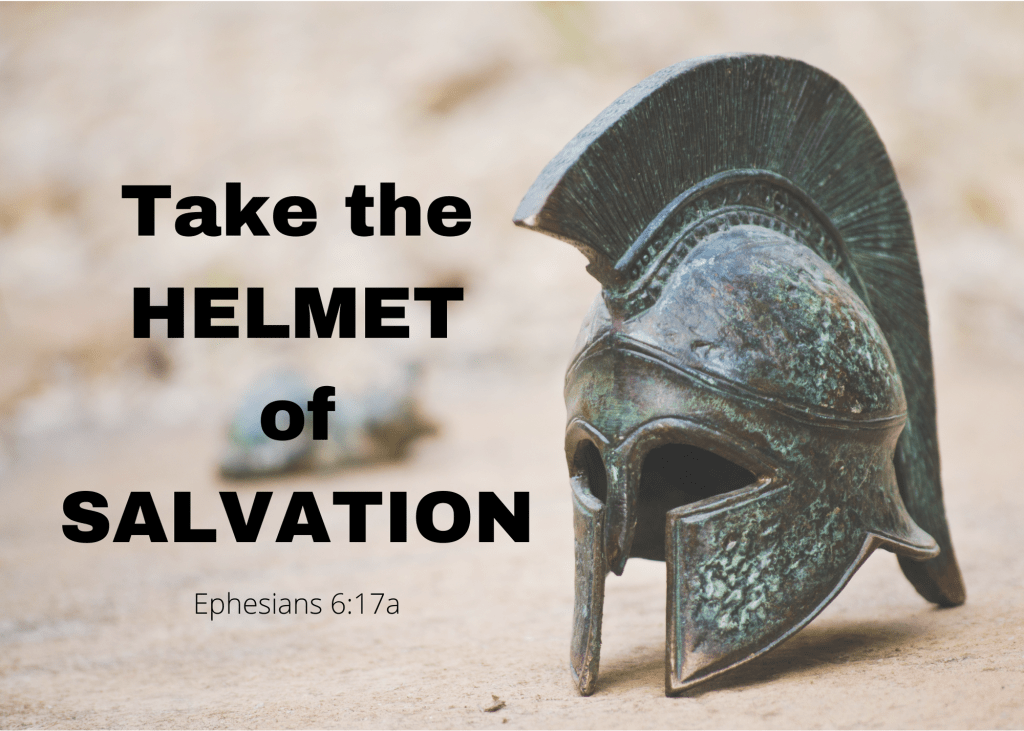
For the apostle Paul, the author of this Epistle, the helmet was the perfect metaphor; after all, he was under house arrest when he wrote this letter. He probably had a lot of face time with a Roman guard who most likely wore some kind of helmet. Each piece of the helmet added another layer of protection against injury or death.
Paul calls this piece of the armor the helmet of salvation. The Greek form of the word for salvation is used only in this verse in all of the New Testament and it means “peace”. As we don this piece of armor, we can have the “peace of God that transcends all understanding will guard your hearts and your minds in Christ Jesus”. (Philippians 4:7)
Where does this salvation or peace come from? It comes from being in the Word of God daily: reading, studying, meditating, and memorizing it. We need to be intentional about the media that we consume and the conversations that we participate in. We need to be aware of entertaining the thoughts that seem to come out of nowhere. Protecting our minds against the thoughts that flow in and out should be something that is carefully monitored as we go about our daily living.
If you want to be in God’s Shalom peace while you engage in spiritual battle, be sure to wear the helmet of salvation.
-Bethany Ligon
Reflection Questions
How do you think the enemy attacks minds? What about yours in particular?
Describe the progression from thoughts to words to action to habits to character. Give an example that leads to ungodly character. Give an example that leads to godly character. Which type of thoughts do you work at thinking most?
What protection is available to you against the thoughts that lead to ungodliness and death? In what ways can salvation and peace mean the same thing? What can you do (today) to strengthen your protection that God has made available to you?
Do you ever feel like you’re being bombarded with issues, concerns, or worries? Have you ever heard yourself saying, “If it’s not one thing, it’s another”? Maybe you’re just having a typical ‘Monday’ even though it’s Thursday. Or maybe you find yourself clumsy dropping things, forgetting why you walked into a room, or having to deal with “that one person” more often than normal? It’s not so much one big thing, it’s just one little thing after another that really tests your patience.
My friend, those big things, those small things, those things in quick succession, those repeated things…those very well could be “flaming arrows of the evil one”.
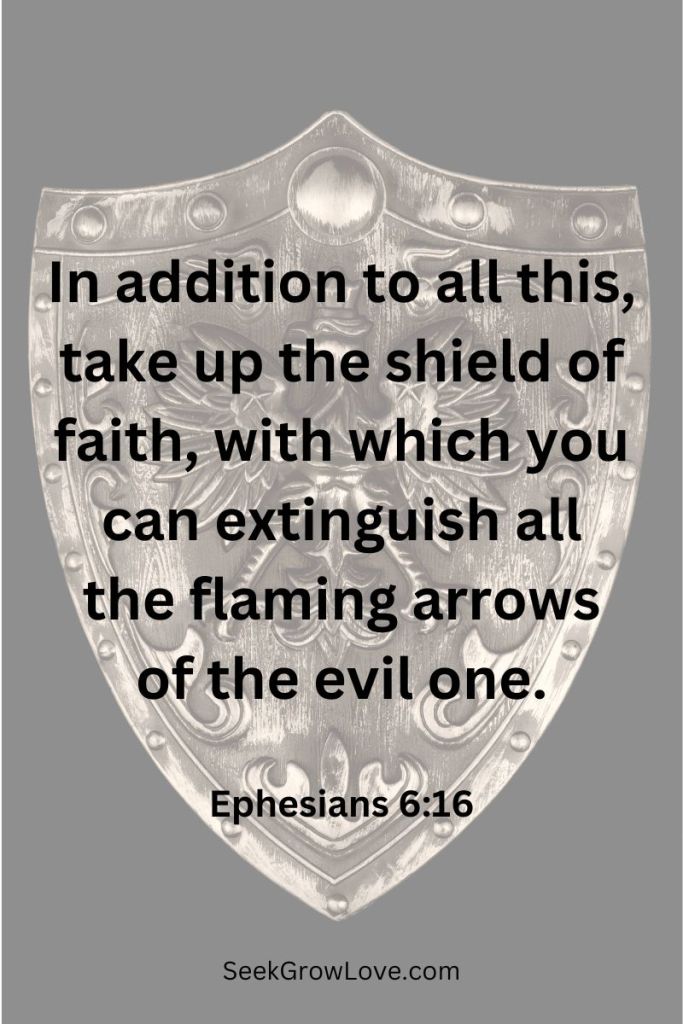
So why does the author of Ephesians, Paul, specifically use the term “flaming” arrows…why not just regular arrows? If a vulnerable soldier were hit by a normal arrow, it would likely only cause damage to himself. But if a flaming arrow hit him, the flame could catch onto nearby flammable material and cause significant damage.
The comparison leads us to think about how these spiritual attacks affect us and those around us. When we’re experiencing trials and tribulations, how are we treating others? Are we still kind and compassionate or do we take our frustration out on others? When the challenges are mounting up all around us, do we hide out and disengage or do we press on with our commitments and ministries? When the attacks start coming from every angle, are we able to keep our head on straight and make responsible decisions, or are we tempted to act recklessly with our resources and health?
You see, from the evil one’s perspective, the more damage that can be done with a single flaming arrow, the more successful the attack. It’s not just you and your personal faith; it’s your physical and spiritual health, your relationships and ministries that are under attack.
This is why taking up the shield of faith is so vital when engaging in spiritual warfare. A Roman soldier would have his wooden shield soaked in water so that when a flaming arrow hit its intended target, the flame would be extinguished and not cause collateral damage.
Likewise, when we are soaked in the Word of God, those attacks become a little less hazardous to how we choose to carry on in the battle.
In John 7:38, Jesus says, “Whoever believes in me as Scripture has said, rivers of living water will flow from within them.”
The more of the living water that we have flowing through us, the more protected we are from the enemy’s attacks on our faith. We need to stay spiritually hydrated by engaging in the Word of God on a regular and consistent basis. This will build up our faith and protect us from the flaming arrows that are pointed in our direction.
-Bethany Ligon
Reflection Questions
What do you see and recognize as flaming arrows of the evil one? How can recognizing them as flaming arrows of the evil one improve your response to them? Which ones have attacked you or caught you off-guard most recently?
Where/when have you seen a flaming arrow in action – with the potential of injuring or taking down more than just the one it hit? How can we guard against the effect of the flames of these arrows?
How strong is your shield of faith? Does it have weak spots that make you more vulnerable? What can you do to strengthen your shield?





 Seek Grow Love