Exodus 31 and 32 are full of some pretty exciting stuff. There seems to be good reason why Moses is a recurring character in children’s lessons and why illustrations of these stories made the cut for one of the rare colored pictures inserted into the old Children’s Bibles of my day!
In this story, while the Israelites were busy stripping off their valuable gold to fashion it into a false god, Moses was busy encountering the LORD. Unfortunately, not only were the Israelites just doing the handicraft work of sculpting calves with gold, we also see in Exodus 32:8,
“. . .they have bowed down to it and sacrificed to it and have said, ‘These are your gods, Israel, who brought you up out of Egypt”
Umm, excuse me, who brought them out of Egypt?? The only God. The one true God. The LORD who was busy inscribing tablets for His people at this same time. God was writing. At a time where writing wasn’t something you did with a stylus on magic screens, when you didn’t highlight or color code or copy and paste. . .writing itself was more rare and precious. And while they were spouting lies and whining, God was inscribing His words in stone for them anyway.
As an occupational therapist, one thing I get to do quite a bit is assess how people write, how I might be able to make it easier, less painful, help children develop writing skills, etc. So, while I read this chapter, I couldn’t help but get intrigued wondering how He was doing it and how it looked. Is God right handed or left? Was He pointing with an index finger? Does He have an index finger? Were there any pink sparkles involved? Basically, I got distracted thinking about things through my filter and what I know. While these chapters don’t share this detail, Deuteronomy and later in Exodus tell us that these tablets were written by “the finger of God”. That is some handwriting action I would LOVE to observe! But most importantly, given the God who parted the Red Sea for this crew to miraculously flee Egypt, was writing with His finger on stone for His people, one would assume these words were treasures. But. . .
How heartbreaking to see two vastly different things going on at Mount Sinai at the same time. A God who loves His people and knows them best writing a message for them. A people who claims to be His in one breath, yet lifting a golden cow as their god in another, all the while clueless to what the true God is busy doing for them. Surely we can relate before we throw stones. We live in a world of gold, cows, false gods, lies, distractions, and people telling us other things are gods constantly. We also live in a world created by the one true God with a beautiful plan for renewal in the coming kingdom. Maybe one day we can see God write, but until then, we have His living word, His spirit, and His love available to us. Let us purge our golden idols and seek to focus our attention on Him even if it means being patient, obedient in tough things, and focused on the promised land.
Reflection Questions:
What can you learn and apply from the characters on the top and bottom of Mount Sinai in today’s story?
What can you do today to treasure God’s word?
Prayer:
Dear God, You are the one true God worthy of all our praise. Thank You for loving us through all our faults. Help us remember to seek You first and cast aside any idols we have. Amen.
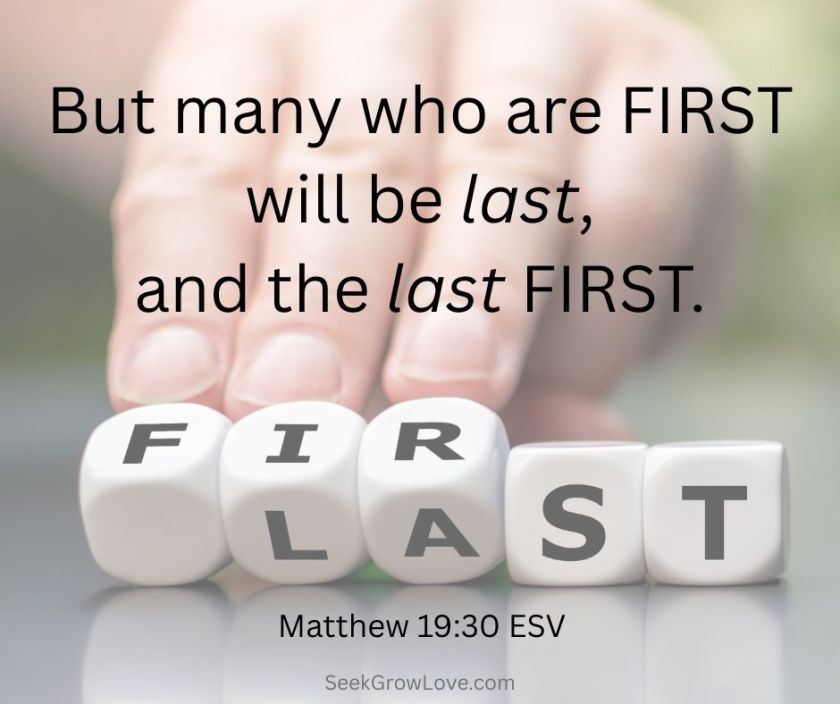
In Matthew 18 we learned that Jesus cares for the lost sheep. In Matthew 19 – we see him calling his disciples to be more like children and making the statement “many who are first will be last and many who are last will be first.” It seems like throughout his teachings, this chapter included, Jesus defines success and portrays the goal of life to be different than what the world is feeding us. Sometimes what the world is forcing upon us.
Psychology Today released an article in 2024 revealing that over the last decade, more Americans polled wanted to be rich than before, more believed that they would be wealthy in their lifetime, and 6 out of 10 interviewed thought they would like to be a billionaire. Granted, the study was also saying wealth does not increase psychological well-being or happiness, but most people still want to be rich. So, that’s us. Then there is Jesus who tells us in such a vivid metaphor that it will be easier for a camel to go through the eye of a needle than a rich man to enter the kingdom of God. So, it will be really really really hard for a rich person to be on the path for eternal life, and that is the only thing that truly matters if we obtain or not. With the vast amount of wealth and material possessions our country has, I think Jesus’ words should make us consider things.
In the opening to Matthew 19, I was struck by some other teachings that are in contrast to what the world teaches us. While reminding the Pharisees that the only reason there even were these “permits to divorce” was because of the hardness of human hearts, Jesus also mentions some significant truths. A man will marry a woman. Period. And “at the beginning, the Creator made them male and female.” (Matthew 19:4). Period. Immediately following these verses Jesus is laying hands on and praying for the children (no thanks to his disciples!). If I ever need reminded to pray for youth, five minutes in a library children’s department (don’t even get me started on the adult or teen!), looking at TV programming targeting youth, social media, the news, literally anything involving technology or a screen, and reading any statistical research on professed Christians and trending beliefs along these subject lines. . . and I am easily reminded to pray. Children are being targeted with agendas of sexualization from a very young age, and it matters. It matters for our churches, our families, our schools, our society, our mental and physical health, and so much more. Unfortunately, I have worked with teen and young adult patients dealing with side effects of interventions associated with this confusion that modern society has allowed. I pray that as we all make decisions on use of time, what we read, watch, laugh at, support, ignore, and how we navigate a very broken world while loving those around us the way Jesus loves. . . that we would continue to seek God’s wisdom and His word for our decisions and how we interact with others.
Jesus assumes the Pharisees were familiar with God’s word, and challenged them saying “Haven’t you read. . .” Today, we live in a world with access to the Bible easier than ever before, but many people simply have not read enough to have conceptualized what God says on topics. Beyond discerning truth, the Bible is so helpful in softening and penetrating our hearts, teaching, encouraging, and enlightening. Before we spout opinions or get riled up by others, before we like, snap, tweet, chat, tick, tock or whatever we do on any of the abundant divisive and confusing subjects in the world. . . let’s make sure we’ve read the words from the author who knows it all and loves us most.
Reflection Questions:
Have you ever felt like a camel trying to get your hump through the eye of a needle? Consider Jesus’s words about what is harder than that.
Why is it hard to be last now even with the hope of being first later? What can help us through those difficulties?
Have you read?. . .
Prayer:
Dear God, thank you for providing easy access to the Bible and the truth written in Your Word. Help us to learn from the teachings of the Bible and practice it daily. Thank you for all you have given us and let us be content with what we have and seek You first above anything else the world offers. Amen.
Ps 4: 3a “But know that Yahweh has set apart the holy one for Himself;…” (LSB)
In Hebrew, the word for “holy” is “qodesh”. Like many of the words that we translate over into English, the original word in Hebrew has a number of meanings and we try to summarize it nicely to the word that most closely matches in our language, but in doing so we also sometimes lose a lot of the “flavor” that the original word encompasses. We translate “qodesh” as “holy”, but it also means “seperated”, “set aside”, and “set apart”. When we read the above verse with that in mind, you can also read it as “Yahweh has set apart the set apart one for Himself” entirely accurately. It’s a clever word play.
But what does that mean? It’s simple, look around you at our society. We live in a world that is rife with sin, carnal images, narcissistic encouragements, pride, immorality, etc. It’s everywhere. We are a people that has largely forgotten about our God, it’s painfully apparent in almost every aspect of our society. God wants us to set ourselves apart from all of this, to remember and honor Him, and to obey His will. In return, He promises that He will set apart for Himself those who set themselves apart. But how are we to do that?
Ps 4:4-5 “Tremble, and do not sin. Ponder in your heart upon your bed, and be still. Offer the sacrifices of righteousness, And trust in Yahweh.” (LSB)
The fear of Yahweh is the beginning of wisdom (Pr 9:10). Fear, and do not sin. Think about God as you’re laying in your bed, and be still. Another translation of “be still” is “quit kicking”, which I’m personally a fan of. This is all about attitude and understanding your place. Acknowledge God as not only your creator, but the creator and master of ALL THINGS, He’s in charge and you’re not. A roommate of mine in college had a fantastic poster that read “2 Foundation Facts for Human Englightment: 1 There is a God, 2 You are not Him.”.
Are you living a righteous life? That is the sacrifice that God requires, not the cattle on a thousand hills, not a specific percentage of your income, not writing the big checks you see on TV that take 2 people to even hold up, but righteousness. It’s a sacrifice, you put aside some of the things you think you’d like to do to set yourself apart and obey God.
Do you trust God? Our society has taught us to trust in ourselves, to trust in the system, to trust authorities, and to trust in our abilities but has largely obscured this critical aspect of trusting in our creator. There are a thousand and one things to distract us, to divert us, to capture our attention and take it away from this critical foundational concept of trusting the God that made us. I will put forth for your consideration that anything you trust in more than God has become an idol to you. Anything that you delight in more than God can become an idol to you, and cause you to focus on things aside from our heavenly Father.
God specifically and repeatedly tells us not to have idols, not to focus on things that are worthless, and remember Him. We look back in history at some of the false gods that the Israelites worshipped and just shake our heads. Then we go back to watching TV, getting on social media, watching movies, trying to get ahead at work, playing video games, reading books, getting a better car/house/mate…anything that diverts and distracts us from what our real job should be; setting ourselves apart and offering up to God the sacrifice of our righteousness and trust. If any of those things is taking more of your focus than you are giving to God, it has become an idol to you. I will tell you a painful reality: if you swim for too long in the sewer, you’re going to smell like poop. Everything that takes your attention away from God is the sewer.
I do trust God, because do you remember the story of the prodigal son? That was me. My Father came running down the road to greet me when I started coming back to Him. I am ashamed that I ever turned aside, and humbled that despite my vast unworthiness, my God came running to me the moment I started back towards Him. I promise, if you have veered off the path, return to God. He will come running to meet you.
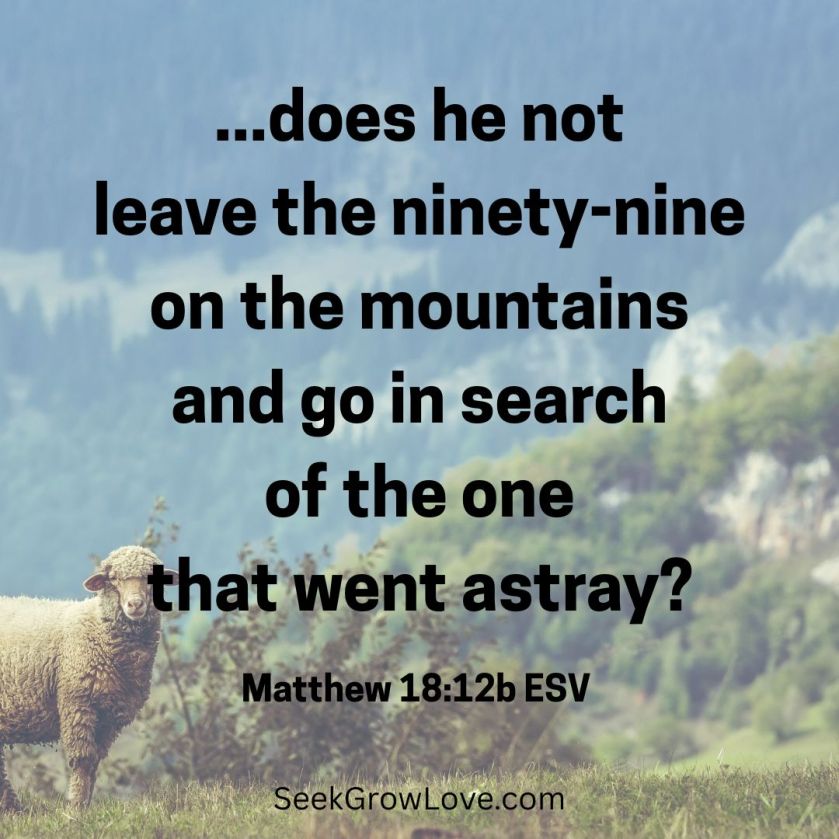
In our Matt 18 reading today, in 18:12-14 is the parable of that lost sheep. That was me, too. God came looking for me when I was lost, and found me. Notably, He found me when I pointed my head back in His direction because I heard Him calling; if I would have kept wandering away, who knows what would have happened? In Luke 15:7 it says that when that lost sheep is found, there is rejoicing in heaven. I get a little choked up just thinking about it, God cares so much about me, about you, about all of us, that He is actively seeking us to find ways to bring us home. There is rejoicing in heaven when we start heading back towards God. This should melt your heart, when you realize the depth of love and compassion that our creator has towards us.
So what about you? Are you trusting in the God that loves you and offering up the sacrifice of righteousness to Him? Have the idols of this present evil age distracted you? Are you playing on the field, and not spectating from the seats in the game of life? Here are a few practical daily tips to help you focus on and trust God.
Pray. Not just at meals, but when you wake up, when you shower, before you go to bed, while you’re driving. Let your heart be melted by the love God has shown to you, and reciprocate it back towards God.
READ SCRIPTURE! Daily.
Fast occasionally. It doesn’t even have to be food, take a break from some of the things that distract you from God and spend that time seeking God instead. Man does not live by bread alone, but he also doesn’t live by TV, social media, or anything else that isn’t something that comes out of God’s mouth.
Love others. God doesn’t just want us to love Him, He says that one of the ways that we can show Him that love is to love the rest of His creation. This includes jerks, hostile enemies, addicts, ugly people, people with different cultures and colors, that person who uses weird pronouns, that guy who took your parking spot, the lady who was gossiping about you at work…every other living being is a creation of God, and by loving them (whether we agree with them or not), we honor God.
Do you want to find Jesus? He’s probably in the parking lot at Walmart, and he’s probably hungry. Go buy him a sandwich. (Matt 25:40). Or maybe he’s lonely, in a nursing home, and wants a visit. Or maybe he’s doing time in prison and needs to talk. Or maybe, he’s a lonely widow who can’t mow their own lawn because they’re feeble. Maybe he just needs a ride. Go find him.
REFLECTION QUESTIONS:
What are your idols?
How can you do better at “setting yourself apart”?
What is your biggest obstacle to living a righteous life? How can you change that?
Do you trust God more than yourself? Why, or why not?
PRAYER:
Father God, you have been faithful and kind to me throughout my entire life. Thank you. Please help me to focus on you, to remove the things that distract my focus, and to live a life that pleases you. Help me to be a servant who pleases his master. Lord, look deep in my heart and show me my flaws, and help me to remove them so that I can love you fully. Thank you for sending us your son. Please forgive me of my flaws, and lead me to You, in Jesus name, amen.
What a powerful moment in history. God has redeemed and claimed His chosen people the Israelites, and is laying down a few ground rules for their behavior towards Him and towards each other. The 10 commandments have just been given a few chapters back, and Ex 23 begins with a continuation of some guidelines for interaction. Read through these carefully, do you see a common theme? These rules that God is giving really highlight His character. When I read through these (Ex 23:1-19) what stands out to me isn’t that God wants a bunch of rules followed, but that the character of God is shining through. Look closely.
God is just. God is merciful. God is forgiving. God is loving. God wants us to respect each other, and Him. God will punish the guilty. These characteristics are easily seen by the rules he asks us to follow. When I read these verses, 23:19 really stands out to me: “You shall not boil a young goat in the milk of his mother.”. Why? Because that would be unjust, and not fair. God is so full of love for all of his creation, that he’s concerned with even a baby goat, and is concerned about justice for it. Which makes sense, when you consider that the earth and all that is in it belong to God (Ps 24:1), and you consider the beauty of God’s character.
If we turn ahead a few chapters to Ex 34, God actually tells Moses (1) who He is and (2) what His character is like. This is one of my dad’s favorite verses: “…Yahweh, Yahweh God, compassionate and gracious, slow to anger, and abounding in loving-kindness (or, mercy) and truth; who keeps lovingkindness for thousands, who forgives iniquity, transgression, and sin; yet He will by no means leave the guilty unpunished…” (LSB translation, Ex 34: 6-7). All of the “Children of the Book” agree on the nature of God, because He has revealed it to us. In the Quran 1:3 it describes God as “Most Gracious, Most Merciful.” (a loving nod to some of our Muslim brothers and sisters). I urge us all, let us exhibit God’s characteristics within ourselves, not only to our creator but to our fellow creation.
In Ex 23:20-23 we once again clearly see the concept of “shaliah” demonstrated, and it’s important to note that God actually clearly states “My name is in him”, granting the angel full authority. I suppose the American equivalent would be “active Power of Attorney”, but that doesn’t quite cover the fullness of the concept. We also see Jesus stating clearly in John 17:11 that he has been given this same name, the name of God, so he is acting with the full authority of the God who sent him. If you’d like a more detailed understanding of “shaliah” you can scroll back to the 1/27/2026 devotional, or just ask a jewish person.
In Ex 24, God cuts a covenant with Israel. The phrase “cuts a covenant” was at the time quite literal and involved animal sacrifice and blood, and was considered a binding promise. In this chapter we see a beautiful moment where God speaks to a large number of the priests and elders of Israel and makes a deal with them. In Ex 24:7 it states “Then he took the book of the covenant and read it in the hearing of the people; and they said, “all that Yahweh has spoken we will do, and we will be obedient!”” (LSB translation). Can you just feel the excited vibe amongst these people, who have witnessed an amazing and miraculous covenenat being formed, with the glory of Yahweh “like a consuming fire on the mountain top, in the eyes of the sons of Israel”?
What an amazing event! Never before had something like THIS happened, this was huge! This is what would be described by most folks as a life altering event, something that would change your outlook and destiny, something that would inspire you for a lifetime and change the very fiber of your being for the better. How long do you think something like this would stick in your memory?
40 days, that’s the answer. Moses disappears up the mountain, into the fiery glory of God and is gone for 40 days and nights before it all goes bad. While God and Moses are chatting, the sons of Israel are getting restless. Despite seeing miraculous signs and wonders, if you flip ahead to Ex 32: 1-2 it says “Then the people saw that Moses had delayed to come down from the mountain. So the people assembled about Aaron and said to him, “arise, make us gods who will go before us; as for this Moses, the man who brought us up from the land of Egypt, we do not know what has become of him.” (LSB translation). Forty days. It’s just embarrasing. It’s really a good thing that God is so forgiving and merciful, because that could very easily have been turned into what the scientific minded folk would call an “Extinction Level Event” for the Israelites.
God not only doesn’t wipe them out, but He continues to shelter them, to love them, and to keep them safe and fulfill the promises he’d made both to them and to their ancestors Abraham, Isaac, and Jacob. WHY? Because God always keeps His promises. Because he is the Most Merciful, the Most Gracious.
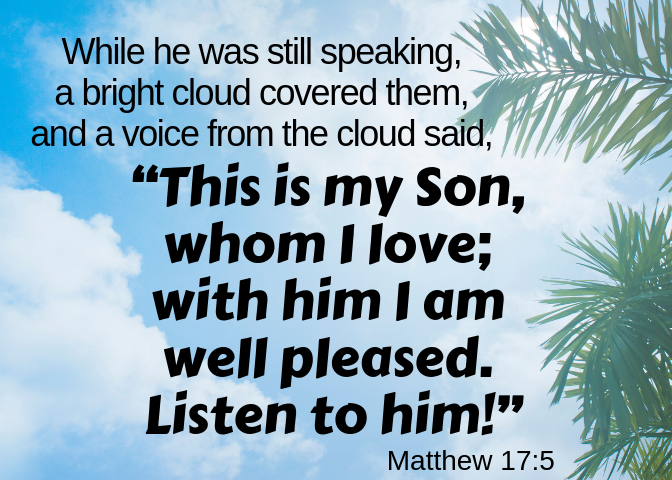
Do you need further proof? Flip over to our NT reading today. In Matt 17:5 God states audibly (for the second time) “This is my beloved son, with whom I am well pleased; listen to him!” (LSB Translation). Then later on, he offers up this man Jesus, His own beloved obedient son, as a sacrifice to grant redemption to humanity and to cut a covenant of salvation. Folks, let me tell you something; I’m a father, and although I absolutely do love a lot of you people out there that I know, if it came to a choice between you and my son…well, let’s just say you would not come out ahead in the equation, I’m sorry. “But God…” (I love that phrase) is the perfection of character, the perfection of love, the highest example of what our own character should be.
What a beautiful God we serve. I know that He is beautiful, because His creation is beautiful. The mist as it gathers at the tops of the mountains is beautiful. The sun arising through the clouds and shedding new light on the world every day is beautiful. YOU are beautiful, as is the entirety of the creation of God, and the voice that spoke all of this creation into being. It should humble and awe you, when you think about the utter depth of the love that God has towards all of His creation. We do not deserve it… “but God…” is the most compassionate, the most merciful, praise His holy name.
REFLECTION QUESTIONS:
Stop for a moment and think. How many times has God done something amazing and miraculous in your life?
How long did it take after that amazing and miraculous thing that God did for you before you “moved on” in your mind?
Why do you think that we, as humans, have this inclination, and what can we do better to hold on to that “awe and wonder” that is rightfully due our God?
Are WE gracious, compassionate, and merciful to our fellow creation? (Answer for all:) What about people of different denominations? Different cultures? Different faiths? Our “enemies”? Why, or why not? What can we do better?
PRAYER:
Father God, thank you.
You are the Most gracious, the Most merciful. Time and time again we have disappointed and failed You, we’ve broken the covenants that we’ve made with You, but You forgive us over and over. Father, help us to have Your character, to love our neighbor as ourself, and to never forget You who gave us life, breath, and all things. Thank You for Your never ending mercies, which are made new every morning. Help us to humbly seek Your face, to obey Your will, and to be servants who please You. Thank you Yahoveh God, in Jesus name, Amen.
I want you to know that my parents are amazing, wonderful, spirit-filled, and God-led people, who have strove their entire lives to live in a manner pleasing to God, and to instill in me that same holiness and humility. That being said, I want you to know that I was a truly terrible person, rebellious and narcissistic, and largely ignoring everything they said until God grabbed me and my attention. Today as a devotion, I am going to give you just a small portion of my personal testimony. This will be the “highly edited” version and summarization, but please know that I was a truly terrible person, despite my awesome parents, and my awesome God. As a spoiler alert, know also that God saved me with a mighty and miraculous hand.
Psalms 3:1-2 (LSB): “O Yahweh, how my adversaries have become many! Many are rising up against me. Many are saying of my soul, “There is no salvation for him in God.””
When I was between the ages of 18-25 I was basically a career criminal, and that is far more a reflection of my own stupidity than my parents efforts. I found that the easy way was…well…easier, so I took it. Then I kept on taking it. I was doing lots of drugs, and drinking too much, and doing things I shouldn’t. Mom and Dad could see that I was drifting away and prayed for me constantly, which is likely why I am alive. I became involved with bad people, doing bad things, for bad reasons. Then as I moved deeper into those circles, I became privvy to information that I shouldn’t have, and as a result I found myself in mortal peril. Those people I’d thought of as my friends began to seek my life. Things got dark and ugly. People that I knew and loved died. It was a hot mess, and in a moment of desperation I called Mom and Dad.
Psalms 3: 3-4 (LSB): “But You, O Yahweh, are a shield about me. My glory, and the One who lifts my head. I was calling to Yahweh with my voice, and He answered me from his holy mountain.”
Miraculously quickly, my parents sent me a plane ticket in another young man’s name, who had just cancelled a trip but not the ticket yet. This was before 9/11 so you could get away with those types of shenanigans. I escaped and moved in with them in Atlanta, where dad was teaching at the Atlanta Bible College. I was expecting to die at any moment, and so I threw myself wholeheartedly into scripture, looking for God to save me, which He did. I was the only kid in history, to my knowledge, to go to the Atlanta Bible College with a mohawk (but nicely done up in a pony tail, usually). I met some great people there, TRUE friends, who loved God and lived in a manner that was pleasing to Him. I immediately stopped doing all of the bad things I’d been doing, and started to study up on scriptures. I was really trying to seek God.
When you’ve lived immersed in a sewer for a long time, though, it’s hard to keep yourself from stinking. When I took up a professional (legitimate) career, I started to get puffed up with myself, and some of the bad habits I’d had started to look appealing to me again. Does this sound familiar, from the stories in Exodus? Even though I’d been miraculously saved, from overwhelming odds and contrary to all worldly sense, I soon began to do some of the things that I had before: namely drinking and smoking various things in my case. The issue was not what I was doing, necessarily, but that in my heart I had determined that I could decide, not God but me. I began to be what I call a CINO, a Christian in Name Only. I was living for myself, seeking advantage for myself, taking care of myself…but I’d still check all the boxes to be considered a “Christian”.
I’d still go to church (check), still pray before meals (check), sing when I was at church (check), and had a bible at the house (check)…but I forgot in my heart about the God who had saved me miraculously and without my deserving to be saved, and started trying to make my own decisions again, instead of listening to God.
Psalms 3:5 (LSB): “Then I lay down and slept: I awoke, for Yahweh sustains me.”
Then, on Feb 14, 2022, I died. I’m not saying this metaphorically, I am saying I died, for a bit over 5 minutes. Specifically, I had a widowmaker heart attack with a 100% blockage (“Wot? I got better!”-Monty Python). In retrospect, this was God tapping me on the shoulder to remind me. Any sane person would have recognized it for what it was, but me? Nope: I got up, kept checking the boxes, and kept on being stupid.
Psalms 3:8 (LSB): “Salvation belongs to Yahweh…“
About a year later, my dad went blind. Now, I knew I wasn’t a good guy…but my dad, my dad was a righteous man, who had tried his entire life to live in a manner pleasing to God, with better succcess in this endeavor than most men. Not perfect, by any means, but he REALLY TRIED. It affected me in a way that my own death did not. I got on my hands and knees and started praying and fasting, asking God to heal dad. About 3 days into a hard fast, I realized through scripture that God would not listen to the prayers of an unrighteous man, so I began to systematically get rid of everything in my life that led to unrighteousness. I burned the things keeping me from God in a fire, and said I was sorry. Then I kept fasting, and praying. I talked to God a lot. A while later, He started talking back.
So now it’s been almost 2 years since I’ve fully submitted myself to God’s will. I’m almost 58 now, but some fools are just slow learners. There have been hills and valleys in my walk, but God has taken me by the hand and leads me. Why? I don’t know, I absolutely don’t deserve it, probably because my parents never stopped praying for me. I have seen miracles. God has spoken to me. Crazy things have happened, too many to detail to you without you thinking I was absolutely insane. So many miracles that I started keeping a journal. I’m not talking about “oh, it was a miracle that I got that job” miracles, I’m talking about “oh look, the Red Sea just parted so we could go through” miracles.
Jeremiah 29:13 says “You will seek me and find me when you search with your whole heart.”Let me just tell you this with absolute sincerity and conviction: God absolutely exists and He still intercedes miraculously for those who seek Him with their whole heart. This is not a knowledge attained from books, this is an experiential knowledge that I am sharing with you, with 100% conviction. My dad is still blind, but God is opening up other things for him (and me) that we wouldn’t have suspected or expected. I live in a state of awe and wonder. I am humbled and amazed that God would seek me out, of all the terrible sheep who have gone astray…but He did.
REFLECTION QUESTIONS:
Have you ever made a conscious decision to do something different than you knew God wanted you to do? If so, why, and how did that work out?
Has God ever saved you? Was it miraculously? Are you sure?
Have you ever tried completely submitting yourself to God, to praying and fasting intently, to speaking to Him almost every moment in awe and worship and love? If you did, did you witness miracles too? If you haven’t tried yet, why not?
PRAYER:
Lord God, Father, I have failed you more times than I can count, but you have been kind and faithful to me despite my foolishness. Please God, forgive me! Help me to be the servant who pleases you. Teach me your ways, and circumcise my heart. Whisper to me the way in which I should go, and lead me by the hand. May the lips of all your creation offer you the praise you deserve, thank you God! In Jesus name, Amen.
In today’s reading, we find our heroes the Israelites 3 months out from escaping horribly oppressive slavery in Egypt and after being led through the harsh desert miraculously arriving safely at Mt Sinai. This is the first time in recorded history that anything like this had ever happened: God has redeemed His chosen people en masse and brought them to Him. This is a direct act of intercession from the hand of a loving God, because He had made promises and covenants with Abraham, and God always keeps His promises. Always, every time, and forever, God keeps His promises. If you remember nothing else from this devotion, remember that.
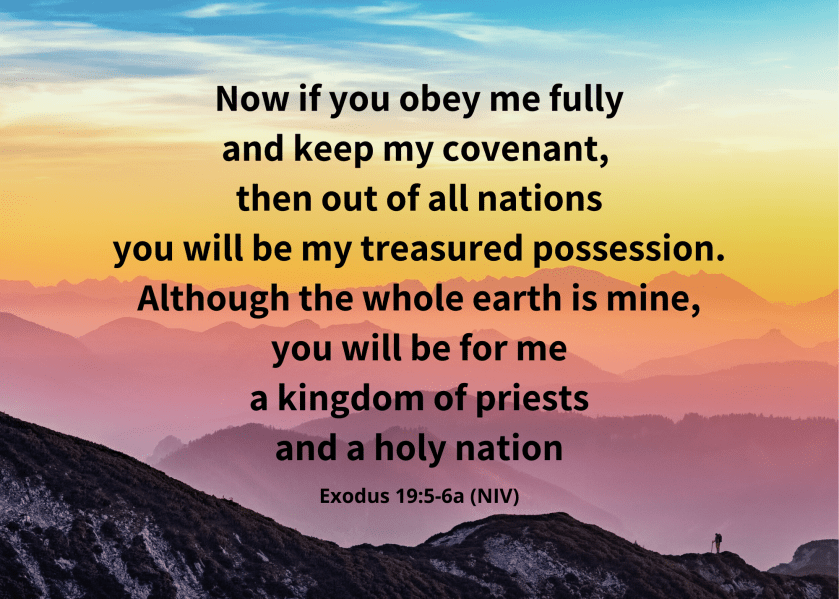
God tells Moses (Ex 19:4-6): “You yourselves have seen what I did to the Egyptians, and how I lifted you up on eagles’ wings and brought you to Myself...”(LSB). That is just beautiful. Pay special attention to 19:5, wherein God clearly states “…for all the earth is mine…” (See also Psalm 24:1). What beautiful imagery! You really need to imagine the setting of Ex. 19; there are most likely millions of people waiting expectantly at the base of the mountain, who all answer together “All that Yahweh has spoken we will do!”, after which God gives them very specific instructions to purify themselves, and then much like to Lt. Dan in the movie Forrest Gump, “…right then God showed up.” Never before had anything like this happened that we are aware of, God speaks to an entire people and gives them the “House Rules”.
This may shock some of you, but I was a rather rebellious child. I remember that the day I turned 18, I thought I had complete autonomy and authority because now I was an adult, and nobody could tell me what to do. Keep in mind that at the time, being a ripe 18 years of age, I already knew everything (most of which I have sadly since forgotten), so I was pretty certain I could just do anything I wanted. I made the mistake of mentioning this to my father at the time to justify a series of extremely poor decisions on my part, in what became a rather fervent discussion. In retrospect, perhaps I was not as smart as I thought I was.
Keep in mind that all of this took place while I was staying rent free in my parents house, the one they’d paid for, paid the bills for monthly, and stocked up with food for my consumption on a regular basis, without any contributions at all from me (aside from my stunning insights and wisdom about my own autonomy, of course). My parents at the time were also paying all of my bills, feeding me regularly, buying me clothes, had bought me a car, etc. So, you know, I was an adult taking care of myself… *ahem* . During this highly needed and educational discussion, my father made the statement “Well, you can absolutely make your own decisions since you’re technically an adult now, but as long as you’re living in my house, you will abide by my rules.”
The conversation that God has with the Israelites in Exodus 20 really strongly reminds me of that conversation, without the fervency perhaps, but with more clarity. Note that God has already defined “My house” in Ex 19:5, so when God is giving us the 10 commandments in Ex. 20 He is basically telling us “when you are living in my house, this is how I expect you to behave,” in advance.
“But…” some folks will say, “these commands were given to the Israelites, they don’t apply to us today as Christians..”. Fair enough, let’s look at what Jesus says about them. Turn over to Matt 19:16-29. In this passage, Jesus first humbly points out that the man shouldn’t call him good because only God is good (which is a bit confusing if you’ve accepted a confusing post-biblical theory about Jesus’ identity), and then states very clearly “…if you wish to enter into life, keep the commandments.” (LSB). Then he goes on to refer to some of the actual commandments, so we know what he’s referring to: it’s right here in Ex 20.
So are we as Christians responsible to keep the commandments? Only if we listen to our Christ, I would say. If you are an adult now, and no one can tell you what to do, and you have full authority and autonomy over your own life, well…you probably, like me at 18, already know everything and you don’t have to listen to anyone, ever (if you didn’t dectect the irony and sarcasm there, read it again slowly).
If, however, you are a humble Christian, seeking to please both Jesus and his God (yes, Jesus has a God, see John 20:17) then you may want to rethink that. You are, after all, living in God’s house. You should probably abide by His rules; particularly if you want a room in the kingdom, on the new earth that has been promised (and God always keeps His promises). Trust me when I tell you, you do NOT want to get kicked out of His house.
I love how God clearly identifies himself to his people, this has been grossly altered in most modern bibles, but what God actually says to preface his commandments is; “I am Yahweh your God, who brought you out of the land of Egypt...” (Ex 20:2, LSB). So we know exactly who’s talking. Then he lists his expectations while we’re living in His house. The first 4 commandments have to do with us and our interactions towards God. The next 6 commandments have to do with us and our interactions towards our fellow man(kind). These are all neatly summed up by our king, the Christ, in Mark 12:29-34 when Jesus says that the greatest commandment is “Hear O Israel! The LORD our God is one LORD, and you shall love The LORD your God with all your heart…”, and the second is this, “you shall love your neighbor as yourself.” Please note that this does not REPLACE the original commandments given by God, but summarizes them nicely.
Praise God that we serve a God of clarity and not confusion, He tells us His expectations right up front, and then lets us make our own decisions about whether or not we will listen and obey. We serve a wonderful, powerful, and amazing God who has shown that He will intercede on behalf of His people in miraculous and powerful ways throughout the scriptures, which cannot be broken. The only real question is: are we going to listen and obey and thereby be God’s People? Choose now for yourself, but as for me and my household, we will serve Yahweh the living God, who has sent us our Christ in order to bring us to Himself.
REFLECTION QUESTIONS:
Do you keep all of the commandments? Why, or why not?
Read Gen 2:3.Do you believe the 4th commandment (the Sabbath) is just for the Jews? Why, or why not? When did it change, if it did?
When Jesus summarized the commandments in Mark 12, did it seem like commandment keeping alone was sufficient to enter the future Kingdom of God, or was there something else we should do? Summarize in your own words what else we should do, if you feel like there’s something else.
PRAYER:
Father God, you have created us and this place, and all things belong to you. Thank you for giving us life, and breath, and all things. You are beautiful. Every blessing that we have has come directly from your hand to us, an undeserving and rebellious people. Please forgive us, and teach us, and help us to follow your commandments. Lead us toward your kingdom, Father, and help us to enter into it. In Jesus name we pray, Amen.
Agur son of Jakeh is not normally a familiar character in our English Bibles. Here we are reading right along with the chapters of Proverbs, mining every nugget of gold and truth from these verses and wondering how Solomon is so wise. And now along comes Agur who writes a whole chapter in the book and is a complete unknown to us.
His name “Agur” can be translated to mean “gatherer” and his father’s name Jakeh means “pious”. So from the name we gain some clues about who this man may have been. He could have been a scholar or writer of their time who wrote down or compiled wise sayings, maybe even from Solomon himself. It is a mystery for us, but we can see from his writing God’s familiar wisdom pattern. He compares the physical with the eternal, the earthly with the heavenly, and the corrupt with the pure.
Agur starts with some statements which are deeply humble in God’s sight and remind me of the later chapters of Job where the majesty of God is compared to our puny, small efforts of this earth.
Proverbs 30:1-4(NLT) The sayings of Agur son of Jakeh contain this message. I am weary, O God; I am weary and worn out, O God. 2 I am too stupid to be human, and I lack common sense. 3 I have not mastered human wisdom, nor do I know the Holy One. 4 Who but God goes up to heaven and comes back down? Who holds the wind in his fists? Who wraps up the oceans in his cloak? Who has created the whole wide world? What is his name—and his son’s name? Tell me if you know!
Right when it seems that I have the wisdom of God for a situation figured out and internalized in my life then failure rears its ugly head. I am confronted with the reality that there is nothing I can do for God that would indebt Him to me for my goodness. Nor can I accomplish any great work that God could not do by lifting his little finger. When we begin to approach God by understanding that with Him we are everything, and without Him we are a complete nothing, then we start to gain wisdom. The only thing we can do for God is to love Him and believe His Word. This is Agur’s message in chapter 30 to us.
Proverbs 30:5-9(NLT) Every word of God proves true. He is a shield to all who come to him for protection. 6 Do not add to his words, or he may rebuke you and expose you as a liar. 7 O God, I beg two favors from you; let me have them before I die. 8 First, help me never to tell a lie. Second, give me neither poverty nor riches! Give me just enough to satisfy my needs. 9 For if I grow rich, I may deny you and say, “Who is the LORD?” And if I am too poor, I may steal and thus insult God’s holy name.
Jesus prays in the Lord’s Prayer: “give us today the bread of our need”. Our prayers and our desires need to be grounded in what we truly need, and what God is so willing to give us. Our words and actions need to be true to His Word, and we need to stop telling lies to ourselves or to others to shade statements to give ourselves the credit.
I was a truck salesman for more than 40 years during my career. Shades of truth in statements about what was good for the customers are sources of scorn and humor about how salesman deal with people. My products and services weren’t always the best but those were the ones I had to sell to our customers. I always took the view that I would not lie about anything but also promise that my efforts, and that of our dealership, would support their purchases. Greed for riches would turn my lips to lies, acknowledging God’s sufficiency for myself and family made telling the truth an easy path.
What are the easy lies that come to your lips?
How do we guard against this?
Look at some more of these pure gold statements that are recorded for us to read by our teacher Agur..
Proverbs 30:18-19(NLT) There are three things that amaze me— no, four things that I don’t understand: 19 how an eagle glides through the sky, how a snake slithers on a rock, how a ship navigates the ocean, how a man loves a woman.
Just like our explaining to God how He should form, make and create the world and everything in it, we cannot explain from human knowledge exactly how these things work. We think we know and understand but true to humility towards God will show us the shallow nature of our understanding and knowledge. Only God’s wisdom is eternal and everlasting.
Reflection Questions
See 2 questions above in bold.
What can bring us to true humility?
How can we turn these lights of understanding towards our hearts and lives?
Prayer
Abba Father, give us today the bread of our need and lead us in paths of righteousness following Your Son and our Savior. God, we have no words or explanations for Your greatness and Your love for us. Help us today to turn our hearts to hear, give us ears to hear Your voice. In the name of our Savior Jesus Christ we pray.
Matthew 13:9-12(NLT) Anyone with ears to hear should listen and understand.” 10 His disciples came and asked him, “Why do you use parables when you talk to the people?” 11 He replied, “You are permitted to understand the secrets of the Kingdom of Heaven, but others are not. 12 To those who listen to my teaching, more understanding will be given, and they will have an abundance of knowledge. But for those who are not listening, even what little understanding they have will be taken away from them.
The parables of Jesus are beloved by so many of us. They are stories that illustrate the true purposes of God by comparing them to physical activities that are familiar to the people hearing the story. The great question that Jesus asks of us is: “Do you have ears to hear?”. The question goes to the state of the ears of our heart, not our physical ears. We will come to an understanding of the secrets of the Kingdom of God when we listen to God’s Word with our hearts and minds. In the Greek the mind is considered to be the place of our thoughts, where the heart is the place of what we truly believe and treasure.
What is the “pearl of great price” of your heart?
Then Jesus quotes from the book of Isaiah chapter 6.
Matthew 13:13-16(NLT) That is why I use these parables, For they look, but they don’t really see. They hear, but they don’t really listen or understand. 14 This fulfills the prophecy of Isaiah that says,
‘When you hear what I say, you will not understand. When you see what I do, you will not comprehend. 15 For the hearts of these people are hardened, and their ears cannot hear, and they have closed their eyes— so their eyes cannot see, and their ears cannot hear, and their hearts cannot understand, and they cannot turn to me and let me heal them.’
16 “But blessed are your eyes, because they see; and your ears, because they hear. 17 I tell you the truth, many prophets and righteous people longed to see what you see, but they didn’t see it. And they longed to hear what you hear, but they didn’t hear it.
In such a few words Jesus cuts right to the important things of life. We will be blessed when hear God’s Word with our hearts, not just having good thoughts. He also shows us what the righteous people of Israel have that makes them the people of God. They desired to understand the wonderful truths that come so easily to us today. Our access to Biblical understanding and the support and support that we have is amazing. The history and scholarship that we have to access brings us a great knowledge, but also a great responsibility.
How precious to you is this truth of God’s Word you have received?
Just in the time of my walk with God we have gone from typing a paper on a manual typewriter to using this wonderful Microsoft Word program I am using. With my less than perfect typing and grammar being constantly corrected, I can put down decent communication without whiteout or retypes. We have access to 20 different Bible versions at the ready and the Internet full of research and commentary to help search out this great truth. I still have research books and materials that are paper bound and treasure them, but to find the passages or section with a search of material online is amazing.
But still the Word needs to become rooted in our hearts. Read Psalm 119:11 with me this morning.
Psalms 119:11(NLT) I have hidden your word in my heart, that I might not sin against you.
Also, Psalm 1 tells us to meditate, which is to consider carefully our thoughts, motives, and actions in the framework of God’s Word.
Psalms 1:1-3(NKJV) Blessed is the man Who walks not in the counsel of the ungodly, Nor stands in the path of sinners, Nor sits in the seat of the scornful; 2 But his delight is in the law of the LORD, And in His law he meditates day and night. 3 He shall be like a tree Planted by the rivers of water, That brings forth its fruit in its season, Whose leaf also shall not wither; And whatever he does shall prosper.
Part of the strength of the Word to change us is that God uses so many figures of speech as well as parables to get us to examine our lives. Knowledge is great, but the understanding of a section comes from the spirit of God within you.
1 Corinthians 2:9-10(NKJV) But as it is written: “Eye has not seen, nor ear heard, Nor have entered into the heart of man The things which God has prepared for those who love Him.” 10 But God has revealed them to us through His Spirit. For the Spirit searches all things, yes, the deep things of God.
What are the truths that you have learned that have most changed your heart to love God?
Have a wonderful day today with the meditation of your heart focused on God’s truths, and building our love for Him and His Son in all we do.
Love in Christ Tom S.
Reflection Questions –
See bold questions above
Prayer
Dear God Almighty – I thank you for the wonderful gift of your Words and Wisdom delivered to us, through your dear Son Jesus, the master of parables, through all 66 books of the Bible, and through Your Spirit. I pray for eyes to see and ears to hear Your truths. Help me discern what knowledge, wisdom and direction is from You that I may go in the way You want me to go and say what you want me to say. I want my heart to be focused on You, Your truth, what You have done, are doing today and will do. Thank You for Your Son who is Coming Again! In his name we pray, Amen.
As we read this morning, I am convicted so many times by the pure and simple understanding that the true Word of God brings to the situations of life. As I read and hear the news of the world around us, the complexity of the situations and actions sometimes is very puzzling. I cannot immediately discern by my own understanding and knowledge what is the best path or the correct statements. But when I read verses like these from Proverbs 28 I am convicted so quickly in my heart about what are the right things to think and to do. These verses cut right to the chase or where our hearts need to be.
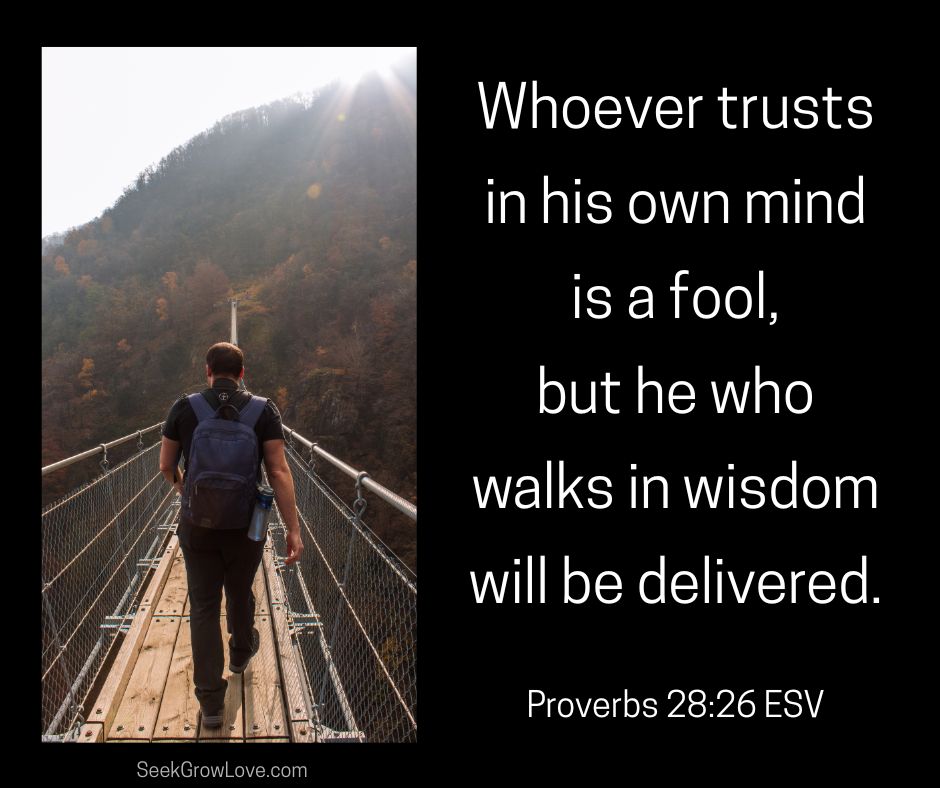
Proverbs 28:19-28(ESV) Whoever works his land will have plenty of bread, but he who follows worthless pursuits will have plenty of poverty. 20 A faithful man will abound with blessings, but whoever hastens to be rich will not go unpunished. 21 To show partiality is not good, but for a piece of bread a man will do wrong. 22 A stingy man hastens after wealth and does not know that poverty will come upon him. 23 Whoever rebukes a man will afterward find more favor than he who flatters with his tongue. 24 Whoever robs his father or his mother and says, “That is no transgression,” is a companion to a man who destroys. 25 A greedy man stirs up strife, but the one who trusts in the LORD will be enriched. 26 Whoever trusts in his own mind is a fool, but he who walks in wisdom will be delivered. 27 Whoever gives to the poor will not want, but he who hides his eyes will get many a curse. 28 When the wicked rise, people hide themselves, but when they perish, the righteous increase.
We also see in the New Testament in Timothy where God identifies for us where our hearts should be when we walk with Him and His Son Jesus Christ. God’s wisdom is pure and simple.
1 Timothy 6:9-10(NKJV) But those who desire to be rich fall into temptation and a snare, and into many foolish and harmful lusts which drown men in destruction and perdition. 10 For the love of money is a root of all kinds of evil, for which some have strayed from the faith in their greediness, and pierced themselves through with many sorrows.
God shows us that prosperity is good, but when we desire to be rich, we are sinful and separate ourselves from God’s fellowship. Money is not the root of ALL EVIL as some teach, but if we read carefully the verse says it is A root of evil. Only when we desire to have it to enrich and pleasure ourselves does it become an evil purpose for us. As we read the verses from Proverbs 28 we find so many pure thoughts and clear statements of how we are to handle our work, money, lives and relationships. When we trust in God we become like that tree planted by the waters which is never without the water, help and love of Our Father.
Psalms 1(NKJV) Blessed is the man Who walks not in the counsel of the ungodly, Nor stands in the path of sinners, Nor sits in the seat of the scornful; 2 But his delight is in the law of the LORD, And in His law he meditates day and night. 3 He shall be like a tree Planted by the rivers of water, That brings forth its fruit in its season, Whose leaf also shall not wither; And whatever he does shall prosper. 4 The ungodly are not so, But are like the chaff which the wind drives away. 5 Therefore the ungodly shall not stand in the judgment, Nor sinners in the congregation of the righteous. 6 For the LORD knows the way of the righteous, But the way of the ungodly shall perish.
Reflection Questions:
What are the priorities of your financial decisions?
How can we get the God perspective on our finances and relationships?
What can we do today to advance the message of the Gospel to others?
PRAYER:
Father God help us to turn our hearts to You. Give us the wisdom that You promise here in Your Word to guide us in our lives. We ask You for the prosperity that is needed to take care of our families and people, and the surplus that we need to support those who are in need. Truly give us today the bread of our need and then help us to forgive those who trespass against us, keeping our lives pure and unblemished before You. We pray these things in the name of our Savior Jesus Christ.
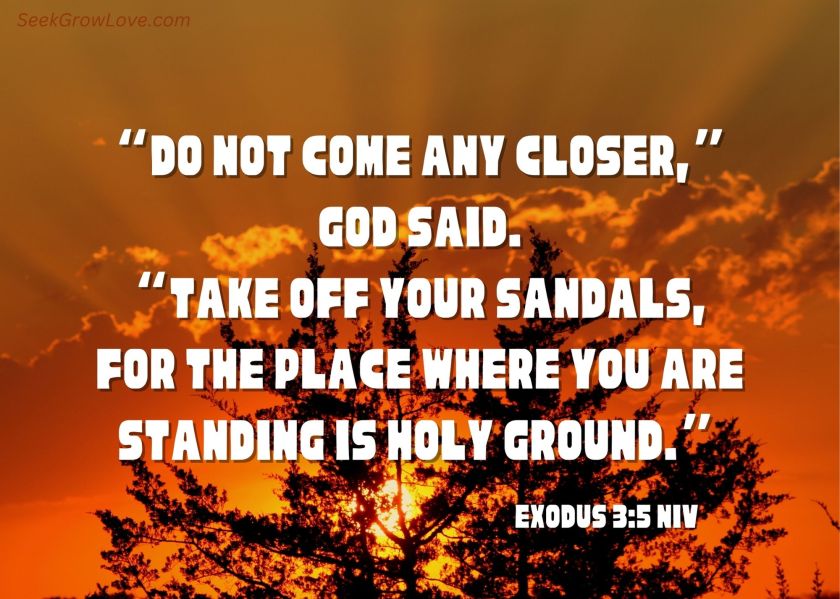
When we start Exodus 3, the Israelites have been demoted from a position of honor to a position of slavery (Ex 1). Moses was born into these turbulent times and through a series of miracles survived and was promoted to a position of authority, and then fled when he was near 40 and remained in exile for 40 more years (Exodus 2, Acts 7: 23-30). This puts Moses at the spry young age of about 80 years old when the story of the burning bush kicks off in Exodus 3. This is one of the most important stories and chapters in the entirety of scripture for a couple different reasons: firstly, for the first time the concept of “shaliah” is indisputably revealed to us in scripture, and secondly God reveals himself to a human (Moses) by name for the first time in recorded history. There are a few chapters in Genesis where the concept of Shaliah can be strongly inferred, but this is the first time I’m aware of that it’s plainly revealed.
If you are not familiar with this concept, understand it is absolutely critical to understanding scripture. You are apt to get a number of scriptures wrong if you don’t view them from the perspective of it’s original authors, that is to say, the ancient Jewish people. This is what wikipedia states about the Law of Shaliah (it is a legal term):
( Quoting Wikipedia) “In Jewish law, a shaliaḥ (in Hebrew : שָלִיחַ or pl.שְלִיחִים , sheliḥim (pl) or sheliah, literally “emissary” or “messenger”) is a legal agent. In practice, “the shaliaḥ for a person is as this person himself.” Accordingly, a shaliaḥ performs an act of legal significance for the benefit of the sender, as opposed to him or herself. “
This concept is shown to us clearly in scripture by comparing and contrasting Ex 3:2 to Ex 3:4. “And the angel of Yahweh appeared to him in a blazing fire…And Yahweh saw that he turned aside to look, so God called to him from the midst of the bush…” (LSB translation). In essence, the messenger that God sends (be it angel, donkey, or human) speaks with the full authority of God, as if they are God. So when “the word of The LORD” comes to the prophets and they speak, they are speaking with the full authority of the Most High God. When God placed His name in the angel leading the Israelites in Ex 23:20-21, He explained to them that this angel spoke with His authority. When the donkey spoke to Balaam, through the “angel of Yahweh”, it states clearly that “Yahweh spoke” (Number 22:22-28). The one speaking was not the donkey, not the angel, but The LORD (YHVH) Himself (through His agent). This is why it’s so critical to understand Shaliah, because the one who is sent by God speaks with the full authority of God. This does not make the messenger mysteriously transform into God, but God lets us know that this messenger is speaking with the full authority of God so we’d better listen up.
This concept is repeated constantly throughout scripture but a lack of understanding of this concept, along with the introduction of a number of popular Greek philosophies later on, have caused numerous misinterpretations of scripture and much confusion amongst believers. That concept carries over into the New Testament as well. Jesus states in the book of John about 42 times that God sent him: he is not only the Messiah prophesied, but the man chosen to be the Shaliah of God. The title “Christ” in Greek means “The Anointed One”, and we see from the OT that you are anointed by God from among men, so every time you see “Jesus Christ” in scripture, it is an affirmation that Jesus of Nazareth was the prophesied messiah, the anointed one, the man chosen by God to be his Shaliah. Christ is a title, not a name, and it affirms Jesus’ humanity every time it is spoken while at the same time affirming that he speaks with the authority of God.
Exodus 3 is one of my favorite chapters in the bible. In it, God clearly reveals himself through his agent (Shaliah, we just talked about that) by name to a human being, for the first time recorded in history. This is both awesome and humbling: that the creator of all things would reach back out to we who bear His image in another attempt to draw us closer to Him speaks to the never ending mercy and lovingkindness of our heavenly Father. While there is some debate as to the proper pronunciation of the most sacred name (YHVH: is it Jehovah, or Yahovah, or Yaweh….?), the fact remains that He chose to reveal his identity to us, and that is wonderfully beautiful. Some people say that every breath that we breathe, in and then out, whispers the name of God. Try it, and visualize the name. That is also wonderfully beautiful, and seems to me like an amazing “made by” stamp like you might see on the bottom of a fine piece of pottery, but in our very breath. Praise God!
Personally “The LORD” really bothers me. Most of your Bibles will say something in the preface notes to the gist of “…and honoring tradition, all references to YHVH (the actual transliterated name of God) have been translated as “The LORD””. This is a horrible mistranslation, as has led to a whole lot of terrible confusion and mistaken identity later. Let me be very clear: GOD HAS A NAME. He reveals it to us, and gives us a command, in Ex 3:15: “And God furthermore said to Moses, Thus shall you say to the sons of Israel, ‘Yahweh, the God of your fathers, the God of Abraham, the God of Isaac, and the God of Jacob, has sent me to you.’ This is my name forever, and this is My memorial-name from generation to generation.” (LSB translation). Did you know that in the Old Testament, the actual name of God is used almost 7,000 times? Why have we stopped using it when we pray or worship? Think about it.
Reflection Questions:
If you had seen the burning bush, would you have turned aside to go investigate or would you be too busy with work/school/life?
How many times in a week do you think that God is trying to get your attention to tell you something important? Of those times, how many times do you stop and listen?
Do you call on God by name when you pray or worship? Why, or why not?
When you breathe in and out, and listen closely, do you hear the name of God?
Prayer
Blessed be the Lord God Yahovah, creator of the the heavens and the earth, who has made all things and us with them, who causes the sun to go down and the sun to rise, and all things to be made anew every day. Lord God, renew me today, help me to listen when you are trying to get my attention. Open my eyes so I can see you, and my ears so I can hear you. I thank you in your son Jesus’ name, Amen.
Side Note: A brief mention of 1 of the 2 verses in the Old Testament that baffled me a bit: Ex 4:24 has always confused me. If God had wanted to kill something, it would die, period. In my Bible currently, I have a handwritten note by Ex 4:24 that says “possible confusion among the host?”. I think this is one of 2 verses in the Old Testament that tend to point out that in some very rare instances, and in some minor matters, there may be some level of miscommunication amongst the Shelihim (legal agents of God; the story of Balaam is the other). This is absolutely inconceivable if it were the most high God performing the actions directly, but becomes understandable if beings lower than God are acting on their own perceptions but with God’s authority, particularly if there are multiple agents in play simultaneously. Just a theory.




 Seek Grow Love