A Goldmine

Old Testament Reading: Genesis 31 & 32

Psalms Reading: Psalm 18

New Testament Reading: Matthew 17

In a year that we are searching in His words for who God is, Psalm 18 is a goldmine. Almost no seeking is required, just taking it in, line after line after line. In 50 verses David shares who His God is: what God has done and why, what He loves, what He doesn’t love, His super powers, what He offers and provides and gives, what is perfect about Him, what He delivers us from, and why He is worthy of praise.

The first time I read Psalm 18 this week I journaled what I saw regarding God – it was the first Psalm that took a full page to record my observations, and I am sure I missed some. Here’s just a sampling from my journal page (with some added thoughts):

  • God – MY strength, rock, fortress, deliverer, refuge, shield, horn of salvation, stronghold, worthy of praise… (written by David so he was the original “MY” referred to – but not the only – thank you God for being MY strength, too)
  • He hears me from his temple…(I am not used to being heard by the “higher-ups” – but here is the Highest of them all, and He hears me.)
  • He gets angry – earth trembles and quakes, mountains shook…
  • He reached down from on high and rescued me…
  • He’s my support…
  • To turn from Him is evil…
  • God saves the humble…not so the haughty… (Be humble, don’t be haughty)
  • To the faithful/blameless/pure – He shows Himself to be faithful/blameless/pure…. (but don’t be crooked with Him, unless you are curious what His other side looks like).
  • The LORD lives!…

As I re-read I began looking for what verse or phrase I would choose to create a picture to accompany the devotion – there were way too many I wanted to use! Here are some of my personal top choices, that I didn’t end up using…

“I call to the LORD who is worthy of praise, and I am saved from my enemies.” (vs 3) – (My enemies will look different from David’s – we each have a different purpose from God to fulfill and different enemies to overcome – but we both have the same God who is worthy of praise and who saves from the enemy.)

“He rescued me because He delighted in me.” (vs 19) – (Thank you God for delighting in me – and rescuing me. Your love and your power work perfectly together. And I am the blessed recipient of both.)

“My God turns my darkness into light.” (vs 28) – (How’s that for a lightbulb moment?)

“You give me your shield of victory, and your right hand sustains me; you stoop down to make me great.” (vs 35) – (Don’t you love the picture that creates in your mind! Re-read it again slower. How is God trying to pass you His shield of victory today?)

“As for God, his way is perfect; the word of the LORD is flawless.” (vs 30) – (Is there anything else in this world that is perfect? We are so used to flawed, broken and mediocre – but that is NOT My God – his way and his word are perfect – and they are for me!)

What pictures/passages do you like best in Psalm 18? What do they tell you about God? Is He YOUR God, too?

Remember those book reports you did back in elementary school when you had to create something to show you learned something from the reading – a mobile, a shoebox diorama, a character chart. I encourage you to create something from Psalm 18 – a journal page, memory verse cards for your bathroom mirror, a friend’s refrigerator and the wallets of all your family members, a wall hanging for your home or your neighbor’s, a card or text for a friend who is feeling surrounded by enemies today.

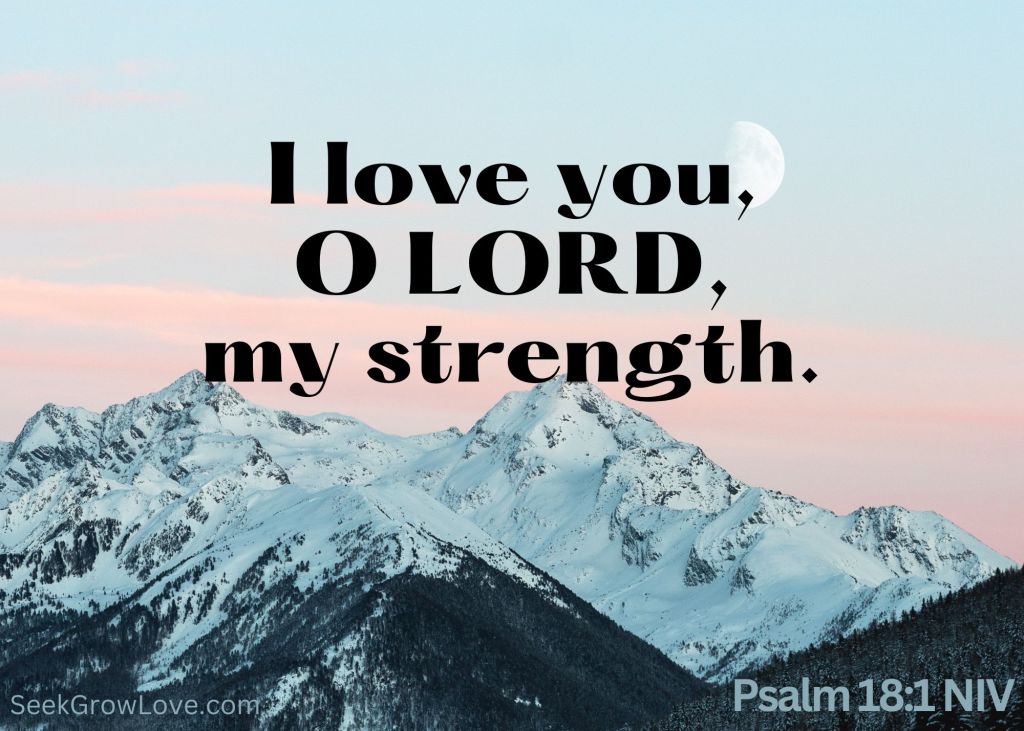
Read His words and remember and share. God is worthy of praise. “I love you, O LORD, my strength.” (Psalm 18:1 NIV)

-Marcia Railton

If you were hoping for a devotion today over Matthew 17 and the Transfiguration which is a very interesting “highlight” of Jesus’ earthly ministry, here’s a good one called A Mountain Top Experience by Rebecca Dauksas.

Reflection Questions

  1. In what way do you think God wants to give you His shield of victory today? How might you receive it? What enemies is God able to help you overcome?
  2. How might your day be different if you remember all day long who Your God is?
  3. Just as we can benefit from David sharing with us how God has helped him, how can you share with others how God has helped you and how might it benefit them?
  4. What pictures/passages do you like best in Psalm 18? What do they tell you about God? Is He YOUR God, too?

Choices

Old Testament Reading: Genesis 29 & 30

Psalms Reading: Psalm 17

New Testament Reading: Matthew 16

Everyday we find ourselves making choices. Some of these choices are small and make little difference on the outcome of our day. Does it matter what color socks I wear today, or even if they match? Does it matter what I have for breakfast? Does my choice of coffee or tea impact anyone besides me? Other choices may have more of an impact. Do I work on my group project today? Do I call a friend God has put on my heart? Do I take a meal to the elderly neighbor who had surgery last week? Do I buy an extra burger for the hungry stranger I see near the restaurant where I’m going to lunch? Some of these may have different answers at different times but we must still make the choice everyday. We have to decide what voices we will listen to and which path we will follow.

As we look at the texts for today we see some following God’s leading and others following the world. This is true for everyday life as well. Sometimes people follow God, sometimes people follow the world, sometimes people follow other people. I can relate to all of those. While I always try to follow God, sometimes I fall short.


In Genesis 29 and 30 we see Jacob meet his future wife. He must choose how he will react. Will he open the well? Will he wait for the rest of the flocks? He must choose will he wait for Rachel in addition to Leah? Will he continue to work for his father-in-law, Laban, even after being deceived by him? I have no doubt that he made some wise choices and others that were not as wise.


In Psalm 17 we get an insight into David’s prayer life. We know from reading the Old Testament that David made both good and bad choices over the course of his life. Here we read of David contrasting the path of God against the path of the violent. In Psalm 17:4-5 David says, “By the word of Your lips I have kept from the paths of the violent. My steps have held fast to Your paths. My feet have not slipped. I have called upon You, for You will answer me, O God”. David finds the strength to make the right choices not by following the voice of the world around him but instead by following the voice of God. When we call upon God He will hear us and will answer us!


In Matthew 16 we get to see Jesus’ reaction to Peter’s choices of words, both right and wrong. First in verse 13 Jesus asks his disciples, “Who do people say that the Son of Man is?” Then in verse 15 He asks who the disciples say He is. To this Peter replies, “You are the Christ, the Son of the living God.” Peter is told that this is an excellent answer that lines up with the prophecies and what Jesus is teaching. Matthew 16:21 says, “From that time Jesus began to show His disciples that He must go to Jerusalem, and suffer many things from the elders and chief priests and scribes, and be killed, and be raised up on the third day.” The very same Peter who had just declared Jesus as the Christ now rebukes him and tells him that none of this can ever be allowed to happen. Jesus has some strong words for our friend Peter. “He turned and said to Peter, ‘Get behind Me, Satan! You are a stumbling block to Me; for you are not setting your mind on God’s interests, but man’s.’” (Matthew 16:23)


It is true that all of these great men of the Bible struggled to make the right choices in service to God. Sometimes I find myself asking, “If they struggled and fell like that, what hope do I have?” The beautiful answer to that question is that even though they stumbled, even though they fell, even though they made bad choices; God still loved them! God still chose them! God still used them for His glory!


I promise you will make some choices that you look back at and it will cause you to question yourself, maybe even doubt yourself or your faith. Remember that just as God loved and chose the men and women of the Bible, He loves and chooses you too!


What can you do right now to ensure your next choice is the right choice?

-Bill Dunn

Reflection Questions

  1. What are some of the wisest choices you have made? What was a good choice you made yesterday? What was one of the hardest wise choices you have made? Are you glad you did it?
  2. Do you agree with Peter regarding who Jesus is? What did Peter not yet understand in regards to Jesus’ mission? How does an incomplete understanding lead to making poor choices? What else plays a role in making unwise choices? How can these be overcome?
  3. In reading the Scriptures today what did God show you about Himself? What did God show you about His Son the Messiah?

Will He Provide?

Old Testament Reading: Genesis 21 & 22

Psalms Reading: Psalm 13

New Testament Reading: Matthew 12

God had promised Abraham, in Genesis 17:19, “Your wife Sarah will bear you a son, and you will call him Isaac.  I will establish my covenant with him as an everlasting covenant for his descendants after him.”

At this point, Abraham was over 100 years old, and had faithfully followed God.  In Genesis 12, Abraham obeyed when God told him to leave his country and family.  Abraham allowed Lot to take the lush land around Sodom in Genesis 13, and trusted God to provide for his own flocks and herds on barren mountains.  In Genesis 15, Abraham trusted God’s promise that he would have a son in his old age, and God counted that faith as righteousness.

In Genesis 22:2, we find God commanding Abraham, “Take your son, your only son, Isaac, whom you love and go to the region of Moriah.  Sacrifice him there as a burnt offering on one of the mountains I will tell you about.”

This doesn’t make sense.  God had explicitly promised that God’s promises to Abraham would be passed down through Isaac’s descendants, and now God was commanding Abraham to sacrifice him – apparently destroying the promise He had made to Abraham.

By this point, Abraham had developed a very close relationship with God.  In fact, we’re told 3 times in the Bible that Abraham was God’s friend (2 Chron 20:7, Isaiah 41:8, James 2:23) – and as far as I know, Abraham is the only person in the Bible of whom this is said.

We’re told in Hebrews 11:19 that Abraham reasoned that God was able to raise the dead, and that He was going to keep His promise.

So early the next morning, Abraham took Isaac and 2 servants and left for the place God told him to go.  When they got close, Abraham told the servants, “Stay here with the donkey while I and the boy go over there.  We will worship and we (emphasis added) will come back to you.”

As they got even closer, Isaac asked his dad, “The fire and wood are here, but where is the lamb for the burnt offering?”

Can you imagine how this must have broken Abraham’s heart, looking down into his son’s questioning face, knowing that in a few minutes he would be killing his beloved son, who would be the offering?  Abraham answered, “God himself will provide the lamb.”  (Actually, God had provided Isaac – as a miracle baby in his parent’s old age.)  When they reached the place God had told him about, Abraham built an altar, arranged the wood, tied up Isaac, and laid him on the altar.  

As he was getting ready to kill Isaac, the angel of the Lord called to him from heaven and stopped him.  Abraham then saw a ram caught in the brush by its horns, and sacrificed it instead.  God then promised Abraham, as recorded in Genesis 22:16-18, “I swear by myself, declared the Lord, that because you have done this and have not withheld your son, your only son, I will surely bless you and make your descendants as numerous as the stars in the sky and as the sand on the seashore… and through your offspring, all nations on earth will be blessed, because you have obeyed me.”

I could point out all the similarities of Abraham’s being willing to sacrifice his son Isaac, and God being willing to sacrifice His Son, Jesus.  I could point out the significance of another quote from this chapter, “Jehovah Jireh – on the mountain of the Lord it will be provided.”  (This was the mountain where Soloman’s temple was built hundreds of years later.)  I could point out the importance of obeying God, and the benefits that result.

Instead, I want to comment on who, when, where, how, and why of God’s provision.  

Who:  God tested Abraham with a very difficult test even after a life of serving God.  We see that God provided the ram in this case only after Abraham trusted and obeyed God – even though it didn’t make sense.  Assertion:  God provides for those who trust Him and obey Him.  

When:  God provided for Abraham at the very last minute, not before.  We’re told in Hebrews 4:16 that we will “receive mercy and find grace to help us in our time of need.”  Assertion:  God provides precisely when we need something, not when we think we need it.  (i.e.  according to God’s timing.)

Where:  God provided for Abraham only after Abraham went where God told him to go, and after he obeyed everything God told him to do.  Assertion:  God will provide if we are where He wants us to be.  We should have no expectation of receiving God’s provision if we aren’t where He wants us to be. 

How:  God didn’t send an angel from heaven with an offering for Abraham to sacrifice, God provided a normal ram, caught in a normal thicket, by it’s normal horns.  And God didn’t send a whole flock of sheep, just one ram, because that was all that was needed.   Assertion:  God will usually provide in ways that are very natural – don’t look for miracles.

Why:  In times of testing, it’s easy to only think about our problems, and focus on, “why is this happening to me?”  I think there may be two general reasons why trials come.  First, we are told in Romans 8:28, “And we know that in all things God works for the good of those who love Him, who have been called according to His purpose.”  Note that this only applies if we are living according to His purpose.  Also note that trials are by definition difficult, and won’t seem to be beneficial at the time.  Second, ultimately, everything is for God’s glory.  Isaiah 43:7 says, “everyone who is called by my name, whom I created for my glory…”  We see an example of this with God destroying Pharaoh and his army for God’s glory in Ex 14:4, 17.  Assertion:  God allows trials and gives provision for our good and for His glory.

The bottom line is, if we are faithfully following God, times of testing will come.  If we remain true to God, if we are where He wants us to be, and if we are obedient to Him, he will provide what we need (not necessarily what we want), at the very last minute, usually through normal means – and this is for our good.  If we aren’t following God, the times of testing may just be to bring Glory to Him.  I’d rather be in that first group.  How about you?

–Steve Mattison

Reflection Questions

  1. Abraham’s thoughts and feelings aren’t recorded much in Genesis, what do you think he may have been thinking and feeling on that 3 day trip to where God wanted him – and after? What similarities do you find in Psalm 11?
  2. How and when has God provided what you needed? What did you learn about God from that experience?
  3. Is there anything that you may be holding onto too tightly, loving more than God? How can you practice trusting and obeying God and not withholding from Him?
  4. What did God reveal about Himself to you in your reading of His words today?

Just Like Dad, but Not Dad

Old Testament Reading: Genesis 13 & 14

Psalm Reading: Psalm 9

New Testament Reading: Matthew 8

Don’t you love seeing pictures of two family generations where the younger looks just like the senior? The family resemblance can’t be mistaken. As I was reading of Jesus calmly calming the storm I was thinking – I have seen this before. The masterful control exercised over the wind and water. It’s been done before. There is a family resemblance there that can’t be mistaken. Sure enough – in the account of Noah and the great flood found in Genesis 7 & 8 (which you may have just read last week), it is recorded that the LORD God controlled the springs of the deep, the floodgates of heaven and the winds. Perhaps the astonished disciples weren’t thinking of the ancient time of Noah, but they were asking, “What kind of a man is this, that even the winds and the sea obey Him?” (Matthew 8:27 NASB).

Interestingly, in the very next passage it is revealed who Jesus is – by the demons. It appears the spiritual world has a pretty clear picture of who Jesus is, as well as what fate awaits them in the future at Jesus’ hand. Even back in Matthew 4 in the wilderness the tempter/devil twice began tempting Jesus by saying, “If you are the Son of God…”. And now here in Matthew 7 the demons recognize the family resemblance and see Jesus as the Son of God. That is an amazing title and honor and job to be the Son of the Most High God Almighty.

But being the Son of God is not the same as being God. Just as you are the son or daughter of your dad and mom, but you are not your dad or mom. There are still many differences. Here is a partial list of some of those differences…

God can not die – but Jesus did.

God knows everything (including when Christ will return) – Jesus didn’t. (Mark 13:32)

Jesus increased in wisdom – God already had it all.

Jesus was God’s servant and he knew God was greater than himself.

Jesus didn’t do his own will, he did God’s – they have different wills.

Jesus had a God.

Jesus prayed to His God, and called Him Father.

Jesus cannot be a mediator between man and God if he was in fact God.

Jesus is now at God’s right hand.

They will rule at different times.

As we spend the year asking God to reveal Himself to us in His Scripture, we get the added supreme joy of finding Jesus in the process. As we read of Jesus’ love and compassion, power, judgment, forgiveness and mercy – we are reminded of his dad. There is an unmistakable family resemblance. There is often much you can learn about a parent by watching a child (even a child all grown up). Also, there is much you can learn about a gift-giver by seeing the gift they have given. As we read through the Bible seeking God may we recognize Him as the Father and God of his Son Jesus and as the ultimate gift-giver who gave His Son to His broken creation, knowing full well they would break his gift as well – for a time.

As I am journaling what God is revealing to me about Himself in Scripture this year, I am also writing in notes about His gift, His Son – clearly labeling those lines with an underlined “Jesus”. In my Bible margins I am using an asterisk to remind me where I found something of God’s character (sometimes with a note to explain at the bottom of the page). I am also using a cursive capital J in the margin marking the passages where I learn more about Jesus, the unique Son of God. I pray this will be a year of great revelation as I seek Him and His Son. I pray this for you as well.

-Marcia Railton

Reflection Questions

  1. What do you learn about Jesus in Matthew 8?
  2. What is most incredible to you about this gift that God has given?
  3. What family resemblance do you see in the Son of God – where did you see those qualities first in his Father? What do you learn about the gift-giver by looking at the gift He has given?

God, You Are…

Old Testament Reading: Genesis 9 & 10

Psalm Reading: Psalm 7

New Testament: Matthew 6

We are a week into our Bible reading plan for 2023. What are your thoughts so far? I have enjoyed reading Scripture and searching for what God is revealing about Himself in the words He inspired the authors to write. Previously, I have most often looked at the Bible as an instruction manual for life, and as such it is extremely valuable. I, for one, need a good bit of direction in my life! And while there are a lot of instruction manuals out there, I want to use God’s directions rather than the world’s. But I am realizing His words are so much more! They allow us the privilege to know God – really KNOW Him. What He likes, what He doesn’t like, what He IS like, what He does, what He doesn’t do, what He will do, what He desires, what thrills Him, what makes Him angry, what He plans, what He promises, what He controls, what He doesn’t control, even if He could. These are the things you would want to know about someone if you were considering entering into a serious relationship. It goes much deeper than knowing a name, a pronoun and 6 descriptive adjectives and thinking that we now know that person.

So, why is it important to really KNOW God? I am reminded of a very sad passage in Romans. It begins by saying all men should know there is a God because of the works of His glorious creation. Yes, we should. But, we know of too many who don’t. What went wrong? “For even though they knew God, they did not honor Him as God or give thanks, but they became futile in their reasonings, and their senseless hearts were darkened.  Claiming to be wise, they became fools, and they exchanged the glory of the incorruptible God for an image…Therefore God gave them up to vile impurity… For they exchanged the truth of God for falsehood, and worshiped and served the creature rather than the Creator, who is blessed forever. Amen.” (Romans 1:21-25 NASB)

So many today have been at a point where they would say there is a God, but because they didn’t honor Him or give Him thanks, it was easy to turn their backs on Him and become fools and be given over to sin and judgment. When we SEE God for who He is and really KNOW who He is, the true response is honor and thanks. We can not give an unknown being genuine honor and thanks. The best list of rules won’t save us. If you don’t have a serious relationship with the author of the best instruction manual in the world, the words will be lost, neglected and even despised. It is time, for us and our children, to get to KNOW God Almighty – so we will honor Him and give thanks and be serious about our relationship with Him.

So, that’s one reason I am enjoying getting to know the author of this great instruction book more and more. In our Old Testament readings we are just finishing with the events of Noah’s life. What did you learn about God from Genesis 6-9? There isn’t one set of correct answers. But some of the things I jotted in my journal over the past few days include:

He feels pain – He sees evil in His creation.

He plans destruction of evil – but He still sees and gives favor to those who walk with Him and are righteous.

He is detail-oriented, gives precise directions that work well. He’s a good ship designer (that means He’s smart).

He creates covenants to save.

He saves families.

It happens as God said it will. He is trustworthy and true.

He controls the floodgates and springs. He controls the animals. He controls the winds. He is powerful.

He blesses with fruitfulness and children.

He gives plants and animals to eat.

He made man in His own image (How many times will we read this – how many times will we ignore it? Trading the truth of the creator was part of the lie spoken of in Romans. I think that makes it important. Thank you God for making us in Your image – you are incredible to make us – and super generous to make us in YOUR image!)

He will demand an accounting for the life of men. He values life, every life.

He makes covenants. He remembers His covenants. He created the rainbow.

If you haven’t tried it yet – I encourage you to give it a go. Read at least one of today’s passages, searching for what you can learn of God. What is He like? What does He like? What did He do? What will He do? It will give you reason to give Him glory and thanks. It will prepare you for a serious relationship with Him – for all eternity.

-Marcia Railton

Reflection Questions

  1. What’s in it for me? What are the benefits to having a serious relationship with God, rather than just agreeing that there is a God out there somewhere?
  2. Do you believe God created you and the world? Does it matter?
  3. If you’ve tried it – what did God reveal about Himself in your reading so far this week, or today? If you haven’t tried it yet – now is the time. Ask Him, God – what do you want to show me about yourself? And then dig in, seeking Him. When He shows you a bit of Himself, how will you express your honor, glory and thanks?

The Beginning

Old Testament Reading: Genesis 1 & 2

Psalm Reading: Psalm 3

New Testament: Matthew 2

“In the beginning God created the heavens and the earth.  Now the earth was formless and empty, darkness was over the surface of the deep, and the Spirit of God was hovering over the waters. And God said, “Let there be light,” and there was light.” Genesis 1:1-3

The origin of the universe is a topic of serious debate in both Christian and secular culture.  There are many who spend their entire lives, tens of thousands of hours, dissecting chapter one of Genesis or looking for clues through a telescope of how we came to be.  While I hope to shed some “light” and context to today’s reading, you will be disappointed if you are looking for a detailed outline of theory or a presentation of observable evidence; you have the wrong blogger.  What has become apparent to me in my last couple of readings of Genesis is the simple significance of verse one of our sacred scripture.  Whether you argue the lifetime of the universe or the age of earth is thousands or billions of years old, God wanted you to know the understatement of eternity: He created the heavens. He created the earth.

The newest estimates place the universe somewhere at 93 billion lightyears across.  This space is  filled with roughly two trillion galaxies, each containing millions of stars. It’s incomprehensible, without description, unfathomable to our miniscule minds.  While there is “universal” truth when we look to the heavens (Psalm 8:1-4), it is no wonder God doesn’t bog us down with the details. The focus of this revealed narrative is on Earth; the light, the sky, the lands, the seas, the moon and sun, the animals, and finally, us. This makes perfect sense when we consider it was deliberately made for you and I to inhabit for eternity, not just for the handful of breaths that are in life as we know it. 

“Then God said: Let us make human beings in our image, after our likeness. Let them have dominion over the fish of the sea, the birds of the air, the tame animals, all the wild animals, and all the creatures that crawl on the earth. God created mankind in his image; in the image of God he created them; male and female he created them.” – Genesis 1:26, 27

While all creation gives glory to God, much of it inspiring awe and wonder, we are the only creation that is directly made in the likeness of the Creator (Gen 1:26). The two-billion galaxy creating Heavenly Father has exalted you as the highest and most purposeful creation. Each one of your 100 trillion cells carry 3.2 billion pairs of unique DNA coding that makes you, you. Again, these are pretty profound and puzzling figures, speaking to the deliberate nature of God Almighty. Because we are made in his likeness, and through Christ are adopted as children of the Light, we have access to the God of the infinite expanse.  And He is not only the God of initial creation, but the God of new creation. The same power that raised Christ from the dead, can be the power that lives in each one of us (Eph. 1:18-21). Jesus has let it be known that there is a place that is being prepared for us according to this new covenant, so we may not only have access to God, but to fully dwell with our Father, God and His son, Jesus Christ. Hallelujah – this is the plan from the beginning.

–Aaron Winner

Reflection Questions

  1. Where do you see God’s amazing qualities in His creation?
  2. What does it mean to you that you are made in His image?
  3. How would you describe the new creation (through Jesus)?
  4. Today is a really fun day to ask – What does God reveal about Himself to you in Genesis 1 & 2? What difference does that make in your relationship with God? Throughout the rest of our Bible reading this year, take note each time God’s creating is mentioned, it might be more than you think. You can create a marking, such as a C in a circle, to add in your Bible margins or journal pages whenever you find reference to God creating.
  5. Praise and thank Him for being the God he is!

(Editor’s Note: If you find yourself unsure of God’s creating – or enjoying more “proof” to share with others – keep searching. There are many scientific and well-researched articles with evidence pointing to the Creator of Genesis 1. You might be interested in starting with a series of devotions written for SeekGrowLove in January 2021 by Greg Landry. Click here for the first one.)

Sit, Stand, Step

Psalm 1

Dr. Albert Mehrabian, a leading researcher in the field of body language, estimates that over half of our social communication is done through nonverbal cues.  Where we place our hands and feet, how or where we choose to stand or sit, the angle at which we hold our head, or even in the position of our eyebrows communicate our desires, our emotions, and our confidence (or lack thereof). Additionally, about one-third of how we send our message is with the tone and inflection in our voice, not the words themselves.  In fact, less than 10% of our social cueing has to do with our spoken word choices. The conclusion of the study is similar to the first verse of Psalm 1: where we choose to sit, where we choose to stand, and where we choose to step communicates our posture to our Heavenly Father and the world around us vastly more than words alone.

“Blessed is the one who does not walk in step with the wicked or stand in the way that sinners take or sit in the company of mockers. but whose delight is in the law of the Lord,and who meditates on his law day and night. That person is like a tree planted by streams of water, which yields its fruit in season and whose leaf does not wither— whatever they do prospers.” – Psalm 1:1-3

There is a good chance that today holds a contrast to where your feet landed yesterday.  Most likely, this Monday represents a return to work, school, or some other social role you will have to step into, stand up in, or sit through. As you enter the threshold, who or what are you walking towards or away from? Where and what are you standing beside or standing in the way of? How and who do you find yourself sitting beside, dwelling with, and meditating upon? Take note not only of the words you say aloud, but the thoughts and signals you send with your body because God doesn’t want a tithe of lip service; He desires the whole of your soul as a living sacrifice.

There is a blessing for living close to the commandments of our Creator.  Those who put their roots down with God are the direct recipients of the Living Water He provides. When we walk in His ways, when we stand on His promises, when we sit and meditate on His statutes, it completely changes our body language. We don’t wither, but we become confident in the hope we have. We are not empty vessels filled with cliche Christianism, but we bear the fruit of the Spirit for others to see.  We can simply sit and delight in the joy of the Lord because we serve a God of promises and follow-through.  Our posture, our actions, and our words stem from the refreshing source from which we draw life more abundantly. Wherever we step, stand, or sit, let the Living Water flow and the Kingdom of God flourish.

– Aaron Winner

Reflection Questions

  1. Compare and contrast the person in Psalm 1:1-3 to the person in verses 4-5? How would you describe each and what makes them different?
  2. Who or what are you walking, standing, sitting amongst? What do you find delight in? What are you meditating on? Are there any changes that ought to be made in order to be where you want to be at the end – of 2023, or of this life?
  3. What do we learn about the LORD God in Psalm 1? Mark it in your margins, journal it, pray to the God of Psalm 1.

AND -in preparation for tomorrow, when we will begin a chapter by chapter New Testament reading – here’s a little…

Introduction to the Book of Matthew

Before we introduce the book of Matthew, let’s quickly contrast it with the book of Genesis and the whole Old Testament.

The book of Genesis begins the Old Testament (and the Bible).  The theme of the Old Testament can be summed up in Genesis 5:1, which says, “This is the book of the generations of Adam…”.  The rest of Genesis 5 has another recurring theme, “… and then he died”.   The Old Testament was the story of Adam, his sin (and the consequences of that sin), and his descendants.  It illustrates the truth that “the wages of sin is death” (Romans 6:23a).  The Old Testament contains many of God’s promises – waiting for fulfillment.

The book of Matthew begins the New Testament.  Matthew starts with, “This is the genealogy of Jesus the Messiah the son of David, the son of Abraham.”  This begins the story of Jesus, and reveals “the gift of God is eternal life in Christ Jesus our Lord.” (Romans 6:23b)  The New Testament describes the fulfillment of God’s promises made in the Old Testament.

Matthew was one of Jesus’ 12 apostles, whom Jesus called from being a tax collector (read hated outcast) to being in the inner circle of the Savior of the world.  Many years after Jesus’ ascension, Matthew wrote the book of Matthew to convince a Jewish audience that Jesus was (and is) the Messiah – God’s chosen and anointed deliverer for His people – who fulfilled so many of the prophecies in the Old Testament.

Even though the Bible doesn’t contain anything that Matthew himself said, the book of Matthew which he wrote reveals Jesus as the Messiah promised and sent by God.  May the book of Matthew speak to you and reveal God’s great gift, Jesus the Messiah, to you in a whole new way as we seek to grow in Christ together this year.

-Steve Mattison

Download and print the 2023 Reading Plan below. You can choose to follow along in 1,2 or 3 readings a day. If you read all three you will read through the whole Bible in 2023.

Your Banquet Invite

Luke 14

Wednesday, December 21, 2022

As life grows busier by the day, holidays grow nearer, preparations for travel are made, deadlines for school are due, or you find yourself putting in those time and a half hours at work, it is so easy to become all consumed in your own day to day life. The same was true in the parable told by Jesus in Luke 14, The Parable of The Great Banquet. As Jesus gathered around the table with the Pharisees and experts in the law, he spoke to them on humbling themselves and serving in the here and now, even when they are giving all and receiving none. He says that their payment will be paid at the resurrection of the righteous. At the mention of the resurrection, one man calls out, blessed is the one who will eat at the feast at the Kingdom of God. Jesus replies with a parable, explaining that a great feast has been prepared for many guests. When word spread that the feast had come, and that it was time to join, many of the guests were found to be caught up in their own world and did not attend with urgency. Excuses were made and the banquet was pushed off. “I just bought a field that I must go and see.” “I bought five yokes of oxen, I must go try them out.” “I just got married, I can’t come.” As a result, each of these guests lost their place in the banquet as they were not ready, not prepared, and were not willing to attend at the call of the host. 

This parable serves as a wake up call to many as it is important to work hard each day and do your best with what has been bestowed upon you, however this life is temporary and our focus should always be on what is yet to come. In the meantime, we need to make sure that we are pursuing our faith, building a relationship with our heavenly father, and implementing spiritual disciplines daily so that when the banquet, otherwise known as the Kingdom of God draws nearer, our hearts will be prepared and our focus will be set on the right priorities. 

As we enter into a busy holiday season, may we be present in the why. Why we celebrate, why we serve, why intentionality matters. Let’s not be a people who become so caught up in each day that we do not humble ourselves before the Lord and serve His great name, no matter the cost. 

Luke 14:11 

“For all those who exalt themselves will be humbled, and those who humble themselves will be exalted.” 

– Kayla Elwell

Reflection Questions

  1. What does it mean to you that the invitation to the banquet in the Kingdom of God has been extended to everyone in the roads and country side? Who had been included in the original invitation – did it include you?
  2. What excuses have you used when you were neglecting the most important things of God?

Make Every Effort

Luke 13

Tuesday, December 20, 2022

“Make every effort to enter through the narrow door, because many, I tell you, will try to enter and will not be able to.” 

In thinking about one’s faith, how easy is it to get caught up in the motions of religion. “I go to church every week, I attend Sunday school, I make food for the potlucks, I give an occasional offering, I went to church camp as a child, etc…when the kingdom comes, surely I will be known and in relationship with the Lord.” 

‭‭Luke‬ ‭13‬:‭25‬-‭27‬ 

“Once the owner of the house gets up and closes the door, you will stand outside knocking and pleading, ‘Sir, open the door for us.’ But he will answer, ‘I don’t know you or where you come from.’ Then you will say, ‘We ate and drank with you, and you taught in our streets.’ But he will reply, ‘I don’t know you or where you come from. Away from me, all you evildoers!’”

Thinking about where your heart is and what kind of faith you have takes courage, honesty, and oftentimes real change within our daily habits. 

Today is a perfect day to renew or strengthen your relationship with God and his son Jesus Christ. This looks different for all in many ways. When I picture a narrow door, I think of a door that not many choose to enter through. This “door” may not be the popular choice, the easy choice, or the fun choice. However, choosing to live a life that is pleasing to God is more rewarding than any earthly desire or temporary pleasure. I encourage you to take a moment today and consider one tangible way that you could get to know God on a deeper level this week. This may be through prayer, worship through song, spending time in nature, reading your Bible, serving others, etc. 

May we be a people who stand outside the door and are fully known as our hearts align to God through his son Jesus Christ. 

-Kayla Elwell

Reflection Questions

  1. Choose at least one way you could get to know God on a deeper level this week? When will you do it? Where? How? Why?
  2. How does “Make every effort to enter through the narrow door” work with Ephesians 2:8&9. Do you think Jesus would say that there are some people who rely too much on their works? Do you think Jesus would say there are some people who rely too much on God’s grace? How do you keep from being in either camp?

Take It Up Daily

Luke 9

Friday, December 17, 2022


“Then he said to them all: ‘Whoever wants to be my disciple must deny themselves and take up their cross daily and follow me. For whoever wants to save their life will lose it, but whoever loses their life for me will save it. What good is it for someone to gain the whole world, and yet lose or forfeit their very self? Whoever is ashamed of me and my words, the Son of Man will be ashamed of them when he comes in his glory and in the glory of the Father and of the holy angels.” – Luke 9:23-26


What does the cross mean to you? Today, it is often seen around us as a symbol of Christianity, a beacon of hope, and a reminder of God’s love. Sometimes in our culture, it is even used in fashion and design outside the church for its aesthetic appeal. It’s “cool.”


But in ancient times, under the Roman Empire, it was feared. The cross was a means of torture and death. To hear their Lord say, “Take up your cross daily” was a terrifying concept. Early Christians died for the cross; for what it meant. Sometimes they even took up their cross literally. They denied themselves at all costs to take up their cross and be a true disciple.

To take up your cross is the noblest thing you can do. Jesus was a cross-bearer, leading the way for all who wish to follow him. He took up the ultimate cross, and denied himself in the ultimate way, giving up his entire life for a world of undeserving people. Following in his footsteps doesn’t mean giving oneself up for crucifixion, but being willing to deny your own wants and desires and follow God’s calling for your life daily, no matter what that is.

-Isabella Osborn


Reflection Questions:

  1. What cross are you being called to bear? Will you make the decision to answer that call today?
  2. Even if you are in a season of unknowns, what is the universal cross we are all called to bear?
  3. Bearing a cross, while unimaginably fulfilling, can definitely come with difficulty and be a huge burden. In what ways can you find joy in taking up your cross, even when the endeavor you’ve been charged with is a challenging one?