Our Job

2 Thessalonians 1-3

Devotion by Emilee (Ross) Christian

After spending the last two days discussing unity, today’s reading from 2 Thessalonians may seem counterintuitive as there appear to be a lot of divisive factors. In Paul’s explanation of the second coming there is clear division between the saved believers and evil doers. What I find interesting is who is doing the dividing. 

Paul makes it clear God will take care of Evil. There is a plan. While we may not have all the details of how said plan will work out, verses like 2:8 make it pretty obvious a plan exists. Today’s text seems to be saying it is God’s job to judge and take care of evil; it is our job to love and teach. 

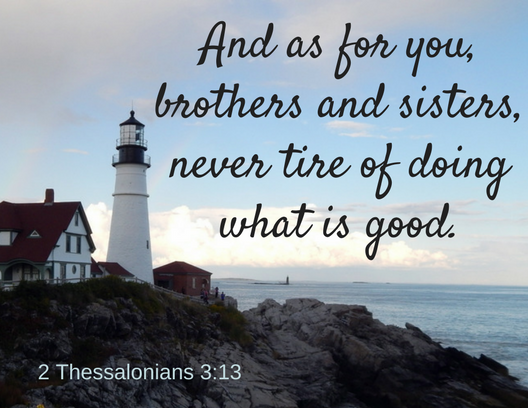
Throughout both letters to the Thessalonians, Paul commends their ability to love one another and remain faithful. In this letter, Paul specifically instructs them to “never tire of doing good” (3:13). The Greek word used here is kalopiountes meaning “to do well, act honorably, do what is right. From Kalos and poieo; to do well, ie Live virtuously” (Strong’s 2569). We know from Paul’s other writings he regards love as the greatest virtue (1 Corinthians 13:13). Basically, after discussing God’s plan to vanquish evil, Paul instructs the Thessalonians to show love. I think there is significance in the order he presents these topics. Our response to God’s judgment upon the earth is to love. 

Yet, it’s also clear Paul does not equate love with acceptance. Again, Paul warns against idleness. Here is where I believe the call to teach comes. While we are not called to judge, we’re also not called to hold the truth to ourselves. In fact, Paul even instructs the Thessalonians to “warn” the ones who “refuse to obey what we say in this letter” (3:14 NLT). As Paul did with the Athens people, we need to find a way to express the Gospel Truth to those with destructive ways of living. This takes faith. This takes action. This takes love.  

Reflection Questions

  1. What are your thoughts on the statement: “Our response to God’s judgment upon the earth is to love”?
  2. What does a loving warning look and sound like? Have you ever received one? Have you ever given one? Is there a person to whom God is asking you to give a loving warning? Pray about it.
  3. When have you been guilty of holding the truth to yourself? How could you respond next time?
  4. How will you show your faith, action and love this week?

Burnt Bedbugs

Jeremiah 4-6

Recently, I was involved in a discussion about parasites. (Old people, right?) One person was telling how their house became infested with bed bugs after buying a used car. Exterminators had to come and use equipment that heated up the ENTIRE house to 135 degrees fahrenheit! All plastics, foods, and other meltable items had to be removed from the home and it cost thousands of dollars. But it was the only way to completely get rid of every one of those little buggers! This story popped into my head while spending time in today’s reading. 

Chapter 4 starts out almost hopeful. Jeremiah tells the people of Judah that if they just turn to God, God will forgive them and they will live free. That hopefulness lasts for about 4 verses. Then, Jeremiah warns of destruction from the north (Babylon). The rest of our reading is pretty dire. In chapter 5, Jeremiah lists their sins, the reasons the Lord is so displeased with them. His chosen people were being cruel to each other, getting rich through exploitation of the poor, and rebellious towards His decrees. Even the priest and prophets were proven to be cheats and liars and no one seems to notice or care (5:31). 

So God promises destruction, similar to what the exterminators have to do to get rid of bedbugs. In 4:11, Jeremiah speaks of a scorching wind that will come and bring ruin to the land, followed by the army from a distant land. While God promises not to destroy it completely, it will be enough that the earth will mourn its loss (4:28). 

Jeremiah ends today’s reading by comparing Judah with metal. As a blacksmith tests metal to determine its strength, God has tested the people but finds they are like tin foil (6:28-30). 

Or maybe they are like all the plastic that had to be removed before my friend’s house had to be heated up to the extreme to destroy the bugs. They would not be able to survive God’s judgment without his mercy. We will read more about that later. 

As we consider these passages today, let’s reflect on the fact that we would be in the same position as the people of Judah without the sacrificial grace we have received through Jesus Christ. Like a plastic popcorn bowl, Jesus has taken us out of the house before the coming heat.. In this case, the second death (Revelation 20:14-15). 

Prayer: 

Dear Lord, 

While the judgement of Your people may be hard to hear, we must so that we can learn from their sins and so that we can also more greatly appreciate the importance of the grace we have received through the blood of Jesus Christ. Let us be aware of the ways the world is trying to turn us to rebellion. Thank you for your promises of peace in this life and everlasting time with You in the next. 

In your Son’s name, Amen 

-Maria Knowlton

Reflection Questions

  1. What are some of the world’s thoughts on God’s judgment? What does God tell Jeremiah about His judgment?
  2. Who gets God’s judgment? Who gets God’s mercy? What does Jeremiah say?

Death and Kingdom: Trivia

THEME WEEK: Death and Kingdom – Daniel 12
Old Testament: 1 Kings 21 & 22
Poetry: Psalm 126

Bible Trivia : The Apocalypse is an apocalypse; the genre of Revelation is not “prophecy” in the strictest sense, but a genre called “apocalypse”. 

There is a LOT of prophecy in Revelation. I think Revelation shows us a picture of the future of the cosmos and the end of this age. However, “apocalyptic literature” is a genre that details events, both of the current day and in the future, with a ton of metaphor and allegory. Apocalypse uses symbolism to teach people that God is acting in history. The authors of this genre also usually view this world pessimistically and declare that a new world is coming quickly. 

In fact, along with Revelation (which we will talk about tomorrow), the book of Daniel is also considered “Apocalyptic”, especially the visions, chapter 7 forward. At the very end of this book, we see a glimpse into the end. I won’t try and explain in a daily devotional the significance of the archangel Michael, the two men speaking at the River, or the specific length of days at the end. (And to be clear, if I had a large book to write to explain it, there is a lot of disagreement and debate about the full meaning of some parts of this book; all my thoughts are just another disciple adding their musing to what the church has said for centuries.)

But there are a few things I would like to point out about chapter 12 that I can say with much more confidence.

First, in verse 2, the author uses a common expression, “many”, to mean “everyone.” In the end, all will be raised. This one resurrection pictured is to be raised to life and raised to judgement. Everyone’s life will be opened up on display before the Messiah. In Hebrews 9:27-28, we read “And just as it is appointed for man to die once, and after that comes judgment, so Christ, having been offered once to bear the sins of many, will appear a second time, not to deal with sin but to save those who are eagerly waiting for him.” After death comes judgment for all, but those who eagerly wait for Christ will be saved. Some will come up to life, those who have done good will come out to the resurrection of life. (John 5:29) Some will come out to everlasting shame and contempt, those who have done evil to the resurrection of judgment. (John 5:29, again) Those who do not receive life, who do not do the work of God by believing in the name of Jesus (John 6:29), will receive the opposite of life. Those of whom the Messiah is ashamed, whom God contempts, they will not receive the life of the Messiah, or be in the presence of the God who is the source of life. 

Second, those whose name are written in the book will be delivered. (12:1) To experience this, you must be numbered among the wise. After the coming of the Messiah, it is not being wise on our own, and certainly not being wise in our own eyes, but being wise by trusting in Him who is the wisdom of God. (1 Corinthians 1:24) Not only should we trust in the Jesus the Messiah, but we should “turn many to righteousness”. (Daniel 12:3) We turn many to righteousness when we preach the message of the Kingdom, when we “make disciples by going into the world, baptizing them, and teaching them all Jesus has commanded.” (Compare Matthew 28:19-20, Mark 16:15-16, Acts 1:8)

Third, and finally, you can be like Daniel. Daniel was told point blank by the angel “you will rest” (die) “and then at the end of the days you will rise to receive your allotted inheritance.” (Daniel 12:13) My friend, if you place your trust in Jesus, if you believe that he died to bring you into relationship with God, that he reigns from heaven at the right hand of God over the church, and that he is coming to reward those who follow his will by the power of the spirit he gives, the words spoken to Daniel, “you will rise to receive your allotted inheritance”, are spoken to you. You WILL have eternal life, the promise of God, given by Christ (Romans 6:23), and confirmed by the Spirit. (Ephesians 1:14)

And that is anything but trivial.  

-Jake Ballard

Reflection Questions

  1. Does the order of events matter – in a story, criminal trial, math problem or God’s plan of salvation?
  2. Is the information given to Daniel (including the order of events) widely accepted and believed today? Why or why not? What is different from many ideas held today? What is not mentioned in Daniel 12? Why do you think it is not mentioned?
  3. Are you prepared for the return of Jesus the Messiah? Why or why not? Is there anything God wants you to do before you rest, rise and receive? If so what? And when, where, how will you do it?

But as for You…

Micah 5

Wednesday, November 9, 2022

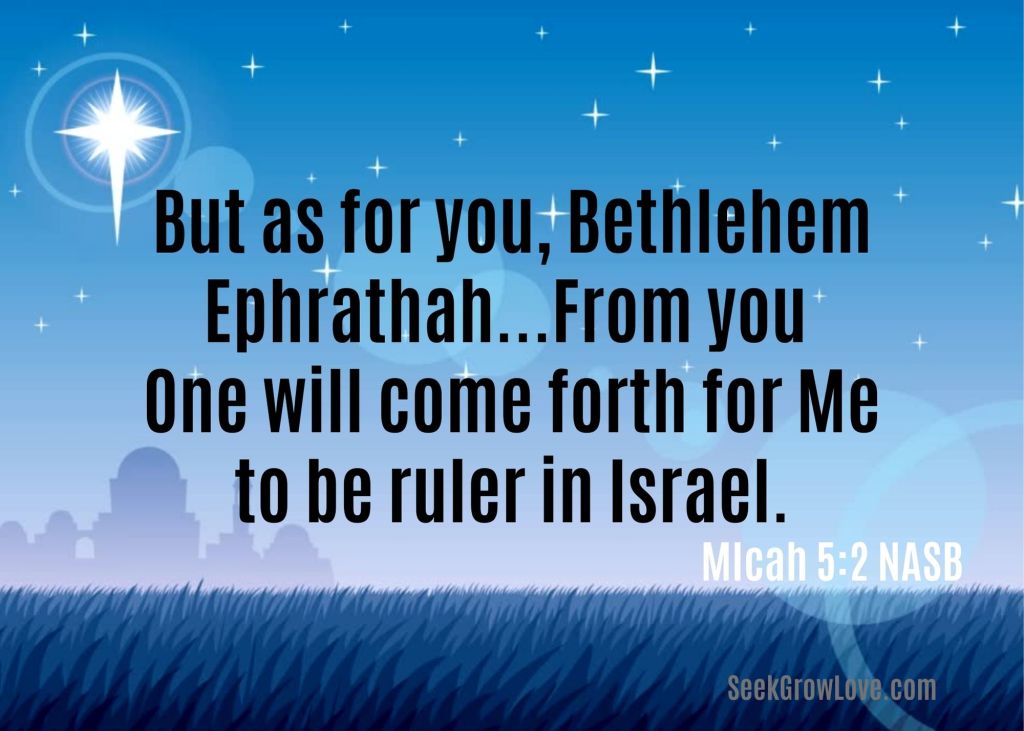
One of the major downfalls of us as humans is that we love evidence. We hear a cool fact, and want to know where it is cited. We learn something in school, and we need a peer reviewed article. When a statistic is cited we like to know how the study was conducted. The cool thing about God is that he knows this about us. In Micah 5 we receive prophecy about Jesus which reads; “Now muster yourselves in troops, daughter of troops; They have laid siege against us; With a rod they will smite the judge of Israel on the cheek. But as for you, Bethlehem Ephrathah, Too little to be among the clans of Judah, From you One will go forth for Me to be ruler in Israel. His goings forth are from long ago, From the days of eternity.” (Micah 5:1-2)

This direct prophecy from God through Micah foretells of the only king the Israelites will ever need, Jesus Christ the Messiah. The remainder of Micah 5 relays the message that the land of the Israelites will be laid waste for their sins and for their breaking of the covenant God set forth to protect them.

There’s a message that parallels something rather unfortunate that goes on in our modern churches today. I have been quite blessed in my experience in church growing up. The people surrounding me who I have known as God’s people have acted accordingly. However, as I meet others my age, I learn that is not always the case. This experience, I have come to learn, is called church hurt. It seems to be when people experience behavior that doesn’t quite align with the ways a Christian should conduct themselves, causing a disruption between what is expected from God’s people and the reality of their actions. But like all sin it’s hardly anything new. Micah was attempting to call out the corrupt leaders of his day, comparing them to Ahab stealing the family vineyard from Naboth, (see 1 Kings 21) and to call out the Prophets who are offering “God’s protection” to those who are willing to pay.

Throughout the book, Micah continues to warn that God has withdrawn his protection and is going to allow the Babylonians to take over and use them to remove the corruption of the Israelites.

“Then the remnant of Jacob Will be among many peoples Like dew from the Lord, Like showers on vegetation Which do not wait for man or delay for the sons of men. The remnant of Jacob Will be among the nations, Among many peoples Like a lion among the beasts of the forest, Like a young lion among flocks of sheep, Which, if he passes through, Tramples down and tears, And there is none to rescue. Your hand will be lifted up against your adversaries, And all your enemies will be cut off.” (Micah 5:7-9)

This is where we are today. Remnants of Jacob. We wait for the day of our prophesied King to return to rule correctly. So what do we do in the meantime? Despite having a bad experience, continue meeting with your fellow Christians, but be on guard for the “Wolf in sheep’s clothing” (Matthew 7:15). There will be a day when we are gathered together as one nation truly under God, and we’ll be awarded according to our faith in the King born in Bethlehem which prompts us to obey and work for him.

-John Evans

Reflection Questions

  1. What is the good news of Micah 5? And for whom is it good news?
  2. What is the bad news of Micah 5? And for whom is it bad news?
  3. Do they both still apply today? Which do we hear more of today?

It is Coming

Obadiah

Monday, November 7, 2022

Sometimes it can be hard to see what God has planned in our lives. When we choose to live a God-honoring lifestyle, it is easy to see all of the pain and suffering in the world and sit back and ask, “Why?” Why are some extremely wealthy and prosperous, yet, evil people allowed to do what they do untouched? The first thing we say is that it just isn’t fair. But really, to the people of God, good is coming and all we need to do is trust in God’s timing.

To be the smallest book in the Old Testament, the book of the prophet Obadiah is probably one of my favorites. Its message, once determined, is quite comforting and tells a message that is familiar to those of the Christian faith, albeit, from a different angle.

The whole book is composed of a powerful twenty-one verses that is to reveal the outcome of Edom, descendants of the family of Esau and long term enemy of the Israelites. And it doesn’t hold back. Condemning them for their pride, and for Esau’s violence against his brother Jacob, God says that though they build themselves up high like eagles, from that place He will bring them down.

“Then the house of Jacob will be a fire And the house of Joseph a flame; But the house of Esau will be as stubble.” (Obadiah 1:18)

The main lesson to be taken from this book is that God is a God that will vanquish our enemies. Yahweh is a living God that if we can trust, does hold the ultimate reward and in verse 21 “The deliverers will ascend Mount Zion To judge the mountain of Esau, And the kingdom will be the Lord’s.” The kingdom of those who can put their peace in the future day of the LORD.

-John Evans

Reflection Questions

  1. What are your feelings when you hear the Day of the Lord is coming?
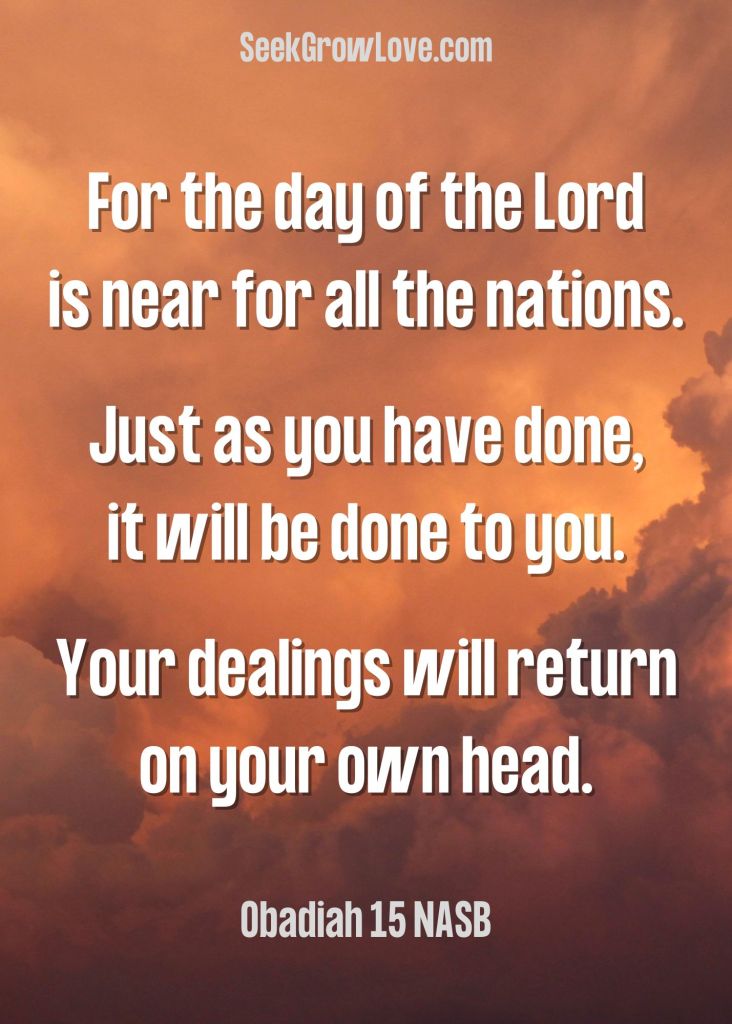
  2. What does it mean to you that, “Your dealings will return on your own head”? Are there any exceptions?
  3. Do you feel prepared for the Day of the Lord? Is there anything you need to take care of in your relationship to God and to others before that day comes?

Come Back

Amos 5

Sunday, November 6, 2022

For the last three years I have been in the retail industry. Working with the public, you are exposed to a wide variety of people. Ever heard of people watching? That’s when you literally just observe people for fun, whether at a shop or restaurant, because the state of our society can be so entertaining. However, it can be disheartening to a Christian. The way people talk and conduct themselves, and especially the way people treat each other, is really hard to watch. Let’s look at today’s scripture.

In Amos 5 we are greeted by a funeral song. Now, music has always been a huge part of my life. From Frank Sinatra to Dr. Dre, my appreciation of music is quite eclectic. Imagine my joy when I hear the chapter I get to write about is Amos 5! It reads, “ ‘The virgin Israel has fallen, never to rise again! She lies abandoned on the ground, with no one to help her up.’ The Sovereign Lord says: ‘When a city sends a thousand men to battle, only a hundred will return. When a town sends a hundred, only ten will come back alive.’ ” This is a warning from the prophet Amos to the people of Israel to provide another chance before facing the judgment of God. The sin they needed to repent from in this case was idolatry, and the imagery of the men dying in battle was to foreshadow the eventual tool God had planned to use to remove this sin, an invasion at the hands of the Babylonian empire. 

In verse 4 it reads, “Now this is what the Lord says to the family of Israel: ‘Come back to me and live!’ ” And that’s the amazing thing about the grace of God, is that’s all it takes. If the Israelites had simply put their false gods aside, they would have not (eventually) been punished.

Let’s pull it all together. You hear all the time from people that modern times are “so awful” and “that nothing like this has ever happened”. But that is plainly false! The sins of man have always been abhorrent, but “God is not a man, that He should lie, Nor a son of man, that He should repent…” (Numbers 23:19, NASB 1995), that means that when God said “Come to me and live” he MEANT that and will ALWAYS mean that.

-John Evans

Reflection Questions

  1. Read Amos 5 and list all the things God saw the Israelites doing that He was warning them against continuing. Also list what God wanted them to do instead. Which of these actions and attitudes do you see today in society? In God’s church? In yourself?
  2. What warning do we need today?
  3. What does it look like to Come Back to God? How will you Come Back to Him? How will you help another to Come Back to Him?

When God says, “Enough”

Patient God – Jealous God

Nahum 1-3 and Revelation 11

In Nahum, we read of God’s declaration of destruction against Nineveh.  You may recall that over 100 years prior to Nahum, Jonah had preached against Nineveh.  At that time, the people repented of their sins, so God didn’t send destruction at that time.

But that repentance didn’t last, and the people of Nineveh became more idolatrous and more sinful than ever.  So in Nahum 1:2 we read,  “The Lord is a jealous and avenging God; the Lord takes vengeance and is filled with wrath. The Lord takes vengeance on his foes and vents his wrath against his enemies.”

Normally, we think of jealousy as a bad thing, like “You have something I want, and I’m jealous.”  Many times in the Bible, God talks of his jealousy as a relationship He wants to protect – sort of like a husband and a wife who are united.  If one strays, the other would be very jealous, not wanting to share their spouse with another.  In this case, God doesn’t want anyone worshiping anyone but Him, but Nineveh is worshiping idols – making God jealous.

And similarly, we typically also think of vengeance as a bad thing – and for us to take vengeance is indeed wrong.  But God is a holy God, and can’t tolerate people flouting His law and do nothing about it.  We’re told in Deuteronomy 32:35, “It is mine to avenge; I will repay.”

So in Nahum, God is declaring war against Nineveh and its people because of their sins.  It seems kind of odd, then, that verse 3 continues by talking about how patient God is:  “The Lord is slow to anger but great in power; the Lord will not leave the guilty unpunished.”

God had indeed been slow to anger.  He had given the people at least another 100 years to get right with Him.  He had been very patient.  But at some point, even God has had enough and will act, not leaving the guilty unpunished.

This was true for Nineveh, when it was destroyed in 612 B.C.  And this fact is still true today.

We’re told in 2 Peter 3: 9-10, “9 The Lord is not slow in keeping his promise, as some understand slowness. Instead, he is patient with you, not wanting anyone to perish, but everyone to come to repentance.  10 But the day of the Lord will come like a thief. The heavens will disappear with a roar; the elements will be destroyed by fire, and the earth and everything in it will be laid bare.” 

Again, God is patient, wanting everyone to repent.  But the time will come when He will destroy not Nineveh, but the earth, because of her sins.

In today’s reading in Revelation 11, we read about 2 witnesses that will prophesy for 1260 days at the end of this evil age.  They will be killed, and then after 3.5 days, they will be resurrected and caught up to heaven.  Then, in Revelation 11:15, the seventh trumpet will sound, and it will be declared, “The kingdom of  the world has become the kingdom of our Lord and of his Christ, and he will reign for ever and ever.”  Then in Revelation 11:18, we read, “The nations were angry and your wrath has come.  The time has come for judging the dead, and for rewarding your servants the prophets and your saints and those who reverence your name, both small and great – and for destroying those who destroy the earth.”

Notice in this passage there is a good news / bad news situation, declaring that God’s wrath has come (a bad thing), but also the time for rewarding His servants (a good thing)

In Nahum’s time, even with the bad things he was prophesying against Nineveh, Nahum was able to comfort God’s people with Nahum 1:15, “Look, there on the mountains, the feet of one who brings good news, who proclaims peace!”  At the same time the guilty were being punished, the righteous were celebrating because of the peace they were about to enjoy.

We don’t know when, but we do know that one day, God will get so angry with the sinfulness rampant on earth that he will say, “enough”.  He will send horrible plagues and destruction, and then send Jesus – who will judge the living and the dead, destroying the wicked in the lake of fire, and granting eternal life to the righteous.

Since we know these things are coming, what kind of lives should we be living – as we await the return of Jesus?  The choice is yours.  But there will be consequences.

-Steve Mattison

Read or listen to today’s Bible reading plan passages at BibleGateway.com here – Nahum 1-3 and Revelation 11

Mercy

Amos 7-9

When you think of judgment, what comes to mind? Maybe you think of a judge, sentencing a convict. Maybe you think of punishment. The minor prophets have a lot to say about “judgment” against Israel. First, we need to understand why God has so much to say to Israel before we can understand God’s judgments against Israel.

In Deuteronomy 30, God is covenanting with the people of Israel. A covenant is not like today’s modern-day transactional relationships, like an employee and client relationship. Rather, a covenant is a binding union between two parties. It can have conditions or strings attached, but the point is that a covenant is not fickle or nonchalant. It’s intimate and binding. Marriage is a form of a covenant: there are expectations (or vows) between the two parties, and it is an irrevocable binding of two parties. In Deuteronomy 30:15-16, Moses says “See, I set before you today life and prosperity, death and destruction. For I command you today to love the LORD your God, to walk in obedience to him, and to keep his commands, decrees, and laws; then you will live and increase, and the LORD your God will bless you in the land you are entering to possess.”   

This is a covenant. You may remember yesterday, in Amos 5, God said “Seek the LORD that you may live.” In other words, life is ONLY found in devotion to God. So what happens when God’s covenant partner utterly forsakes the agreement? We find our answer in Amos 7-9.

This passage can be hard to understand. It’s rife with visions. In chapter 7, God shows a series of images depicting total destruction–this is what Israel deserves– but He promises mercy instead (see 7:3,6). Chapter 8 describes horrific famines that affect even the strongest men and women in the land. But in chapter 9:11-15, after these fearsome images of judgment and punishment, God says something the reader might not expect. God says that He’s going to restore Israel, build it up, and make them prosper. He’s going to pick them back up, dust them off, and help them to be the nation He designed them to be. In other words, God is keeping His end of the covenant, no matter what.

Amos shows us an image of judgment (in fact, most of the minor prophets do). However, even moreso, Amos shows us that God is loyal in spite of our sin, merciful in the face of our sin, and blesses us when we don’t deserve it. He is so good! Praise God! 

-Levi Salyers

Read or listen to today’s Bible reading passages at BibleGateway.com here – Amos 7-9 and Revelation 4

God is My Teacher

Jeremiah 15-16 and Psalm 105

Yesterday’s Psalm (104) gave a history lesson on creation. Today’s Psalm (105) gives an overview of God at work during the years of Abraham, Isaac, Jacob, Joseph and Moses. God makes a great history teacher – He was there when it all happened and He knows clearly the lessons that ought to be learned to celebrate the good parts of the past and to prevent the tragedy of history repeating the ugly parts. The inspired Psalmist wrote: “Remember the wonders he has done, his miracles, and the judgments he pronounced.” (Psalm 105:5). We would do well to remember and be in awe of the amazing miraculous ways God has worked in the past to help teach and provide for His children. And, we must not forget the times He has taught (and will teach) with punishment and judgment those who have turned their backs on Him.

Our passage in Jeremiah today speaks of God as a teacher. Unfortunately, it is at a time when, “Each of you is following the stubbornness of his evil heart instead of obeying me.” (Jeremiah 16:12 – see the recurring stubborn heart problem we talked of earlier this week). Because of their disobedience and collection of false gods (one false god is too many) the lesson coming wasn’t going to be a pleasant one. God says, “Therefore, I will teach them – this time I will teach them my power and might. Then they will know that my name is the LORD.” (Jeremiah 16:21 NIV)

I love the idea of God being a teacher. We chose the name Moriah for our first born daughter, partly because of the reminder to always keep God first, even above our precious children (Moriah was the name of the mountain God sent Abraham to when He tested his faith and allegiance to Him). And, then when I found out Moriah means “God is my teacher” in Hebrew, it became an automatic favorite. This world tries to teach us many lies. I pray me and my family (and you and yours) will listen to and learn from God instead. And, if we learn the lesson well to put Him first and seek Him always, perhaps we will be saved the agony of the lessons He has reserved for those who have turned to false gods and neglect following His words. May we be busy listening to, and doing, what the Teacher says.

Jeremiah gives a good example of what kind of a student we ought to be. He says to God, “When your words came, I ate them; they were my joy and my heart’s delight, for I bear your name, O LORD God Almighty.” (Jeremiah 15:16) What teacher wouldn’t love having a student like this – one who listens, loves, devours, and receives great joy from the Teacher’s words and also takes pride in calling themselves the Teacher’s student. In fact, God told him if he repents (turns from evil) and speaks worthy not worthless words, he will use Jeremiah as his spokesman (Jeremiah 15:19 – perhaps a promotion to teacher’s aide?)

A good teacher knows the subject matter well – God does. He made the world and everything in it. He knows everything. He is the one and only omniscient being.

A great teacher must also know his students well – God does. What are the students’ strengths, their weaknesses, their needs, their fears? What motivates them, what distracts them, what do they already know, what do they still need to learn today, what do they need to be truly successful? How many hairs are on their head? God knows! In Jeremiah 16:17 God says, “My eyes are on all their ways; they are not hidden from me, nor is their sin concealed from my eyes.” The all-knowing, all-seeing teacher doesn’t miss a thing.

And, of course, the very best teacher not only knows each student backward and forward, inside and out, but that teacher loves each and every child to pieces, and is willing to sacrifice for that child’s benefit – God does! He loved you so much that He gave His one and only Son so that you, His student, could have life. His love doesn’t mean punishments won’t be given when earned. After all, punishment is a powerful way to teach a needed lesson. But through it all, never doubt, He knows, He loves and He teaches.

If God is the teacher, what kind of student are you? Are you the child who is easily distracted and zones out during the lesson, missing what the Teacher wants you to know? Are you the one who is making jokes during class to gain the attention and praise of your classmates? Do you deserve several time-outs a day due to your lack of self-control – throwing pencils across the room and getting caught up in sin? Are you a student with a stubborn heart problem and way too many gods in your life? (Hint: the most important math lesson is – the correct number of Gods is ONE and He is the Almighty Creator and Teacher who gives the final grades.). Or, are you a student who is feasting on the Teacher’s words, seeking Him, repenting, and searching for worthy words in an effort to help other students hear His words, too?

Report cards are coming – for you, your family, your church, and all nations. What will the Teacher say about you?

“Look to the LORD and his strength; seek his face always.” Psalm 105:4

-Marcia Railton

Today’s Bible reading passages can be read or listened to at BibleGateway.com here – Jeremiah 15-16 and Psalm 105

Hope for A Broken World

Isaiah 33-34 and 2 Thessalonians 1

Hello!

I am excited to dig deeper into God’s word with you this week as we go through some chapters in Isaiah, 2 Thessalonians, and 1 Timothy!  I have to be honest with you… I am never “looking forward” to writing these devotions when the time comes.  However, I am always so surprised and happy with how God speaks to me while I write to you, so each year when the wonderful Marcia asks for writers, I will never turn her down! I imagine that this year will be no different 😊

We are going to start this week off in Isaiah, chapters 33 and 34.  The first chunk of Isaiah is mainly discussing destruction, purification (not really a fun process), and God’s vengeance.  What I find so interesting about the prophecies of the Old Testament is that we often look at them through the lens of our current age, yet so many of these destruction prophecies seem to apply to our world across generations and generations.  People have been going through cycles of brokenness throughout all of existence!  These prophecies to broken people in Isaiah’s day applied in the moment just as much as they apply to our lives today. Thankfully, the prophecy of hope will also apply!

In chapter 33 Isaiah is describing a sad, sinful, and broken world.    There are destroyers, traitors, broken agreements, despised cities, no ways to travel, and human life has been disregarded.  Sounds pretty familiar to me.  In verse 10 God starts to speak, and OH MAN does it get exciting.  From this perspective Isaiah describes God essentially smack-talking the kingdoms of that day and putting them in their place, under Him, and shares how His people (the righteous) will be blessed and safe, also in their place as citizens to a just and majestic King.  We are told that everyone who dwells in this Kingdom will be forgiven of all their sins (v. 24).  Visualize that AMAZING day and tell me it’s not something you want to be part of!! 

In chapter 34 Isaiah explains all the emptiness and evilness that will be in Edom, a nation “set apart for destruction” (v. 5) after God has had His day of vengeance.  This idea can seem confusing, especially if we don’t take the overall context into account.  Here’s a quick recap of what we know about Edom based on the Bible: God had given the land to Esau, the nation of Israel and the nation of Edom were active enemies, Isaiah prophesied about Edom’s destruction (as we see here) and multiple other books of prophets describe the same eventual ruin, Edom was attacked multiple times, and this prophecy eventually came to pass when King Amaziah slaughtered the nation in 2 Chronicles, even though the people were not officially wiped out until King Herod (that guy that tried to kill Jesus as a baby) died.  While this still doesn’t completely answer my questions of “Why Edom?”, it does give that much more credibility to the prophets and to God following through with what He says he will do.  In my quick research of Edom to provide the recap, I came across some notes of people who had more recently traveled to the ruins of Edom and described the deserted space filled with ‘unclean’ wild animals, just as God says it will be forever, from generation to generation (v. 17). 

We also see God’s consistency in judgement in our verses from 2 Thessalonians today!  We are told that God will show vengeance to those who don’t know Him and to the people who afflict His righteous citizens (v. 6 & 8).  Our broken world has not changed, and neither has God’s opinion on how to handle it.

I am not going to pretend that God’s plans and purpose for the world always make sense to me.  But I am always convinced that God follows through on everything He says, and I do trust that it all has a plan and purpose, even when it doesn’t make sense.  Our world has always been broken (since the fall of man that is…), and God has always had a plan, and that plan has always included a way out for the righteous.  How lucky are we to be living in the age of brokenness that has the opportunity to experience salvation in such a grace-filled way?

The rest of this week we will continue to dive into scripture and see that our brokenness isn’t all that new, and our hope is closer now than ever!

-Sarah (Blanchard) Johnson

Today’s Bible reading plan passages can be read or listened at BibleGateway here – Isaiah 33-34 and 2 Thessalonians 1