Imagine

Isaiah 5-8

As you might have noticed from previous days, I love to take time to imagine I am in a different place or time. When I visualize an event or outcome, it helps me to understand what is happening better. It deepens my understanding and my connection to whatever and wherever I am because I can see it and almost be a part of it.

My encouragement today is for you to try to visualize Isaiah chapter 6. This is one of my go-to scriptures to connect with God before prayer because it helps me to slow down, focus, and reminds me just who I’m praying to. I want to try to share with you the journey I go on with this passage, and I hope that it helps you to enter His presence in a new way.

In chapter 6, we see that Isaiah is having a vision. He says he sees, “The Lord sitting on a throne, lofty and exalted, with the train of his robe filling the temple.” This is such a strong reminder to me that I’m not just sitting down and having a chat over coffee. I’m talking to God, the creator of the universe. His presence is so vast and mighty that I imagine myself looking up in awe. He is marvelous. He is magnificent.

In my mind, I can smell the sweet but potent smell of incense burning in the temple while my eyes travel to the seemingly unending flow of the fabric of his robes. They glisten with an iridescent sheen. They are as white as newly fallen snow.

I hear the flutter of wings and look even higher up above my creator. I see creatures that are like nothing I’ve ever seen before. They have six wings and are melodically crying out, “Holy, Holy, Holy, is the Lord of hosts, The whole earth is full of His glory.” It’s almost like a chant. They repeat it over and over again, until I hear myself repeating it too. I feel centered. I feel open and at peace. Nothing else matters at this moment except my connection to my God.

I still smell the incense, but it’s now mixed with the smell of smoke. The cool stone foundations under my feet begin to tremble so much so that I fall on my face and kneel. I hear the most beautiful yet powerful voice of God.” Again, I am reminded just who I’m in the presence of. When I lay my cares and worries down at His feet, I know beyond a shadow of a doubt that He is able to take them from me. I feel His power and His love all around me as I kneel in his presence.

In my mind, I hear him speak to Isaiah, telling him to speak the words God wants to share with His people. Although I’m not given the same message to speak as Isaiah, I open my heart to God’s leading. I open my ears to His words. “Here am I. Send Me!” I say just as Isaiah had said. I wait and I listen. I feel a warm breeze wrap around me. My spine begins to tingle, and my eyes fill with tears. I am unworthy to be in the same room as my creator, and yet he desires to hear me and spend time with me. No matter is too big or small for Him to hear. He wants me to be in His presence and He wants to guide me. I am His child. This magnificent God, whose power cannot be contained, created me and has a plan for me. I am in awe, and I am humbled.

-Lacey Dunn

Reflection:

• Even if you are not a person who is able to visualize, what is one new thing you could do to deepen your connection with God today?

• If you enjoyed trying out this visualization, perhaps try out visualizing other stories such as being with God in the Garden of Eden or being on the mountain with Moses as the Ten Commandments were given. 

Trying it Their Own Way

Leviticus 8-10

Leviticus is usually the most difficult book for people to read through, specifically because so many of the rituals from the ancient time of the Israelites don’t apply anymore. Many Christians when they come to this book in their Bible reading plans enter “skimming mode”, and brush over most of the content. However, we may be surprised at just how important this book really is when it comes to experiencing the presence of God. In order to understand how significant Leviticus really is, we need to look at the end of Exodus to grasp the story.

Then the cloud covered the tent of meeting, and the glory of the LORD filled the tabernacle. Moses was not able to enter the tent of meeting because the cloud had settled on it, and the glory of the LORD filled the tabernacle.” – Exodus 40:34-35 NASB1995

The story up to this point has been God desiring to be with His people, but when His glory finally does come to earth in the tabernacle, even Moses isn’t able to experience it fully… Leviticus is the answer to the problem. Through the rituals and the laws that Leviticus spells out for the Israelites, they are able to fully experience God’s presence. What is really cool about this book is that it worked: when we come to the following book of Numbers, Moses is finally able to enter into the tabernacle and see God’s glory.

Then the LORD spoke to Moses in the wilderness of Sinai, in the tent of meeting, on the first of the second month…” – Numbers 1:1 NASB1995

Moving forward, I hope that you will have a renewed appreciation for this often misunderstood and skipped-over book, especially as we discuss our chapters today. Through the first seven chapters, God has been telling Moses and his brother Aaron about all the very specific details they need to follow in order to bring forgiveness of sins into the Israelites’ lives. When we come to chapter eight today, they begin to put these instructions into practice: however, not everyone follows the clear instructions from God and suffers for it. Aaron’s sons, Nadab and Abihu, didn’t follow the proper procedure for worshiping before God, choosing to offer “strange fire” (10:1) onto the altar. Because they didn’t follow God’s instructions, they were struck dead and stand as an example for everyone that will worship afterwards.

We learn that God takes worship SERIOUSLY: to “worship” Him in an unworthy manner will not be tolerated. He told Moses and Aaron, “By those who come near Me I will be treated as holy, and before all the people I will be honored.” (10:3) He is a good God and Father who tells us exactly what we need to do, but will punish those who choose to “try it their own way”, especially those in positions of religious authority. No matter what, when we come to worship before our God and before our Savior, Jesus, we need to treat it as a serious matter, and seek to bring them total glory. True worship goes far beyond what type of music is played (hymns or contemporary), what order of service our church has “always used”, and beyond how we “feel” after the service: true worship is about God and Jesus being honored and exalted. If you don’t have that as your primary focus, nothing else matters. 

-Talon Paul

Reflection Questions

  1. Give some examples of how the world “tries it their own way” instead of following God’s instructions. When have you “tried it your own way” instead of following God’s instructions?
  2. We aren’t told what Nadab and Abihu might have been thinking as they were experimenting with their ‘strange fire’. Whar are some possibilities?
  3. Instant death is not always the consequence for acting contrary to God’s commands. What are some other consequences you have seen or experienced for acting contrary to God’s instructions?
  4. Why do you think God places such great importance on worship, and worship done right? How do we come into His presence today?

On Your Behalf

Leviticus 1-4

At the end of Exodus, after the Tabernacle has been finally built, God’s glory comes to rest in it, but Moses is unable to enter (Exodus 40:35). However, at the beginning of the next book, Numbers, Moses is speaking with God in the Tabernacle (Numbers 1:1). This middle book, Leviticus, is the explanation about what is necessary to come into God’s presence and enjoy His fellowship. Since God is so holy and separate from us, there are things that we are expected to do in order to come into His presence. Thankfully, out of His love, mercy, and desire to be with us, God provided a way for us to come before Him, both for the Israelites back then and for Christians today.

Immediately in Leviticus 1 and 2, we find descriptions of different animal sacrifices and what is necessary to perform certain rituals in God’s presence. Since we don’t have a Tabernacle or Temple to worship in, and we don’t perform animal sacrifices anymore, how is this really relevant for us?

In Leviticus 1:4, we are told that these animals are dying in the place of the person who is offering it to God. The truth of these sacrifices is simple: sin is serious and deserves death. Whenever you do something that is contrary to God’s laws, both minor and major, it is offensive to the One who gave you life in the first place, and we deserve death for it. The mantra of our age that “everyone is naturally good in their own way” is simply not true; we are all broken, sinful, and corrupt human beings in need of God’s saving grace. For the Israelites back then, the answer to the problem was an animal sacrifice to cover their offense against God; for us today, it is the one sacrifice of Jesus Christ that is sufficient.

The New Testament continues the teaching that sin is serious, offensive to God, and deserves death: “For the wages of sin is death…” (Romans 6:23a) We cannot forget the seriousness of our situation, because when we do, we lose the power of the gospel. The good news for us is that we don’t have to die for the things that we did; Jesus died in our place, like the animal sacrifices in Leviticus. “… but the free gift of God is eternal life through Christ Jesus our Lord.” (Romans 6:23b) The sacrifice of Jesus was sufficient to cover over every sin that we have ever committed or will commit (Hebrews 10:10). We need to thank God for providing a way out of our sinfulness, both in Leviticus and today through Jesus Christ. Through this sacrifice, we can enter the presence of God and enjoy fellowship with our heavenly Father (Hebrews 4:16).

-Talon Paul

(Originally posted February 15, 2021 for SeekGrowLove)

Reflection Questions

  1. What were the duties or responsibilities of the Israelites to come before God to be forgiven? What are the duties or responsibilities of the Christians to come before God to be forgiven?
  2. How many times do you find the phrase ‘without defect’ or blemish? Why was that important to God for the Israelites? How does that apply to Jesus as sacrifice?
  3. As Christians we can bring (living) offerings and sacrifices to God, not to earn salvation and forgiveness, but to thank God and show we live for Him and He has first place. What would you like to offer/sacrifice to God and how can you do it?

Your Longing

Old Testament: Malachi 4

Poetry: Psalm 84

New Testament: Luke 18:1-8

Close your eyes with me and replay in your mind the best day of your life so far. Try to recall all the vivid details – the sights, sounds, and smells, the intense feelings! (Then open your eyes so you can continue reading!)

Want to hear about one of the best days of my life? There are obvious ones not to be downplayed, such as my wedding day and holding each of my children outside the womb for the first time, but one of the most special days of my life was the day I swam with the manatees. 

Perhaps it sounds silly to you, but I adore manatees. I have spent copious amounts of time gazing at them through the massive glass aquariums at our two local zoos, both of which have manatee rehabilitation centers. So you can imagine my excitement a few years ago when my husband agreed that on our trip to Florida that year, we could splurge on an excursion to swim with the manatees in the Crystal River! I’ll never forget floating on the water while observing my beloved sea cows in a submerged, restful state ten feet away, surfacing every few minutes for air. It was an incredible experience to watch the momma manatee with her calf coasting through the shallow river beside us, the small herds interacting peacefully just under the surface, the chubby mermaids living their best (slow) life soaking in the warmth of the underwater spring. The tranquil experience was very healing for me, as one prone to anxiety who had to overcome many anxious thoughts to even pursue this swim-with-manatees dream. My mind still wanders in wishes… Why can’t life just be as peaceful for us as it is for our manatee friends? I’ve relived that day in my mind many times, and it always brings a smile to my face. 

“How lovely is your dwelling place, O LORD Almighty. I long, yes, I faint with longing, to enter the courts of the LORD. With my whole being, body and soul, I will shout joyfully to the living God… A single day in your courts is better than a thousand anywhere else! I would rather be a gatekeeper in the house of my God than live the good life in the homes of the wicked.” (Psalm 84:1-2,10, NLT). 

Psalm 84 is generally considered a song of pilgrimage, one that was recited or sung when God’s people would journey to the Temple to worship. The writer was longing to be in God’s presence again. Now that Jesus has made a way for us to connect to God again even without a temple, this song could apply to coming into His presence anytime, anywhere, describing our longing just to be near him. Though I am so grateful that we can come into His presence all the time now through prayer and worship, I have always thought of this Psalm as more of a hope of the coming Kingdom. Perhaps we take for granted that we can approach God at any time with our praise and concerns. (I know I do.) And perhaps we don’t really wholeheartedly perceive the amazing promise of the Kingdom. (I know I don’t.)  

This world claims to have it all: fame, fortune, fun. But it will never truly satisfy. C.S. Lewis once said, “It would seem that Our Lord finds our desires not too strong, but too weak. We are half-hearted creatures, fooling about with drink and sex and ambition when infinite joy is offered us, like an ignorant child who wants to go on making mud pies in a slum because he cannot imagine what is meant by the offer of a holiday at the sea. We are far too easily pleased.”

Sometimes I feel so overwhelmed with my never-ending to-do list and difficult, anxiety-provoking decisions that I lose focus of the eternal perspective. And other times, I think that everything is awesome and couldn’t possibly get better! For good or bad, it’s easy to get lost in the chaos of each day, isn’t it? It is important to focus on our purpose as followers of Christ and on the amazing hope of the Kingdom, which will be better than anything we can imagine. Even your best day in this life is nothing compared to the Kingdom experience, in which we will live with God and Jesus forever and where there will be no more sickness or crying or pain (see Revelation 21:4). 

Even just one day in God’s Kingdom will be better than a thousand of your best days in this lifetime. What a fantastic hope we have! 

-Rachel Cain

Reflections:

Close your eyes and imagine what the Kingdom will be like. Now, multiply that by a bazillion and you still won’t even be close to envisioning the peace and beauty of the Kingdom! 

Approach God in prayer and worship this week with a similar longing as expressed in this Psalm. Thank Him for the ability to enter His presence. Pray for a deepening desire to experience His presence during this life, as we await the coming Kingdom.

Light. Will. Come.

Old Testament: Job Intro – found below

Poetry: Psalm 30

New Testament: John 10

Sometimes things are just hard. Life is not going our way. We’re feeling burdened, overwhelmed, or just plain sad. When we are stuck in the middle of these times, it can bring relief just to see the possibility of a light at the end of our dark tunnel. We don’t even have to see the light yet. Just knowing that it’s coming can lighten our load and bring a deep breath of hope.

I was talking with a friend recently who is feeling a lot of stress at work. My friend is doing her own job as well as another person’s job. When we talked, she told me that her company had posted the other person’s job and should be hiring to fill it soon. Even though her workload hadn’t changed, in that moment she felt a subtle lifting of her burden. The relief wasn’t there yet, but just knowing that it was coming gave her hope, and a boost to continue on until the relief actually showed up and she could go back to just doing her own job.

Weeping may last for the night, but joy comes with the morning. Psalm 30:5b

Have you ever experienced insomnia? How about being up all night with a sick child (or sick self)? We’ve all been in those situations where we wish with every fiber of our being that morning would just arrive. And it does. Every single time.

Although some nights may be long and dark, joy will come again. The darkness may even get worse but God will meet you in your darkness and the light will come.

Life is not free of struggle or pain– not even for the most faithful servant of God. But in our pain and confusion, God is always with us, working for our good.

Isaiah 43:2 reminds us of that: “When you pass through the waters, I will be with you; and through the rivers, they shall not overwhelm you; when you walk through fire you shall not be burned, and the flame shall not consume you.”

It would be nice, wouldn’t it, if God promised that he’d take away all of our burdens? Snap his fingers and make everything sunshine and rainbows. The reasons why he doesn’t are probably many and accurate.

What he does promise us, though, is that not only will he be with us in the dark times (and as someone who is still afraid of the dark, that is no small gift) but he promises us that light will come. Let me say that again for those who need to let that sink in…

Light. Will. Come.

But even more than THAT, God doesn’t simply promise to give us peace at the end of the long, dark night. He offers dancing. Dancing!

You turned my wailing into dancing; you removed my sackcloth and clothed me with joy, that my heart may sing your praises and not be silent. LORD my God, I will praise you forever. Psalm 30:11

Thanks, God. Thanks for being so kind to a dummy like me who, even though I know the morning always comes, still doubts…still fears in the darkness. And yes, thank you for asking, you may have this dance.

-Susan Landry

Reflection Questions

  1. Read Psalm 30 looking for how God is described and what He is doing/has done. Now re-read it and find how the Psalmist is responding. What image of God do you have after reading Psalm 30? What is your response?
  2. What is the darkest night/hardest struggle you have encountered so far? Are you still in it right now or have you already experienced some light/joy/and perhaps even dancing? How did you see God during the dark mourning – and also in the light morning?
  3. Who do you know who is stuck in a dark night right now and could benefit from hearing that the light is coming? How can you use God’s promises, His Word, and perhaps even this devotion to be an encouragement to this person? What/who can you also be praying for?
  4. After reading the Job Introduction below, how does it apply to today’s devotion?

Job Introduction

The Book of Job is about a righteous man named Job who remained faithful to God despite God allowing Satan to take everything from him except his life.  We don’t know who wrote this book, or even exactly when it took place.  Given Job’s age (he lived 140 years after the events recorded in the book), it’s likely Job lived around the time of Abraham, or possibly earlier.

In the first two chapters, we get a glimpse of one reason bad things happen to godly people – Job seemed to be a pawn in a cosmic battle to test Job’s integrity.  

Job had 3 “friends” who came to comfort him, but they were really more torment.  They consistently accused Job of hidden sins – otherwise, God wouldn’t be punishing him they said.  But Job consistently maintained his innocence.

Despite Job’s intense suffering, he maintained his belief in the resurrection, as is recorded in Job 19:25-27, “I know that my Redeemer lives, and that in the end he will stand upon the earth.  And after my skin has been destroyed, yet in my flesh I will see God; I myself will see him, with my own eyes – I, and not another.  How my heart yearns within me!”  (This is one of my favorite passages in the Bible.)

In the end, God Himself confronted Job, and eventually blessed Job with twice as many possessions at the end of his life as he had before his downfall – including 10 more children.

This is a good example to show us that we don’t need to understand why bad things are happening, we must just remain faithful, no matter what.  Job also shows us that we can be honest with God when we are suffering and when we don’t understand why things are happening.

Finally, no matter what happens to you, may you, with Job, be able to say, “I know that my Redeemer lives, and that in the end he will stand upon the earth.  And after my skin has been destroyed, yet in my flesh I will see God; I myself will see him, with my own eyes – I, and not another.  How my heart yearns within me!”

-Steve Mattison

This Only Do I Seek

Old Testament Reading: Genesis 49 & 50

Psalms Reading: Psalm 27

New Testament Reading: Matthew 26

(Sorry, if you didn’t receive this earlier today – it seems to have appeared on wordpress and facebook this morning, but not to the email list…Or, sorry if you DID receive it earlier this morning and this is now a repeat.)

If you could have anything in the world, what would it be?


For some of you, the answer might be a trip to a neat destination (Ireland seems pretty awesome). For others, it might be to finally marry that person of your dreams. Maybe you would ask to have children one day, or for your current children to have successful lives. If you’re in some financial difficulty, like so many are, maybe you’d wish to just be debt-free. None of those things are bad of course! However, they aren’t the most important thing; and thankfully, you don’t need to have a magic genie in a bottle to acquire the most important thing. It is readily available to each and every believer right now.


In Psalm 27, the author (likely not David due to his references to the Temple) states that the only desire he is seeking after is to be in the presence of YHWH in His holy temple. For the author, God’s presence was the most precious gift one could ask for; it surpassed all the greatness to be found on earth. For in God’s presence, one can finally be at rest and peace (see Psalm 23), and receive the forgiveness of sins that all of us long for (see Psalm 25). Being in God’s presence is everything; and thankfully, it is readily available to us.


In the New Testament, Jesus says that “wherever two or three are gathered in my name, I am there in their midst” (Matthew 18:20), and wherever Jesus is found, God’s presence is found, too (see John 1:14; 14:9). If you truly want to experience God’s presence today, the greatest gift that you could ever experience in this life, it is available with other believers. When we gather together to worship, to serve, or even to eat a meal, the presence of God is there. We feel closest to God when we are surrounded by our brothers and sisters in the faith, gathering together in Jesus’ name. And while you can pray to God in private by yourself, you will never experience His powerful glory if you remain alone; we need to prioritize time together as believers (Hebrews 10:25). We were not designed to be alone (Genesis 2:18), but to enjoy fellowship with each other.

Brothers and sisters, come and join with your fellow Christians today and this week. There is no greater gift on earth than what you can experience there.

-Talon Paul

REFLECTION QUESTIONS

  1. What verse from Psalm 27 would be a good one to have on your refrigerator and in your heart this week? Make it so.
  2. What are the benefits of being together with your Christian brothers and sisters? List as many as you can. In what ways can you make more opportunities and time to do this more and more?
  3. What do you learn of God in your reading today?

This Only Do I Seek

Old Testament Reading: Genesis 49 & 50

Psalms Reading: Psalm 27

New Testament Reading: Matthew 26

If you could have anything in the world, what would it be?


For some of you, the answer might be a trip to a neat destination (Ireland seems pretty awesome). For others, it might be to finally marry that person of your dreams. Maybe you would ask to have children one day, or for your current children to have successful lives. If you’re in some financial difficulty, like so many are, maybe you’d wish to just be debt-free. None of those things are bad of course! However, they aren’t the most important thing; and thankfully, you don’t need to have a magic genie in a bottle to acquire the most important thing. It is readily available to each and every believer right now.


In Psalm 27, the author (likely not David due to his references to the Temple) states that the only desire he is seeking after is to be in the presence of YHWH in His holy temple. For the author, God’s presence was the most precious gift one could ask for; it surpassed all the greatness to be found on earth. For in God’s presence, one can finally be at rest and peace (see Psalm 23), and receive the forgiveness of sins that all of us long for (see Psalm 25). Being in God’s presence is everything; and thankfully, it is readily available to us.


In the New Testament, Jesus says that “wherever two or three are gathered in my name, I am there in their midst” (Matthew 18:20), and wherever Jesus is found, God’s presence is found, too (see John 1:14; 14:9). If you truly want to experience God’s presence today, the greatest gift that you could ever experience in this life, it is available with other believers. When we gather together to worship, to serve, or even to eat a meal, the presence of God is there. We feel closest to God when we are surrounded by our brothers and sisters in the faith, gathering together in Jesus’ name. And while you can pray to God in private by yourself, you will never experience His powerful glory if you remain alone; we need to prioritize time together as believers (Hebrews 10:25). We were not designed to be alone (Genesis 2:18), but to enjoy fellowship with each other.

Brothers and sisters, come and join with your fellow Christians today and this week. There is no greater gift on earth than what you can experience there.

-Talon Paul

Reflection Questions

  1. What verse from Psalm 27 would be a good one to have on your refrigerator and in your heart this week? Make it so.
  2. What are the benefits of being together with your Christian brothers and sisters? List as many as you can. In what ways can you make more opportunities and time to do this more and more?
  3. What do you learn of God in your reading today?

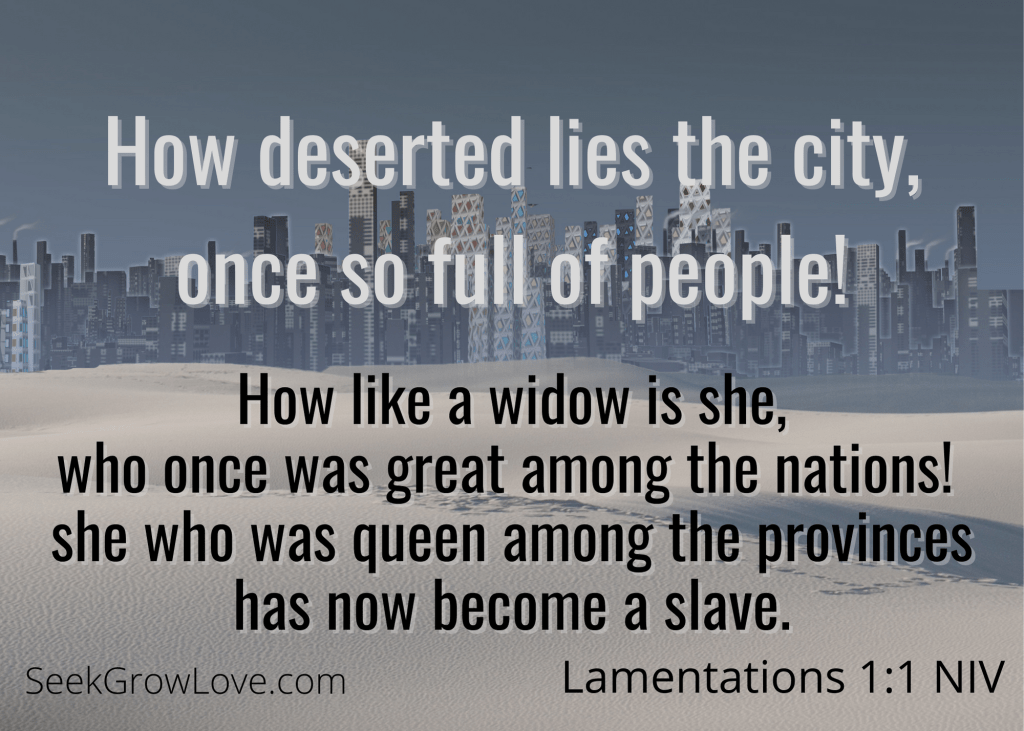
Abandoned Inheritance

Lamentations 1 & 2

Whenever I see a post on my social newsfeed that features images of abandoned buildings, especially amusement parks, I go ahead and click on it to scroll through the photos. I am always intrigued with what I see: carousels with missing horses; buildings with broken window panes; rusted park rides; overgrown weeds winding their way through what used to be “Main Street”. 

To think that these amusement parks used to be the location of families creating memories, friends laughing with one another, people being thrilled have now turned into deserted playgrounds creates a sadness over what used to be.

As I read through the first two chapters of Lamentations, I get a similar feeling of sadness because I cannot help but think about how Jerusalem was described at its apex of prosperity. If you have a few extra minutes, go back and read 1 Kings 10. King Solomon had completed building the temple and his palaces and in this chapter it states that silver was considered of little value (1 Kings 10:21). God’s people truly were experiencing the Promised Land, the land overflowing with milk and honey. If there were a time in history to visit, this would be it!

And 400-ish years later, Jerusalem falls and its inhabitants are taken into captivity in Babylon. God’s Presence literally left the building and the city, as well as its walls, are left to erode.  

As Believers, you and I are filled with God’s Spirit. We are meant to be thriving and living life abundantly. Sure we have seasons of struggle, but overall, we get to experience God’s blessings NOW and have an even greater hope for eternity. Think of it like the days of Solomon where prosperity rules.

Let’s learn the lesson from these two chapters in Lamentations. Let us not find ourselves losing our inheritance due to disobedience. Let us not become like an abandoned place that is left to devastation. Instead, let us focus on being diligent with our studies of Scripture and allowing God to be ruler of our lives.

-Bethany Ligon

Today’s Bible reading passages can be read or listened to at BibleGateway.com here – Lamentations 1 & 2 and James 5

My House Is In Ruins

Haggai

Yesterday we ran across Ezra 5:1-2, which mentions that the prophets Haggai and Zechariah come and encourage the people in Jerusalem to continue rebuilding the temple. As promised, today we are zooming into Haggai’s role in this. How convenient that there is a book in the bible named Haggai that gives us this information.

We know from Ezra 4 that the people in Jerusalem were forced to stop rebuilding the temple by the Persian king Artaxerxes. Some time passes by, and Haggai comes on the scene to prophesy to them. God has some things to get across to them.

The temple sits unfinished, and people of Jerusalem are either too fearful or apathetic to continue working on it. God calls them out on this, saying that his house is in ruins while they are decking out their own. They have been running around doing their own thing, and they never seem to have enough of anything. It’s a rat race. And since the house of God is being neglected, there is a drought in every aspect of their lives. God commands them to get working on the temple again.

This convicts their hearts as it should ours as well. What is the work God has called us to do that we’ve been putting off? What are we allowing to distract us from it? How could we be more intentional about building the opportunities to encounter God in our daily lives?

Heeding this conviction, the people begin building again, but there are some who are discouraged about something we saw in Ezra 3. The people who are old enough to have seen the original temple think this new temple is nothing in comparison. God tells them to take courage, and work, because he is with them. He assures them his spirit is among them as promised when he brought them out of Egypt. That hasn’t changed, don’t be afraid. God tells them he will “shake” things, which at first sounds like an earthquake, but is a dramatic way of saying he will upset the balance. The treasures will be transferred from the nations to his house. He owns all the gold and silver anyway! What doesn’t God own? God promises the splendor of this new temple will be more than the old, and that he will give prosperity.

When you work for God, you do what you can. It is easy to get discouraged. But the one who commissioned you will honor your efforts. He has all the resources in the universe at his fingertips to make it happen. What may be impossible for you is possible for God; he wants it to be your project too.

What follows is an interesting discussion about how contagious holy and unclean things are. If you are carrying around a holy ribeye steak and it touches your fries or soda, does it make the fries and soda holy too? No. But if you touch a dead guy and then touch your fries or soda, does it make them unclean? Yes. Holiness doesn’t just spread automatically, it takes work. Spreading bad things around takes no effort at all. You don’t have to do anything at all, things will fall apart without your attention. “So is it with this people, and with this nation before me, says the LORD; and so with every work of their hands; and what they offer there is unclean.” It’s like there was a contagion of apathy spreading while they were not doing the work, or the work they were doing was with the wrong heart, and things were not going well for them. But now that they are working on the temple according to God’s wishes, they will be blessed. They’ll have enough of everything.

What’s the reason God wants them to build a temple, anyway? It isn’t like God needs a temple. He would be just fine without one. The temple is the way they know how to connect with God and have his life-giving presence among them. To build this temple is to invite his presence. To not build it is to signal to God that they aren’t interested enough in his presence. For us, the temple isn’t a structure we go to, but a kind of metaphor for the sacredness of our own bodies, the network of others in our churches and faith communities, and the use of our time.

At the close of the book of Haggai, God mentions shaking things up in a dramatic way again, and that he will make the governor Zerubbabel a “signet ring” or chosen one. It sounds like God is making him a messiah of sorts. Of course, with hindsight, we know he won’t be the messiah. But he is being recognized by God as a leader of significance. And to add to his significance, he is from the line of David, mentioned in the genealogies of Christ provided by both Matthew and Luke. That’s quite the legacy, when you think about it.

There’s a lot that God wants to do, and he is asking for our cooperation, to take up the projects with him, and by doing so, to invite his presence. My advice to you, and I am speaking to myself as well, is to not put off those good things God has put on your heart to do. Even if you don’t feel ready, you’ve got the support network of the God of the universe, and your brothers and sisters in Christ.

-Jay Laurent

Today’s Bible reading can be read or listened to at Bible Gateway here – Haggai 1-2

Tomorrow we read Zechariah 1-7 as we continue on our

God is Present

1st Samuel 4-8

1 Samuel 4 3 NIV

If a tree falls in the forest, does it make any sound?

This is what I think of when I read 1 Samuel 4-8. The Israelites and Philistines seem to think that the presence of the ark of the covenant is equivalent to God being present and vice versa, if the ark is not anywhere around, God must be absent. The ark of the covenant is merely a physical and tangible symbol of God’s presence. And while it is true that some amazing things took place while the ark was in possession of the Israelites, it wasn’t always a guarantee that having it around would lead to a win. That my friends, is called manipulation. It’s honoring the thing rather than the Creator.
I feel like I might have shared this story with some of you before, but here I go again. Many years ago, I was out on the lake with some friends. It was a gorgeous day and we were wake boarding. I was out in the water waiting for the boat driver to circle around and I just started praying out loud, not loud enough for others to hear me, but it was obvious that my lips were moving. After I had gotten back into the boat, a friend asked me what I was talking about and I just responded, “I was praying”. And her response has stuck with me, “You can pray out on a lake?” She wasn’t kidding, when she asked me that question. She really wasn’t a church goer but she had gone through Catholic Catechism. She was so used to the act of praying being limited to certain environments that praying on a lake was a new concept for her.
It’s easy sometimes to compartmentalize our lives. If we’re not careful, we may find ourselves dressing, speaking, and acting one way at home, another way at church, and another way at school or work. We can become chameleons in our environments in order to cast a persona that works for our benefit, instead of being our real and authentic selves.
What 1 Samuel 4-8 can teach us, if we’re willing to pay attention, is that no matter where we are, what we are doing, or who we are with, God is present. And our ever-present God desires to be our authority, our protector, our provider, our friend. Should we ever be insistent on wanting something else to stand in his place, that is our choice, but that does not mean that God goes away. He will always be there, wherever we are, whatever we’re doing, and whomever we’re with, loving us just the same as always.
Bethany Ligon
Today’s Bible reading can be read or listened to at https://www.biblegateway.com/passage/?search=1+Samuel+4-8&version=NIV
Tomorrow’s reading will be 1st Samuel 9-12 as we continue the 2020 Chronological Bible Reading Plan