Some words can get you in trouble. Some words can get you beat up. Others, in the right situation, can even get you killed! You might be surprised to know that merely quoting some words from Daniel chapter 7 once got someone killed. How? When? It was only a few hours before Jesus’ death on the cross. Jesus was being examined before the high priest. They were attempting to find some guilt in Jesus. They wanted a reason to condemn Him. Finally, in Matthew 26:63, the high priest demanded of Jesus, “…tell us whether you are the Christ, the Son of God…” Jesus answered, “…you have said it yourself; nevertheless, I tell you, hereafter you will see the Son of Man sitting at the right hand of power and coming on the clouds of heaven….” Essentially, Jesus confirmed that He was the long-awaited Messiah, the Son of Man described in the book of Daniel chapter 7. As a result of this confession, the high priest concluded in Matthew 26:66, “He deserves death!” So, as I said, the words of Daniel 7 can get you in trouble. For the words of Daniel 7 are still revolutionary and they still challenge the current world order. They are dangerous and threatening words for those who would defy the will of God.
Jesus, as He appeared before the high priest, quoted in part from Daniel 7:13: “….and behold with the clouds of heaven one like a Son of Man was coming…..” Daniel 7:14 continues to describe the Son of Man, “…and to Him was given dominion, glory and a kingdom, that all the peoples, nations and men of every language might serve Him. His dominion is an everlasting dominion which will not pass away; and His kingdom is one which will not be destroyed.” The early Christians thought this was an important verse. It was directly quoted or referenced several times in the New Testament (Revelation 1:7, Matthew 24:30). Even before the birth of Jesus, Daniel 7 was thought to be a prophecy of the coming Messiah. Jesus even used the term “Son of Man” to speak about Himself throughout the Gospels. Daniel chapter 7 describes a series of empires that will rise and fall. Some of what Daniel described is now history for us. However, there is yet to arise another terrifying empire in the time of the end. This is the empire which the Son of Man will vanquish at His second coming in glory. Even the mightiest of empires will fail, but the kingdom of God and of His Messiah will stand forever.
As we enter this Advent season, we see Daniel 7 as evidence that God keeps His promises. Jesus was born. He lived. He taught us the good word of God. He died for our sins. He was raised to immortality. He sits at God’s right hand. He is coming again to reward those who believe in Him and to punish the wicked.
-Scott Deane
Today’s Bible reading plan passages can be read or listened to at BibleGateway.com here – Daniel 7 & 8 and Psalm 145-147
Have your parents ever planned a big surprise for the family. Maybe a big trip that everyone is excited about and looking forward to. They will do whatever is possible to make it happen. My mother would always say “Lord’s willing” on the off chance that something unforeseen would happen. With God, we don’t have to worry because if he says something will happen, it WILL happen. The Israelites should know this by now, but just like us, sometimes it’s hard to get things through to them.
Jeremiah 29 is a letter from Jeremiah to the exiles in Babylon. We all know Jeremiah 29:11, it’s on lots of items from shirts to artwork, because it has a great message, but continue to read on, the whole passage is just as meaningful. It’s like a love poem written to His children. It starts in verse 10 when He tell them he will bring them back after 70 years, just like He promised. Jeremiah 29: 11-14 says “For I know the plans that I have for you,’ declares the Lord, ‘plans for prosperity and not for disaster, to give you a future and a hope.Then you will call upon Me and come and pray to Me, and I will listen to you. And you will seek Me and find Me when you search for Me with all your heart. I will let Myself be found by you,’ declares the Lord, ‘and I will restore your fortunes and gather you from all the nations and all the places where I have driven you,’ declares the Lord, ‘and I will bring you back to the place from where I sent you into exile.”
Even after all that happened and the fact that they had followed after other gods, the one true God had not given up on His people and He had good plans ahead for them. They just needed to trust Him. We need to all learn to lean on and trust God during the times when we may feel like we are exiled and in captivity. God has good plans for His children. But we have to do our part, it says that we need to call on Him, seek Him, and search for Him with all of our heart. If we do that, He says “I will let Myself be found by you.” He is going to restore them and bring them back to their promised land. These chapters deal with the future prosperity of Israel that God has promised them. In Jeremiah 30:24b it says “Until He has performed, and until He has accomplished the intent of His heart; in the latter days you will understand this.”
We can rest assured that God’s promises will happen, just as He has said, and one of His promises is that He will give us a hope and a future. In Hebrews 6, we learn of better things that are ahead for all believers, we have assurance of our hope of salvation. It tells us that Abraham waited for the promise of God to be fulfilled just like we must and it tells us to be imitators of those who persevered through faith and patience who will inherit the promises. Jesus has gone before us as the first fruits of those resurrected to eternal life and is in heaven acting as our high priest. A better day is coming for all of us when Jesus returns to this earth to set up his Father’s kingdom.
-Sherry Alcumbrack
Today’s Bible reading passages can be read or listened to at BibleGateway.com here – Jeremiah 29 & 30 and Hebrews 6
Hello again! Thanks for joining me for another day!
Isaiah 35 depicts a joyful return of the redeemed of the LORD. There is singing, gladness, no sorrow, and healing (v. 5-10). What an incredible celebration to be part of! I certainly am looking forward to our day of celebration with God. Unlike this celebration, ours will be one that lasts forever and ever, and never has the possibility for someone else to come and bring us back to a broken place. No one to come and scare the righteous and try to deceive them!
In Isaiah 36 the king of Assyria tries to overtake Judah and Jerusalem. Interestingly, the king here is not only using physical tactics to try and capture the cities, but he is also using some mind-game strategies to create doubt in the people and offer a false hope in his own strength. The king tries to convince the people that by surrendering to him they will have security and a new, prosperous land (v. 16-17). He uses the language the people are familiar with and attacks the character of their current leader who follows YHWH. He creates doubt in God’s promises that are not immediately present and begins to offer the easy way out of the situation with empty promises of independent success, security, and familiarity. We see these same types of empty promises coming from politicians, employers, and even our own friends or families at times today. While they may not be empty in what is being offered, they will never satisfy whatever our wants or needs are as they are not promises from God. I believe that Satan consistently tries to use different tactics to pull us away from God and His promises, and people surrounding us can be lead astray on empty promises of what will make them happy, secure, or comfortable.
Throughout the Bible we see a common theme is a warning not to fall for the deception of the current age, to not fall for empty and unsatisfying promises offered by man. This is because no matter what time period, the only promises that will ever fill someone up are those that come directly from God!
Our passage in 2 Thessalonians discusses deception from the ‘lawless one’ who is coming with false miracles, signs, and wonders set out to deceive all those who do not accept the truth (v. 9 – 10). Paul is writing to a church that seems to already be doing a good job of continuing to follow God’s promises despite attempts at deception. He is writing to encourage them to STAND FIRM in what they already know (v. 15). We can know that the promise that Paul writes about (the coming of Jesus) is not one that is empty because he does not write it with the purpose of his own gain, or the purpose of leading us astray from what Jesus himself preached! In general, this is a pretty good standard to judge promises made by others… does it match with what Jesus said? When we use this standard to gauge the reliability of promises we are guaranteed to experience less disappointment and confusion!
I pray over you today and this week that “Our Lord Jesus Christ himself and God our Father, who has loved us and given us eternal encouragement and good hope by grace, encourages your hearts and strengthens you in every good work and word” (v. 16 – 17). Life is hard, full of empty promises, deception, and brokenness. Praise God we have grace and an everlasting promise that is still coming!
-Sarah (Blanchard) Johnson
Today’s Bible reading plan passages can be read or listened to at BibleGateway.com here – Isaiah 35-36 and 2 Thessalonians 2
In 1 Kings 17, we are introduced to a widow that was struggling in the time of the drought. Now Elijah had been sent to stay with this widow by God. The brook he had been living at dried up. He needed somewhere to go, and this was where he was told to seek refuge. When he comes upon the widow, she is out gathering sticks to fuel the flames that would cook what she perceived to be her and her son’s last meal.
When Elijah asked her for a drink, she was more than happy to comply. However, when he asked her for some bread, she revealed her situation. She had no bread. All she had was a small bit of flour and oil. She said she was saving this for her and her son, for they were going to eat it and then die. She did not believe that they were going to make it through the drought. In her mind, this was the end of the road for both her and her child.
But then, as we read, Elijah tells her not to fear for the LORD would not allow her to run out of flour or oil until rain came again. He offers her hope. The widow showed great faith in what Elijah said. She did not question this or wonder how such a thing could be promised. She went in and did as Elijah had said. She had faith in God’s promise. And so, as Elijah had said, the flour nor the oil went empty. They had plenty to eat. God had provided for them and kept his promise.
Here was this widow and her son. She is on the brink of preparing their last meal, when Elijah shows up. God used the widow’s home as a place for Elijah to find refuge. And through Elijah staying there, God provided for the widow and her son who were on the brink of starvation. God orchestrates many stories and brings many people together so that they may help one another. God used the widow to help Elijah and Elijah he used to help the widow.
-Hannah Deane
Today’s Bible reading passages can be read or listened to at BibleGateway here – 1 Kings 17-18 and Proverbs 2
Joshua and the Israelites are getting things done and cleaning up Canaan land. Piece by piece, city by city, town by town, they are accepting their inheritance – the Promised Land that God has been preparing for them the past 430 years.
Beginning with the promise made to Abraham, the old man with no offspring, that if he followed God he would be made into the father of a great nation that would occupy the land. The promise was passed down to Isaac his miracle child, and given again to Isaac’s son Jacob, the father of 12 sons/tribes. It was these brothers that were saved by Joseph when he brought his family to Egypt to survive the famine in their land. A new pharaoh brought the Israelites into slavery and for the next few generations their numbers continued to grow in Egypt. Then Moses entered the scene with the 10 Plagues and “Let My People Go”.
This hasn’t been the easy way to grow a nation. But, God doesn’t have to go the easy route. He was not just creating any nation, but creating a holy nation that called on Him and relied on Him and followed Him.
In Joshua 11:15-16a it is recorded, “As the LORD commanded his servant Moses, so Moses commanded Joshua, and Joshua did it; he left nothing undone of all that the LORD commanded Moses. So Joshua took this entire land…”
The work passed on to the next generation and the promise passed on to the next generation. And here they were, back in the land where Abraham had pitched his tent. They were seeing the fulfillment of so many years of waiting and watching to see how God would make His promises come true. They had seen the waters of the Jordan stop flowing at flood stage so they could cross into this land. They had felt the ground shake when the walls of Jericho came down. They had witnessed the sun standing still! This was not a usual way to create a nation, because they did not have a usual God!
I love that this same awe of God is found about 200 years later in the writings of David. David is still writing about when God “turned the sea into dry land” (Psalm 66:6), as well as His majestic creation, His forgiveness, His care through rain and crops, and His “awesome deeds of righteousness” (Psalm 65:5).
I especially love a passage from yesterday’s Psalm reading – Psalm 62:11-12
“One thing God has spoken, two things I have heard;
that you, O God, are strong,
and that you, O Lord, are loving.
Surely you will reward each person according to what he has done.”
We serve a strong and loving God who rewards his faithful children. It is not enough for God to just be powerful (that could be scary). It is not enough for God to just be loving (that is also scary if you consider a loving but powerless God). But a loving and powerful God is the one I want to follow. He will have good things for His children and the strength to deliver them. Just as He delivered in mighty ways for the children of Israel as they entered the Promised Land under the outstretched arm of Joshua, God is now preparing the fulfillment of all His promises in the Coming Kingdom of God which will be ushered in at the return of His Son Jesus. And that is an event you don’t want to miss.
-Marcia Railton
Today’s Bible reading passages can be read or listened to at BibleGateway here – Joshua 11-12 and Psalm 65-66
We’ve seen Israel’s unfaithfulness to God because of their lack of ability to trust God over the previous chapters. Even so, God still provides for the Israelites. He still shows up for them and helps them to overcome their obstacles, the battles that they face. In Numbers 21, Israel faces the Amorites, one of the desert peoples who tried to stand up against them. They defeated them and the surrounding peoples and dwelt in their cities with the help of God.
After living in the land of the Amorites, they left that area and traveled to Moab, whose king was Balak. Balak was terrified of the Israelites, because of their previous victories and phoned help in the form of Balaam, a diviner from a land 400 miles away from Moab. Balak the Moabite wanted Balaam the diviner to put a curse on the Israelite people, and so Balaam traveled to meet Balak (despite God’s repeated warnings). Numbers 23-24 details the oracles that Balaam gives about the Israelite people. In each oracle, Balaam speaks exactly what God wants him to. Even though Balak asked for a curse, Balaam is not able to give one. Instead, he speaks truth, blessings, and good promises about the Israelites based on God’s faithfulness to them. In fact, Balak gets so fed up with Balaam’s oracles that he summons him in Numbers 24:10-11 and tells him to go home without a reward! Balaam responds by saying, “Didn’t I tell you? If Balak were to give me his house full of silver and gold, I could not go against the Lord’s command, to do anything good or bad of my own will? I will say what the Lord says” (Numb. 24:13). The Spirit of God allowed Balaam to proclaim God’s truth. He proclaimed the good deeds God had done for the Israelites, and he proclaimed words that spoke blessings for the people.
Interestingly, in Luke 2, we also read of proclamations and oracles. However, these proclamations are given by a very different kind of being on a very different occasion. In Luke 2, we read about the birth of Jesus. This account includes the shepherds greeted by the heavenly host who praised God after they sent the shepherds on the way to baby Jesus. These angels proclaim “good news of great joy that will be for all people: Today a Savior, who is Messiah the Lord, was born for you in the city of David” (Luke 2:10-11). The angels proclaimed the greatness of God. And, they proclaimed the good things that God was going to bring to his people, the Christ.
We may not have a diviner proclaiming God’s promises to us. We may not have a heavenly host appear to us. But, we do have God’s word. In his word, we have proclamation after proclamation of the good things that God is giving us. We have promise after promise of what a life as a believer will lead to. When you are facing difficult times, where the end seems unclear and your feet feel unsteady, trust in the proclamations of God. What is he proclaiming over you today?
After Jacob had served Laban in Padan Aram for 20 years, God told him to go back home. It was finally time for him to face his past. Remember, he had cheated his brother Esau, and had run for his life. He had about 500 miles to go to get home. He sent some servants ahead to let Esau know he was coming home. When the servants returned, they told Jacob that Esau was coming to meet him with 400 men. Jacob was terrified, and prayed a beautiful prayer that is recorded in Genesis 32:9-12.
He started, “Oh God of my father Abraham, God of my father Isaac…”. In this section, I see Jacob acknowledging the history his family had with following God, ever since God called Abraham in Genesis 12.
He continued, “O Lord, who said to me, ‘Go back to your country and to your relatives, and I will make you prosper’. ” In this section, I see Jacob acknowledged what God had told him to do, and he had followed what God had told him to do.
Next, he acknowledged his own unworthiness, praying, “I am unworthy of all the kindness and faithfulness you have shown your servant. I had only my staff when I crossed this Jordan, but now I have become two groups.” And he acknowledged what God had done for him, even though he was unworthy.
He continued, “Save me, I pray, from the hand of my brother Esau, for I am afraid he will come and attack me, and also the mothers with their children.” In this section, he admitted his fear to God, and then he finally got around to begging God for what he needed help with – “save me”. Note that he didn’t give God suggestions as to how God could solve the problem. He just turned it over to God.
He concluded with, “But you have said, ‘I will surely make you prosper and will make your descendants like the sand of the sea, which cannot be counted.’.” He closed with reminding God of His promises.
In this prayer, I see a potential model for our own prayers. It goes sort of like this:
Start by thanking God for his provision until now for our family, including for our ancestors.
Today, God speaks to us through His word. I think it is important to be familiar with his word and follow his word. And I think that’s a perfectly fine topic to bring up in prayer, “God, you said to …, and I have done that as you commanded.”
I believe we need to humble ourselves before God, and acknowledge that we don’t deserve all he has done for us. I think it also helps to remind ourselves in our prayers what God has done for us. (We don’t need to remind God. He already knows.)
We should admit whatever we’re feeling to God. (He already knows anyway, but it helps us maintain an open channel of communication with Him.)
We are finally at the point in our prayer where we should clearly lay out the problem we’re facing. And we don’t need to offer God suggestions as to how He could solve our problems. He can come up with solutions better than we can even imagine.
I think in the closing of Jacob’s prayer, he was not just reminding God of the promises God had made. I think he was also looking forward to those promises himself. We should do the same.
And I think it’s fine to pray something like, “God, you promised that everything works for the good of those who love you. I don’t understand how that is possible in the situation I’m in right now. Please open my eyes to understand that, or at least to accept it as truth. I know you have promised that nothing can separate us from your love, not even death. God, things aren’t looking very good from my perspective right now, but I’m holding on to your promise that when Christ returns, you will wipe every tear from our eyes, and there will be no more death or mourning or crying or pain. God, I’m really wanting that now. Please keep me focused on you, and living for you. And please send Jesus soon. Amen.”
In Genesis 28, we find the story of “Jacob’s Ladder.” Jacob had deceived his father, Isaac, and had “stolen” the blessing intended for Esau. Jacob was on the run to move in with his uncle, roughly 500 miles away, so his brother Esau wouldn’t kill him. That night Jacob had a dream with angels going up and down a ladder between God and Jacob. When God spoke to Jacob, He didn’t condemn him for his trickery; instead, He extended the covenant to Jacob that He had made with Abraham and with Isaac. God promised Jacob that he and his descendants would inherit the promised land, his descendants would be numerous, and all nations on earth would be blessed through Jacob and his descendants. God also promised He would be with Jacob wherever he went.
When Jacob woke up, his first response was surprise and fear. He named the place “Bethel” which means “the house of God”. He set up this stone pillow as an altar and worshiped. Finally, he dedicated his life to God.
According to “The Wiersbe Bible Commentary” by Warren Wiersbe, “The ‘if’ found in many translations of verse 20 can also be read ‘since’. Jacob wasn’t making a bargain with God; he was affirming his faith in God. Since God had promised to care for him, be with him, and bring him back home safely, then Jacob would affirm his faith in God and would seek to worship and honor Him alone.”
I see several applications for us.
As I understand it, the ancients believed gods (with a little “g”) were local, and if you left an area, you left the protection of the local god. In this encounter, Jacob thought he had stumbled into the “house of God”, but found that God isn’t limited like that. Since God would be with him everywhere, everywhere can be the house of God. According to James 4:8, if we come near to God, God will come near to us.
Once Jacob encountered God, his first response of surprise and fear quickly turned to worship. When we first encounter God, we may also be struck with surprise and depending on the circumstance, fear too. I think it is important for us to continue on to the worship stage as Jacob did. Note that the altar he built wasn’t for offering sacrifices, it was really more of a memorial that reminded him of his encounter with God. When we encounter similar milestones in our own lives when God has done something noteworthy for us, I think it is important for us to set up a memorial of some sort. Ideally this is something physical, that we can look at and be reminded of what God has done for us.
Jacob’s next step was to dedicate his life to following God. I think this step is imperative for us. Given what God has done for us so far, our natural response should be, “Since you have brought me this far, and since you have made such great promises to me – the promise of eternal life if I remain faithful until Christ’s return, because of these things, I will live the rest of my life for you, God.”
As the story continues, Jacob had many hardships throughout his life. Despite them all, God was still with Jacob. And Jacob remained true to God for the rest of his life.
Psalm 46:7 says, “The Lord of hosts is with us; the God of Jacob is our refuge.” God kept his promises to Jacob, and he will keep his promises to us.
The real question is, will you remain true to Him?
After serving God for 100 years, “Abraham breathed his last and died at a good old age, an old man and full of years”. This fulfilled a promise God had made to him in Genesis 15:15, when God had promised Abraham that he would die in peace at a good old age.
In addition to a great quantity of life, I think Abraham had also enjoyed a great quality of life for all those years. At the end of his life, he could look back with satisfaction, and even then could still look forward with anticipation to God’s promises. Promises including: Abraham and his descendants would inherit the promised land forever, his descendants would be as numerous as the sand and the stars, and that all nations on earth would be blessed through him.
I suspect only a small minority of people can face death like this. I’m guessing most look back at their life with regret, and look ahead with fear.
You may be wondering how Abraham could die in peace, with peace. I believe it all comes back to his relationship with God. We’re told that Abraham was God’s friend (2 Chron 20:7, Isaiah 41:8, James 2:23). In Hebrews 11, we’re told that Abraham died in faith, having not received what was promised, looking forward to the city with foundations, whose architect and builder is God.
You may be wondering how Abraham developed such a close relationship with God. I’ll give you a hint, it wasn’t by following the law. He died hundreds of years before God would give the law to Moses. He didn’t become righteous by circumcision, because he was declared righteous years before he was circumcised. Back in Genesis 15, God made a promise to Abraham, and in verse 6, “Abram believed the Lord, and He credited it to him as righteousness.” Abraham became right with God, because Abraham believed God. And in so doing, Abraham became a model of how all of us can become right with God. Paul used this example in Romans 4 to argue that all are justified through faith alone.
Ephesians 2: 8-10 tells us, “For it is by grace you have been saved, through faith —and this is not from yourselves, it is the gift of God — not by works, so that no one can boast. For we are God’s handiwork, created in Christ Jesus to do good works, which God prepared in advance for us to do.”
In chapter 2, James used Abraham as an example to demonstrate the importance of proving faith by deeds. We aren’t saved by works, but those works prove our faith. And lack of works proves lack of faith.
Abraham left quite a legacy. When God reiterated His promise to Isaac, as recorded in Genesis 26:3-6, we read, “…I will be with you and will bless you. For to you and your descendants I will give all these lands and will confirm the oath I swore to your father Abraham. I will make your descendants as numerous as the stars in the sky and will give them all these lands, and through your offspring all nations on earth will be blessed, BECAUSE (emphasis added) Abraham obeyed me and kept my requirements, my commands, my decrees, and my laws.” Did you catch that? All of this was because Abraham was faithful to God.
The New Testament starts with, “A record of the genealogy of Jesus Christ the son of David, the son of Abraham.” God had promised Abraham that all the world would be blessed through him, and God kept his promise.
I’d like to leave you with a few questions..
Have you thought about preparing now to face death when it comes? Ecclesiastes 12 encourages us to start young. Ecclesiastes 12:1 says, “Remember your Creator in the days of your youth, before the days of trouble come and the years approach when you will say, “I find no pleasure in them.” Verses 13-14 go on to say, “Now all has been heard; here is the conclusion of the matter: Fear God and keep his commandments, for this is the whole duty of man. For God will bring every deed into judgment, including every hidden thing, whether it is good or evil.”
Are you living by faith? Hebrews 11:6 says, “And without faith, it is impossible to please God, because anyone who comes to him must believe that he exists and that he rewards those who earnestly seek him.” And are you demonstrating your faith by your actions?
Finally, what legacy are you leaving? Exodus 20: 5-6 says, “…I, the Lord your God, am a jealous God, punishing the children for the sin of the fathers to the third and fourth generation of those who hate me, but showing love to a thousand generations of those who love me and keep my commandments.”
This world is a wicked place. We see evidence of that every day. It is so wicked, that one day, God is going to destroy this world with fire. But it will not be the first time that God has destroyed the Earth because of wickedness, or will it?
Sadly, many Christians think that the story of Noah’s flood is a myth, or at most was just a local flood, questioning the accuracy of scripture.
Let’s look at exactly what scripture says, and then take a look at real world evidence for a global flood.
Genesis 6:6-7 – The Lord regretted that he had made human beings on the earth, and his heart was deeply troubled.7 So the Lord said, “I will wipe from the face of the earth the human race I have created—and with them the animals, the birds and the creatures that move along the ground—for I regret that I have made them.”
Genesis 6:13 – So God said to Noah, “I am going to put an end to all people, for the earth is filled with violence because of them. I am surely going to destroy both them and the earth.
Genesis 6:18 – I am going to bring floodwaters on the earth to destroy all life under the heavens, every creature that has the breath of life in it. Everything on earth will perish.
Genesis 7:4 – Seven days from now I will send rain on the earth for forty days and forty nights, and I will wipe from the face of the earth every living creature I have made.”
Genesis 7:23 – Every living thing on the face of the earth was wiped out; people and animals and the creatures that move along the ground and the birds were wiped from the earth. Only Noah was left, and those with him in the ark.
These verses make it clear that it was more than just a local flood, declaring that humans and all animals on the face of the earth would be destroyed and the earth itself would be destroyed.
If that were not enough, in Genesis 9:11 God said, “I establish my covenant with you: Never again will all life be destroyed by the waters of a flood; never again will there be a flood to destroy the earth.” If Noah’s flood was just a local flood, then God has broken His promise, because we have had thousands of local floods that have taken life since that time. But God is not a promise breaker.
Finally, both Peter and Jesus make reference to Noah’s flood as a historical event, thus tossing out the theory of it being a myth.
But what about real-world evidence? Can we point to real world evidence that there actually was a world-wide flood that destroyed all life on the Earth?
As a famous creationist likes to say, “If there truly was a global flood, what would we expect to find? Billions of dead things buried in rock layers, laid down by water all over the earth. And what do we find? Billions of dead things buried in rock layers, laid down by water all over the earth.”
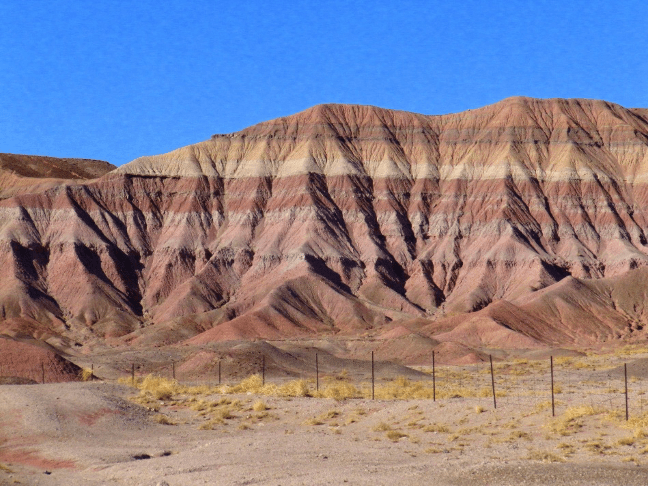
You are probably all familiar with seeing rock layers like the ones below.
Many geologists claim these layers prove an old earth because they argue it should take a long time, millions of years in some cases for so many layers to build up. They also claim these layers are not evidence of a global flood (which has led many Christians to doubt the flood.)
But actually, the opposite is true. What you typically observe is a clear delineation between layers. If the layers took a very long time to accumulate, you should see evidence of erosion between the layers. But that is not the case.
The varied colors of layers indicate different types of sediment. But there is no known justification for uniformity of sediment supposedly for millions of years and then switching to another type. The truth is that these multiple layers were very obviously laid down quickly as a result of a large flood.
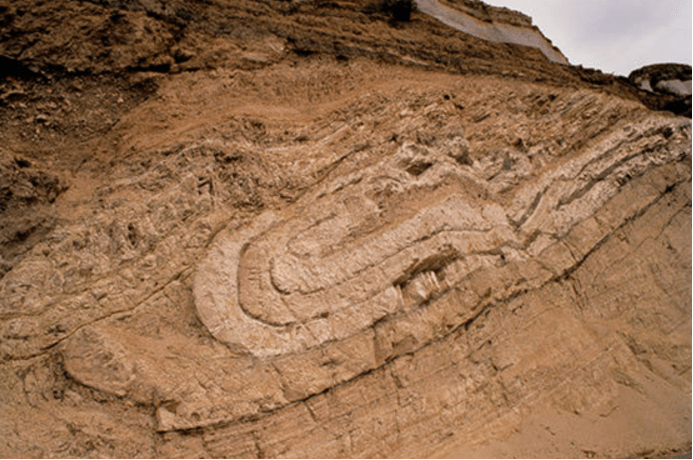
All over the world are examples of a phenomenon called folded strata, seen below.
Hard rock does not fold over like a blanket, it breaks instead. The only explanation for multiple layers being folded together like this is that the multiple layers were still soft. In other words, multiplelayers were all laid down quickly, together, in order for them to all still be soft and pliable.
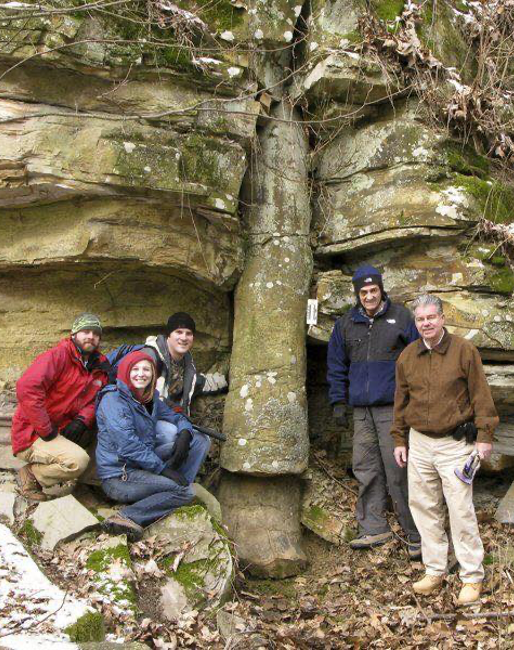
Lastly, there is another phenomena called polystrate fossils, meaning many strata. See below.
These are fossilized that stand upright through many rock layers. But the tree would rot and collapse waiting millions of years for the layers to build up around it. The only possibility is that the tree and all of the layers were quickly deposited together in short order.
As for the billions of dead things, mentioned earlier, which would have resulted from the global flood, that is precisely what we find in the rock layers, whether it be plant and animal fossils, or fossil fuels that were once various living things.
The fact that we find so many fossils is itself evidence of a great flood, because fossils are only able to be formed when an organism is quickly buried, before it has time to decay or be scavenged. And in fact, any of the fossil beds found around the globe contain mixtures of many types of creatures all in one place, even mixtures of land and sea creatures.
There are many other objections to Noah’s flood such as the ark not being big enough to house and maintain the animals (research shows that it was) or that the ark wasn’t seaworthy (research again shows that it was). Some also argue there isn’t enough water to cover the face of the earth, but researchers believe they have recently discovered a vast ocean 400 miles beneath our feet that could fill our oceans three times over.
I hope you are beginning to see a pattern this week. What you read in scripture is reliable and is backed up by what we observe in the world around us. None of the alternate ideas of origins are able to stand up under scrutiny. And the great Biblical event of Noah’s flood, which should have left a lasting mark on our planet, actually did! The evidence is all around us.
2 Peter 3:3-6 – Above all, you must understand that in the last days scoffers will come, scoffing and following their own evil desires. They will say, “Where is this ‘coming’ he promised? Ever since our ancestors died, everything goes on as it has since the beginning of creation.” But they deliberately forget that long ago by God’s word the heavens came into being and the earth was formed out of water and by water. By these waters also the world of that time was deluged and destroyed.
Don’t be a scoffer!
-Greg Landry
If anyone has any questions or comments they would like me to address on any of the devotions dealing with creation this week, please reach out to me at gregrlandry@gmail.com