Clean Before the Lord

Leviticus 14-16

Whenever we watch a movie or read a book, we are anticipating “the moment” in the story where everything comes to a climax and all the puzzle pieces finally come together: chapter 16 of Leviticus is that climax within this book. In this chapter, God gives a special ceremony for the Israelite people, later called Yom Kippur (the Day of Atonement). At this special ceremony, the sins of ALL the people were forgiven and forgotten: at this special annual celebration, every person in God’s family gets a fresh start.

Once a year, the high priest would offer a sin offering for himself, his family, and all the people of Israel within the tabernacle. Since atonement and forgiveness are only possible through blood (Leviticus 17:11), the high priest offers this sacrifice on behalf of all the people to cover all their past yearly sins. He also presents a “scapegoat” before the people, a goat that would bear the sins of all the people and be led out into the wilderness, representing their sins being carried away and forgotten forever. Meanwhile, the people were expected to “deny themselves” in humility before God, repenting and mourning over the ways that they had offended their God throughout the year (and likely fasted from food and water).

What a wonderful and merciful act that God blessed His people with! This was the most important day of the year for every Israelite: the day that they could walk into a new year, cleansed and forgiven of every past mistake they’d made. God didn’t have to provide this ceremony: He only allowed it because He loves His people and understands that we are only dust.

As far as the east is from the west, so far has He removed our transgressions from us. Just as a father has compassion on his children, so the LORD has compassion on those who fear Him. For He Himself knows our frame; He is mindful that we are but dust.” – Psalm 103:12-14 NASB1995

Unfortunately, under the Old Covenant, only the high priest was able to bring about this forgiveness and atonement: only he could offer the sacrifice needed to cover over the sins of the people. There hasn’t been a tabernacle, a Temple, or a priesthood for Israel since 70 AD… based on the standards of Leviticus, it is impossible for the people to have their sins forgiven before God. That is, unless God provided a better way, which He did.

We find out in the book of Hebrews that Jesus Christ has taken the role of our new High Priest, and also as the sacrifice we need to take away our sins: not only just for the year, but forever.

Every priest stands daily ministering and offering time after time the same sacrifices, which can never take away sins; but Jesus, having offered one sacrifice for sins for all time, sat down at the right hand of God, waiting for that time onward until his enemies be made a footstool for his feet. For by one offering he has perfected for all time those who are sanctified.” – Hebrews 10:11-14 NASB1995

We all have regrets and understand that we haven’t lived perfectly: what if you knew that tomorrow all those deeply regretful moments would be washed away, never to be remembered again? Would that change the way you lived before God today? Under the New Covenant, we have the opportunity to live completely free from the guilt and pain that comes from regretful sin, because Jesus died in our place: this is an opportunity available to you, not just once a year, but every single day.

We all have the choice to live differently today than we did yesterday, because Jesus has removed all our sins from the past. What will you choose to do?

-Talon Paul

Reflection Questions

  1. What similarities and differences do you see between Aaron as high priest and Jesus as high priest?
  2. What regrets, guilt, and shame have you experienced? Are you living with them today? Do you need to? What are the New Covenant’s steps to accepting God’s free gift of forgiveness? What will you choose to do?
  3. Did living under the Day of Atonement mean they could do whatever they wanted because once a year all the sins would be forgiven? Does living under the sacrifice of Jesus mean we can do whatever we want because we have forgiveness of sins every day of the year?

The Best High Priest

OLD TESTAMENT: Isaiah 25-27

POETRY: Song of Songs 3

NEW TESTAMENT: Hebrews 9

No one talks about the sins committed by God’s people in ignorance. But it’s these sins that the Levitical high priest offers a sacrifice for yearly. If that’s the case, then what of the sins of the people that are committed willfully? I think we’ll find out about them in Hebrews Chapter 10.

The more I read, the more I have to change my mind about what God’s will for me actually is. There’s so much confusion that’s been passed on from generation to generation that gets stuck in our minds and in our hearts. Confusion is not good, because if we continue in it, someone’s going to get hurt. This studying of the book of Hebrews has helped me tremendously in that regard.

The Old Covenant had a high priest who sacrificed for sins with regulations that had to do with food, drink, and regulations for the body UNTIL the reformation of the covenant. An example of this is in washing hands and feet prior to entering the tabernacle or making a sacrifice. God told them that if they didn’t do this, they’d die. The priest would do this to make sure they didn’t die (literally), for the purpose of cleansing the flesh (the body) of the sin that was committed that year. But it could not cleanse the conscience. It, along with the various gifts and sacrifices offered amongst the people of God under the Old Covenant, could never make the worshiper perfect in conscience. Why?

The Holy Spirit (God) had not yet revealed the way into the holy place while the outer tabernacle was standing, separating the people from God. Nothing offered could compel the person to desire to flee dead works and serve the living God out of self-sacrificial love (God’s will for us all) because Jesus hadn’t demonstrated this kind of love yet. Jesus’s love is what changes the heart, soul, mind—the conscience, if you will. It causes us to desire to repent when we miss the mark and strive to do God’s will out of love.

The New Covenant, with its better high priest, better promises, and better tabernacle, will help the chosen people of God live well for his kingdom. They (we) can start living that way now because the Kingdom of God is at hand. Our great high priest Jesus is working for us (in us), from heaven for our own good, and for the good of others to do God’s will out of love. We’ll desire this with a clean conscience because of what our savior did for us.

The Levitical high priest was only able to make a sacrifice on behalf of his own and the people’s sin once a year. He was only able to cleanse sin once a year. But Jesus’s one time love sacrifice makes it available to cleanse our conscience of sin at any time, as he is available to save forever those who draw near to God through him, since he always lives to make intercession.

It makes sense that if Jesus is always available to make intercession for us that we can become entangled in sin again that kills. When that is the case, we can draw near to God through our high priest and repent because he’s always available to save. I think this is what the writer to the Hebrews is trying to get across. They needed to draw near to God through their new, better high priest with repentance. And they can do that without dying because Jesus already did that.

The new, better high priest has the job role of cleansing our conscience from dead works to serving the living God once we enter the holy place of God. We are the people who desire that because of what Jesus did for us. He demonstrated for us that love conquers sin and sets people free (to serve God). We must choose to follow in Jesus’s footsteps to remain cleansed, repenting when we miss the mark.

God’s desire for his people isn’t new. This has always been God’s will for his people. That’s why he brought his firstborn son Israel out of slavery to Egypt, to serve him, with a clean conscience (the heart) so that it would be well with them. But most of them chose not to.

How the people would be reconciled back to God is new. It was revealed by the Holy Spirit after the veil was torn. Jesus’s body was torn so that we could be in God’s presence to offer sacrifices, just like the Levitical Priests could, but without a chance of dying when we enter (Jesus already did that). The sacrifices we bring in are repentance, praise, thanksgiving, humility, brokenness, contriteness, etc.  

People can now have hope of resurrection from the dead to everlasting life by entering the New Covenant, made available through Jesus’s love sacrifice. We are called to do the same, Jesus showed us how. Jesus was able to do this through the eternal spirit working in him. We can do it through Jesus’s spirit working in us.

Jesus tells us what is required of us. It’s the better requirement than the Old Covenant stipulations because it can make us perfect in conscience. Our requirement is to love, as Jesus loved. How has he loved? Jesus Christ laid down his life for us. And we ought to lay our lives down for our brothers and sisters. Hopefully not literally, but we will be willing to if it comes to that. We can do this through the spirit of Jesus working in us. We can desire this because of Jesus’s demonstration of love. If we don’t, Jesus is always able to save when we draw near to him (repent) with our better sacrifices.

-Juliet Taylor

Reflection Questions

1. Without the shedding of blood, there is no forgiveness. Those under the Old Covenant were forgiven for their sins through the blood of animal sacrifice that year, but it didn’t save them (they had no hope of resurrection). With the shedding of Jesus’s blood, there is forgiveness of sins that saves us. What do you think is the difference between forgiveness under the old law and forgiveness under the new law?   

2. Hebrews 9:26 says, “Otherwise, He would have needed to suffer often since the foundation of the world; but now once at the consummation of the ages He has been manifested to put away sin by the sacrifice of Himself.” This does not mean that people don’t sin anymore. We can clearly see that that’s not the case. What do you think it means to “put away sin”?

3. Christ loved us by dying for us. How do you think God wants you to demonstrate his love to someone today who is in need of some love from you?

“Jesus is Better” Continued

OLD TESTAMENT: Isaiah 22-24

POETRY: Song of Songs 2

NEW TESTAMENT: Hebrews 8

“Jesus is better” talk continued…

Jesus is a better high priest because the Lord set it up, not man. He was chosen. The Lord (Yahweh) chose Jesus to be high priest of his New Covenant due to his loving obedience, as opposed to being appointed by men after their predecessor in lineage died (like in the Levitical priesthood). Jesus’s place as high priest is in heaven itself, not on earth as it was under the law of Moses, where there could only be a mere copy of the sanctuary.

Jesus wasn’t in the priestly line of Levi, he was in the line of Judah – whose line was chosen to be the king-ly line (after Saul (Benjamin’s line) screwed up and another (David) was found who chose God). It was after this chosen man (David) set his heart on choosing God that God swore his oath regarding the new priesthood that was to come in Psalm 110:4. God was going to make his new forever priest one who chose him, after the order of Melchizedek (chosen to be both king and priest; no lineage that made him so). And through him (the new high priest Jesus), he made a New Covenant with people who chose him from their hearts and had God’s laws in their minds.

The Old Covenant promised Israel that they would be God’s people – a kingdom of priests and a holy nation among all the inhabitants of the earth (Exodus 19:6). To serve God in this way, they had to know God’s will in how to live rightly, or at least better than how the rest of the world had been living (and hurting each other). God gave them laws to help them become holy, for their own good and the good of the world. But not all of them were faithful to uphold their end of the deal.

Although God chose them, some didn’t choose God back based on their actions. The law was not in their hearts. If it was, they would have trained themselves to distinguish between good and evil (to stop the evil and do good). They didn’t, hence, the need for a new covenant made with chosen people, through a perfect high priest.

The New Covenant through Jesus is written on the minds and hearts of God’s chosen people. To be chosen means that God chooses us because we choose God. We choose God by obeying him from the heart because we know that he loves us and sets up his commandments for our good, and for the good of the world through us. He’s a good father who establishes our ways for us so that it will be well with not only us, but those whom we affect by following God. We are the people who want that. We want it so badly, that we train for it. 

I understand that God set up the Old Covenant for the people’s own good – because they needed it to live well in their time – to be the people that God wanted them to be for their own good, to affect the lives of those around them positively as God’s holy people. But they didn’t want it (based on their behavior). God says of them, “For they did not continue in My covenant, And I did not care for them, says the Lord.” We know that God cared for his firstborn son Israel. He showed them mercy time and time again. But eventually, their continuously evil actions caused God to cease from his pleading with them to be faithful – until the better man Jesus inaugurated the better covenant based on his faithfulness.  

In this better covenant, all will know God, because they are people who choose to know him. In this better covenant, God will be merciful to them, because they will choose to repent. In this better covenant, God will not remember their sins, because they will choose to ask for forgiveness and do better, in the name of their high priest Jesus, because God’s laws are in their minds and written on their hearts (because they chose to put God’s laws in their minds, and on their hearts for their own good, and for the good of those around them). Don’t let Calvin persuade you otherwise.

There is usually a good reason people are chosen. They aren’t generally going to be randomly selected when it comes to matters of importance. And if they were chosen, they generally have to maintain the qualities that got them chosen in the first place to remain chosen. Throughout our bible history, some did, some didn’t. When God chooses someone, it almost always has to do with that someone choosing him. If God is choosing you, I pray you choose him back.

-Juliet Taylor

Reflection Questions:

1. Do you think God cared for the Children of Israel, even though he’s quoted from an Old Testament statement that he did not (Hebrews 8:9)?

2. Do you think God puts his laws into our minds and writes them on our hearts under the New Covenant (which would take away our autonomy) or do you think action on our part is involved?

3. Hebrews 9:13 says, “When He said, “A new covenant,” He has made the first obsolete. But whatever is becoming obsolete and growing old is ready to disappear. What does obsolete mean here?

The Priest, Melchizedek, & Jesus

OLD TESTAMENT: ISAIAH 6-7

POETRY: PSALM 62

NEW TESTAMENT: HEBREWS 7

In Hebrews 7 the author of Hebrews (who for simplicity I’ll call “Herb”) describes Jesus’ greatness, particularly as a high priest. Herb is following a pattern we recognize, he has compared Jesus to angels, Moses, Joshua, and now Levitical high priests and says ‘that was good, but he is greater.’ The style of argument he is using was one employed by rabbis, it emphasized moving from a lesser thing (never a thing without value) to a greater thing. In the case of the priesthood connected to the Levites Herb compares it with a priesthood connected to Melchizedek, who has almost no known history (see Genesis 14:18-20, Psalm 110), and ties that to Jesus’ High Priesthood.

When Melchizedek and Abraham met it was several hundred years before the Levitical priesthood began with Aaron’s family, and before the Law which records instructions for those priests. There was no Ark of the Covenant then, and no Tabernacle to house it. It is difficult to imagine what form Melchizedek’s service toward God took, and for whose benefit it was provided. Should we suppose that Melchizedek and Abraham met often, and that the first frequently ministered to the second? We are told that Melchizedek was not only a priest but also the king of Salem (that city seems to have been at or near the site of Jerusalem, Psalm 76:2). Might Salem, under Melchizedek’s leadership, have been faithful to God?

We may find Melchizedek mysterious, rather like Balaam who operated as a prophet separately from the Hebrew people in Moses’ day (and ended up turning away from God). But Herb’s description in Hebrews 7:3 makes Melchizedek’s life sound even less clear, getting into whether we know who this priest-king’s parents were, or when he was born or died, as though Melchizedek had no birth or death. Herb’s point really is that Melchizedek was never stated to have become a priest based on inheriting the position, and that it is never mentioned that anyone took up his role as a priest after him. This is following a second style of reasoning accepted among rabbis, one in which you didn’t need to assume the reality of things which scripture left unstated. This allowed Herb to draw connections to Jesus, as one who did not inherit a priestly role from a parent, and who would never stop serving in his role as high priest. That was in contrast with the carefully kept genealogies of the Levitical system – there were tens of thousands of priests living in the New Testament period, each of whom gained their title through their father, and each of whom was to retire at age 50 (Numbers 8:25) – the order of Melchizedek was not joined based on birth records and was not temporary, but was through the permanent oath of God declaring membership (v. 21, 28; Psalm 110:4). So Herb’s statement “made like the Son of God, he remains a priest perpetually” (3b), paired with him saying that Melchizedek “lives on,” (8) may not just involve the rabbinical argument about an unstated death being assumed not to have occurred – it may refer to Melchizedek retaining his status as priest when he is resurrected. Melchizedek will continue to serve alongside the high priest of his order.

Hebrews repeatedly points to Jesus as the fulfillment of God’s plans and calls believers to follow Jesus to gain perfection / maturity / completion (the Greek term doesn’t translate simply). We are told in 7:19 that “the Law made nothing perfect,” but 7:28 says that “the word of the oath, which came after the Law, appoints a Son, made perfect forever.” Now of course when Herb tells us to join with Jesus he doesn’t mean that believers will stop sinning in this life, after all in 7:25 he describes Jesus as “able also to save forever [completely] those who draw near to God through Him, since He always lives to make intercession for them” (you see the point, people don’t need intercession unless they are still doing wrong; by the way, where 7:25 says “forever” and I note the Greek was more like “completely” that wasn’t the same Greek term as I was mentioning Herb used related to “perfection” and “completion.” I am sort of in the habit by now of noting with translations that say things like “forever” or “eternal” what word they should have said, though, because – say it with me – there was no New Testament word for eternal). As chapter six reminded us, a high priest never took the task on for himself, God made the choice, and when God provided us with Jesus we got the best (and only) high priest possible for the purpose of bringing us fully into contact with God.

I’m not sure if people in the church today think very often about how salvation works, but Herb felt it needed clarification and provided some in his book. We have read about Jews who were concerned over the idea of the Law continuing to be followed in the Church, a meeting was held at Jerusalem with apostles and other leaders to discuss that. At one point Paul addressed the issue by pointing to how God interacted with faithful Abraham, centuries before the Law. Paul showed that obedience to the Law was not required to please God, God was more interested in faith. Herb describes something similar with the priesthood, showing that it existed in Abraham’s time well before Aaron or Levi’s line and so the Levitical priesthood was not required for making connections to God. Herb also showed that Levi effectively tithed to Melchizedek when Abraham gave him a tenth of the spoils of battle, which Herb said meant that the earlier line of priesthood was greater than the later one. 

Such interpretations as Paul and Herb wrote, or the many statements interpreting prophecies in the Bible, do not result from authors ‘putting together the pieces’ for what they wanted to support. I don’t think they could have been so fortunate in locating such details anyway. Rather we are talking about a God who shaped event, prophecy, and interpretation. Just as God chose Abram, by His own will, from whom to make a great nation, God also determined that He would use Abram as the starting point to reach the world. God’s choice involved setting up a whole imperfect system to put the Hebrew people on their path, creating a nation and a history and a culture that prepared the way for Jesus. Jesus then opened the way for people from the world; Jesus also provided for better things than the Hebrew people had been experiencing. It can be mindboggling to think about all the steps of the plan God put in place. I tend to wonder if some of those steps along the way were interchangeable, based upon whether certain people would follow through or fail in what they were called upon to do. What I am certain about is that God’s plan was never going to fail.

Thank you, Lord, for your plan, which you have been preparing for so very long. Thank you that we do not have to depend upon who gave us birth in this world to determine if we may enter your kingdom, but that you allow us to become inheritors of your kingdom through a relationship with your son Jesus. I may come into the relationship fallen, but he can lift me up. However dirty I seemed to myself, he was able to wash me clean. However useless I have felt, he can make me useful. As inheritors with him please help us each to joyfully work in your plan, caring and serving as he does for the will of his Father. And please help me be eager to serve him, let me help in ways I have not yet even been of help. Thank you, Amen.

~ Daniel Smead

Reflection Questions

  1. Do you find it encouraging to think that your future is not based on your past, but on your connection to Jesus?
  2. Hebrews 7:25 says that Jesus is able to save completely “those who draw near to God through” Jesus – do you see this more as part of the cautionary language in the book, saying salvation calls for drawing near to God, or as part of the promissory language of the book, pledging that we are able to draw near to God? How might a difference in outlook on that point affect someone’s life? How have you drawn nearer to God in the last few months?
  3. Perhaps it will seem to be a side issue, but we are told we will be priests in the coming age (Revelation 5:10). If the offer had existed through the Levitical order almost no Christians would be eligible – they are not Levites, they are not male, they are the wrong age, etc. But as members of the Melchizedite order alongside Jesus we are not subject to those restrictions, and we can serve with our High Priest Jesus for centuries. How can you honor God today?

sgl23bibleplanDOWNLOAD

Why is Jesus Better?

Hebrews 9

Tuesday, September 27, 2022

Previously, in chapter 8, the author disclosed that Jesus has now obtained a superior ministry and is the mediator of a better covenant that is enacted on better promises (8:6). While the author has simply made this assertion, it now remains for him to explicate how Jesus’s ministry is “superior.” And it is in chapter 9 that the author takes up this very task.

In the 1st part of the chapter, the author recounts the old covenant ministry under the Mosaic Law. There was a tabernacle and sacred items and a place where atonement was made by priests. Yet, it says that “this is a symbol for the present time…until the time of restoration” (vv. 9-10).

All the institutions of the old covenant were limited because they “cannot perfect the worshiper’s conscience” (v. 9). They mandated various sacrifices and rituals which by their nature were unable to bring the worshiper the true cleansing that was the intended goal of atonement and salvation.

But, in verse 11, the author now turns to present the superior ministry of the Messiah in the new covenant. Throughout the rest of the chapter, the author goes into great detail about how Jesus as our high priest in the new covenant has accomplished everything that the former covenant and regulations could never achieve. Everything from the cleansing of the tabernacle to the sprinkling of the blood of the sacrifice was done by Jesus, not in the earthly tabernacle, which was a copy of the heavenly reality, but in the heavenly tabernacle by offering himself as the “better sacrifice.”

Jesus’ sacrifice was “better” in at least two regards. First, the author says that Jesus did not offer a sacrifice many times as the high priest in the former covenant had to because he entered the tabernacle every year. Jesus entered the sanctuary in the presence of God only once. Second, Jesus did not offer the “blood of another” by bringing an animal sacrifice like the high priest of the previous covenant but rather offered his own blood as the sacrifice for sin.

As verses 13-14 say, “For if the blood of goats and bulls and the ashes of a young cow, sprinkling those who are defiled, sanctify for the purification of the flesh, how much more will the blood of the Messiah, who through the eternal Spirit offered himself without blemish to God, cleanse our consciences from dead works to serve the living God?” What the author is comparing is that if under the old covenant the animal sacrifice was sufficient to sanctify the worshiper for the purification of the flesh, then the blood of Jesus must be able to do more than that.

And this is exactly his point: Jesus’s sacrifice is able to do what the old covenant sacrifices never could, and that is to cleanse our conscience from “dead works,” which are the sinful deeds that lead to death and require forgiveness and healing. The old covenant had no power to cleanse the worshiper’s heart from their sinful deeds.

But praise be to God that through Jesus and his sacrifice our minds and hearts can be washed clean of our sin and that we may with a pure conscience “serve the living God.”

-Jerry Wierwille

Application Questions

  1. Compare the conscience of a sinner under the old covenant to your conscience under the blood of Jesus. What makes the difference?
  2. How will you use your pure conscience to serve the living God today?

A Better Hope

Hebrews 7

Hebrews 7 26

Hello everyone!

Thank you to Kyle McClain for getting us started into Hebrews; he’s a hard act to follow!  We can’t jump right into chapter 7 without revisiting the last few verses in 6.  In the end of the previous chapter we are discussing Jesus being regarded as a high priest forever in the order of Melchizedek.  (Gesundheit!)

The beginning of chapter 7 explains who Melchizedek was for the readers and, in a way, giving Jesus some street cred.  The author clearly wants to stress the place of power and importance this King was in (vs. 4) and why it was important that Jesus came from his order.  Verse 15 and 16 explain a little more on why Jesus was to come from his order- it’s because his ancestry doesn’t exactly lead to priesthood!  Coming from a carpenter and a seemingly average woman isn’t a common start for someone so deserving of our praise and worship.  I think the author here was trying to give Jesus some more credibility for the Hebrews he was writing to.

Verse 18 and 19 has some of my favorite language in it!  “The former regulation is set aside because it was weak and useless (for the law made nothing perfect), and a better hope is introduced, by which we draw near to God.”  Why do we need Jesus?  Because the old law was weak, useless, and made nothing perfect!  Couldn’t be more clear than that.  With our new hope (Jesus), we are able to draw near to God and have a close personal relationship with Him.  Before Jesus, the law required sacrifice and prevented people from having that personal relationship with God that we all know and love.  After Jesus, or rather after Jesus’ death and resurrection, we are saved completely and always have a connection to God through Jesus’ intercession (vs. 25).  How amazing is that?

In the last few verses of chapter 7 the author again is explaining how lucky we are to have Jesus and why we should come to him!  He is not only perfect and blameless, but he also sacrificed himself once for the forgiveness of all sins (vs. 26-27).  Past, present, and future.  He took care of them all!  As someone who has grown up in the church it’s easy for me to unconsciously be aware of this fact.  I know Jesus died for all of my sins.  Big and little, from when I was born to where I am now, and where I’ll be tomorrow.  But I’m guilty of forgetting, or at least not recognizing how important that is for my life.  If I try and place myself in the shoes of the people who were reading this letter for the first time in that setting, how overwhelmed with grace and love would I be?  I no longer have to sacrifice by the old law, because there is a new oath that has been appointed by a forever-perfect Savior.  Can you imagine the relief, love, and astonishment you might have as someone hearing that for the first time?  Why is it different for us today, simply because we already know?

Today and throughout this week I encourage you to pause and consciously reflect on the gift of Jesus Christ.  Recognize his sacrifice and thank him for the relationship he allows us to have with our Heavenly Father!

-Sarah Blanchard

Kingdom Ticket – Paid

Will You Accept the Gift?

Hebrews 5_8,9

Hebrews Chapter Five

Hebrews chapter seven is known for being the chapter about Jesus being our high priest.  However, that theme is found in previous chapters, including chapter five.  Jesus being our high priest is one of the main themes of Hebrews.  God appointed Jesus to be our high priest.  Verse one shows us that the purpose of a high priest is “to act on behalf of men in relation to God, to offer gifts and sacrifices for sin.”  Jesus being our high priest acts on our behalf in relation to God.  He is our mediator between us and God.  Jesus being our high priest also offers a sacrifice for our sins.  A normal high priest like Aaron needs to offer sacrifices for his own sins and the sins of others.  However, Jesus had no need to offer a sacrifice for himself because he was sinless.  Rather, he offered himself up to be our permanent sacrifice for sins.  That is a sign of a high priest who loves us dearly.

One would think that since Jesus was perfect that he would not suffer.  However, Jesus “learned obedience through what he suffered,” (Heb 5:8).  Jesus truly did suffer when he was here on this earth.  Two examples that come to my mind are when Jesus wept when his friend Lazarus died and when Jesus sweat tears of blood in the Garden of Gethsemane before he was crucified.  It’s through experiences like this that Jesus learned obedience.  It’s through experiences like this that we too can learn obedience.  It’s often through the most difficult times in life that people draw closer to God.  Job is a great example of this, as he lost nearly everything he had in one day.  However, he responded by worshipping and praising God.  He was brought closer to God and learned obedience through his suffering.

In verse nine, we see that “being made perfect, he became the source of eternal salvation to all who obey him.”  Jesus truly was made perfect, and he was sinless.  He was the last person in the world who should have had to suffer on the cross.  However, because of his and our Heavenly Father’s great love, he did die and suffer on the cross.  Through his suffering on the cross, he became the source of eternal salvation!  Jesus paid our way to go to the Kingdom!  All we have to do is accept the free gift of God of eternal life through Christ Jesus our Lord.  Unfortunately, not everyone is going to accept that free gift.  Verse nine states that Jesus is “the source of eternal salvation to all WHO OBEY HIM.”  To accept the free gift of eternal life, we must obey Jesus.  We accept the gift through obedience and faith.  Similar to what we talked about yesterday, don’t belittle the consequences and meaning of sin because eternal salvation is granted to those who obey Jesus, not those who disobey.

Similar to the chapter break between chapters three and four, the chapter break between chapters five and six is an awkward break.  At the conclusion of chapter five, the author of Hebrews is talking about the difference between elementary and mature doctrines, and he continues the talk in chapter six.  The author compares the elementary and mature doctrines to milk and solid food.  A baby needs milk, and adults eat meat.  New Christians focus on the elementary doctrines, whereas the mature Christians should focus on the more mature doctrines.  Since it’s a weird chapter break, I also want to sneak peek to verse one as well.  Hebrews 6:1 states, “Therefore let us leave the elementary doctrine of Christ and go on to maturity.”  Throughout the first six chapters of Hebrews we have seen some good proof to suggest that the Trinity may be false.  This is good proof as well.  Many people who claim they believe in the Trinity cannot even explain the Trinity themselves because it is so confusing and complex.  They have to use extra biblical illustrations to describe the Trinity.  The Trinity is anything but an elementary doctrine.  It is one of, if not the most, complicated doctrines out there.  However, the author of Hebrews states that the doctrine of Christ is supposed to be elementary.  Jesus being the Son of God does sound like an elementary doctrine to me, not the Trinity.  This is just some food for thought (pun intended).

I hope you have a great day!

In Christian love,

Kyle McClain

Hold Firmly

Hebrews Chapter Four

Hebrews 4_14

There is a belief in the Christian world that some hold to called “once saved, always saved.”  Basically this means that if you come to a saving relationship with God and Christ, then you can never lose your ticket to eternal salvation.  This can be a dangerous perspective because it enables Christians to become complacent with where they are at if they believe they can never lose their salvation.  Worse yet, it can lead people to a life of sin and destruction if they do not take seriously the consequences of sin.  Verse six of Hebrews chapter four discusses this doctrine of once saved, always saved a bit by stating, “Since therefore it remains for some to enter it, and those who formerly received the good news failed to enter because of disobedience.”  The author is stating that some who receive the good news/gospel fail to enter rest because of their disobedience.  They initially accepted the promises of the gospel, but they failed to enter because of their disobedience.  In other words, they were once considered saved when they accepted and received the gospel, but they lost it when they disobeyed.  This verse suggests that maybe the doctrine of once saved, always saved is not founded in the Bible.

This should provide a wakeup call for us!  We need to take the sin in our lives very seriously.  We are to be sanctified and set apart from this world, so let’s act like it!  Let’s not become complacent and degrade the consequences of sin.  God hates sin.  The hardening of our hearts can lead us to sin, and again the author warns us of hardening our hearts in verse seven.  We should take this warning seriously since the author has repeated it three times in chapters three and four.

The concept of rest is repeated a lot in this chapter.  What exactly is the author referring to when he is talking about rest?  Let’s take a look at what this rest is described as in chapters three and four:

  1. Israelites unable to enter God’s rest because of their disobedience and unbelief (3:18-19)
  2. The promises of entering God’s rest still stand (4:1)
  3. We who believe enter the rest (4:3)
  4. God swore that some will not enter his rest (4:3,5)
  5. God rested on the seventh day (4:4)
  6. Remains a Sabbath rest for the people of God (4:9)
  7. Whoever enters God’s rest also rests from his works (4:10)
  8. Strive to enter the rest (4:11)

Here’s what I get from all of this.  God offered the Israelites during the exodus a chance to rest, but they were not able to enter God’s rest because they were disobedient.  The author then compares the rest that was offered to the Israelites to the coming Kingdom.  I come to this conclusion because the promises of entering God’s rest still stand.  There is still a chance to enter God’s rest.  However, not everyone will attain that rest, only the people of God.  In fact God swore that not everyone will enter his rest.  If we are disobedient and unbelieving, then we will not enter God’s rest.  However, if we are a people after God’s own heart, then we surely will enter God’s beloved rest in the coming Kingdom.  Hallelujah! Praise God! Amen!  Therefore, continue to strive toward the Kingdom and bring as many people with you as possible because one day you will enter God’s rest in the Kingdom.

Chapter four ends with talk of Jesus being the great high priest.  We truly do have a great high priest in Jesus.  One of the awesome things about Jesus being our high priest is that he is able to sympathize with us.  Jesus was tempted just like we are, but fortunately he did not sin.  He knows what we go through when we are faced with trials and temptations.  He is no stranger to struggle and suffering.  We can seek refuge in our high priest when we face these temptations because he is able to sympathize with us and plead our case to our Heavenly Father, YHWH.  Jesus being tempted is also more great proof against the trinity.  James 1:13 states, “God cannot be tempted with evil.”  If Jesus were God as well, then James and the author of Hebrews would be contradicting one another.  It cannot be possible for the word of God to contradict itself.  Jesus can’t be tempted, and never have been tempted at the same time.  It doesn’t work that way.  It logically does not make sense.  Jesus was indeed tempted like us, and being our high priest, he is able to sympathize and help us.

To close out today’s devotion, I want to point out Hebrews 4:12, “For the word of God is living and active, sharper than any two-edged sword, piercing to the division of soul and of spirit of joints and of marrow, and discerning the thoughts and intentions of the heart.”  I hope you have gotten benefit from reading these posts.  However, if you don’t get anything else, I want you to know and fully understand that the word of God is living and active.  We are beyond blessed to have the Bible today.  If it weren’t for God’s supervision, there would be no stinking way that we should have it because of the numerous attempts to rid the world of the Bible.  The Bible has only flourished though.  It is truly a divine miracle that we all have access to a Bible, God’s word.  I want to encourage you to keep up the awesome work in delving into God’s word through these devotions.  You are truly doing a great deed.  Keep up the awesome work, and truly believe in your heart that these words are living and active.

-Kyle McClain

What is Your Refuge? (Joshua 19-21)

Wednesday, September 28

nikki-wed-1

Nikki Green

The Israelites were given the privilege to celebrate the LORD as their military general, intelligence leader, informant, strategist, defender, King, and Promise Keeper.   Joshua followed the orders of his commander in chief and finished up the land divisions.  Inheritance was finally bestowed on him, as well, and he received the town of Timnah Serah in the hill country of Ephraim.  Joshua rebuilt the town and settled down.  He was reminded many times through his career to be strong and courageous.  He listened and believed – and the LORD granted him success.

nikki-wed-2

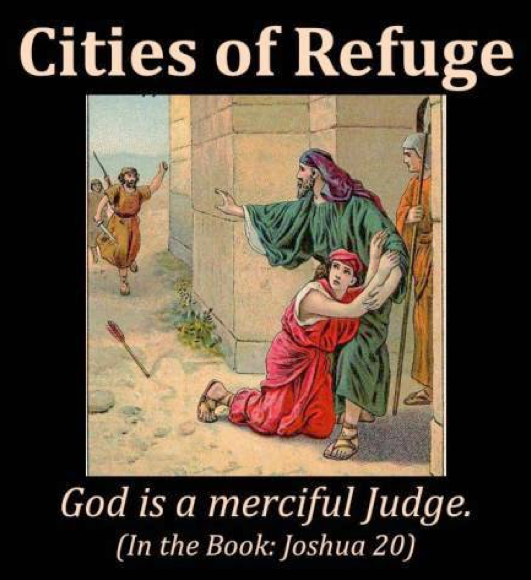
The LORD requested Joshua to set aside cities of refuge for those guilty of accidentally causing someone’s death.  Moses heard this command also, in Numbers 35:9.  This was the beginning of the judicial system for God’s people.  If someone had been accused of murder and was a fugitive, they could find sanctuary as they awaited judgement.  They could flee to one of these designated cities of refuge, stand at the gate, and state their case.  The elders of the city would allow the fugitive to enter their city and provide a place of protection for them to live as they awaited trial.  These people, awaiting trial, were safe there, as long as the high priest was alive.  How grateful I am to have a high priest who never dies!  “The LORD will be a refuge for the oppressed, a refuge in times of trouble” (Psalm 9:9).