“Be My Holy People”

Exodus 22-24

                Social transformation is often a long and painful process.  Think about efforts at equality within the United States.  The founders’ vision was for a society where everyone had the right to life, liberty and the pursuit of happiness.  The Declaration of Independence expressed this in 1776.  Yet it took nearly a century and a Civil War to bring an end to slavery.  It took nearly 150 years for women to be able to vote and nearly 200 years and a lot of blood, sweat and tears to make significant strides toward racial equality.

                How does one take a community that has been enslaved for over 400 years and transform them into a nation that shines a beacon of light to all other nations in the world pointing them to the true God.  How does an entire nation become holy, set apart for God’s service and God’s glory?

                This is the challenge that was before God, Moses and the nation of Israel.  They were leaving behind one type of structure, slavery, to enter into a new way of living.  They needed a new structure to help them know how to live.  They had to be taught how to live in community.  They had to be taught how to work, and how to rest, how to care for their neighbors, and how to punish wrongdoing that threatened to destroy their community.

                In today’s reading we see how God begins to organize and structure the transforming community of Israel.  He teaches them how they are to live and become a holy nation and a royal priesthood.  This transformation would not come quickly or easily.

                They had to be taught how to show respect for personal property: “Whoever steals an ox or a sheep and slaughters it or sells it must pay back five head of cattle for the ox and four sheep for the sheep.” (22:1)  Those who steal must give restitution.

                They had to be taught to respect the family structure and to place their sexuality within proper boundaries: “If a man seduces a virgin who is not pledged to be married and sleeps with her, he must pay the bride-price, and she shall be his wife. If her father absolutely refuses to give her to him, he must still pay the bride-price for virgins.” (22:16-17)

                They had to be taught that there were severe consequences for failing to follow appropriate sexual boundaries: “Anyone who has sexual relations with an animal is to be put to death.” (22:19).

                They had to be taught to have empathy and to show kindness to strangers and people who were different: “Do not mistreat or oppress a foreigner, for you were foreigners in Egypt.” (22:21).

                They had to be taught to have compassion for people in the community who had suffered major losses: “Do not take advantage of the widow or the fatherless. (22:22).

                They had to be taught to show respect both to God and to their earthly leaders: “ Do not blaspheme God or curse the ruler of your people.” (22:28)

                They had to be taught how to live as a just community by not giving false testimony, and by neither showing favoritism toward the poor nor withholding justice from the poor (23:1-6).

                They had to be taught to care for their bodies and minds by getting appropriate rest. (23:12).

                It was also important that everyone be taught these and other guidelines for how to live in community as God’s people and that they verbally acknowledge that they understand and intend to follow “Everything the Lord has said we will do.” (24:3)

                Israel’s transformation from slavery to covenant people of God living a set apart life as the community of God’s people was a slow and challenging process.  It was painfully difficult, but necessary.  In the end, people failed more often than they succeeded in carrying out their assignments.  And yet, somehow, despite tremendous opposition from aggressive and hate filled neighbors, the Nation of Israel survived.

                As Christians, we can learn much from studying how God worked with His people Israel to bring about their transformation.  It is important to note that they were God’s people first, and then they were given this particular set of laws.  In the same way, as Christians, we become God’s people first, through faith in Jesus Christ, and then we commit to following Jesus and obeying Jesus’ commands.  We do not become God’s people by following laws, but by following Jesus Christ.  However, when we follow Jesus Christ, we do not descend into lawlessness.  Structure is still required.  So Jesus spends three years teaching his disciples how to live as the people of God who are called to be holy, set apart to be a light to all nations.  We complete the mission that the nation of Israel began, and we do so following the yoke or community guidelines as laid down by Jesus Christ.  The foundational teaching of Jesus is to Love God and Love our Neighbors.  That is a good place for each of us to start each day.

Jeff Fletcher

(originally posted February 6, 2020 for SeekGrowLove)

Reflection Questions

  1. What is the purpose of rules for your country, work/school or family? What is the purpose of God’s rules for His people?
  2. Does God still want a holy people today? What does a holy people look like?
  3. Which characteristic of a holy people do you want to especially work on developing more this month?
A Kingdom of Priests

Exodus 19-21

Today’s reading is probably one of the most familiar passages in the whole Bible for it includes the Ten Commandments.  It is important to understand the context of these commandments.  God entered into a covenantal relationship with Abraham and Abraham’s descendants through Isaac and Jacob and Jacob’s sons who became the twelve tribes of Israel.  God promised to bless and provide for his people and in exchange His people promised to be faithful and obedient to God and worship God alone.

After 400 years of slavery, Israel has grown from 12 sons and their immediate family to millions of people.  These people, God’s covenant people, will be settling in a land where they will need to live in community.  They are no longer slaves.  They are now responsible to live in that community in peace and productivity.   They need help to know how to live together.  God provides His people with the structure of how to live together as God’s people.  The Ten Commandments and subsequently nearly 600 additional laws were all designed to help them be healthy and blessed representatives of God to the rest of the world.

God loves all people.  We must never falsely believe that God only loves certain people.  God considers all human beings His children and loves them all.  God wants to be in a right relationship with all of his children; however, many are disobedient and have no willingness to be in a relationship with God and many deny that God even exists.

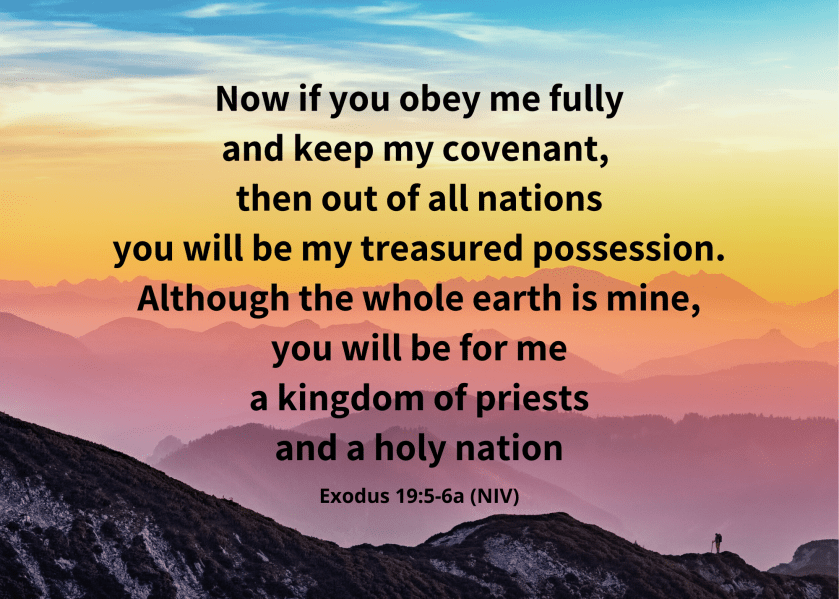
So God needed to start with one group of people and prepare them to be a special, chosen people who would bring the knowledge of God to others.  Exodus 19:5-6 says, “Now if you obey me fully and keep my covenant, then out of all nations you will be my treasured possession. Although the whole earth is mine, you will be for me a kingdom of priests and a holy nation.”

Israel was to be a kingdom of priests and a holy nation.  A priest is one who helps connect people and God.  God would go on to designate priests in Israel to help the people connect with God, but His expectation for Israel was that the whole nation serve as priests to help other nations connect with God.  Because the whole nation was being set apart by God to be priests for the world, they needed to live holy or set apart lives.  There were behavioral expectations that they were to follow.  They had to  be exclusively loyal to God, they could not murder, steal, lie, cheat, they were to be respectful and honoring of parents and not misuse God’s name.

Now we are completing what God began in Israel.  Through Christ we have entered into a covenant with God.  We are now the covenant people, we are called to be a kingdom of priests and a holy nation.  That is the Church’s role.  And God expects us to live lives of holiness as we are set apart to serve God.  As you read through the many laws in the Old Testament, recognize that some applied very narrowly to the Nation of Israel and do not necessarily apply to us.  Dietary laws and sanitary laws were important in Israel at the time they were given but are no longer applicable.  However, some of the laws which pertain to morality have been reaffirmed by Jesus Christ for the Church.  In other words, as Christians we are free to eat pork and worship on Sundays, but we are not free to practice polygamy or murder.

God is truly a God of grace and mercy, but God is also a God who hates sin and punishes sin.  In this way we are still to live in fear of the Lord: Exodus 20:20 “the fear of God will be with you to keep you from sinning.”

Jeff Fletcher

(originally posted for SeekGrowLove on February 5, 2020)

Reflection Questions

  1. What are the duties and responsibilities of a holy nation/kingdom of priests? How would you rate how well/poorly Christians in your nation are doing this job? How would you rate how well/poorly you are doing this job? What can you improve upon this week?
  2. How can we mirror God’s grace and mercy? How can we remind the world (and ourselves) of God’s rule book and judgment? What is the problem with doing just one but not the other?
  3. What does it look like to live in fear of the Lord? Is this only an Old Testament concept or do we find it in the New Testament, too?

And , here is the February Calendar!

Complaint Free Zone

Exodus 16-18

A number of years ago I led one of my churches through the 21 day Complaint Free Challenge.  The challenge was to go for 21 days in a row without complaining.  We each were given a purple wristband to wear throughout the challenge.  You were to wear the wristband on the same wrist for 21 straight days.  If you caught yourself complaining, then you had to switch your wristband to the opposite hand and start your 21 day challenge again.  Some of the studies I read said that it takes most people  about a year to go 21 consecutive days without complaining.  I forget how many months it took me to get to that point.

What was the purpose?  To help people break the habit of complaining.   For many people complaining is simply a bad habit.  Will Bowen, who invented the 21 Day No Complaining Challenge says that most people complain for one of 5 reasons using the acronym G.R.I.P.E.

Get Attention

Remove Responsibility

Inspire Envy

Power

Excuse Poor Performance

When we habitually complain to get attention, to remove responsibility (shift the blame), inspire envy, exert power or excuse our poor performance, we dig a behavioral rut and complaining becomes our default response to just about any situation.  That’s a sinful habit from which we need to repent.

In order to break the bad habit, like any bad habit, one must counter the undesired behavior with more desirable behavior.  The goal of the complaint free world experiment was to improve the world by reducing the amount of complaining that goes on.  During that process I became aware of just how often I did complain.  I don’t like hearing other people complain all of the time, I don’t think anyone does.  Parents don’t like to hear their kids complain all of the time.  Spouses don’t like to hear their husbands/wives complain all of the time.  Children don’t like to hear their parents complain all of the time.  Students don’t like to hear their teachers complain, and teachers, I’m sure don’t like to listen to their students complain.  Churches don’t enjoy hearing their pastor complain all of the time and pastors don’t like hearing church members complain a lot the time.  And guess what…even God gets fed up with human beings complaining all of the time.

In today’s reading, God has been busy taking care of Israel.  He led them out of slavery to the Egyptians by performing ten amazing signs.  When Israel was being chased down by Pharaoh’s army and looked like they were doomed for destruction, God miraculously parted the waters and brought them through on dry land.   God led them by cloud during the day and fire during the night.  God was taking them on a journey to a land that he was going to give them.  God was doing nothing but good for them.

And how did God’s people respond to all of this goodness?  They complained.  We’re thirsty… we’re hungry.  They sounded like a bunch of whiney kids on a long trip.  If you’ve gone on a long trip, the experience is very different for the parents up front and the children in the back.  Think about a family going on vacation.  The parents are the ones preparing for the trip.  Mom’s doing the laundry, packing everyone’s clothes, preparing snacks, arranging for neighbors to come and feed the animals and water the plants.  Dad is making sure the car is running well, changing the oil, getting the mail stopped, gassing up the car, checking the route to make sure there are no road closures.  The parents buy the tickets for wherever they are going, pay for the meals along the way, pay for the hotel rooms, make sure the kids have stuff to do in the car/van/suv.  And what do the kids do?  They complain: I’m hot… I’m bored… I’m hungry…I’m thirsty… I have to pee…  sister’s looking… brother hit me… and are we there yet?  I had 11 children and I know what I’m talking about here.

Imagine Moses… and God.  They are moving roughly 2 million men, women and children across the wilderness toward the promise land.  There are no McDonalds on the journey.  There are no Holiday Inns with an indoor pool.  There are no air conditioned SUVs with built in blue ray players and no iPhones or Nintendo Switches to keep them occupied.  They are tired, they are hot, they are thirsty and hungry, and they are complaining… a lot!

If I’d been Moses or the Lord I would have been tempted to say “Ya’ll be quiet or we’re turning around and going back!”  Fortunately the Lord, and Moses, have more patience and grace than I ever had:

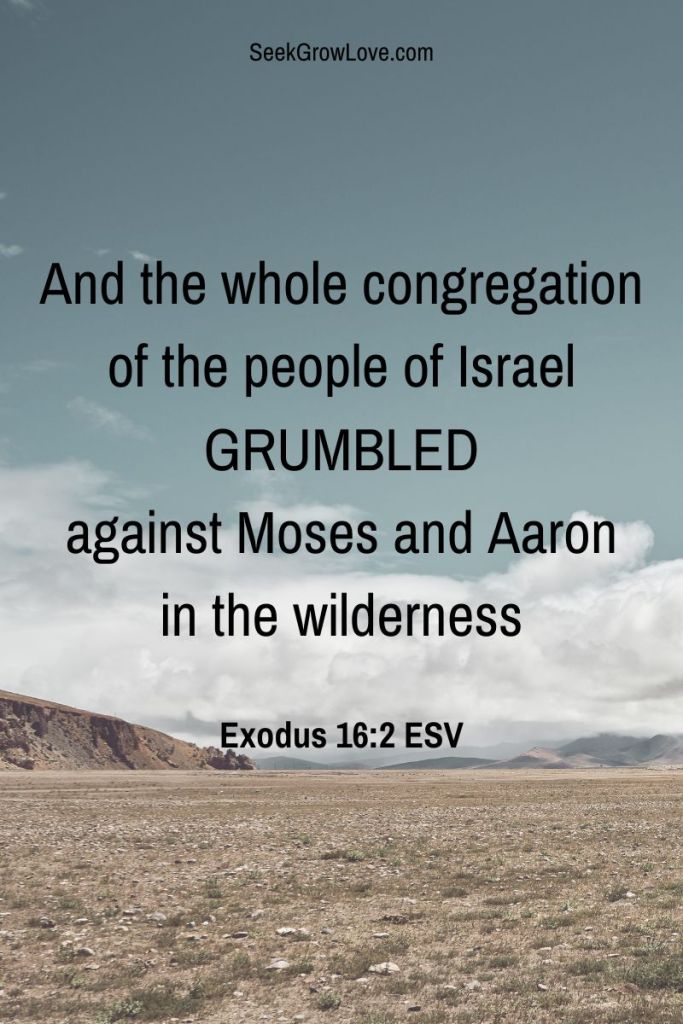
Exodus 16:6 So Moses and Aaron said to all the Israelites, “In the evening you will know that it was the Lord who brought you out of Egypt, 7 and in the morning you will see the glory of the Lord, because he has heard your grumbling against him. Who are we, that you should grumble against us?” 8 Moses also said, “You will know that it was the Lord when he gives you meat to eat in the evening and all the bread you want in the morning, because he has heard your grumbling against him. Who are we? You are not grumbling against us, but against the Lord.”  9 Then Moses told Aaron, “Say to the entire Israelite community, ‘Come before the Lord, for he has heard your grumbling.’”  10 While Aaron was speaking to the whole Israelite community, they looked toward the desert, and there was the glory of the Lord appearing in the cloud.  11 The Lord said to Moses,   12 “I have heard the grumbling of the Israelites. Tell them, ‘At twilight you will eat meat, and in the morning you will be filled with bread. Then you will know that I am the Lord your God.’”

God heard their grumbling and he gave them quail and manna to eat.  There it was, as much as they wanted.  They were able to eat their fill.  And after that they never complained again. Well, that’s not true…. before long they were complaining about being thirsty too.

What God should have done was give each of them a purpose wristband to remind them not to complain.  It would take them a few more lessons before they quit complaining.

I’m sure God does get tired of hearing our complaining… but he still loves us and he even gives us ways to complain in the Bible.  Many of the Psalms are called Psalms of complaint and/or Psalms of lament.  Jesus himself, while he was on the cross prayed  one of those Psalms of complaint/lament, Psalm 22 which begins: “My God, my God why have you forsaken me?”   When we are suffering real pain, real sorrow, real trials, God wants us to turn those into heart felt prayer and we should.  God is able to handle our complaints and do something about them.  At the same time, too often our complaining comes from a place of ingratitude.  The ungrateful complaining that fails to acknowledge and appreciate God’s blessings needs to stop; legitimate complaining for true hurt in faith is something God is ready and able to hear and respond to for his glory and our blessing.

Jeff Fletcher

(originally posted on February 4, 2020 for SeekGrowLove.com)


Reflection Questions

  1. What could the Israelites have said instead?
  2. What happens when you are around people who are complaining? What positive message could you share with a complainer?
  3. Try it out just for today – how long can you go without complaining and grumbling? What could you say instead every time you catch yourself (almost) complaining? How long do you think it would take you to go 21 days without complaining? Will you take the 21 Day Challenge?

Light Dawns on the Dark Night of the Soul

Exodus 10-12

As we go through life, there are times when it seems like God is very active and involved in our day to day lives and we sense God’s love, nearness and active interest in our lives.  However, if we are honest, there are other times when life seems to just move along and God doesn’t seem to be saying much or doing much on our behalf.  The technical term for this awareness of God’s absence is called “the dark night of the soul.”  Many growing Christians have and do experience times of God’s apparent absence in our lives.

As we read through the Bible it becomes apparent that there are times when God gets actively involved with His people.  God was there in creation, making the earth, making the plants and trees, making the animals, making Adam from dirt and Eve from Adam’s rib.  God was there in Eden talking openly and directly with Adam and Eve.  God was there asking Cain about his brother Abel.  But then we don’t hear much from God.  We know that people like Enoch “walked with God”, but we’re told very little about what God is up to for hundreds of years, as the population of earth increases and also the sin of humanity increases.  There is a long period of God’s apparent absence from history until the days of Noah when God appears to Noah and tells him to build the Ark because a flood is coming.

After the flood there appears to be more years of silence, until the Tower of Babel gets built and God comes down and confuses people’s language.  Then there is more silence from God until he calls Abraham.  And so on and so on…There are intermittent times where God is active and involved and times when God seems silent throughout the book of Genesis.

At the end of Genesis God saves Abraham’s family from famine by bringing them down to Egypt.  At first, all is well as Joseph, Abraham’s great grandson is the second most powerful man in all of Egypt.  But Joseph eventually dies, and he is no longer able to protect his family from the powerful Pharaoh, and eventually the descendants of Abraham are enslaved by the Egyptians.  This lasts for a period of roughly 400 years.  During that 400 years it seems that God is once again silent.

During that time Israel is growing from a few hundred people, to millions of people.  Millions of men, woman and children living in bondage in a foreign land.  Perhaps stories about God and their ancestors Abraham, Isaac and Jacob were passed along by word of mouth, but we might imagine that so many years of silence may have left the nation of Israel in a permanent Dark Night of the Soul.  But then… out of the darkness and silence, Moses is born and becomes a member of the Egyptian royal family.  God is at work, but he’s not quite ready to make himself fully known to Israel.  Moses kills an Egyptian and flees to the wilderness and it seems that the darkness continues and the voice of God remains silent…until God appears to Moses in the burning bush and tells him to go back to Egypt.

In Exodus 10-12 the time has come for God to make himself known to His people… and to Egypt. Exodus 10:1-2 – “Then the Lord said to Moses, “Go to Pharaoh, for I have hardened his heart and the hearts of his officials so that I may perform these signs of mine among them that you may tell your children and grandchildren how I dealt harshly with the Egyptians and how I performed my signs among them, and that you may know that I am the Lord.”

Here, God tells Moses that He’s about to make his presence known in a powerful way.  God’s about to show up, the darkness is ending, the silence is over.  And show up He does!  God shows up in a profound and powerful display of his power and might.  Bear in mind, Egypt was, at the time, the most powerful empire in the whole world.  Pharaoh was the most powerful person in the whole world.  Pharaoh had been exerting his power in a ruthless way over God’s chosen people for hundreds of years.  Lord Acton once said “Absolute power corrupts absolutely.”  In the United States we live under a Constitutional system that intentionally balances power among three different branches of government- Executive, Legislative and Judicial.  This is to prevent any one person from having too much or absolute power.  These lessons were learned after observing thousands of years of kingdoms.  Pharaohs and other absolute monarchs have historically used their power in destructive and unjust ways.  And with such unmatched power comes hubris.

The Poet Percy Bysshe Shelly captures the hubris in his powerful poem Ozymandias:

I met a traveller from an antique land,

Who said—“Two vast and trunkless legs of stone

Stand in the desert. . . . Near them, on the sand,

Half sunk a shattered visage lies, whose frown,

And wrinkled lip, and sneer of cold command,

Tell that its sculptor well those passions read

Which yet survive, stamped on these lifeless things,

The hand that mocked them, and the heart that fed;

And on the pedestal, these words appear:

My name is Ozymandias, King of Kings;

Look on my Works, ye Mighty, and despair!

Nothing beside remains. Round the decay

Of that colossal Wreck, boundless and bare

The lone and level sands stretch far away.”

Pharaoh, like Ozymandias in the poem, was filled with hubris over his unmatched power.  He believed himself to be king of kings.  He needed to be taught a lesson in humility by the true King of Kings.  God showed up.  Ten plagues later and all of Egypt was brought to their knees.  Meanwhile, the people of God began to see first hand just how great and powerful their King, the true God, YHWH really was.  That story has been told for thousands of years, and today, the people of Israel continue to sit down and eat bread without yeast and drink wine and remember the Passover and how powerful their God really is.

Sometimes, God seems to be silent, but make no mistake, God is still there and God is still powerful and in the end, God will show himself to be greater than all human opposition.  May you know the true God.

Jeff Fletcher

(originally posted for SeekGrowLove on February 2, 2020 – Thank you, Jeff!)

Reflection Questions

  1. Have you ever felt like you were in a dark night of the soul? How would you describe this time? How might God describe this time? Is there anything you found helpful during this time?
  2. How do you think the Israelites were feeling as they: made bricks without straw, encountered the first 9 plagues, asked their Egyptian neighbors for jewelry – and received, selected a lamb, killed it, put the lamb’s blood on their doorframe, experienced the distinction God made between Israel and Egypt?
  3. What lesson was Pharaoh learning in Exodus 10-12? What were the Israelites learning? What are you learning about man and about God?

Blessings

OLD TESTAMENT: Ezekiel 31-32

POETRY: Psalm 128

NEW TESTAMENT: John 3:22-36

Psalm 128

A song of ascents.

Blessed are all who fear the Lord,
    who walk in obedience to him.

You will eat the fruit of your labor;
    blessings and prosperity will be yours.

Your wife will be like a fruitful vine
    within your house;
your children will be like olive shoots
    around your table.

Yes, this will be the blessing
    for the man who fears the Lord.

May the Lord bless you from Zion;
    may you see the prosperity of Jerusalem
    all the days of your life.

May you live to see your children’s children—
    peace be on Israel.

Today is a special day.  It’s the birthday of my oldest grandchild, Scarlett.  All of my grandchildren are precious and I love them all dearly.  I can’t believe how blessed I am to have so many who call me Grandpa or Poppa or Poppy.  Scarlett is the first to make me a grandparent.  Psalm 128 names being able to see your children’s children a special blessing.

Reading this Psalm again touches me deeply and reminds me not to take things for granted like enjoying the fruit of your labor.  Not everyone does enjoy the fruit of their labor due to war, disaster, or disease.  We should not take the blessings we receive in life for granted.  Life does not always go how we planned or wished.  Not every man is blessed with a fruitful vine with a table surrounded by olive shoots.  Not every parent is blessed to live long enough to enjoy their grandchildren.  I’m currently battling some pretty serious diseases.  One of my motivators to be healed is to enjoy my family… and honestly, I’d like to meet not only my grandchildren but also my great grandchildren in a few years.

I also want to see the prosperity of Jerusalem and peace in Jerusalem.  That will happen when King Jesus returns.  I’d like to be around to see that too.  But if I should close my eyes in the sleep of death, I will see Jesus, and I hope my family, my church, and my friends at the first resurrection.

The blessings that await us at the coming of Jesus will be awesome. I want to see you there too.  Don’t overlook both the promises or warnings in John 3:36 “Whoever believes in the Son has eternal life, but whoever rejects the Son will not see life, for God’s wrath remains on them.” Don’t miss out on the blessings that come through Jesus. May God bless you.

Pastor Jeff Fletcher

Reflection Questions

  1. What are the blessings you have already seen? Thank God for them
  2. What are the blessings you still hope to see before Jesus returns or you sleep in death?
  3. What does Jesus’ return mean to you?
  4. What is your greatest hope for the future? What do you need to do today to increase your chances of taking part in that future?

The Wise Raising of a Family

OLD TESTAMENT: Ezekiel 29-30

POETRY: Psalm 127

NEW TESTAMENT: John 3:1-21

Most of the Psalms were written by David, but there are a few that were written by others.  For example, Psalm 90 was written by Moses and Psalm 127 was written by David’s son, Solomon.

Today’s reading, Psalm 127 is what we will reflect upon.  It offers wisdom about the wise raising of a family.  I find some parts of Solomon’s teaching a bit paradoxical.  Solomon’s father, King David, had 19 sons by his wives.  The year before his father David died Solomon’s first wife Naamah gave birth to his one and only son, Rehoboam.  She also gave birth to two daughters Taphath and Basemath.  As far as we know from the Bible these are the only three children Solomon fathered.  This is odd considering Solomon had 700 wives and 300 concubines.  Solomon valued children and saw them as a reward from God.  

A Song of Ascents. Of Solomon.

Psalm 127 

Unless the Lord builds the house,
    those who build it labor in vain.
Unless the Lord watches over the city,
    the watchman stays awake in vain.

It is in vain that you rise up early
    and go late to rest,
eating the bread of anxious toil;
    for he gives to his beloved sleep.

Behold, children are a heritage from the Lord,
    the fruit of the womb a reward.

Like arrows in the hand of a warrior
    are the children of one’s youth.

Blessed is the man
    who fills his quiver with them!
He shall not be put to shame
    when he speaks with his enemies in the gate.  

If Solomon valued children so much why didn’t he have more?  The most likely answer is that Solomon’s next wife was the daughter of the Pharoah of Egypt.  She worshipped idols and brought them into the royal palace.  Many Biblical scholars believe that Solomon had no more children as punishment for allowing idolatry to enter his family.

Psalm 127 begins “Unless the Lord builds the house, those who build it labor in vain.”  The house referred to here is not a physical house or palace but a family or a household.

That strikes me as a very wise teaching. And yet Solomon’s actions weren’t very wise when he had 700 wives and 300 concubines.    Another paradox is that in 1 Kings 3 Solomon asked God for the gift of wisdom.  Because Solomon’s request of wisdom was very unselfish (he didn’t ask for riches or a long life, God agreed to give him what he asked for, wisdom and what he didn’t ask for: wealth, honor, and long life as long  Solomon followed God’s commands.

This begs the question… how did God give him wisdom?  Did he open up Solomon’s head and pour in wisdom, or was wisdom acquired over time?  Perhaps Solomon grew in wisdom over time, when he realized that he missed out on the blessings of a large and fruitful family because he allowed idolatry to enter his home?

Solomon doesn’t quantify a number of children that qualify one as blessed.  David had 19 sons.  Solomon’s 1 son Rehoboam had 28 sons and 60 daughters (wow, that’s a lot of weddings to pay for).

My wife Karen and I have been blessed with 7 sons and 4 daughters (JJ, Jon, Joshua, Karee Anne (Gregory), Joel, Kailyn, Katie Beth (Mattison), Kass, Jordan, Josiah, and James).  We also have been blessed with 16 grandchildren (soon to be 17). We are greatly blessed.  My children (and their spouses) and grandchildren are precious gifts from God and I’ve always appreciated this Psalm. Of course, having a large family is not the only sign of blessing from God.   However God chooses to bless you, receive it with gratitude and joy.  

Peace, Grow, Love             

-Jeff Fletcher

Reflection Questions

  1. How would you put in your own words and explain Psalm 127 verse 1? Compare what a house/family built by the Lord looks like versus one built in vain. Consider the home you were raised in – which was it more like? Which do you want for a home/family you will/are or have raised?
  2. What are some of the current views towards children that you have witnessed? Which ones would God agree with, which ones would he not?

Sowing and Reaping

OLD TESTAMENT: Ezekiel 27-28

*POETRY: Psalm 126

NEW TESTAMENT: John 2:12-25

          As a child one song I enjoyed singing in church was called Bringing In The Sheaves.

1 Sowing in the morning, sowing seeds of kindness,

Sowing in the noontide and the dewy eve;

Waiting for the harvest, and the time of reaping,

We shall come rejoicing, bringing in the sheaves.

Refrain:

Bringing in the sheaves,

Bringing in the sheaves,

We shall come rejoicing, bringing in the sheaves;

Bringing in the sheaves,

Bringing in the sheaves,

We shall come rejoicing, bringing in the sheaves.

2 Sowing in the sunshine, sowing in the shadows,

Fearing neither clouds nor winter’s chilling breeze;

By and by the harvest, and the labor ended,

We shall come rejoicing, bringing in the sheaves. [Refrain]

3 Going forth with weeping, sowing for the Master,

Though the loss sustained our spirit often grieves;

When our weeping’s over, He will bid us welcome,

We shall come rejoicing, bringing in the sheaves. [Refrain]

As a little child I really had no Idea what the song meant.  What were sheaves?  Why did people go out sowing with weeping.  What made them so sad? Why were people rejoicing while bringing them in?

Fortunately, Psalm 126 answers a lot of those questions.

Psalm 126

A song of ascents.

When the Lord restored the fortunes of Zion,
    we were like those who dreamed.
Our mouths were filled with laughter,
    our tongues with songs of joy.
Then it was said among the nations,
    “The Lord has done great things for them.”
The Lord has done great things for us,
    and we are filled with joy.

Restore our fortunes Lord,
    like streams in the Negev.
Those who sow with tears
    will reap with songs of joy.
Those who go out weeping,
    carrying seed to sow,
will return with songs of joy,
    carrying sheaves with them.


The first half of the Psalm is a Song of Rejoicing.  It likely refers to the time when Israel returned from their time in Exile.  King Cyrus of Persia released the exiles in Israel and allowed them to return to Israel where they could live in freedom and rebuild the city of Jerusalem and the Temple.  It was a time of rejoicing.  It was a time of rejoicing, laughter, songs of joy.  The surrounding nations could see how God did great things for them.  Sadly over time Israel faced a whole new set of trials.  So God’s people pray that once again God would step in and bless his people and restore their fortunes.

There was a time of drought that led to famine.  The people were sad from their misfortune so they went out in faith with bags of seed to plant.  It was an act of faith that God would supply abundant rain so that their seed would grow and be harvested so that they would carry back bundles… sheaves or grain.  There would be laughter and shouts of joy in happy gratitude for God’s blessings.

Today, we go through times of great rejoicing at the blessings.  November is a special time of celebrating God’s abundant blessings and rejoicing in God’s gifts.  It can also be a time when we go through pain and loss.  There’s a passage in Job that says “The Lord gives and the Lord takes away, blessed be the name of the Lord.” (Job 1:21)  Some times we go out weeping and, in hope plant seeds believing that God will give blessings.

Is today a day that you are going out weeping with seeds to sow, or is today a day that you come back rejoicing  at what God has provided, carrying those seeds of blessing? 

Trust that God will give blessings if we faithfully sow, even with tears.

Pastor Jeff Fletcher

Reflection Questions

  1. Is today a day that you are going out weeping with seeds to sow, or is today a day that you come back rejoicing  at what God has provided, carrying those seeds of blessing? 
  2. What seasons of sowing in tears have you had? What seasons of rejoicing in reaping have you had? Where have you seen God’s faithfulness?

Wedding Celebrations

OLD TESTAMENT: Ezekiel 25-26

POETRY: Psalm 125

NEW TESTAMENT: John 2:1-11

Weddings are a lot of fun.  I’ve been blessed to lead wedding ceremonies for 6 of my own children and over 100 other weddings over the last 40 years of ministry.  Of all the weddings I’ve been involved in, the one that affected me most was the wedding of my wife Karen and me.  In 11 days we will celebrate our 40th wedding anniversary- November 24, 1984.

Weddings hold a lot of meaning in the Bible.  Abraham and Sarah’s son Isaac had a special wedding when he married Rebekah.  Their son Jacob had a huge wedding surprise when he thought he was marrying Rachel but her father tricked him into marrying his older daughter Leah.

Jesus’ first miracle came at a wedding when Jesus turned water into wine at a wedding.

John 2:1-11

2 On the third day a wedding took place at Cana in Galilee. Jesus’ mother was there, 2 and Jesus and his disciples had also been invited to the wedding. 3 When the wine was gone, Jesus’ mother said to him, “They have no more wine.”

4 “Woman, why do you involve me?” Jesus replied. “My hour has not yet come.”

5 His mother said to the servants, “Do whatever he tells you.”

6 Nearby stood six stone water jars, the kind used by the Jews for ceremonial washing, each holding from twenty to thirty gallons.

7 Jesus said to the servants, “Fill the jars with water”; so they filled them to the brim.

8 Then he told them, “Now draw some out and take it to the master of the banquet.”

They did so, 9 and the master of the banquet tasted the water that had been turned into wine. He did not realize where it had come from, though the servants who had drawn the water knew. Then he called the bridegroom aside 10 and said, “Everyone brings out the choice wine first and then the cheaper wine after the guests have had too much to drink; but you have saved the best till now.”

11 What Jesus did here in Cana of Galilee was the first of the signs through which he revealed his glory; and his disciples believed in him.

The symbolism of marriage can be seen throughout the New Testament.  It begins in John 2 and makes an appearance in Matthew 22 with a parable of a King who has a wedding banquet for his son.  He hosts a great banquet, but his invited guests refuse to come to the banquet.  Instead, they mistreated and killed the king’s servants. So the king brings his judgment and wrath against the wicked.

Jesus tells a parable about the bridegroom coming to meet his bride for their wedding, but her wedding attendants were not ready and miss out on the wedding banquet (See Matthew 25).

Finally, the book of Revelation reveals the marriage supper of the lamb of God, when Jesus returns to claim his bride and celebrate his own wedding feast. 

 Revelation 19:6-9:

“6 Then I heard what seemed to be the voice of a great multitude, like the roar of many waters and like the sound of mighty peals of thunder, crying out,

“Hallelujah!
For the Lord our God
    the Almighty reigns.

Let us rejoice and exult
    and give him the glory,
for the marriage of the Lamb has come,
    and his Bride has made herself ready;

it was granted her to clothe herself
    with fine linen, bright and pure”—

for the fine linen is the righteous deeds of the saints.

9 And the angel said to me, “Write this: Blessed are those who are invited to the marriage supper of the Lamb.” And he said to me, “These are the true words of God.”

Who is the bride of Messiah Jesus?  It is his Church.  We are the bride of Christ and when Christ comes we will celebrate our union with our savior and king Jesus.  So let us be prepared for this grand and glorious celebration with Jesus.  

Jesus begins his ministry with a miracle at a wedding, and when he returns to earth there will be a great and final wedding feast.  Don’t miss your great celebration.  The greatest banquet in human history.

Pastor Jeff Fletcher

Reflection Questions

  1. What are some of your favorite wedding memories? What makes them so precious?
  2. Imagine what each of the characters at the wedding in Cana were thinking and feeling. Jesus and Mary were disagreeing as to if this was the right time for a first miracle. What do you think God thought?
  3. Why do you think God chose a wedding banquet to compare with the church meeting Jesus at his return? How does a bride prepare for her wedding? How ought the church to be preparing to meet Jesus? Are there any details (or larger issues) that you may have overlooked in your preparations thus far?

Traveling Songs

OLD TESTAMENT: Ezekiel 23-24

POETRY: Psalm 124

NEW TESTAMENT: John 1:35-51

There are 150 Psalms in the Bible.  There are a variety of Psalm styles including Psalms of Praise, Songs of Thanksgiving,Songs of Zion, Songs of the Temple and Liturgy, Laments, Prayers, Petition, Trust, Wisdom, Songs about the Law, Royalty Songs and Imprecatory songs.  One set of Psalms are called Songs of Ascent.  The comprise 10% of the Psalms ranging from Psalm 120-134. These 15 Psalms are believed to have been sung during the three pilgrimages – Passover and Pentecost in the Spring and Tabernacles in the Autumn.  As the Israelites ascended Mt. Zion and the Temple they were climbing to gather to worship so these were known as Songs of Ascents.

It is also believed that these 15 Psalms were sung by the priests as they climbed the 15 steps leading up to the temple.

Psalm 124 was one of these Psalms of Ascents.

Psalm 124

A song of ascents. Of David.

If the Lord had not been on our side
    let Israel say—

if the Lord had not been on our side
    when people attacked us,

they would have swallowed us alive
    when their anger flared against us;

the flood would have engulfed us,
    the torrent would have swept over us,

the raging waters
    would have swept us away.

Praise be to the Lord,
    who has not let us be torn by their teeth.

We have escaped like a bird
    from the fowler’s snare;
the snare has been broken,
    and we have escaped.

Our help is in the name of the Lord,
    the Maker of heaven and earth.

This Psalm celebrates the source of their help when they came under attack from their enemies.  Their source of help and protection is the Lord.  Every time they gathered to celebrate these festivals in Jerusalem they remembered God’s saving hand.

For we Christians, we have no physical temple to make a pilgrimage to 3 times a year, but we gather each week to celebrate the different ways God saves us.  Our help truly comes from the Lord.

I hope you regularly pray this Song of Ascents and with gratitude give thanks to God for his help and care.

-Pastor Jeff Fletcher

Reflection Questions

  1. What does the Psalmist thank God for that did NOT happen to them – because the Lord was at their side? We often worry about what could happen – but how much time do we spend thanking God for what didn’t happen?
  2. Today what will you thank God for that didn’t happen? How will you remember God’s care for you and for others?
  3. What do you like to listen to when you travel? How can your song selection help or hinder your thanks to and worship of God?
  4. How can you celebrate and share with others what God has done?

John Introduces Jesus

OLD TESTAMENT: Ezekiel 21 & 22

POETRY: Psalm 123

NEW TESTAMENT: John 1:19-34

Last week in the United States we had our election for President.   For months people campaigned on behalf of the candidates.  There were debates, speeches, and interviews.

2000 years ago in Israel, there were questions surrounding potential leaders.  One man who had developed a large following drew interest in from the leaders who sent religious leaders to question who he was.  He made it clear who he was not.

John 1:19-34

19 Now this was John’s testimony when the Jewish leaders in Jerusalem sent priests and Levites to ask him who he was. 20 He did not fail to confess, but confessed freely, “I am not the Messiah.”

21 They asked him, “Then who are you? Are you Elijah?”

He said, “I am not.”

“Are you the Prophet?”

He answered, “No.”

22 Finally they said, “Who are you? Give us an answer to take back to those who sent us. What do you say about yourself?”

23 John replied in the words of Isaiah the prophet, “I am the voice of one calling in the wilderness, ‘Make straight the way for the Lord.’”

24 Now the Pharisees who had been sent 25 questioned him, “Why then do you baptize if you are not the Messiah, nor Elijah, nor the Prophet?”

26 “I baptize with water,” John replied, “but among you stands one you do not know. 27 He is the one who comes after me, the straps of whose sandals I am not worthy to untie.”

28 This all happened at Bethany on the other side of the Jordan, where John was baptizing.

John Testifies About Jesus

29 The next day John saw Jesus coming toward him and said, “Look, the Lamb of God, who takes away the sin of the world! 30 This is the one I meant when I said, ‘A man who comes after me has surpassed me because he was before me.’ 31 I myself did not know him, but the reason I came baptizing with water was that he might be revealed to Israel.”

32 Then John gave this testimony: “I saw the Spirit come down from heaven as a dove and remain on him. 33 And I myself did not know him, but the one who sent me to baptize with water told me, ‘The man on whom you see the Spirit come down and remain is the one who will baptize with the Holy Spirit.’ 34 I have seen and I testify that this is God’s Chosen One.”

John made clear that he was not the one, he was not the Messiah, the King.  John made it clear that Jesus was the true King.  God himself declared that Jesus was revealed to be the savior of the world.  Jesus was God’s chosen.  He was God’s sacrificial lamb who would take away the sins of the world.

John was a man of great humility.  He did not pursue power and glory.  His call was to witness the truth about God’s true savior.

Presidents come and go, but Jesus is the true Messiah and Savior.  Just as John in all humility pointed people to Jesus, let us all point to Jesus as our savior and king.

Pastor Jeff Fletcher 

Reflection Questions

  1. What characteristics of John do you admire? What makes a good Christian leader?
  2. What evidence did John have that Jesus was God’s Chosen One – God’s Messiah?
  3. Like John, how can you prepare people to meet Jesus? How can you introduce Jesus to your friends/co-workers/neighbors?