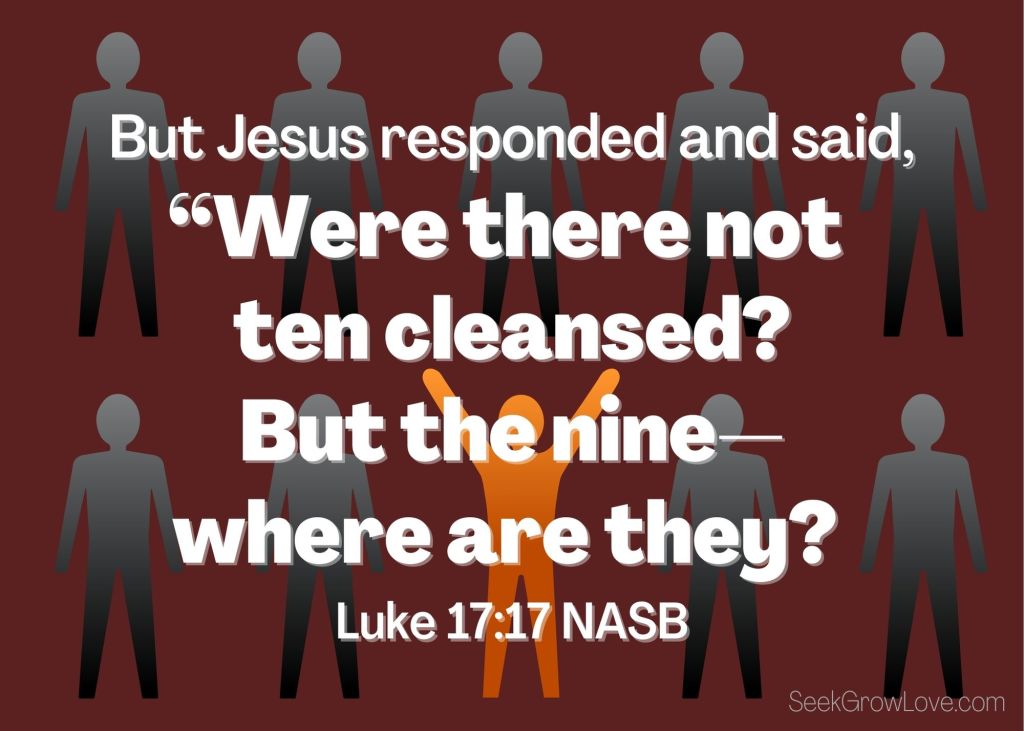
1 Out of 10

*NEW TESTAMENT: LUKE 17

Poetry: Psalm 117

Old Testament: Ruth Intro below

(and I forgot to include Judges 21 yesterday, so you can finish that up today)

The story of the ten lepers is familiar to many of us. Luke 17:11-21 is often included in youth Sunday School lessons as a powerful tale of healing and to give thanksgiving. In the parable, we read about the ten men who were cleansed but learn that only one returned to give thanks to Jesus. Often, we use this parable to teach young children about the importance of giving thanks.

Though like many, I learned this tale in my youth, it wasn’t until my adulthood that I more fully understood the need for thanksgiving. Verses 15-16 of this parable are what jump out at me as an adult. “Now one of them, when he saw that he had been healed, turned back, glorifying God with a loud voice, and he fell on his face at His feet, giving thanks to Him. And he was a Samaritan.”

It’s interesting to me that it’s specifically pointed out that the man who returned to give thanks was a Samaritan. This man had a double whammy in society! First, he had leprosy and would have been kept apart from others. Secondly, he was a Samaritan, considered less than desirable among people of Jesus’ time. In that simple phrase at the end of verse 16, we see yet again that Jesus’ ministry sought out and served the marginalized people. Healing and grace was for all people, not just an elite few.

That phrase jumps out to me, because at heart, I am a Samaritan. I’m one of the less desirable that Jesus came to save. As a youth, I didn’t have life experience to fully appreciate and understand the gift of God’s grace or the need for thanksgiving. As an adult, I have both the education of life and Bible study to have a full awareness of God’s grace and mercy. Just like the marginalized people that Jesus served in His day, I am in great need of healing and grace due to my sin. 

Verses 15-16 also strike a chord in me because of the manner in which the leper gave thanks. Look at the way he praised Jesus! He used a loud voice and he fell on his face before Christ. He did not shrink in giving praise and thanksgiving because he understood the power of the healing bestowed upon him. He had a true gratitude to Jesus. Do we have a true gratitude for the way in which we have also been saved?

Oh, how I want to praise Jesus just like the leper who fell at his feet! He has given me much, so let me praise him much! In our lives, can we live out Psalm 117? “Praise the Lord, all nations; Laud Him, all peoples! For his lovingkindness is great toward us, And the truth of the Lord is everlasting. Praise the Lord!”

Today, can you offer true gratitude for the mercy and loving kindness that God has offered to us through the gift of Jesus’ life on the cross? Can you share that mercy with others? As a church, can we seek out the marginalized people of our society and offer them the same love that Jesus lived in His ministry?

~Jen Siderius

Reflection Questions

  1. How can you (will you) offer true gratitude for the mercy and loving kindness that God has offered to us through the gift of Jesus’ life on the cross?
  2. How can you (will you) share that mercy with others?
  3. As a church, how can we (will we) seek out the marginalized people of our society and offer them the same love that Jesus lived in His ministry?
  4. In our Bible reading today what do we learn about God? What do we learn about Jesus? Why do you think it says that as the cleansed leper was throwing himself at Jesus’ feet he was praising God?

Ruth Introduction

The Book of Ruth is one of only two books of the Bible named after a woman.  It takes place during the time of the Judges in Israel.  It is named after the main character in the story, a Moabite woman by the name of Ruth, who became a believer in God, and followed her mother-in-law back to Israel.  Because it mentions Ruth’s great-grandson, King David, the book of Ruth must have been written after David became King.

One of the most familiar passages is Ruth 1:16-17, which says, “…Where you go I will go, and where you stay I will stay.  Your people will be my people and your God my God.  Where you die I will die, and there I will be buried.  May the Lord deal with me, be it ever so severely, if anything but death separates you and me.”

The Book tells about a woman, Ruth, a foreigner, born to a people with no relationship to God, who became a believer, and was richly blessed by God.  Ultimately, she was listed in Matthew 1:5 in the ancestry of Jesus.

The Book of Ruth shows the incredible loyalty of Ruth to Naomi.  It also shows the kindness of Ruth to her mother-in-law, Naomi, as well as the kindness of Boaz to Ruth.  These remind us of God’s kindness toward us.  We are also introduced to the concept of a “kinsman redeemer” – a relative who will redeem someone when they can’t pay their own way.  This reminds us of Jesus, our relative, who paid for our sins, because we couldn’t pay for them ourselves.

As you read the Book of Ruth, consider how God watches over and blesses those who follow Him.

-Steve Mattison
When God Celebrates

Old Testament: Judges 17 & 18

Poetry: Psalm 115

*New Testament: Luke 15

The Parable of the Prodigal Son is a perennial favorite in Sunday School lessons. As a child, how many of us studied this lesson on God’s forgiveness? I imagine most hands being raised! As adults, how many of us have taught our own children or other youth about redemption through this parable? Again, I can envision many nods of agreement!

Between you and me, I intensely disliked this parable in my youth and early adulthood. Don’t get me wrong; I understood the meaning and value of the parable. Through it, we learn that no mistake can separate us from God’s love and that He will always desire for us to return to the sanctuary of that love. 

However, a part of me always sympathized with the older brother. I understood his indignation, albeit misplaced, over the celebration of his wayward younger brother. Can’t you just hear the anger and self-righteousness dripping from his words in verses 29-30? “Lo, these many years I have served you, and I never disobeyed your command; yet you never gave me a kid, that I might make merry with my friends. But when this son of yours came, who has devoured your living with harlots, you killed for him the fatted calf!”

Minus the part of being given a kid or killing a fatted calf, those words could have been mine. As the youngest of four girls, I understood the older brother’s resistance to the celebration. Throughout my childhood and young adulthood, I strived to be the “good child,” not giving my parents cause for grief, assisting them in old age, and caring for them in sickness. As I devoted my time to my parents’ needs, my sisters’ seeming freedom and my parents’ unconditional love towards them caused my resentment to grow unchecked.

It was during my father’s last months when I had my “Aha” moment. In one of our final conversations, he told me, “We always loved all of you girls. You all just needed our love in different ways.” During our conversation, I realized that my parents’ love for my sisters didn’t diminish their love for me. Love wasn’t meant to be a competition in the way I tried to make it. Love isn’t something to be given to a sole recipient, hoarded and kept from others. In fact, love isn’t something to be earned or gained through works. Love is given freely in spite of ourselves and our works. 

I hope the older son of this parable also had an “Aha” moment. Based on the final verses, I’d like to think he did. Read verse 28 in the parable again. When the older brother had his temper tantrum, his father “came out and entreated him.” His father so desired for him to be part of the celebration that he left the party to go find him. Then in verse 31, the father says, “Son, you are always with me, and all that is mine is yours.” In his words, we see that the father’s love is multifaceted. Just because he loves one brother and rejoices in his homecoming, doesn’t mean that he loves the other brother any less. In fact, he acknowledges that he appreciates the older brother’s hard work and is already blessing him for his devotion. But the father confirms that he also loves the younger brother and that this love is freely given, in spite of each brother’s work or personality.  

If our earthly parents can love all siblings with equal love, imagine how much greater it is with God’s love! In those final verses of the parable, we are reassured that God’s love has room for everyone, whether it is a faithful worker or someone returning to Him. Throughout 1 John 4, we are reminded that “God is love.” In this chapter and in the Parable of the Prodigal Son, we see that the very nature of God is to love and do all things within the scope of His love for us.

We should not possess envy or resentment towards others in their faith journey because we are reminded in 1 John 4:20-21, “If any one says, “I love God,” and hates his brother, he is a liar; for he who does not love his brother whom he has seen, cannot love God whom he has not seen. And this commandment we have from him, that he who loves God should love his brother also.” From now on, as I read the Parable of the Prodigal Son, I’ll be reminded to focus my eyes on the father of the story. Do I rest in the love of God? And, how do I show that love to others?

Throughout your walk this week, how can you share God’s unconditional love with others? Is there someone, like the younger brother, who could use your encouragement as they seek their way to God? Or, is there someone, like the older brother, working hard but needs a gentle reminder that we are saved by faith not works?

~Jen Siderius

Reflection Questions

  1. Focusing on the Father – do you rest in the love of God? And, how do you show that love to others?
  2. Throughout your walk this week, how can you share God’s unconditional love with others? Is there someone, like the younger brother, who could use your encouragement as they seek their way to God? Or, is there someone, like the older brother, working hard but needs a gentle reminder that we are saved by faith not works?
  3. Through Jesus’ parables what do we learn about the heart, motives, purposes, desires, words and actions of his Father?

Egyptian Hallel

Old Testament: Judges 15 & 16

*Poetry: Psalm 114

New Testament: Luke 14

In yesterday’s devotion, we learned that Psalms 113-118 comprise the “Hallel,” or praise. These verses are recited or sung together at Jewish observances such as Passover. These specific verses are called the “Egyptian Hallel” to identify them from two other passages in Psalms also referred to as “Hallel.” Today, our reading brings us to Psalm 114, which focuses on praising God’s rescue of the nation of Israel from Egypt and contributing to the moniker “Egyptian Hallel.”

Instead of focusing on a detailed account of the exodus from Egypt, Psalm 114 uses beautiful language to focus the reader on the majesty of God displayed throughout that time period. It centers on the miracles that God uses to fulfill His promises to His people. In the eight short couplets, we get a sense that all things, including nature, are under God’s control.

Israel was never meant to make Egypt their home. In fact, in the first two verses, we read, “When Israel went forth from Egypt, the house of Jacob from a people of strange language.” It is a recognition that they did not belong there and were being delivered from their oppressors.

Throughout the remaining verses, we read about miracles performed during the exodus from Egypt and while Israel wandered for forty years. While in the desert, God performed miracles, such as bringing forth water from rock, to provide for His people. The verses also refer to “the mountains skipped like rams,” which happened when the Lord descended to Mount Sinai (Exodus 19). The psalmist shows how even the earth obeys God’s word and reacts to His mighty power.

By stating, “The sea looked and fled, Jordan turned back,” the psalmist encapsulates the beginning and end of Israel’s journey. He refers to the parting of the Red Sea (Exodus 14) and the crossing of the Jordan under Joshua’s command (Joshua 3). He shows the completion of the work that began in Egypt. It’s affirmation that God sees all things through to completeness and within His time.

Though these verses are used in the Passover feast to remember the exodus and thank God for His miracles, I feel that they are also a promise to us. Like the nation of Israel living in Egypt, we too are a people living among “people of a strange language.” As sin grows within our world today, it becomes increasingly challenging to adhere to our faith and follow God’s word. But like Israel laboring within Egypt, we must labor within this world, holding fast to the promise that God has something much better in store for us. John 17:14-16 says, “I have given them thy word; and the world has hated them because they are not of the world, even as I am not of the world. I do not pray that thou shouldst take them out of the world, but that thou shouldst keep them from the evil one. They are not of the world, even as I am not of the world.” This is not our home. We must keep our eyes focused forwards on the Kingdom of God.

Isn’t it beautiful to think about the coming Kingdom? As a child, I always wondered when it would be established. In my lifetime? After my death? We will never know the exact time, but that’s not what is important. What is important is that God will fulfill His promises, just like He brought His promises to Israel to completion.

Just like within the exodus, even nature will obey God’s commands. Psalm 114 states, “Tremble, O earth, at the presence of the Lord.” In Revelation, we read about several earthquakes that will occur in the end times (during the opening of the seals and the bowls of God’s wrath), as well as other natural events that will reveal God’s power to the inhabitants of the earth.

To me, it is interesting how Psalm 114 mirrors our own wait for the promise of the Kingdom and the events that will lead to its establishment. As we go throughout this week, let’s reflect on what we are doing to prepare. Are we being faithful like the Israelites in Egypt? Are we prepared spiritually to endure a wait? Are we thankful for the promises that will be fulfilled?

~Jen Siderius

Reflection Questions

  1. Spend some time considering the questions at the end of today’s devotion.
  2. Consider your view of God – are there any areas where your view does not completely match the God we see in our Bible reading? Any areas where your view is too small, too powerless?

Forevermore!

Old Testament: Judges 13 & 14

Poetry: Psalm 113

New Testament: Luke 13

Psalms 113-118 are known as “Hallel,” which means praise. These Psalms are recited, either in unison or responsively, in Jewish observances such as Passover and Hanukkah. This specific passage of Psalms is a prayer of thanksgiving and praise to God for the blessings He poured out on Israel during the Exodus from Egypt. Though “Hallel” typically refers to Psalms 113-118, two other sections of Psalms are also referred to as “Hallel.” Thus, Psalms 113-118 are also specifically referred to as the “Egyptian Hallel” due to recounting of the Exodus story in Psalm 114.

In Passover remembrances, the Hallel is used within both the temple and homes. Before the Passover meal, Psalm 113-114 would be sung together. Most scholars believe that Jesus and his disciples would have sung these verses together while gathered for the Last Supper. When you read the verses of Psalm 113 closely, they seem a fitting hallmark to Jesus’ ministry.

In verses 7-9, we read, “He raises the poor from the dust, and lifts the needy from the ash heap, to make them sit with princes, with the princes of his people. He gives the barren woman a home, making her the joyous mother of children.” Throughout Jesus’ ministry, his work angered many because he focused on the ones that others forgot or ignored. Just like the words of the Psalm, he shook social norms. How many instances can we recount of him healing the less desirable, such as the woman at the well, or socializing with sinners, such as Zaccheus? Jesus acknowledged in words and actions that all will be made equals in God’s kingdom? 

In today’s New Testament text, we read another example of Jesus lifting the needy, while others found fault. In Luke 13: 10-13, we read, “Now he was teaching in one of the synagogues on the sabbath. And there was a woman who had had a spirit of infirmity for eighteen years; she was bent over and could not fully straighten herself. And when Jesus saw her, he called her and said to her, “Woman, you are freed from your infirmity.” And he laid his hands upon her, and immediately she was made straight, and she praised God.” Later in the text, we read how the Synagogue leaders were indignant that Jesus healed on the Sabbath, causing Jesus to rebuke them. He had once again turned expectations upside down.

While reciting this Psalm during their Passover meal, did any of Jesus’ disciples connect his ministry to the words they were singing? It’s also poignant to think that despite his imminent betrayal and death, Jesus could recite this prayer of praise and thanksgiving from the Psalm. “Blessed be the name of the Lord from this time forth and for evermore! From the rising of the sun to its setting the name of the Lord is to be praised! The Lord is high above all nations, and his glory above the heavens!” 

When we are faced with trials, can we do the same as Jesus? These verses remind us that in all things, the Lord is worthy of continual praise. It does not instruct us to be thankful once. Rather, it is imploring us to offer thanks “forevermore.” God is unchanging and there will never be a time in which we cannot offer homage to Him. 

My daughter’s teacher has her students complete a daily task in their agendas. At the end of each school day, the students are tasked with reflecting on the day and writing down two positives that happened to them. The teacher is striving to enable a mindset of gratitude and positivity within her class.

Could we take on the same task in order to offer continual praise to God? At the end of each day, let’s take time to reflect on that day. What can we praise God for? Perhaps your day at work was rough. But could you thank God that you had a job to go to that will provide for your needs such as food and shelter? This week, I challenge you to find at least two things in your day for which you can offer God praise and thanksgiving.

~Jen Siderius

Jen Siderius is a member of the Fair Oaks Community Church of God in Virginia. She and her husband Dan live in Maryland, where she works as an elementary school media specialist. When she’s not busy being entertained by the antics of their 9-year-old daughter, she loves to read, run, knit, quilt and try new crafts.

Reflection Questions

  1. Where do you see Jesus upsetting social norms? What was his purpose in doing so? Where have you – and can you – follow Jesus’ example?
  2. How would you rank yourself in the thankfulness category? Do you daily praise God for what He has done and who He is? How can you work at increasing your spirit of thankfulness?
  3. What did you see about God in today’s reading that you will praise Him for? What is Jesus revealing about His Father and God that we can praise God for?