A Golden Thread

*Old Testament: Genesis 27 & 28

Poetry: Psalm 11

New Testament: Matthew 11

Jumping into our Old Testament reading today of Genesis 27-28, we find ourselves among a muddy set of characters. Isaac, Rebekah, Jacob, and Esau are quite the dysfunctional family in a lot of ways. As a kid I heard the story of Jacob and Esau many times, and I remember coming home from Sunday School one week quite indignant as to why the “liar” got the blessing.  That just didn’t make sense to my immature brain which was picking up information from stories in isolation, and in many ways, is still working on weaving them all together. Jacob and his manipulative mother had stood out to me as being the “bad guys” in the story since they were busy lying, sneaking around, wearing hairy disguises, whipping up really good goat stews that just might taste like something Esau’s hunting could have contributed to, and yet somehow, they got away with it. What good Sunday school teacher would have the moral of the story be “lie, cheat, and steal and you’ll be blessed”?

 Now when I read this story, I realize….it’s kinda like war. Ultimately, like most stories of human beings, all of the characters are wrong in different ways at different times and full of mistakes. In this case, at times they were all conniving and trusting in themselves to fix problems versus trusting God wholly and His sovereign plan.  While Rebekah had been told the older would serve the younger, she certainly hadn’t been told to take matters in her own hands and assume she had to be manipulative and conniving to achieve what God himself had already told her was going to happen. Nor had Jacob been instructed to trick and lie to his father. And Esau certainly was not just an innocent victim with his misplaced priorities like bowls of red stew and pagan wives. Interestingly, according to commentaries, Isaac lived 40 more  years after giving the blessing to Jacob. I always pictured him on his deathbed in this story, but apparently he had another 40 years to see what unfolded! 

God had a plan, a promise, a land and blessings to give, despite this family’s actions, not because of them. The story of this imperfect crew in Genesis 27-28 falls after Abraham has died. They are descendants of the promises given to Abraham already, and in Chapter 28, Jacob hears those promises reiterated again to him personally. As promised, not because his costume was really good and his lying skills were top notch, Jacob’s descendants are bountiful, and form the biological lineage of King David and our Messiah, Jesus. Genesis in fact, is a book full of beautiful promises, and not just promises found in interesting tales of old, full of characters who like red stew. They are full of incredibly relevant promises for any Christian today, and are absolutely central to the gospel message. For that matter, these passages are also very relevant to current events today and a land that we must trust to God’s sovereign plan. He doesn’t need our plotting, manipulating, and worrying.  Not only that, He doesn’t want them. God alone knows the who, what, when, where, why, and how of it all. Jesus will return. The meek will inherit the earth. 

In trying to come up with an analogy for the importance of the promises of Genesis in relationship to the gospel, and how they impact what we live for, hope in, and are sustained by, I realized Anthony Buzzard, a faithful teacher of the Abrahamic faith, had already done it for me. In an article I ran across recently in his Focus on the Kingdom magazine, I found comfort and inspiration in his golden thread description:

Underlying the entire Bible story, running like a golden thread through Scripture, is the promise made to Abraham that he would receive, as a reward for his obedience to God’s call to leave Ur of the Chaldees, prosperity, progeny, and property. This amazing, divinely promised guarantee of success, which Christians are invited to share as spiritual children of Abraham, is summed up in the compact phrase “the blessing of Abraham.” This beautiful and memorable phrase is found only twice in Scripture, in Galatians 3:14 and Genesis 28:4. This provides the essential link between the two Testaments.

The article, The Land Promise to Abraham and His Descendants: The Key to the Whole Bible Plot, can be read here.

May He also give you the blessing of Abraham, to you and to your descendants with you, so that you may possess the land where you live as a stranger, which God gave to Abraham.

 New American Standard Bible (La Habra, CA: The Lockman Foundation, 2020), Genesis 28:4.

in order that in Christ Jesus the blessing of Abraham would come to the Gentiles, so that we would receive the promise of the Spirit through faith. 

 New American Standard Bible (La Habra, CA: The Lockman Foundation, 2020), Galatians 3:14.

Reflection Questions:

What can you do to facilitate more trust in God and less tendency to manipulate and control circumstances in your life and around you?

How can you weave more of the “golden thread” of the promises to Abraham into your mind, heart, and life and learn more about what those are?

Have you ever had goat stew? 🙂 

-Jennifer Hall

Fulfillment

Old Testament Reading: Isaiah 61-62

Poetry Reading: Psalm 89

New TestamentReading: James 3

Every city has a story. My parents and extended family grew up in Cleveland, Ohio, and most school breaks, I went to Cleveland. While some refer to it as “the mistake on the lake”, I love the city! I like the architecture and history, the cultural diversity and ethnic foods, the Westside market, being right on Lake Erie, the Metropark system, a plethora of cute donut shops putting my hometown in southern Indiana to shame, and what is still my favorite ice cream place ever, Malley’s! But, while I enjoyed visiting and genuinely liked the place, I didn’t have the memories of what it used to be like or appreciate the changes as much as those in my family who had known its previous years. It seemed like around every corner though someone had a story. My Dad’s old high school is now an apartment complex. My Mom’s old church that she went to take pictures of is….shall we say…. no longer in a neighborhood welcoming cheerful little ladies in Oldsmobiles with cameras driving slowly down the street snapping photos and pointing. Now Cleveland hasn’t been destroyed like Jerusalem was, and it is still a great city, but as a person who never saw the “olden days”, I couldn’t appreciate all of the changes in the same way. In today’s reading of Isaiah 61, I think it is important to remember that Isaiah KNEW Jerusalem.  He had grown up there in its glory days, and he knew what it had been. Similar to stories of people who see their cities and countries devastated by war today, Isaiah had seen a city destroyed.  When he uses phrases like verse 4 “ancient ruins” and “devastations of many generations”, he could visualize exactly what it used to be.  How painful that must have been without the promise God gave him that he shared with others through his prophecy.

The Hebrew name for Jerusalem is Yerushalayim which I recently learned while attending a Bible study, is a combination of the Hebrew word “Yireh” (referencing an abiding place) and “Shalem” (meaning peace or complete). Hence….sometimes we hear “the City of Peace”. Hmm. If you haven’t heard much about Jerusalem yourself, a quick Wikipedia scan of facts doesn’t seem to cry out “city of peace” to me:

  • destroyed twice
  • besieged 23 times
  • attacked 52 times
  • captured and recaptured 44 times

And really, who could possibly keep count of the violence and destruction given – it’s one of the world’s oldest cities. But, it is also a city of current world conflict, not just the past. We see its involvement in current world events, and we can read of its historical and future significance in the Bible. In fact, Jerusalem is mentioned over 800 times in the Bible! It seems to be a place that is important to God. Eternal peace also seems to be important to Him, and while Isaiah saw the city destroyed once, Isaiah also prophesied the LORD’s message regarding a coming day of peace that we’ve read about several times this week already.

For those hearing this in Isaiah’s days (and for the next 700 years or so!) there would have been some questions. While we certainly still have our own questions today, Jesus himself takes care of explaining Isaiah 61 pretty nicely in Luke 4.

And He came to Nazareth, where He had been brought up; and as was His custom, He entered the synagogue on the Sabbath, and stood up to read. 17 And the scroll of Isaiah the prophet was handed to Him. And He unrolled the scroll and found the place where it was written:

18 “the spirit of the lord is upon me,

because he anointed me to bring good news to the poor.

he has sent me to proclaim release to captives,

and recovery of sight to the blind,

to set free those who are oppressed,

19 to proclaim the favorable year of the Lord.”

20 And He rolled up the scroll, gave it back to the attendant, and sat down; and the eyes of all the people in the synagogue were intently directed at Him. 21 Now He began to say to them, “Today this Scripture has been fulfilled in your hearing.”

 New American Standard Bible (La Habra, CA: The Lockman Foundation, 2020), Lk 4:16–21.

I love to picture Jesus just unrolling the scroll written ~700 years before, skimming along to see….oh yes….this is one of the passages talking about me.

Some of Isaiah’s prophecies are already fulfilled, some are yet to achieve complete fulfillment in the New Jerusalem. But, in our generation, we have the privilege of looking back at so many already which have taken place to provide assurance and hope for the best one yet to come. We can thank God that through Jesus, we do have peace and reconciliation with Him, and one day, we will all live in true peace. Until then, may we all seek to know the word of God the way Jesus did, may we all seek to be peacemakers, and may we share the message of true peace with others in a world in desperate need.

Behold, the Lord has proclaimed to the end of the earth:

Say to the daughter of Zion, “Behold, your salvation is coming;

Behold His reward is with Him, and His compensation before Him.”

12 And they will call them, “The holy people,

The redeemed of the Lord”;

And you will be called, “Sought Out, A City Not Abandoned.

 New American Standard Bible (La Habra, CA: The Lockman Foundation, 2020), Is 62:11–12.

-Jennifer Hall

Reflection Questions:

1. Jerusalem isn’t alone in not always being a place of peace. Our minds can be places of war and devastation sometimes. What worried, anxious, angry, depressed, un-peaceful weights should you share with the LORD through Jesus today?

2. How does looking back over history and seeing scriptures fulfilled boost your confidence in the Bible and its message? Are there questions you have that you could ask someone in the body of Christ?

3. How can you use the hope of Isaiah’s message to find peace with God and to be a peacemaker in situations in your life?

In Its Time

Old Testament Reading: Isaiah 59-60

Poetry Reading: Psalm 88

New Testament: James 2

These two chapters read together continue a familiar pattern that we have run across several times this week already in Isaiah. We see rebuking of sin and rejection of the LORD followed by compassion and a plan of reconciliation to the LORD.

Chapter 59 starts with a good reminder too that sin separates us from God not because God doesn’t hear, cannot save, or we are beyond his reach. The separation comes from us through our wrongdoings. Verse seven uses the words destruction and devastation and I can’t think of any more accurate words to describe how a life without the LORD would be. Yet, so many people in this world live this way every day.

So often, I hear Christians in difficult times say, “I can’t imagine life without God”, and that is so true of how I feel as well. Even in the worst of circumstances and turmoil, if we are reconciled to God through Jesus, aware of the hope of His eternal kingdom and plan, and trusting Him, we feel a connection and peace that sustains us.  Currently I have a dear friend I have worked with for years who is in her fourth year of a faithful battle with a rare cancer, her son-in-law was tragically murdered eight years ago in a random act of violence while he was on a prayer vigil walk, leaving behind her daughter and their newborn grandchild, and now that daughter is remarried with a 3 week old baby who is currently hospitalized having constant seizures, recently diagnosed with an incredibly rare genetic mutation which will lead to increasing seizures and tremendous danger if not stopped. This diagnosis has led to one of the few specialists in the country experienced in this diagnosis doing a pediatric neurosurgery in Washington DC which will leave her newborn daughter with half of a brain, obviously creating tremendous risk and unknowns for everyone involved. And yet, my friend and her daughter, in the darkest times or the lighthearted ones, sound so much more at peace, sustained, and reasonable than those I know with the smallest of stressors who lack a relationship with God.  Isaiah 59 talks about the separation, growling, gloom, moaning, of those who are separated from the LORD due to sin, even “like the dead” verse 10 tells us. A life without the LORD and without His redemption and hope is not a life worth living. My heart goes out to those living that way at this moment, and my heart is sustained by Isaiah 59:21 and Isaiah 60 because it is not the way God has left us to live.

Thankfully, where Isaiah 59:16 mentions there was no one to intercede, we have an intercessor on our behalf now.  Thankfully, where Jerusalem has seen its ups and downs and enemies from all around over the centuries, Isaiah 60 concludes with what appears to be reference to the New Jerusalem. One so bright with the glory of God we won’t need the sun or moon. One without devastation or destruction (remember Chapter 59?). One without violence. A land possessed forever. Isaiah 60:21 gives us one of my favorite promises about it too….”your people shall all be righteous“! A wonderful, sin-less, perfect, peaceful, joyful place.

When?

       “I am the Lord; in its time I will hasten it”

 The Holy Bible: English Standard Version (Wheaton, IL: Crossway Bibles, 2016), Isaiah 60:22.

-Jennifer Hall

Reflection Questions:

1. Knowing you are never beyond God’s reach, when you are feeling separated from God, what from His word today might help you in your path of reconciliation?

2. What might help sustain you or others in your life through the difficult times as you wait for the New Jerusalem to descend in the LORD’s time?

3. What attribute of the New Jerusalem mentioned in Isaiah 60 comforts you most?

First This, Then This

Old Testament Reading: Isaiah 57-58

Poetry Reading: Psalm 87

New Testament Reading: James 1

The last few chapters of Isaiah have been full of day brighteners including promises of a Messiah with an everlasting reign and abundant pardon and forgiveness. Today, we start with some well deserved reminders that the LORD does chastise the disobedient. While His mercies are great, as recipients of that, He calls us to obedience for His glory. And sometimes, direct communication is just what we need. I found it quite effective in verse 3 when my attention was caught by,

“But come here, you sons of a sorceress,

Offspring of an adulterer and a prostitute!”

 New American Standard Bible (La Habra, CA: The Lockman Foundation, 2020), Is 57:3.

In fact, the exclamation point alone caught my eye since they aren’t nearly as common in the Bible as they are in some of my written communications!!!

Does it seem harsh? Well, umm…let’s see. These people are literally generations deep into a smorgasbord of pagan/idolatrous practices like we see in verses 5-6: worshipping false Gods through things like infant sacrifice “slaying of children” to Molech, dark caves and clefts of rock often used for pagan superstitious practices, and lusting toward tree idols as the Assyrians did. While it sounds so foreign and wrong, it doesn’t take too much work to see a parallel to our contemporary society. We are a nation full of pagan practices, and while hanging out in dark caves might not be our thing, we are entrenched in ungodly customs and superstitions that are so infiltrated we don’t even always recognize them. Slaying of children brings one practice to mind against which thankfully some states like my own in Indiana have put some new laws in place recently, and we are also a people truly idolizing many earthly things as Philippians 3:19 tells us.

However, as always, it seems that there is comfort to be found for the contrite and humble before God as Isaiah 57:15-16 says.  And that comfort is contrasted to the never ending turmoil of the waves symbolizing the wicked. I generally think of waves as peaceful things. The type of noise people want on white noise machines, the type of view we use for meditations and/or swirling about behind worship songs on the projector screens, but the waves themselves never really do get a rest, do they? The waves are full of muck and mire. Always crashing and tossing amidst turmoil causing erosion and destruction in some cases. Makes me get motion sickness just picturing that as my lot in life. It sounds awful to be stuck as a “wave”, and in turn, worth reading this chapter of rebuke and seeking to be contrite in heart.

The next chapter of Isaiah 58 made me think of work when I noticed a few repeated words of “if” and “then”. As an occupational therapist, some of the children I work with have a variety of behavioral and developmental challenges, autism, sensory processing dysfunction, etc. A technique that works with some children struggling to make sense of information and attend to a task is a simple cue of “First this, Then this”.  We have signs up in our clinic with “first” and “then” labels and pictures choices they can select, and sometimes we just use the words themselves.  Many times a day I say things like “first wash hands, then play” or “first shoes, then run”. It helps kids direct attention and understand what to do next, and it works far better than most adult ramblings and attempts to verbally rationalize the request or directions. A simple directive communicated in a way they understand, and often a preferred “then” can really help some people understand the task before them. Isaiah 58 reminded me of this.  We don’t need a rationalization or justification from God for his directions to us. And in this chapter, He mentions some of His “firsts”:

  • care for the hungry
  • provide shelter for the wanderer
  • satisfy the oppressed
  • stop malicious talk and arguing
  • stop pointing fingers
  • stop doing as you please!

It is really important to intentionally consider what the LORD’s firsts are sometimes because unfortunately they are in stark contrast to what the world’s noise tells us. I see no firsts commanding the American dream, “me time”, building wealth, being a busy beaver, living vacation to vacation, or “you do you”. In fact, we are flat out told the opposite.  “Stop doing as you please” is simply not a cultural norm in America, so knowing that a Biblical worldview is in contrast to the worldview so prevalent around us is important.

Because THEN. . .

Then your light will rise in darkness,

And your gloom will become like midday.

 “And the Lord will continually guide you,

And satisfy your desire in scorched places,

And give strength to your bones;

And you will be like a watered garden,

And like a spring of water whose waters do not fail.

“Those from among you will rebuild the ancient ruins;

You will raise up the age-old foundations;

And you will be called the repairer of the breach,

The restorer of the streets in which to dwell.

 New American Standard Bible (La Habra, CA: The Lockman Foundation, 2020), Is 58:10–12.

-Jennifer Hall

Reflection Questions:

1. What conviction might you find in reading Isaiah 57 as you consider your nation? your church family? you personally?

2. Which of God’s “firsts” might you need to emphasize in your life?

3. Which of your “firsts” might you need to deemphasize?

Abundantly Pardoned

Old Testament Reading: Isaiah 55-56

Poetry Reading: Psalm 86

New Testament: Book of James Intro – found below

Today’s Old Testament reading of Isaiah 55-56 is another encouraging message for those who reflect and return to God. Along with instructions to listen carefully, incline ears, and come to Him, we also read terms like mercy, compassion, and the phrase “abundantly pardon”.  People who return to God ( a daily need it seems!) are not just scraping by in a free trial period or conditional agreement. They are abundantly pardoned. The preceding chapters told us how (and through whom) that works, and it is not through anything we do. We are unworthy, but when we seek Him, we are recipients of abundant love, provision, and pardon in ways we far too often take for granted.

Some of my favorite passages in the Bible are the ones that remind me that God’s ways are perfect, and He has a plan and understanding that is superior to mine.  One example is Proverbs 16:9, and another is right here in Isaiah 55:9: 

For My thoughts are not your thoughts,

Nor are your ways My ways,” declares the Lord.

For as the heavens are higher than the earth,

So are My ways higher than your ways

And My thoughts than your thoughts.”

 New American Standard Bible (La Habra, CA: The Lockman Foundation, 2020), Is 55:9.

 I don’t know how you feel, but I read this and I say…..thank goodness!

As I was reading along in Isaiah 55 the reference to the plants stood out to me in verse 13. I really enjoy plants….learning about them, looking at them, growing them, sometimes killing them, watching perennials spread and annuals do their thing, seeing flowers turn into fruits, milkweed attract monarchs, learning about their medicinal and nutritional uses, smelling them. Pretty much, God’s creation of plants and nature are good things for us all around! (In fact, I learned a new term at work recently from a colleague who works with me with our pediatric patients who all need more time outside it seems, and if you haven’t heard of “forest bathing”…..it’s a thing!)  But, back to verse 13.  I was familiar with juniper, but wanted a reminder what the myrtle plant was that was going to replace stinging nettle.

And while I learned myrtle is apparently a lovely, fragrant, evergreen shrub, I also learned that it is quite Biblically significant. It is referenced as a choice plant according to Isaiah 41 and included in Zechariah’s prophecy. Interestingly, it also pops up in the book of Esther since her Hebrew name (instead of the Persian one), Hadassah, is the feminine form of the word “hadas” or “myrtle”.  Jews and Christians celebrating the Feast of Booths often use myrtle in their sukkots and celebrations. In fact, that is coming up next week so myrtle of the world is undoubtedly getting ready to make some appearances!

But, whether or not you ever see or grow myrtle, the message of a beautiful, fragrant, fertile, eternal hope God has in store for you is one to keep alive no matter what!

Isaiah 56 continues to call God’s people to a pursuit of righteousness and obedience and shares the promise with those of us who may not be biological descendants of Jacob.

-Jennifer Hall

Reflection Questions:

1. Consider the abundant, complete, and perfect pardoning you have received regardless of the gunk in your life. Have you allowed God to share that forgiveness and hope?

2. What is hard about sharing forgiveness and mercy toward others as we are called to do as followers of Jesus? How can you extend abundant pardon toward another today?

3. As you reflect on God’s ways being higher than yours, how can you better trust and rely on Him to plan your steps and make sense of this world even when you don’t get it?

Book of James Introduction

The Book of James was written by a man named James, who was probably the brother of Jesus (Matthew 13:55) and the leader of the Jerusalem church (Acts 15:13).  The book was written to the Jews who were scattered among the nations.  These Jews were obviously persecuted based on the way James started chapter 1.  These may have been Jews who were part of the Jerusalem church that were scattered after Stephen’s martyrdom (Acts 8:1). 

The main point of the book is to encourage the reader to actively live faithfully for God.  This can be summed up by looking at a couple of verses:

James 1:21 – Therefore, get rid of all moral filth and the evil that is so prevalent and humbly accept the word planted in you, which can save you.

James 1:22 – Do not merely listen to the word, and so deceive yourselves.  Do what it says.

James 2:17 – …faith by itself, if it is not accompanied by action, is dead.

James 4:17 – Anyone, then, who knows the good he ought to do and doesn’t do it, sins.

Here are some interesting verses about the author:

  • Acts 12:17 –  After Peter was rescued from prison, he told his friends to tell James and the other brothers and sisters…
  • Acts 15:13 – James was an important member of the council that met in Jerusalem
  • Acts 21:18 – Paul went to see James after Paul’s last missionary journey to give James a detailed report of his missionary journeys
  • 1 Corinthians 15:7 – Jesus appeared to James, then to all the apostles
  • Galatians 1:19 – Paul went to see James on his first trip to Jerusalem after his conversion
  • Galatians 2:9 – Paul called James a pillar of the church
  • Jude 1:1 – Jude identified himself as the brother of James

As you read the book of James, consider how it applies to you:  How do you react during trials?  How do you treat those who are less fortunate than yourself?  How do you speak?  Do you resist the devil and draw near to God?  Are your prayers powerful and effective?

I’ll close with James 5:20, “remember this: Whoever turns a sinner from the error of his ways will save him from death and cover over a multitude of sins.”

–Steve Mattison

From Suffering Servants to Shouts of Joy

Old Testament Reading: Isaiah 53-54

Poetry Reading: Psalm 85

New Testament Reading: Mark 16

Today’s Old Testament reading of Isaiah 53 actually starts mid-way in the last of four “Servant Songs” from the book of Isaiah. If you didn’t read Isaiah 52 already, you might want to back up to Isaiah 52:13 since that is often considered the start of this poem.

Recently, I learned a new word at a Bible class I was attending when the teacher mentioned the variations of “pericopes” Bible publishers use. For some reason the word entertained me enough to laugh, and while I couldn’t remember the word writing this and had to look it up and laughed again saying it to myself, it just means the heading at the top of the divisions of scripture.  In my Bible, the pericope for Isaiah 53 is called The Suffering Servant, giving a good clue that this is a rather serious subject.

I have been enjoying a Christian historical fiction book recently set during the time of Jesus as a Jewish family is piecing together scriptures and promises as they are hearing what is going on near their “out of town relatives in Nazareth”. I have been struck by how much of Isaiah they knew and were waiting to see fulfilled and come clear, and how much what we know of our Messiah today is woven together throughout scripture. It brings such credibility and contextual understanding to have the Old with the New Testament and Isaiah 53 is certainly one of those linking passages. From what I can see, it is directly quoted at least eight times in the New Testament in a variety of writings including Matthew, Luke, John, Romans, Acts, and I Peter. Beyond these, we also see more New Testament references to the chapter’s concept referenced indirectly.

If you are doing the New Testament readings this week wrapping up Mark as well, you will certainly see the parallel to this concept that a blameless Messiah suffered torture and humiliation as an intercessor for the sins of all. It was prophesied about hundreds of years before Jesus came into existence in the womb of Mary, and it came true, bringing credibility to the well-preserved and passed down Hebrew scriptures. We have a mediator between God and us. We don’t have to sacrifice animals, recite chants, or come up with meaningless ways to “pay back” for our sins. We can’t fix the problem. But the son of God did:

He poured out His blife unto death,

And was counted with wrongdoers;

Yet He Himself bore the sin of many,

And interceded for the wrongdoers.”

 New American Standard Bible (La Habra, CA: The Lockman Foundation, 2020), Is 53:12.

Isaiah 54 starts with shouts for joy and continues on with an encouraging message that supersedes whatever brings shame, sorrow, and feelings of abandonment. While the main character in chapter 53 was the Servant, in this chapter we are reunited with a female character mentioned earlier in Isaiah. Earlier in Isaiah this woman was abandoned by her husband and then later reunited with him. (Side note: I know someone who had this happen in real life just like Israel did!) This woman seems to be a personified “Zion”, sometimes representing the city of Jerusalem, sometimes the nation of Israel, sometimes the descendants of Abraham. Whatever the case in chapter 54….she’s getting good news! While she’s felt abandoned and forsaken for a time, she is given a lot of beautiful promises. She doesn’t need to fear weapons, enemies, or past mistakes. She is promised everlasting comfort, compassion, peace, and some pretty cool gems (like maybe the ones in the New Jerusalem?!). I couldn’t even pick a favorite verse to pull out, but here’s one I liked and I’m sure you’ll find other words of encouragement in this chapter.

“For the mountains may be removed and the hills may shake,

But My favor will not be removed from you,

Nor will My covenant of peace be shaken,”

 New American Standard Bible (La Habra, CA: The Lockman Foundation, 2020), Is 54:10.

-Jennifer Hall

Reflection Questions:

1. How does learning the Old Testament scriptures impact your understanding of the New Testament?

2. What message in the Suffering Servant poem might you need to be reminded of today?

3. What words of encouragement do you see in Isaiah 53 and 54 for yourself? Or for someone else you know?

Listen to Me

Old Testament Reading: Isaiah 51-52

Poetry Reading: Psalm 84

New Testament Reading: Mark 15

Our Old Testament reading today, coming from Isaiah 51 & 52 starts with a call to attention.  In the first 7 verses the reader is instructed three times to “listen” or “pay attention”. In fact, depending on your version, you might even have a good old fashioned “Hearken!”  Isaiah 51:1 calls those who are pursuing righteousness to listen and verse 7 speaks to those who know righteousness. I was challenged as I considered the implication that those being asked to listen were those pursuing rightousness when I consider how poorly a job I do at times pursuing God compared to pursuing everything else. Even amidst Assyrian captivity, the LORD was aware of His people and this chapter is full of comfort for them. We are showered with words like joy, gladness, thanksgiving, and justice. I even found myself humming “Therefore the Redeemed of the LORD shall return. . .” reading through this chapter. The source of comfort and hope described throughout Isaiah 51 is attributed to the LORD. It isn’t going to come from political freedom, overtaking enemies, gaining wealth, or stockpiling weapons and food. It comes from,

“. . .the Lord your God, who stirs up the sea so that its waves roar (the Lord of armies is His name). 16 And I have put My words in your mouth and have covered you with the shadow of My hand, to cestablish the heavens, to found the earth, and to say to Zion, ‘You are My people.’ 

 New American Standard Bible (La Habra, CA: The Lockman Foundation, 2020), Is 51:15–16.

Thankfully, while he was speaking to the nation of Israel at that time when he said “You are my people”, today, if we are believers and followers of the promised Messiah talked about in Isaiah, we are also His people. We also have a hope of eternal security and an unshakable kingdom yet to come.

Isaiah 52 continues the message of removing the weight from the burden of sin and oppression and shares a message of liberty and redemption.  Isaiah again seems to be conducive to use for song lyrics if you are familiar with “Our God Reigns” which is based on this chapter. And Chapter 52 concludes with the exalted servant Messiah imagery. The sprinkle he offers in verse 15 doesn’t come in rainbow variety as a donut or ice cream topping. It is the same word used in Leviticus 16 referencing sacrificial blood. The servant was sacrificed for our sins. And at his name, one day, every knee should bow.

Behold, My Servant will prosper,

He will be high and lifted up and greatly exalted.”

 New American Standard Bible (La Habra, CA: The Lockman Foundation, 2020), Is 52:13.

-Jennifer Hall

Reflection Questions:

1.  How might “pursuing righteousness” look in your life?

2.  Are you one of God’s people, and if so, how does that change and affect your life?

3. What might you need cleansed of today as you consider the sacrificial sprinkling of blood for your redemption?

YHWH is Salvation

*Old Testament Reading: Isaiah 49-50

Poetry Reading: Psalm 83

New Testament Reading: Mark 14

In this week’s readings, I notice the parallel between the OT and NT readings. While I will focus on the Isaiah passages, if you are finishing up Mark instead, you will certainly notice the connections.

The reason I personally chose to focus on Isaiah is because comparatively to Psalms and Mark, I am far less knowledgeable, and it is always a book I want to take the time to “study more.” In addition to that, I’m enjoying a Christian historical fiction book series loaned to me by some friends that is set in Jesus’s time, but told from a Jewish family’s perspective. They have all sorts of questions about the book of Isaiah and their awaited Messiah, and as I have enjoyed seeing those connections unfold in the book, I thought I just might enjoy a deeper look at Isaiah this week myself.

Isaiah grew up during an affluent and successful time overall during the reigns of King Uzziah of Judah and King Jeroboam II of Israel. Economically and politically, things were going pretty well.  In addition to being born in a prosperous time, many commentators suggest that as son of Amoz, Isaiah had access to the royal family itself and was born into a cultivated upper class. Of course, riches and power don’t last forever, particularly when nations and individuals prioritize those things over following the LORD. In fact, his call to prophesy aligned historically with the increasing threat of Assyria toward Israel. Isaiah’s name means “YHWH is salvation” and the book shares the story of salvation and redemption that transcends challenging times of collapsing kingdoms and disobedient hearts.

In today’s reading of Isaiah 49-50, we come into this book of prophecy a little over halfway through, finding ourselves amidst one of four poems sometimes referred to as “servant songs” by commentators.   They are poems worth reading and are reflected in the New Testament when the Messiah comes on the scene.  I enjoyed how both 49:1 and 49:5 quickly reference the LORD’s calling and forming being from the womb. I think in America, amidst the chaotic noise on this subject, it is far to0 easy to gloss over its significance. Having had the opportunity to work with children who are born prematurely, seeing God’s creation itself at an age when a child should ideally still be “in the womb” combined with the overarching message of what is fortunately still the best selling book of all time (The Bible!), it isn’t poetic “fluff” when we see the emphasis on God’s prenatal calling on His intentional creation as part of His sovereign plan.

Chapter 49’s poem includes a servant ready to restore the nation to the LORD. And not just the tribes of Jacob mentioned in verse 6, but “that my salvation may reach to the ends of the earth.” We see a God who doesn’t forsake His people even during dark days, and Chapter 49 concludes with glory given to the LORD through that relationship. “And humanity shall know that I, the LORD, am your savior, your redeemer, the Mighty One of Jacob.” -(Isaiah 49:26)

In Chapter 50 we see prophecy of a servant who was not rebellious, who would not be ashamed, and who trusted and relied upon the LORD. We are challenged to do the same and to obey the LORD’s Messiah, walking in light.

Such great hope in the words “Behold the LORD God helps me. Who is he who condemns me?” -Isaiah 50:9

-Jennifer Hall

Reflection Questions:

1. How have your growing up years in the United States been similar or different to Isaiah’s growing up years in a prosperous Jerusalem? How might prosperity and power affect a nation’s spiritual health?

2. Have you ever felt forsaken by the LORD or outside of his reach of forgiveness? What do the messages of these poems say about redemption and salvation?

3. How might the LORD receive glory through the plan He has had for you since before you were in the womb?

Generations

* Old Testament Reading: Numbers 20 & 21

Psalms Reading: Psalm 69

New Testament Reading: 2 Corinthians 6

In Numbers 20-21 we encounter the Israelites at the end of their journey as they wrap up their years in the wilderness and prepare to enter the promised land of Canaan. Unfortunately, before they do that, we see a purging of a generation of people who had rebelled, distrusted, and quarreled with themselves and with the LORD. In Chapter 14 God had instructed them that only Joshua and Caleb would enter the promised land, and now we see God was serious. In Numbers 20:1 Miriam dies, in verse 12 Moses is told he will not be entering the promised land, and by the end of the chapter Aaron is dead. No special privileges here for being a priest, a leader, or related to a special someone who “was a really good person most of the time”.

In recent years I’ve heard more and more talk about generations.  Terms like X, Y, Z’s, Millennials, Zillennials, Baby Boomers. All have their strengths and weaknesses, and since I fall right in-between two, depending where I am or what is being said, I might want to associate with one more than another. That is because there are stereotypes of generations, but none are always accurate nor are they particularly important or beneficial. No matter what, as a body of Christ, we are an intergenerational people, and research continues to show the benefits of multigenerational worship and education. The year of your birth simply does not have anything to do with who we are in Christ. What does matter is our faith in Jesus and being a follower of him. In today’s reading, we see a generation dying out who knew God, yet had managed to waste the better part of 40 years not doing much to please Him, but doing a great job finding things to fight and complain about. We are currently living in a world where fights and complaints are the norm, and also one where our life expectancy is dropping. Many people born in recent generations have a lower life expectancy than their parents did. We are on this earth for a finite time, and unless we live until Jesus returns, we will “rest with our fathers” the same way people have been doing since the days of Numbers.

But, the story of Numbers doesn’t just end with death and burials, and ours doesn’t have to either. Joshua and Caleb (and crew) did get to the Promised Land. And we see more symbolism again in this idea since Yeshua can be translated as Joshua in Hebrew (our OT character leading them to the promised land) and when translated into Greek/from Greek can be translated as Jesus (our NT character through whom we have hope of our promised land in the kingdom). There is lots more out there to learn about as far as name studies if that interests you which I’ve learned a bit more about through a friend who has “Yeshua is my king” stickered across his back window. I couldn’t help ask about that one the first time I met him!

Another thing I found interesting as I read Numbers 20-21 is that a lot of the pagan enemies they are fighting on their way to the promised land are their “relatives”. The Edomites come from Esau (who was later named Edom), the Moabites and Ammonites come through incestuous relationships through Lot, and for that matter, all of them go back to Noah’s three sons! But, it didn’t matter if you were a descendant of Abraham or a relative of someone who once believed in the one true God. The people who entered the promised land were those who trusted and relied on Him, humbling themselves to allow Him to lead. Everyone else who didn’t worship the one true God as he instructed them to, set apart and holy according to his expectations. . . they were enemies. It didn’t matter if they had heard YHWH, the God of Israel, was powerful and real and they were a little scared of him. It mattered if they honored and obeyed him, and they certainly did not. While family trees can be interesting, that is about all they are good for when it comes to things of eternal perspective. The fact that your great grandpa was an elder who walked 10 miles uphill to go to church every Sunday doesn’t matter, and whether or not your relatives called themselves Christians or you attended church as a kid does not matter for your future. What matters is that in your present, regardless of which generation you are from or how much longer you may have left on this earth, you humble yourself before God and let Him lead.  The wilderness surrounds us, but the promised land to come is real.

Yesterday I ended with a verse I really liked about Jesus being the sacrifice for sins for all of us, for the whole world for all time. No more sacrifices required, and we are cleansed and forgiven. That is beautiful and true. But, the verse immediately following is too. It tells us how God expects us to respond to that gift and is a good way to wrap up our studies in Numbers this week I think.

“And by this we know that we have come to know him, if we keep his commandments.” (I John 2:3, ESV)

-Jennifer Hall

Reflection Questions

  1. What did this Israelite generation have going for them? What were strikes against them? What most important thing did they keep forgetting?
  2. Right now, this week, have you been more like Joshua and Caleb – intent on trusting a great big God who saves and will lead you into the Promised Land – or the generation that will not survive the wilderness – losing sight of God’s greatness as you focus instead on complaining, arguing, living in fear and negativity and quarreling with the Lord? Are there any changes that need to be made starting today?
  3. What does God reveal about Himself in the passages we have read from His Holy Word today?

The Red Heifer

*OLD Testament Reading: Numbers 18-19

Psalms Reading: Psalm 68

New Testament Reading: 2 Corinthians 5

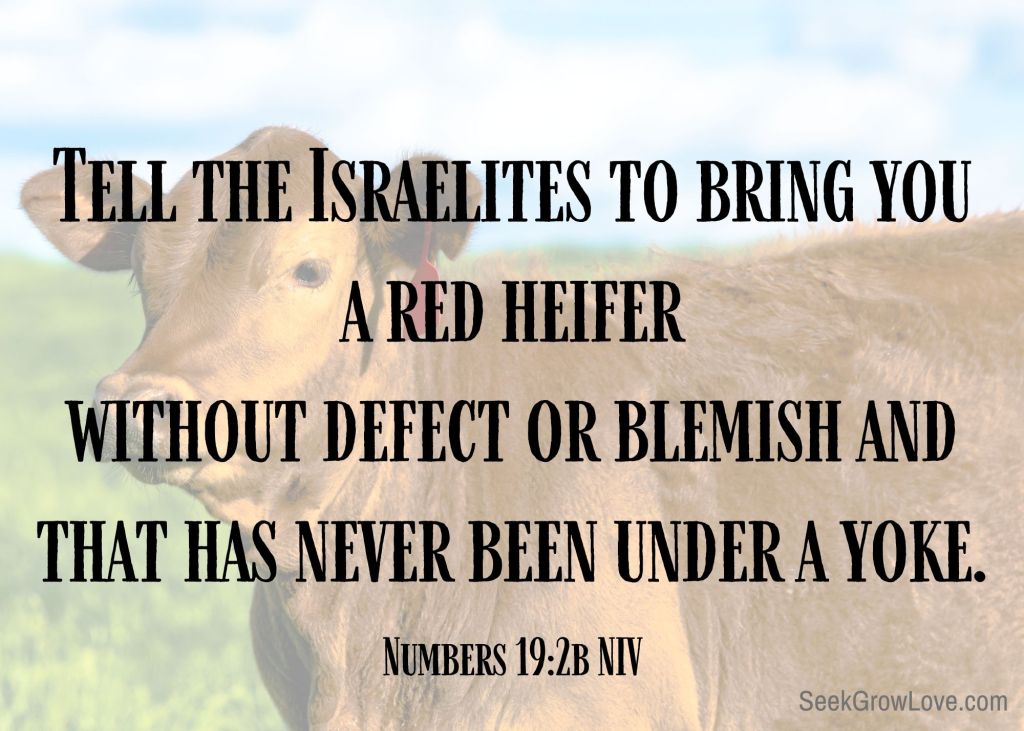
Numbers 18-19 continue laying out God’s specifics for his tabernacle with things like priestly duties, purification procedures, and one topic covered in detail in Chapter 19 is the sacrifice of the red heifer. This sacrifice is unique from others, and worth taking the time to look at a bit. The sacrifice of the red heifer was different than other animal sacrifices laid out in the law of Moses.

For one, this was a female animal instead of male. Also, this one was to be slaughtered outside the camp, burned in all of its flesh and blood (and dung!) with a few specific additions to the fire including cedar, hyssop, and scarlet wool. (Interestingly, I realized that I now have some hyssop popping up that I planted last year, and I added cedar shavings to the garden this past week. But, no scarlet wool and no red heifers around here!).  It seems this sacrifice was extremely specific and unique, and definitely similar to some things we see in Jesus’s sacrifice for us. If you want to read more about the symbolism and foreshadowing from the red heifer to Jesus, it is certainly out there. And, without looking too hard, we can definitely see connections including Jesus being killed in all of his flesh/blood outside of the temple, being perfectly flawless, being offered hyssop on the cross, being a sacrifice for our sins the way the red heifer was for the Israelites, etc., etc.

Evidencing that Old Testament stories are still relevant for us today, according to the Temple Institute, five blemish-free red heifers from Texas arrived in Israel in September 2022. Some view this acquisition as a step forward to the functioning of the new temple and related to Bible prophecy. No matter what, it is interesting to see how this reading from Numbers is still related to current events, and humbling to think what Jesus was willing to sacrifice for all of us.

“My little children, I am writing these things to you so that you may not sin. And if anyone sins, we have an Advocate with the Father, Jesus Christ the righteous;  and he himself is the propitiation for our sins; and not for ours only, but also for those of the whole world.” (I John 2:1-2, NASB)

-Jennifer Hall

Reflection Questions

  1. How was Jesus’ sacrifice different from the red heifer sacrifice – and different from all the other Old Testament sacrifices? What do all these sacrifices have in common?
  2. What can we learn about God through our Bible reading today?