On any given day in Israel, the sounding of an alert can send an entire city scrambling toward a miklat—a bomb shelter—seeking safety from the enemy’s incoming attack. While this would not be commonplace for most of us, this is just another routine feature of Israeli life, a reality woven into the mandated architecture of homes, hospitals, and schools. These shelters stand as silent witnesses to the real persistent threat, offering all within its walls refuge from the destruction.
We can find the use of this word in Ancient Israel too, describing again, protection from harm, although the enemies are more likely to be within the same walls. In Numbers 35:6–15, God commands the establishment of six cities of refuge, places where those guilty of involuntary manslaughter could flee for safety. These cities were not loopholes for the guilty, but lifelines for the vulnerable—spaces of mercy in the midst of justice. Without them, the accused would face certain death at the hands of an avenger. With them, they were given time, protection, and the hope of appeal and even restoration. God used the physical space to deliver a message of hope for his people.
That truth echoes in Psalm 23:4–6, where the psalmist walks through “the valley of the shadow of death” yet fears no evil. Why? Because refuge is no longer merely a place; it is a presence. “For you are with me.” In seasons of fear, sorrow, or struggle, our instinct is often to run—to escape, to deny, or to despair. Yet the Shepherd leads us differently. He guides us to green pastures and still waters (Psalm 23:2), even though it may look more like scorched earth than scenic mountain hike. A family singing hymns in the dim light of a bunker, the shared hope in a friend’s embrace as we grieve, a desperate flight from addiction that leads you back to the Word of God, all can be reminders of a present, working God.
In the same manner, we find this constant companionship in Jesus Christ. As the fulfillment of the Law, He becomes our ultimate miklat, both the bearer and redeemer of our sin. In Mark 8:1–9, Jesus feeds the four thousand, revealing Himself as the true Bread who satisfies not only physical hunger but a far greater spiritual need. Just as those awaiting the Gospel message outside of the boat, we neither have the strength to stand judgment nor the ability to walk to the next town over. Our miklat is built in the foundation of salvation’s careful plan, so let us be constantly reminded we can run to His refuge at any moment.
Reflection Questions
When and where have you experienced God’s refuge?
What might God’s refuge look like in a current situation you face?
How can you be a part of offering God’s refuge to someone who feels like they are in a dark valley?
Prayer
Dear Heavenly Father, giver of all life and true refuge, thank you for providing refuge and giving the gift of Your Son and salvation. Help me see and feel that You are near. Even when my situation doesn’t change, Your presence calms and shelters me. Show me where and how I can share You, Your strength, Your guidance, and Your peace with others. In Jesus’ name I pray.
We’ve all heard the saying, “it’s the thought that counts.” Intentions matter. That’s what Jesus is getting at in today’s scripture reading in Mark 7.
Jesus tells the Pharisees actions without heart mean nothing. He quotes Isaiah 29:11 saying, “These people honor me with their lips, but their hearts are far from me” (NLT). It got me thinking about how easy it can be to practice routine spiritual disciplines without our hearts being fully present. The spiritual disciplines I’m referring to include tithing, regular church attendance, praying before meals, communion, prayer, worship, and reading of scripture. These are the things that easily become mundane for the longtime practicing Christian. It’s important to find ways to mix things up once in a while. We can easily get stuck hamster wheeling through the motions without taking the time to really consider what it is we’re doing. Taking a break from your normal routine can reignite your passion. When we feel like we’re going on autopilot, switching things up, practicing our spiritual disciplines in different ways, helps us refocus on the task and approach it with a renewed attitude.
I understand not everyone’s mind works like this, so I’ve created a list of suggestions. This week I encourage you to choose one discipline to switch up. See if the task means more to you. If you get more out of the experience. Or, perhaps you’ll learn just how much you enjoyed doing it your way, which will hopefully renew your heartfelt intentions. The goal of this challenge is to bring yourself back to the heart of why we do what we do, by pausing and re-evaluating your intentions.
Tithing
Write your check at a different time than normal. If you’re always doing your check right before the plate is passed, try preparing it at home first. If you always come with your check prepared, try writing it during the worship service. I personally really enjoy tithing during services. To me, there’s something intimate about listening to the worship music, getting on my phone and checking my pay stubs, doing quick math on the back of a bulletin, then placing my check in the offering box.
Include your children in tithing. This may be by encouraging them to put their own money in the plate, or giving them something to put in the offering. I still remember the feeling of importance I got as a little girl whenever I dumped my change into the offering. It felt good to give to God and made me feel part of something bigger than myself, even if all I contributed were pennies.
Church Attendance
Go to service at a different time if your church offers multiple services.
Sit somewhere else during the service.
Praying Before Meals
If you typically pray silently, pray aloud.
If your family is the fold hands type – try holding hands to pray.
Put your hands in a different position.
Start your prayer off with thanking Him for one specific blessing you experienced since your last meal.
Have your family take turns saying the prayer.
Communion
If you know it’s communion Sunday, sit somewhere else during the service so you are taking communion in a new environment.
Prayer
Pray aloud.
Pray at a different time in the day.
Put your hands in a different position.
Start a prayer journal. Or just simply write down your prayers.
Create a prayer chart with a white board.
Pray when you are bored or waiting. This is how we learn to pray without ceasing and be in constant conversation with God.
Take yourself to a quiet place and pray on your knees.
End your prayer time with a worship song.
Pray with your children.
Pray with your spouse.
Pray in public. Without being the annoying guy in Luke 18:9-14. For example, you could end your coffee date with your friend by praying for her right there in the shop, quietly in the corner taking a private moment together.
Worship
If your church is a standing and singing church, sit down during a song, bowing your head in prayer.
Don’t sing. Listen to the words.
Do sing! Even if you are no good and you think no one wants to hear your voice – God does.
Do a mini worship session in the car on the way to work. Turn on the local Christian radio, or play some of your favorite worship music.
Take a Sunday off from leading worship if you’re part of the worship team. Sometimes it can be nice to simply be a part of the service instead of leading it. This also may give the opportunity for others in your church to step up and serve.
Reading of Scripture
Sit someplace else in your house for your quiet time.
Take a break from what you are currently reading. It’s okay to flip to a different part of the Bible, or a different devotional book. Doing it just for the sake of doing it and saying you completed something is exactly what Jesus was accusing the Pharisees of doing.
Questions:
Which challenge are you going to choose?
Give yourself a heart check. Are there areas of your faith that have become mundane?
Prayer –
based on the lyrics “The Motions” by Mathew West
Dear God,
I don’t want to go through the motions. I don’t want to go one more day without your all consuming passion inside of me. Let your love make me whole.
Mark 6:45-52 Immediately after this, Jesus insisted that his disciples get back into the boat and head across the lake to Bethsaida, while he sent the people home. 46 After telling everyone good-bye, he went up into the hills by himself to pray. 47 Late that night, the disciples were in their boat in the middle of the lake, and Jesus was alone on land. 48 He saw that they were in serious trouble, rowing hard and struggling against the wind and waves. About three o’clock in the morning Jesus came toward them, walking on the water. He intended to go past them, 49 but when they saw him walking on the water, they cried out in terror, thinking he was a ghost. 50 They were all terrified when they saw him. But Jesus spoke to them at once. “Don’t be afraid,” he said. “Take courage! I am here!” 51 Then he climbed into the boat, and the wind stopped. They were totally amazed, 52 for they still didn’t understand the significance of the miracle of the loaves. Their hearts were too hard to take it in.
Mark! What’s the deal with saying our hearts were too hard??? Why would God have you write that in your gospel??
The official line about the gospel of Mark is that Peter and other original apostles are the source of the material he writes from. They tell him what happened and then he writes it down. We need to ask ourselves so many times when reading these records about what was Jesus trying to teach his apostles and disciples? Then what is the lesson for us in the recalling of them?
The trip on the sea of Galilee that includes another walk on the water by Jesus comes after feeding 5000 men plus women and children (maybe 15-20K people). He uses such the small amount of food to start with. So many questions come to my feeble mind. How did Jesus ever break up that much bread or fish? How did God multiply the food to fill baskets full? Where did the baskets come from? Who ate the leftovers and for how long? So many questions on these records.
What was the apostle’s reactions to helping to break and hand out the food to that many people? Jesus says “you feed them” to the apostles. Which is exactly what they proceed to do. What should they and we learn from the experience besides astonishment at the event?
I believe that the lesson for us and those disciples there is that God is the source of all blessing and sufficiency. God alone is the giver of all that is good and fruitful, the only source of true food and health for all the people of the world. Our very food we eat is only because of the grace and mercy of God to give it to us. Jesus looks to God and then blesses this small amount of food, making it sufficient to do the humanly impossible. What great power of God is at work in Jesus’ life and is still available to us today.
Christians must bring their lives to God in an attitude of obedience and sacrifice. When we do this, we need to expect God to do far beyond what can be imagined. We should trust that God not only wants to meet our needs, but that He wants to give to us with overflowing spiritual blessings.
Are our hearts too hard to believe our God’s promises? “Hardened” here is to be “petrified” or maybe should mean “calloused”. Our habits of life that don’t believe the promises of God cause our hearts by repetition to become calloused to the truth. We develop a lifetime set of beliefs that doesn’t believe that God can do anything very miraculous. We start to believe miracles and all that Jesus stuff died out with the apostles and isn’t that important today.
We say we have faith but prove that we don’t by our actions and speech. “You feed them” is what Jesus tells us to do, but we say, “OK we will, but here’s our few loaves and fishes. Don’t blame me when it really doesn’t work out. I’ll do it but I don’t really believe that it will work with my resources.” When we pray for someone to be delivered or healed are we really standing in our confidence of God’s help or do we just go through the motions?
I know that one of my lazy habits is to excuse my prayers by telling God that I will pray for people, but because I really don’t know what to pray for, I will just put them up before God and then go on with my life. Ever been confronted with a specific situation that is right there in front of you with no apparent answers to it? How did you react? Our first habit needs to become the truth of God’s Word for us, not the calloused habit of our hearts to give Him our excuses.
So, I thought we were going to look at the walking on the water event. More questions come to mind. Why does Jesus send them off across the lake without him and just go pray by himself? What happens that changes their hearts so much from this experience of the waves and wind? Here they are again in a situation that faces them head on and close in. No amount of rowing or sail handling will get them out of it. Remember that they were experienced fisherman with a great deal of boat handling and weather experience. “Jesus don’t worry about us we have it handled, have some confidence we are the experts”. But once again we and they don’t really have it. For the apostles it is that if God can feed the five thousand then He does have the answers for every situation.
What is the lesson of the waves? Once again that God has our care in place, and we need to put our trust in His promises. Jesus says he will ever be with us to the end of the earth. This is his church and he is building it and taking care of it. We are not really in charge of what we think we are. We are confident every minute until the wind and waves are overwhelming. How many times God saves us from disaster and even death.
Ephesians 3:20(NLT) Now all glory to God, who is able, through his mighty power at work within us, to accomplish infinitely more than we might ask or think.
Psalms 22:22-24(NLT) I will proclaim your name to my brothers and sisters. I will praise you among your assembled people. 23 Praise the LORD, all you who fear him! Honor him, all you descendants of Jacob! Show him reverence, all you descendants of Israel! 24 For he has not ignored or belittled the suffering of the needy. He has not turned his back on them, but has listened to their cries for help.
Questions:
See bold questions above
Prayer:
Father God, come to us with your promises and give us the heart that hears them and will believe You. Thank you for the records of Your Word to give us confidence to do Your will. Help us to see the Christ-in -us that will give us strength to act and speak. Thank you that Your will is still to feed and save people from destruction. Be with us this day as we hear you with our hearts. In Jesus’ name we pray.
The streets were hot and crowded as the people jostled for space. In the midst of the dust and sweat, a woman with a trembling hand reached out and touched the rough-hewn cloak of the man walking and talking in front of her.
She knew that this was a life-or-death situation. She knew she just had to reach him. If she could only touch him, the horror of the last decade would at last be finished. She shuddered. Years of being alone. Years of throwing her money at doctors for a cure. Years of being barred from the temple.
With a look to the side and the left, she leaped at her chance and grabbed the hem of his cloak. Just then, the man turned and said, “Who touched me?”
Fear settled in the pit of her stomach. Everyone looked around with a questioning glance. What was he talking about? But the woman knew – it was her. She spoke up, stammering, expecting a rebuke, “It was I, my Lord.”
Instead of speaking harshly to her, he gently turned to her and said, “Go. Your faith has made you well.”
Today, we read of this woman’s story and her miraculous faith in Jesus. We also read about Balaam’s curses (or lack thereof). Each of these stories shows the truth of Psalm 21:6-8:
“Now I know that the Lord saves his anointed;
he will answer him from his holy heaven
with the saving might of his right hand.
Some trust in chariots and some in horses,
but we trust in the name of the Lord our God.
They collapse and fall,
but we rise and stand upright.”
Balak had chosen to trust in the curses of Balaam. He wanted Balaam to bring about the destruction of the Israelites, but he was thwarted because the people who trust in the name of God will rise and stand upright. Balaam was not even able to curse the Israelites because God as with them. The curses instead fell on Balak.
The woman chose to trust in God through Jesus, and she was able to rise and stand upright, healed and made clean through Christ. Doctors, money, and status could not save her, but God did.
We are constantly blown and tossed by the storms of life. When we go through suffering, when we go through pain, we have to turn and fix our eyes on the Lord. Others may collapse and fall, but if we trust in him, we will rise and stand upright.
Reflection Questions
What have you found yourself trusting in lately?
What are the chariots and horses of today? Why is it so much easier to trust in ‘chariots and horses’?
Is there a situation in your life where you need to trust God more?
Prayer
Dear Lord,
Thank you for the care that you give each one of your servants. Thank you for not neglecting us in our sorrow and need, but instead, providing for us in every way. Help us to trust in you more.
The Israelites are approaching the end of their 40th year wandering in the desert. The older generation had passed away, and the new generation was rising up and being prepared to enter the Promised Land.
At the end of Numbers 21, Edom had refused passage to the Israelites, so the people were forced to take the longer way back around the Red Sea. In the quintessential Israelite fashion, they began to complain about Moses’s leadership and the ‘worthless food’ they were eating. So, God sent ‘fiery serpents’ to attack the people.
Why fiery serpents? The word ‘fiery’ here is seraph. This could mean a venomous snake – whose bite would sting. But the word seraph is interesting. Fire throughout the Old Testament is often used to describe God’s judgment and holiness. By sending a fiery snake, God was inciting judgment on the Israelites for their complaints.
Why fiery serpents? Ever since the Garden of Eden, serpents are synonymous with evil. Why would God send those to the people? David Christensen writes, “The serpents point to “Egyptian symbolism.”” The people had desired Egypt and its God, so God effectively sent them these things. But, of course, the effect of this is the opposite of what the people wanted. When the people get what they desire, it results in death.
This is true for us as well. Sometimes, we desire what we should not. We complain. We get bitter. We think, if only I could have that instead of the worthless things around me. But when we get that desire, it results in death. James 1:14-15 describes it like this: “But each person is tempted when they are dragged away by their own evil desire and enticed. Then, after desire has conceived, it gives birth to sin; and sin, when it is full-grown, gives birth to death.”
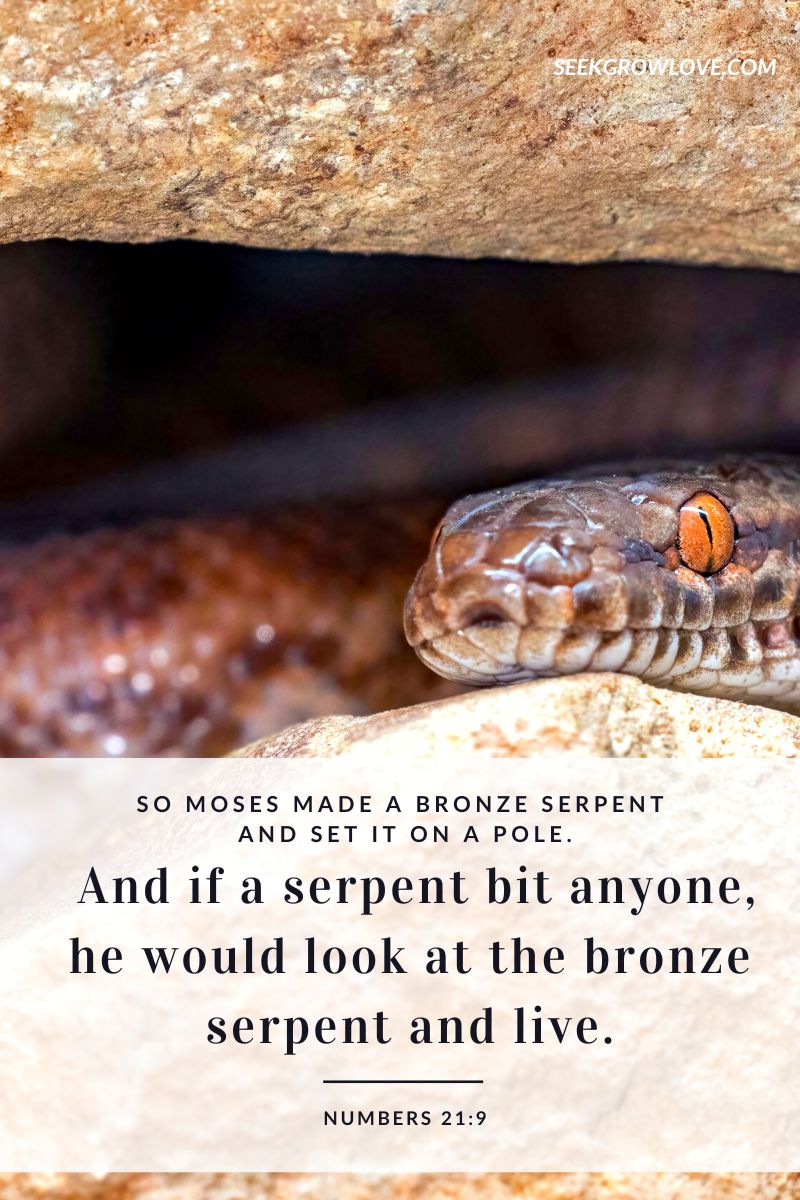
Thankfully, our salvation mirrors the salvation found in this passage. Moses was told to put a bronze serpent on a stick, to lift it up, and anyone who looked at it would be healed. John 3:14-15 says, “Just as Moses lifted up the snake in the wilderness, so the Son of Man must be lifted up, that everyone who believes may have eternal life in him.”
Left to our own desires and devices, we will follow a path that ends in death, but when we look to Christ as our sacrifice, savior, and King, we will find the path to eternal life. Where are you looking today?
Reflection Questions
Why do you think the Israelites wanted to go back to Egypt despite all they had seen?
Why do you think God sent the fiery serpents as a punishment?
How do you see yourself in the story of the Israelites?
Prayer
Dear Lord,
Thank you for the sacrifice of your Son, whom we can look to for eternal life. Help us to follow after you in obedience and reverence. Let us not turn away to our own desires. Help us to flee from them and run towards you.
I love Jesus. I don’t just mean that in the way I have dedicated my life to him etc etc, but also in the same way you might discuss your favorite characters on TV. I love the way Jesus acts. I love his role in God’s great plan. He’s compassionate, level-headed, and kind of snarky. He’s real, he tells it like it is. I like that in my story characters, in my friends, and in my Savior.
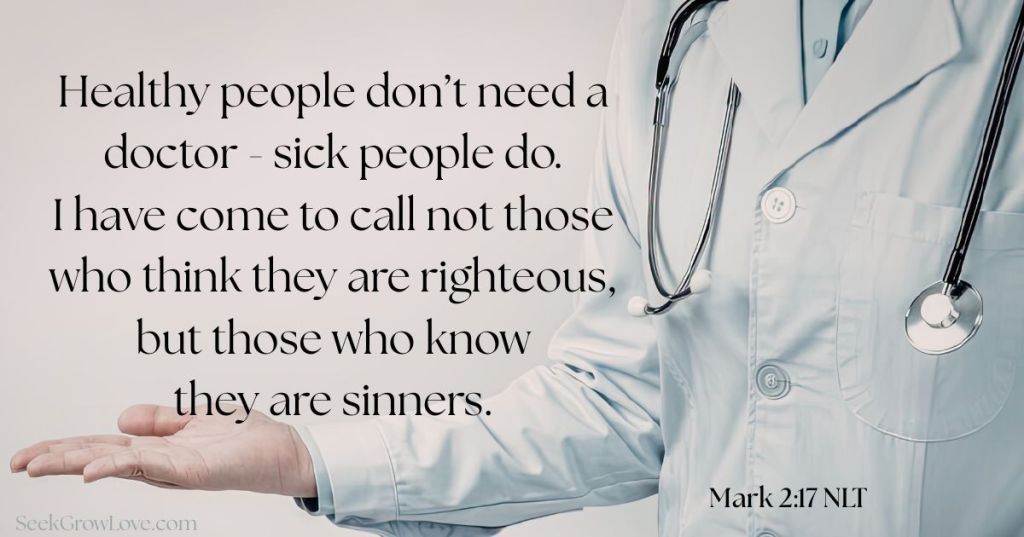
We get a real juxtaposition in our scripture, today. In Numbers 13 and 14 we see an angry God, fed up with his people’s unfaithfulness, ready to strike. Then we get this moment from Mark 2, where Jesus is eating with sinners and says “Healthy people don’t need a doctor – sick people do. I have come to call not those who think they are righteous, but those who know they are sinners.” (verse 17 NLT). It is this same God who rebuked the Israelites, punishing an unfaithful generation never to enter the promised land, that sent this Jesus in Mark 2.
I have always had a fascination with the continuity of the Bible. I like for things to make sense. I have humbly come to the realization there are simply some things about God we will never be able to comprehend or understand. Yet, I think Mark 2:18-28 helps clarify this juxtaposition between Jesus, the Law and the angry God we see in Numbers. They aren’t meant to contradict one another. Jesus says so himself in Matthew 5:17: “I did not come to abolish the law of Moses or the writings of prophets. No, I came to accomplish their purpose.” (NLT). Traditionally, the purpose of Mosaic law was to set apart God’s people from other nations, protection (we see this in many of the food and clean/unclean laws), and ultimately to show that sin needs a solution. Therefore, if the purpose of the law is to show there is a sin problem and Jesus is the accomplishment of said purpose, he must be the sin solution. This idea is supported in Mark 2 as Jesus essentially tells the Pharisees certain aspects of the law are no longer relevant as he has come to dwell amongst the people (v 18-20). In fact, now that he has come, there are new laws that should be put into practice. We can read a lot of these teachings from Christ’s sermon on the mount found in Matthew 5 – 7.
In Mark 2:22, Jesus says, “And no one puts new wine into old wineskins. For the wine would burst the wineskins, and the wine and skins would both be lost. New wine calls for new wineskins.” (NLT). Basically, Jesus is saying the old ways of doing things aren’t going to work anymore. It doesn’t mean the old ways were bad, just as the old wineskins themselves once had value. However, they are no longer needed. The Mosaic law served its purpose during its time. Jesus is here now. His teachings call for new wineskins.
He drives this point home in the final verses of this chapter. When criticized about how his disciples were spending the Sabbath day he exclaims, “The Sabbath was made to meet the needs of people, and not people meet the requirements of the Sabbath. So the Son of Man is Lord, even over the Sabbath!” (v. 27 & 28). I believe this is an example of a synecdoche, a figure of speech where the part of something is used to refer to the whole thing. In this case, the Sabbath is representative of the law. Substitute the word Sabbath with law and this becomes quite the powerful statement.
In Jesus we see how God can be “slow to anger, and filled with unfailing love, forgiving every kind of sin and rebellion. But does not excuse the guilty” (Numbers 14:18). Jesus is the answer. He is the fulfillment of Old Testament prophecies and law. It is beautiful and poetic. Best of all, it is real.
Reflection Questions
What do you love about Jesus? What do you love about God?
How would you describe the role Jesus plays in God’s great plan?
Are you more often the one who thinks they are righteous or the one who knows they are a sinner?
Do you believe Jesus is the answer? If so, how can you share the Jesus answer with others?
Prayer
Dear God, we praise You for being a God of perfect character and we thank You for Your Son Jesus. You created him with so much for us to love about him. Help us see You and Your Son clearly and Your plan of salvation that You have been working on through the ages. We know so much has been fulfilled already, and more is yet to come. Help us love You and follow Jesus well so we are ready to be his bride.
Now ask yourself, do you believe that Jesus Christ has been raised from the dead (verse 6), and that all authority in heaven and on earth has been given to him (verse 18)? “Given” implies receiving authority — not possessing it inherently. This authority is the result of the Father’s exaltation of the Son after his obedience and resurrection (Philippians 2:9–11). God is the source of all authority; Jesus exercises that authority on God’s behalf.
Let’s continue. He will be with his disciples to the end of the age (verse 20)?
If this is true, then nothing is more important in our lives, nothing is more crucial or more urgent or more necessary than believing it and becoming a follower of Jesus. I know it’s a big if, if this is true, if this is real (you may believe it or not). If the premise is true, wouldn’t you agree with the conclusion? That nothing is more important for everyone in the world than to believe in him and be his follower.
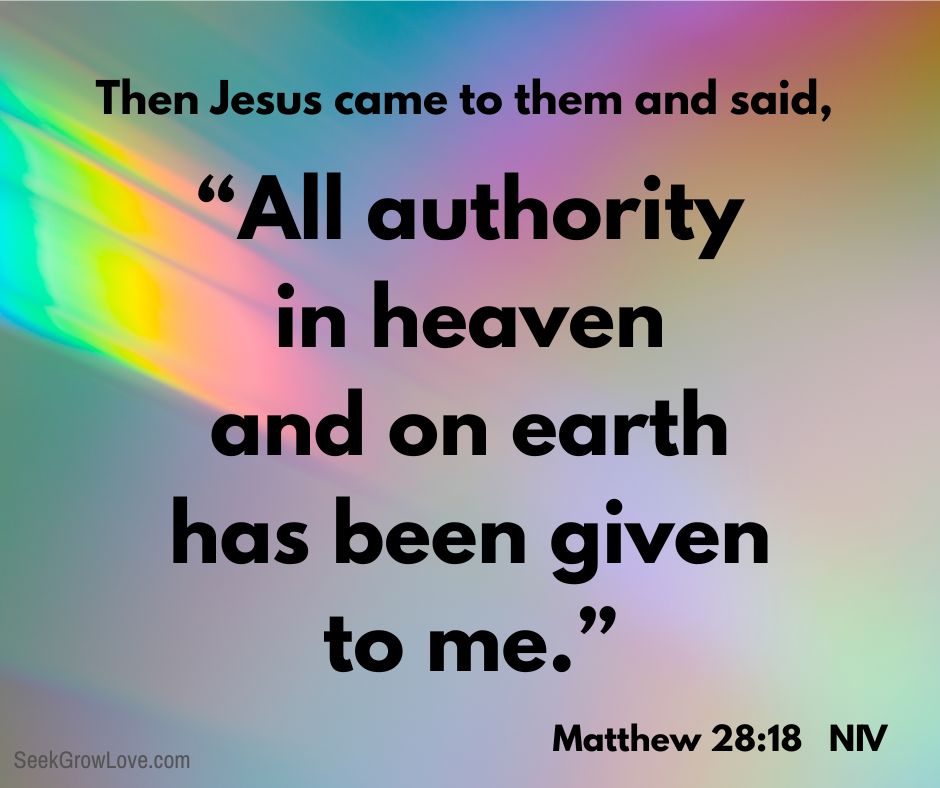
Just think of it. Jesus says in verse 18, “All authority has been given to me in heaven and on earth.” If this is true, then today Jesus Christ is the Lord of the universe. Now it’s important to remember, God’s authority is absolute, eternal, and derived from no one. Jesus’ authority is delegated from the Father to accomplish redemption and judgment (John 5:19–30, Matthew 28:18). But his authority is absolute!
He has authority over politics and government; he has authority over all armies and military, even over the wars that are taking place today.
He has authority over all industry and business (NASDAQ and Dow Jones); farms, and chat GPT, even the industry you work in.
He has authority over science and education — all research and discovery and universities and colleges;
He has authority over all entertainment and media — radio, TV, Internet, social media, theater, art;
He has authority over all sports and activities — over your favorite team and every playoff game;
He has authority over all natural phenomena — all weather and floods and volcanoes and earthquakes and tornadoes and hurricanes and any other storm of life;
He has authority over all planets and moons and stars and light and energy and motion and time;
and therefore he has authority over our lives — health and disease and success and failure and life and death.
I don’t know where you are this morning. You may or may not believe the testimony of Jesus and his disciples. But I hope you see at least that if — if — it is true that Jesus rose from the dead as the Lord of the universe with all authority in heaven and on earth, then believing it and following Jesus as our Lord is the most important, most urgent, most crucial thing in our lives.
Reflection Questions
What do you imagine Jesus was thinking and feeling as he was speaking to the disciples on the mountain in Matthew 28? What do you imagine the eleven disciples were thinking and feeling?
What have you heard about Jesus? What does this passage teach you about Jesus? And about God?
What do you believe about Jesus? Does your life show what you believe? Is there anything that needs to be adjusted to better believe and reflect those beliefs in your daily decisions?
Prayer
Dear God and Giver of all authority, we praise You. And if we truly knew and recognized all there is to know about You, we would praise You even more. We thank You for revealing Yourself in Your Word. Help me to seek You more and more. Thank You for Your amazing son Jesus who is indeed worthy of all the authority You have given to him. I want to follow him well. Show me, Lord, where I need to change my beliefs and behaviors and priorities to better follow Jesus and be Your child now and in that beautiful age to come.
First of all, let me say CONGRATULATIONS on finishing what many consider to be the hardest book in the Bible to get through due to its “repetitive rules and low relatability.” One online reader even called it, “Where Bible reading plans go to die.” (guilty!)
And I’m not going to lie. I feel like reading chapter 27 is basically reading a page out of a law book at the law offices of Dewey, Cheatum, & Howe.
The first part is a little confusing… why are they paying money for people?? They weren’t. Basically, people could dedicate themselves, their children, animals, or properties to the Lord at anytime, but if they need any of the above back, they could buy them back at the values the Lord set in this chapter. (Certainly, this was a lot clearer to the people of the time than it is to me!) The rest of the chapter is similar information that does seem repetitive and irrelevant.
So I’m sure you’re thinking, “Well, Miss Negative Nellie, why did I just bother reading this whole book?!”
We are told our whole Christian lives how Christ died to set us free from the law ( Acts 13:38-39, Romans 6:14, 7:6, 8:2, Galatians 3:25, 5:1). But do we stop and think how deep and broad the Mosaic Law was? Not easy stuff to get through, let alone emulate with your life. Reading Leviticus brings us, not only to the reality that living by works alone is nearly impossible, but also to how truly, throughly, and deeply holy is our God. I hope that reading Leviticus has done this for you.
The poetry of Psalm 14 and the prose of Matthew 27 are easier to understand if not exactly pleasant to read. Can you imagine reading the Resurrection story for the first time and stopping at the end of 27?! What a sad cliffhanger! But like reading Leviticus, you can’t understand the point of the really good stuff until understanding the tragic background. Without understanding the NEED for a savior, from the stringent laws that a Holy God commands, to the awful details of Judas’s betrayal, we will miss the complete picture of Jesus’s sacrifice for us.
So, GREAT JOB with your reading! You’ve got this! Let’s Go!! Even through the rough parts, time spent in scripture is never wasted!
Reflection Questions:
What does it mean to have a holy God?
What was the purpose of Leviticus? What is the purpose of Matthew 27?
What is the hardest part of reading Matthew 27?
Prayer:
Dear Holy God, thank you for not giving up on us – Your creation that turned our backs on You and repeatedly broke Your law. Help us see our sin for what it is and the distance that it puts between us and You. Thank You for Matthew 27. Help us see the depth of Your great love for us and the loving obedience of Your precious Son. Help me have the mind of Christ which says and lives “Not my will, but Yours be done” – even when it hurts and is so hard. Help me see what You will and follow well, like Your Son who gave his life as the perfect sacrifice so I can pray to You today and be heard as Your child.
I hold it that a little rebellion now and then is a good thing, and as necessary in the political world as storms in the physical. -Thomas Jefferson
Jefferson wrote those words to James Madison in 1787 after a group of farmers physically fought their local government to protest high taxes. His argument was that rebellion is what keeps government accountable to the people it serves.
He may have had a point and many people have used this quote to justify many acts of rebellion. However, there is one area of our lives where rebellion leads to destruction.
In all three of our readings today, people participate in vile rebellion against God.
In Leviticus, God decrees what happens when actions meet consequences.
Praise God, follow His decrees, you will be richly blessed. Deny God, either by evil acts or general apathy, you will be cursed. It seems so odd that at time God spoke directly to His people, their society was set up to follow the decrees (at least physically) and the consequences immediate, that so many people so often turned from God.
But even centuries later, people were still rebelling in Psalm 14, denying His very existence. They were so rebellious, not only did they want to sin, they wanted to take down everyone with them. Hmmmm
In Matthew 27, we see the greatest rebellion of mankind. The denial of God (or at least His rule) and consequently His son, leads to the torture and death of our savior, Jesus.
Obviously, we know the outcome of that… but what has the outcome of that meant for you?
I wish I would have written it down.. but I saw a great quote that said something like, “ Don’t continue with the sin Jesus died to save you from.” When we sin, we are in rebellion against the God of the Universe. The One who made all and yet cares about the hairs on your head.
While Jefferson was talking about imperfect people rebelling against imperfect people to maintain justice, there is no need to rebel against the perfect One who cares for our every need. Allow the Lord to be your refuge in this world of rebellion.
Reflection Questions
What do we learn about God in our readings today?
Where have you seen rebellion against God today?
How have you personally rebelled against God? Why? Have you experienced consequences from that rebellion? What would you tell others about your experience?
Prayer
Dear God – We praise You and thank You for being a just and true God of love and mercy who gave Your own Son for sinful, rebellious mankind, which includes me. I confess my times of rebellion. Help me see my own sins and rebellion and foolishness and turn from it. I seek You, Lord, and Your Way. Help me discern what is rebellion against You in the world today, and what leads to destruction. Help me speak for You, giving wisdom and warning from a heart of love for You and Your creation. Thank you for Your promises for those who follow You. May I be ready for Your Son’s return.




 Seek Grow Love