“Now there was…”

OLD TESTAMENT: Esther 1-2

POETRY: Psalm 140

NEW TESTAMENT: John 13:1-17

Esther 2:5 – “Now there was in the citadel of Susa a Jew of the tribe of Benjamin, named Mordecai son of Jair, the son of Shimei, the son of Kish,”

The book of Esther opens up with introducing the reader to the reign of King Xerxes of Persia. His kingdom was vast and wide. His wealth was beyond measure. His wife, Queen Vashti, was one of the most beautiful women in all of the land. He seemed to have it all. Except King Xerxes didn’t have it all. He hadn’t yet conquered Greece. And his wife, well, she wasn’t keen on being paraded around objectified by men in drunken states. And for this, she was punished, dethroned, and for all intents and purposes, exiled. Now, King Xerxes didn’t have a queen.

Chapter two of Esther opens up with the phrase, “Now there was…” introducing us to a new set of characters in the story, Mordecai and Esther, who are the individuals that we should really turn our attention to. These two new characters are Hebrew exiles living in Persia under the reign of King Xerxes. And as we read through the book of Esther, we see that their presence in this kingdom is vital to the survival of Xerxes, but more significantly, the Hebrew population in Persia.

This phrase “Now there was…” has gotten me thinking about the other times it is used in Scripture. Within the NIV translation, it is used eight additional times. (Gen 12:10; 26:1; Nu 20:2; 2 Sam 9:2; 1 Kings 13:11; Luke 2:25; 23:50; and John 3:1) It’s an author’s way of transitioning to something new, maybe even something unexpected. 

As we find ourselves in the middle of Advent season, I’m going to take my devotional-writer prerogative and divert slightly and transition to another, but related, idea. (We’ll come back to Esther tomorrow, I promise.)

I am thinking of key people in the narrative of Jesus’ birth that also deserve a “Now there was” introduction.

Now there was…Mary, the betrothed of Joseph, chosen by God to be the mother of the long awaited Messiah.

Now there was…Joseph, the man selected to raise the Messiah as his own.

Now there was…Gabriel, the angel who was sent to share the news of parenthood with Mary and Joseph.

Now there were…the shepherds who witnessed a great company of the heavenly hosts praising God upon the birth of Jesus.

Now there were…the Wise Men who traveled from afar to present gifts of frankincense, gold, and myrrh to the new born child. 

All of these people had a role in introducing Jesus to the world, just as he was born. There are many prophets who foretold Jesus in the Old Testament. There are many apostles and disciples who continued to tell the world about Jesus through the Gospels and Epistles of the New Testament. 

Who is telling the world today about Jesus?

Now there was…YOU.

We each have the privilege and responsibility to continue to share the Gospel message to those who do not know it yet. 

As we celebrate the birth of Jesus with family and friends, let us not forget that there might be someone we know who needs to be introduced to the Lord and Savior of the world. They need to hear the message that they are loved, that they can be healed, that there is hope beyond what they experience today. YOU can be the difference for someone else today and give them the greatest gift of all, the Gospel message. 

May God bless you and keep you as you go about your day.

-Bethany Ligon

Reflection Questions

  1. In the first two chapters of Esther what have we learned so far about the main characters: the King of Persia, Mordecai, and Esther? How would you describe each one?
  2. Choose a character from the events of the birth of Jesus. How would you describe him/her?
  3. How would you like to introduce someone to Jesus? Pray about the opportunity, the words, the hearts (yours and theirs) that can make the difference.
The Day We Have All Been Waiting For

Old Testament: Zechariah 5 & 6

Poetry: Psalm 144

New Testament: Luke 2

“For unto you is born this day in the city of David a Savior, who is Christ the Lord.”

            It’s Christmas Day!  The day we have all been waiting for.  Unless you’re really, really good, you likely will have already gotten up, peeked in your stocking and maybe opened gifts with your family.  You may have even eaten a large meal.  Maybe now you’re taking a few minutes to check your email and give some attention to your devotions for the day.  Whether you’re reading this at 8 a.m. or 8 p.m., it’s still Christmas Day.  A day you’ve been waiting for.  Christmas comes every year so at most, you’ve had to wait 364 days for Christmas. 

            The people of Israel had to wait hundreds of years for the first Christmas.  From the time King David was first promised that his son would be the Messiah and would reign forever, it had been many generations.  Now that day had finally come.  Normally, when a royal birth happens, especially a future King, it’s a pretty big deal.  There are grand proclamations that come from out of important palaces in important cities.  The whole community might stand outside the walls of the royal palace to hear the great news officially announced.  But this first Christmas announcement was quite different.  It wasn’t in the city of Jerusalem outside the palace walls, it was in the fields of rural Bethlehem.  The audience wasn’t the whole city gathered, it was a few sleepy shepherds in the middle of the night making sure their sheep were safe from predators.  The one making the announcement wasn’t the royal page or member of the court of Jerusalem, it was an angelic messenger of God.

            News of the Messiah’s birth went largely unnoticed for many years.  It would take several announcements from God “a voice from heaven saying, this is my beloved son, with whom I am well pleased.”  Eventually, his few disciples understood that he was the Messiah.  What finally sold many people was his death and resurrection.  The Bible says that one day “every knee shall bow and every tongue confess that Jesus is Lord” (Messiah/king).  On this Christmas Day, let us be sure that we not only hear and believe the Good News that at long last the promised Messiah was born in a manger in Bethlehem over 2000 years ago, but that he died for our sins and God raised him up from death and clothed him in immortality, he has ascended to the side of God and will come again to reign over all.  One day every knee will bow, but for today, be sure that you are bowing and giving your allegiance to King Jesus, and be sure to share this news with everyone you know. 

Merry Christmas!

-Jeff Fletcher

Reflection Questions

  1. How was God’s plan for a Messiah different from what many people expected? What do you love about how God brought about His plan for a Messiah? What does His plan reveal about Him? 
  2. Does your holiday festivities show that you are celebrating that Jesus is Lord? How are you bowing before him and confessing that he is Lord – yesterday, today and tomorrow?
  3. How can you share the good news of great joy? Who needs to hear it?

The Birth of the Messiah

Matthew 1 and Luke 2:1-38

The coming of the Messiah is one of the greatest desires of pious Jewish people. The desire for the Messiah to come is encapsulated in modern times by a statement of the 12th century Jewish teacher, Moses ben Maimon (Rambam): “I believe in perfect faith in the coming of the Messiah”. By the promise of God, the Messiah would be a descendant of King David.

Two Gospels, Matthew and Luke, record the birth of the Messiah (in Greek translation, “Christ”). As we saw in Luke 1, the birth of Messiah was proceeded by a visit from the angel Gabriel to a Jewish maiden, Mary (Miriam in Hebrew) in the Galilean town of Nazareth. Gabriel announced to Mary that her child would be the one to inherit the throne of David. Like Solomon, he would be called the Son of God. After the child was born, Mary was to name him Jesus, which is in Hebrew, Yeshua or Joshua, which means “Yahweh saves”.

The child was given this name on the day of his circumcision, the eighth day after his birth. The name Jesus is the name of the human being, the “man Christ Jesus”. “Jesus” is never the name of a pre-human divine being.

Matthew begins his Gospel by describing the genealogy, or in Greek the genesis or beginning or origin of Jesus the Messiah. Matthew traces Jesus’s origin especially to David and Abraham.

God had promised to Abraham that he would have many descendants, and that his descendants would inherit the Land of Canaan, that kings would come from him, and that he and his descendant(s) would be a blessing to all peoples on earth. God’s plan of redemption for the world was to come through a physical descendant of Abraham.

Some 800 years after Abraham, and 1000 years before Jesus was born, God chose a descendant of Abraham, David, and established the only perpetual divinely ordained monarchy on earth. God promised that one of David’s descendants would rule forever over God’s ordained monarchy. The genealogy of Jesus as recorded in Matthew’s Gospel declares that Jesus is descendent of Abraham and David in whom God fulfills His promise.

The birth of the Messiah Jesus was accompanied with miraculous signs that were evidence that Jesus is indeed the Messiah of God. Somewhat parallel to the first man Adam, who had no earthly father but whom God formed from the dust, the “second Adam” Jesus was formed by direct divine activity. Angelic beings appeared both before and after Jesus’s birth, to announce the coming of this divinely appointed human king.

Jesus’ mother came to the temple 40 days after Jesus’ birth for purification according to the Law of Moses (Luke 2:22, Lev. 12:2-6). His parents brought the baby Jesus along. There was a righteous man in Jerusalem, Simeon, to whom God revealed that he “would not see death until he had seen the LORD’s Messiah. Simeon took Jesus up in his arms and uttered a blessing and praise. He knew the child Jesus was the fulfillment of God’s promise to both Abraham and David:

“A light for revelation to the Gentiles, and glory for your people Israel” (Luke 2:32).

-Bill Schlegel

Bill Schlegel is the author of the Satellite Bible Atlas and general editor of the One God Report podcast.

Bethlehem in Judah

Today’s Bible passage can be read or listened to at BibleGateway here – Matthew 1 & Luke 2:1-38

Tomorrow we will read the rest of Luke 2 and Matthew 2 as we SeekGrowLove and follow along on our 2020 Chronological Bible Reading Plan. Print your own copy, read along and finish out the year 2020 strong!

Looking For and Following the Star!

Romans 8 24 a

This week, as we look forward to Christmas and celebrating the birth of our Lord and Savior Jesus, we will look at his birth and what that means going forward for us. Just as the wise men looked for and followed the star to find Jesus, we also have a “Star”, Jesus, to look for and to follow.


As Christmas draws near I, like so many others, am filled with anticipation. Christmas is truly the most wonderful time of the year. I remember growing up as a kid and being filled with so much excitement and anticipation counting down the days and looking forward to Christmas Day! When I think back to the anticipation I felt, it reminds me of the anticipation that the wise men must have felt. No one really knows for sure where the wise men came from, but it is believed that they could have come from the Babylon area, a journey of 800 miles.  If that’s true, they must have really been waiting for and anticipating the sign of the star that would show them the way to the “King of the Jews” –Matthew 2:2. They must have been watching and waiting for the day when that star would appear so they could honor and worship the King.  Once they saw that star, they followed and never looked backed, but followed that star until they found him.


If I were to relate this story of the wise men to myself and the time we live in now, following the first advent of Jesus, I am reminded of the anticipation I have for the second advent of Jesus when he will come back and when God himself comes back and “makes all things new”- Revelation 21:5.


Romans 8:23-25 beautifully states how we should be anticipating the return and coming of our King!


“23 Not only so, but we ourselves, who have the firstfruits of the Spirit, groan inwardly as we wait eagerly for our adoption to sonship, the redemption of our bodies.

24 For in this hope we were saved. But hope that is seen is no hope at all. Who hopes for what they already have? 25 But if we hope for what we do not yet have, we wait for it patiently.”


The prayer that I have for myself and for everyone who reads this is that we anticipate and long for the coming of the King as much as the wise men did.  May we “groan inwardly as we wait eagerly”, may we turn our eyes to the risen “Star”, Jesus, and follow him and never look back, until God sends him back to this earth at his second advent.


-Luke Elwell


“Away in a Manger”

Away in a Manger


Away in a manger, no crib for a bed,
The little Lord Jesus laid down his sweet head.
The stars in the sky looked down where he lay,
The little Lord Jesus, asleep on the hay.

The cattle are lowing, the baby awakes,
But little Lord Jesus, no crying he makes.
I love thee, Lord Jesus! Look down from the sky,
And stay by my cradle till morning is nigh.

Be near me, Lord Jesus; I ask thee to stay
Close by me forever, and love me, I pray.
Bless all the dear children in thy tender care,
And help me with others Thy mercies to share.


When Jesus was born he did not come with the splendor and pageantry that would be expected of a king; instead, Jesus was laid in a manger.  A manger is a feeding trough for hungry animals, such as cattle, horses and donkeys.  It is no place for any sleeping baby to lay, much less a king.  Although Mary and Joseph probably tried to clean the manger up before they laid Jesus down, it was still undoubtedly a dirty and rough place for a baby to sleep.

Baby Jesus was laid in a manger because there was no other place for him to lay.  “She [Mary] gave birth to her firstborn son and wrapped him in swaddling cloths and laid him in a manger, because there was no place for them in the inn” (Luke 2:7).  At first it may seem that it was just a series of misfortunate, unforeseen circumstances that resulted in the baby Jesus being laid in the manger.  However, that simply can’t be the case. God had centuries to prepare for the birth of his son.  Since the first sin in the garden, God had foretold of Jesus’ coming (Genesis 3:15). 700 years before Jesus was born Micah prophesied that Jesus would be born in Bethlehem (Micah 5:2).  So, God had plenty of time to plan every detail of his son’s birth.  God could have easily arranged to have Jesus born in a castle with an ornately decorated cradle as a bed; after all, He is God, and He can do anything.

So, why would God choose that Jesus’ first bed should be a manger? Jesus was laid in a manger as an infant king because he came to teach mankind that God’s expectations are often opposite of the world’s.  Jesus taught his followers that the last would be first and the least would be the greatest (Matthew 19:30).  He humbled himself and became a servant, washing his disciples’ feet.  Jesus’ entire life was an example of humility.  Based on Christ’s life-long example, Paul instructs us to, “Do nothing out of selfish ambition or vain conceit.  Rather, in humility value others above yourselves, not looking to your own interests but each of you to the interests of others” (Philippians 2:3-4).  In verse 8 of the same chapter Paul goes on to say, “he [Jesus] humbled himself by becoming obedient to death – even death on a cross!”  The manger was just a foreshadowing of the humility that that would lead to the cross.

What about you?  Are you ready to live humbly to follow Jesus?

“As they were walking along the road, a man said to him [Jesus], ‘I will follow you wherever you go.’

Jesus replied, ‘Foxes have dens and birds have nests, but the Son of Man has no place to lay his head’” (Luke 9:57-58).

Jesus’ first bed was a manger, because there was no other place for him to lay his head.  Later, as an adult he still had no place to lay his head.  We have been called to follow Jesus.  What are you willing to leave behind to humbly follow your Savior?  Are you ready to give up your comfy cradle for a manger?

-Jill McClain


“Joy to the World! The Lord is Come”

joy to the world


Isaac Watts published the words for “Joy to the World” in 1719.  A century after Watts wrote the words, Dr. Lowell Mason, heavily influenced by Handel’s “Messiah”, set the words to music. Watts wrote the famous carol after meditating on Psalm 98.  Psalm 98:4 reads, “Shout for joy to the Lord, all the earth, burst into jubilant song with music.”  This is precisely what Watts was trying to do by writing the hymn.

 
Joy to the world, the Lord is come;
Let earth receive her King
;
Let every heart prepare Him room
And heaven and nature sing, and heaven and nature sing,
And heaven, and heaven and nature sing.

Joy to the earth, the Savior reigns;
Let men their songs employ
While fields and floods, rocks, hills, and plains
Repeat the sounding joy, repeat the sounding joy,
Repeat, repeat the sounding joy.

No more let sins and sorrows grow,
Nor thorns infest the ground;
He comes to make His blessings flow
Far as the curse is found, far as the curse is found,
Far as, far as the curse is found.

He’ll rule the world with truth and grace,
And makes the nations prove
The glories of His righteousness
And wonders of His love, and wonders of His love
And wonders, and wonders of His love.


The first verse of the carol talks of Jesus coming to earth.  It does not talk about Jesus’ coming as a special baby, but more importantly his coming as King. There is no mention in the entire carol of Bethlehem, a manger, shepherds, or a special star.   In fact, much of the carol has more to do with Jesus’ future, second coming, than with his birth as a baby.


The third verse of the carol mentions “thorns infesting the ground” and “the curse”, both references to God telling Adam that the ground would be cursed as a consequence of his sin (Genesis 3:17-18). Because Adam and Eve had disobeyed God, mankind would have to work to produce food, and instead of abundant crops growing effortlessly, now weeds and thorns would be plentiful.  However, the carol is looking forward to a day when there will be no more sin, sorrow or thorns.  We know all too well, that that day has not yet come, but we look forward with confidence to the day Jesus will return to earth again and all the consequences of sin will be defeated.

Although much of “Joy to the World” tells the story of Jesus second coming, it is still a wonderful song for us to sing at Christmastime.  As we celebrate Christmas, it is important for us to remember that Jesus did not stay a baby in a manger.  His story does not end with his death on the cross, or even his resurrection. We sing of “Joy to the World” because we know that one day Jesus is coming back to set up his Father’s perfect, never-ending, kingdom here on earth!

-Jill McClain

“While Shepherds Watched Their Flocks”

While shepherds watched

The theme for each of our devotions this week is based on a different Christmas carol.  Today, I would like for us to examine, “While Shepherds Watched Their Flocks”.


While shepherds watched their flocks by night,
All seated on the ground,
The angel of the Lord came down,
And glory shone around,

And glory shone around.

“Fear not!” said he; for mighty dread
Had seized their troubled minds,
“Glad tidings of great joy I bring
To you and all mankind,

To you and all mankind.

“To you, in David’s town this day,
Is born of David’s line,
The Savior who is Christ the Lord,
And this shall be the sign:

And this shall be the sign:

“The heavenly Babe you there shall find
To human view displayed,
All meanly wrapped in swathing bands,
And in a manger laid;
And in a manger laid.
“All glory be to God on high,
And to the earth be peace:
Good will henceforth from heav’n to men,
Begin and never cease,

Begin and never cease.”


“While Shepherds Watched Their Flocks” tells the story of the shepherds found in Luke 2:8-20.  At the time of Jesus’ birth shepherds were at the bottom of the social ladder.  They often lived for long periods of time, right in the same fields where they took care of the sheep; so most people looked down on them.  God could have announced the birth of his son to the most influential, rich and successful leaders of the time.  However, instead God chose to first tell the lowly shepherds. “But the angel said to them, ‘Do not be afraid. I bring you good news that will cause great joy for all the people.  Today in the town of David a Savior has been born to you; he is the Messiah, the Lord’” (Luke 2:10-11).  God sent his son for all people – for the rich and the poor, the leaders and the abandoned, the educated and the uneducated, the popular and the friendless.  God had his good news first delivered to the shepherds to demonstrate that the gospel is for all people.

The angels told the shepherds that baby Jesus was “born to you” (Luke 2:11).  Typically, we think that a baby is born to his parents.  But Jesus was a gift given to the shepherds, and each of us.  Jesus was born for us, to save us from our sins so that we may one day have eternal life.  Jesus is the ultimate Christmas gift, given to each of us.

When the angels left, the shepherds said, “’Let’s go to Bethlehem and see this thing that has happened, which the Lord has told us about.’ So they hurried off and found Mary and Joseph, and the baby, who was lying in the manger.  When they had seen him, they spread the word concerning what had been told them about this child.  The shepherds returned, glorifying and praising God for all the things they had heard and seen, which were just as they had been told” (Luke 2:15-17,20).  The shepherds heard the good news, they believed it, they told others the good news and they worshiped God. What about you?  Do you believe the gospel?  If so, are you telling others the good news?  And are you spending time worshiping and praising God for the wonderful gift that has been given to you?


-Jill McClain

“Come, Thou Long Expected Jesus”

come thou long expected

I thoroughly enjoy celebrating the Christmas season.  I like the bright lights and decorations, the baking and yummy treats, the crowded shopping and wrapping presents, the parties and corny Hallmark movies (that make my husband cry), and the extra time spent with friends and family.  I also really enjoy Christmas music. I like new contemporary songs and the old classic carols.  For this week of devotions I will be sharing with you some thoughts on a different carol each day.

The Carol, “Come, Thou Long Expected Jesus” was written in 1744 by Charles Wesley.  Although, not as popular as some other Christmas Carols, it does have a wonderful message.

Come, Thou long-expected Jesus,
Born to set Thy people free;
From our fears and sins release us,
Let us find our rest in Thee.
Israel’s Strength and Consolation,
Hope of all the earth Thou art;
Dear Desire of every nation,
Joy of every longing heart.

The central theme of the song is that Jesus’ birth fulfilled Israel’s longing for a Savior.  God’s chosen people were waiting for the Messiah, who was promised to them by God.  Throughout the Old Testament, written hundreds of years before Jesus’ birth, God’s prophets repeatedly told the Jewish people of a coming Messiah.  Jesus’ birth fulfilled many prophecies, such as the following:

“Therefore the Lord himself will give you a sign: The virgin will conceive and give birth to a son, and will call him Immanuel.” Isaiah 7:14

“For to us a child is born, to us a son is given, and the government will be on his shoulders.  And he will be called Wonderful Counselor, Mighty God, Everlasting Father, Prince of Peace.” Isaiah 9:6

“But you, Bethlehem Ephrathah, though you are small among the clans of Judah, out of you will come for me one who will be ruler over Israel, whose origins are from of old, from ancient times.” Micah 5:2.


The long expected Jesus came not only to fulfill Israel’s prophecies, but also to save the entire world.  “For God so loved the world that he gave his one and only Son, that whoever believes in him shall not perish but have eternal life.”  (John 3:16) Jesus is God’s plan for salvation for each of us.  As Wesley states, Jesus is the “hope of all the earth,” the “dear desire of every nation” and the “joy of every longing heart.”

-Jill McClain

The End of the Christmas Story

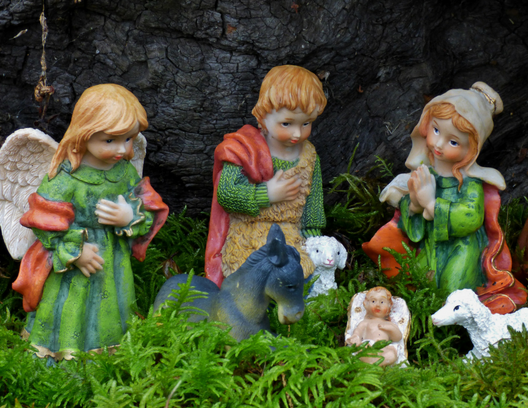
nativity

What is the end of the Christmas Story?

Perhaps when Mary was treasuring these things in her heart and the shepherds were  returning and praising God? (Luke 2:19,20)

Or maybe when the magi were worshiping and presenting their treasures? (Matthew 2:11)

Too often, that is where we stop celebrating in December.  A sweet baby (the Son of God) is born in humble surroundings and certain segments of the population respond with fitting praise and wonder.  The end.  But, as we have seen in our devotions this week, that is far from the end of the story.  I have enjoyed reading through Luke especially at this time of year to see once again what we are REALLY celebrating.

Jesus came as a baby – and what a great opening act that was (you, know the opening act that followed thousands of years of God setting the stage)!!  And 30 years later all sorts of people (fishermen, tax-collectors, sinners, chief priests, foreigners, the sick and diseased, teachers of the law, governors and kings and politicians, rich and poor, Jew and Gentile, men, women and children)  all prepare to meet this traveling preacher, teacher, healer, miracle maker, story-teller, leader, servant.  His favorite topic is always the good news of the kingdom of God (Luke 8:1).  Through his teaching, his parables, and his miracles, the world sees a clearer picture of God than they have ever seen before.  The son truly has his Father’s resemblance.

And, he also is committed to doing his Father’s will – even when that means death on the cross, crucified as a criminal, to take away the sins of the world.  His followers are crushed as they were sure this Jesus was going to set up the Kingdom on earth and begin his reign right then.  How could they have been so wrong?

Thankfully, that is still not the end.  Three days later…the tomb is empty!  Joy to the World!!  Jesus appears to his disciples and uses Scripture to explain to them again how the Old Testament foretold what must take place.

44 He said to them, “This is what I told you while I was still with you: Everything must be fulfilled that is written about me in the Law of Moses, the Prophets and the Psalms.”  45 Then he opened their minds so they could understand the Scriptures. 46 He told them, “This is what is written: The Messiah will suffer and rise from the dead on the third day, 47 and repentance for the forgiveness of sins will be preached in his name to all nations, beginning at Jerusalem. 48 You are witnesses of these things.   Luke 24:22-28

A way was needed for both Jews and Gentiles to be washed clean before they could be full citizens of God’s Kingdom.  And Jesus’ death made the way.  And his resurrection gives the hope for a future resurrection.  For there is one more key element that must take place before Jesus will begin his reign over all the world and the Kingdom of God will fully begin.  This is hinted above in Luke 24:47 and spelled out in Matthew 24:14 “And this gospel of the kingdom will be preached in the whole world as a testimony to all nations, and then the end will come.”

There have been many godly men and women who have died while preaching the gospel – but still the good news has not reached all people in all nations.  The Church of God mourned the death of a very special and faithful pastor, Rex Cain, just this week.  But the mourning was not without hope because the Christmas story isn’t over yet.

In the final verses of Luke (24:51), Jesus ascends into heaven.  When the same event is recorded in the book of Acts (Luke’s sequel) the disciples are told, “This same Jesus, who has been taken from you into heaven, will come back in the same way you have seen him go into heaven.” (Acts 1:11).  The best is yet to come!

The end of the Christmas story is a new beginning.  A beginning that is still to come.  When Jesus breaks through the clouds at his Second Coming this will be the start of his reign on Earth over all who have been faithful.  The dead in Christ will rise and we will see Jesus coming – not as a babe but as a triumphant warrior and king.  A new heaven and a new earth will worship him and his Father.

I pray I will be found ready.  And I pray you will be found ready.  Let’s get to work and tell the nations!

“Come, Lord Jesus!”(Revelation 22:20 b)

-Marcia Railton


What Shall I Do? I Will Send My Son.

Luke 20

Luke 20 13

Merry Christmas!

May your day be full of sweet reminders of God’s love.  And may you pass along that love to others.

It is easy to lose sight of the whole picture of Jesus when we gather to feast and exchange presents amid the tinsel, lights, tree, and nativity scene.  A pregnant virgin, a faithful fiancé, a holy night, an angel assembly, a crew of shepherds, traveling wise men, pass the ham, and unwrap the presents.  But wait . . . why??? And then what????

It appears Jesus didn’t spend time preaching about his miraculous and incredibly true birth.  In fact, only two of the four gospels record bits and pieces of his birth story.  But here in Luke 20 Jesus taught the Parable of the Tenants.  And while it isn’t likely used in very many Christmas sermons or devotions, it actually paints a very fitting picture of why Jesus was sent – and what was “the rest of the story” – beyond the shepherds and wise men.

In this parable God plays the role of the vineyard owner.  He entrusts his vineyard (earth) to mankind as farm tenants to care for his vineyard.  The owner sends back several servants (Old Testament prophets) to the vineyard to retrieve some fruit for the owner.  Instead the selfish, greedy tenants mistreat the servants and send them back with nothing for the master.   

“Then the owner of the vineyard said, ‘What shall I do? I will send my son, whom I love; perhaps they will respect him.’ (Luke 20:13).  And so, the Son of God is given a mission for his Father: go to the vineyard to represent his Father to attain what belongs to his Father – the fruit of the vineyard.  God could have done this in so many ways.  He could have sent a violent and powerful son to use force to swiftly get the Father’s work done and repay the tenants for their selfish, greedy wickedness.  But instead the Son was given – a baby – as the Son of Man and Son of God.  And the angels rejoiced.   And the shepherds were in awe as they found things just as they had been told and then joyfully shared the news.

And the Son of God “grew in wisdom and stature, and in favor with God and man” – the tenants of the vineyard. (Luke 2:52).   And the son of the vineyard owner teaches and preaches and performs miracles to display and prove the goodness and sovereignty and master plan of the vineyard owner.  But, they still don’t get it.  Forsaking the master’s plan, as well as his very son, they conspire together and the tenants kill the son.  Now, they figure, the vineyard will be theirs.  There is no longer an heir.  And so, the tenants triumph for a time and seem to have free reign of the vineyard.

But, that is not the end of the story.   In his parable Jesus now switches from past tense to future tense as he says, “What then will the owner of the vineyard do to them?  He will come and kill those tenants and give the vineyard to others.”  So, too, there is a future in our Christmas story today.  And, there is a price that will be paid for all tenants who have chosen to forsake the son.  

In your celebrating today, and in your work tomorrow, in your heart and mind and actions, in your time, in your giving, in your whole living – do not forsake the son.

-Marcia Railton