I love the Psalms, especially those by David. David didn’t shy away from sharing his conflicting emotions with the Creator. Psalms 13, while short, is an excellent example. He begins the Psalms questioning God, feeling abandoned by Him. David pleads with the LORD for deliverance. Yet, David ends with a submission of praise. Personally, I don’t think anything happened to change David’s circumstances in between verses 4 and 5. Rather, I think David resolved himself to continue to trust in God’s unfailing word, even when he could not see its immediate fulfillment. The sort of dedication David has towards the LORD at the end of this Psalm very much reminds me of Jesus’ prayer in Gethsemane.
Jesus, like David, knows what it feels like to be alone. We see this in our reading from Matthew 26. Jesus understands how it feels to feel forsaken or forgotten by God. Jesus knows anguish, a sorrow that rests heavy in one’s heart. The words of David in Psalms 13 echo the story of Jesus’ crucifixion. Jesus’ accusers had the upper hand as they beat him, gloating and rejoicing in his suffering. Knowing all he was about to endure, Jesus still submitted to God’s plan. He went away with his accusers willingly. His submission was an act of praise and worship, just as David’s words are in the conclusion of Psalms 13.
We will face struggles in our life as well. Though many of us will not be facing death by crucifixion or a life on the run from an angry king, we will face trials that leave us feeling desolate and hopeless. It is then we can take refuge in knowing our Savior, our High Priest, has felt the same.
There is strength in numbers. Even the most introverted value and thrive upon community. It’s how our Creator designed us. When our soul feels crushed, we can run to the Savior who understands us. May we not forget that we have a powerful best friend in our corner. Jesus knows pain. Jesus knows loss. We are not alone.
Reflection Questions:
Why do you think there is so much detail about Christ’s suffering? Is it simply for the fulfillment of scripture or do you think there could be another purpose for the narrative?
What does the knowledge of having a savior who can personally relate to your pain mean for you? If you are currently going through a trial, how does the knowledge your Savior can relate affect you?
How can you rededicate yourself to God during your own trials?
PRAYER:
Dear LORD,
Thank you for your Word. Thank you for reminding us that we are not alone. Thank you for giving us a Jesus who knows what it is to cry tears of anguish late into the night. Even when things feel hopeless, may I turn to You. Strengthen my resolve to do Your will. It’s in Jesus’ name we pray, Amen.
Our reading in Leviticus lists the six festivals the LORD commanded the Jews to follow and observe. I thought it would be fun to take a deep dive into each. For each festival, I searched additional scriptures where it was mentioned. I also investigated how it is celebrated in today’s modern world.
Passover and Festival of Unleavened Bread
This is perhaps the most commonly known Jewish holiday. In our passage today, the festival is said to last seven days, the first and last days marked with a “holy assembly” and “no work.” This festival commemorates when the tenth plague passed over the Israelites in Egypt. This final plague ultimately led to their deliverance from Egyptian slavery. In scripture, Passover is seen as a time of rededication, purification, remembrance, and celebration. It is during this celebration the Last Supper takes place, and from this the Christian practice of communion. The reverence and sincerity in which passover is handled in the Old Testament is a reminder to us Christians of the mindset we should have when taking communion. The passover is still celebrated by Jews, today. Jewish families gather in their homes for a special meal called the Seder. During this, the story of the Israelites exodus from Egypt is read. Special food is served at this meal to symbolize aspects of the Jewish faith.
Celebration of First Harvest
This celebration is marked by bringing sacrificial grain offerings from the first fruits of the crop to be presented to the LORD. It is also referred to as the Feasts of Firstfruits and is tied into the Festival of Harvest, yet still as a separate day of celebration, according to the text. I found it much more difficult to find information of this day alone as it is so closely related to the Festival of Harvest. From what I can tell, this day is no longer celebrated on its own. Yet, God made a distinction here, in Leviticus. I think part of that purpose is to show how God desires our worship and honor. God wanted a separate day set aside just for the first fruits of a crop. This was so he could be acknowledged as creator and giver of life. One way that we as Christians can continue this theme of gratitude for provisions is to pray before our meals.
Festival of Harvest
The Festival of Harvest, or Festival of Weeks, was later referred to as Pentecost and is known today as Shavout. It is to take place fifty days after the Celebration of the First Harvest. According to our text in Levitus, this festival was marked by various offerings of “pleasing aroma to the LORD” and a day or holy assembly in which no work was to be done. In Deuteronomy 16:9-12 it is described as a time of great celebration. The focus of the holiday in today’s age is no longer agricultural but instead serves as a time to celebrate the giving of the Torah. It is a sacred time in Jewish culture. It is observed with traditional foods, decoration of synagogues, and confirmation services. I think it’s incredibly special how practicing Jews set aside a time to remember and give thanks for their scriptures. How often do we as Christians pause and give thanks for our own Scriptures? When was the last time you honestly thanked God for the Bible? Perhaps we Christians could learn something from the modern day celebration of Shavout.
Festival of Trumpets
The Festival of Trumpets is a day for holy assembly and no work. Specific offerings are to be presented. These are described in more detail in Numbers 29:1-9. During this celebration there is to be a blast of trumpets. I imagine this was the biblical version of setting off fireworks. This festival later became known as Rosh Hashanah, the Jewish New Year. It is celebrated by traditional foods, such as sweet breads to signify the hopes of a sweet new year. The specific readings during services focus on God’s sovereignty, past deeds, and anticipation of the future. The instructions in Leviticus for this festival are unique as it shows music as an example of worshipful offering. This is something each of us are capable of doing. God wants to hear our praise in song and deed.
Day of Atonement
The Day of Atonement is the second most well-known Jewish holiday. It is known today as Yom Kippur. Leviticus 16 goes into further detail of the requirements for the Day of Atonement. It is a day of holy assembly, fasting, and offerings of purification made by the High Priest. Jesus is our High Priest and his sacrifice on the cross is symbolic of the offerings made on the Day of Atonement. It is considered one of the holiest days in Jewish culture. Today, it is marked by a time of fasting and confession. The Day of Atonement shows that God is in the business of reconciliation. He provides a path of redemption for all people. The Day of Atonement was a physical reminder of God’s covenant grace with his people. Jesus has allowed that same covenant of grace to extend to all people who come to Christ.
Festival of Shelters
The Festival of Shelters is also referred to as Festival of Booths or Festival of Tabernacles. It is an eight day celebration. Days one and eight are characterized by holy assembly days and days of rest. On each day of the festival, specific offerings are to be made, detailed in Number 29:12-40. Deuteronomy 16:13-17 reveals it is to be a time of great joy and celebration, reflecting upon the good harvest. Our text, Leviticus 23, instructs families to build tiny huts from branches to live in during the week of the Festival. This is to represent their time living in shelters after being delivered from Egypt. Today, this holiday is known as Sukkot. Interestingly enough, it is still widely celebrated in a similar fashion with families gathering in small temporary huts called sukkahs. This festival reminds us of the importance of pausing to thank God for all our many blessings. It is meant to be a joyous celebration, where we are to rejoice in God’s goodness. We should have this attitude of praise daily, but it is also good to set aside time dedicated just for thankfulness.
Questions:
What do you do to prepare yourself for communion?
Do you pray before every meal? Why or why not?
Do you think Christians take scripture for granted? How can we remember to treat God’s word with holiness?
Do you sing along during worship at church? Why or why not? Do you think you should start?
In what ways is Jesus our High Priest?
Can you think of a U.S holiday similar to the Festival of Shelters? Even though Thanksgiving is a long ways away, how will you plan to make this year’s celebration a holy time?
PRAYER:
Dear Lord God, You are so worthy of our worship. Help me daily, and in special ways and times, honor and celebrate You, Your scriptures (yes, including Leviticus), Your precious Son – the perfect High Priest we need, , the good gifts that You give, the good God that You are. Thank you for life and redemption, for your perfect plans through the ages, for music, prayer, communion, church, feasts, fasting and holidays. Help me to prepare well for the celebration that will surpass them all, when Your Son returns to earth to set up Your Kingdom for eternity.
Ever see one of those warning sign where you have to wonder? What happened here that made this sign necessary. I kind of felt this way reading Leviticus 20-22…some of the laws made sense as God was establishing the Mosaic law. Especially the opening of the chapter talking about child sacrifices.
Some of it I’m a little unclear on. Previously, you could marry your step sister (Abraham and Sarah) and other family members. But God was putting an end to that. And then some of the laws, were just for specific people and some of those I don’t understand at all. Why did you have to be physically perfect in order to be a priest who could enter the temple? I don’t get that one… but I trust God has His reasons I may not understand before the coming kingdom.
As independent adults, we often question the things we’re told to do and want to know why so we can decide if we really want to do it.
But throughout the Bible, God gives us laws and tells us to do/not do things that we don’t understand. We don’t feel like it’s right.
However, that is the difference between believing in God and Christ and truly surrendering to them as the ones who control your life. You may not alway understand why God is telling you to do something, but total submission means you follow God’s word no matter what. It’s a matter of trust. Trust is hard, but vital to our relationship with God.
Speaking of total submission, we go to Matthew 26 where Jesus is fully aware of what is going to happen but continues on as he trusts in God’s overarching plan for humanity as mentioned in Psalms 12. God knows what he’s doing with humanity, we just have to trust Him.
Reflection Questions:
Are you bothered by the times you don’t understand God, His law or plans? Why or why not?
What could be helpful advice for someone who is questioning God?
Have you found God to be trustworthy? How can you build your trust in Him?
Did Jesus have the mind of God? What can we learn from Jesus’ example when it might seem like we don’t want the same things God does?
PRAYER:
Father God, I praise You because You are wise, all-knowing, all-powerful and completely trustworthy, and I am not. Thank You for Your love and for being a Good God. Open my eyes to see Your goodness in all You do, and all You ask me to do. Thank You for the incredible gift of Your Son. In all ways big and small may I echo his words and heart of surrender: “Not my will but Yours be done.”
In today’s chapter, there are three parables: the Parable of the the Ten Virgins, the Parable of the Talents, and the Parable of the Sheep and the Goats.
It is important to note that parables are earthly stories that teach spiritual truths. Jesus creates images that his hearers would understand, and applies them to spiritual realities. The Parable of the Talents section will go into more detail about interpreting parables.
The Parable of the Ten Virgins
In the first parable, we see ten women who are waiting to guide a groom to his bride. Five of these virgins were wise and prepared for the coming of the groom by have enough oil to last all through the night. Five were foolish, unprepared, who have to run off and fill up their supply of oil while the groom is on the way. They weren’t ready for the bridegroom and his coming, and they were not allowed in because they were late.
Obviously, we can see the parallel with our faith. The point made by this story is simple and spelled out for us in verse 13: “Be on alert then, for you do not know the day nor the hour.” We must be prepared for the coming of Christ, ready for his return.
But what does it mean to be ready for his return?
Parable of the Talents
In the second parable, a master goes on a long journey, and gives talents to his slaves. When we read “talent,” remember that the word HERE means “an amount of money”. A talent is a VERY LARGE amount of money, about 6,000 denarii. A denarius is one days wage. 1 Talent would take a working person 16 years to save. (see note) Five talents, two talents, and one talent are all VAST sums of wealth, and the King gives them to his slaves and entrusts that money into their care according to their abilities. When the master returns, he rewards those who use his wealth to make more, but punishes the one who hides the money away and does not use it.
Again, we should start to see some connections to our own life. It is important to remember that this is a parable. Jesus is using images from the world around him to teach a spiritual point. The talents given by Jesus, the King, to us, his slaves, are decidedly not always money. There may be people who follow Christ who are dirt poor. Moreover, it should not be considered specific abilities or spiritual gifts. Because this story is a parable, one-to-one relations don’t always work. For example, what is the oil and who are the oil sellers in the parable of the ten virgins? Don’t think too hard on it, because those are silly questions. The parable is about being ready for the return of Christ. I’m making a similar point for this parable: don’t try to define what the talents are (spiritual gifts, or natural abilities, or other) but think of them as the blessings of God in our life generally. And that makes the point clear: We can either use the blessings God has given us to produce more blessings for ourselves and others while risking and sharing, or we can bury our blessings and avoid the risk of interacting with others.
If you use the talents with which you are gifted, you will receive the reward the master gives. He says to both the one with five talents as well as the one with two : “Well done, good and faithful slave. You were faithful with a few things, I will put you in charge of many things; enter into the joy of your master.” (21, 23). Note the words aren’t different, though the blessings are. We are to use our blessings that we have been given. We are not to worry about not having as much as the next person or whether we can see the fruit of them using their blessings. It is for the master to judge them, not another slave.
Finally, Jesus, our master, EXPECTS us, his slaves, to gain on the blessings given. For the slave given one talent, even if the talent was just “put in the bank”, then it would have been better. Instead, the slave played it safe, and is punished for his unfaithfulness. The one who is was unfaithful has their blessings revoked and the blessings were given to the faithful. (Another reason we don’t think of talents as specific spiritual gifts or natural abilities. It seems doubtful that God would take the spiritual gift or natural talent from one and give it to another.)
We need to be ready at all times for the return, and that is by using our blessings to bless others. Jesus puts a fine point on this teaching by saying the final parable of the chapter.
The Parable of the Sheep and the Goats
In the final parable, all humanity is imagined as a herd of animals, sheep and goats. The final judgement, that comes at Christ’s return, has him separating sheep and goats. Jesus tells the sheep that they fed, watered, invited, clothed, and visited the great king by doing it for the “least of the brothers of mine.” When we care for other Christians, we are caring for Jesus, the great king Himself. Moreover, many Christians have understood a greater implication. Because Jesus is human, he views all of humanity as brothers and sisters. This is why Paul says in Galatians 6:10 “Therefore, as we have opportunity, let us do good to all people, especially to those who belong to the family of believers.” Not ONLY believers, but especially believers. It starts in the family and radiates outward. However, the goats did not feed, water, invite, clothe, or visit the great king. When they did not care for their brothers and sisters in Christ and for their human family, they were not caring for the king.
And what happens to each group is shocking. One is given eternal life, life in the age to come, life that lasts forever because it is in the presence of the One who is Life. And the other is punished, and the punishment, death, will be eternal and final.
These three stories teach us what it means to be ready for the return of Christ which is promised in chapter 24. To be serving the least of these, both in and out of the family of believers, with any and all blessings that God has given us, actively waiting and expectantly watching for the coming of Christ. It is not staring at the sky while twiddling our thumbs nor is it quietly serving with no Kingdom messages. It is serving the least, blessing them, and sharing with them the Gospel of the Kingdom. That’s the message of the parables.
(Originally posted for SeekGrowLove January 25, 2022)
Questions for Reflection and Discussion
Are we the wise or the foolish virgins? Will we be found prepared, without knowing the day or the hour? Will we be running around when he comes, hoping to be found ready?
Are we faithful with the blessings of God we have been given? Are you using the gifts God has given in an effective way?
The sheep seem to be surprised that they were serving the King, and the goats are surprised they weren’t serving him. Are you taking care of the least, the last, the little and the lost? When have you fed or given water to the poorest in your community? When have you given clothes to those who have none or invited them into your homes? It is tempting to say “I give to charities that do that” but Jesus won’t be asking the charity if THEY cared for the least of these, he will be asking you and me. Will we be in surprise that we served or in surprise that we did not?
Prayer:
Dear God, You are amazing and so is Your love! Thank you for giving us Your Son and these powerful parables to prepare us for the perfect unfolding of Your plan of salvation and eternal life in Your presence. Help us listen well and respond wisely so we are not caught unaware. Forgive me, Lord, for the times I fail: when I am too distracted to be prepared, when I bury the talents, gifts, blessings and resources you have generously given, and when I haven’t recognized Jesus and the opportunities to serve him through caring for the least. Open my eyes to see and live these parables every day in my own life, that I might be wise, generous, prepared and serving til Your Son returns.
Does anyone remember the “cold war”? It was a time in our history where we publicly acknowledged that even though we weren’t “weapons hot” in direct combat with an opponent, we were still actually fighting in a secret war. The term was a little misleading because while there was all sorts of nefarious activity going on, it was mostly kept out of the public eye, or fought in other places. The exact number of men who died during the Cold War is not definitively known, as the conflict was primarily geopolitical and indirect, involving proxy wars, political repression, and nuclear threats rather than direct large-scale battles … However, estimates of total deaths linked to Cold War-related conflicts range from (according to a Quora analysis) 10.8 million to 25 million. Stop for a moment and think about that.
We are similarly involved in a spiritual “cold war” right now. People are dying as you read this, because most of us are too scared to acknowledge that it is going on, and those who understand that it’s going on are too scared to get directly involved. Fear is one of the greatest tools used by our enemy(ies) to keep us in line, and from becoming a threat. We’ve been divided into different “denominations”, and told that we should only socialize with folks who think exactly like we do, because we (insert your denomination here) are the only ones who have rightly understood scripture and everyone else is wrong, and therefore, the enemy. Even though we are told repeatedly in scripture that our standard of measure is our love and unity, not necessarily agreement mind you, but love and unity. We never even stop to think about the hard, cold fact that the first tactic in almost any military incursion is to isolate, misinform, divide, and conquer.
Our reading today of Psalms 10 lets us know that this isn’t a new problem. This has been going on since just after the creation, but if you pay attention, you can see that it’s ramping up now. Our reading of Matthew 24 gives us an idea of what more is coming, and how it all ends. Whenever my wife sees something on the news that is shocking and appalling, and gasps “Can you believe that?” to me, I always respond by saying “It’s going to get worse before it gets better.”. We know that when our King returns, it will get better…but it’s going to be tough until then.
“Why do You stand afar off, O Yahweh?…” (Ps 10:1, LSB). Sometimes it seems that way, but know that He does not. That is a deception by the enemy. If you are alive, right now, it is because the breath of your God is in your lungs. He is with you, and beside you, all around you, and within you. God tells us directly (through Jesus) that the tares must be allowed to grow alongside the wheat (Matt 13:24-30), and also that it is through many trials and tribulations that we must enter the kingdom of God (Acts 14:22). We’re at war, did you expect a cake walk? Toughen up, soldier. We have a mission.
“For the wicked boasts…and the greedy man curses and spurns Yahweh. The wicked…does not seek Him. All his thoughts are ‘There is no God.‘” (Ps 10 3-4, LSB). It becomes easier to do what you know is wrong if you deny the fact that there is a Creator, and that this Creator will one day bring forth His justice, His salvation…His Yeshua (seriously, look it up. The name Yeshua, or “Jesus”, means the “Salvation of God”). Many people turn to alcohol or drugs to help them forget this, even if it only works for a little while, and then you need more. Foolishness. God will judge the earth, so every action you take in your lifetime should be to offer a good accounting of yourself during that judgment, if you are wise. We will be judged by our fruits, we need to get to planting.
“He sits in the places…where one lies in wait; In the hiding places he kills the innocent; His eyes stealthily watch for the unfortunate. He lies in wait…to catch the afflicted…and the unfortunate fall by his mighty ones. He says in his heart, “God has forgotten; He has hidden His face; He will never see it.” (Ps 10:9-11, LSB). Folks, this is still going on right now. I knew some of those guys. They’re bad guys. 1 Peter 5:8 depicts the devil as a roaring lion seeking whom he may devour. Whether or not you believe in a personal Adversary, understand that there are bands of men doing this right now for a livelihood, in your town. Stay alert, and live a righteous life. Shema! If you succumb to your vices, they will consume you.
“O Yahweh, You have heard the desire of the humble; You will strengthen their heart, You will cause Your ear to give heed. To give justice to the orphan and the oppressed, so that man who is of the earth will no longer cause terror” (Ps 10:17-18 LSB). If you have read and believe in the scriptures, you know how this story will end. No matter how bad it looks right now, we know that we have a hope. We await the salvation of God, His Yeshua, to come and judge this earth in righteousness and equity, to “break the arm of the wicked (Ps 10:15) and to seek out his wickedness until none is found”.
“Then they will deliver you to tribulation, and will kill you, and you will be hated…and at that time many will fall away and will betray one another and hate one another. Many false prophets will arise and will deceive man. And because lawlessness is multiplied, most peoples love will grow cold.” (Matt 24 9-12, LSB). God have mercy, it’s going to get worse. If we are hating each other, or betraying each other, or our love grows cold…we will have lost the battle, and we will die forever.Guard your heart above all else, because when your love grows cold, so will your life, and your hope for a life in the kingdom. Do all that is within your power to prevent this, seek ye first the kingdom of God, love Yahweh God with all your heart, and love your neighbor as yourself. Don’t you see that your enemy is trying to kill you right now? Wake up, and FIGHT!
We have some specific signs and indications that tell us of the coming of the Son of Man in Matthew 24:29-31. There is a reason that at this time “the tribes of the earth will mourn” (Matt 24:30), because the time has come, there is a God, and the judgment of the wicked has come upon them. No man knows the time or the hour (not even Jesus at the time), but only the Father (Matt 24:36); but we see in the parable of the fig tree in Matt 24: 32-39 that when we see these things, we should understand that the time near.
My friends, look around you. The time is near. Now is not the time for distractions and diversions, but for a redoubling of focus and effort. Our king is returning, and soon! Do not think proudly that you have already attained admittance into the kingdom, but humble yourself before God, ask God for wisdom, pray, fast, read scripture, do all that you can do to restore and renew your relationship with your God. If you do, who knows? Seek Yahweh, all you humble of the earth who have worked His justice, Seek righteousness, Seek humility. Perhaps you will be hidden in the day of Yahweh’s anger (Zeph 2:3, LSB).
REFLECTION QUESTIONS
As Christians, how can we fight in this war?
What are some of our offensive weapons?
What are some of our defensive weapons?
Are we utilizing them effectively, and why or why not?
PRAYER
Father God, thank you. You have given us life, breath, and all things. Our enemy seeks to destroy us, Father protect us. Lord God, may your will be done in my life. When you return to judge the earth, have mercy on me on that day, and let me humbly seek to please you until I go to rest in the ground to await You. Please grant me wisdom, and grant me Your spirit to guide me and protect me. May the lips of all of Your creation offer you up the praise that you deserve, in Jesus’ name, Amen.
Religious practice is exactly what is said. It is our habitual practices that we bring to our walk with God and make rules for our lives. These practices are not necessarily good or evil but become the habits that we follow as people in our daily life. We also build habits that govern our time together as the body of Christ at church or fellowship. Once again, these practices are neither good or evil but are the way that we have decided to fellowship together.
The law of Moses covered almost every aspect of life for the nation of Israel and gave instruction in how to do righteous actions and have righteous thoughts. As we read in Leviticus these instructions can be very complex and to our culture maybe not very understandable.
In our reading in Matthew, we are at almost the end of Jesus’ life here on earth and he is at the temple. He has many debates with the leaders there and also spends time teaching the people. He throws out the moneychangers and vendors and then has many interactions with them that are maybe not the most decorous from their viewpoint.
Matthew 23:1-13(NLT) Then Jesus said to the crowds and to his disciples, 2 “The teachers of religious law and the Pharisees are the official interpreters of the law of Moses. 3 So practice and obey whatever they tell you, but don’t follow their example. For they don’t practice what they teach. 4 They crush people with unbearable religious demands and never lift a finger to ease the burden. 5 “Everything they do is for show. On their arms they wear extra wide prayer boxes with Scripture verses inside, and they wear robes with extra long tassels. 6 And they love to sit at the head table at banquets and in the seats of honor in the synagogues. 7 They love to receive respectful greetings as they walk in the marketplaces, and to be called ‘Rabbi.’ 8 “Don’t let anyone call you ‘Rabbi,’ for you have only one teacher, and all of you are equal as brothers and sisters. 9 And don’t address anyone here on earth as ‘Father,’ for only God in heaven is your Father. 10 And don’t let anyone call you ‘Teacher,’ for you have only one teacher, the Messiah. 11 The greatest among you must be a servant. 12 But those who exalt themselves will be humbled, and those who humble themselves will be exalted. 13 “What sorrow awaits you teachers of religious law and you Pharisees. Hypocrites! For you shut the door of the Kingdom of Heaven in people’s faces. You won’t go in yourselves, and you don’t let others enter either.
Jesus gives us a compact instruction on how we are to practice our religious life in these short verses.
We are to obey the true Word of God which does not fall
We should not add rules and conditions of man to the Word of God
We need to worship and practice with humility to God and His instructions to us.
Bring people into the kingdom of God not draw lines to exclude them
In Micah God reminds us of what is important to Him and what we really need to do to live out the life of compassion and grace that He has called us to.
Micah 6:6-8)NLT) What can we bring to the LORD? Should we bring him burnt offerings? Should we bow before God Most High with offerings of yearling calves? 7 Should we offer him thousands of rams and ten thousand rivers of olive oil? Should we sacrifice our firstborn children to pay for our sins? 8 No, O people, the LORD has told you what is good, and this is what he requires of you: to do what is right, to love mercy, and to walk humbly with your God.
Why does this judge our hearts so well?
We must be careful every day not to start to exalt our minds against God by patting ourselves on our backs for the great works of righteousness for Him that we do. Just doing religious practices and ignoring the grace that God has given us is the way to go down the wrong road (that’s when the pat on the back needs to be down lower). If our religious practices bring us closer to God through prayer, praise, love for others, and Christian service then we are building our relationship with God.
This is what He truly desires from us, not a showy religious practice. Contrast this with what so much of Christianity does today and the consequences of religious practice become immediately evident. Our God wants us to have the heart of grace and mercy towards this fallen world and people that He has. He has built the way to life through His Son Jesus Christ, and he is who we are to become like.
Galatians 2:16(NLT) Yet we know that a person is made right with God by faith in Jesus Christ, not by obeying the law. And we have believed in Christ Jesus, so that we might be made right with God because of our faith in Christ, not because we have obeyed the law. For no one will ever be made right with God by obeying the law.”
God’s grace is the important thing to bring to every part of life and practice. It is so human and wrong to be judgmental of people based on how I think they should act or think. I am offended in my mind by their lack of doing of the things that I think they ought to be doing.
Is this the mind of Christ towards others?
Titus 2:11-15a (NLT) For the grace of God has been revealed, bringing salvation to all people. 12 And we are instructed to turn from godless living and sinful pleasures. We should live in this evil world with wisdom, righteousness, and devotion to God, 13 while we look forward with hope to that wonderful day when the glory of our great God and Savior, Jesus Christ, will be revealed. 14 He gave his life to free us from every kind of sin, to cleanse us, and to make us his very own people, totally committed to doing good deeds. 15 You must teach these things and encourage the believers to do them
Hope of life with God and Christ in the kingdom to come is the guiding light for everything that we should be doing. When our motivations and intents of our hearts towards others is right with God then our actions will be godly and good. Our religious practices will become pleasing to God.
How can we examine our hearts in light of this understanding?
Romans 14:10-11(NLT) So why do you condemn another believer? Why do you look down on another believer? Remember, we will all stand before the judgment seat of God. 11 For the Scriptures say, “‘As surely as I live,’ says the LORD, ‘every knee will bend to me, and every tongue will declare allegiance to God.’”
Ultimately the motives of our hearts will be examined before all the creation and we will be judged at the “bema” for our actions and thoughts. It is not in the actions but our hearts that God sees as important to Him. To renew our minds is to change to become like Christ and do the true instruction of God in this world.
Matthew 23:37-39(NLT) “O Jerusalem, Jerusalem, the city that kills the prophets and stones God’s messengers! How often I have wanted to gather your children together as a hen protects her chicks beneath her wings, but you wouldn’t let me. 38 And now, look, your house is abandoned and desolate. 39 For I tell you this, you will never see me again until you say, ‘Blessings on the one who comes in the name of the LORD!’”
Reflection Questions
See questions in bold above.
Prayer:
Dear God, Thank you for the gifts of Your Word and Your Son where we see what You desire and the perfect example of loving and pleasing You. Forgive me for the times I have had a Pharisee’s heart. I want instead the mind of Christ. Help me see myself and others with Your eyes and remembering Your grace humbly respond as You want me to.
Psalms 9:1-2 I will praise you, LORD, with all my heart; I will tell of all the marvelous things you have done. 2 I will be filled with joy because of you. I will sing praises to your name, O Most High.
Praises should flow from our hearts all our lives because of the great God and Father that we have. Yahweh is His name and it means our God who is in a relationship with us.
One of the things that has taken me a long time to understand and also to help me let the Word interpret itself to us is the question of agency. God is the ultimate power and creator of all the universe, but He delegates His power and authority to those that He chooses to give it to. All created beings are given freedom of will to obey God, and are given various levels of authority to exercise on His behalf.
For example, God is the author of our salvation, but Jesus is the agent of our salvation. God has decided to give us His grace, but it comes to us through His agent Jesus Christ.
Titus 3:4-7 (NLT) But—When God our Savior revealed his kindness and love, 5 he saved us, not because of the righteous things we had done, but because of his mercy. He washed away our sins, giving us a new birth and new life through the Holy Spirit. 6 He generously poured out the Spirit upon us through Jesus Christ our Savior. 7 Because of his grace he made us right in his sight and gave us confidence that we will inherit eternal life.
God decided to save us, but the way that He does it is through His Son the Lord Jesus Christ. God also has judged His Son worthy of authority to judge the whole world in the future. Only Jesus Christ has the qualifications to do the judging and giving of rewards to all the world’s present, past and future populations. We see the results of this agency here in Psalm 9.
Psalms 9:7-8 But the LORD reigns forever, executing judgment from his throne. 8 He will judge the world with justice and rule the nations with fairness.
Yahweh executes judgement from His throne, but the agency for that judgement will come from His Son. God has ultimate authority over all the creation but gives Jesus the rulership over the nations.
Acts 17:30-31(NLT) God overlooked people’s ignorance about these things in earlier times, but now he commands everyone everywhere to repent of their sins and turn to him. 31 For he has set a day for judging the world with justice by the man he has appointed, and he proved to everyone who this is by raising him from the dead.”
Revelation 19:15-16(NKJV) Now out of His mouth goes a sharp sword, that with it He should strike the nations. And He Himself will rule them with a rod of iron. He Himself treads the winepress of the fierceness and wrath of Almighty God. 16 And He has on His robe and on His thigh a name written: KING OF KINGS AND LORD OF LORDS.
As we read Psalm 9 there is so much that we could unpack from it. It has declarations of praise, and proclamations of confidence in God’s care and instruction, and declarations of what the ultimate kingdom of God will be.
Psalms 9:7-10(NLT) But the LORD reigns forever, executing judgment from his throne. 8 He will judge the world with justice and rule the nations with fairness. 9 The LORD is a shelter for the oppressed, a refuge in times of trouble. 10 Those who know your name trust in you, for you, O LORD, do not abandon those who search for you.
The other thing that we should contemplate today is what authority and power has God delegated to you?
Ephesians 1:19-20(NLT) I also pray that you will understand the incredible greatness of God’s power for us who believe him. This is the same mighty power 20 that raised Christ from the dead and seated him in the place of honor at God’s right hand in the heavenly realms.
Ephesians 3:20-21(NLT) Now all glory to God, who is able, through his mighty power at work within us, to accomplish infinitely more than we might ask or think. 21 Glory to him in the church and in Christ Jesus through all generations forever and ever! Amen.
2 Timothy 1:7(NKJV) For God has not given us a spirit of fear, but of power and of love and of a sound mind.
Thanks be to our God for His great love and grace that we have received and that we need to accept and exercise our position and power that God has given us in Christ.
Psalms 9:15-18(NLT) The nations have fallen into the pit they dug for others. Their own feet have been caught in the trap they set. 16 The LORD is known for his justice. The wicked are trapped by their own deeds. 17 The wicked will go down to the grave. This is the fate of all the nations who ignore God. 18 But the needy will not be ignored forever; the hopes of the poor will not always be crushed.
Reflection:
How does God ultimately judge the world and the nations?
Who is His agent of judgment?
Prayer:
Our God and Father, creator and ruler of all the cosmos, we lift our hearts in praise to you today. Thank you for the wonderful gift of Your Son who is the agent of our salvation and future. We look to You Father for the power to do Your good in this life. Thank you for the Christ in us which gives us this power. In Jesus wonderful name we pray.
We are reading today in the book of Leviticus which is where many Bible reading plans go out the window. Tough going I admit but full of truths for us to mine if we can look past the intricacies of the law of Moses set down. Reading from Leviticus 4 and 5 today there are some words that we could examine more deeply. We read about sin offerings, trespass offerings and others. What is this all about?
Leviticus 4:2-3(NKJV) If a person sin (ha’ta Strong’s H2398) unintentionally against any of the commandments of the LORD in anything which ought not to be done, and does any of them, 3 if the anointed priest sins, bringing guilt on the people, then let him offer to the LORD for his sin which he has sinned a young bull without blemish as a sin offering.
When God talks about sin, He is talking about something much deeper and more complex than regulatory lists of good and bad behaviors or choices. He is concerned with the corruption of God’s intentions for us that show up in human relationships and choices. This can be something that we do or something that happens to us.
(ha’ta Strong’s H2398) is translated as sin but means “to miss the mark”, like shooting an arrow at the target and missing. We miss the direction that God wants and has asked us to go in, and then end up in a place He did not intend us to be. All the words in bold below are this word (ha’ta)
Leviticus 5:5-6(NKJV) And it shall be, when he is guilty in any of these matters, that he shall confess that he has sinned in that thing; 6 and he shall bring his trespass offering to the LORD for his sin which he has committed, a female from the flock, a lamb or a kid of the goats as a sin offering. So the priest shall make atonement for him concerning his sin.
Leviticus 5:17(NKJV) If a person sins, and commits any of these things which are forbidden to be done by the commandments of the LORD, though he does not know it, yet he is guilty and shall bear his iniquity. (ʿāôn Strong’s H5771)
We start down the path of sin by doing something or saying something that misses the mark, but then we are told that we must bear that “iniquity” (ʿāôn Strong’s H5771) This is a different word that starts from the missing of the mark, but then causes us to become “bent or twisted”. When we intentionally or unintentionally miss God’s standard of life, we become bent by our sin. In the Old Testament the answer was the sin offering for the original sin, or a trespass offering for the bent nature of our lives. Unfortunately, we all have missed the mark of the standards of God’s Word and have become twisted in our human natures. Examples of this type of twisted behavior include deceitfulness, violence, and other kinds of harm we might do to others.
This is the root cause of our human sin nature that no amount of self-discipline or self-chastisement can make us straight again. We are never able by our own efforts to make ourselves perfect before God, only by His grace and mercy can we come before Him.
Take a paper clip and unbend it to a more or less straight piece of wire which is what it was to begin with. Can you make it straight? Close maybe, but not really. Now bend it back into the same shape as it was before coming out of the box. Can you bend it back to the original? These are the results of our sin nature that we have in our human lives. Our sin causes us to become bent or twisted, and no amount of effort on our parts can make us straight or perfectly formed again.
Our “Good News” though is that there is an answer to our bent nature coming from the sacrifice that God gives us in the life of His Son. Look at this familiar passage from Isaiah 53.
Isaiah 53:4-6(NKJV) Surely He has borne our griefs And carried our sorrows; Yet we esteemed Him stricken, Smitten by God, and afflicted. 5 But He was wounded for our transgressions, He was bruised for our iniquities (ʿāôn Strong’s H5771)” The chastisement for our peace was upon Him, And by His stripes we are healed. 6 All we like sheep have gone astray; We have turned, every one, to his own way; And the LORD has laid on Him the iniquity of us all.
Jesus brings our sin, trespass and bent nature to the cross and takes it all on him to heal us in every way. “He has born our griefs” which is our sicknesses and “by His stripes we are healed” which is to take away our pain.
Luke 22:41-44(NKJV) And He was withdrawn from them about a stone’s throw, and He knelt down and prayed, 42 saying, “Father, if it is Your will, take this cup away from Me; nevertheless not My will, but Yours, be done.” 43 Then an angel appeared to Him from heaven, strengthening Him. 44 And being in agony, He prayed more earnestly. Then His sweat became like great drops of blood falling down to the ground.
Questions for Reflection:
How great is the grace of God in Christ to us?
What can we do to live out our walks in Christ today?
Has the discussion changed your perception of what sin is?
Prayer:
Father God thank you for straightening us out in Christ and keeping us on the straight paths to You. Give us help today to confess our sin and walk with You in the spirit that you have given us. Bless the works of our hands and keep them that they would do the good works that You have ordained for them. In the name of Jesus Christ, we pray this day.
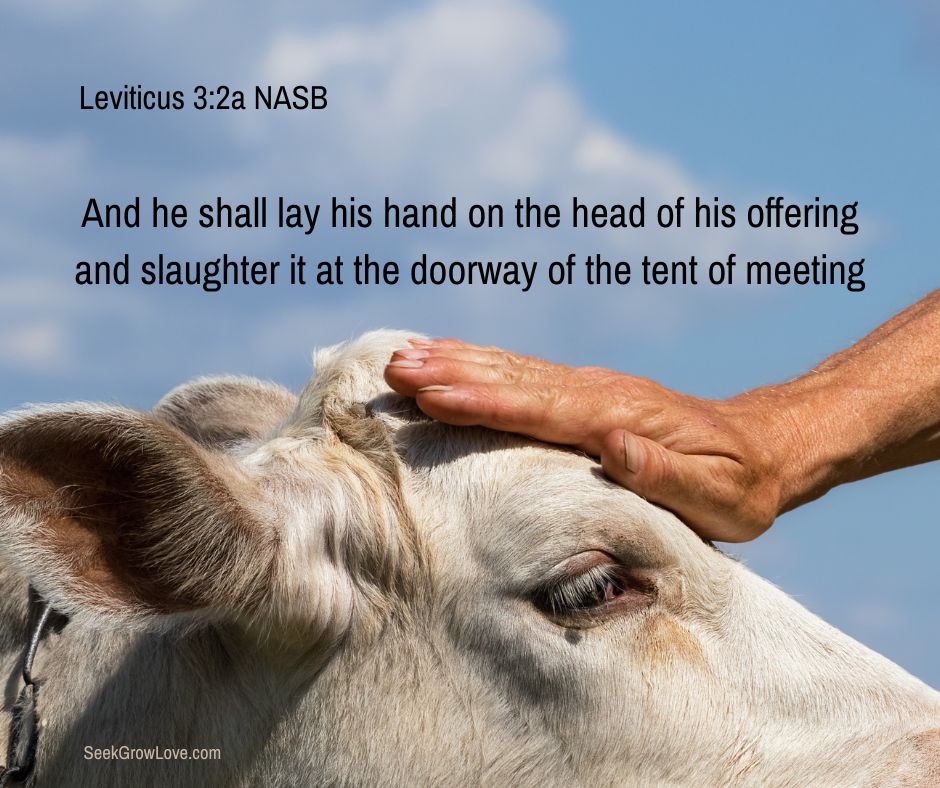
Leviticus 3:1-3(NLT) If you present an animal from the herd as a peace offering to the LORD, it may be a male or a female, but it must have no defects. 2 Lay your hand on the animal’s head, and slaughter it at the entrance of the Tabernacle. Then Aaron’s sons, the priests, will splatter its blood against all sides of the altar. 3 The priest must present part of this peace offering as a special gift to the LORD.
The peace offering is also known as the fellowship offering and one of the five types of sacrifices that are shown in Leviticus. The five types of offerings described in Leviticus are the burnt offering, grain offering, sin offering, and guilt offering. Each has a purpose but also look forward to a perfect sacrifice coming in the future where Christ will fulfill all their purposes. The peace-offering is one of communal fellowship and thanksgiving. It served as a means for the Israelites to express gratitude, fulfill vows, or seek reconciliation with God.
The sacrifice also became a communal meal with the giver, priests and other people invited to eat and enjoy the meat while the other parts of the animal were burned as the sacrifice to God. These fellowship aspects of the sacrifice are the important thing for us to look at here. We as the body of Christ have now the peace fellowship with all the believers and with our Father and His Son.
The peace offering points to the ultimate reconciliation brought through Jesus Christ. Christ is seen as the complete fulfillment of the sacrificial system, including the peace offering.
Ephesians 2:11-18(NLT) Don’t forget that you Gentiles used to be outsiders. You were called “uncircumcised heathens” by the Jews, who were proud of their circumcision, even though it affected only their bodies and not their hearts. 12 In those days you were living apart from Christ. You were excluded from citizenship among the people of Israel, and you did not know the covenant promises God had made to them. You lived in this world without God and without hope. 13 But now you have been united with Christ Jesus. Once you were far away from God, but now you have been brought near to him through the blood of Christ. 14 For Christ himself has brought peace to us. He united Jews and Gentiles into one people when, in his own body on the cross, he broke down the wall of hostility that separated us. 15 He did this by ending the system of law with its commandments and regulations. He made peace between Jews and Gentiles by creating in himself one new people from the two groups. 16 Together as one body, Christ reconciled both groups to God by means of his death on the cross, and our hostility toward each other was put to death. 17 He brought this Good News of peace to you Gentiles who were far away from him, and peace to the Jews who were near. 18 Now all of us can come to the Father through the same Holy Spirit because of what Christ has done for us.
Does this change your perception of what true peace is?
We can praise the great name of Our God who has accepted this sacrifice and made us part of His family and fellowship. When we were far away and did not know Him at all God saw you and called you to Him. Praise His name for the wonderful fellowship He has given us today and in the future.
Psalms 8 O LORD(NKJV), our Lord, How excellent is Your name in all the earth, Who have set Your glory above the heavens! 2 Out of the mouth of babes and nursing infants You have ordained strength, Because of Your enemies, That You may silence the enemy and the avenger. 3 When I consider Your heavens, the work of Your fingers, The moon and the stars, which You have ordained, 4 What is man that You are mindful of him, And the son of man that You visit him? 5 For You have made him a little lower than the angels, And You have crowned him with glory and honor. 6 You have made him to have dominion over the works of Your hands; You have put all things under his feet, 7 All sheep and oxen— Even the beasts of the field, 8 The birds of the air, And the fish of the sea That pass through the paths of the seas. 9 O LORD, our Lord, How excellent is Your name in all the earth!
In Christ we have fellowship and reconciliation with God. Jesus has broken down the walls of separation that kept us from God and given to us the position as children of God whether Jew or Gentile, male or female.
Hebrews 13:20-21(NLT) Now may the God of peace— who brought up from the dead our Lord Jesus, the great Shepherd of the sheep, and ratified an eternal covenant with his blood— 21 may he equip you with all you need for doing his will. May he produce in you, through the power of Jesus Christ,
every good thing that is pleasing to him. All glory to him forever and ever! Amen.
Reflection:
Who is the sacrifice of peace for us today?
How should we view our fellow believers today in light of what we have seen here?
PRAYER:
We pray to you God our Father this day asking for your peace on our hearts and lives, as well as the fellowship of believers that we are part of. Father, we thank you for the gift of Your Son becoming the sacrifice that we need for all parts of our lives. Help us today to see your Hand of blessing and help in all we do. Thanking you in the name of Jesus Christ.
“Then the cloud covered the tent of meeting, and the glory of the Lord filled the tabernacle. 35 And Moses was not able to enter the tent of meeting because the cloud had settled on it, and the glory of the Lord filled the tabernacle” (Exodus 40:34)
As we wrap up our time in Exodus today, we end with an uplifting picture. After slavery in Egypt, rejection, persecution, wandering, many poor choices, and hard labor, the work was finished. The curtain for the gate was hung. People washed up. Burnt offerings and incense in place. “And the glory of the LORD filled the tabernacle”. Since the tabernacle functioned as a mobile dwelling place of God, His presence filling it symbolized His presence with His people. Yesterday we read of God as our shield and righteous judge in Psalm 7. Earlier we read of Him hearing our cries. Today we read of Him pursuing a close relationship with His people as His presence enveloped the sacred place He designed.
In Exodus 40:38, the last verse of Exodus and all its adventures, I noticed the phrase the “cloud of the LORD” and did a bit of a word study to see where else that comes up in scripture, knowing it was a familiar one. One of those places is Isaiah 4:5 where we find a prophecy reminiscent of the cloud filling the tabernacle, and also perhaps with some foreshadowing of a future hope. Isaiah 4:5 says
“Then the LORD will create over all of Mount Zion and over her assemblies a cloud of smoke by day and a glowing flame of fire by night. For over all the glory there will be a canopy.”
Mount Zion is a term that references Jerusalem, and Isaiah paints us a picture of Jerusalem canopied by a cloud of smoke. Today, Jerusalem is often polluted with clouds of smoke from war and weapons. But, Isaiah tells us there is more to come for Mount Zion made possible through the promised Messiah who will build a bridge to. . .a new Jerusalem. From the last chapter of Exodus to its connection to the end of the Bible itself, I can think of no better thought to fix my eyes and heart right now than,
“I saw the Holy City, the new Jerusalem, coming down out of heaven from God, prepared as a bride beautifully dressed for her husband. 3 And I heard a loud voice from the throne saying, “Look! God’s dwelling place is now among the people, and he will dwell with them. They will be his people, and God himself will be with them and be their God. 4 ‘He will wipe every tear from their eyes. There will be no more death’[b] or mourning or crying or pain, for the old order of things has passed away.”
5 He who was seated on the throne said, “I am making everything new!” Then he said, “Write this down, for these words are trustworthy and true.”
(Revelation 21:2-5)
Reflection:
Consider God’s presence in your life today.
Pray for the coming kingdom and a day when God will wipe our tears.
Rest in His canopy of love and protection.
PRAYER:
Dear Heavenly Father, we praise You for Your perfect plan of salvation which mankind, including myself, is not worthy or deserving of, which we have proven over and over again. And yet, You continue to reveal Yourself and Your plan to us, giving purpose and peace in a troubled world, and hope and joy for the coming kingdom. Thank You for Your presence, direction and love. Help me to pursue You and Your presence and Your Kingdom with all that You have given me. In Your Son’s precious name I pray, Amen.




 Seek Grow Love