There has been a lot of talk and anticipation over widespread storms this week. Much of the United States has been impacted in one way or another and depending on where you live that could mean changing travel plans or school closings due to snow, ice, wind, limited visibility, heavy rains, and flooding or even tornadoes. And sometimes, like today in parts of lower Michigan, just the threat of poor conditions which could produce dangerous situations is enough to alter course for many.
Jesus too, warns of storms with such driving rains and rising waters which have the power to totally destroy and wipe out homes if we don’t take the proper actions beforehand. Storms are coming – and in some cases they have already begun. Jesus tells us, some houses will stand, some will not. It depends on their foundation. Is the house built on rock - or on sand – which is determined by how wise – or how foolish – the builder is. Both builders listen to the words of Jesus – good first step. The wise builder proceeds to “put it into practice” – and his house endures the storm. The foolish builder with his house built on sand has heard the words of Jesus but does not put them into practice. And when the storm comes, his house is destroyed.
Hear the words of Jesus. And then, put it into practice. It is not enough to sit at his feet listening every week or even every morning – if you don’t then spend your days DOING what he says. We have just spent the last seven days reading and looking at Jesus’ Sermon on the Mount (Matthew 5-7). Now, what will we do with oit? What will it look like to put it into practice today and tomorrow and every day of 2024 and the rest of our lives – however long or short that may be?Both houses will experience the winds and the rain. Will your house stand?
-Marcia Railton
Reflection Questions
What shape is the foundation of your life/house in right now? Have you built on rock or on sand? Are there some cracks to be filled in before the storms start or worsen or are you in need of a totally new foundation re-do?
What are some reasons people who have heard what Jesus said then don’t put it into practice? Which of these have been the biggest issues in your own life?
Look back over the Sermon on the Mount (Matthew 5-7). How can you put these words of Jesus into practice? What would he like to see you do today? What steps will you do to put it into action?
Many surprises are really good surprises: birthday parties, just because flowers or gifts, snow days, finding bacon in the fridge (said my husband), a check in the mail, your daughter coming home from college 4 days early. But, the surprise in our short New Testament passage today would have to be one of, if not the total WORST surprise ever. But, that’s no place to start a good devotion – let’s save that surprise for the (fitting) end and start with the two gates.
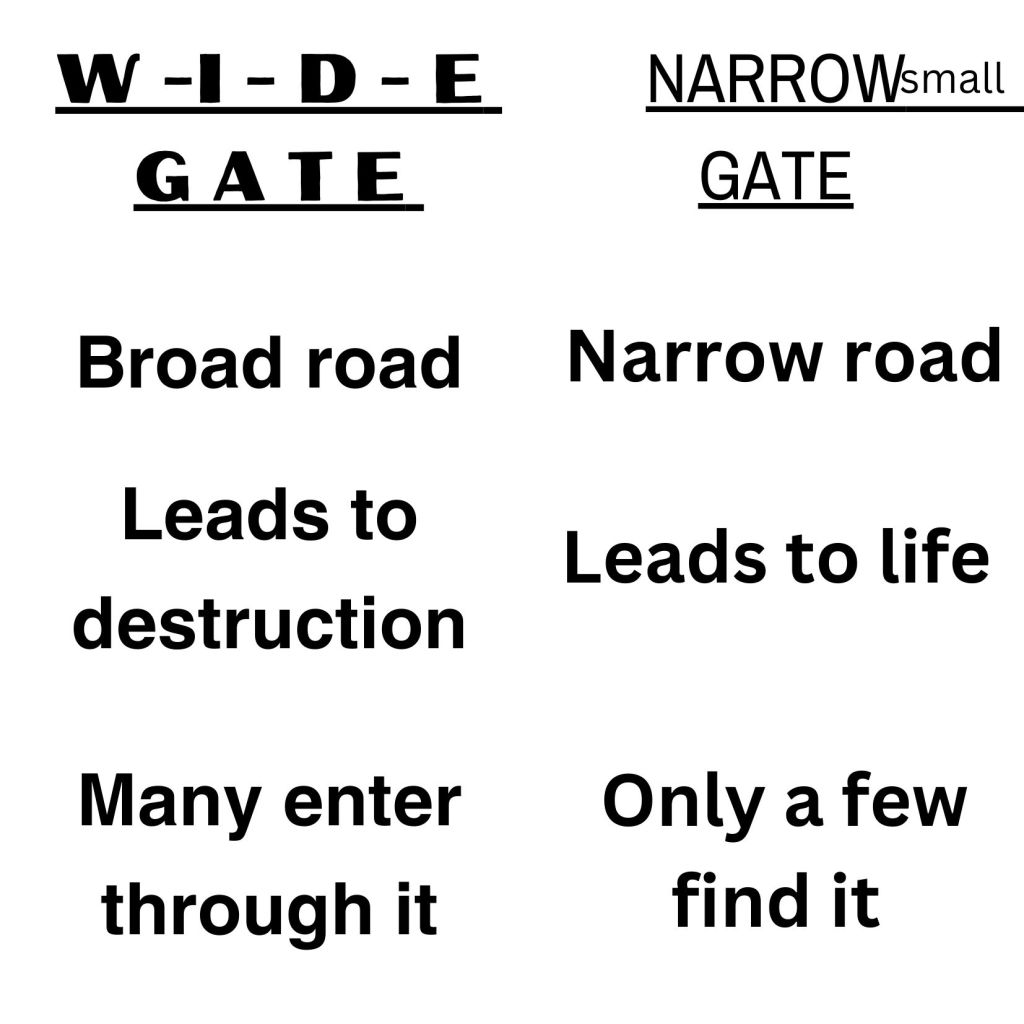
I am a visual learner (though not too artistic) so I made a simple little chart in my journal of the two gates in Matthew 7:13 & 14- two simple little verses with a very big lesson.
It brings to mind the repeated refrain of the desperate teenager arguing with his or her parents to be allowed to ___ (fill-in-the-blank with whatever popular but not always wise pursuit kids are into at the time), “But, everyone else is doing it!” Unfortunately, even as adults we too often strive to fit in with what everyone else is doing, saying, watching, thinking, and even being. When will we learn that “what everyone else is doing” is not a good argument for joining in but actually should raise giant red flags and make one consider reversing course immediately. MANY are on the road leading to destruction. It is popular, easy, fun, attractive, politically correct and what everyone else is doing. It is where your friends and neighbors and co-workers are and likely some family and church members, too. It is where the majority live and work and play, where entertainment and media, social and otherwise, hang out, and where influencers thrive. Why wouldn’t anyone want to join in? Just one reason. It. Leads. To.
Destruction.
Not just a bad day, not just a mistake, not just a lesson learned, but destruction, final and ultimate and forever destruction. Many are headed there now. Many are on that road. And you know them. You might be them. This popular road is also the road with the teenager (and now even younger) tragically contemplating and committing suicide. This is the road with the pregnant hopeless woman planning an abortion. This is the road that is raising way too many of our world’s children and youth. This is the road with ferocious wolves dressed up as harmless sheep. This is the road with hatred and despair and deception grotesquely mixed in amongst the glittery fun popularity. This is the overflowing road that leads to destruction.
Who will find the way out? Just. A. Few. Will I? Will you?
Remember that surprise we were saving for the end? The WORST surprise ever? Jesus said that MANY (where did we see that word recently?) who appear to know Jesus and speak in his name – who even drive out demons and perform miracles in his name – will be told by Jesus, “Away from me, you evildoers!” as he denies them entrance into the kingdom. And if you aren’t going into the kingdom the only other option is that wide slippery slope of a road that drops you straight into destruction.
This is one of those many times in the Scriptures where I want more information to answer all my burning questions starting with, who are these (many) people? Yeah, I want names, Jesus, but if you can’t give me that, at least some more details… What denomination(s) are they? What hidden sins? Who do they believe Jesus is? Are they wrong? Is that why they are denied? What role does pride play? Are these different from the wolves in sheep clothing? They kind of seem to be “better” good and effective “Christians”- are they? Do they think they are? It seems they look really good on the outside, could something be wrong on the inside? Have they fooled even themselves?
But the most important question is: How can I make sure I, and the ones I love and care for, are not in this group? And Jesus does give us that answer. Do the will of His Father in heaven. ONLY the people who DO the WILL of GOD will be allowed into eternal life anew in the Kingdom of God. Just wearing the Christian name is not the ticket. Merely calling Jesus Lord is not enough. Even driving out demons and performing miracles – which do appear to be convincing signs of doing the will of God – is not enough to prove one is actually doing God’s will. GOD always knows who is and who isn’t doing His Will. And Jesus isn’t fooled either. It is indeed much harder for us to see and always know who Is and who Isn’t doing the will and work of God. We are told that false Christs and false prophets and even a powerful beast of the earth will come with great signs and wonders in order to deceive. (Matthew 24 and Revelation 14).
Don’t be deceived. Don’t deceive yourself. Don’t set yourself up to receive the worst surprise in the world. Don’t join them on that wide road. Don’t let your last words be, “But everyone else was doing it.” Don’t be tricked into believing you have to stay on that wide road if that is where you are now. Get off. Change your course. Change your destiny. Fight against that loud crowd and find your way to the unpopular narrow road. Do His Will. And in order to DO that – you need to study to know Who God is and what His Will actually is so you won’t be tricked into thinking you are good and safe and got your ticket in. Be one of the few heading toward the narrow gate doing God’s will. It is the only way to life.
-Marcia Railton
Reflection Questions
What do you think makes the wide road so popular?
Do you find the narrow road appealing? Why or why not?
Which road do you think you are on now? What evidence do you have? Is this where you want to stay? Why or why not?
With the information you have right now, what do you think doing God’s will would look like for you today? Are you doing it? How can you learn more about what God’s will is for you? What’s the danger in not learning more about God’s will?
If Sarai of Genesis 16 was my neighbor or Bible study partner or worse, my daughter-in-law, I’m not sure I would like her much. There is the big problem of Sarai sending her maidservant Hagar to sleep with her husband Abram. Perhaps, with a bit of study I could accept this as a cultural Canaanite tradition which was indeed an effective way of fulfilling God’s first command to Adam and Eve: Be fruitful and increase in number (Genesis 1:27). It gets trickier to do this God’s way when there are more than two people on earth, but still no law. In fairness to Sarai, she did not have the benefit of God’s law yet as she was born hundreds of years before Moses. But, even if I were to give her grace and excuse her from that act, there is the whole problem with her attitude and overall mean spirit. Even when her plan works out as she had orchestrated, she quickly casts blame on her husband and mistreats/abuses Hagar. Not a pretty picture, Sarai.
I am glad I am so much better. I would never impatiently try to help God give me blessings in my own way not His. You would never find me blaming my husband. And I have certainly never ever mistreated – anyone. Well, probably not enough to make them run away into the desert.
Maybe, I am exactly what Jesus was talking about in Matthew 7 when he begins, “Do not judge, or you too will be judged. For in the same way you judge others, you will be judged, and with the measure you use, it will be measured to you” (vs 1-2). Unfortunately, the world has heard just the first three words, “Do Not Judge” and has twisted Jesus’ words into permission to sin and accept sin. But that is not the case! Jesus tells us over and over again (and even multiple times in this same chapter) to look carefully and judge whether people and actions and ideas are good or bad, righteous or wicked, wise or foolish, innocent or dangerous, taking us closer to God or further from Him. He warns you and I about the wolf in sheep’s clothing who wants to deceive you and figurative dogs and pigs that will tear you to pieces. And if you have already decided that it is not your place to judge if they are good or evil or to discern if they want what is good and godly for you or what will destroy you, then I fear you are already sitting in a very dangerous spot.
So, what did Jesus mean when he started out with the words, “Do not Judge…or you too will be judged” and then gave the excellent illustration of the speck and the plank? Make sure you read it for yourself from Matthew 7. I think he was saying judge yourself first in order to be helpful in then spotting sin in others. Specks are hard to see clearly when we have a plank lodged in our eye socket. And our restored sight is crucial in then being able to delicately help our neighbor remove the irritating speck in their eye. When we judge rightly we can start out by putting every single one of us in the sorry sinking boat of sinners in need of a Savior – and make sure you jump into that boat first. Stop bad talking and blaming the neighbors and church members and see yourself for what you are and what you do. Don’t sugar-coat the truth trying to make yourself look better than the rest.
I am no better than Sarai. I have been quick to blame my husband and my kids and my friends, when the fault was more with me. I have mistreated people, sometimes to their face, sometimes behind their back. And I have tried to ‘fix’ things my way rather than patiently trusting God for what He said He would do in His time. I can be very selfish and prideful and rude. And the list goes on. And if I don’t accept and work to correct these problems and sins in myself FIRST then I will be hypocritical and ineffective when I, with that plank still stuck in my eye, turn to help my neighbor who has a speck in her eye.
Jesus was not saying specks and planks are okay and we should leave them be. Sin is not okay. He was telling us the order in which to judge and correct – self first SO THAT you can actually be useful in helping others recognize and remove the sins that are affecting their sight and health and well-being. Sin surgery for yourself first. Recognize it for what it is and get it out! Then look with compassion not contempt on the Sarais and Hagars and neighbors of the world, some of whom do not even know God’s law and have no idea they are stuck in evil because they only heard “Do Not Judge” and never heard the rest.
-Marcia Railton
Reflection Questions
When you honestly look at yourself what sins do you find? How can you work at removing them? What roles do Jesus and God’s word play in surgery to remove sin?
When you encounter sinful stories how can you respond less like a hypocrite and more like “The God who sees me” that Hagar experienced in the desert in Genesis 16?
What is the problem with not judging what you see around you?
How does Matthew 7:12 relate to the “Do not Judge” part of Matthew 7? In what other situations is it wise to live by Matthew 7:12?
Treasures and worry – those two things go hand and hand so often. No matter how much treasure or money one has or doesn’t have it is common to grow anxious about getting more or protecting or hoarding what one already has. And I am guessing it isn’t just a modern problem, as Jesus so wisely blends his teaching on these two topics in the second half of Matthew 6.
Today’s passage has so much wisdom! Make sure you read it for yourself – even multiple times – it is short. Jesus begins this section (Matthew 6:19-34) by warning about storing up wealth here on earth where all sorts of uncertainty can steal it away in a jiffy (and that was even before the stock market). He asks us to examine what we hold dear, “For where your treasure is, there your heart will be also” (6:21). And your heart can’t love and treasure both God and money. You have to choose which you will serve. Which will you go after? Which will you give your life to?
It is recorded that immediately after saying, “You cannot serve both God and money.” Jesus said, “Therefore, I tell you, do not worry about your life…” Do you notice the correlation? If you choose to serve money – be prepared for the worry that goes along with that – do you have enough, will it buy what you want, will you look good enough, will it run out, what will you do if or when it does? But, if you choose to be wholeheartedly devoted to serving a great big God and keeping His first things first in your life, the rest of the worries of life practically dissolve as you put your trust in the One who cares for the birds of the air and the lilies of the field and loves you so much more. What comfort and peace comes to replace the worry and striving when we know that God knows what we need and He is the best at providing that and more when we seek Him first.
Right now, we are half way into an anti-worry/money experiment at our house. About a year and a half ago my husband decided it was a good time to start looking for a new job. I was working hard at giving him my full support. And yet…there was a little cloud of uncertainty as to if this was the right timing – because anyone serving money would be quick to say it didn’t make any sense to change jobs then. At the time his current employer was an educational institution which generously paid out very healthy tuition benefits to the school of choice for our college age kids. It was a pretty good deal we had already benefitted from for several semesters and many college bills. But, we still had two in college and weren’t sure how in the world we would make up all the thousands and thousands of dollars we would not receive for their college bills for the next three years, while also not wanting them to graduate deep in debt.
The unknown can be hard! Of course we want to provide for our kids and be wise with our finances and sometimes it’s hard to know what that should look like. But while wrestling with this decision: pursue a new job now or wait – a light-bulb moment gave me peace. My light-bulb said, “Marcia, you have been trusting (insert name of husband’s employer) to pay those college bills, but don’t you know that God can be trusted much much more?” And with that came peace, not all the answers of where the money was going to come from – but peace that my God was indeed much bigger than anything or anyone else I could put my trust in – and He knows what I need and He can provide it in ways I never would have thought of.
So, we are half-way in. We had three years of college bills left and now we have just 1 ½ years. My husband DID start a new job and it has been a great change for us all! He likes his new employer and responsibilities a lot. And, he is able to work from home and my daycare kids and I love that! I have found I also enjoy tutoring and teaching sewing lessons and the people that has brought into my life, which I probably never would have thought to try if I hadn’t been searching for ideas to contribute a little bit more. And those college bills, they are getting paid. We aren’t even always sure how, but the money is there over and over again. Ask me again in 1 ½ years and I am sure I will have even more examples of God’s overwhelming faithfulness.
Our Father loves to prove Himself true and reliable, but we will never know it and see it and experience it for ourselves if we keep serving and trusting in our man-made treasures and pleasures.
Keep Him first! He is big enough to provide what you need and more and He also knows what you don’t need. Keep your eyes on Him, His righteousness and His Kingdom. You don’t need a fast buck or a larger bank account. You need eternal life and your treasures on earth can’t buy that. Release your worry and grow in your trust in the God who creates, sustains, and makes all things new.
-Marcia Railton
Reflection Questions
Every life serves something or someone, sometimes self. Who or what are you trying to serve? Are there any instances where you are missing the mark or competing with mixed loyalties or masters? What corrections can you make? Will you? Why or why not?
How has God shown Himself faithful in providing?
How can you focus on God, His Kingdom and His righteousness? If you do that well, will this help you worry less?
Looking for some more help on overcoming worry (especially over money)? I found very helpful a UPS driver illustration Rick McClain shared in a SeekGrowLove devotion in 2021 and have brought it to mind many times since. You can read it here.
Remember how we recently read in Matthew 5 to SHINE – “before men, that they may see your good deeds and praise your Father in heaven.” (Matt 5:16). And, then we get to Matthew 6 which begins, “Be careful not to do your ‘acts of righteousness’ before men, to be seen by them. If you do, you will have no reward from your Father in heaven.” (Matt 6:1). One says do your good deeds before men while the other specifically says don’t do your acts of righteousness before men. Is there a contradiction there? I want to follow Jesus, I do – but sometimes…I am not exactly sure what it should look like. But, over and over again I find I am the one that needs to grow in my understanding and action. So, let’s dig a little deeper and see what we’ve got here.
In our SeekGrowLove Bible reading plan last year we focused on looking at what we can learn about God or what He reveals about Himself every time we read His words. I learned a lot. I had a great year journaling and marking in my Bible margin little asterisks when I read descriptions of God, what He’s like and what He likes, what He is doing and will do. In the gospels it is extra fun to find all the descriptions of God given to us by one who knows Him so well – His Son Jesus. I have found it can be very valuable to read God’s word not as a checklist of do’s and don’ts but as a search for more and more about our Heavenly Father.
These first 18 verses in Matthew 6 on giving, praying and fasting seems at first to be primarily a lot of direction on what we should be doing – and sometimes what we should not be doing. But, upon looking closer – there are quite a few asterisks in my margins. God, specifically called ‘Your Father’, shows up, again and again. Twice He is referred to as unseen – perhaps in contrast to the Pharisees and religious leaders who enjoyed making themselves very well seen, and perhaps just as a reminder we all need – God is here – don’t be fooled at just concerning yourself with what you can see with your eyes. He is unseen and very real.
In each of the three sections on giving, prayer and fasting Jesus states, “your Father, who sees what is done in secret, will reward you.” So, even though He is unseen, He sees. There are no secrets we can keep from God. He sees it all. And when He sees what He likes – giving in secret to the needy, one-on-one prayer with Him, and fasting in secret – he will reward us. He is real, He sees and He rewards, when we do it right.
So, what is the wrong way to give, pray and fast? They all seem like good deeds to do – should we shine while doing them? Jesus answers that question – give, pray and fast, but don’t do them, “before men to be seen by them.” When we are putting on a holy show to let others know how good we are – that is when God says, “I got nothing for you – you already received your praise from men. You weren’t really looking for My praise anyways. You wanted to look better than the rest. Your pride was lifting yourself up. You weren’t pointing people to a Me. You were just plain showing off and trying to create a name for yourself.” (This was also what the Tower of Babel folks got in trouble for in our Old Testament reading of Genesis 11 today – trying to make a name for themselves).
So, it becomes another heart issue where motive and manner is extremely important. What is your motivation to give, pray or fast? Do you have selfish reasons and are motivated by looking good? Do you do it in a manner to get the most attention and eyes on you? Just remember, God sees, too, and He ain’t happy. Those acts of righteousness were supposed to come from a pure and sincere heart seeking ways to thank, honor and draw closer to your Father in heaven. But you took that sacred interchange between yourself and Him and cheapened it by broadcasting it before men.
But what about those good deeds that we ARE supposed to do before men SO THAT God is praised? It seems the “good deeds” category is different and perhaps broader than the “acts of righteousness” we just discussed. While the acts of righteousness were things we do for and with God (and most appropriately in secret), the good deeds are what we can do for and with others. Motive is still really important. No one (least of all, your Father) wants to see your good deeds that are only done to bring praise to yourself. How do we do good deeds that others will see, and when they do see, they will praise our Father in heaven? Perhaps (like always) the best answer and example is seen in Jesus. As we read through the rest of Matthew let’s look for what he does in secret with and for His Father and what he does before men to bring praise to His Father. What are his acts of righteousness and what are his good deeds? Can we tell what his audience and motives are in each?
-Marcia Railton
Reflection Questions
How are you doing with your acts of righteousness? Do you think God sees and is pleased? What motivates your acts of righteousness – where is your heart? What would you like to do better – for Him?
In Matthew 6:8 what do we learn about your Father? How is this reassuring to you? How can knowing this affect your prayers? What do you learn from Jesus’ model prayer in verses 9-13?
In Matthew 6:14 & 15 what do we learn about your Father and forgiveness? Why is this so important? Is there someone you need to forgive today?
Would you rather have been born in the Old Testament era when following the law was the measure of one’s righteousness, or born after Jesus came and shook things up a bit? Keep in mind that the Old Testament law as delivered through Moses was not just the good old Ten Commandments (which we sometimes have a hard time remembering and living by) – but roughly 603 additional laws throughout the first 5 books of the Bible. God’s people were expected to know them and live by them, a long list of what to do and what not to do. And there was punishment and judgment when the people didn’t do what they were supposed to do and did what they weren’t supposed to do.
Then comes Jesus. He is probably best known for his love. We love to remember how he answered the burning question: What is the greatest commandment? The Jews had tried for over 1,000 years to keep all these commandments. Some of the religious leaders (the Pharisees) prided themselves on how well they did it. And they had even added to the number to create more laws to try to keep the people further from breaking one of God’s important laws. And Jesus took all those 613 plus laws and said the most important was “Love the LORD your God with all your heart and with all your soul and with all your mind…and the second is like it: Love your neighbor as yourself. All the Law and the Prophets hang on these two commandments.” (Matthew 22:37-40). Well, that simplifies matters. Love God. Love people. Sounds simpler. Sounds almost easy.
But, wait there is more.
Back in Matthew 5 Jesus introduces this new “law”, this new way of life and new way of measuring righteousness. He started his Sermon on the Mount not with a list of laws to keep with punishments if you don’t – but with a beautiful list of attitudes to keep and the rewards for those who do. Next he gives us jobs to do – be salt and light – all the time – shine – be different – do good – not to look good yourself, but to bring glory to your Father in heaven.
Jesus realizes this is different. This doesn’t sound like Leviticus any more. He knew people would accuse him of completely overturning and throwing out the Old Testament law. He clarifies, “Do not think that I have come to abolish the Law or the Prophets; I have not come to abolish them but to fulfill them.” (Matt 5:17). Something is up but we aren’t exactly sure what yet. But, it’s not throwing out the Old. It’s like there is a new measuring stick in town. He even goes so far as to say that NOW we need to be MORE righteous than the Pharisees and teachers of the law if we want to enter the Kingdom. (I am sure they loved hearing that.) And then he proceeds to give several examples of Old Testament law, with his new Jesus spin added.
The next six sections in Matthew 5 all begin with some variations of, “You have heard that it was said long ago…but I tell you…”. And Jesus takes the Old Testament laws regarding murder, adultery, divorce, oaths, eye for an eye and loving your neighbor and ramps them up. No longer are you called good if you can merely check the box for not murdering or committing adultery. Now, you have the larger job of also controlling your anger and your lust – the heart issues that originally led to the breaking of the Old Testament law.
God gave the law and it is good. But, His desire was never to create legalistic robots without a heart. His desire was not to create a people that praises themselves for keeping a long checklist of do’s and don’ts, but misses seeing the needs of their neighbor. His desire was not to create a people that only loved those who love them.
So, it was time to add more. Time to add His Son who would teach us and show us how to love.
God gave us His Son and he is very good (though the Son would tell us that only His Father is good because he was always drawing distinctions between himself and His Father and giving praise to his God and his Father not himself). We have so much to still learn from Jesus about this new, life-giving, from the heart way of life. Jesus wants to teach us what God is looking for. And in Matthew 5 we see God is looking for heart, love, devotion, reconciliation, self-control, commitment, purity, truth, generosity, prayer, compassion, gentleness. And perfection. That’s all.
The new is better. But not because it is easier. Where would you rather be?
-Marcia Railton
Questions for Reflection
It is time for a heart check. Are you more righteous than those who worked so hard to keep the Old Testament? Do you pride yourself on being better than others? What heart issues have led you to breaking the law in the past?
How can you work towards godly perfection today? Maybe try re-reading Matthew 5 looking for what heart changes God would like to see in you.
What do you learn about Jesus from Matthew 5? How does he fulfill the law and not abolish it?
According to a study by the NORC at the University of Chicago, the last three decades have seen a rapid decline in those who confidently believe there is a God. In 1993, two-thirds of respondents answered “yes” to the claim they “know God exists and have no doubts.” In the most recent survey taken last year, this number has been reduced to 50%. That means in roughly a generation, 50 million Americans have reduced, abandoned, or failed to pass on their faith. No doubt, we are seeing the symptoms of this in our culture, where the most influential theology being preached is that each man or woman is their own idol and that their identity, narrative, or definitions supersede any relationships, including God.
“The Lord saw how great the wickedness of the human race had become on the earth, and that every inclination of the thoughts of the human heart was only evil all the time.” – Genesis 6:5
“Remember this! In the last days there will be many troubles because people will love themselves, love money, brag, and be proud. They will say evil things against others and will not obey their parents or be thankful or be the kind of people God wants. They will not love others, will refuse to forgive, will gossip, and will not control themselves. They will be cruel, will hate what is good, will turn against their friends, and will do foolish things without thinking. They will be conceited, will love pleasure instead of God, and will act as if they serve God but will not have his power. Stay away from those people.” – 2 Timothy 3:1-5
I would love to end this first week of 2024 on a more positive note, but here we are at the ministry of Noah, and I can’t help but see the correlations. I consider myself a church half-full, not half-empty type of person, so please understand I am not hanging an albatross around the neck of the place I call home. Recently, we have seen and could see more revival as people realize there is no salvation in pursuing self. Nevertheless, as it stands today, it seems like the wind is blowing hard in a different direction, and I can’t help but look at the forecast and know that the rain is coming. It may not be here or now, but it is. It is so disheartening to see people jump off the boat, abandon their God, so they can instead find their own way swimming to survive. I want none of us to be the next person overboard, so let us be ready to answer the challenges of the storm that very well may lie ahead, and be defiantly obedient as the prescriptions of Jesus in Matthew 6
Leave your righteousness at the door – Jesus says that if actions are done for the sake of being seen by others or if we are religiously pious thinking that we are worth saving and others are not, that we have already received our reward in full. Noah was the only righteous man left, but while building the boat, he did not tout his own righteousness. He preached to bring salvation to others, even if it fell upon deaf ears. We do not decide who is and isn’t worthy (see: Jonah). Our own righteousness is as filthy rags and none of us can be restored without the atonement of Jesus.
Extend the grace of forgiveness of God – If for no other reason, we should forgive because it is the measure for which we are forgiven; however, we forgive because we have the love of Christ that shows us mercy every time that we fall short. By simply listening and looking for those who thirst, we become more like Christ. A quote that has stuck with me by psychologist Russell Barkley, “The children who need love the most will always ask for it in the most unloving ways.” Do not let rhetoric or trespasses keep you from loving those who need Living Water. You can be the bearer of grace and forgiveness they are most desperately looking for if you cut through the crap and see the child of God.
Endure any suffering with joy – Those of us in the United States have enjoyed a pretty good run of Christian values as the dominant culture. While this run has been far from perfect, it has been easy to avoid persecution. It is very likely that my children will not live in this world. God, I pray that they will be able to declare you in a world that will try to snuff them out. For us all, may we endure the coming trials with joy. When we are persecuted because of the Gospel, we suffer alongside Him. What greater joy could there be than to live out the fullness of Christ?
Don’t worry about not going with the flow – God has promised to take care of our needs if we trust in Him and share His words. We may be unflatteringly categorized, lose our social standing, our job, live threatened, or the reality of violence. If God takes care of the flowers and the sparrows, He will take care of you in every single instance. Even though the traffic may be moving against you, be singularly focused on the Gospel of the Coming Kingdom, and everything else will be added unto you. Ask for your daily bread and then get to work for His Glory because the harvest is becoming more plentiful, but the workers are fewer.
-Aaron Winner
Describe the world you live in today. What similarities do you see to the time of Noah?
What do you admire most about Noah? What can you learn from him? What do you learn about God in Genesis 7 & 8?
What is the problem of going with the flow? How can you help yourself, your family, your church stay in the boat?
There is so much to digest in the Sermon on the Mount. Jesus sets the standard of living in all aspects of life and slowly combats the legalistic Jewish culture of his time. Our Messiah makes us aware that His Father can see through our actions, straight to the root, or better yet, the heart of our motivation; this is truly convicting. What may look like altruism or mercy from the outside may, in fact, be manipulation and control in the mind. Out of all the qualities in the Beatitudes, it may be most rare to find someone who is pure of heart.
In Genesis 5, the great-great-great-great-grandson of Adam, Enoch, is given more than the standard father/age line. It states that Enoch walked faithfully with God and then God took him away. Many times the discussion around Enoch prioritizes “Where did he go?” The more important discussion is “How was he so faithful in his walk with God?” I don’t really have an answer to either question, but I will make an inference about the latter based upon the promise within the Beatitudes. Enoch faithfully walked with God because he was pure of heart and he has seen or will see God (Hebrews 11:5-6,39-40).
“Create in me a pure heart, O God, and renew a steadfast spirit within me. Do not cast me from your presence or take your Holy Spirit from me. Restore to me the joy of your salvation and grant me a willing spirit, to sustain me.” – Psalm 51:10-12
To gain further insight into what exactly is a pure heart, we can ironically turn to David at the moment he felt the most disconnected from the Almighty. David had accomplished so much in the name of the God of Israel. Fighting a giant in faith, leading Israel into battle, giving mercy to God’s anointed, becoming king of the chosen people, and writing a myriad of worship songs in honor of the Lord, yet, in his most impure moments, he had committed adultery, was responsible for a cold-blooded death of a man, and was delivered a bleak message by God through His prophet, Nathan. In reflection, David indirectly states that a pure heart is steadfast, focused on the joy that comes from God, and is in tune with the Holy Spirit. Ultimately, David is restored through repentance and the mercies of God and is still considered a man after God’s own heart, the purest of them all.
So what exactly does it take for each one of us to be pure of heart? First, we must be motivated by and steadfast in the love of God. If we are motivated for the glory it will bring to ourselves or in the indulgences of our flesh, we will never be satisfied. There are not enough likes or followers to replace the unconditional attention of your Heavenly Father. Next, we must be joyful in all seasons. When we become motivated by God, we are no longer victims of circumstance but part of God’s salvation plan. Our pressings and persecutions become opportunities to share our promise. Finally, purity is finding and following God’s will through receiving and responding to His Holy Spirit. Let His power lead your feet and the Gospel message . By remaining pure of heart, walking with God, we will see God move and experience the fullness of Him and live with the hope that our faith will be made sight, seeing Him face to face.
-Aaron Winner
Reflection Questions
What grade would you give your heart’s purity (or lack thereof)? For you personally, what motivations, behaviors, attitudes get in the way of having a pure heart? In what ways can you work towards a more pure heart?
How would you describe each of the other Beatitudes in Matthew 5:1-12 – and the reward for each?
Why do you think Jesus started his sermon this way?
The most formidable opponent to our righteousness is the person reflected in the image of a mirror. Being solely tempted is not sin in itself, but it means that we will soon enter the ring or octagon for a fight. The attack will come at the points where we are weakest. Our pride, greed, lust, envy, gluttony, anger, or laziness are soon exposed and without the proper guidance by the words of God, we will soon leave ourselves fully exposed to a finishing move. No matter where the dragging and enticing draw from, submission to temptation to serve ourselves rather than submitting to our Heavenly Father’s will, leads down the slippery slope away from the Kingdom of God.
“When tempted, no one should say, ‘God is tempting me.’ For God cannot be tempted by evil, nor does he tempt anyone; but each person is tempted when they are dragged away by their own evil desire and enticed. Then, after desire has conceived, it gives birth to sin; and sin, when it is full-grown, gives birth to death.” – James 1:13-15
“If you do what is right, will you not be accepted? But if you do not do what is right, sin is crouching at your door; it desires to have you, but you must rule over it.” – Genesis 4:7
We see this pattern unfold in Genesis 4 when Cain is issued a warning directly by God to stop jealousy in its path. God states that “sin is lurking at the door.” By giving temptation a place to live, Cain and each one of us are inviting sin to be the next resident. What started as an unchecked emotion, turned into temptation, which led Cain to selfishly taking the life of his brother. Temptation must be addressed and combatted, otherwise we will find ourselves on a path, either through deliberate action or indecision, that leads us far away from the Will of God.
“Therefore, since we have a great high priest who has passed through the heavens, Jesus the Son of God, let’s hold firmly to our confession. For we do not have a high priest who cannot sympathize with our weaknesses, but One who has been tempted in all things just as we are, yet without sin. Therefore let’s approach the throne of grace with confidence, so that we may receive mercy and find grace for help at the time of our need.” – Hebrews 4:14-16
Jesus, as always, provides our example of dealing with temptation because he was tested in every measure. Specifically in Matthew 4, Jesus is tested in the desires of his flesh, the integrity of his faith, and his pride. Jesus meets each one of these temptations head on, attacking them with words of his Father. In doing this, he removes himself from temptation by placing himself closer to God Almighty. By remaining perfect and being raised to life, He now sits at the right hand of God understanding our struggles and weakness. Christ intercedes on our behalf and beckons us to remember that we have the advantage that Cain did not: we do not have to go through it alone.
The Apostle Peter is no stranger to succumbing , and in all reality, he is the disciple with whom we most identify. His advice to those scattered about Asia Minor in his first letter is to remain watchful and alert for the threat that may approach us. He likens our Adversary to a lion, crouching in the savannah, waiting for our guard to be down and becoming the next prey devoured. We have to be ready for the attack, by remaining sober-minded even in the duress of physical, spiritual, or mental stress. We do this best by filling our hearts with the words of God and repeating them time and again, so temptation is at bay, and when it comes, like Jesus, we are ready to strike it down with the Sword of the Spirit.
-Aaron Winner
Reflection Questions
There is a lot to think about in the following sentence: “Temptation must be addressed and combatted, otherwise we will find ourselves on a path, either through deliberate action or indecision, that leads us far away from the Will of God.” What examples can you think of from your own life?
What temptations do you need to address now?
With what 3-5 specific ways can you combat this temptation?
What roles can God’s Word and God’s Son play in your spiritual battle against sin?
There are some four-thousand years between the first and second Adam, both the bookends of the fall of man. Through the first Adam, sin found a foothold in the world. Through the second Adam, Jesus Christ, the sting of eternal destruction in the second death (Rev. 21:6, Rom 6:23) is broken and restoration that comes from God is complete. Being familiar with scripture and his role as Savior, Jesus knew he was the precious Lamb of God, who upon him was transferred the weight and debt of all our sins. Jesus would go on to fulfill this role as our purification offering, fulfilling the law and the words of prophets.
In a similar manner, Jesus redefines and completes baptism in Matthew 3. Although not defined by religious laws in the Old Testament, baptism had become a common practice for sects of Judaism from the time of Malachi to the beginning of the Common Era. It was performed as a ritual cleansing, done in preparation to ready oneself to make a sacrifice at the temple. This could be done time and time again because of the literal and spiritual uncleanliness that would appear between trips to the Temple. John’s baptism took on this role, specifically for the forgiveness of sins. So why would a sinless Savior need to engage in such a symbol?
“Then Jesus came from Galilee to the Jordan to be baptized by John. But John tried to deter him, saying, ‘I need to be baptized by you, and do you come to me?’ Jesus replied, ‘Let it be so now; it is proper for us to do this to fulfill all righteousness.’ Then John consented. As soon as Jesus was baptized, he went up out of the water. At that moment heaven was opened, and he saw the Spirit of God descending like a dove and alighting on him. And a voice from heaven said, ‘This is my Son, whom I love; with him I am well pleased.’ – Matthew 3:13-17
The first reason Jesus is baptized is as simple as he stated, “to fulfill all righteousness.” Baptism is not merely for the forgiveness of sins. It is first and foremost the public dedication of your life to love God, accept Jesus as Lord and Savior, and live for his Kingdom. To us this means that looking for a pass on sin without submission is not living-saving nor does it accept the grace of God. Specifically, those who participated in the baptism of John for the forgiveness of sin were told to be rebaptized when they knew this Good News.
The second basis for baptism is the fulfillment of the gracious cleansing we receive by the sacrifice of Jesus. Just like the payment of Christ, baptism is once and for all. By being fully immersed in water, we demonstrate not only His death, but our own. Likewise, in rising out of the water, we illustrate the cornerstone of our hope, that Jesus has risen from the dead. Furthermore this illustrates by dying to Him, we are raised to life, asking the raised Christ to live in us as Lord of our life today and being assured of the hope of our own resurrection if we remain faithful.
Arguably the third purpose for baptism is the invitation of the Holy Spirit in our lives. Jesus is shown this power of God at His baptism, and the Holy Spirit descending onto ministry of miracles. Baptism, in fullness, is an invitation for the Spirit of God to direct your path (Rom 8:14), bear fruit because of its presence (Gal 5:22-23), and to even comfort in times of hardship or grief. (John 14:26) It is the same power that raised Jesus from the grave that can now live in us. (Rom 8:11)
If you haven’t considered baptism up to this point, what is stopping you from such a confession of faith? Baptism is not the culmination, but the entry point of faith. You do not have to understand the nuances of scripture, only that our Heavenly Father sent His Son into the world to die for your sin, and they are coming back to Earth with eternal life in hand.
If you have already dedicated your life through this public confession, hold close to your heart the promise that is in the symbol. Time and time again, we trip, stumble, and fall flat on our faces, but with each fall, we are lifted out of the waters of baptism and covered in the grace of God through Jesus Christ. Thank God we do not have to be reimmersed. Many of us would spend the vast majority of life underwater. We can confess to Heavenly Father with a repentant heart and the power of baptism in Jesus Christ not only banishes the wages of sin, but gives us the present presence of God for now and for eternity.
-Aaron Winner
Reflection Questions
If you haven’t considered baptism up to this point, what is stopping you from such a confession of faith?