Seek Not to Please Myself

John 6-7

john-6-35

Saturday, May 27

As I started reading John 6 & 7 a few key quotes from Jesus recorded in the end of John 5 were still ringing in my ears:

“For I seek NOT to please myself but him who sent me.” (John 5:30)

“I do not accept praise from men…How can you believe if you accept praise from one another, yet make no effort to obtain the praise that comes from the only God.” (John 5:41, 44)

Here Jesus Christ, the Son of God and Son of Man, was saying quite clearly and repetitively – it’s not about me.  He did not seek to please himself or earn the praises of men – his goal was only and always to please God and hear the praises of his Heavenly Father.

Chapter 6 begins with this same Jesus feeding the famished five thousand with five small barley loaves and two small fish – and ending up with twelve baskets of left-overs.  As the one primarily responsible for feeding my family of 5 three times a day, I have always been greatly impressed with this miracle!  And, he follows it up with walking on the water!  There is no doubt that this Jesus has just earned some serious bragging rights.

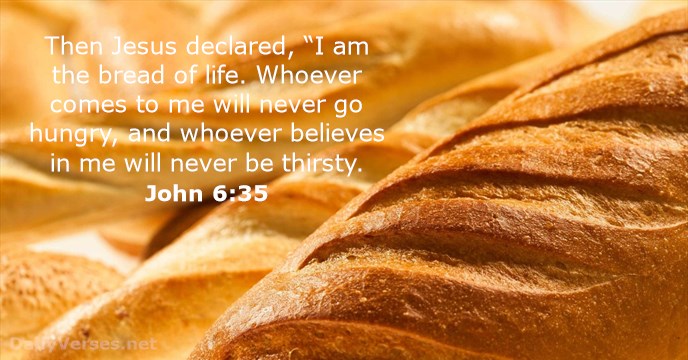
Instead, he turns it into a teachable moment and offers himself as the bread of life – the bread and body that must be broken for others to live.  This is what he offers to the world not because he is the one who dreamed it up, and not because he was looking forward to it, and not because he desired it – but because he knew he came, “Not to do MY (Jesus’) will but to do the will of him who sent me.” (John 6:38).

In Chapter 7 he continues, “My teaching is not my own.  It comes from him who sent me.” (7:16) and “I am not here on my own, but he who sent me is true.” (7:28).   While some wanted to kill him, others wanted to make him king.  And yet – none of that really mattered to Jesus.  He was teaching God’s Word and living – and later dying – God’s Will.  His one-track mind and life was centered on what his Daddy desired and had planned from the beginning of the world.

Two things seem clear.

First, Jesus was definitely NOT claiming to be God, nor did he desire to be considered as God in any way.  His repeated use of, “not me/mine…but He/His” were pointing out the differences – two beings, even though their purposes would be the same – at Jesus’ choosing.  Today, would I hold any credibility if I stated, “I do not seek to please myself, but only what I want?”  Or, if I said, “My teaching is not my own but it comes from me”, would people listen to me for long?  Over and over again, Jesus is drawing some pretty clear lines between His Father God and himself.  Two beings, united in purpose – because that is what Jesus chose – to follow His Father and not himself.

Second, how must I change my focus, my goals and my everyday life so that I, along with Jesus, can confidently say, “Not my will, but His be done,” “My teaching is not my own, but God’s.”  “I seek not to please myself, but my Heavenly Father.”  No doubt the Son of God set an example for us to follow.  It is a path that requires laying aside all selfishness and pride, as well as false teaching.    It is not an easy road.  But when we live our life to please God our Father, just as Jesus did, we won’t be disappointed in the end!

-Marcia Railton


(Photo Credit: https://dailyverses.net/john/6/35)

Aspiring to Be a Servant

Luke 22

luke 22

In Luke, Chapter 22, Jesus sits down to have a Passover meal with his disciples.  Starting at the top of verse 24, Jesus immediately begins to interject into an argument between the disciples over who is the most faithful.  Jesus, rather, intercedes to say:

            “The kings of the Gentiles lord it over them, and those who have authority over others like to be called, ‘friends of the people’.  But you must not be like that.  Instead, the greatest among you should be like the youngest, and the leader should be like the servant.” (Luke 22:26)

This is an important moment for Jesus’ disciples on a personal level, because at this point in time, they all would have lived through one of the most difficult times in Israel’s recent history.  They would have seen various rebellions waged against the Roman occupation of Jerusalem, none of which were successful and all of which provoked Rome unnecessarily.  Jesus had seen the Roman occupation for what it was, an inconvenient change of circumstance that only affected the political structure of Jerusalem.


Jesus believed that matters on one’s own internal spirit were where the importance was, and so his statement to the disciples is more than just a generalization regarding their attitude as his followers.  It’s a personal rebuke of the mindset most Jews would have lived in, especially from the poor, hard-working classes of people from whence many of his disciples came from.  For the people at the bottom of the totem pole, Jesus knew, it mattered not who was at the top.  His disciples, and most of us at large, are yet to truly understand that as well as Jesus did.


-Dillon Driskill

An Impossible Question

Luke 20-21

luke 20

Tuesday, May 23

Throughout chapter 20, the Pharisees attempt to undermine Jesus with trick questions, and starting at verse 20, they decide that they’re going to try to pose him another unanswerable question. They comment on his lack of favoritism in his teaching, although it seems to imply that they are cynically calling him out on a lack of respect for authority. Following up on this, they ask him another question meant to undermine his teachings.

They ask Jesus whether or not they have an obligation to pay taxes to Caesar. This has an important historical context behind it, because there had been several Jewish revolutions against Roman occupation that had turned out terribly for the Jews. The Pharisees, who were cooperating with the Roman governors much to the expense of their own people, were essentially asking Jesus an impossible question.

Consider this, if Jesus had answered that they were obligated to pay taxes, then he would be implying the relevancy of both Roman authority and the authority of Pharisees and would be undermining the tenacity of his own teachings. However, if he had spoken against the need to pay taxes to Caesar, he would be openly defying Roman authority and so would be putting himself on grounds of treason, and would have been executed as quickly as it could be reported to the Romans. As it was, Jesus’ answer was simple and avoidant, while also proving a much larger point to them. His response is to take a look at whose face is on the coin, which was Caesar’s face. He then tells the Pharisees to give to Cesar what is “his” and give to God what is “God’s”.

Not only did Jesus successfully navigate around their impossible question, but he also gives a stronger context for understanding his teachings as well. This seems to tie into what Jesus meant when he said that his purpose was not to destroy the law, but to fulfill it. According to Jesus, the call that we have is a moral one beyond the law or social convention. Neither is he advocating that law is unnecessary. Rather, he invites us to be pragmatic about the circumstances, but understand that the truth he teaches is a way of finding meaning in our lives, rather than how to simply conduct it.

-Dillon Driskill


(Photo Credit: https://www.jarofquotes.com/view.php?id=and-he-said-unto-them-render-therefore-unto-caesar-the-things-which-be-caesars-and-unto-god-the-things-which-be-gods)

Coming to Jesus for Healing

Luke 19-20

508x306xLuke19-10.jpg.pagespeed.ic.VgcXwAvHSW

Monday, May 22

The ending of chapter 18 and the beginning of chapter 19 have an interesting parallel. Whereas the end of chapter 18 includes the story of Jesus curing a man of his literal blindness, in chapter 19 Jesus cures another individual, Zacchaeus, of his figurative blindness. However, there’s a reason why Zacchaeus is so memorable, and it’s probably obvious to those of you who’ve ever gone to Sunday school as a kid.

Zacchaeus is remembered as “the guy who climbed the tree”, and that’s not an insignificant detail of the story. In fact, (in my translation, at least), there’s nothing in the beginning of chapter 19 that necessarily states that the events of the two chapters happened in linear order. In fact, it could have been that Luke himself placed the story of Zacchaeus directly after the story of Jesus curing a blind man on purpose, and perhaps to indicate something to the reader.

My interpretation of why these two stories correlate together goes like this; Luke shows that Jesus was capable of curing people of their blindness. He shows us Jesus curing a man of his literal “blindness” to show Jesus’ ability to purify us. After this, he tells the story of Zacchaeus who not only received redemption from Jesus, but he had to exert a clear effort, (so much so that he had to physically and figuratively rise above the crowd), and from there Jesus was able to find him and make his way to him. What Luke seems to be relaying to us here is that Jesus has the capacity to redeem us, but that it’s not enough to know this. Having this knowledge is only the first part, and the second part for us is pursuing him ourselves. Whatever qualities Jesus has to purify us and turn our lives around, it is something that we must actively pursue before we’ll really be able to experience it.

-Dillon Driskill


(Photo Credit: http://www.daily-bible-verse.net/Luke19-10.html)

Millstones, Specks, and Planks

Luke 17-18

luke17-1

Sunday, May 21

            This chapter of Luke opens as such; with Jesus saying, “Temptations to sin are sure to come; but woe to him by whom they come! It would be better for him if a millstone were hung round his neck and he were cast into the sea, than that he should cause one of these little ones to sin.” Jesus often reserved his rebukes and warnings for the Pharisees who sought to undermine him, but here he warns his own followers about not just how they conduct themselves, but warns them about how their conduct is influencing those around them.

An easy way to compare this verse to real life is when a young child behaves badly in public. Often, you’ll hear those nearby make remarks condemning the parents of the child. Well, you could simply leave it at that and go on thinking that Jesus was condemning those who directly influence young ones to behave badly. Like most of Jesus’ teachings, however, it’s not that simple. He follows this line up directly with an analogy of a man who sees a speck of wood in his brother’s eye, but does not see the “plank” in his own.

They say it takes a village to raise a child, and so in keeping with the example of a misbehaving child, we should perhaps temper our own knee-jerk criticisms of people whom it is easy to scapegoat issues onto. Perhaps those commenting around the misbehaving child should ask themselves who they’re influencing, and what kind of example they’re setting when concern for someone’s child turns into gossip about their family. This seems to be Jesus’ point in relaying the analogy of the two brothers. On the one hand, he calls us to avoid setting a poor example, but on the other, he warns us against “witch-hunting” others whilst failing to examine ourselves.

-Dillon Driskill


(Photo Credit: https://reversingverses.com/2013/03/17/luke-171/)

Go Plant Some Trees!

Luke 12-13

hands-holding-seedling-posters

Friday, May 19

I like three things more than most anything else, sailboats, stars, and trees. No particular reasons other than I am fascinated by how they work and what they look like. My interest in trees started when I was young when I learned from my Grandpa Ben that trees grew from these tiny little things called acorns. It was and still is amazing to think something so small has such great potential.

Jesus uses this illustration to compare the mustard seed to the kingdom of God. “It is like a mustard seed which a man took and planted in his garden. It grew and became a tree, and the birds of the air perched in its branches..” Luke 13:18-19 Something that seems so small now, will eventually grow to be very large and influential in this world. Just like the man in this illustration where he took the seed and planted it in his garden, we too must plant the kingdom in our gardens. In other words, the kingdom lifestyle should be obvious in our lives. Though the kingdom will be fully established when Jesus returns it is our responsibility to live as if it is a reality now, and see to it that it grows.
I think its crazy that Jesus gave us the responsibility to grow the community of Kingdom citizens. With that said, what are you waiting for – go plant some trees!
-Jesse Allen

Got To Tell Somebody!

Luke 10-11

harvest lo Luke 10

May 18, 2017

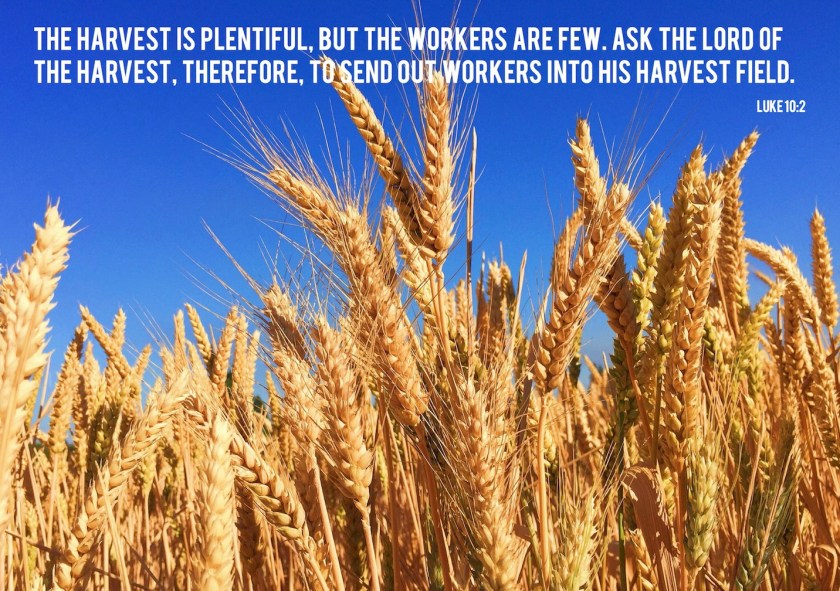
Have you ever tried to go evangelizing by yourself? Its terrifying! Unless that is your gift and it just comes naturally, evangelism can be pretty intimidating. Especially when you are trying to get people to see that they may not be right about a certain issue or topic. Even though we have carefully thought out every verse and illustration it always seems to fail. I think Jesus knew this because of Luke 10:1-16.

Although it was customary to send two people on journeys to deliver messages, I think Jesus knew this way of evangelism would boost the confidence of the messengers. This section of verses causes me to think about being more intentional about evangelizing and talking to others about my faith, but approaching it with a friend or mentor in the faith.
Though, when we fail, even together, we should understand that we will not reach everybody. That is what the last part of this passage is talking about when it mentions “wiping off the dust that clings to your feet”. Not everyone we talk to can or will be convinced by us.
When will be the next or first time you intentionally go tell people about the Kingdom?
-Jesse Allen
(Photo Credit: https://engageworship.org/ideas/luke-10-visual-reflection)

Great Faith

Luke 7-9

great20faith

Wednesday, May 17

Great faith is not always defined as a noun. I feel like in church that we sometimes believe things with our minds more than we believe them with our actions. I would argue that Jesus thought the same about some of the people he was around when he was still on earth. Except maybe a few were different. Like this one case in Luke 7 involving a centurion.
The centurion knew that Jesus could help. He could have easily stayed in his home and made Jesus come into his house by sending a servant. But the centurion, a man of honor and high authority in the Roman ranks chose not to send a servant to act upon the faith he had in Jesus, and went himself because he knew he was not worthy of having him in his house. The centurion also assumed with faith that Jesus could heal from anywhere.
Where in our lives do we need faith like the centurion had? We as believers of Jesus and his works must rely on his power from heaven to heal us just like the centurion’s servant. We also must humble ourselves and realize we need Him.
-Jesse Allen
(Photo Credit: https://andrewkgabriel.com/2009/09/07/anxious-about-the-need-to-have-great-faith/)

Some Peace in this Crazy World

Luke 6-7

o-LOVE-YOUR-ENEMIES-facebook

May 16, 2017

Have you ever prayed for your enemies? Not to make you feel guilty if you haven’t but I think it’s a good habit to start. My reasoning behind this relies on the fact that the kingdom of God will be peaceful, and if we are to be a part of the kingdom of God why not pray for that peace now? You might think praying for peace is different than praying for your enemies but I don’t think there is that big of a difference.


But prayer is one thing, what about actions? Can we love our enemies with our actions? Jesus seems to think so, and even demands that we do it in Luke 6:27-36. He even gives a couple examples, one of which is prayer.


Why should we do this? Well, other than to be obedient to Jesus, which is emphasized in verses 46-49, it is because God has been intentional in reaching out to us. Yes, at one point in time, we were against God, and yet he still gave his Son for us. He was merciful to us, even when we might have hated him. Luke 6:36 “Be merciful, just as your Father is merciful.”


I encourage you today to read through this section of verses. Write down how you could love those who you may consider enemies. Your answers may surprise you, and if you follow up by doing some of the things you write down, you might find that loving your enemies isn’t all that hard. Who knows, you might even create some peace is this crazy world.


-Jesse Allen

thechristiantaco


My Life Purpose

Luke 4-5

purpose road

May 15, 2017

Have you been on youtube lately? If you have I’m sure you may have heard this on one of the ads before your video. “Do you know your life purpose? Do you know your destiny?” (Yes, Tai Lopez has made it into my Fuel Devotion.) But regardless of who asked these questions, they are good questions to ask and to think about.

Jesus knew his life purpose, we see this in Luke 4:43 “I must preach the kingdom of God to the other cities also, for I was sent for this purpose.” Jesus was sent so he could preach the message about the coming Kingdom of God. We know today that he did that very well considering how big Christianity has become. I believe this has something to do with the fact he called other people to join him in preaching this message.

We can see Peter, James, and John joining Jesus after he tells them they will be fishing for men in Luke 5:10-11. “. .they left everything and followed him.” Peter, James, and John thought they were going to be fishers of fish their whole life. But plans changed when Jesus called them to be fishers of men.

For the entirety of my senior year of high school, I wanted to become a full-time firefighter. I was already a volunteer at my local Fire District and had already taken Firefighter 1 and 2, plus EMT-B training. It was a done deal, I was set on making it a career. Well, all I can say is be careful what you wish for because I am becoming a full-time firefighter. Someone once told me that “To be a Pastor is to be the ultimate firefighter.”. Here I am freshly graduated from ABC about to do a pastoral internship. I guess I became a firefighter after all, huh?

Just like Peter, James and John were fishermen, they kept their job title but the job was different. They thought they knew their life’s purpose and destiny but God, through Jesus, had directed them to the ministry of preaching the kingdom of God. Have you thought about your life’s purpose lately?

-Jesse Allen