Ephesians Introduction

Paul wrote the book of Ephesians to the saints in Ephesus while he was in jail in Rome. 

In chapter one, Paul pointed out that it was God’s will “to bring all things in heaven and on earth together under one head, even Christ.”  

Chapter two starts out by reminding us that we were dead in our transgressions and sins, gratifying the cravings of our sinful nature and following its desires and thoughts.  But because of God’s great love for us, God made us alive with Christ by grace.  Paul then shared Ephesians 2:8-10, “For it is by grace you have been saved, through faith – and this not from yourselves, it is the gift of God – not by works, so that no one can boast.  For we are God’s workmanship, created in Christ Jesus to do good works.”

Paul then pointed out that Gentiles had originally been excluded from citizenship in Israel – without access to Israel’s covenants and promises – without hope.  But Jesus’s sacrifice abolished the law with its commandments and regulations, and reconciled not only Jews and Gentiles but also gave Jews and Gentiles peace with God.

Paul shared in 3:16-19, “I pray that out of his glorious riches, he may strengthen you with power through his Spirit in your inner being, so that Christ may dwell in your hearts through faith. And I pray that you, being rooted and established in love, may have power together with all the saints, to grasp how wide and long and high and deep is the love of Christ, and to know this love that surpasses knowledge – that you may be filled to the measure of all the fulness of God.”

I love how Paul squashed “spiritual elitism” in 4:4-6, when he said, “There is one body and one Spirit – just as you were called to one hope when you were called – one Lord, one faith, one baptism; one God and Father of all, who is over all and through all and in all.”

Paul then went on to say that as Christians, we must live as new people, “Do not let any unwholesome talk come out of your mouths, but only what is helpful for building others up according to their needs, that it may benefit those who listen. … Get rid of all bitterness, rage and anger, brawling, and slander, along with every form of malice.  Be kind and compassionate to one another, forgiving each other, just as in Christ God has forgiven you.”

And if this wasn’t hard enough, Paul went on to say, “Be imitators of God, therefore, as dearly loved children and live a life of love, just as Christ loved us and gave himself for us.”

In Ephesians 5, Paul showed that the marriage relationship is a beautiful reflection of the relationship between Christ and the church.  The husband is supposed to be the head of the wife, as Christ is the head of the church.  And the husband should love his wife, and sacrifice himself for his wife – as Christ sacrificed himself for the church.  In turn, the wife should submit to her husband – just like the church submits to Christ.  (I am absolutely convinced that this is the only pattern to follow in order to be happily married.)

Paul closed the book of Ephesians with the warning that we’re in a battle against spiritual forces – so we need to put on the whole armor of God and stand firm.

In closing, I’d like to echo Paul’s words from Ephesians 1:17, “I keep asking that the God of our Lord Jesus Christ, the glorious Father, may give you the Spirit of wisdom and revelation, so that you may know him better.”

-Steve Mattison
Now is the Day of Salvation!

Old Testament Reading: Exodus 28-30 (see note below)
Psalms Reading: Psalm 41
* New Testament Reading: Romans 11

Editor’s Note: I apologize for missing the fact that three days ago our reading plan jumped to 3 chapters a day in our Old Testament reading – it will do that occasionally (mostly during genealogies, land surveys, and detailed “building” descriptions) to fit the whole OT into one year. If you have been following the devotions reading schedule not the printable schedule/download you might have a little bit of catching up to do in Exodus. Sorry!

We’ve talked the last two days about the Israelite’s rejection of God, and the subsequent grace God has shown us Gentile believers who he has adopted into His family.  Gentiles, both in Paul’s day and also today, might be tempted to condemn the Israelites and also become conceited because of God’s grace toward us.

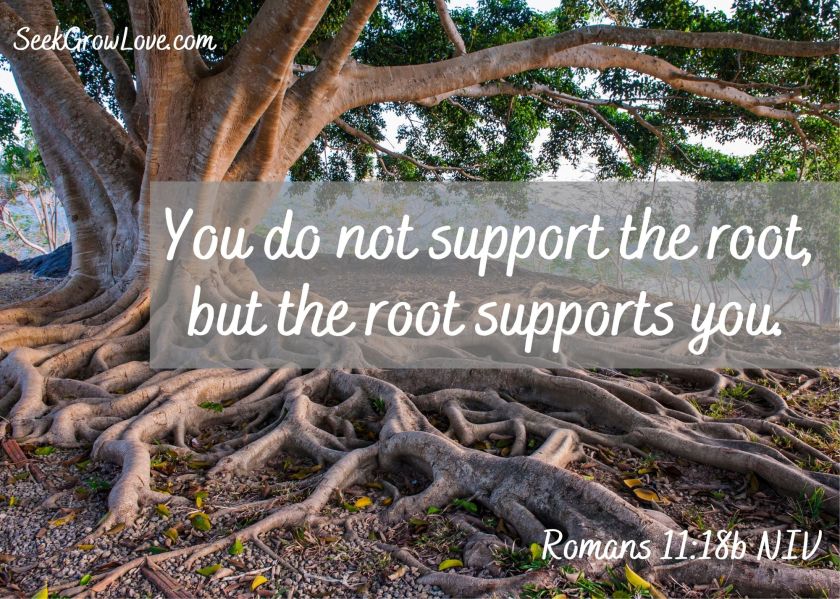
Paul addressed the potential conceit we might feel in Romans 11:17-21 which says, “If some of the branches have been broken off, and you, though a wild olive shoot, have been grafted in among the others and now share in the nourishing sap from the olive root, do not boast over those branches.  If you do, consider this: You do not support the root, but the root supports you.  You will say then, “Branches were broken off so that I could be grafted in.”  Granted.  But they were broken off because of unbelief, and you stand by faith.  Do not be arrogant, but be afraid.  For if God did not spare the natural branches, he will not spare you either.”

I find this analogy interesting.  In orchards, often a wild rootstock is more hearty than a domesticated rootstock.  So when grafting, someone will graft a desirable shoot that will produce good fruit onto a strong rootstock to get the best tree possible.  Nobody would ever consider grafting an autumn olive (or Russian olive) branch onto a productive olive tree.  Autumn olives are an invasive species, have thorns, and are completely undesirable.  Even deer don’t eat autumn olives.  

So, given Paul’s analogy, we are worthless.  Israelites, in the analogy, were far more valuable than we are.  If God pruned them off because of their unfaithfulness, and then grafted us in, we should be thankful, not conceited.  Because if God pruned them, he will certainly prune us who are worth so much less, if we don’t continue in our faith.

Paul said that some of the motivation for his preaching to the Gentiles was to make the Israelites jealous, and want to be reconciled with God.  Some wonder if God would ever accept back a person who walks away from God.  Romans 11: 23-24 suggests that God will welcome rebels back, “And if they do not persist in unbelief, they will be grafted in, for God is able to graft them in again.  After all, if you were cut out of an olive tree that is wild by nature, and contrary to nature were grafted into a cultivated olive tree, how much more readily will these, the natural branches be grafted into their own olive tree!”

This is great news, not only for Israelites, but also for us.  First, we have been extended the opportunity of salvation because of the Israelites’ rejection of God.  And secondly, because if God will welcome them back when they have walked away from Him, this suggests He will welcome us back if we have turned away from Him.

It’s a dangerous thing to presume on the grace of God.  But if you have wandered, come back to God while there is still time.  2 Corinthians 6:2 says, “For he says, ‘In the time of my favor I heard you, and in the day of salvation I helped you.’ I tell you, now is the time of God’s favor, now is the day of salvation.“

If you haven’t yet accepted Christ as your Lord and Savior, today is the day of salvation.  If you accepted Him in the past, but have wandered away, today is the day to come back.  We don’t know when Jesus will return.  I assume it will be relatively soon.  Once He does return, it will be too late to accept Him.  Today is the day.  Seize the day.

-Steve Mattison

Reflection Questions

  1. What do you need to do since Now is the day of salvation? How will you do it?
  2. How have you been a recipient of God’s grace? Tell Him how you feel about it.
  3. What do you think of God’s grafting skills? What have you learned about Him in our Bible reading today?

How Do You Save the World?

Tuesday, August 9, 2022

 Galatians 2

            The following story is based on a Poem by Loren Eiseley called The Star Thrower:

Once upon a time, there was a man walking along the shore. As he looked down the beach, he saw a human figure moving like a dancer. He smiled to himself to think of someone who would dance to the day. So he began to walk faster to catch up. As he got closer, he saw that it was a young man and the young man wasn’t dancing, but instead, he was reaching down to the shore, picking up something and very gently throwing it into the ocean.

As he got closer, he called out, “Good morning! What are you doing?” The young man paused, looked up and replied, “Throwing starfish into the ocean.”

“I guess I should have asked, “Why are you throwing starfish into the ocean?”

“The sun is up and the tide is going out. And if I don’t throw them in they’ll die.

“But young man, don’t you realize that there are miles and miles of beach and starfish all along it. You can’t possibly make a difference!”

The young man listened politely. Then bent down, picked up another starfish, and threw it into the sea, past the breaking waves. “It made a difference for that one!” https://starthrower.com/pages/the-star-thrower-story

            How do you save the world?  One starfish at a time.  That seems to be how God does it.  When you look at the history of salvation as revealed in the Bible, God often begins the work through a single person.  When God decided to create one special nation who would enter into a personal, covenant-based relationship with Him, He began with one man, a man named Abram (later Abraham).  God entered into a special bond with Abraham and promised to make him into a great nation that would eventually bring blessing to all the earth.  Abraham was the father of the nation of Israel, God’s chosen people.  Israel’s mission as God’s people was to be a light to all the nations of the world. 

            Israel struggled to fulfill that calling from God and became very inward-focused.  They elevated their unique relationship with God and emphasized their “set apart” status, worn as a badge of superiority.  They lost the mission imperative that God first gave to Abraham.

            God always had the heart to reach all people, not just descendants of Abraham by birth.  When the time came to expand his relationship with all humans and open the doors of salvation to the nations not descended from Abraham, God again started small.  Through one man, Jesus of Nazareth, God’s only begotten Son, God would open the doors of salvation to people from every nation.

            It was difficult for many of Abraham’s descendants to grasp that in Christ, God was extending his saving hand to all people.  One of the issues the early church wrestled with was “what is necessary for one who is not a descendant of Abraham, not from the nation of Israel, to do to become a member of God’s chosen people?”  The church agreed that they needed to be baptized into Jesus Christ and be obedient to Christ as their Lord and observe the basic commandments to not worship idols, not steal, kill, commit adultery or misuse the name of the Lord.  But still, for many of the descendants of Abraham who had lived separated lives, eaten special kosher food, and not shared meals with Gentiles, it was very difficult for them to imagine embracing those Gentiles, whom they had previously considered to be nothing better than dogs, as equals in the sight of God.

            While Peter, James, and the other Apostles continued to make their primary focus on sharing the message of Jesus Christ died and risen and coming again as King with their fellow Israelites, the Apostle Paul was called by God to bring that same message about Jesus to the Gentiles.  Through Paul’s preaching and missionary work, God’s kingdom was expanding to include people from every nation, and language on earth.  God made it clear to Peter in a vision that the dietary laws that they followed as Jews and the physical act of having all males circumcised were not to be a requirement for Gentiles coming into the Church.  You didn’t have to become a Jew in order to become a Christian.  But this did not sit well with many Jewish Christians who found it challenging to let go of those old prejudices and barriers.

            Paul’s letter to the Galatians was written to correct his fellow Jewish Christian and convince them to change their attitudes and practices in relation to Gentile Converts.  When they tried to make the Gentiles become Jews when they became Christians, Paul called this a “different gospel”.  They were creating unnecessary barriers to salvation.

            Do we today put up unnecessary barriers to salvation for people who are outside of the Church?  Sometimes we place our cultural preferences and traditions in the same category as the message of Jesus Christ and require others to jump through those hoops in order to be accepted into the Church.  When we create extra requirements beyond the basic teaching of the gospels and expect people to meet our cultural expectations in order to be saved, we are preaching a different gospel and keeping people away from Jesus and his saving love.

-Jeff Fletcher

Questions for Discussion:

1.  What can the young man in the Star Thrower teach us about going about the overwhelming task of rescuing the world from sin?

2.   What are some unnecessary barriers to salvation that you have observed in church or in your own witness to unbelievers?

One Goal

Acts 21

May 9

Unlike many Jewish leaders, James and the elders were not jealous of Paul’s success among the Gentiles.  But they were aware that not everyone was so accepting.  To head off problems, the elders asked him to pay the costs of men completing a vow.   Likely a Nazirite vow, this voluntary, temporary commitment to total dedication to God required extensive sacrifices, including a female lamb, a male lamb, unleavened bread, loaves of bread, crackers, oil, and a grain and drink offering.   

Paul wasn’t buying acceptance. In 1 Corinthians 9 he writes “19 Though I am free and belong to no one, I have made myself a slave to everyone, to win as many as possible. 20 To the Jews I became like a Jew, to win the Jews. To those under the law I became like one under the law (though I myself am not under the law), so as to win those under the law. 21 To those not having the law I became like one not having the law (though I am not free from God’s law but am under Christ’s law), so as to win those not having the law. 22 To the weak I became weak, to win the weak. I have become all things to all people so that by all possible means I might save some. 23 I do all this for the sake of the gospel, that I may share in its blessings.”  He had one and only one goal….to win others to Christ.  Let’s be as focused as Paul.

-Annette Osborn

Questions for Reflection and Discussion

  1. If people who knew you were to guess what your main goal was, what might they guess? Would they be right?
  2. How have you become “like others” (while remaining true to Christ’s law) in order to be able to share the good news with them?
  3. What group(s) of people would you want to be accepted by, so that they are willing to hear from you about Jesus Christ? How can you go about this mission?
  4. What was Paul willing to do, and willing to give up, in order to reach more people with the saving gospel? What are you willing to do, and willing to give up, for the same purpose?

They Thought it Could Not be Done

Acts 10

April 28

Acts 10:36 – You know the message God sent to the people of Israel, telling them the good news of peace through Jesus Christ, who is Lord of all.

Our history books are filled with stories of people doing something that has never been done before. From Neil Armstrong taking the first steps on the Moon, to Rosalind Franklin capturing the first image of DNA, to women getting the right to vote in 1920. 

For every time that something has been done for the first time, there was a time that it was believed that it couldn’t be done. 

Have you ever been told something couldn’t be done, and then you proved your naysayers wrong? 

These are the kind of thoughts I have when I read through Acts chapter 10. Up until this point in time, followers of Jesus were predominantly converts of Judaism. Cornelius the Centurion, was “devout and God-fearing”, as was the rest of his family. He was generous and prayed daily to God. He probably thought that this was as good as it was going to get. Until God gave him a vision of something more. 

Peter, along with all of the other disciples, were most likely glad to have a Roman Centurion on their side. But they too thought that because he was a Gentile, Cornelius wouldn’t and couldn’t have a relationship to God like the Hebrews could. Until God gave him a vision of something more. 

God made it clear to both of these men that the gospel message wasn’t limited to just one group of people, but that Jesus came for us all. And this led to Cornelius, the Roman Centurion, to be the first recorded baptized Gentile in all of Scripture. 

I don’t know if I will ever be the first of anyone to do something for the first time, but I am grateful that I am one of the benefactors of someone who did. And while I may never be a trailblazer, I do know that God still gives us dreams and visions for the kind of life that He longs to bless us with. Don’t shy away from a radical notion that God places on your heart. You never know how that might turn into a blessing not only for you, but for generations after you.

-Bethany Ligon

Questions for Reflection and Discussion

  1. Who do you think was most surprised – Cornelius or Peter?
  2. How has God surprised you with how deep and wide and wonderful His plan of salvation is?
  3. Who still needs to hear it and how will you be a part of sharing it with those who need to know?

The Laughter was Far More Powerful

Romans Chapter 11 –
Paul completes his three chapter address of the fact that the Jews missed the Messiah here in chapter 11.  He emphasizes again that God did not completely reject Israel, for Paul himself is a Jew, and there is always going to be a remnant, until the entire nation will one day believe.


Verse 11 reads, “Did they stumble so as to fall beyond recovery?  Not at all!  Rather, because of their transgression, salvation has come to the Gentiles to make Israel envious.”  This speaks to a great truth.  Very often, God is able to use transgressions or struggles in our own lives to bring about good.


My wife Susan and I have learned from mistakes in our marriage, and have shared those revelations with others.  I know of people who have wrestled with drug addiction who have then participated in programs to help others who are still wrestling.  In a very public example, Abby Johnson is a former director of a Planned Parenthood clinic in Houston, who came to the revelation that what was going on there was wrong, and began a ministry to combat abortion.  (There is a movie titled Unplanned opening in theaters this month about her experience.)


So, yes, things in our lives that we are not proud of can indeed be used for good and for God’s glory.  But Paul continues in verse 12, “But if their transgression means riches for the world, and their loss means riches for the Gentiles, how much greater will their fullness bring!”  When we are fulfilling our purpose in Christ, that is when we are going to be used to our fullness!


greg 4This reminds me of the movie Monsters Inc.  You know the story.  The monsters snuck into kids rooms at night, in order to scare them and collect their screams. They then used the screams as a power source for the monster city.  Yes, it worked, but at a cost, and with a huge amount of effort.  But (spoiler alert) at the end of the movie, it was discovered that laughter was a far more powerful power source, that was much easier to collect.   Maybe this analogy is a stretch, but the point is that God would rather us make good choices (the laughter) and work with that instead of having to work with our mistakes (the screams.)

Speaking of analogies, Paul makes the analogy of Gentiles being a branch grafted onto the tree of Israel.  But he warns the Gentiles not to become arrogant or look down upon the Jews because they do not believe.  Paul says, “do not boast over those branches.  If you do, consider this:  You do not support the root, but the root supports you.”


There is a lot of anti-semitism in the world today.  New York City police records indicate that Jews are the most targeted group in regards to hate crimes.  There are many reasons for this hate, but let’s make sure we are not counted among the anti-semites of the world.  God is going to save a remnant of Israel in the last days.  I for one do not want to stand against God’s chosen people then or now.


Greg Landry

Thankful for this Current Age

Romans Chapter 10 


Building off of the previous chapter, Paul again laments that his brethren have missed their Messiah.


But by God’s grace, knowing that His own chosen people would reject His son, He made the saving power of Christ’s sacrifice available to everyone, Jew and Gentile alike.


The Jews were full of knowledge, and knew all there was to know about the appearance of their Savior, but they still missed it.  Let that be a lesson to us all, to not be so stubborn and arrogant as to miss truths, whether they be large or small.


Another big shift at this time, beyond salvation becoming available to Gentiles, was the idea that righteousness with God was not going to be obtained by works, by keeping the law.  Instead, it is now attainable by confessing with your mouth, “Jesus is Lord,” and believing in your heart that God raised him from the dead.  Through these things you will be saved.


In verse 10, Paul says “For it is with your heart that you believe and are justified, and it is with your mouth that you confess and are saved.”  How seemingly simple that is, compared with the copious laws and rituals the Jews had to observe to obtain the same outcome.


I am so thankful for both of these changes.  We take them for granted today, but for thousands of years, things were quite different.  In fact, for the majority of history, God was the God of his chosen people Israel only, who were under the law, with no access to Christ.


To say that Jesus Christ is Lord seems so easy to us today.  But at this time, for a Jew to say this meant that they fully accepted that Jesus was the son of God, which was a very big step for them.  Likewise, for a Gentile to proclaim Jesus as Lord meant that they were putting the Lordship of Christ over whatever Emperor they were under.   As we know, this was a dangerous public statement to make in those times, for Jew and Gentile alike.


greg 3

Never take your position in history for granted.  I am thankful for many things based on our current technology, such as automobiles, air conditioning, modern medicine and indoor toilets.  But I am most thankful that we are living in an age where we have access to our Lord and Savior Jesus Christ.


Greg Landry

Don’t Step on Superman’s Cape

Romans Chapter 9 

In Romans 9 through 11, Paul deals with the problem associated with the condition of Israel. What does it mean that Israel has missed its Messiah? What does this say about God? What does it say about Israel? What does it say about our present position in God?


Paul first expresses his grief over his lost Jewish brothers who have rejected their Messiah.  It had to be very difficult for Paul to fully believe that Jesus was indeed the Messiah, and yet see his brothers reject this truth and thereby reject the potential that accepting that truth held for them.


Do you similarly mourn for the lost today, especially people you are close to?  If so, have you ever attempted to share the life-changing good news with them?  If you haven’t, maybe you are the one God has always intended to share the gospel with that person.


Paul then responds to a concern that people then must have had.  If the Jews are God’s people, and yet they have seemingly been rejected by God, then how can the Gentiles have confidence that God will not similarly reject them.


Paul makes the point that the nation of Israel has not been rejected as a whole.  There has always been and always will be at least a remnant remaining.  Just because someone is a member of the nation of Israel does not not mean they are necessarily a follower of God.  Similarly, not everyone who calls themselves a Christian is truly following Christ.  If such an individual is missing out on the promises of God, it is not because God is a promise breaker.


Beginning in verse 14, Paul explores the topic of God’s mercy.  It is important to remember what mercy is. Mercy is to not get what we deserve. God is merciful to us every day that he does not smite us down for whatever sin we have just committed.  At the same time, God is never less than fair with anyone, but fully reserves the right to be more than fair with individuals as He chooses.


But if God uses the disobedience of someone like Pharaoh to fulfill his plans, then how can God still find fault with Pharaoh?   Did Pharaoh have freewill or not?


It is tempting to want to question some of God’s decisions.  How foolish.  There is an old song with the following chorus:


You don’t tug on superman’s cape
You don’t spit into the wind
You don’t pull the mask off that old Lone Ranger

And you don’t question God’s choices.

greg pic2


OK, I changed the last line.  But that is Paul’s response to the previous question of freewill.  I will expound upon that and say that indeed we do have freewill.  But God will allow the direction of our heart to be used for His glory, even if that direction is away from Him.  And He doesn’t need to explain himself.


We should all aim to be used for God’s glory due to the goodness of our hearts, not the hardness.


Greg Landry