So many of the psalms focus on directly worshipping and declaring the goodness of God, which is good, but this psalm takes that knowledge of God and comes in with a missional view: Let God be known and praised by all the people. All the nations. Not just Israel, his covenant people, but by everyone.
The psalmist recognizes the goodness of God and what he has done for his people. In light of this fact, they want the goodness of God to be experienced by all people and for there to be abounding joy for all.
God provides sustenance for all people, the earth yields its produce. It does so because God designed it that way, so may the nations recognize that Yahweh created life and sustains it through his order.
Verse 4 talks about the nations being judged with equity. Equity here is the Hebrew word mishor, which literally means levelness or uprightness. God will not play favorites with his judgment, he will judge with prejudice, but he will judge fairly and give the same outcomes to the faithful of all tongues and tribes. In the same way, destruction comes from rejecting God, regardless of the background of the individual.
We can look at this through the lens of Jesus, but even without a clear picture, the psalmist saw a future where there was no Jew nor Greek, nor slave nor free, but a world where all could bask in and enjoy the glory of God and worship him in spirit and in truth.
Let the nations be glad.
-JJ Fletcher
Reflection Questions
Where does your joy come from?
Do you view your role as a believer to be missional? To bring others into a saving relationship with Jesus and his Father?
Do you have trouble with being equitable in your sharing? Can it be difficult to share with people from different backgrounds?
If you find great hope and strength in the gospel, shouldn’t you share it? Why are we worried about “offending people” with the gospel?
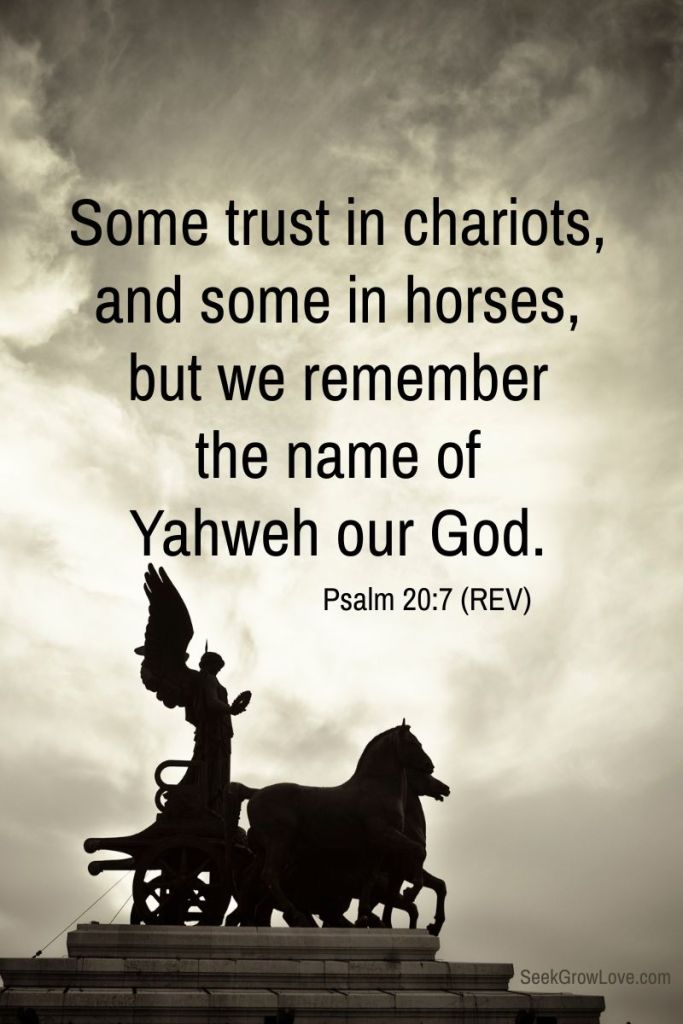
Some trust in chariots, and some in horses, but we remember the name of Yahweh our God. – Psalm 20:7 (REV)
It is very easy to rely on our modern technologies for help. The United States spent around 1 trillion dollars on defense last year, and it is easy to look at that high spending and have some confidence that the US would have an upper hand in any conflicts that it is engaged in, and that soldiers might enjoy a higher level of safety. We can look at medical technologies and pharmaceuticals and have confidence that something out there can diagnose and treat our potential maladies.
Yet despite these great resources, soldiers still die, and people still get sick and do not receive the diagnosis or treatment that they want or need. Confidence can lead to letdowns when placed in earthly things.
In 1 Chronicles 19, we see King David extend kindness to his potential foes, only for it to be repaid with treachery and opposition. When the Ammonites realize that they have put themselves at odds with David, they amass a significant force of chariots to fend off any attacks. They put confidence in the technology of the day to help deliver them from the potential conflict with Israel.
As Psalm 20:7 says, some people put their trust in chariots and horses, but we remember – or put our trust in – Yahweh. David trusted his God to deliver him and his armies from whatever his enemies devised as a means of attack or defense strategy. David recognized God as sovereign and that God is capable of anything. Historically and personally, David knew that God used underdogs and laughably small forces to conquer the enemies of his chosen people.
We do not have promises from God that we will never suffer or experience pain, death, or illness. God does promise us redemption through the blood of his son Jesus. We have a promise of restoration for the earth, which is something that has never been accomplished by human effort, whether governmental or environmental.
-JJ Fletcher
Reflection Questions
What will you put your trust in?
Who will you put your trust in?
Why is God’s provision so much more powerful than earthly promises?
But the Israelites broke faith in regard to the devoted things: Achan son of Carmi son of Zabdi son of Zerah, of the tribe of Judah, took some of the devoted things; and the anger of the LORD burned against the Israelites. Joshua 7:1 (NRSV)
As God promised, He led the Israelites to victory over Jericho. It is to be ransacked and destroyed, and there are to be none left alive, aside from Rahab and her family. There were specific items (gold, silver, etc.) that were taken from the rubble that were to be set aside and placed in the treasury of the house of the Lord.
After this great blessing of victory, one would assume that everyone would honor the directives of God and be obedient to him, but alas, we’ve been here before. Despite God proving himself time and time again to be a God of his word, both in blessing and in punishment, this knucklehead named Achan decides to take a heap of these goods for himself, and he buries them underneath his tent.
The stuff is hidden, there was so much of it, no one is going to know. The only one that this affects is him, and he’s going to keep it a secret. Maybe, eventually, it will just seem like this is some of the swag that was received from the Egyptians as they sent their ancestors out of Egypt. I don’t know what exactly was going through Achan’s mind, but I’m sure we’ve all been there, deceiving ourselves, justifying the stupid decisions that we have made to disobey or to take something that we have no business possessing.
As I sit here, I am reminded of an instance where one of my brothers took something that did not belong to him. This would have been sometime in the mid to late 90s and I’m a little fuzzy on some of the peripheral details. But we get home after a trip to the grocery store (Bohning’s in Ponchatoula, LA, I believe), and we discover that my brother has in his possession a whistle pop. After further investigation, it is discovered that he has many of them; in fact, he has a FULL BOX of whistle pops. At some point while we were standing in the check-out line, he grabbed the box off the candy shelf and shoved it under his shirt or down his pants. Now, I’m assuming that my mom took him back to Bohning’s to return it, as had happened when other contraband candy items had “shown up” in our house.
Now, a 5-year-old is not going to get arrested for petty theft and is probably going to get some sort of punishment for their misbehavior, but that action did not just affect him. There is embarrassment when a parent brings their child in to cop to a misdeed, apologize, and return the uneaten contraband. The stakes are low in this situation, but the principle is there: sin and error do not just affect the perpetrator.
Israel is feeling a kind of high as their God has just handed their enemies to them, and they are going to press forward into the land. They go make military advances on Ai, but they are driven back; they do not experience deliverance against their enemies; they are driven back and several dozen of their comrades fall to the enemy.
How? Why? Why would God deliver them a fortress and then allow them to fall to a less powerful fortification?
Because sin doesn’t happen in a vacuum. Sin affects everything. You don’t have to sin against someone for them to be affected; there are plenty of indirect effects of sin. We don’t have to go into a laundry list of sins, but different sins can cause us to behave and think in certain ways that harm others. Sin can lead to anger. Sin can lead to spousal abuse or neglect. Sin can lead to broken relationships. Sin can lead to more and more sins being perpetrated. Sin can break hearts. Sin can put a wedge between a person and God, and I’m not talking about the person that sinned.
Achan’s sin caused God to be furious, and he withheld his blessing and protection from Israel. Achan’s misappropriation of riches, which had nothing to do with the battle against the people at Ai, led to the loss of a battle. The sin affected all of Israel. In this case, Achan lost his life because of his sin.
So, if there is unrepentant sin in our homes, in our churches, in our relationships, and our individual hiding places, we can expect that it is going to affect others in one way or another. Sin cannot be reconciled with good. Jesus died to free you from sin, not to free you to sin. Yes, sin is crouching at our door; your enemy, the devil, is on the prowl like a lion to devour you with temptation that leads to sin (1 Peter 5:8). But when we sin, we are not to try to justify it or explain it away. I’ve cited it already this week, but here it is again:
“If we confess our sins, he is faithful and just and will forgive us our sins and purify us from all unrighteousness”1 John 1:9 (NIV)
Achan confessed his sin, but the damage had been done. He waited till he had been found out and others had suffered extreme loss due to his actions.
When we fall short, it is best to confess quickly before it becomes a bigger mess in our lives and the lives of those we love (or don’t even know).
-JJ Fletcher
Reflection Questions:
Why is it so easy to overlook God’s commands?
Is it difficult to read about the punishment for sin that is described in scripture? Does it lead you to a greater appreciation for the New Covenant in Christ’s blood?
What thoughts did you have on Achan’s sin as you read through today’s reading in Joshua 5-8?
Why is it easy to be blind to the way that our sin affects others?
Then Joshua son of Nun sent two men secretly from Shittim as spies, saying, “Go, view the land, especially Jericho.” So they went, and entered the house of a prostitute whose name was Rahab, and spent the night there. Joshua 2:1 (NRSV)
Context is important. Out of context, this verse might convey something completely different from the story that follows. In the same way, when we hear an unsavory detail about an individual, it could easily prejudice our opinion of them. Everyone has messy parts of their lives, but those messy parts don’t tell the whole story.
Descriptors carry weight. Rahab the prostitute… If, in casual conversation, you hear that about someone, what do you think? The modern vernacular is “sex worker” trying to clean up a description about someone who works in a profession that is not lacking in crude descriptors. We won’t go there. You probably don’t think the best of that individual. You ask what happened that they went down that path in their life? So many questions… or maybe none. We write them off as someone who is living outside of God’s will and God’s grace.
The spies are commissioned to go and get a close-up of what Jericho is about. Boots on the ground in an espionage mission to help determine what will need to happen to eliminate a fortress city that is currently situated in the land that has been promised to God’s people.
The spies get there, they meet a prostitute, and they go lay low in her house. Probably not who they expected to find as a sympathizer. Rahab is knowledgeable about the God of Israel. She offers and provides help to these spies and ensures they remain hidden from the Canaanites, who are wary and fearful of the impending insurgence of Israelites into “their land”.
But a prostitute…
Everyone does not get to choose their lot in life. Millions of people are trafficked or remain in a human sex trafficking situation at any given time. These people do not enter this willingly, it is essentially slavery.
Rahab. A prostitute. By choice? We don’t get much clarity here, but Rahab was likely forced into this situation where she engaged in prostitution. Slavery of this kind would not have been uncommon. Perhaps she was widowed or divorced and had no other recourse? Again, we don’t know. What we do know is that this unlikely ally to the people of Israel changed the course of history. While her profession was unsavory, her heart was made of gold. She had respect for Yahweh, the God of the Israelites, and she was willing to help Israel for a guarantee of safety and liberation. Seems legit. It’s a bad situation Rahab has found herself in, but she has heard of the power of God and wants to be a part of the community that is protected by the almighty God.
The spies promise her safety if she protects them, and they uphold their end of the bargain after she keeps them safe (Josh 6:22). When Jericho is destroyed, Rahab and her household are spared.
James 2:23-26 says, “And the scripture was fulfilled that says, “Abraham believed God, and it was credited to him as righteousness,” and he was called God’s friend. You see that a person is considered righteous by what they do and not by faith alone. In the same way, was not even Rahab the prostitute considered righteous for what she did when she gave lodging to the spies and sent them off in a different direction? As the body without the spirit is dead, so faith without deeds is dead” (NIV).
Describing Rahab as a prostitute, something that she did in Jericho, does not do her justice. We are, after all, talking about King David’s great-great-great grandmother. She is not just a footnote in history; she is in the genealogy of the savior of the world (Matthew 1:5)! Rahab is, in her actions, a savior for the Israelites, especially the two spies who trusted her, and is an ancestor to Jesus, the most consequential figure in human history. The Son of Man, the Son of God, the anointed king of the coming Kingdom of God.
Don’t write people off. They may be far from God or living in situations that, for lack of a better descriptor, we would call complex. No one is beyond redemption, and we should strive to extend grace and try to bring the joy that we find in Christ into the lives of everyone we meet, whether they be a pastor, an executive, that elderly woman who sits three rows in front of you every week at church, or the prostitute you bump into at a diner at 3 AM when you are adjusting to being many time zones away from home.
-JJ Fletcher
Reflection Questions:
Why is it so easy to dismiss “unsavory” people?
Do you have “unsavory” parts to your life that you don’t want anyone to know about? What if people knew? How would they treat you? Is there a way you can use the messy parts of your story to help someone else?
What can we glean from the role of Rahab in the victory of the Israelites over Jericho? What can we glean from how the spies treated and trusted her?
Sin is sin. Why does sexual sin have a different gravitas than most other sins?
When Moses had finished reciting all these words to all Israel, he said to them: “Take to heart all the words that I am giving in witness against you today; give them as a command to your children, so that they may diligently observe all the words of this law”. Deuteronomy 32:45-46 (NRSV)
I’m a music lover. My memory of “contemporary” music goes back about 30 years. 1995-1996 is when I first remember getting into music on the radio. It’s not just the music of my era… I grew up listening to the classic rock format as well as ‘90s rock and pop. If I were to anonymously give you a top 20 list of my favorite albums or songs (which I’d probably never be able to narrow down), you might be left scratching your head, wondering who this person is and when they were born. Powerful is the art of song and music. I love music for the notation, the way that notes and chords are put together to create melody and harmony, even dissonance, but also for the lyrics… The way that someone can convey emotion or conviction in a way that hits hard, that makes you think and feel.
Great songs come in many forms. There is much to be gleaned from a simple lyric – Jesus loves me, this I know, for the Bible tells me so; and there is much to contemplate from an imaginative and thoughtfully written gem that paints an image in the mind: “Could we with ink the ocean fill, and were the skies of parchment made; were every stalk on earth a quill, and everyone a scribe by trade; to write the love of God above would drain the ocean dry; nor could the scroll contain the whole, though stretched from sky to sky”.
The Beatles were a smash with their early simplistic songs, but also with more thought-provoking tunes toward the end of their run. Leonard Cohen’s “Hallelujah” (Jeff Buckley did it better) is one of the most gut-wrenching (in a good way) songs that I can think of. It carries the listener through peaks and valleys of emotion as it describes tensions in the human experience of love. Perhaps I have digressed too much, but I can get distracted when I get into the minutiae of music.
In Deuteronomy 32, we have recorded a song that Moses recited to the Israelites shortly before he went up to Mount Nebo to get a distant view of the promised land and then die. In this song, we see a variety of things addressed. Moses glorifies Yahweh, his God, but takes the people on a journey to envision their future failure and rejection of God’s ways that they are on a path toward. Challenges, encouragement, and perspective.
While Moses covers some pretty negative territory regarding the Israelites in his words, he also gives assurance that Yahweh is a God of mercy and redemption and that his people will be cleansed. Despite impending failure, there is forgiveness and mercy on the docket, and there will ultimately be protection for the people of God against their adversaries.
I find it a little curious that Moses addresses the people in song, diverging from the status quo of God’s revelation to his people up to this point, but song can be a powerful way to commit things to memory. In contrast to the ten commandments and the subsequent revelation of the full law, this presentation perhaps was remembered and recited in a way that was engaging and complementary.
-JJ Fletcher
Reflection Questions:
How has music impacted your relationship with God and Jesus?
Do you find it easier to remember lyrics and scripture put to song than simply memorizing bible verses?
How do we balance the desire that we might have for catchy and relatable tunes with the directive to glorify and worship God with music?
What impact do you think Moses’s addressing the people in this manner had on them? (might be helpful to look back at Deuteronomy 31:19-22)
Then Moses called Joshua, and said to him in the sight of all Israel, “Be strong and courageous; for you will go with this people into the land that Yahweh has sworn to their fathers to give to them, and you will cause them to inherit it. Yahweh, it is he who goes before you; he will be with you, he will not leave you or forsake you. Do not be afraid, and do not be dismayed.”Deuteronomy 31:7-8 (REV)
In Deuteronomy 31, Moses begins to reflect on the fact that his life is about to come to an end and he will not be leading the Israelites into the promised land. We see Joshua enshrined as Moses’s successor, as God directed Moses (Numbers 27).
Succession plans are important as leadership changes are critical junctures for organizations. When a known change is coming, it is easier to start laying the groundwork for succession, but that can be short-sighted. There is wisdom in succession plans that consider the unknown. No one knows how many days they have left to live in this age. Illness can come on suddenly, and tragic accidents happen frequently. By the grace of God, you reader, will live many more years to serve God faithfully, but what if the unthinkable happens? Have you ordered your house? Have you, in your role as pastor, leader, director, or church volunteer, poured into those around you and prepared individuals to do the necessary ministry of the church if, for some reason, you must vacate your position, voluntary or otherwise?
In my first year at Atlanta Bible College, I took the course Principles of Ministry and Leadership (I think that was the correct class name) with Professor Jon Cheatwood. One of the books that we used was the 21 Irrefutable Laws of Leadership by John Maxwell. While I have not touched that book in nearly twenty years, I remember clearly one of the concepts in the book: Leaders should be training their replacements, figuratively working themselves out of the job. You should ensure that those under you or around you can take over the tasks and responsibilities you are responsible for. This is not to create job insecurity but to ensure stability for an organization or ministry if unexpected departures happen.
Just as Moses was chosen by God to lead his people out of Egypt, Joshua was chosen to lead them into the promised land. Moses publicly enshrines Joshua as leader, making clear the succession plan and avoiding a power vacuum with multiple individuals striving for the top spot or fearful individuals that pick up camp and head back to Egypt.
Several years ago, there was a TV show called Succession that was loosely based on real events from a power struggle within a powerful business. I am not recommending the show, but it showcases the chaos that surrounds an organization that does not have clear protocols and succession plans in place.
About 10 years ago, my church was thrust into unexpected changes in pastoral leadership. While not without bumps in the road, the leadership of the church was equipped enough to manage a very difficult period. Clearer succession plans certainly could have made some things easier and maybe would have created some different dynamics in leadership structures than what was implemented during the transition. While you may not be able to perfectly clone yourself as a leader (and you probably shouldn’t), you can pour into the next wave or generation of leaders and begin preparing them for the joys and difficulties of ministry and leadership. Whether you are a senior pastor, a volunteer coordinator, or somewhere else on the spectrum of ministry roles, we should always be working to ensure that the ministry of the Gospel is primed to continue in our organizations, with or without us.
-JJ Fletcher
Reflection Questions
Have you ever experienced a sudden change in leadership? Either as a member of leadership or someone that looked to leadership, what were some of the takeaways that you had from that experience? What could have been better in that situation?
How important do you think it was that Moses made a public showing of the transition of leadership from himself to Joshua?
What are some of the pitfalls of tight-fisted leadership that does not allow for the incremental growth and training of future leaders?
Does God choose leaders now like he did in the times of Moses and Joshua? What does leadership selection look like now?
“And if you faithfully obey the voice of the LORD your God, being careful to do all his commandments that I command you today, the LORD your God will set you high above all the nations of the earth… But if you will not obey the voice of the LORD your God or be careful to do all his commandments and his statutes that I command you today, then all these curses shall come upon you and overtake you.Deuteronomy 28:1;15 (ESV)
Motivating my four children, ages 4 to 12, requires different strategies. My 12-year-old is motivated by rewards, i.e., if you do all your chores and then some extra work, you can have an extra 30 minutes playing the Switch. Consequences, however, don’t seem to faze her quite as much. The other 3 children are less cut and dry and require a more measured approach with rewards and consequences; however, one great challenge is follow-through. As busy parents with hundreds of things to do each day and limited energy reserves, it can be difficult to be consistent and follow through on our threats and promises.
God is not inconsistent. God is merciful, but he follows through on his promises. In Deuteronomy 28:1, he promises a blessing in return for obedience, but in Deuteronomy 28:15, he promises punishment for disobedience. It’s the same as a carrot and stick. Something tasty to motivate or something that brings pain to correct course. We see through Israel’s history that even though God followed through on his promises of blessing, he still had to break out the stick to use on a hard-headed people.
Over the past couple of weeks, I have been preaching from Romans 7-8. In Romans 7, Paul writes about not understanding his actions. Paul knows what is right, he knows what God desires of him, and he wants to be obedient, but there’s a problem. Despite the faith in and knowledge of God’s ways, Paul succumbs to human desire and does the things he does not want to do, i.e., the things of the flesh. Can you believe it? Paul, the apostle, was a “slave” to sin in the flesh! Is that hard to believe? Paul is human like us, and despite what we know is right, we often don’t do the right thing. Why, why, why? Because sin is ingrained in the flesh.
There are debates on something called original sin, which is not something we’ll get into here, but it is clear we learn how to sin from an early age. We are naturally selfish as children; we need to be self-focused to survive, but as we mature, we should become less self-focused and more focused on the big picture. In the Christian view, we should be imitating Jesus, who humbled himself (Philippians 2). Jesus was a model of selflessness and submission to God’s will. Jesus did not want to die, yet he was obedient to the point of death so that many could be ransomed from the death that comes from sin; he saw the big picture. Though we can see the big picture, we often fall short of the kind of selflessness that Jesus modeled.
Unlike the Israelites under the old covenant, we have Jesus in clear view. We are not holding out hope for a future savior but rather holding onto the promise that the blood of Jesus has covered our sins past, present, and future. While we are called to obedience, God does not hold our salvation in limbo every time we mess up. We are faced with the present consequences of our mishaps with sin, but we have constant forgiveness through the blood of Christ Jesus. “If we confess our sins, he is faithful and just and will forgive us our sins and purify us from all unrighteousness”1 John 1:9 (NIV). We don’t have to go through the carrot and stick metaphor as partakers of the New Covenant in Christ’s blood. We must strive to be obedient, but fess up when we miss the mark, and move forward in each new day as we are redeemed by the blood of the lamb.
-J.J. Fletcher
Reflection Questions:
Why do you think it is so hard to balance the desires of the flesh with the knowledge of the living God and some pretty clear instructions on his will for us?
Is it easy to become discouraged when we fall short? What are some obstacles to confidence in our faith walk?
Does a tendency toward legalism sometimes impede our ability to deal with flaws in ourselves and others?
Is there a place for carrot-and-stick dynamics in church life and discipline?
What would Paul think about the way that some modern churches deal with reconciling the desires of the flesh with faithfulness to the gospel?
And behold, now I bring the first of the fruit of the ground, which you, O LORD, have given me.’ And you shall set it down before the LORD your God and worship before the LORD your God. Deuteronomy 26:10 (ESV)
It is Sunday morning. What are you going to do this morning (or, depending on when you read this, what did you do this morning)? It is the first day of the week; did you spend it on yourself, or did you give some of your time in worship of Yahweh our God and in remembrance of his son, Jesus, our savior? Most of those reading this likely attended a local church this morning, but some of you may have needed to work, or perhaps there was another reason for not being in church today.
Why am I asking these questions? Deuteronomy 26 speaks of the act of giving the first fruits of the harvest as an offering to God. Looking forward to the entrance into the land of milk and honey, the promised land, the Israelites are instructed to take a portion of their first fruits and bring it to the priest to set before the altar. Taking a portion of what God has blessed them with and giving it back as a sacrifice or offering. Things are different now. We are not under the ceremonial law, but are we exempt from sacrifices?
Through him then, let us offer up a sacrifice of praise to God continually, that is, the fruit of lips that make confession to his name. Do not neglect to do good and to share what you have, for such sacrifices are pleasing to God. Hebrews 13:15-16 (REV)
Worship is something God desires of us, and while it is not for us, it does us good, for it puts God into our focus and puts him in his exalted place. Jesus told his disciples to break bread and partake of the cup whenever they got together “in remembrance of me”. We need to remember Jesus’ sacrifice as we try to live sacrificial lives.
Gathering for worship and fellowship is important, but it is a sacrifice. Many people don’t work on Sunday, a day to sleep in and relax! We may see the value of setting this time aside for worship, but sometimes we may struggle with it. Churches are filled with imperfect people (sorry if this comes as a surprise to you), and sometimes those people are a source of pain in our lives. We hurt one another and sometimes struggle to confess our sins against one another, and sometimes we fail to forgive those who sin against us (that seems backwards from how Jesus instructed us to pray). Maybe we see this sacrifice of our time as a duty, and we lose some of the wonder that we experienced toward Christ’s church.
There can be reconciliation through our sacrifices of praise and obedience, just as Christ’s sacrifice reconciles us to God, as we spend time in community and in fellowship through the spirit of God, we should be transformed to be like Jesus, who was able to forgive the betrayal and brutality that was directed to him. Jesus had to slog through difficulties and disappointments like we do; he had his times of questioning, and maybe he even struggled at seeing the wonder of it all at times. Through obedience, sacrifice, and confession, we can be conformed to his image of Jesus and also glorify God as we recognize him as our provider and source of our hope.
-J.J. Fletcher
Reflection Questions:
What do we have for first fruits that can be brought before God?
I see time as being our most valuable resource. When we give time to God, what does this do to and for us?
Do you give money to your church or other ministries? How does financial offering correlate to first fruits?
When you give the first fruits of your day or week to God in devotion or worship, does it differ from giving him whatever you have left at the end of a long day or week?
Gender is a hot topic these days. We live in a society where there is much flexibility in how someone chooses to live their life, irrespective of cultural norms or the directives of our creator (let’s stick to what Peter writes about in his letter). Misogyny and radical feminism are two ways in which humans have messed up what was designed to be a tremendous blessing from God.
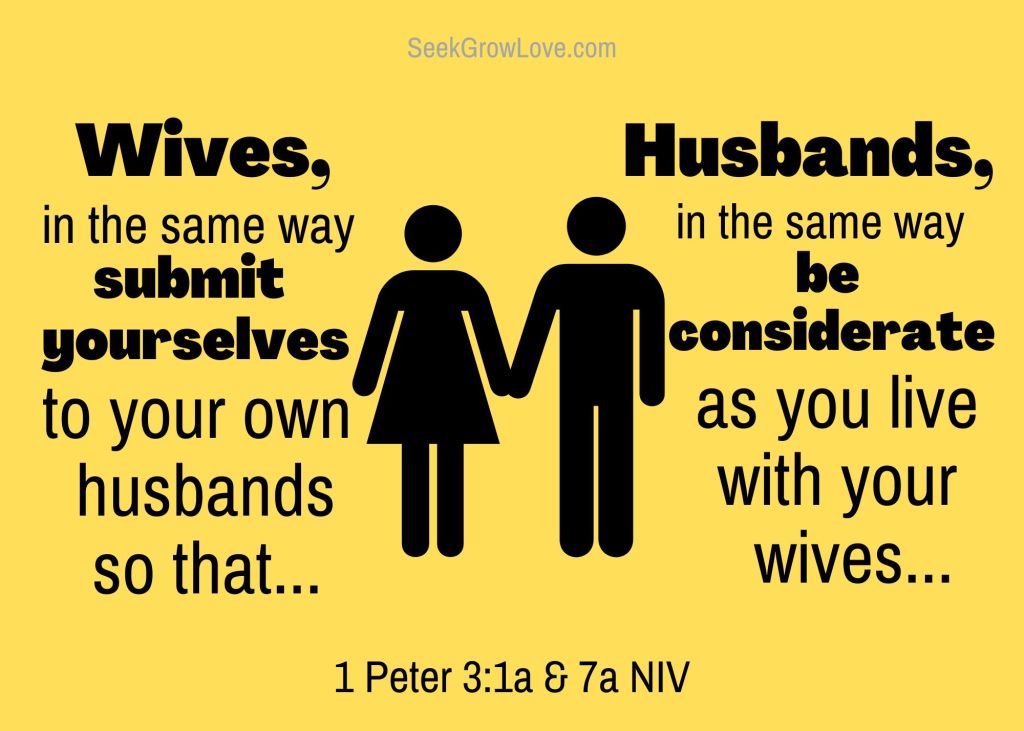
There is a lot to unpack here as Peter begins by addressing wives. In reading the text and then looking at commentaries it appears that foremost in Peter’s mind is a woman who has come to a saving faith in Jesus but is married to a man who does not share that faith (though we can gain something from this even if we’re not in that demographic).
The way that societies functioned, specifically the society that Peter would be writing to, did not offer much in the way of opportunity for a woman to exert influence over her husband. Her options may be quite limited in what her husband allowed her to do or permitted her to go. Where a husband and father who came to faith would be expected (even simply allowed) to bring his family along with him to religious functions, the same could not be said for the wife.
So how is a woman to minister to her unbelieving husband? How does she influence him intentionally in a way to bring him into the body of Christ? Nagging is probably not the most effective way to do this, in fact it might have the opposite effect; rather, the solution that Peter proposes is to allow the gospel of Jesus (i.e., the gospel of the Kingdom) to radically influence your way of living. Being salt and light (Matthew 5:13-14) is not just something that you are to be for people whom you may be unfamiliar with, even more importantly it is something you are to be with those who you are most intimate with. Living a life that bears the fruit of the spirit (Galatians 5:22) and exemplifies Jesus’ beatitudes (Matthew 5:3-11; Luke 6:20-26) will make you a more desirable (and influential) person.
Obviously, there is no way to guarantee that an unbelieving spouse will come to faith, but by being holistically attractive (not just externally, but internally as well) you will have a far better chance to influence them than if you were to try to get by on physical attraction (I don’t even know how that would really work) but be ugly on the inside.
Peter addresses the ladies in verses 1-6, but he shifts gears in verse 7 and speaks to husbands. He says to “live with your wives in an understanding way” (ESV), literally living with her “according to knowledge” as opposed to living with her in “sheer thoughtlessness” as the Expositor’s Bible Commentary puts it. I can speak from experience, it is very easy to do what I want and expect my wife to pick up the slack, but that is not the way that Peter instructs husbands to operate. Instead of living in a way that could breed resentment and other problems (infidelity?), husbands are commanded to live in a thoughtful way.
Husbands are instructed to honor their wives as “the weaker vessel.” Huh? What does that mean? There are different ways to look at this… Societally women were weaker (we’ve already considered the lack of influence), typically women are weaker in physical strength (I can think of a few ladies that could probably wipe the floor with their husbands in a fight), and sometimes women are more emotionally fragile (have a wider range of feelings?) than men. The word for weaker (ἀσθενεστέρῳ) can be translated with lots of nuance, but one big take away from this is that women are not inferior to men. Whatever Peter is getting at with the idea of the wife being a weaker vessel, something is very clear: we are co-heirs of all the benefits that come with accepting Jesus and believing in the kingdom message. As objects of God’s salvation there is no distinction between male and female, just as there is no distinction between Jew or Greek. While husbands and wives may be called to different roles in their relationship and even in their roles in the church, this is not because of a lack of capability, this is the function that God has laid out. Husbands and wives are to minister to one another and to minister to others. We can use our marriages as an example and an opportunity in ministry. Authentic Christianity has done more to liberate women from misogyny and oppression than any other organization ever has; that being said, it has not changed the fact that men and women are different. We have equality in standing before God, we have equality in salvation, we ought to have equality in rights, but we are still different and that is a blessing. As the church is a body with many parts, the one flesh that we become in marriage takes into account our uniqueness as individuals and the differences in our physiology. We are to be reliant on one another (do not read as co-dependency), and we are responsible to one another to meet the needs that we have as image bearers of God and the uniqueness that we have as men and women.
-J.J. Fletcher
Action/Reflection:
To those of us who are married: We should evaluate where we are at in living as Peter instructs. Hopefully you are married to a fellow believer who you can discuss this passage with and commit to one another to implement these tactics in your union. If married to a non-believer, behave in a way that is intentional in living the gospel out to them.
To those of you who are engaged or hope to be married one day: Look for a spouse who takes scripture seriously and is willing to change their behavior to conform to what scripture dictates, both in their life as an individual and the way that they approach relationships.
For those of you who are called to a life of singleness (or just end up that way) or those of you who know someone who fits that description: I believe that the behaviors that the relational and internal things that Peter speaks of here will be beneficial in building authentic relationships that help navigate the potential challenges that a life of singleness may bring.





 Seek Grow Love