Romans 5:1 “Therefore, having been justified by faith, we have peace with God through our Lord Jesus Christ,” (NKJV)
Devotion by Merry Peterson (Canada)
In the part of Ontario where I live there is a museum called ‘Ripley’s Believe It or Not’. Inside there are lots of strange and unusual items and displays about occurrences that are most, well, quite frankly unusual! The sign says it all – believe it – or not. Some things in that museum I find really hard to believe.
Faith is really about belief. Our belief that God is who He says He is, and will do what He says He will do. That’s the tenet of having faith – those beliefs about God. His existence as the supreme ruler of the universe and that His declarations of what He will do He follows through on.
In the previous chapter we see that Abraham was justified by his faith even though the whole salvation plan through Jesus dying on the cross for our justification hadn’t happened yet in his time. It was Abraham’s belief that God was in control and able to do what He said He would do that brought him justification.
We as Christians have received justification through Christ’s sacrifice because we live in a different time frame than Abraham. Christ, the promised savior that God declared would become the sacrifice for sin has indeed died, and risen again, and our justification comes through that fulfilled promise.
Notice that the fulfilled promise brings peace. We have peace with God through Christ. We have peace knowing that our sin is covered by Jesus’ blood, that we are no longer God’s enemies because of our sin. The blood of Christ washes away the debt of our sin. We become in good standing with God. How is this achieved – by our belief that God is in control and follows through on his promises. He said that Jesus would be the once for all atoning sacrifice for mankind bringing us justification with Himself. We believe it!
For Reflection:
Do you have friends or family members who have a hard time with faith?
When did you first start to have faith and believe?
Was there something or someone who helped you truly believe?
Are there ways that you could help guide another person to belief?
Today, in Romans 4, Paul takes us way back to a patriarch of our faith – Abraham. Abraham was and continues to be a key figure in the grand scheme of the world. Three of the main religions in the world can trace their lineage back to the man himself. He was a special man whom God made special arrangements with a couple thousand years before Jesus was born. Abraham is the central focus all throughout Romans chapter 4 – pretty impressive for a man who lived 2,000 years before Paul wrote this letter. Abraham is the central focus, as Paul finds common ground in Abraham – for the Jews and Gentiles.
Specifically, Paul looks at how Abraham attained his status as righteous, as somehow, someway Abraham was justified (declared righteous) in the eyes of God. Was it through his works? Was it through some other means? Paul reveals to us that Abraham was not justified by his works; rather, he was justified by his belief/faith. Paul quotes Genesis 15:6 when he writes, “Abraham believed God, and it was counted to him as righteousness,” (Romans 4:3 ESV).
Context is key. What in the world was going on in Genesis 15? I’m glad you asked! To save you a bit of time, I’ll refresh your memory. In Genesis 15, Abraham had already left his home to travel to the land that God would show him. God then told Abraham, “Look toward heaven, and number the stars, if you are able to number them… so shall your offspring be,” (Genesis 15:5). Unfortunately for myself and most of you reading this, surrounding lights mute the starry sky at night. However, God told this to Abraham long before the fateful invention of the light bulb. If not too cloudy or humid, Abraham would have viewed a starry sky like many of us never have. I can only imagine the sight of a starry sky that is not infiltrated by the invention of the lightbulb.
The idea of Abraham’s descendants being as numerous as the stars of the sky is great and all except for the fact that Abraham is getting up there in age and has ZERO children! How in the world is an old man with no children supposed to have descendants as numerous as the stars in the sky?! If you are anything like me, then you would appreciate logic, reason, and common sense. This bold statement totally goes against sound logic, reason, and common sense. I get a bit uncomfortable reflecting on how I would respond in those circumstances. What would be your response if you were put in Abraham’s shoes? Abraham’s response was simple: “And he believed the LORD,” (Genesis 15:6). Boom! End of story. Abraham believed in God. And Abraham believed God. If God told him his descendants would be as numerous as the stars in the sky, then somehow, someway God would make his descendants as numerous as the stars in the sky. Because of Abraham’s belief, God “counted it to him as righteousness,” (Genesis 15:6).
That is the moral of the story here that Paul brings our attention to. We are justified by what we put our faith/belief in. We all put our belief in someone/something whether it be ourself, our spouse, our finances, our parents, our home, or God himself. You are justified if you put your faith in God. Abraham chose to put his faith in God, as he was “fully convinced that God was able to do what he had promised,” (Genesis 4:21). Because of this, Abraham was counted as righteous. You and I have that same offer today. Let me ask you, are you putting your faith in God?
-Kyle McClain
Reflection Questions
What do you appreciate most about Abraham?
What is the difference between believing in God and believing God? Where are you?
Remember that time that you held an imaginary debate or argument in your mind with either an imaginary figure or your spouse, coworker, boss, or friend? We have all been there before. Evidently, Paul has been there before as well. Except this time, Paul records this imaginary debate in Romans 3. How exciting!
Romans 3:1-8 gives the impression that Paul is debating an imaginary figure on how the Jews fit into the bigger picture. Paul’s conclusion to this mini debate is that the Jews are not better off, “For we have already charged that all, both Jews and Greeks, are under sin,” (Romans 1:9 ESV). There we have it. All of mankind is under sin. This conjoins the Jews and the Greeks together. If you don’t believe Paul, no need to worry. Paul has plenty of ammunition to help prove this point. Paul quotes a number of scriptures from the Old Testament in the following verses to bring home this point.
After Paul’s introduction, his letter to the saints at Rome has been rather gloomy thus far. However, verse 21 is where we start to see a shift. Paul recognizes that we are all under sin… “BUT NOW…”. This is where it gets fun! This passage in Romans 3:21-31 can preach! Essentially, this is a teaching on the doctrine of salvation, as the righteousness of God is revealed through faith in Christ Jesus for all who believe.
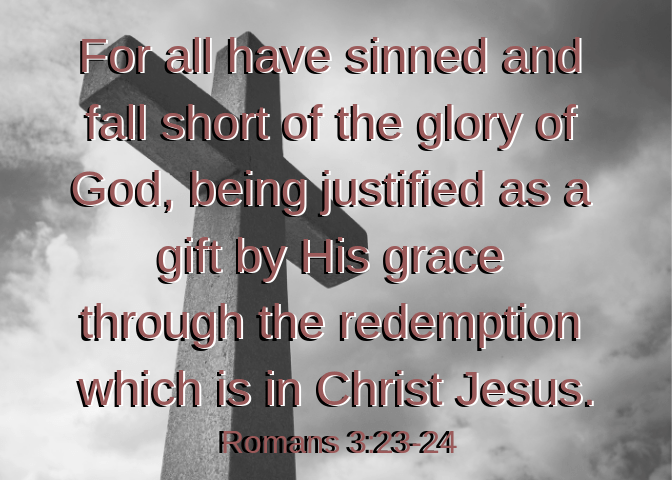
Many are able to quote Romans 3:23: “for all have sinned and fall short of the glory of God.” Paul is only halfway through his sentence when we have a verse break. Don’t forget about verse 24: “And are justified by his grace as a gift, through the redemption that is in Christ Jesus.” Paul compares God’s grace to a gift. Whenever you are given a gift from someone, you have two choices: you can receive it and open it or you can deny the gift. I have many memories as a child of receiving gifts from my parents for Christmas, my birthday, or other special occasions. Not once did I ever reject a gift that my parents gave me; I openly received the gifts every single time. Nearly every child receives the gifts they are given without a second thought. We need to mimic the attitude of a child here and gladly receive God’s gift of grace with open arms. How do we receive God’s grace? Well, fortunately for us, Paul tells us exactly how to receive that grace in the following verse. Paul tells us that it is “to be received by faith,” (Romans 3:25).
Paul crams a lot in this short passage to conclude chapter three, as he talks about our salvation. You can sum up Paul’s discussion in the following formula: sin + grace + faith = justification. Paul will later reveal to his audience that the justification leads to eternal salvation. For you math nerds out there, that’s a pretty awesome formula. For those of you not interested in math, trust me, that’s still a pretty awesome formula.
As we go through our lives, let’s remember to keep our arms open wide ready to receive God’s free gift of salvation.
-Kyle McClain
Reflection Questions
Have you ever rejected a gift given to you? Have you rejected or gladly received God’s free gift of salvation? Who do you know who might need some more information or encouragement to receive this gift?
How would you define and describe each of the words in the following formula: Sin + Grace + Faith = Justification. What is the importance of each one?
In the gloomy moments of your life, how can Romans 3 lift your spirits and bring joy, hope and peace?
Last year, the young adults at my church went through an in-depth study of the gospel. We discussed what the gospel is and why it is so important to be able to “give an answer for the hope that you have” (1 Peter 3:15). What is your understanding of the gospel? Go ahead a pause for a minute and try to sum up what you think the gospel is in a few sentences.
It’s important to be able to quickly and succinctly sum up what the gospel is. Yes, we can go deeper in our theology. Some things about our Christian walk take a whole life time of wisdom to be able to truly understand. However, when it comes to the basic building blocks of our faith, we need to have an answer for it. We need to understand what we believe. This is the first step towards spiritual maturity.
In today’s reading, Paul begins his letter to the Colossian church. He give thanks to God for the people in the church and then describes to them why Christ should be so highly esteemed. This passage is a good go-to passage for understanding what the gospel is. Paul begins in Colossians 1:18-20, “And [Jesus] is the head of the body, the church. He is the beginning, the firstborn from the dead, that in everything he might be preeminent. For in him all the fullness of God was please to dwell, and through him to reconcile to himself all things, whether on earth or in heaven, making peace by the blood of his cross.” The gospel, or good news, is the reconciling of us to God through the blood of Jesus. Jesus’ sacrifice made peace between God and man. Not only that, the gospel also points to our hope. Jesus was the firstborn from the dead. His resurrection is proof and assurance of our future resurrection.
Paul goes on to describe how the gospel changes us in verses 21-22. He says, “And you, who once were alienated and hostile in mind, doing evil deeds, he has now reconciled in his body of flesh by his death, in order to present you holy and blameless and above reproach before him.” When we were not reconciled, we lived doing evil deeds. We were in darkness. Because we have been justified before God, we also can be sanctified. This is the process of being made holy, blameless, and above reproach before God. We are learning how to be made righteous, be made perfect. This is a process that takes a lifetime. The gospel changes everything about us, maybe not right away – but instead through consistently trying to live for God in the best way we can.
This is why it is so important to understand the gospel and be committed to living for God throughout our life. We will be sanctified “if indeed [we] continue in the fath, stable and steadfast, not shifting from the hope of the gospel that [we] heard” (v. 23). Hold fast to the one who saves!
Some may be tempted to think the burden of living a Christian life just isn’t worth it. Life is boring, you can’t have any fun, and all the rules make life almost not worth living. If someone ever thought that, Romans 5 is for them. This is an exciting chapter in an exciting book.
Romans 5 talks about justification – which refers to how a person can be declared righteous before God through faith in Jesus Christ. The first half of Romans 5 talks about the benefits of being justified, and the second half tells how justification is possible.
You might think the benefits are just for the future, limited to eternal life in God’s future kingdom. Think again. There are real benefits to living a life completely sold out to God right here and right now.
Romans 5:1 starts out in the past tense, “Therefore, since we have been justified through faith, we have peace with God through our Lord Jesus Christ.” (Chapter 4 pointed out that being justified before God has always been through faith, not through works.) If we’re living the life God called us to live, and we are living by faith, we have been reconciled to God through Jesus. If we meet the criteria, whatever else we have done in our past is forgiven, and we have been declared righteous.
We’re told the alternative in Isaiah 48:22, “There is no peace, says the Lord, for the wicked.” Peace with God versus no peace. Let me think, which should I choose? I want peace! When you live a life of sin, you’ve declared war against God. If you’re currently at war with God, how’s that working out for you? Consider peace.
Romans 5:2a continues by talking about the present, “through whom [speaking of Jesus] we have gained access by faith into this grace in which we now stand.” In the Old Testament, Jews didn’t have direct access to God. Only priests could even enter the tabernacle, and only the high priest could go into the Holy of Holies only once a year. And Gentiles couldn’t even come into the inner courtyard. Through Jesus, we have gained access to God’s grace, and ultimately to God. And this is for today, not just in some distant future. We can boldly approach His throne of grace, and pray directly to God in Jesus’ name.
Romans 5:2b tells of the future “And we rejoice in the hope of the glory of God.” When Jesus returns, the faithful will live eternally with God. That’s not just a “hope” in the ordinary meaning of the word, that is our assurance. And in the assurance for our future, we can rejoice today – no matter what problems today may bring. Again, I want that tangible benefit today. Especially when times are tough.
The next passage points out that we won’t be immune from suffering, just because we have a great relationship with God. But instead of destroying us, that suffering will be for our benefit, building Christian character, and making us more firm in our future hope.
Romans 5:5 finishes this paragraph by saying, “And hope does not disappoint us, because God has poured out his love into our hearts by the Holy Spirit, whom he has given us.” As we wait for our future hope, we also have the love of God in our hearts today (that goes right along with the peace above).
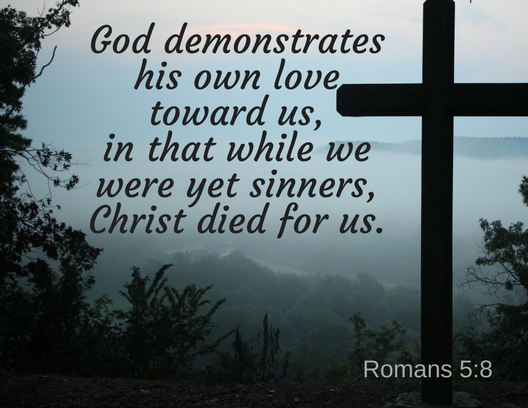
The next section tells us that God loved us so much, that while we were still sinners, Christ died for us. We didn’t deserve it. In fact, since we were at war with God, we deserved only death. That shows how much God loved us, even when we were in open rebellion against Him. So since we have been justified, we have been reconciled with God, and He will save us from His coming wrath through Jesus’ blood.
I’d say all of this is a powerfully compelling reason to live a Christian life today, completely sold out to God. Even if there wasn’t a future reward (which there is!).
The rest of Romans 5 tells us how we are justified, but first, it reminds us how sin entered the world. Adam sinned, and all of his descendants inherited his punishment – death. You might think that isn’t fair. Honestly, God was gracious in establishing this pattern, and I’ll explain why. If each of us had the opportunity of never dying in this current age if we just didn’t sin, we’d still all sin, and all die. So the result would be the same as inheriting our punishment from our first ancestor. But since God established the pattern of one person earning something, and many others inheriting that… God was able to use the same pattern to have Jesus live the only perfect life, and to have his spiritual descendants inherit His reward.
This shows God’s incredible grace. One sin caused innumerable deaths, even for those before Moses (when the law was given) who didn’t break a specific law of God. But Jesus’ one act of obedience – paying the penalty for sin with his perfect life – was after a seemingly infinite number of sins. Romans 5:19b says, “…so also through the obedience of the one man the many will be made righteous.
The bottom line is this: Only Jesus deserves eternal life, because only Jesus lived the perfect life God requires. Jesus wrote us into his will with his blood, leaving his reward (eternal life) to those who would believe in him and live the life God called them to live. Jesus died to put the will in effect. He now lives, and is distributing some of the benefits of that will to believers today including:
Peace with God
Access to God’s grace and to God himself
Hope today for a future in God’s kingdom
Building Christian character through suffering
God’s love in our hearts
The final distribution of Jesus’ will will be at the Great White Throne Judgement when Jesus will judge the living and the dead. Those whose names ARE NOT found in the book of life will be thrown into the fiery lake of burning sulfur. This is the second death. Those whose names ARE found in the book of life will have God “wipe every tear from their eyes. There will be no more death or mourning or crying or pain.” (Revelation 21:4) And will get to live with God and Jesus in paradise forever.
So, is it worth it to live a Christian life? As for me, absolutely! Sign me up!
What do you think?
-Steve Mattison
Reflection Questions
Is it worth it to you to live a Christian life? Why? What benefits do you receive? What is the alternative and the consequences?
What do you know about God from your reading today? Thank Him.



 Seek Grow Love