Lost and Found

Matthew 18

Devotion by J.J. Fletcher (Minnesota)

Yesterday, we read Mark 9, and today we see some of its parallels in Matthew 18. The idea of causing “a little one” to sin is here, as well as dealing with one who sins against you, and addressing our own sinful actions. Sandwiched in between these teachings, we read the parable of the lost sheep.

The image of Israel as a flock of sheep is prevalent in the Old Testament. Leaders are viewed like shepherds, but God is the ultimate shepherd. When Israel loses its way, God sends a messenger or “shepherd” to seek out the lost and bring them back to the fold, to the path that they should be walking on.

Sheep get a bad rap. They are often characterized as dumb, but they are far from it. Sheep can remember human faces and differentiate between them. Sheep are herd animals, and the fact that they rely on following the herd, or the sheep in front of them, contributes to the mischaracterization of their lack of intelligence.

You have probably followed someone whom you had a level of trust in, but at some point, you realized that you had followed them the wrong way. Was it easy to course correct, or did you wander for a while? Did someone have to come and find you to bring you back to where you were supposed to be?

There’s a saying that not all who wander are lost, but many who wander are in fact lost. We follow the wrong crowd or come under the teaching of someone who is guiding us in the wrong direction. Those of us who are parents are acutely aware of how challenging it is to raise our “flock” in a culture that embraces self-gratification and relative truth (my truth as opposed to objective truth). Maybe we have become devotees to tradition rather than God’s commands (see the Unwritten Rules devotion from Tuesday). 

We probably all have friends or family members who have gone astray, and we desperately hope to get them back to the flock. We see that God has that same desire, for the lost to be found, to be reunited with his flock. There is much joy when someone returns. The rejoicing over the one who returns over those who remained is not a statement of value; all the sheep are valuable. The celebration is that the one who has been saved from death is now safe, like the 99. 

There are powerful testimonies from people who have lived problematic lifestyles, who walked in a way that was destructive or even dangerous. Many of us have boring testimonies. What a joy to have not had to be saved from a life of trauma, addiction, or danger! We celebrate those powerful testimonies not because those who have struggled are better, but because we can see in their stories the power of the one who went out and found them.

Reflection Questions:

1.        Think about ways that you were lost and how God brought you back. What methods did he use? How can you see His handiwork in your faith story?

2.        How has God used you to seek out his lost sheep? When you feel God’s prompting, do you embrace it, or have you struggled and responded in some other way (Jonah, anyone?)? 

3.        What ways can we work to keep the flock together and avoid having that one sheep split off that we may need to go searching for?


Refocus

Old Testament: Obadiah

Poetry: Psalm 132

New Testament: Matthew 18

Who is the greatest?  The GOAT (is that still a thing)?  This is what the disciples come to Jesus asking at the beginning of Matthew 18.

Jesus doesn’t answer them directly, per usual.  Their question isn’t even worth answering.  It doesn’t matter who is the greatest.  That comes with the wrong focus.  Instead Jesus tells them:

And he said: “Truly I tell you, unless you change and become like little children, you will never enter the kingdom of heaven. Therefore, whoever takes the lowly position of this child is the greatest in the kingdom of heaven. 

Your position is not important.  Rather, not viewing yourself as the greatest will put yourself in a better, more humble position.

There are several parables in this chapter, and I think you could probably tie them all to humility in some way, but I want to look at the last section.  It starts with:

21 Then Peter came to Jesus and asked, “Lord, how many times shall I forgive my brother or sister who sins against me? Up to seven times?”

22 Jesus answered, “I tell you, not seven times, but seventy-seven times.[g]

That is going to require humility.  When someone sins against us, we probably feel we are in the right to be angry or to hold a grudge.  After all, they sinned against me.  But Jesus’ instructions don’t allow for this kind of pride.  Instead, we are to go on forgiving our fellow Christians time and time again, swallowing our pride, pushing it aside, for the sake of forgiveness.

We might think this is unfair, but through the parable Jesus tells of the unmerciful servant, we can see that God forgives us so much!  For us to accept God’s forgiveness for our own sins, but to hold another’s sins against them is prideful.  It is saying that you deserve forgiveness more than them, or that your sins weren’t as great.

Instead, Jesus wants us to humble ourselves, to admit that we are just as low, or even lower, than others and offer the grace to others that we have been given.

Humility is a topic that has come up often in my discussions and readings the last few months.  It is hard – it is against our human nature.  But I really believe it is one of the most important things for us to focus on.  And likely, it isn’t a one-time thing.  We need to constantly be reminded and refocus on humility to make sure that pridefulness doesn’t seep into our lives, because pride does come naturally.  But humility is key.  It is key to forgiveness, to serving others, to spreading the gospel.  Your message will be better received if it comes from a place of humility rather than pride.

~Stephanie Fletcher

Reflection Questions

  1. What does pride look like? What does humility look like? Why do you think Jesus teaches humility? Which type of person do you prefer to be around? 
  2. When and how does pridefulness seep into your life? What has helped you remember and practice humility?

Take the Lowly Position

Old Testament Reading: Genesis 33 & 34

Psalms Reading: Psalm 19

New Testament Reading: Matthew 18

In our daily life we find ourselves interacting with others. It may have been less often over the last few years, but still we were created to be social beings. So it should come as no surprise that a lot of the teachings of Jesus would have to do with how we should treat those people when we come in contact with them. 

Here in Matthew 18 he begins by correcting his disciples over a fight they were having, on who would be the greatest among them, when they were in the Kingdom. So often we, like the disciples here, find ourselves trying to one up each other. We want to be the one in charge. We want to be the one who has the biggest slice of cake, the one who gets the best parking space, or the one who gets to be at the front of the line. I’m not saying that these things are bad. I’m just saying that in this culture we live in, where everyone is putting their wants and desires above everyone else around them, we are called to be different. We are called by God to put others ahead of ourselves.

I think one of the best examples of putting other people first comes from our greatest example, and who we are to model our lives after, Jesus. In Matthew 14 we find the story of one of the coolest miracles in the Bible. It is the time that 5000 men plus all the women and kids that were with them, were fed with only five loves of bread and two fish. But look at what happened right before this. The beginning of the chapter tells us that Jesus’ own cousin, John the Baptist had just been killed by King Herod, and Jesus got word of it. When he found out, Jesus decided to have some alone time, most likely to mourn for his cousin and to pray. So Jesus and his disciples traveled by boat to a solitary place. But the crowds seeing that he had left followed him. When Jesus arrived and found everyone waiting for him, he didn’t get mad at the crowds and tell them to go away so he can be alone. Instead, the Bible says, “When Jesus landed and saw a large crowd, he had compassion on them and healed their sick.” (Matt 14:14) Jesus did take some time for himself, to mourn over John later that day, going up on the mountain, while the disciples headed back across the water. But he still put the needs of the crowd ahead of himself.

As you read Matthew 18 today, be sure to notice all the ways that Jesus teaches us to treat others: reaching the lost with the gospel, approaching other believers who have sinned and forgiving those who wronged you. And as you read Jesus’ teachings, think of the examples he set for us, in these regards, by the way he lived his life.

-Jonny Smith

Reflection Questions

  1. In what situations do you have a harder time putting the needs of others before your own? When is it difficult for you to happily and humbly take the lower position?
  2. In what ways is Jesus calling you to be different from the world? In what ways is Jesus calling you to be different from what you were last year?
  3. In what ways does Jesus’ example line up with his teaching?
  4. What can we learn of the Kingdom designer and Father of Jesus in your reading today?

Sin is Serious – And So is Mercy

Today’s Bible Reading – Genesis 35 & 36 and Matthew 18

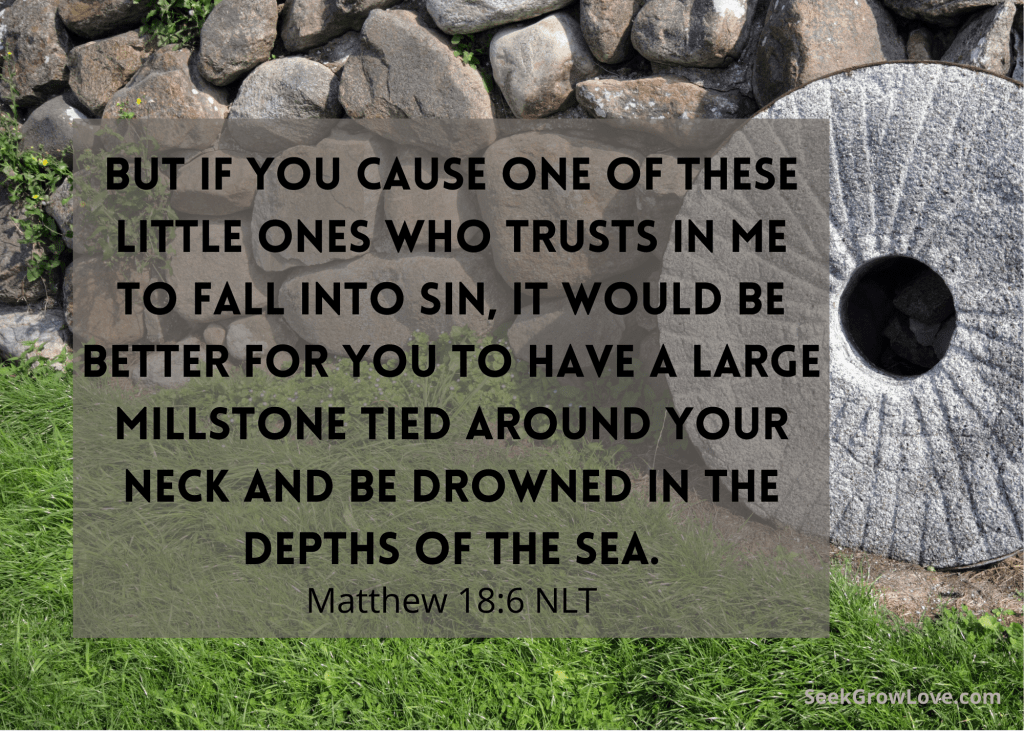
I have watched just enough mobster movies to know the awful fate of those who anger the mafia boss and receive the “cement shoes” treatment. That is the vision that always comes to mind when I read of the seriousness of leading a child to sin. “And whoever receives one such child in My name, receives Me;  but whoever causes one of these little ones who believe in Me to sin, it is better for him that a heavy millstone be hung around his neck, and that he be drowned in the depths of the sea.” (Matthew 18:5,6 NASB) Jesus was giving a pretty heavy answer to the disciples who had asked who would be greatest in the kingdom. He answered that instead of trying to be great, they should focus on being childlike instead – not immature (we see enough of that), but humble, knowing that they don’t know everything and they need a Father and a Savior. And while the child is standing in their midst – Jesus commends those who welcome a child and blasts those who recklessly (or accidentally?) lead a child to sin. As a parent and a Christian this is a strong warning that I will be judged based on how I am spiritually leading and guiding God’s children. I do not know where the line will be drawn. We might be able to safely point out some cases that would definitely receive Jesus’ condemnation (those who exploit children and youth for sex trafficking, pornography, cults or gangs). But what of the parent who signs their child up for the youth sports, campouts and Sunday morning jobs knowing it will take them away from opportunities for God’s little children to grow closer to Him? I don’t know. But it seems wise to do my best to err on the side of caution. What else can I be doing to spiritually guide His children away from sin? Life is easier when you don’t feel the weight of a millstone around your neck or cement hardening in your shoes.

And, if that isn’t scary enough – Jesus broadens the picture next – to all people and sinners and the extreme measures that need to be taken to keep oneself from falling into sin. “Woe to the world because of the things that cause people to stumble! Such things must come, but woe to the person through whom they come!” (Matthew 18:7 NIV). And then comes the gruesome cutting off of body parts that causes you to sin. This gives a strong mental picture of doing whatever it takes to hold oneself accountable and keep oneself from sin. If your eye causes you to sin, cut it out, to save yourself from judgment and hell. This is definitely true in a metaphorical sense. We need to do all we can, even what would be considered extreme measures, to keep ourselves from sin. And, sometimes that will mean cutting off the influence some people hold over us – cutting off a friend or family member or social media/entertainment who entices us to sin. It’s a hard thing to do, just like cutting off your hand – but it could save your eternal life. And, we must watch ourselves to make sure we are not the ones enticing others to sin!

While I love the parable of the lost sheep and it hurts to skip over it…I am going to skip ahead to the next two passages in Matthew 18 which both deal with the brother who sins against you. Having just established the seriousness of sin, the consequences for those who lead others to sin and the extreme measures we are to employ to keep us from sin – it is easy to assume that the best course of action is to shun all sin and sinners. But, wait, what kind of cut off, silent, lonely, bitter world would that be? While we are all sinners – God gave us a way to be forgiven and to restore relationships. Jesus begins to explain it here.

First, if a brother sins against you – go and talk to him. Matthew 18: 15-17 goes through an important series of steps to work towards either resolution or healthy distance and cutting off -and it starts with talking to the “offender”. Too often when we feel someone has sinned against us we talk to others about it. I know I am guilty of this and need to do a better job of lovingly confronting the person I have an issue with – first. So the steps Jesus laid out are: talk privately to the person, if he doesn’t listen take 1-2 witnesses and try again, if he doesn’t listen tell the church, if he still doesn’t listen cut him off. The goal is always to win him back to ‘God’s saving side’, not to humiliate, point fingers or feel better about ourselves or peace at any cost. But, sometimes repentance doesn’t happen, and then we must be willing to cut the ties that would bring others down to sin as well.

So, let’s assume we correctly followed the steps Jesus left. Peter asked how many times he needed to forgive a brother who sinned against him. He thought 7 sounded like a lot. But Jesus said no – 77 or 70 x 7 or whatever number you want to use to remind yourself to keep forgiving – the same way you want others to forgive you. And the same way God has forgiven you. I think we can safely assume this is not the brother who was unrepentant and cast out of the church, but a brother who was repentant and seeking to live a godly life – but still tripped up – like you and me. And so Jesus lays out the powerful Parable of the Unmerciful Servant (make sure you read it again). Now the harsh words and judgment are not for the sinner who tripped up, or even the one who caused him to sin, but for the one who didn’t forgive. “Then the master called the servant in. ‘You wicked servant,’ he said, ‘I canceled all that debt of yours because you begged me to.  Shouldn’t you have had mercy on your fellow servant just as I had on you?’  In anger his master handed him over to the jailers to be tortured, until he should pay back all he owed.” (Matthew 18:32-34).

It isn’t that sin is nothing – and easily forgiven. Sin (of all kinds) is something huge and serious and able to block us from eternal life. If we could see how much our sin hurts others, handicaps ourself and damages our relationship with God we might more readily run from it. But we don’t always, and God in His mercy still lays out a way for us to restore a relationship with Him, ultimately it would cost Him the death of His Son Jesus. To accept the forgiveness offered to you, but not extend it to others puts you again in grave danger. Sin is a big deal – and so is mercy.

-Marcia Railton

Because I Received Mercy

Matthew 18

matthew 18 33


There are some things that are not optional for the followers of Jesus, and forgiveness is one of them. Jesus talked many times about forgiveness to his disciples, but he couldn’t be more clear than in Matthew 18:21-35. We not only learn that we must forgive others, but also learn that there are consequences if we refuse, and the reason why we are expected to forgive.


Jesus gives his disciples a parable about a guy who owed his master 10,000 talents of money. Now, one talent was equal to about 15 years worth of labor, so this guy owed his master 150,000 years worth of labor. By today’s standards, the average person makes about $50,000/year in the United States; that would be equal to $7.5 billion dollars!!


Needless to say, there was absolutely no way that this guy is going to pay his master back. However, he begged his master to be patient with him and give him more time. His master showed mercy on him and forgave everything!! You would think that this guy would be the most grateful man ever and forgive everyone else that he came across, right?


Unfortunately, after all of this, he found a slave of his who owed him money (not nearly as much as he owed his master), and refused to forgive his debt as he had been forgiven. Because of his actions, the guy’s master punished him by putting him in prison until he paid back all he owed, which would never happen…


This is a stern warning from Jesus for us today. Our debt for sin has been completely removed from us because of Jesus’ sacrifice! Because of that fact, we should be the most forgiving people on earth! Whatever someone has done to you cannot compare with the debt that has been paid for us; we need to forgive freely to all those who ask for it. We cannot bear grudges or hatred for anybody; it is time to let it go.


-Talon Paul