Storytime in the Gospels

Matthew 13 & Luke 8

Devotion by Shelly Millard (Nebraska)

Storytime when putting the grandchildren to bed is the best.  One of my favorite books is called “Tale of Two Beasts”.  In the story, a little girl is walking through the forest and finds a small beast hanging upside down from a branch.  She decides to take this little one home and turn him into a pet.  The book first tells the story from the perspective of the little girl.  The second part of the book tells the story from the perspective of the little beast.  Gradually, the two tales come together in a happy ending as they learn to appreciate one another despite their differing perspectives.   I love the book because it teaches something I think is important and that is to step back and consider the perspectives of others throughout life.  Many, if not most, children’s books attempt to teach a lesson through storytelling.  In Matthew 13, we see that Jesus knew the power of stories in teaching abstract principles through parables.   He knew that using parables was an effective way to communicate profound truths about faith and life.  He merely looked around him and identified familiar elements and characters like farmers, fishermen, bread making, and harvesting crops that could be used to help his listeners understand deeper spiritual truth.  Using learning principles that we’ve identified today, he uses metaphors and similes to draw comparisons of the everyday to deeper spiritual truths. These stories stay with us and help us to understand and remember what Jesus wanted us to know. The stories told over 2000 years ago still have relevance to us today.

The beautiful thing about parables is it teaches a truth that at first glance seems simple yet allowing for increasing layers of understanding.  Like the layers of an onion, a parable provides layers of depth and nuance that with reflection and application can reveal increasing insights while challenging individuals to grapple with the truths and grow from them.  Jesus is using these stories to turn the listener into a participant rather than just the audience—the best way to learn. Parables Jesus shared are sprinkled throughout the gospels;  Matthew 13 contains several significant ones teaching about faith and the Kingdom of God.

Parable of the Sower: A sower scatters seeds on different types of soil; the path, rocky ground, thorn and good soil with each type of soil representing different responses to the message of the Kingdom of Heaven.  It asks, “How do you receive the message of the kingdom?”

Tares and the Wheat: The combination of tares and wheat together teach lessons about the coexistence of good and evil in the world, emphasizing the importance of discernment and patient waiting. It asks, “How do you understand and identify between good and evil?”

The Mustard Seed: Just as a tiny mustard seed can grow into a large plant, even the smallest amount of faith can be transformative.  It asks, “How does your faith, even if it is found in small belief and actions, lead to significant outcomes?”

The Leaven: A woman mixes leaven into the dough causing it to rise and transform into a delicious loaf of bread just as the message of the Kingdom of Heaven can gradually and irreversibly alter the world.  It asks, “How can you be influential by sharing the message of the Kingdom of Heaven?

Hidden Treasures: A man discovers a treasure and recognizes its value, selling everything to buy the field where the treasure is hidden. The discovery of the message of the Kingdom of Heaven is a remarkable treasure that is worth sacrificing everything to obtain it.  It asks, “What are you willing to sacrifice to pursue the incomparable value of the Kingdom of Heaven?”

Costly Pearl: A merchant is actively searching for fine pearls and when he finds one of great value, sells everything he has to purchase it just as a person searches for truth and spiritual connection.  It asks, “How are you diligent in your search for truth and are you willing to give up everything to make it yours?”

The Dragnet: The fisherman casts out a net that gathers in all kinds of fish, just as the message of the kingdom will gather in all types who will eventually be subjected to God’s judgment.  It asks, “How do you respond to the “all types” gathered together by the gospel message”?

As you engage in these stories, immerse yourself in the “world” that Jesus is creating for us.  If it is the Parable of the Sower, imagine yourself walking through the field and seeing where the seeds you scatter are landing.  If it is “The Leaven”, imagine that you are the one making the bread and leaven to make it rise.  Becoming a part of the story will allow you to deeply engage with the lesson Jesus is teaching.  Approach them with an open heart and mind, asking, “What can I learn and take away from this story”.  Reflect on the story and connect the teachings with your own life asking, “How is what I am learning impacting my faith, my relationships and my behavior”?  The ultimate test is to begin to apply what you have learned and allow those insights to change how you live. 

Questions for reflection

Which of these parables resonate most closely with you?  

Focus on one parable.  Imagine yourself in the context of the story and immerse yourself for a moment in the action.   How does that impact your understanding of the parable?

If Jesus was walking through your world today, what might he choose to build a parable around?

How do you think a parable might increase your faith?
Clean the Pot

Ezekiel 24-27

Devotion by Rebecca Dauksas (South Carolina)

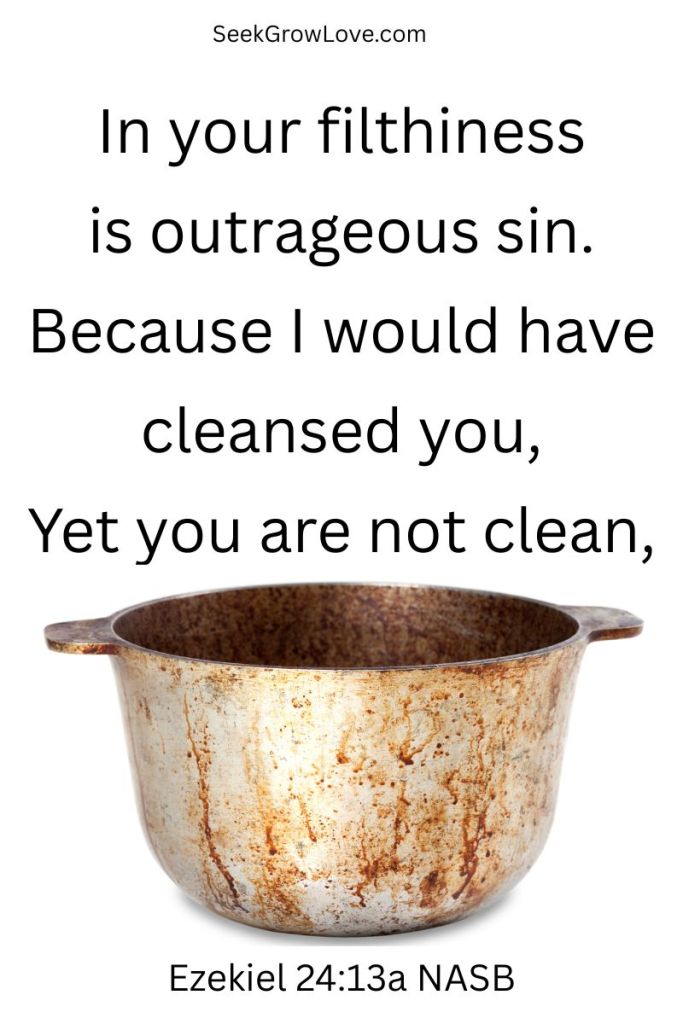
Today I scrubbed out our cast iron skillet. It would have been easier the night before, but I put this task off until today. It reminded me of our reading from Ezekiel 24. The parable for the Israelites contains a dirty, rusted boiling meat pot destined for cleansing by destruction. The pot was symbolic of Jerusalem. Ezekiel once again shares what the Sovereign LORD has said by telling his people this parable. The king of Babylon has laid siege to Jerusalem. The LORD shows the people what will happen if they continue in their evil practices. The LORD refers to Jerusalem as the city of bloodshed. When faced with a warning that severe negative consequences including death for many will follow their actions, we would think that they would stop sinning. We want the people to repent, to turn to God and accept His deliverance and His salvation. Unfortunately, they do not. 

That nasty stuff in the pot should have been removed long ago, but the people continued in their sins. We could compare the rust of the pot to the bloodshed that had taken place in Jerusalem. God had seen the killing and wounding of others in this city of blood. All the actions of the people were in full view for God. He also states that their impurity was lewdness. They did detestable acts and committed adultery. They chose indecent, obscene behaviors rather than allowing God to clean out all that crud.  They should have been filled with shame and repentance, but they openly committed their sins. The scripture tells us that the LORD tried to cleanse them, but they would not be cleansed. They were told, “You will be judged according to your conduct and your actions,” declares the LORD. 

The people of Jerusalem would not turn from their sin, but we can. We can recognize when we fall short and confess our sin. After all, He is faithful and just and will forgive us our sins and purify us from all unrighteousness. So God can make us a “vessel for honor, sanctified, useful to the Master, prepared for every good work.”

Reflection Questions

  1. What sins has Ezekiel mentioned in his book? What does God not like about them?
  2. Why do you think God is giving warnings before the punishment comes?
  3. What sins do you think God sees today – in you – that he would (or is) sending you a warning about? And what sins in the world around you?
  4. What would the cleansing process look like if we turn to God? What would the cleansing process look like if we don’t?

When Giving it All is a Wise Investment

Old Testament: Genesis 37 & 38

Poetry: Psalm 16

New Testament: Matthew 13:44-46

Some of my favorite commercials have come from the Klondike Bar ice cream company. Their catchphrase is “What would you do for a Klondike?”, followed by some of the most extreme examples of people doing something to get their ice cream bar. One of my favorite commercials involved a man willing to shave off one of his eyebrows and looking ridiculous for the ice cream (I apparently am not willing to do much, because I’ve never actually eaten one).


We are asked a similar question in our devotion today, but not involving ice cream: this involves the kingdom of God. In Matthew 13, the kingdom of God is compared to two gentlemen willing to sell everything that they possess to acquire it, like a hidden treasure or a precious pearl. They recognize two things: the kingdom of God is something of tremendous value, and that everything they own cannot compare with its marvelous wonder. Although they are sacrificing much, they are making the wisest investment of their life. Imagine if you had the opportunity to possess a winning lottery ticket that would give you 100 million dollars: all it would take is to sell all your possessions… would you take that deal? Would that lottery ticket not be able to buy back everything you had and more?


See, Jesus also promised that if we give our lives for the kingdom of God, we would receive a hundred times as much in this life and in the next age (see Matthew 19:27-30). He wasn’t asking us to simply give up everything just because he felt like it: he promised infinitely more than we could ever imagine, if we would simply trust him and follow his kingdom-way. You would
be making the wisest investment of your life if you chose the kingdom of God over every possible path that this life has to offer, and you would gain much more than this life could ever offer. So, “What would you do for the kingdom of God?” What are you willing to risk for eternal life?


Perhaps a more direct question is in order as well: “What are you NOT willing to risk for the kingdom of God?” We all have something we hold dear, whether that be personal possessions, a deeply-held family connection, or a desired career path. There are some things that will be difficult to let go of to pursue Jesus and the kingdom of God, but that’s the point: he wants you FULLY committed, willing to give him everything because he gave everything for you. This is something that we must consistently ask ourselves and reflect on what we are holding back from our Lord.


What would you do for the kingdom of God?


Talon Paul

Reflection Questions

  1. Both men in today’s parables recognized the kingdom of God as something of great value. What value do you place on the kingdom of God? Why?
  2. What have you already given up to pursue Jesus and the Kingdom of God?
  3. What are you having a difficult time letting go of in order to gain the kingdom of God? 
  4. Explain how giving it all can be a wise investment.
  5. What is the wisest investment you can make with your day today, and with the week ahead of you, if you are fully committed to living for the kingdom? 

Good Seed, Weed Seed

Old Testament: Genesis 33 & 34

Poetry: Psalm 14

New Testament: Matthew 13:24-43

“The Kingdom of heaven is like…”Six times we will read that phrase through the rest of Matthew 13 as Jesus shares parable after parable, with the purpose of explaining the Kingdom of heaven, first to the large crowd on the shore and then more directly to his disciples. Jesus knows that they are expecting a Messiah to come rule and set up a kingdom that will overthrow the Roman army and government. Jesus wants them to know the Kingdom he is teaching about is far greater and very different from what they are looking and hoping for. 

It is interesting that Matthew is the only Old or New Testament writer who will use the phrase “kingdom of heaven”. Many of the same parables will also be told in Mark and Luke and they will use the phrase “kingdom of God”. John doesn’t include all of Jesus’ parables in his gospel account, but does write of the “kingdom of God.” So, why is Matthew different? As a Jew himself Matthew was writing to convince the other Jews that Jesus was indeed the Messiah promised to Jews long ago. His original audience was very aware of God’s laws about misusing His name and so they cautiously omitted referring to God by name and replaced God’s name with the place God dwells – heaven. Matthew was not trying to create confusion about where this Kingdom would take place. As we read these parables and continue throughout the gospels and New Testament let’s look again and again to see if the hope of the kingdom Jesus taught is to be whisked away to live in clouds or to inherit and possess the land. And when does it take place? 

A word repeated many more times than “kingdom” in Matthew 13 is “hear”. Open up your ears and really listen to what Jesus has to say. Don’t assume you’ve heard this sermon before so you can check out. He has mysteries to reveal about the kingdom, but so many will miss it because they don’t really listen to the words of Jesus. So, this year instead of reading through Matthew 13 in one day we thought it would be profitable to slow down and take the parables one day at a time. Many times through the year in our SeekGrowLove Bible reading plan when we come to a new parable we will give a day to the reading and thinking and hearing of that parable. Sometimes the devotion might be written about one of the other Bible passages, but you can still take the opportunity to soak in what Jesus is saying and teaching, often about God’s kingdom. 

So, today’s parable is about weeds (we’ll go back and hit the mustard seed and yeast tomorrow). Who doesn’t love a good weed story? And, with this particular weed parable we get the benefit of hearing Jesus’ explanation when the disciples questioned Jesus after the crowds were gone. But the story didn’t start with weeds – it started with the Son of Man planting good wheat seeds in the world. But then the devil sneaks in at night and plants weed seeds. And so the sons of the kingdom and the sons of the evil one grow up together. This is your neighborhood, your school, your office environment, your world. Side by side. Sons of the kingdom and sons of the evil one. Growing older and taller, together. All mixed up, together. Side by side. Wheat and weeds. Righteous and wicked. Until…

Why do we have to wait? Can’t we just take out the weeds NOW? No, Jesus says. Both will grow together until the time of the harvest at the end of the age. Will the weeds and the wheat be sorted out when they each die? No, Jesus says. Both will grow together until the time of the harvest at the end of the age. We aren’t there yet, but every day we are a day closer.  What will the harvest look like? Let’s hear what Jesus has to say: “The Son of Man will send out his angels and they will weed out of his kingdom everything that causes sin and all who do evil. They will throw them into the fiery furnace, where there will be weeping and gnashing of teeth. Then the righteous will shine like the sun in the kingdom of their Father. He who has ears, let him hear” (Matthew 13:41-43). 

Wheat or weeds? You are one or the other. There isn’t a third choice. Which do you want to be?

Son of the Kingdom or Son of the evil one? You are one or the other. Which do you want to be? Which will you strive to be? What will it look like?

Fiery furnace or shining like the sun? Which will the harvest reveal as your destiny? 

Have you heard the words of Jesus? How will you respond? 

-Marcia Railton

Reflection Questions

  1. What have you been taught about the Kingdom of God/Kingdom of Heaven? Does it line up with Jesus’ words and teachings?
  2. How can we better listen to and actually hear and then respond to the words of Jesus? 
  3. What encouragement and warnings do you find in the parable of the weeds? 
  4. How can you grow as a Son of the Kingdom living amongst the sons of the evil one? 
  5. What are some of the “everything that causes sin” that you look forward to being destroyed at the harvest at the end of the age?

Master Storyteller

Matthew 13

January 13

I was excited to see that Matthew 13 begins with the Parable of the Sower because that is definitely one of my favorite parables. And then there was the Parable of the Weeds – oh that’s a great one, too. And, the Mustard Seed and Yeast. As well as the Hidden Treasure and the Pearl and finally, the Fishing Net. I believe Matthew 13 is the home of more parables than any other chapter of the Bible -but please correct me if I am wrong. It’s been a long time since I was in junior high, but I still remember Joyce Knapp, my junior high class Sunday School teacher, describing parables as earthly stories with heavenly meaning. Jesus was a master at telling stories about common, everyday things everyone listening would know about (fields, farming, seeds, yeast, weeds, fishing nets), and creating out of it a deeper spiritual, godly lesson. He didn’t give long confusing lectures filled with mile long words that you need a masters level degree to understand. He wanted to make it as simple as he could so that anyone willing to listen with an open mind could learn, even while knowing that many would not get it because they didn’t want to change or didn’t think they needed what Jesus had to offer.

What was it Jesus was offering? What was the point of all these earthly stories with “heavenly” meaning? It is interesting that Matthew is the only gospel writer who uses the phrase “The kingdom of heaven is like…” to introduce many of Jesus’ parables. In fact the term “kingdom of heaven” is only found in the book of Matthew (31 times – and 8 of those are in Matthew 13). The other gospel writers, as well as Paul in his letters, refer instead to the kingdom of God (even Matthew uses this term 5 times). When Matthew was writing with the Jews in mind he knew they took very seriously the commandment to, “Not misuse the name of the LORD your God, for the LORD will not hold anyone guiltless who misuses his name.” (Exodus 20:7) So, in order to remain guiltless it might be better to not use his name at all. So, when speaking of God and godly things, Matthew often replaced the word God with heaven as that is the throne of God and it would be understood that he was speaking of godly, holy matters belonging to God, without having to risk misusing his name or offending a Jewish listener. These parables are not about being whisked away to heaven when you die. Indeed, they are very much grounded in what is happening on earth both now and in the future judgment. These parables of the kingdom of heaven/God are down-to-earth stories illustrating spiritual/Godly matters.

Take some time today reading and even rereading these parables. Each one has a gem hidden for those who will listen and seek. Each one reveals a little more about what Jesus found most important, what God is preparing, what is required, what is most valuable, what the evil one is up to, what is promised, what are dangerous challenges, what is worthy of sacrifice, what judgment will look like, what is to come, what will be. It’s a treasure hunt in Jesus’ parables. What does the Master want you to find in his stories?

There is one verse that really struck me as I read and re-read Matthew 13. It seems to say perfectly what discussed earlier this week about not throwing away the Old Testament but adding to it the love and beauty of Jesus and what he taught and what he has done and will do. After telling 7 parables Jesus asks his disciples if they are getting it. They reply yes. Then, “He (Jesus) said to them, ‘Therefore every teacher of the law who has become a disciple in the kingdom of heaven is like the owner of a house who brings out of his storeroom new treasures as well as old.'” (Matthew 13:52 – NIV) The teacher of the (Old Testament) law who learns and lives by these (New Testament) principles spoken by Jesus and recorded by Matthew as the kingdom of heaven parables and teachings has double the treasure – both old and new.

What treasure in His Word will you find today? How will you use these treasures to make a difference in your life? How will you use these treasures to make a difference in someone else’s life?

-Marcia Railton

Questions for Reflection and Discussion

  1. Which of the Matthew 13 parables is your favorite today? Why? What is the lesson Jesus was teaching? Why is this important? How can you apply it or put it into action today?
  2. Jesus chose perfect illustrations for his parables. Even 2,000 years later, even if you are not a farmer, you know what happens when a seed is planted. Even if you have never been fishing, you understand how a net works. But consider how you would create a parable with one of these same teachings using a modern day illustration.
  3. Consider the Parable of the Sower (Matthew 13:1-9 and 18-23). What 4 types of soil did Jesus mention and what do they stand for? What happened to each of the seeds? Have you seen these 4 instances occur to others? What kind of soil best describes you right now, and in the past? What lessons can you learn for evangelism from this parable?

Listening to Jesus

Today’s Bible Reading – Matthew 25 and Genesis 49 & 50

                I Love stories, don’t you?

Here’s a story by CS Lewis found in the book: The Voyage of the Dawn Treader as retold by Jennifer Neyhart:

               “Eustace is a character you kind of just want to punch in the face until his transformation experience with Aslan. He was arrogant, self-centered, and all around annoying to Edmund and Lucy.

On one of the islands the crew lands on, Eustace finds a dragon’s lair and is very greedy for the treasure. He puts on a gold bracelet and falls asleep, and when he wakes up, he has been turned into a dragon. Lewis writes, “Sleeping on a dragon’s hoard with greedy, dragonish thoughts in his heart, he had become a dragon himself.” Eustace had fleeting thoughts of relief at being the biggest thing around, but he quickly realizes he is cut off from his friends, and all of humanity, and he feels a weight of loneliness and desperately wants to change.

That night, Aslan comes to Eustace and leads him to a large well “like a very big round bath with marble steps going down into it.” Eustace describes the scene to Edmund after the fact. He says the water was so clear and he thought if he could get in there and bathe it would ease the pain in his leg (from the gold bracelet he had put on when he was human). But Aslan told him he had to undress first. And doesn’t God ask this of us? As Lewis wrote in Letters to Malcolm: “We must lay before him [God] what is in us; not what ought to be in us.”

Eustace found that no matter how many layers of dragon skins he managed to peel off of himself, he was still a dragon.

“Then the lion said – but I don’t know if it spoke – ‘You will have to let me undress you.’ I was afraid of his claws, I can tell you, but I was pretty nearly desperate now. So I just lay flat down on my back to let him do it.

“The very first tear he made was so deep that I thought it had gone right into my heart. And when he began pulling the skin off, it hurt worse than anything I’ve ever felt. The only thing that made me able to bear it was just the pleasure of feeling the stuff peel off. You know – if you’ve ever picked the scab off a sore place. It hurts like billy-oh but it is such fun to see it coming away.”

“Well, he peeled the beastly stuff right off … And there was I as smooth and soft as a peeled switch and smaller than I had been. Then he caught hold of me – I didn’t like that much for I was very tender underneath now that I’d no skin on – and threw me into the water. It smarted like anything but only for a moment. After that it became perfectly delicious and as soon as I started swimming and splashing I found that all the pain had gone from my arm. And then I saw why. I’d turned into a boy again…” – C. S. Lewis, The Voyage of the Dawn Treader

 This scene always grabs my heart. It reminds me that I cannot fix myself. It paints a beautiful picture of baptism and transformation to new life. It humbles me as I put myself in Eustace’s place. And even long after our initial baptism we have the ongoing challenge of surrendering to God’s work in our lives which can be painful at times, even when it’s a good pain.

And I like Lewis’s note of narration at the end of this scene as well:

“It would be nice, and fairly nearly true, to say that “from that time forth Eustace was a different boy.” To be strictly accurate, he began to be a different boy. He had relapses. There were still many days when he could be very tiresome. But most of those I shall not notice. The cure had begun.”        

https://www.jenniferneyhart.com/2014/10/c-s-lewis-undragoning-of-eustace.html

End of Story.

Jeff’s comments:

                Stories have a way of capturing our attention and keeping our interest.  In a really good story like the undragoning of Eustace we might discover after reading it that it stays with us, that it somehow changes the way we see the world or the way that we are in the world.

                Jesus was a master storyteller.  Throughout the Gospels we hear him telling stories, and amazing stories they were as they somehow manage to transcend time and place and language and cultural barriers.

                In Matthew 25 Jesus tells three stories.  One story is about bridesmaids and oil, one is about masters and servants and bags of gold, and one is about sheep and goats.  Jesus told these stories just a few days before he was to be arrested, tried, condemned and nailed to a Roman cross and publicly executed. 

If you’ve ever been around someone who knew that they were going to die soon, you know that near the end of life people usually want to focus on those things which are most important.  They want to say “ I love you” to people they care about.  They want to say “ I’m sorry” to the people they have hurt or they want to say “I forgive you” to the people who have hurt them.  Since Jesus is running out of time and opportunities to preach and teach before his arrest you can imagine that what he has to say is very important to him. This is Jesus saying “I love you” to people he cared deeply about.

I encourage you to read and reflect on those stories in Matthew 25. 

Why is he talking about weddings and bridesmaids and having enough oil and the danger of missing out on the wedding banquet?  What does he want us to do or not do?

Why is he talking about a rich landowner going away on a long trip and leaving behind something valuable and asking his trusted workers to manage his valuable gold well?  What does he want us to do or not do?

Why is he talking about sheep and goats and why is he praising and rewarding some for the good things they do to help others (and him) and condemning  and punishing others for the good things that they fail to do to help others (and him)?  What does he want us to do or not do?

Spend some time thinking about each story.  Imagine yourself there in the story.  What’s it like to be a bridesmaid who wasn’t ready and missed out on your friend’s wedding?  What’s it like to be a worker who gets praised and rewarded for working hard when the master returns?  What’s it like to be called a goat (not The G.O.A.T. –a.k.a. Michael Jordan or Drew Brees) but a goat who failed to care for the sick, the hungry, the prisoners and the naked and gets turned away by Jesus?

Listen to Jesus’ stories and allow them to teach you whatever Jesus wants you to learn.

-Pastor Jeff Fletcher

Luke 16-17:10

In our world today, there are so many distractions that can lead us away from God. When we turn our focus on other things, we can get choked out like the seeds in the parable of the sower. When we consider what is worth pursuing in life, we have to ask ourselves whether or not the things that we are pursuing are things that glorify God. If they do not, they have no true worth. 

In today’s reading, Jesus tells a series of parables that show how we should view money and possessions in our lives. The Pharisees listened to his teachings and scoffed at Jesus, because they loved Money. Jesus recognizes this, and tells them that “ What people value highly is detestable in God’s sight” (Luke 16:14b). What do you value highly in your life? How does that affect your ability to glorify God with your life? 

We’ve all been given an allotted period of time that we can use for God and for ourselves. We are responsible to manage that time wisely. We are stewards, not only of our wealth, but our very lives. Luke 16:10-13 says, 

10 “Whoever can be trusted with very little can also be trusted with much, and whoever is dishonest with very little will also be dishonest with much. 11 So if you have not been trustworthy in handling worldly wealth, who will trust you with true riches? 12 And if you have not been trustworthy with someone else’s property, who will give you property of your own?

13 “No one can serve two masters. Either you will hate the one and love the other, or you will be devoted to the one and despise the other. You cannot serve both God and money.”

Who is the master in your life? Let’s turn our focus on God. He is worthy of all our life. 

~Cayce Fletcher

Today’s Bible passage can be read or listened to at BibleGateway here – Luke 16:1-17:10.

Tomorrow we will read John 11.

Luke 14-15

I love enjoying Sunday dinner with others. Sharing a potluck or going out to eat together is great, but in our reading we see Jesus was invited to the house of a prominent Pharisee where he was being carefully watched. Some of the leaders had been listening very carefully to Jesus, but not to learn from him. They hoped to find fault with Jesus and to catch him in something he said then report him to the authorities. Imagine being a guest at this table. You have the opportunity to sit and eat with the Son of God. You have the chance to hear his teaching. But these leaders are so blind that they are trying to set a trap for Jesus. The leaders get their wish because a man who is suffering is there. Of course, out of compassion the Lord heals the man. Rejoicing should have happened around this table, but instead Jesus has to explain that healing on the Sabbath is doing good and it is acceptable.

Jesus noticed that these guests were picking the places of honor at the table. They were self-promoting and needed to learn the importance of humility that Jesus illustrates through a parable of taking the lowest position at a feast.  Explaining that “all those who exalt themselves will be humbled, and those who humble themselves will be exalted.”  

Jesus then teaches that meals should be given for the less fortunate, which will result in the host being blessed and repaid at the resurrection of the righteous. Someone at Jesus table said to him, “Blessed is the one who will eat at the feast in the kingdom of God.”

Jesus then used a parable to explain that the “stuff of life” should never keep us from accepting the invitation we have received from the Lord to the great banquet He has prepared for us. When we count the cost of being a disciple, we realize that giving up the things of this life are a small price to sit at the Kingdom feast table. As Christ said “many will come from the east and the west, and will take their places at the feast with Abraham, Isaac and Jacob in the kingdom.” I love that he states that there are places for us at that feast (reserved seating). Each person is important to God as we see in Chapter 15. Stay close to our Heavenly Father and rejoice when those that are lost are found. Remember that we will one day celebrate like never before around our Father’s table at the Kingdom feast.

~ Rebecca Dauksas

Today’s Bible passage can be read or listened to at BibleGateway here – Luke 14-15.

Tomorrow we will read Luke 16:1-17:10.

The Kingdom of God is Like

Luke 13

Then he told this parable

During this time of year, you can simply feel it in the air — people buzzing like bees, quickly moving from place to place, passing off presents, sternly shaking hands, embracing each other, even some merry kissing under the mistletoe.  All humanity grows a bit closer in this glorious time of the year – flu season.  That is right – the flu — the microscopic menace spreading like wildfire, which we can only hope to contain.  Yet the flu is like the Kingdom of God.  Wait. What?

To see the comparison, we started with the question Jesus poses in Luke Chapter 13, “What is the Kingdom of God like?  What should I compare it to?”  He points to two tiny, but curious, examples from nature that illustrate the uncontainable and incurable makeup of the message of the Kingdom of God: the mustard seed and yeast.  Two of the smallest items that can be seen with naked eye can easily work their way into their host with seemingly no offense.  Once mustard seeds are sown, it would be an impossible task to remove them from their soil.  Additionally, if you were to knead yeast into a dough, it would be equally difficult to eradicate.  In just a small matter of time each grow (for lack of better biological terms), changing the landscape around them.

I am by no means a scientist or theologian when I make the claim that the Kingdom of God is like a virus, but I see it as an alike analogy to the yeast and seed, present in today’s known world.  When we become infected by a single strand of a seemingly insignificant substance it almost immediately multiples.  Our body’s biology begins to react by reprioritizing processes and protocols.  Even the most cautious of host cannot help but spread the contagion to others.  Similarly, the hope we have in the Kingdom of God starts merely as a few words that come in through our eyes or ears, terribly trivial when placed within the context of the hundreds of millions we will experience in our lifetime, yet they knowingly or unknowingly work on our hearts differently.  As these words begin to work in us, our priorities shift, our behaviors change, and our effort increases.  The virus begs to be shared in every encounter inside and outside the body – passing of presents, sternly shaking hands, embracing each other, or even in merry kissing under the mistletoe.  It becomes the definition of our existence.

You will undoubtedly be sharing space with the suffering in the coming weeks. As you hear the coughs, sniffles, or maybe even some of the more unsavory sounds of the infected this season, remember that you too, suffer in a similar way.  The eternal infection – the Kingdom of God – is the longing placed into the hearts of all men by God who made them incomplete without it, but this virus is the cure for the condition of humanity, not the sickness. Work it into the dough, sow the seed, and spread the disease, to help others to know what the Kingdom of God is like.

-Aaron Winner

Return Home

Luke 8

Luke 8_39

Luke 8 is a pretty fast-paced chapter.  Jesus is in full ministry mode at this point and going about performing many miracles and teaching a lot of parables.  Here are a couple that jumped out at me.


Jesus tells the parable of the Sower, a farmer who is spreading seeds. The seeds grow based on the quality of soil that they are planted in.  The disciples do not understand the parable, so Jesus explains it in more clear language in Luke 8:11-15.


11 “This is the meaning of the parable: The seed is the word of God.12 Those along the path are the ones who hear, and then the devil comes and takes away the word from their hearts, so that they may not believe and be saved. 13 Those on the rocky ground are the ones who receive the word with joy when they hear it, but they have no root. They believe for a while, but in the time of testing they fall away. 14 The seed that fell among thorns stands for those who hear, but as they go on their way they are choked by life’s worries, riches and pleasures, and they do not mature. 15 But the seed on good soil stands for those with a noble and good heart, who hear the word, retain it, and by persevering produce a crop.


I think it is important to realize that the gospel is not directly injected into our hearts (metaphorically) but is presented to us.  It is up to us to make the decision to accept it, and then to purposefully fill our lives with the word in order to change our hearts.  As Jesus said, only through perseverance will we grow.  You cannot be passive about your relationship with God.


Later in the chapter Jesus drives out many demons from one man and they go into a herd of pigs, which immediately drown themselves.  Which is kind of weird.   But anyway, the man’s life had been completely changed by Jesus and he wanted to serve Jesus, and here is Jesus’ response in Luke 8:38-39.


38 The man from whom the demons had gone out begged to go with him, but Jesus sent him away, saying, 39 “Return home and tell how much God has done for you.” So the man went away and told all over town how much Jesus had done for him.


Instead of hitting the road with Jesus and spreading his testimony all over he is instructed to stay in his hometown and to give his testimony to the people in his hometown.  When a lot of people think about spreading the gospel they think about people far away that haven’t heard the gospel, and some are called to travel great distances as some of the disciples were, but many more of us are called to stay home and tell our story to unbelievers in our home towns.  Either way it is very important to share what God has done for you in order to help strengthen the faith of other believers.  For my family God performed a mighty act of healing in my Mom with her cancer and I try to share that as much as I can to show the power of prayer.

So I encourage you to “return home and tell how much God has done for you”.

– Chris Mattison