Seeker Sensitive?

1 Corinthians 14

i Corinthians 14 25

Any Princess Bride fans out there?  There’s a scene in the movie where one character keeps using a word and another character says to him, “You keep using that word.  I do not think it means what you think it means.”

There’s a lot of talk about whether churches should make their services more ‘seeker sensitive’ or ‘seeker friendly’.  Believe it or not, Paul actually addresses this issue in 1 Corinthians chapter 14.  And I believe his view is a resounding ‘YES’ to the question of seeker friendly churches.

However, I think our definition of seeker sensitive and Paul’s definition are vastly different.

Typically, a seeker friendly church service does anything possible to avoid causing guests to feel uncomfortable.  We want them to come back, after all.

Here’s what Paul thought,

“If an unbeliever or someone who does not understand comes in…he will be convinced by all that he is a sinner and will be judged…So he will fall down and worship God, exclaiming, ‘God is really among you!’” (1 Corinthians 14:24-25)

Understand that this teaching comes in a section of Paul’s letter in which he’s digging in to exactly how the Corinthian church should ‘do’ church services.  He talks about speaking in tongues, sharing prophecies, and what an orderly service might look like.  While specifics of church services may have changed over the years, I believe the principles that Paul is teaching remain true.

I’ve heard the opinion that in order to be more seeker friendly, churches should not mention the names of God or Jesus.  The Bible may be referenced, but only generally because giving verse references may cause outsiders to feel…well, like outsiders.

How can God convict someone that they are a ‘sinner and will be judged’ if we aren’t clearly and boldly preaching the Bible?

Churches should be the most loving, welcoming, friendly places in a community.  But there should be no doubt when entering that one is in a Christian environment, surrounded by people who live their lives by the instruction of God’s word.

Wouldn’t it be cool if we could master the art of boldly yet kindly speaking truth?  Maybe if we did, we’d have more visitors fall down and worship God, exclaiming, “God is really among you!”

-Susan Landry



Baby Spit-Up – Really?

1 Corinthians 11

1 Corinthians 11 26

Transubstantiation.  It’s a big word that means the belief that when communion bread and wine are taken, they literally become the body and blood of Christ.  The Catholic church holds this view.

A friend of mine was sharing a story recently of a visit to a Catholic church in which he discussed this with the priest.  The priest explained how it was because of this belief that the Catholic church began the tradition of priests placing the communion wafers directly into the mouths of parishioners.

You see, if the bread literally is the body of Christ, how awful if it were to fall and break on the floor.  The lay people of the church did not want to bear this responsibility.  They felt more secure in only having priests handle such a precious treasure.  And thus began this now common tradition.

My friend went on to share how he had asked the priest how this played out when they administer the tiny morsel of communion bread to babies upon baptism.  What if the baby spits the bread up?

The priest has to eat it.

Yup.  Let’s just leave that there and read a couple of verses from our chapter in Corinthians.

1 Corinthians 11: 27-28

Therefore, whoever eats the bread or drinks the cup of the Lord in an unworthy manner will be guilty of sinning against the body and blood of the Lord.  A man ought to examine himself before he eats of the bread and drinks of the cup.

Have you ever felt that taking communion can become rote?  Something you do without really thinking?

Clearly God cares that we take this exercise seriously.  But can we agree that we should find a happy medium between mindlessly consuming the bread and the cup and having to eat baby spit-up?

What this passage encourages me to do, and I encourage you to do, is to be mindful during the communion service.  How?

  • Always always always take a moment to pray and examine your heart before the Great God of the universe.
  • Humble yourself.
  • Be quiet.
  • Look around your church and ask God how you can build unity among the body (this instruction from Paul comes, after all, in a section of his letter instructing the Corinthian church on getting along at church).
  • Think about the fact that the last time Jesus participated in this it was the night before he died for you. Maybe thank him for that.
  • Realize that the next time Jesus participates in this he will have come again. Wow!  Maybe ask him how you can get ready for that.


-Susan Landry

Go! Fight! Win!

1 Corinthians 9

Do you not know that in a race all the runners run, but only one gets the prize_ Run in such a way as to get the prize.

Do you not know that in a race all the runners run, but only one gets the prize?  Run in such a way as to get the prize. (1 Corinthians 9: 24)

Being competitive is sometimes presented in a negative light.  Probably because competition can bring out the ‘jerk’ in people.  That’s too bad, because in his letter to the Corinthians, Paul is telling them (and us) to lean into that competitive spirit.

Paul is using this as an analogy, by the way, he’s not telling us that we are in competition with other believers.  He uses two phrases that I hope will inspire you as you run your race.

“strict training”

Athletes preparing for a big competition don’t eat whatever they want and binge Netflix all day.  What do they do instead?  They do things that will help them succeed in their goal.  (Winning!)  Paul’s goal, and ours, is “a crown that will last forever.”

How do we train for eternal life?

The word obey comes to mind.  In order to obey we need to really know Scripture.  If we want to hear the words “Well done, good and faithful servant,” we need to know what the Master expects of us.  And we need to do it, even when it’s hard.  Just like the athlete in training gets off the couch and goes to practice, even when he’s tired, we need to obey even when it doesn’t make sense to our human sensibilities.

“do not run aimlessly”

If you’ve ever been to a kid’s sporting event, you know that there are players that do not have their head in the game.  They are wandering around the field, chatting with friends, maybe even picking flowers in the grass.  Adorable.

Not so adorable when it’s adults in an Olympic competition and not cute when we’re talking about forever.

So many of us say that we are sharing our faith by they way that we live our lives.  But how much of that is a cop-out because we’re not comfortable evangelizing?  If we are actively sharing our faith through our life, we will be intentional in planning ways to do it.  We won’t just be going about our life, wandering aimlessly along.

I encourage you today to make a training plan.  How are you getting ready for Christ’s return?  I also encourage you to make a game plan.  How are you looking for ways to share your faith with those around you?

-Susan Landry


Knowledge Puffs Up, But Love Builds Up

1 Corinthians 8

Those who think they know something do not yet know as they ought to know.

Would it surprise you to know that in a discussion about issues that people disagree on, Paul would bring up the subject of pride?  The Corinthians disagreed on a lot, what to eat, how to worship, what was moral behavior, and more.  Paul kind of leads with this in chapter one (1:10) saying that he ‘appealed to them’ to get rid of the divisions and live in unity with one another.

Now here, in chapter 8, Paul is in the middle of working through one of their many dividing issues.  But instead of focusing on the issue, I’d like to hone in on some wisdom that Paul shares about unity in the body.

“Knowledge puffs up, but love builds up”

We shouldn’t be mistaken.  Paul is not saying that knowledge itself is bad, or that the desire to pursue knowledge is in itself prideful.  He’s not suggesting that we should pursue love instead of pursuing knowledge.  Not at all.  It seems that what Paul is concerned with is what that knowledge does in us and how we share that knowledge.

Do you like to be the smartest person in the room.  That’s pride.

Do you use your tone of voice to make people feel dumb because they don’t know what you do.  That’s pride.

And here’s an important thing to note… we’ll only really know that we are building up (or edifying) with our knowledge by how others respond.  Edifying is not something we can claim.

“I hereby edify you!”

Nope.  Not how it works.

If you think that you are sharing your knowledge with love, it will be evident by the unity that you are helping to create.  When Scripture calls us to be peacemakers (Matt. 5:9, James 3:18) it implies actively building peace and unity.  Being a peacemaker is more than just not shooting anyone.  A peacemaker makes peace as opposed to division, they edify and build up those around them.

Picture a person filled with knowledge who you just love to be around because of the way they make you want to know more, to be better, simply because of the kindness and grace with which they speak.  Their whole demeanor draws you to them.  Sounds a lot like Jesus, if you ask me.  It also sounds like the kind of person Paul is calling us to be.


-Susan Landry


What Counts

1 Corinthians 7

Keeping God’s commands is what counts.

I hope you have enjoyed working through 1 Corinthians this week.  I’m going to finish with chapter 7 today.


Up until now Paul has been telling them about all of the changes that they need to make.  He has told them to set aside the worldly wisdom, and the associated status that comes with gaining it, for God’s wisdom.  He has told them to seek purity because they are members of the Body of Christ, and they cannot do things anymore just because their conscience says it isn’t bad, they need to listen to the Holy Spirit.   He has also instructed them to seek unity in the Body of Christ instead of handling their issues in the courts in order to “win” the argument. Several times in these instructions Paul has shifted tone between one of condemnation and rebuke, to one of conciliation and support.  Again here in chapter 7 Paul is lightening the blow from all of the changes he has asked of them in these previous chapters.


Paul does not want to overwhelm them with the changes he is asking for, so in chapter 7 he clarifies about the things that he is not asking them to change, but they may have thought he wanted them to change.  They do not need to get a divorce if they are married to an unbeliever, but are to do everything in their power to maintain a healthy relationship. If they are a slave then they do not need to attain freedom, although if they can that is nice, but it is not required. Contrary to what some of the Jews in the early Church were saying they do not need to be circumcised. Paul understands that these life changes would be a roadblock to some new believers and that they are not what God really wants, he says “Keeping God’s commands is what counts.”  God wants them to change their hearts. And maybe some of the life changes would be wise, but those things can come later as you grow in God’s wisdom. The most important thing to work on is obeying God’s commands and following the leading of the Holy Spirit.


Thanks again for reading along.  I hope some of this has helped you.

Until next time,

Chris Mattison

Paul is Proof

Free Theme Days – Evidence for the Risen Jesus

Acts 9

Acts 9 5 (2)

Much of what we believe in the Christian faith is taken, understandably, on faith. However, if I had to give one story that almost shuts down the need for faith and instead have PROOF about  Jesus and the Resurrection, it would be the story of Saul/Paul and his conversion in Acts 9.

Up until the point in Acts 9, Saul has been persecuting the Christian faith. They were most likely being stoned or thrown in prison for trumped up charges. Stephen was accused of blasphemy and he was stoned to death. We all know he spoke no words of blasphemy, because the truth is not blasphemous, but that is where the Jewish leaders were.

But in Acts 9, something amazing happens, Saul gets knocked off a horse, goes down, hears the voice of a man who claimed to be Jesus, goes blind, and wanders into Damascus blind and healed by a Christian, one of the very people who he had just been persecuting.

Why does this count as proof for me?

1. Because it’s clear that Paul is not crazy. In a day and age where scholars doubt everything from the historical Moses to the historical Jesus, one would assume that when they agree on a traditional understanding, that counts for something. No scholar doubts that Paul wrote Romans. Ask for yourself, is Romans the work of a man out of his mind with guilt, that turned to follow Christ because he was driven to the small band he once hated out of a plagued conscience? There are parts of certain letters where we see Paul’s expressed sorrow (1 Corinthians 15:9, for example), and one could point to that as a case. But Romans! It’s a theological magnum opus! He is a man still gifted with all his intellect and faculties.

2. Could Paul be lying, hoping to gain wealth or fame off this new movement? We will go into this kind of theory even more in depth tomorrow, but Paul lost everything by getting on board this Jesus movement. He was persecuted, beaten, battered, and abused (2 Corinthians 11), and this after he had everything he ever wanted. He was the top dog of Judaism (Philippians 3) but he turned away from all those things so that he may follow Christ.

I encourage you to consider the persecutor-turned-evangelist Paul. What could cause a man rabidly dedicated to defending the faith of his ancestor and the honor of his God to so drastically change his tune and agree with those whom he persecuted?

For my part, it convinces me there is something going on with this Jesus movement, particularly that the leader must still be alive.


So, do you believe Jesus is alive?


-Jake Ballard

Because He Accepted Me

Romans 15

Romans 15 7

Hello friends!

I do not necessarily have a set style of writing when it comes to devotionals… so (un)lucky for you, you get to listen to my general thoughts on the chapters this week!  I will list a few of my thoughts that are a little less common or obvious on each chapter and pose some reflection questions that will hopefully get you thinking deeper about what we’ve read this week.  My goal is that something I think of, you hadn’t thought about and you’re willing to dig deeper into the idea.  So, let’s look at Romans 15 according to Sarah’s brain, shall we??

Thought #1 – Vs. 1 – 12: There are some great verses in that small chunk that carry big meanings and can be so relevant to our lives!  Focusing on verse 7 specifically, I think it can be very easily manipulated to satisfy an individual’s personal agenda.  “Accept each other… ” that means you can’t tell me what I’m doing is wrong.  Because maybe it’s wrong for you, but it’s right for me.  How many times have you heard that or said that yourself?  I’ve definitely used that excuse!  And while that statement may not always be abused, or even inaccurate, we need to use discernment when bringing that idea up.  When we finish out that sentence, “Accept each other just as Christ has accepted you, SO THAT God will be given glory”  we see more clearly into the message Paul was trying to get across.  If we are accepting others as Christ accepts them, we are not letting them do whatever they want.  We are loving them enough to correct them when necessary, pick them up when they need, and not leaving them even when they mess up.  Let’s be honest, interacting with people can be difficult.  Accepting people who are difficult, is difficult!  But yet we are called to do so.  And why are we doing this?  SO THAT God will be given glory.  We don’t have to try to accept people when it’s hard for any other reason other than to bring God glory.  When you interact with difficult people in a positive way, what is your thought process behind it?  Are you doing it with a self-righteous attitude or genuinely trying to bring God glory?

Thought #2 – Obviously we know that prayer is important, but seeing yet another example of how Paul truly and genuinely believes in the power of prayer is very motivating to my own prayer life.  Not only does Paul live out a strong prayer life, he encourages others to join him and asks that they pray for him.  He clearly truly believes and trusts in the power of prayer.  Are you fully utilizing the power of a praying body of Christ?

Thought 3# – Vs. 30: Final thought for today… Sometimes you need to be refreshed by the presence of like-minded believers!  FUEL, Family Camp, ReFUEL, Refuge, Christian Worker’s Seminar…. These are all great places to be uplifted, encouraged, and refreshed.  But, just as Paul writes, I think it makes a difference in the attitude you come with.  If you are not looking forward to meeting with like-minded believers with joy and anticipation, are you being held back from refreshing company?

I hope some of these ideas were able to make you think a little deeper about our text today!

“May the God of peace be with you all.” Romans 15:33

~Sarah Blanchard

Jesus and Paul, Paralleled

image

Acts 23

The Apostle Paul was no stranger to persecution. He saw it from both sides. He was at times the persecutor and the persecuted. While he was a zealous Pharisee in Jerusalem, he targeted Jews who joined the sect of followers of Jesus called the Way. When he became a follower himself and preached the Gospel throughout Asia Minor and Macedonia, he was imprisoned multiple times and warned by friends not to return to Jerusalem, because if he did, he would likely be killed. Yet in chapter 23, we see Paul is not only in Jerusalem but in the custody of the Romans, facing the Sanhedrin.

About a quarter century earlier, another Jewish preacher stood in front of the same group of religious leaders. The name of that preacher was Jesus, and it was because of him that Paul found himself in an identical position. Like Paul, Jesus had also returned to Jerusalem that final time knowing it could mean death. And both times, each was the target of a treacherous plot. But neither Paul nor Jesus were moved from their mission because of this threat. They were both willing to die for the cause.
But there are several important differences between Paul and Jesus during their final days in the Jewish Holy City. Unlike Paul, Jesus put up no defense while in front of the Sanhedrin and Roman rulers. The prophecy in Isaiah 53:7 puts it this way: “He was oppressed and afflicted, yet he did not open his mouth; he was led like a lamb to the slaughter, and as a sheep before its shearers is silent, so he did not open his mouth.” Paul, on the other hand, started his remarks to the Sanhedrin by stating that he has lived his life with a clear conscience. Then, after inadvertently insulting the High Priest, he cleverly changed the subject from himself to a disagreement between the Pharisees and Sadducees. The ensuing bruhaha allowed Paul to get out of there without facing any penalties.
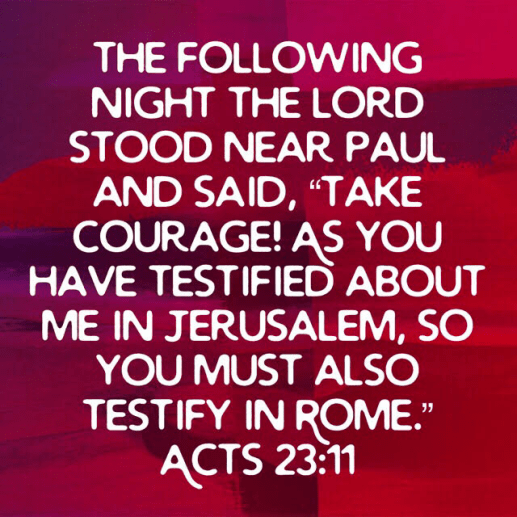
The following night Paul was told by the Lord that he would not die in Jerusalem but would make it to Rome to testify there also. Despite the fears of his friends, Jerusalem would not be the end of the road for Paul. And this is the other difference between Paul and Jesus. Because Jesus would not defend himself when he had the opportunity, the intimate Passover meal he shared with his twelve disciples would be their last together; the following day he was beaten and crucified.
Paul and Jesus both went to Jerusalem to save lives. The latter accomplished this goal by taking on the sins of the world and offering his life as a sacrifice for all. The former did this by telling any who would listen about that sacrifice and how to receive the salvation offered as a result of it.
Usually, I would say that we should follow the example of Christ. But when it comes to facing charges that are unfounded, we should look to Paul as the model. Yes, Paul was willing to die for what he believed in, but he didn’t intend to because of false accusations. Paul defended himself so he could advance the Gospel; Jesus didn’t so he could guarantee it. We must be willing to die for the cause of the Kingdom, yet always seeking to put ourselves in the best position to champion it.
-Joel Fletcher

Rehashing the Road to Damascus

96567

Hello! My name is Joel Fletcher and I am going to be writing the daily devotions for this week. I live in Minnesota with my wonderful wife, delightful daughter, and as of next Friday, a pastoral puppy. I like adjectives, alliteration, and Aussiedors.

This week we’re going to wrap up the book of Acts.

Since chapter 9, Luke has been chronicling the campaigns of one Saul of Tarsus (now called Paul), a Jewish Pharisee turned Christian Missionary. Now the story of how this up-and-coming member of an exclusive Jewish religious group became the follower and apologist of a so-called radical who was crucified has already been told, but over the next few chapters, it will be reiterated.

At the end of chapter 21, Paul is arrested due to a ruckus caused by his presence in Jerusalem. From this moment until his presumed death in Rome, Paul will be in the custody of the Romans. This incarceration will enable Paul to spread the Gospel to people he would have not met otherwise.

The method Paul will use to do this is called witnessing. Witness or testimony is the attesting of facts or events. A witness is someone with personal knowledge of something. What happened to Paul on the road to Damascus is the central point he uses when sharing his testimony. As we will see throughout this week, Paul does not shy away from sharing what he knows to be the truth—even if it means facing death.

As you read through these final chapters of the Book of Acts this week, be mindful of how passionate Paul is in defense of his beliefs. Paul uses every opportunity he has to persuade people of the power of God, demonstrated in the resurrection of the Christ and his coming Kingdom. We may not have the same powerful testimony of being struck blind by the risen savior, but each one of us who believes has the opportunity and mandate to witness to any who will listen.


-Joel Fletcher

Are You Ready?

ACTS 21

Acts 21_13

In Acts 21 we see Paul as he is heading towards Jerusalem.  He wants to report to the apostles what has been done during his ministry.  While on his way there he is warned that he will be beaten by the Jews and handed over to the Romans if he enters Jerusalem.  This does not deter Paul and he says “For I am ready not only to be bound, but even to die at Jerusalem for the name of the Lord Jesus”.  When Paul arrived in Jerusalem he met with James and the other elders of the church and reported to them about the gentiles that had come to Christ during his ministry.  They rejoiced with him, but were worried that he would be attacked by the zealous Jews in Jerusalem because they thought that he was telling people to forsake the Law of Moses.  In order to prove to them that he was not preaching that he went through a purifying ritual in the temple that lasted seven days. Even with this display of acceptance for the Law the Jews still mobbed him and beat him and turned him over to the Romans.


There are many people today who have a preconceived notion of what Christians believe and will not believe you about your faith even when you show them with your actions.  I have had people tell me various versions of, “You are a Christian, therefore you believe/do such and such, and you are wrong”. And it doesn’t matter what you say to them, they are not there for a conversation, they just want to tell you that you are wrong and they are right.  Now I wasn’t beat in the streets for my beliefs, but it can be discouraging and intimidating. As Christians we need to be like Paul and listen to Christ, not our detractors. We all have Paul’s boldness to thank for our Christian culture, because it was his boldness that enabled Christianity to be spread to the western world.  I just hope that years from now people can look back and praise God for our boldness in following him.

In Acts 15-21 we see the hardships and adventures that Paul had while he was preaching the gospel to cities in modern day Turkey and Greece.  In many ways these hardships that he endured seem like something that would only happen far away or to missionaries in a third world country. Historically we have not had much anti-Christian public in the US, but that has been changing for a while now.  It is no longer socially acceptable in some areas of the US to be a Christian, and is frowned upon to voice Christian values. I think that during my life these situations that Paul found himself in will become more and more relevant to modern Christians as we are continually more and more ostracized from society for our beliefs.  It will help us to stay strong to the end if we have a bold faith and a strong prayer life so that we are in tune with the leading of the Holy Spirit just as Paul was.

Thanks to all who have read along this week, I really enjoyed studying these chapters and hope that you grew from this as well.

I’ll see you around,

Chris Mattison