Notes from Paul

Romans 13 12

In Romans, Paul is describing the sorrow he feels that the Jews he has been trying to teach have not accepted the good news of Jesus Christ.  Even though he recognizes it is in God’s plan, he is mourning their stubbornness and their hardened hearts.

It is important to God why we follow Him…what motivates us.  He wants us to pursue Him because our faith compels us to do so, not as a result of our obligation to the law.

Paul begins to bring his message around again to the idea that Christ came for all people.  Paul continues to hope that the Israelites will listen and allow their hearts to be opened to God’s message of love and mercy. (Romans 11:11-16)

I believe Paul is saying to the early believers who are not of Jewish descent that they are the branches which come from the foundation of the Israelites.  If the root is holy, then so are the branches. As a result they need to continue to live and work together in the hope that the Jews’ eyes and hearts will be opened to a new understanding of God and Jesus Christ as Savior.  Paul points to this idea more clearly by instructing them in Romans 12:9-17…

 Love must be sincere. Hate what is evil; cling to what is good. 10 Be devoted to one another in love. Honor one another above yourselves.11 Never be lacking in zeal, but keep your spiritual fervor, serving the Lord. 12 Be joyful in hope, patient in affliction, faithful in prayer. 13 Share with the Lord’s people who are in need. Practice hospitality.

14 Bless those who persecute you; bless and do not curse. 15 Rejoice with those who rejoice; mourn with those who mourn. 16 Live in harmony with one another. Do not be proud, but be willing to associate with people of low position.[c] Do not be conceited.

17 Do not repay anyone evil for evil. Be careful to do what is right in the eyes of everyone. 18 If it is possible, as far as it depends on you, live at peace with everyone.

As we do our best to live at peace with everyone, Paul gets into more controversial subjects next…it could be controversial yet today too.  In Chapter 13, Paul includes the authorities which govern the members of the early church in his statements about how to treat one another if we are followers of Christ.

Romans 13:6 & 7

This is also why you pay taxes, for the authorities are God’s servants, who give their full time to governing. Give to everyone what you owe them: If you owe taxes, pay taxes; if revenue, then revenue; if respect, then respect; if honor, then honor.

I am guilty of not appreciating those who are in authority over me.  I speak out against the actions, decisions and judgements those in civil service make sometimes.  There are many times that I don’t agree and wish the government didn’t appear so corrupt and hypocritical, but rather than allowing my anger to rise and my resentment to grow, I should be praying for those in power.  I should be blessing them…tough pill to swallow Paul, tough pill to swallow…sometimes it is bitter too.  Nevertheless, if I am to be obedient to God’s call on my life, this is one area I can improve…I think Paul was speaking the early believers about this subject because he knew they could do better too.

The next part is a little easier to accept, though not necessarily easier to accomplish:

Romans 13:8-10

Let no debt remain outstanding, except the continuing debt to love one another, for whoever loves others has fulfilled the law. The commandments, “You shall not commit adultery,” “You shall not murder,” “You shall not steal,” “You shall not covet,”[a] and whatever other command there may be, are summed up in this one command: “Love your neighbor as yourself.”[b] 10 Love does no harm to a neighbor. Therefore love is the fulfillment of the law.

Why do we do this? Why do we live this way?  Because the day is near…

Romans 13:11& 12

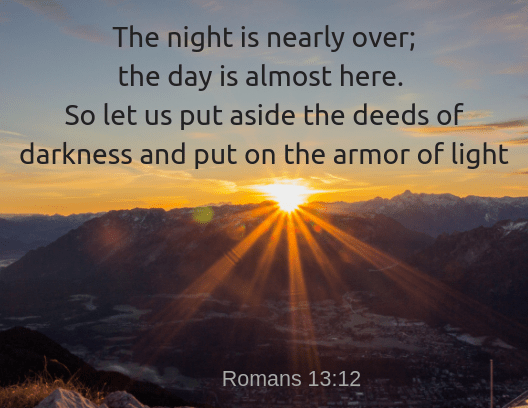
And do this, understanding the present time: The hour has already comefor you to wake up from your slumber, because our salvation is nearer now than when we first believed. 12 The night is nearly over; the day is almost here. So let us put aside the deeds of darkness and put on the armor of light

Let us also join that high calling, that of putting aside the deeds of darkness and putting on the armor of light…let us love one another in spirit and in truth, in action as well as in word…the day is near

Come, Lord Jesus, Come…

Joyanne Swanson

Real Peace

Peace

What is peace? We often define it in terms of what it isn’t—as in, it’s the absence of conflict or distraction or anything that makes us feel uncomfortable or disturbed. A nation is at peace when they’re not involved in any wars; a person is at peace when they feel relaxed and comfortable.  But what if I told you that the biblical idea of peace sometimes means diving into conflict, choosing discomfort, and being disturbed?

“For he himself is our peace, who has made us both one and has broken down in his flesh the dividing wall of hostility by abolishing the law of commandments expressed in ordinances, that he might create in himself one new man in place of the two, so making peace, and might reconcile us both to God in one body through the cross, thereby killing the hostility.” (Ephesians 2:14-16)


According to Ephesians, Jesus is our peace, and Jesus came to reconcile us both to God and to each other. And the biblical idea of peace is much broader than our modern understanding; it is not simply the absence of conflict but also the presence of harmony. It’s not ceasefire; it’s community.  Sometimes, we get so caught up in seeking peace for ourselves that we create discord for others. Or we isolate ourselves from the problem, so that we can pretend like it doesn’t exist or isn’t relevant to us. But conflict avoidance is not peace.

We can trust Jesus to provide miracles, because Jesus is our peace. And while pursuing perfect harmony and reconciliation may be hard, it is far from hopeless. In fact the truth is just the opposite: peace is promised to us from God.

Katie-Beth Fletcher

A Lesson From Mexico: Peace

lupe

Missions Spotlight: Mexico

In 1961, After working as a migrant working in the USA, Lupe’s husband, Roberto, returned to Mexico with the only Bible in their village in hand.  Today, Lupe is a widow who has faithfully served our God and community for many years.  Lupe has served as a mother figure to countless children around her.  Unfortunately, the region of Mexico where she resides has become increasingly dangerous over the recent years, and has thus limited our ability to visit with Lupe from the United States. 

Peace is an interesting thing isn’t it? Peace is something that contradicts the way the world operates. When you are poor, the world says to steal and to cut corners to get ahead. When you are afraid, the world says to attack or run away. When you are angry, the world says to get revenge. But peace, humble old peace, throws that all back into the face of the world. A great passage to look at when talking about peace is Ephesians 2:13-18.

13 But now in Christ Jesus you who formerly were far off have been brought near by the blood of Christ.14 For He Himself is our peace, who made both groups into one and broke down the barrier of the dividing wall, 15 by abolishing in His flesh the enmity, which is the Law of commandments contained in ordinances, so that in Himself He might make the two into one new man, thus establishing peace, 16and might reconcile them both in one body to God through the cross, by it having put to death the enmity.17 And He came and preached peace to you who were far away, and peace to those who were near; 18for through Him we both have our access in one Spirit to the Father.

Jesus came to preach peace. Peace is where, despite your circumstances, you are okay with who and where you are because of your greater belief in something. In our case as Christians, that is God and His son Jesus, who very obviously came to bring us peace – perhaps even a “peace…which surpasses all understanding” (Philippians 4:7). When we are founded on the truths of the Bible and our redemption from sin, we can be be filled with divine peace in any situation. Our sister Lupe carries on in faith. She understands that Jesus came as the, “Prince of Peace” (Isa. 9:6). I encourage you next time you feel overwhelmed or that you might soon be overcome by your circumstance, to take some time to remember who has your back. The creator of all the things around you has your back. Look around you, literally stop reading this for a couple of seconds and look around you and then come back to this post. How intricate and wonderful is this world that we live in? The creator of all of that has your back.  God has established a future that is better than anything you can imagine.  Breathe deeply knowing that the Prince of Peace shed his blood, so that we can live each moment with a peace that only comes from knowing our LORD.  Our hope in God, His son, and the coming kingdom fuels our peace.

Please take some time and pray for our sister Lupe.  Please pray that she might feel an everlasting peace from God and the strength to continue in faith, even as the world around her is different from anything she has ever known. If God so leads you, I encourage you to follow the link below and support her financially. Thank you for reading and God bless!

If you would like to support Lupe in Mexico, please follow this link. https://www.givelify.com/givenow/1.0/MjM0MDg=/selection Thank you!

-Josiah and Amber Cain


Be More Open

Ephesians 1 18-19a

This week I have been talking a lot about all different New Year’s resolutions, that many Christians try to add into their lives every year around this time. Today, our last day is no different. This week I talked about looking for Jesus, and being willing to look silly for him, we looked at the story of Zacchaeus for this teaching. Then we looked at the parable of the talents in Matthew and talked about making good investments, not only with finances but also with the people that we surround ourselves with. We continued throughout the week talking about building our prayer lives, and trying to read our Bibles more. I also talked about striving for fellowship with other believers, and working on having more patience as well. (Let me tell you, patience is definitely one that I need to work on big time, and that is okay.)

The reading today is from Ephesians 1:15-21, & John 11:1-44

Today I am going to talk about something that is built into the rest of these “resolutions” this week. We as believers should be more open. How many times have you felt like you were not being heard, or that you were not hearing from God? How many times have you felt like absolutely nothing is going your way? Have you ever felt completely alone, and confused? God works in mysterious ways sometimes, and I am not always quick to understand what he is doing in my life, and I am sure you are the same. There have been times where I just want to ask God what in the world he is doing, because none of it makes sense to me, at all.

Sometimes I have felt like I was not being heard, or that God was not speaking to me, but I often forget to look in the little things. God gives us comfort when we need it, and he gives us hope and strength, and more often than not, it comes in ways that we would not have ever expected. This fall was one of the most difficult for my family, and I remember there being a few days where I felt lost and confused, worried, anxious and scared for so many things. There was one day in particular where I felt very lonely and forgotten. On that day I walked back to my room at school and on my door was a hot pink and sparkly card that said, “Peace, Love & Glitter.” I opened it and inside were many folded up little notes that had instructions on the outside that said, “Open when you need strength.” “Open when you need peace.” “Open when you need comfort” & me being the impatient person that I am, ( I said that I need to work on that) I opened all of them. Each note contained a Bible verse that had been hand picked by some of the residents in my building and given to me to help me through a tough time. This was God reaching his hand out to me and saying, “Hang on, I’m going to get you through this, I am always here, but I have given you people to lean on also.” Had I been closed off, I would not have been able to see the love and care that God was trying to show me through the people that he intentionally placed in my life.

One more moment I would like to share with you happened yesterday morning. A memory popped up on my facebook, and usually it is a post of pictures that my Grandma tagged me in years ago, but this time it was something that I said a year ago. This is what I said, “It’s always a good day when you get chills all over in the middle of a worship service. It’s like a big hug from God saying, ‘I’ve got you my child, I hear your praises, and I’ll never let you go.'” Again, this was a great reminder of how wonderful our God is, and as soon as I read this post on facebook I remembered the exact service I was at, and a wave of peace washed over me. If I was not open to hearing God in the moments that he makes himself known, in the moments where he is desperately reaching out to me, I may have missed these moments of peace and comfort. These moments that have gotten me through some pretty tough times in my life, and that I will bring with me into the countless storms of this life.

Ephesians 1 talks about Paul’s prayer for the hearts of the Ephesians to be open, that they would appreciate the calling of the Lord, that they would have their inheritance, and understand that power that God has, and they would know the reward for believers. That all sounds pretty awesome to me, God is going to give us rewards for being open to him and his powers. I feel like I have already been rewarded by being able to have a relationship with God, but I know that it will be better someday because the Kingdom of God will be here.

John 11:1-44. These verses are all about the resurrection of Lazarus. This is an important story because we see a blessing where Mary and Martha did not expect one, but because they were open to the power and love that God has and that God had given to his son they were able to receive a tremendous blessing. Their brother Lazarus died of an illness, and they had believed that if Jesus had been there, their brother would not have died. They believed him to already be gone, but because of their intense faith and belief and openness to the power of God and of his son Jesus Christ, their brother was resurrected and they were blessed beyond belief. (I am not saying your loved ones will be brought back to life right now because of your belief) but I am saying that there may be unexpected blessings in the little things, that you would not notice unless you are open minded.

I want to leave you this week with a couple of songs that I think follow this week well, and will support you as you possibly add some or all of these resolutions into your life.

Thank you for reading this week!

“Blessings”- Laura Story https://www.youtube.com/watch?v=1CSVqHcdhXQ

“Open the Eyes of My Heart” – Michael W. Smith https://www.youtube.com/watch?v=Vnqb7Vn4AEE

-Thanks, Jana Swanson

Paul’s Final Exhortation for Unity

Philippians 4

IMG_0280

Yesterday we took a break from our discussion on unity in the body to talk about our union with Christ—the head of the body. Today we’re back to the theme of unity in the Church and looking at Philippians 4, where Paul offers the Philippians some final exhortations for unity. From Paul’s advice to the church at Philippi in this passage, we can see four principles that, if applied, will help promote unity in our own churches.


The first principle we see here is reconciliation. In verse 2 Paul calls attention to an apparent disagreement that was causing strife among two of the woman in the church. He urged them to “be of the same mind in the Lord.” These women had been workers, alongside Paul, for the Gospel and this disagreement between them was hindering their ministry. Personal differences should never get in the way of our commitment to the Gospel. When disagreements arise, the church should work together towards reconciliation so that it can get back to its primary focus.


The second principle we can take from this passage is to live gently. Paul says in verse 5 (NRSV) to “Let your gentleness be known to everyone.” Gentleness is one of the Fruit of the Spirit, but one that I think is often overlooked. This comes from a misunderstanding of what gentleness is all about. Many people equate gentleness to weakness, but it is actually a sign of strength. A weak person is one who lacks strength but a gentle person is one who appears weak for the benefit of others. Gentleness allows us to care for those who are weak and need special attention. Jesus was gentle—this aided him greatly in his ministry to sick and inflicted. If we want to have inclusive churches that minister to the needs of those who are weak, we must promote gentleness.


Living worry free is another principle Paul pushes in this passage that can aide our goal of church unity. In verses 6 and 7 (NRSV) he says “Do not worry about anything, but in everything by prayer and supplication with thanksgiving let your requests be made known to God. And the peace of God, which surpasses all understanding, will guard your hearts and your minds in Christ Jesus.” Worry and anxiety are enemies of the Gospel. Worry is a prison; the Gospel is freedom. Worry keeps us focused on the evils of the age we live in—all the bad things that come about from our sinful nature. It takes our minds off the hope we have in the future Kingdom of God, where everything will be made right and worry rendered obsolete. When bad things do happen in our lives, we shouldn’t spend time thinking about how much worse they could get or why it is happening to us. We should instead bring our concerns before a God who can offer us peace that we won’t find anywhere else, and that can get us through this evil age until we dwell with him in His kingdom. A church at peace and without worry is one that is focused on the future and making a difference in the present.


The final unity principle Paul offers in Philippians 4 is filling our minds with that which is good. In verse (NRSV) he says, “Finally, beloved, whatever is true, whatever is honorable, whatever is just, whatever is pure, whatever is pleasing, whatever is commendable, if there is any excellence and if there is anything worthy of praise, think about these things.” There are a lot of things in this world that try to grab our attention and many of them are not beneficial. Our minds our shaped by what we take in, just as our bodies are by the food we eat. This is why what we think about is so important. If we want to get good out, we must put good in. If we want to be unified in our purpose, we must be unified in our thinking, and that thinking should be on things that are true, honorable, just, pure, pleasing, commendable, and excellent.


While they are not always easy to follow, these four principles will go a long way towards promoting unity within the Church.


– Joel Fletcher

Four Enemies of Unity

Philippians 2:12-30

IMG-0276

Yesterday we learned about Paul’s advice for moving towards unity—having an attitude of humility. Today, I’d like to discuss some attitudes and actions that can hinder unity. These four enemies of unity that I will mention are just some of the obstacles that get in the way of the Church achieving unity. 

Enemy 1: Pride

Pride is the opposite of humility. In humility, we put ourselves in the service of others; in pride, we use others to serve our own purpose. It is an easy trap to fall into; pride catches those who do well and convinces them that this gives them cause to boast in themselves. It inflates their ego—giving them a reason to look down on others and view their own ideals as the be-all-end-all. When even just one person in a church body is infected by pride, it can have terrible consequences for church unity. This why Paul cautioned against boasting in one’s self and works:

“For it is by grace you have been saved, through faith—and this is not from yourselves, it is the gift of God—not by works, so that no one can boast. For we are God’s handiwork, created in Christ Jesus to do good works, which God prepared in advance for us to do.” (Ephesians 2:8-10, NIV)

Enemy 2: Gossip

There is no redeemable quality in gossip—it is a destroyer of friendships and communities. Gossip is broadcasting the shortcoming of others with no attempt to help them get better. It is a mechanism used to make the one gossiping feel better about themselves. Where gossip is present, unity cannot exist. The one being gossiped about is treated like an outsider and is pushed away from the community. Gossip is a unity killer.

“Do not let any unwholesome talk come out of your mouths, but only what is helpful for building others up according to their needs, that it may benefit those who listen.” (Ephesians 4:29, NIV)

Enemy 3: Complaining/Grumbling 

When we complain or grumble about something we don’t like, this is typically a sign we are struggling with pride and not embracing humility. If something is actually wrong, grumbling under your breath about it is not the way to go. Never will a good solution be found when it is brought to the attention of leaders through complaining. If we feel something is not being done the way it should be, we should humbly voice our concern to those in leadership after much prayer and meditation. Complainers don’t promote unity—those who genuinely want what is best for the church need to find the right way to address changes. 

Enemy 4: Arguing 

By arguing, I don’t mean mere disagreement, but an incessant need to be proved right (which also comes from pride). When a person goes around trying to convince everyone that their own views on various issues are right and then get angry when they’re not agreed with, it is not beneficial. We must always be striving to find the truth, but we must never do so in a matter that is unloving. Our discussions should be edifying and result in a more unified body; not filled with bitterness and anger which causes strife.  

“Do everything without grumbling or arguing, so that you may become blameless and pure, ‘children of God without fault in a warped and crooked generation.’ Then you will shine among them like stars in the sky as you hold firmly to the word of life. And then I will be able to boast on the day of Christ that I did not run or labor in vain. But even if I am being poured out like a drink offering on the sacrifice and service coming from your faith, I am glad and rejoice with all of you. So you too should be glad and rejoice with me.” (Philippians 2:14-28, NIV)

Each one of these enemies come about naturally from our human nature. We must fight against them just as we do with other sins. We must instead embrace humility, love, peace, and encouragement in order to promote unity and avoid these divisive enemies. 

If you struggle with any of these, start pushing them out of your life today. 

– Joel Fletcher

The Storms of Life

Mark 4

Mark 4 41b

As I write this, masses are evacuating Florida in the anticipation of Hurricane Irma. By the time you read this, I hope that the storm has passed and that the loss will be minimal. I pray for the recovery teams who will be in the areas doing their best to help families begin to put lives back together.


In Mark 4 we read about another storm. One that scared the disciples beyond anything that they had ever experienced before. This huge squall was both a test and a teachable moment. Jesus was testing the men’s faith and trust in the Son of God. Jesus also used this time to teach the men the extent of His great power. If these men had any doubts before about who Jesus was and what He was able to do, His calming the winds and the waves certainly would have clarified any misconceptions, don’t you think?


I think that we all have to experience a storm or two in our relationship with Jesus in order to find out what our faith is made of. I can think of several of you who I personally know and the storms that Jesus has lead you through and how it has reinforced your faith. I too have been tossed about in a violent storm and the only thing I knew to do was to call out to Jesus. I’ve had my share of nights where the only thing that brought my mind enough peace was to sleep with an open Bible on my bed and my hand literally resting on God’s promises. I’ve had days when anxiety was so great within me that the only thing that could keep the negative thinking at bay was to read Scripture out loud for hours on end.


If you are not currently experiencing a storm, then now is the time to make sure that you are in the Word daily and living out your faith while the waters are calm. 2 Timothy 1:14 says, “Guard the good deposit that was entrusted to you – guard it with the help of the Holy Spirit who lives in us.”


If you are living through a storm right now, hang on tight. Hebrews 4:14 encourages us with this: “Therefore, since we have a great High Priest who has gone through the heavens, Jesus the Son of God, let us hold firmly to the faith that we profess.”


I many not know the details of your personal storm, but I do know the One who is powerful enough to keep our boats from overturning. And He certainly will bring you through to the other side. Believe. Trust. Love. Obey.


-Bethany Ligon


I’ve Been Robbed of My Peace and Happiness

Philippians

verse-of-the-day (3)

Friday, June 30

There are three different types of problems, which sometimes can also be referred to as opportunities.  First, there are problems that are only problems because our perception of the situation is not what it should be.  Second, there are problems that are in our control and could be solved if we put our mind to it.  Lastly, there are troubling situations in our lives that we have little or no control over.  They all can rob our peace and happiness, but fortunately the first two types of problems can be eliminated.  But how can we find peace and happiness if there is a problem that won’t go away and we can’t do anything about?

Some examples of the type of problem where our perception needs to be altered are when they forget to put the French fries in the bag at the drive thru, when you can’t watch your television show because someone else had the television first, or when the strap on your purse breaks.  If these types of things make you upset or unhappy, you need to work on your perspective in life.  Stuff happens; we need to learn how to deal with it without getting so upset.  These are not the types of “problems” that I want to talk about today.

The types of problems in our control are that I cough too much because I smoke, I am getting poor grades in school because I waste too much time, or I don’t have enough energy because I am overweight.  We can solve these problems with a good dose of self-discipline.  Stop smoking, do your homework, exercise, and eat less.  You’ll be amazed at how your problems will disappear.  I’m not saying it will necessarily be easy, but it can be done.  I am also not going to talk anymore about these types of problems today.

I’ll be honest; I don’t have a lot of sympathy for people that get upset about the small stuff that aren’t really problems (sometimes referred to as first-world problems) or for people that have self-inflicted problems that they could fix if they wanted to.  However, there are problems that are quite real and there is little or nothing they can do to fix them.  They can be quite serious in nature and can very easily rob you of your peace and happiness.  I am talking about someone with an alcoholic spouse that refuses to get help, yourself or a loved one that has been diagnosed with an incurable disease, someone who has been paralyzed due to an injury, a parent who has a child who refuses to be a Christian, someone who made a big mistake and will be spending the rest of their life in prison, or someone who just had a parent die.  These problems are real and they suck.  These problems might not go away.  They can really weigh on your heart and mind and they can make you extremely sad or very stressed out.  How can you still have peace and happiness if your problem doesn’t go away?

The answer lies in Philippians 4:6-9.  In verse 6 we are told to never be anxious and to let our requests be known to God through earnest prayer and thanksgiving.  Verse 7 does not say that your problem will go away; instead, it says you will receive the peace of God that surpasses all comprehension.  God is saying that He will give you peace in your heart and mind in situations that peace doesn’t even seem possible.  How can you feel true peace when you know someone you dearly love is going to die soon?  That doesn’t begin to make sense, but that is exactly what God said, it surpasses comprehension.  It makes no sense that you could have peace, but God can give you an amazing gift of peace that we can’t understand because He is God.

I had a problem that pretty much sucked the joy out of my life for a long time.  I tried hard to make the problem go away, but to no avail.  I really struggled with this because I had always had a pretty easy life with few problems, and I couldn’t change this situation no matter how hard I tried.  I didn’t know what to do.  Then I stumbled across Philippians 4:8, which is now one of my favorite verses in the Bible because of the peace and happiness that it gave back to me.  “Finally brethren, whatever is true, whatever is honorable, whatever is right, whatever is pure, whatever is lovely, whatever is of good repute, if there is any excellence and if anything worthy of praise, let your mind dwell on these things.”  It all makes perfect sense.  If we dwell on the stuff that makes us sad or stressed out, we are going to be sad or stressed out.  Duh.  If we dwell on the excellent things in life that make us happy, we are going to be happy.  It was too simple, but I couldn’t figure that out until I read that verse.  It was life-changing.  Do I still think of my problem from time to time?  Sure, but I don’t dwell on it.  I will no longer let it rob my joy.

If you have a problem that you can’t fix, pray for some peace that surpasses comprehension and start dwelling on the good things in life.  It works.

-Rick McClain

(Photo Credit: https://biblia.com/bible/esv/Phil%204.8)

Some Peace in this Crazy World

Luke 6-7

o-LOVE-YOUR-ENEMIES-facebook

May 16, 2017

Have you ever prayed for your enemies? Not to make you feel guilty if you haven’t but I think it’s a good habit to start. My reasoning behind this relies on the fact that the kingdom of God will be peaceful, and if we are to be a part of the kingdom of God why not pray for that peace now? You might think praying for peace is different than praying for your enemies but I don’t think there is that big of a difference.


But prayer is one thing, what about actions? Can we love our enemies with our actions? Jesus seems to think so, and even demands that we do it in Luke 6:27-36. He even gives a couple examples, one of which is prayer.


Why should we do this? Well, other than to be obedient to Jesus, which is emphasized in verses 46-49, it is because God has been intentional in reaching out to us. Yes, at one point in time, we were against God, and yet he still gave his Son for us. He was merciful to us, even when we might have hated him. Luke 6:36 “Be merciful, just as your Father is merciful.”


I encourage you today to read through this section of verses. Write down how you could love those who you may consider enemies. Your answers may surprise you, and if you follow up by doing some of the things you write down, you might find that loving your enemies isn’t all that hard. Who knows, you might even create some peace is this crazy world.


-Jesse Allen

thechristiantaco


Peace in Our Time

 IMG_0034

Daniel 10-12

I am no expert on Biblical Prophecy, or on anything for that matter. So I’m not going to try to explain the prophecies in Daniel 10-12. Instead I want to share three things we can learn about God from Biblical Prophecy and three implications of those things for our own lives.

(1) Biblical Prophecy illustrates that God is not in time. This means that God is not bound by the same time constraints as we are. You and I can only deal with the present. We may have memories of the past and fantasies of the future, but we can see what is really happening only while it is actually taking place. God is not like this. He can see all of history at a glance; this is how He could reveal to people like Daniel the goings-on of the future.

(2) Because God is not in time He is the greatest of planners. The people we think of as planners (people like my wife) tend to have a focus on the future. This is why they plan—to be prepared for what is coming in the future. Since God can see the future He is able to plan things out in such a way as to generate best possible result. And because God loves us, those plans promote our welfare.

(3) Not only does God make plans, but those plans happen just as He promises. There are hundreds of prophecies throughout the Bible, some of which have already been fulfilled. Many of the prophecies in the Old Testament predicted that a Messiah would come. They foretold of the place of his birth, the characteristics that would define him, and the ultimate sacrifice he would have to make. When Jesus came, he was the embodiment of these promises—although many didn’t recognize this. When God makes a promise, you can bet your bottom dollar that He will come through.

(4) Because of God’s track record in promises department, we can trust that the prophecies in the Bible that haven’t yet happened will eventually happen. While it is very easy to lose trust in the empty promises of politicians, we can rest assured that God won’t let us down.

(5) Our trust in the promises of God should give us hope for the future. While the Bible does prophesy that in “the end” difficult and trying times will come, after that there will be no more pain, no more tears, and we will be with our God in His perfect Kingdom.

(6) What all this really means is that right now, in the time we are constrained to, we can live at peace. Despite the craziness of the world around us, however terrible and unbearable it may become, our hope can anchor us so that we can stand firm and live in serenity. So look at the promises God has made, see that He keeps them and that they are good, and live in peace, with hopeful expectation for the culmination of all the prophecies in the Bible.

– Joel Fletcher