Throughout the month of May, we have been gleaning Solomon’s wisdom, as we read a proverb each day. In our broken world, wisdom is the ability to distinguish between what’s good and what’s fallen. It allows us to see from God’s perspective and make choices that honor Him. Solomon received wisdom in the same manner we do: asking for it.
At Gibeon the Lord appeared to Solomon in a dream by night, and God said, “Ask what I shall give you.”
And now, O Lord my God, you have made your servant king in place of David my father, although I am but a little child. I do not know how to go out or come in. And your servant is in the midst of your people whom you have chosen, a great people, too many to be numbered or counted for multitude. Give your servant therefore an understanding mind to govern your people, that I may discern between good and evil, for who is able to govern this your great people?” (1 Kings 3:5, 7-9, ESV).
Solomon was humble. He knew that he could not navigate his responsibilities on his own. He refers to himself as a little child in charge of too many people to even count. The first step in asking for wisdom is recognizing you need it.
Solomon was prepared to receive. He goes to Gibeon to make a sacrifice on the same altar he once sacrificed one thousand burnt offerings to God. Gibeon was considered the most holy place at the time because it was home to the Tabernacle that Moses built (2 Chronicles 1:2-3). Solomon’s dedication is astonishing! I think we are sometimes quick to overlook how incredible facts like this are when reading our Bibles. I mean—imagine slaughtering, draining, cutting, and burning one thousand animals. It’s this dedication and intimacy with God that puts him in the posture to hear God’s voice and receive His gifts.
Solomon’s priorities were in order. He could’ve asked for wealth, to live forever, or a plethora of wives (well… he kinda does that later). Instead, he asks for wisdom to govern Israel, God’s chosen people, better. Solomon knew the great calling on his life and chose a gift accordingly. God honored the way Solomon ordered his desires and blessed him with the riches, honor, and longevity in addition.
At first, it’s easy to be jealous of God’s blank check offer to Solomon. But what if I told you that God has extended the same offer to you? Like Solomon, we can receive wisdom just by asking for it. God wants us to see from His perspective, to discern right from wrong, and make choices that honor Him. It’s really a win-win situation.
If any of you lacks wisdom, let him ask God, who gives generously to all without reproach, and it will be given him. (James 1:5, ESV)
God gives wisdom generously. Have you asked?
-Mackenzie McClain
Reflection Questions:
Have you humbled yourself before God? We live in a broken, gray world that requires more than your own understanding. Unpopular opinion: you actually don’t have what it takes (on your own, that is). You need God’s help!
Are you prepared to receive? Are you ready to listen to God’s voice? Do you spend your days with your Bible open, hands folded in prayer, and surrounded by godly influences?
Are your priorities in order? Are you seeking after the right things?
Raspberry pie filling had poured on my shoes as I finally wrestled the large, heavy aluminum pan filled with pie onto the countertop. It was then that I noticed that this extra-large catered size pan had spilled raspberry filling from the car into the house and through the kitchen. I caught myself wondering if the restaurant staff had booby-trapped this massive dessert and I still had another to bring in. My friends were empathetic, but they were frantically searing ribs on the grill. This last minute pickup for a large rehearsal dinner had turned into chaos. Yes, it is hilarious now, but at the time, it was a little overwhelming. So I can completely identify with Martha in Luke 10.
Jesus was accompanied by his disciples and often with large crowds. Imagine the bustle in the village of Bethany as Jesus enters the home of Martha. Jesus loved Martha, her sister Mary and their brother Lazarus. Jesus had been revealing some amazing spiritual truths. He confirmed that eternal life could be inherited by loving the Lord God with all our hearts, souls, strength and minds while loving our neighbors as ourselves.(v.25-28) He explained that love is expressed by mercy in action through the parable of the good Samaritan.(v.30-37) His teaching was amazing and we can understand why Mary did not want to miss a minute of it. I imagine Mary had helped Martha with preparing for Jesus’ visit, but he was there now and he was teaching so Mary sat at the Lord’s feet listening to what he said.But Martha was distracted by all the preparations that had to be made. She came to Jesus and asked, “Lord, don’t you care that my sister has left me to do the work by myself? Tell her to help me!” “Martha, Martha,” the Lord answered, “you are worried and upset about many things, but few things are needed—or indeed only one. Mary has chosen what is better, and it will not be taken away from her.”
We can all learn from Jesus’ words. There are so many things to do – good things to do – but these good things should never take the place of just being with and listening to Jesus. We all need to choose to be in Christ’s presence “which is better” and it will not be taken away from us.
-Rebecca Dauksas
Reflection Questions
What is the one thing that is needed?
What most often distracts you from what is most important? What does this reveal about your priorities? How can you work towards fixing this?
What does it look like to sit at the feet of Jesus today? How can you do it more consistently?
What do you find most amazing about the teachings of Jesus? What does this tell you about Jesus and even about His God and Father?
The next few days of readings will be centered around Jesus’s crucifixion. Luke’s account tells us of the interaction that Jesus had with the thieves on the crosses next to Christ, which is what I’m focusing my attention on today.
Jesus has been arrested and has appeared before Pilate, the highest Roman official in the area, and been found guilty of nothing more than inciting a spiritual revolution. Yet he was punished and tortured and hung up on a cross with criminals to die an agonizing death.
The criminals were guilty. They knew that they were being punished for wrongs they had committed. Still one mocked Jesus, telling him to save himself and them. The other, however, knows that he has sinned. He knows that he deserves punishment and that Jesus does not. And rather than asking Jesus to remove him from the cross and death, he has his focus on something far more important. He asked Jesus to remember him when he comes into his kingdom.
How remarkable. Honestly, when I’m in trouble I’m not thinking of whether or not I deserve that trouble. I’m not focused on what is ultimately important. I should be acknowledging that I’ve done wrong and that I likely deserve whatever mess I’m in. I should acknowledge that whatever battle I’m in the midst of, I can continue to fight because God has already won the war. Instead, I’m just looking for God to rescue me from my current situation. I’m looking for an easy way out. I have lost sight of the end game, which is an everlasting kingdom that can be had by accepting the gift of grace offered to us when Jesus was punished and killed for our transgressions.
The thief had his priorities straight, and Jesus acknowledged it by promising him a place in his everlasting Kingdom. How beautiful.
Take some time with me today to prepare yourself by realigning your priorities. Ask yourself:
When I am struggling, is my focus on myself or on God’s plan?
Have I accepted the free (for me) gift of salvation, or am I still trying to earn my way into God’s kingdom?
Have I truly acknowledged and accepted that no matter what I have done or said to redeem myself, I cannot?
How can I better reflect my joy and gratitude for this gift of eternal life? How can I express it to others so that they can accept it as well?
My prayer for you and myself today is that we each accept with a humble heart the gift of salvation, acknowledging that it is only by grace that we are saved. I pray that we accept that grace with extreme joy, because it is truly something to celebrate. I pray that our priorities are not focused on anything in this world, but on God’s coming kingdom.
Welcome to the first post of our 2023 SeekGrowLove Bible reading plan! We are beginning the year with a little time in Psalm 119, and in the next couple days will add in the other Old Testament and New Testament readings. You can download and print the whole plan found at the end of today’s post. Every time we begin a new book of the Bible, we will include a little introduction written by Steve Mattison.
Introducing the Book – Psalm
The book of Psalms was Israel’s songbook. It contains a collection of psalms (or songs) that primarily focus on praising God for who he is and for what he has done. The Hebrew title is, “the book of praises.” Most of these psalms are prayers to God written by King David, although other authors, ranging from Moses, to Solomon, to the sons of Korah also contributed.
The book of Psalms teaches us to seek God with our whole heart, to tell Him the truth and to tell Him everything, and to worship Him because of who He is, not just because of what He has done. It contains a range of topics, from people crying out to God from the depths of their despair, to those praising God with jubilation from the depths of their hearts.
The book of Psalms has spoken to me in my lowest lows as well as in my highest highs. May the inspired words in this book resonate well with you as you read these psalms this year.
Psalm 119 Devotion
Who in their right mind is thinking about the end right now? Really? Terrible title. TERRIBLE. This is the time of fresh starts! New beginnings! Redos! Our mind focused on the brief novelty of this moment’s pants kicking; the annual motivation for improvements we have put off for weeks, months, or even years. While we might commit to a dream today, I would say there is little thought given to the realities of December 31st, 2023: 365 calendar days away. Whether it’s gym memberships, nicotine patches, cauliflower pizzas, saving accounts, or even bible reading plans, have we bought into the idea that we are preparing ourselves for a full year of commitment in our resolutions? Look at your Google Calendar or your bank statement: what have you planned and paid for in a full-year upfront knowing that it will change your life by the end? Or is your resolve more like the free 7-day trial, leaving one foot in 2022 in case you want to make a getaway?
“How can a young person stay on the path of purity? By living according to your word. I seek you with all my heart; do not let me stray from your commands. I have hidden your word in my heart that I might not sin against you.” Psalm 119:9-11
I will go ahead and say, it is not fiscally responsible, or even logically feasible, to pile up a year’s worth of cauliflower pizza into a deep freeze, but our commitment level to any life-changing resolution, should count the cost of sacrifice with the end in mind. This is an echo of what our Heavenly Father has done through Jesus Christ. Paul speaks to this in Colossians 1:16 when he states “For through [Jesus] were all things created, things that are in heaven, and things that are in earth, visible and invisible, whether they be thrones, or dominions, or principalities, or powers: all things were created by him, and for him.” Our eternal God has dictated to us the rules, plans, and ordinations of his personal and universal will that will lead us to a relationship with Him, which has ended the penalty of sin with the blood of Jesus Christ and leads to the big finale, the Kingdom of God. Knowing the end, it is much easier to keep to and dictate the decrees of each day. Without the end in mind, we are just tragic creatures of toil, mindlessly moving from one task to the next.
“Teach me, O LORD, to follow your decrees; then I will keep them to the end.” – Psalm 119:33
Our God is not a God of chaos (1 Cor 14:33). He works in logic and rules that are shared with us because WE as heirs according to the promise are included in the end. We don’t have to feel out the way, make up the path, or bump down the lane. God has made his moral law clear. It is not just a list of “thou shalt nots” but enhancements and boundaries provided for our own physical safety, societal responsibility, psychological well-being, and the eternal enhancement of the connection and relationship between the Heavenly Father and his children. He is not a part-time parent, nor can we be part-time children. You can’t periodically pause your subscription or ghost your way out of the membership. Our life is better lived, today and eternally, when we are resolute to learning and practicing His ways that are forged in the ultimate love and truths. We become devoted.
That devotion begins with finding a way to be connected to the Word of God every single day. It could be found in this blog. It could be found in personal study, podcast, prayer time, or all the above. What I propose, if we truly are wanting to grow in the word of God this year, to engage and act upon His message that is delivered through His word, you and I must set alarms, write in on our mirrors, put it in our checklist and calendars, and make it priority. Being here to read every day provides an opportunity to do that alongside others who are also seeking out a devoted life to Christ. If our end of life is found in 2023, if Jesus returns, or the Lord tarries for another year and He still gives us life, how much more abundant will December 31st, 2023 be if we have committed ourselves fully to understanding the precepts, the statutes, the laws, the understanding, and the wisdom of your heavenly Father? Let’s be committed to the end, even if we are at a loss of where to begin our year.
“May my lips overflow with praise, for you teach me your decrees. May my tongue sing of your word, for all your commands are righteous. May your hand be ready to help me, for I have chosen your precepts. I long for your salvation, Lord, and your law gives me delight. Let me live so that I may praise you, and may your laws sustain me.” -Psalm 119:171-175
-Aaron Winner
Reflection Questions
In reading through Psalm 119 what do you see of God’s character – how does He show who He is through His inspired word? This is a question we will be asking regularly this year (sometimes phrased differently). We think you will find great benefit in journaling, or making notes in your Bible margin, on how you see and what you learn of God and His character from His written word every day this year.
What are your favorite verses of Psalm 119? What words are used in Psalm 119 to name God’s law or directions for life? What are the benefits given for knowing, following, loving these words of God? What do you find about the results of neglecting these words of God? How would you rate your knowledge of and then, love for, the words of God?
Where do you want to be at the end of 2023? What steps will help you get there? Spend some time in prayer to the God of Psalm 119.
As life grows busier by the day, holidays grow nearer, preparations for travel are made, deadlines for school are due, or you find yourself putting in those time and a half hours at work, it is so easy to become all consumed in your own day to day life. The same was true in the parable told by Jesus in Luke 14, The Parable of The Great Banquet. As Jesus gathered around the table with the Pharisees and experts in the law, he spoke to them on humbling themselves and serving in the here and now, even when they are giving all and receiving none. He says that their payment will be paid at the resurrection of the righteous. At the mention of the resurrection, one man calls out, blessed is the one who will eat at the feast at the Kingdom of God. Jesus replies with a parable, explaining that a great feast has been prepared for many guests. When word spread that the feast had come, and that it was time to join, many of the guests were found to be caught up in their own world and did not attend with urgency. Excuses were made and the banquet was pushed off. “I just bought a field that I must go and see.” “I bought five yokes of oxen, I must go try them out.” “I just got married, I can’t come.” As a result, each of these guests lost their place in the banquet as they were not ready, not prepared, and were not willing to attend at the call of the host.
This parable serves as a wake up call to many as it is important to work hard each day and do your best with what has been bestowed upon you, however this life is temporary and our focus should always be on what is yet to come. In the meantime, we need to make sure that we are pursuing our faith, building a relationship with our heavenly father, and implementing spiritual disciplines daily so that when the banquet, otherwise known as the Kingdom of God draws nearer, our hearts will be prepared and our focus will be set on the right priorities.
As we enter into a busy holiday season, may we be present in the why. Why we celebrate, why we serve, why intentionality matters. Let’s not be a people who become so caught up in each day that we do not humble ourselves before the Lord and serve His great name, no matter the cost.
Luke 14:11
“For all those who exalt themselves will be humbled, and those who humble themselves will be exalted.”
– Kayla Elwell
Reflection Questions
What does it mean to you that the invitation to the banquet in the Kingdom of God has been extended to everyone in the roads and country side? Who had been included in the original invitation – did it include you?
What excuses have you used when you were neglecting the most important things of God?
The prophet Haggai is among the first prophets to prophesy after the destruction of Jerusalem and the Temple in 586/587 BCE. The ministry of Haggai can be dated to happening in the year 520 BCE and his words are directed towards two people in particular: Zerubbabel the governor of Judah and Joshua the high priest (Hag.1.1). The message of the prophet is to encourage Zerubbabel and Joshua to rebuild the dilapidated and desecrated temple.
Verse four of chapter one contains what God has against the people and leaders. To paraphrase God says, ‘Why are you living in your nice comfortable homes while my house, the temple, lies still ruined?’. Now this is a different generation than the one that experienced the destruction and exile, but when they returned to the land they carried on about their concerns first before tending to the things of God, namely the temple. Zerubbabel and Joshua hear this charge from God and they take action and focus their attention on the rebuilding of the temple. God blesses their work and encourages them to continue and finish.
Do you put the things of God first or the things of you first? In my experience, when I put myself first ultimately in the end it leaves me unfilled in addition to neglecting God. However, when I put God first not only am I putting things in the right perspective but God also provides for my needs and desires. Putting the things of God first can look like: discipleship, evangelism, Bible study, prayer, pursuing holiness, and so on. When you reflect on your life are you putting yourself first or God first? Is God and the kingdom a priority for you? Be a Matthew 6.33 man or woman.
-Jacob Rohrer
(originally posted for SeekGrowLove on April 22, 2017)
Reflection Questions
When you reflect on your life are you putting yourself first or God first?
Is God and the kingdom a priority for you? How do you show it?
What do you think of verses 5-11 in Haggai 1? Where might God be asking you to “Consider your ways”?
A few years ago the term YOLO became popular and used as a reason to partake in some very reckless behavior. If you’re not familiar with the acronym, it is an abbreviation for You Only Live Once. It drives me bananas when I observe others taking unnecessary risks because of this attitude.
I admit that I tend to be cautious. I’m not a huge risk-taker. I prefer to know possible outcomes before making a decision. I have the mindset that it’s because I only live once (this side of God’s Kingdom) that I want to be prudicious with my choices.
As I approach the half-way mark of life, I am even more aware of how precious my time, energy, resources and relationships really are. Knowing and respecting my priorities helps me make decisions that align with the kind of life that I believe God is calling me to live.
As we continue through the letter to the Ephesians, Paul is instructing the new believers in the local church to evaluate their life choices. The way that they used to live is no longer in alignment with a holy lifestyle. To live carelessly and without regard to the purpose for which they were saved is a waste of time.
We too need to be self-controlled and alert. We need to know who we are in Christ and make decisions accordingly. Living in these times requires us to use our resources of time and energy wisely so that we can make an impact and a difference for the Kingdom of God.
Sometimes, this way of living does mean that we will take risks and might look foolish to the world’s way of thinking. But if we are obedient to God, those risks will pay huge dividends because others will have an eternal benefit.
So as you go about your day, your week, your month, and even the rest of this year, be strategic; be careful; be wise about how you live your life in Christ.
Once again, I’ll ask:
What should you continue doing?
What should you stop doing?
What should you start doing?
-Bethany Ligon
Questions for Reflection and Discussion
Do you consider yourself to be living life wisely? What adjustments might Paul suggest to you?
What should you continue doing? What should you stop doing? What should you start doing?
The book of Haggai records events that took place in 520 B.C. The foundation of the temple had been laid in 536 B.C. (Ezra 3:8-13), but building stopped because of opposition. In Haggai 1:2, we see that people were making excuses, “The time has not yet come for the Lord’s house to be built.” The people themselves were living in fine houses, but just hadn’t gotten around to building God’s temple. Their priorities were wrong.
God pointed out that He had been undermining the people’s prosperity because they hadn’t made God a priority. Haggai 1:6 tells us, “You have planted much, but have harvested little. You eat, but never have enough. You drink, but never have your fill. You put on clothes, but are not warm. You earn wages, only to put them in a purse with holes in it.”
Once confronted with this, the people obeyed God and began to work on the temple. The word of the Lord came to Haggai again in chapter 2, where God told Haggai in 2:9, “The glory of this present house will be greater than the glory of the former house, says the Lord Almighty…”
Interesting. When Solomon’s temple was dedicated, fire fell from heaven to consume the offering, and God’s shekinah glory appeared so the priests couldn’t enter the temple. The ark of the covenant, the representation of God on earth had been there. But in this new temple, there was no ark of the covenant, no urim or thumim, no fire from heaven, no shekinah glory. So how would this new temple have greater glory than Solomon’s magnificent temple, you may ask. Here’s how: Over 500 years later, Jesus taught in this new Temple.
Further, God promised that starting on that very day, God was going to bless them because of putting one stone on another. In Haggai 2:19, we read, “From this day on I will bless you.” Because they were finally putting God first in their lives.
How are things going for you? Does it seem that you’re working harder and harder, but getting farther and farther behind? Does it seem like your wages go into purses with holes in them? Could it be that you have prioritized enjoying the good life for yourself, but haven’t made serving God the priority you should? Only you can answer these questions.
If this is true for you, I challenge you to rededicate your life to serving God wholeheartedly. He will certainly bless your commitment to Him. Maybe even materially. But ultimately, you will gain a far greater reward – eternal life.
I’m reminded of Joshua 24:15, “But as for me and my house, we will serve the Lord.”
May we each say that – and live it.
-Steve Mattison
Read or listen to today’s Bible reading passages at BibleGateway.com here – Haggai 1-2 and Revelation 14
If you are just jumping in now, I have been pulling out a few lines in Proverbs that stand out to me, but I encourage you to do the same – you will likely find different ones!
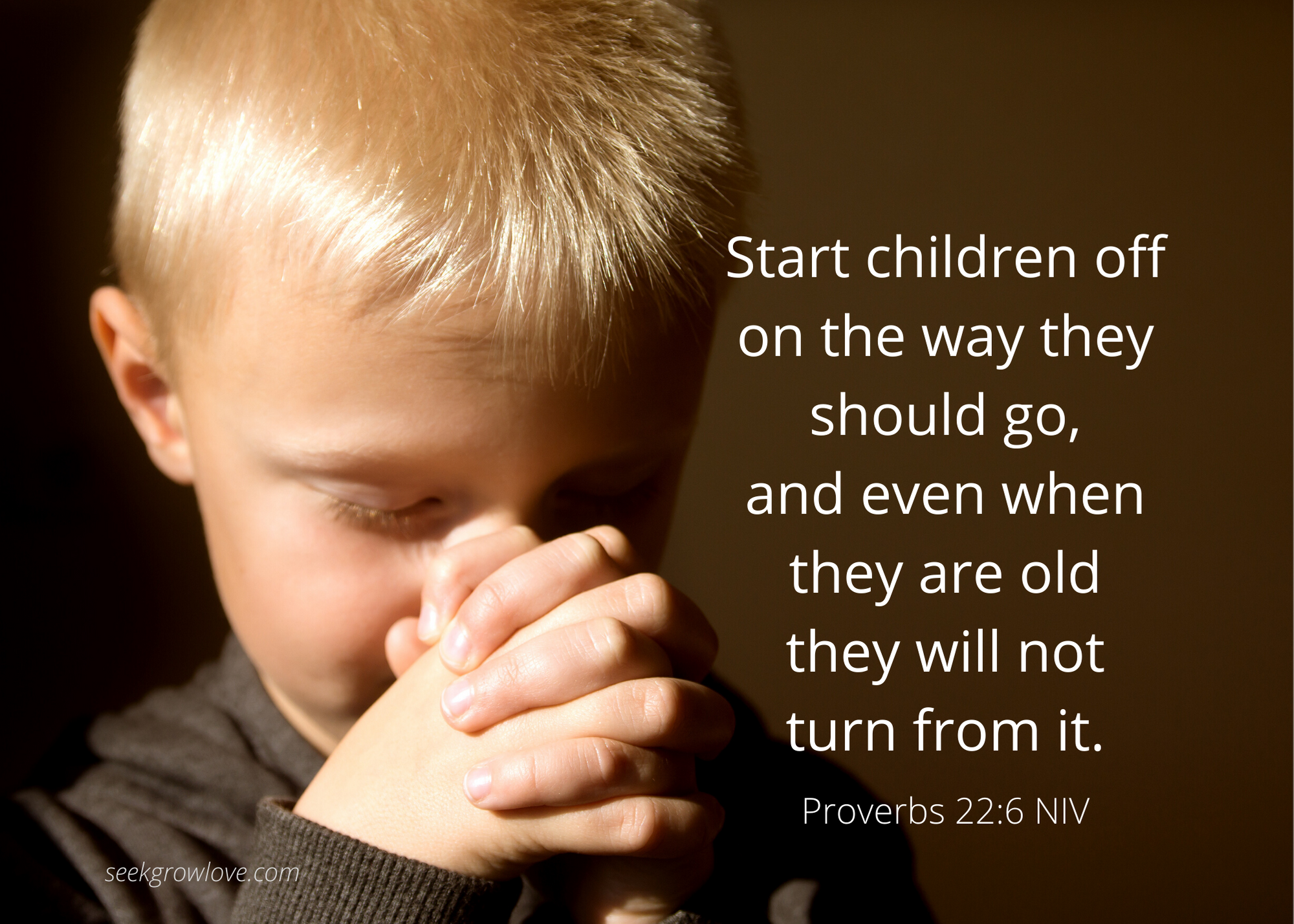
22:6 Start children off on the way they should go, and even when they are old they will not turn from it.
My mom always tells these horror stories from when I was a young child about how I was a nightmare to deal with (I’m sure she exaggerates…), but that didn’t mean that she just accepted it. She tells me she prayed and asked that God would turn my stubborn, strong-willed self to be stubborn and strong-willed for God. I can’t say that I have done a perfect job, but I know I am thankful for the prayers my mom said. I don’t hit people in anger anymore (or throw whatever is in my hand across the room when I get mad). Though I sometimes struggle to stay on fire for God, I am trying to do what I can to stay faithful through it. The attribute of being strong-willed has been put to use in staying steadfast even when I go through times of struggle. If you are the child who was raised in the faith and is still in it, thank your parents! If you are someone who has children or plans to someday, keep this in mind. It starts young.
23:4-5 Saying 8
4 Do not wear yourself out to get rich;
do not trust your own cleverness.
5 Cast but a glance at riches, and they are gone,
for they will surely sprout wings
and fly off to the sky like an eagle.
Finding a balance between providing for life and accumulating wealth can be difficult. Most of us want to have nice things in life, but it can consume us. That first line stands out to me – “Do not wear yourself out to get rich;” If I am so focused on work that I am worn out everyday, or don’t have time to spend with my family, I don’t think that is right. Don’t get me wrong – there are plenty of other places in the Bible that tell us we should be hard workers and not to be lazy (see next section), but overworking yourself just to gain wealth doesn’t feel right. You might not be able to get everything you want, but learning to be content with what you have is for the better. Contentedness is something I have been working on the last few months. What I have is enough.
24:30-34
30 I went past the field of a sluggard,
past the vineyard of someone who has no sense;
31 thorns had come up everywhere,
the ground was covered with weeds,
and the stone wall was in ruins.
32 I applied my heart to what I observed
and learned a lesson from what I saw:
33 A little sleep, a little slumber,
a little folding of the hands to rest—
34 and poverty will come on you like a thief
and scarcity like an armed man.
Being lazy leads to an inability to thrive. We have to find that balance of hard work, but not letting it consume us to where gaining possessions becomes our sole focus. How are your priorities? Where is God on that list?
We are moving out of Proverbs tomorrow, so enjoy these little bits of wisdom!
Tomorrow we jump from Proverbs (many of Solomon’s writings) to 1 Kings 5-6 and 2 Chronicles 2-3 to read some of the events of King Solomon’s life and reign. We return to the rest of Proverbs next week on our 2020 Chronological Bible Reading Plan.
Scrolling through the text messages I send to my wife, I realize there is a constant theme connecting about half of our communication: food. “What are we having tonight?”, “Where do you want to go to eat?”, “Do we have any dinner plans?”, “What are you making?”, “I think I will have…” I can only imagine if the Lord tarries for a few hundred more years, and they discover my phone in an archaeological dig, they will no doubt conclude that I was one of the hungriest people on earth. The thing is I’m not. In fact, thank the Lord, I’ve never had to worry about a meal in my life, and truth be told, it probably would benefit me if I skipped a few meals. So why am I (and so many others) obsessed with food, or clothing, or money, or all of these things, the very things God assures over and over again he will provide what we need in exact proportions?
Today’s reading, Matthew 6, is a continuation of the Sermon on the Mount. Jesus takes the time to teach us how to pray, and then gives us the appropriate perspective on our food and stuff, to make sure our priorities are straight so our pursuits are fruitful. How do we know what our priorities should be? Some say that the model prayer that Jesus gives is also a priority list (Matt 6:9-13). If this is true, then it is later confirmed when Jesus says “Seek FIRST His Kingdom and His righteousness, and all these things will be added to you. (Matthew 6:33). Kingdom first. Everything else, don’t sweat.
This reminds me of a recent discussion we have been having about theme in my classroom. In fiction, the theme is the single most important factor that guides your story. Everything else is of significantly lesser importance. The setting could be the United States, another country, space, or complete fantasy. Your characters could be people, animals, aliens, or inanimate objects. The conflict can be internal or external. The main idea in these thoughts: you can tell the same story with a variance of characters, settings, conflicts, but the theme, or the central message, remains the same because it controls everything else.
When the theme of our lives becomes food and stuff, we become literal or figurative “packrats.” Our pantries begin to overflow, we save for every eventuality and rainy day, and we have closets full of clothing for every season and occasion. To what purpose? While it might be unwise to go to the grocery store to buy a single day’s worth of food, to not acknowledge retirement, or our only shoes to be flip-flops in Minnesota, is this really the side where most of us err?
The theme controlling our story should singly be the Kingdom of God. It should be the driving force, controlling our story. It doesn’t matter who we are. It doesn’t matter where we live. It doesn’t matter the challenge we face. We know the theme. It is the very reason Paul says he “can do all things through Christ who gives him strength” because rich or poor, here or there, famous or obscure, those are just the “all these things” of the story (Phi 4:13). It is true that each day has enough trouble of its own, so don’t worry about tomorrow (Matt 6:34). The sun will rise. The birds will fly. The flowers will grow. You will get your food and stuff WHEN you acknowledge first, the Kingdom of God. Knowing this, use the details of your story – picking out your clothes, sitting down to eat, or making a purchase, to find a way to acknowledge, thank, and share God for or with your food and stuff.




 Seek Grow Love