30 Pieces of Silver

OLD TESTAMENT: Zechariah 11-12
POETRY: Psalm 146
NEW TESTAMENT: John 18:12-27

Zechariah 11:10-13(NLT) Then I took my staff called Favor and cut it in two, showing that I had revoked the covenant I had made with all the nations. 11 That was the end of my covenant with them. The suffering flock was watching me, and they knew that the LORD was speaking through my actions.
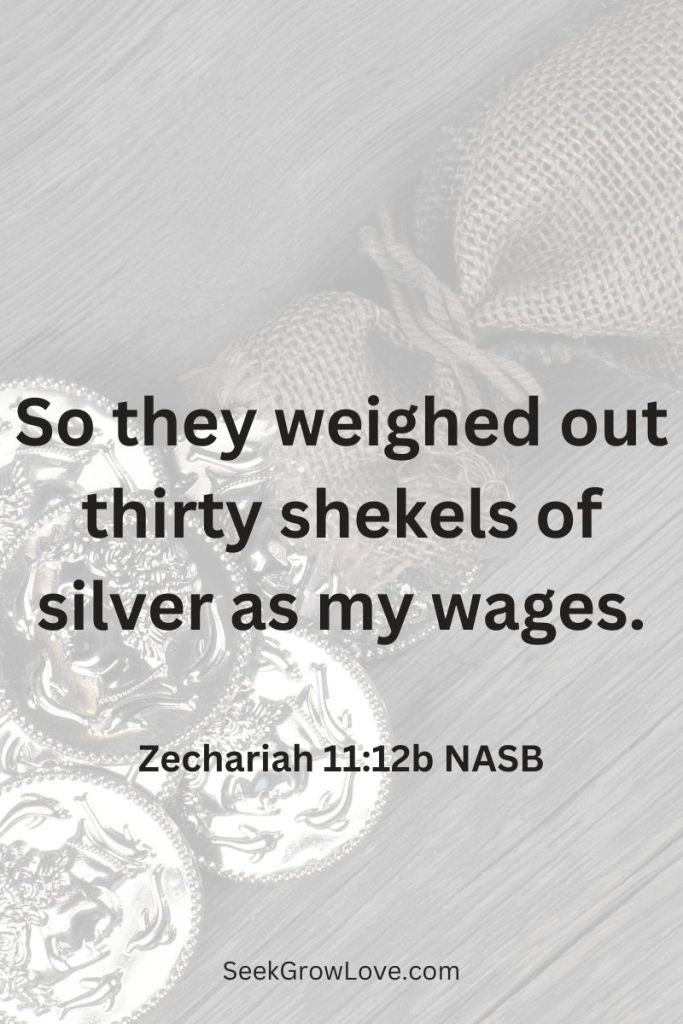
12 And I said to them, “If you like, give me my wages, whatever I am worth; but only if you want to.” So they counted out for my wages thirty pieces of silver.
13 And the LORD said to me, “Throw it to the potter”—this magnificent sum at which they valued me! So I took the thirty coins and threw them to the potter in the Temple of the LORD.

Zechariah 12:10(NLT) Then I will pour out a spirit of grace and prayer on the family of David and on the people of Jerusalem. They will look on me whom they have pierced and mourn for him as for an only son. They will grieve bitterly for him as for a firstborn son who has died.

Psalms 146:1-4 (NLT) Praise the LORD!
Let all that I am praise the LORD.
2 I will praise the LORD as long as I live.
I will sing praises to my God with my dying breath.
3 Don’t put your confidence in powerful people;
there is no help for you there.
4 When they breathe their last, they return to the earth,
and all their plans die with them.

John 18:19-23(NLT) Inside, the high priest began asking Jesus about his followers and what he had been teaching them. 20 Jesus replied, “Everyone knows what I teach. I have preached regularly in the synagogues and the Temple, where the people gather. I have not spoken in secret. 21 Why are you asking me this question? Ask those who heard me. They know what I said.”
22 Then one of the Temple guards standing nearby slapped Jesus across the face. “Is that the way to answer the high priest?” he demanded.
23 Jesus replied, “If I said anything wrong, you must prove it. But if I’m speaking the truth, why are you beating me?”

What an intense experience Jesus Christ has that we are reading this week.  The tears come to my eyes when I read what they do to him and what they say about him.  Jesus all through this ordeal keeps his eyes and heart steadfast on the truth of what God is planning to do.  God is the author of salvation, which is to make people whole or healed.  Jesus many times in his ministry corrects the Jews in their thinking about earthly kingdoms and power with what God really wants from people. 

Once again in this reading today we see two significant prophecies which are fulfilled in the passion of Christ.  Zechariah prophecies the payment of the thirty pieces of silver as the price for the life of Jesus.  Judas goes to the authorities and makes the arrangements to betray Jesus to them.  He demands that they pay him and they agree.  The price which is set is the thirty pieces of silver.  This price is the amount that would be paid for a slave.  The most precious Son of God who is without price has his life sold for the common price of a slave.  Judas then when things don’t go well comes back to the temple and throws the thirty pieces to floor.  The money is used to buy the potter’s field and used for a burial ground for poor people.

The other prophecy that we see in this section is that “we will look on him who is pierced” which foretells the spearing of Jesus at the end of the crucifixion.  

John 19:37(NKJV) And again another Scripture says, “They shall look on Him whom they pierced.”

His bones are not broken, foretold in Psalms, but he is pierced with a spear and blood and water come out, which is an indicator of heart failure.  Jesus dies of a broken heart on the cross for you and for me.  What love God has to let Jesus who knew no sin be the sacrifice for us today. 

Christmas is coming soon and our thoughts in this season are on his birth.  But here we see greater evidence again of who he was, and what is accomplished on the cross.

-Tom Siderius

Reflection Questions:

What is the value of a man’s soul?

Who can we tell this good news gospel message to today?

A Strong Green Olive Tree

OLD TESTAMENT: Zechariah 3-4
POETRY: Psalm 144
NEW TESTAMENT: John 17:1-5

Zechariah 3:6-10 (NKJV) Then the Angel of the LORD admonished Joshua, saying, 7 “Thus says the LORD of hosts:
‘If you will walk in My ways,
And if you will keep My command,
Then you shall also judge My house,
And likewise have charge of My courts;
I will give you places to walk
Among these who stand here.
8 ‘Hear, O Joshua, the high priest,
You and your companions who sit before you,
  For they are a wondrous sign;
For behold, I am bringing forth My Servant the BRANCH.
9 For behold, the stone
That I have laid before Joshua:
Upon the stone are seven eyes.
Behold, I will engrave its inscription,’
Says the LORD of hosts,
‘And I will remove the iniquity of that land in one day.
10 In that day,’ says the LORD of hosts,
‘Everyone will invite his neighbor
Under his vine and under his fig tree.’ ”

Psalms 144:3-4 (NKJV) O LORD, what are human beings that you should notice them,
mere mortals that you should think about them?
4 For they are like a breath of air;
their days are like a passing shadow

John 17:1-5 ​(NKJV) After saying all these things, Jesus looked up to heaven and said, “Father, the hour has come. Glorify your Son so he can give glory back to you. 2 For you have given him authority over everyone. He gives eternal life to each one you have given him. 3 And this is the way to have eternal life—to know you, the only true God, and Jesus Christ, the one you sent to earth. 4 I brought glory to you here on earth by completing the work you gave me to do. 5 Now, Father, bring me into the glory we shared before the world began.

The greatest message of the kingdom that we need for ourselves, and that we also need to share with others is this wonderful news about Christ and his life and death.  When we read the Bible histories in both OT and NT we are brought to an understanding of who the Father is and what He desires for mankind.  We get this by opening our hearts to His message that He is sending to us.  The Bible is not an encyclopedia where we look up the answers to our questions alphabetically.  God wants us to have faith and trust in Him and He shows us who He is in all these interactions with people who believe.  Especially we see Him in the life of Christ.  Jesus fulfills the law of God by doing the things and saying the things which truly represent God’s love and grace.  We become involved in a lifetime study of trust and faith.  Every day we should see a larger and greater picture of this love God has for us. We also learn of our inability to earn our own salvation but are dependent on His grace.  As we grow, we should come to  appreciate more and more God’s wonderful plan for mankind. 

About 500 years before Christ is born Zechariah prophecies about a man who is called the “Branch”.  This word is better translated as “shoot” or tree.  The stump of the tree of Israel has been cut off and this tree is no longer what it was.  God in the OT compares Israel to a strong olive tree. 

Jeremiah 11:16(NKJV) The LORD called your name,
Green Olive Tree, Lovely and of Good Fruit.
With the noise of a great tumult
He has kindled fire on it,
And its branches are broken.

Jesus becomes a strong tree shoot that grows from the roots of this tree stump and becomes a new tree of life. In Romans 11 God tells us that we are branches from a wild olive tree grafted into this new tree of Christ.  “Romans 11:24 You, by nature, were a branch cut from a wild olive tree. So if God was willing to do something contrary to nature by grafting you into his cultivated tree”.  The words “wild olive” in the Greek is “Oleaster tree”.  If you have noticed in the Midwest we have a terrible plague of invasive Russian olive or autumn olive trees growing everywhere.  These are from the “oleaster” family of trees.  They are very invasive and have no particular value to anyone.  They have small red berries which the birds eat and spread everywhere, but which are very bitter and have no food value.  They look at first like an olive tree especially from a distance.  They have silvery gray leaves and a shape like an olive tree.  But when you get close you see that it is this tree which everyone wishes to get rid of with no value or fruit.  God takes us Gentiles who have no value and aren’t even the right genus of plants and grafts us onto the wonderful tree of Christ.  We become part of this tree of life which God has decided to make us.

 These are branches grafted onto the roots in the humanity of people (which is why it is called the stump of Jesse instead of the stump of David).  But this is a tree chosen and prospered by God and then made even more diverse with the addition of wild olive tree branches to the tree.  What a wonderful picture of the love God has for us.  When we see ourselves in God’s plan then we are trusting Him with our hearts.  This is the desire that God has for us to be in His wonderful family of faith and love. God is always faithful to keep His Word. We have received a wonderful life today and a future with Him.  Have a great day in fellowship with our big brother Jesus Christ and our Father Yahweh God.

Revelation 19:10 (NLT) Then I fell down at his feet to worship him, but he said, “No, don’t worship me. I am a servant of God, just like you and your brothers and sisters who testify about their faith in Jesus. Worship only God. For the essence of prophecy is to give a clear witness for Jesus.”

-Tom Siderius

Reflection Questions:

How do you see yourself in God’s plan?

What ministry does He have for you to do this day?

Prophecy So Accurate…

OLD TESTAMENT: Daniel 11

POETRY: Psalm 139 (the rest of the week)

NEW TESTAMENT: John 12:1-11

In Daniel 11, we are given a detailed play-by-play of the ins and outs of kingdom in the ancient world. If you would allow me a moment, here is what is going on : The King of the North and the King of the South (Dan. 11:1-10) are the Seleucids and the Ptolemys, respectively. There is a prophecy about Antiochus “the Great” [223-187 BC] trying to invade the South but failing. (11:10-12) A group of Jews try to throw off Ptolemaic Rule by siding with Antiochus (11:14). The king of the North will capture a well fortified city (11:15) and that city is Sidon, a frontier city for the King of the South. Antiochus gave his daughter to be a peace offering to the Ptolemys, but she sided with her new husband. (11:17) Finally, a Roman general stopped Antiochus the Great. (11:18-19) Seleucus IV Philopator sent a tax man to Jerusalem (11:20), but much worse than Seleucus is Antiochus IV “Ephiphanes” [or God manifest] who lived from 176-164BC. Sometimes we was called “Epimanes” which means crazy or mad. This is the despicable person of 11:21. “The prince of the covenant” who is “swept away” (11:22) is Onias, the high priest and traditionalist who is killed by Milenaus, a Hellenist, who wanted to compromise with Greek Culture. The Roman Navy, “the ships of Kittim” stop Antiochus from his desire to rule the sea. (11:30) But he does desecrate the sanctuary and do away with sacrifices and set up an abomination with makes desolate (11:31) by stopping the Jews from performing the sacrifices, by sacrificing a pig on the altar, by planning to set up a statue of Jupiter with the Face of Antiochus. During this time men were beaten if they didn’t eat pork and women were thrown off the wall of Jerusalem into the streets below if they circumcised their children. All this happened in 168 BC. However, “the End time” as prophesied by Daniel is that resistance to Antiochus increases and becomes a movement. Matthias, a Jew, killed the official for Antiochus and the Jews began to sacrifice again. Finally, Judas Maccabee, “the Hammer” begins to reign in a free Jewish Kingdom, beginning the Hasmonean Kingdom. 

Take a deep breath, because I do have one more date to throw at you. Belshazzar/Darius the Mede/Cyrus the Great in power? Around 539 BC. Nearly 400 years before the events that are spelled out in great detail in Daniel 11. There are Biblical scholars who don’t believe in God (which may or may not surprise you), and many of them believe that Daniel must have been written after 168, because he is too accurate in his prophecy about the Kings of the North and the Kings of the South. 

Or maybe, we serve a God who tells us the future he will cause to come to pass.

Maybe we serve a God who is greater than our minds can fathom. 

Maybe God will call things that are not as though they were.

Don’t worry, there is no test on Daniel, no followup on the names of the Greek Kingdoms. But if you ever wonder how God could make your life, your stress, your situation work out for good, remember that he made every prophecy of Daniel 11 come true; when he says he will give you life and you will have it to the full, you can *know* he will make it come true. 

The God who directs the courses of history can direct you to his blessings. Amen. 

-Jake Ballard

Reflection Questions

  1. What have you learned from history, archaeology, or science that has backed up what God tells us in the Bible?
  2. Daniel probably didn’t know exactly why he was receiving this prophecy or know exactly what it would look like when it did come to pass, but he was faithful in writing it down to pass it along. You probably have not received such detailed prophecies from God, but what have you heard from God that could be helpful for someone else to hear? How will you pass it along?
  3. What can help grow your faith in believing that God will do what He says He will do?

When the End Isn’t the End

OLD TESTAMENT: Daniel 8

POETRY: Psalm 137

NEW TESTAMENT: John 10:22-42

I love a good hyperbole. The standards like “I could eat a whole elephant.” The things you ask kids like “how much money does the president have?” ”A million billion dollars!” They reply. Or getting to more beautiful like the hymn “The Love of God.” “Could we with ink the ocean fill, and were the skies of parchment made; were ev’ry stalk on earth a quill, and ev’ryone a scribe by trade; to write the love of God above would drain the ocean dry; nor could the scroll contain the whole, though stretched from sky to sky.” That last one is beautiful, and maybe not completely a hyperbole; God’s love for creation *is* beyond words. 

Today, we are going to see how Daniel uses hyperbole in chapter 8. After reading the chapter, we can put together vision and interpretation to understand what is going on. There are two kingdoms, the kings of Media and Persia (8:20) represented by a ram with two horns. (8:3-4) Then a male goat (8:5-7), explained to be the Kingdom of Greece (8:21), comes along and destroyed the Kingdoms of Media and Persia. The first great King of 8:21 is Alexander the Great, the conqueror of the ancient world. Notice that the horn is broken into four horns, just like the Kingdom of Alexander was broken into four kingdoms after his death (8:22), and just like the horn of the fourth, terrible beast grows, so the horn of 8:9 starts small and grows in power. 

After Alexander’s death (323 BC), much later (215-164 BC), there is a man, Antiochus IV, who grew in power, who stopped the sacrifices of the people of God, who with a “bold face” decided to put his face on the statue of Jupiter and set it up in the sanctuary. Who sacrificed a pig on the altar, we put down those who opposed him and killed those who followed the law or who circumcised their children. (8:23-24) Antiochus even is judged by God and killed, not with human hands, but with a sudden sickness (8:25)

By now, you might be asking, “Why do I need the history lesson?” Because when we read about this, Daniel is told not to worry because this will be “for the time of the end” (8:17, 19) and again that this will occur “many days from now.” The first thing you need to see is that prophecies aren’t ALWAYS about the future. We should *know* this, because December and Christmas is the fulfillment of multiple prophecies to the people of God about the Messiah. There is a time when every prophecy will be fulfilled, some of those in our world, and some of those at the end. But, what I also want you to see is that Daniel looked at this time of Antiochus, and the coming of the Maccabean Kingdom and the Hasmonean dynasty which ended Greek rule in Judea, and he was told that it was like the end. God gave his people a kingdom, he gave them power, he gave them a thrown. They cast out their enemies. But, and this is the final point, Jesus points to the future with some of the language here. Jesus talks about, from his perspective a future “abomination of desolation” or “transgression that makes desolate”. Clearly, from our point of view the temple was destroyed, but immediately after those days, the world did not come to an end. Maybe it was, again, a type. It would not be impossible for God to fulfill a prophecy multiple times and more perfectly each time. (A young woman gave birth in Isaiah; but Jesus was truly born to a virgin. (See Isaiah 7:14))

What I want you to see is that Daniel, Jesus, and John the Revelator were not necessarily speaking only for the far future. Of the end times. Daniel’s message was important to the people of the 160s BC, Jesus meant something in 70 AD, John clearly imparted wisdom for the 90s and 100s. But that is not the end of their story. The command to remain faithful in the midst of chaos and challenge, to look for the coming of the Son of Man and not fall prey to false Messiahs, and to be faithful unto death, each of those messages matter every day. Maybe the reason hyperbole works so well is that it shakes us to our core, wakes us up to the message. “The world is ending today!”… maybe; but my world could also be after I finish this devotion. Am I awake to the Lord? Did I live my mission and my purpose faithfully? Isn’t that a question we should all ask ourselves? Maybe, when we can say yes, a day will come when we can finally sing full and true the love of God, because we will live forever. 

Luckily, there is no hyperbole to “eternal life.”

-jake Ballard

Questions:

  1. Does Biblical hyperbole scare you or make you uncomfortable? Why or why not? If the Bible is really literature, and in literature we use hyperbole, shouldn’t we expect to see it in the Bible? As a thought it might be helpful to remember the genre when thinking of hyperbole. “A log in your eye” is a teaching, and not to be taken literally; Jesus feeds 5000 is narrative of the miracle working Christ and *should* be taken literally. 
  2. Understanding the history of the people of God between 400 and 0 BC is very helpful. While I couldn’t go in to depth here, what does this brief overview show you?
  3. What is keeping you from being awake to the Lord? To live your life and purpose faithfully, so that one day you may live forever? Are you talking to anyone about those things that are holding you back? May you be blessed by sharing those this advent season. 

The Son of Man and the Ancient of Days

OLD TESTAMENT: Daniel 7

POETRY: Psalm 136

NEW TESTAMENT: John 10:1-21

If you have never read Daniel before, or you don’t remember it if you have, then we are now getting away from the stuff that we usually remember. Chapters 1-6 are mainly narrative, stories of Daniel and the boys and the people they encounter and the God who is with them every step of the way. Chapters 7-12 leave the comfort of narrative behind, and we move into the murky and deep waters of visions and interpretations. Let’s start with a caveat: we don’t know everything that will happen in the future. If and when Daniel speaks about the end of days and the beginning of a new world, then we should and must take his prophecies seriously. But there are a lot of different opinions on the interpretation of the book of Daniel. I am hoping to give you mine. First, we’ll do a rundown, and then we will see what it means to us now. 

First, Daniel’s four beasts who come up out of the sea are connected with the four kingdoms in the vision of Daniel from chapter 2. If you were curious then, here is what we begin to see. It is clear that the head of gold is Babylon, and the fact that the beast was a lion with wings and had the mind (found in the head) of a man connects these two. If we skip down to the fourth kingdom, notice the ten toes vs. the 10 horns; also, the legs are of iron and the feet of iron and clay, and the fourth terrible beast has ten horns where one uproots three. If it is clear that the first beast and the fourth beast are the same as the head and the legs of Daniel 2 respectively, then we can allow Daniel 2 to help shape our understanding of this passage. Still, we are not yet given the identity of the other kingdoms, so all we are working with, so far, is Babylon. We will fill in the blanks as we go forward. 

Second, we are treated to a picture of the throne rooms of God. God in the passage is called the “Ancient of Days,” basically saying God is the one who has existed from the beginning. He is not a tame, fatherly, or grandfatherly God, with a jolly face and an upturned nose handing out candy canes to good boys and girls. God isn’t Santa. He sits upon fire, and the wheels of the throne are fire, and he is served by legions of angels, and there is judgment held before this one who brings terror. And the fourth beast and the horn are destroyed, and their authority is taken away. 

Third, one “like a son of man” comes into the presence of the ancient of Days, and is given dominion and glory and a kingdom and all will serve him. To be clear, this is explained in Daniel by an angel in the vision. The beasts are kings, but “the saints of the Most High shall receive the kingdom and possess the kingdom forever, forever and ever.” Again, later in verse 27 we read “the kingdom and the dominion and the greatness of the kingdom under the whole heaven shall be given to the people of the saints of the Most High.”

What does it mean for us now? 

  1. Simply, no matter how bad the world gets, God is going to win. If you are feeling like giving into gloom and despair as the world gets darker, literally in the Northern Hemisphere and metaphorically *everywhere*, remember, God is not worried about the end of the age, and we shouldn’t be either.
  2. The reason to not fear is that there is a kingdom coming. Back in chapter 2, this kingdom was described as a stone that crushed the feet mixed of iron and clay. Today it is the judgement of God upon the fourth kingdom of this world. We are going to have an interesting discussion about the fourth beast soon, and what kingdom it represents. But more importantly, the victory of God over the kingdoms of this world is not in doubt. The reason this is different from point one is that something better is coming. It’s not just that God is powerful over the fourth beast; its that something better is going to be put in its place, a kingdom for and of his priests, with life as the center (see Daniel 12). Look for and be ready for the kingdom. 
  3. We do that by being found in Jesus. Jesus calls himself “the son of Man” extremely often, seemingly in reference to Daniel. Daniel, however,  interprets the son of Man as the saints of God. What gives? Jesus is the personification and leader of the saints of God. Every promise for God’s people is given to and fulfilled in Jesus. As Christians, when we trust in Jesus, the Bible says we are “clothed in Jesus”. Jesus moves into our hearts and we dwell in his power. The reason we receive the Kingdom of God is only because Jesus shares it with us as the perfect saint of the Most High. The reason we have life is because he has life. If you want to be able to face the darkness of this world knowing it will be destroyed, and that you will be given’s God’s blessings rather than undergoing his wrath, you must trust in Jesus for this salvation, rely on him for his spiritual power, and live the way he commanded in response to the salvation he offers. 

And that is “the end of the matter “ (Dan. 7:28)

-Jake Ballard

Questions:

  1. Does it matter to you personally to know the identity of the Kingdoms in Daniel? Why or why not? Even if we might acknowledge that our knowledge is faulty, are you comfortable saying “I don’t know” to any question? Most questions? Every question? If we say “I don’t know” more often than giving an answer, are we truly loving God with all our mind?
  2. I don’t want to harp on yesterday’s theme, but notice the mispicturing of God: like a grandfather giving sweets, or Santa bringing presents to good kids. What is the picture of God in Daniel? How does this compare to the beginning of Ezekiel or Isaiah?
  3. Check in with your heart: are you worried about the world being too dark? Are you giving up hope in a brighter future of the kingdom of God? Don’t give in to despair. God desires for you to hope; it is a cardinal virtue. “These three remain, faith hope and love, but the greatest of these is love.”

What Tomorrow Brings

Old Testament: Jeremiah 49-50
Poetry: Proverbs 27
New Testament: Revelation intro – found below


As I was leaving an elderly patient’s room, I told him I’d see him tomorrow. He replied, “God willing and the creek don’t rise!” I whipped back around, “What did you say?” I had never heard that saying before, but I immediately decided this line was going in my personal repertoire of phrases. It aligns very well with Proverbs 27:1 and James 4:13-15. We can make all sorts of plans, but we do not know exactly what God has planned for us tomorrow.


I don’t think anyone in Israel saw the events of October 7, 2023 coming. While there have been skirmishes between Israel and the Palestinians for decades, people were just going about their day. Some were shopping, eating out, or attending a music festival. No one was prepared for the Hamas ground and air attacks that took the lives of over 1,400 with 200 more kidnapped. My first thought when I heard this was – could this possibly be the wars and rumors of wars (Matthew 24-6) that could spark the end of this age? That thought led me to the book we are about to enter into: Revelation. I’m gonna be honest, the book of Revelation is scary. The first time I heard a sermon about Revelation, I cried all the way home. Parenting tip: don’t let 1st graders listen to a sermon about the end times, even if it’s their father preaching! But God, through Christ, did not give that Revelation to John to scare us, but rather to prepare us. Even as young as I was, my biggest fear about the end times was if my grandparents had heard about this! I don’t remember all she said to comfort me, but my mom assured me that they knew.


There have been other times when God has given his people warnings and instructions for preparations for His people. In Jeremiah 49-50, God instructs Jeremiah to let Ammon, Edom, Damascus, Kedar, Hazor, Elam and last but not least, Babylon know of their upcoming destruction. He also delivers hope for Israel and Judah to be restored as His holy nation. And all of those events happened.


Both in the past and the end-time prophecies, God has given us these messages so that we can be prepared, and part of that preparation includes letting those we meet know about what is to come. Tomorrow I plan on doing some laundry, dishes, and painting the stairwell and the bathroom, God willing and the creek don’t rise. But if God has something else planned for me, I pray I will be found prepared for what HE wants of me.

-Maria Knowlton

Revelation Introduction

The apostle John wrote the book of Revelation (along with the gospel of John, and 1, 2, and 3 John) to the 7 churches in Asia, while in exile on the Isle of Patmos, “because of the word of God and the testimony of Jesus”.  Our word revelation is translated from the Greek word “apokalypsis”, which means ”revealing” or “unveiling”, but because of the contents of Revelation, the word apocalypse is often thought of as “catastrophe” generally, and “the end of the world” specifically.

Revelation shows the fight between God and his Son Jesus on the one hand, and Satan and his evil followers on the other hand, and shows God’s ultimate complete victory via Jesus over Satan, sin, and death.  Much of this is shown by a series of symbolic visions, with many allusions to Old Testament prophecies – making this probably the most complicated and most misunderstood book in the Bible.

Revelation includes successively more intense punishment on the world, starting with 7 seals, progressing to 7 trumpet judgments, and then moving to 7 bowls of God’s wrath.  (For those of you worrying, 1 Thes 5:9 reminds us that Christians will not endure God’s wrath, “For God did not appoint us to suffer wrath but to receive salvation through our Lord Jesus Christ.”)

Jesus is shown returning in glory in chapter 19, where he will make war against the beast, false prophet, and their armies. He destroys the armies with the sword that comes out of His mouth.  Chapter 20 then tells about the future 1000-year reign of Christ on the earth before the final great white throne judgment.  Chapters 21 and 22 then tell of the eternal Kingdom of God.

I’ll close with my favorite verse in the Bible, Rev 21:4, “He [God] will wipe away every tear from their eyes.  There will be no more death or mourning or crying or pain, for the old order of things has passed away.”

-Steve Mattison

Reflection Questions

  1. What is the difference between being prepared for tomorrow and boasting about tomorrow? Where does God want us to be?
  2. What are your feelings about the book of Revelation? What are your feelings about the book of Jeremiah? Why do you think God gave each of these books to the original audiences – and also to you and I?
  3. What is the benefit to knowing a storm is coming? How does this relate to the book of Revelation? What is the benefit to knowing a storm won’t last forever? How does this also relate to the book of Revelation?
  4. What specifically will you do today to be better prepared for tomorrow and for God’s plans for the future? How will you help others be better prepared?

Know Your Audience

Matt 1 22

Matthew Chapter 1

I remember in high school English classes the teachers talking about knowing your audience.  I really enjoyed math and science classes, but English and literature classes were a different story.  I really didn’t like figuring out the audience, the theme, symbolism, etc.  However, I now know that in at least some cases, the teachers were correct.  You gain a lot of extra understanding when you know the primary audience for a book.  I say primary audience in this case because I firmly believe that all of the Bible was written to everyone who will take the time to read it or listen to it.  However, the author had a primary audience they were writing to at the time.

Each gospel was written for a different primary audience.  Matthew was writing to the Jews who had a good knowledge of the Old Testament scriptures.  They would have learned the prophecies regarding the Messiah and were looking towards the fulfillment of those prophecies.

The first chapter of Matthew starts with the genealogy of Jesus.  This is the first step to showing that Jesus is the Messiah they are looking for.  Several prophecies are fulfilled in this.  The first is that the Messiah is a seed of Abraham (Gen 22:18).  The Messiah is a descendent of Isaac (Gen 21:12) and a descendent of Jacob (Num 24:17), and a descendent of Judah (Gen 49:10).  Then, skipping a few generations, the Messiah is from the line of Jesse (Isaiah 11:10) and David (Jeremiah 23:5).  All of these names are listed in the genealogy of Jesus recorded in the first seventeen verses of Matthew.

They may not have each known every one of these prophecies, but the people who first read or heard the gospel of Matthew probably knew at least some of them.

After we finish looking at the genealogy, Matthew moves on to the birth of Jesus.  Compared to the gospel of Luke (which was written primarily to the Greeks), the account of the birth of Jesus is very brief.  Why would this be?  It goes back to the primary audience, and what was necessary to show Jesus is their Messiah.

Matthew basically tells that Mary was going to have a baby, Joseph was told about it and listened to what an angel said to him, and Mary remained a virgin until Jesus was born.  Matthew then quotes an Old Testament prophecy from Isaiah 7:14 in Matthew 1:23: “Behold, the virgin shall be with child and shall bear a son, and they shall call his name Immanuel.”

We can read scripture and learn tons without understanding who the primary audience was at the time each book was written.  However, understanding the audience, culture, etc., can add a whole new dimension to our understanding.

-Andrew Hamilton

Promise Keeper

The Beginning of the NEW TESTAMENT – Matthew 1-4

matt 1

Thursday, April 27

So after years of prophecies and waiting, the Messiah is finally here!

Matthew 1: 21-23       21 “She will bear a Son; and you shall call His name Jesus, for He will save His people from their sins.” 22 Now all this took place to fulfill what was spoken by the Lord through the prophet: 23 “Behold, the virgin shall be with child and shall bear a Son, and they shall call His name Immanuel,”

After reading through Zechariah and Malachi I’ve come to appreciate Jesus as the Messiah even more than I already did. Understanding the ups and downs of God’s relationship  with the Israelites helped me understand the need and reason for Jesus. He was born as a fulfillment of prophecy and that’s exactly the life he lived.


God keeps his promises.


-Elleigh Dylewski


heb 10


(Matthew 1:21 Photo Credit – http://my-savior-lives.tumblr.com/post/69954608098

Hebrews 10:23  Photo Credit: http://www.mygivingback.com/2016/08/)

Do You Get It?

Malachi 1-4

Malachi

Wednesday, April 26

Have you ever tried reasoning with someone who just doesn’t get it? After reading Malachi that’s exactly how I felt. At this point the temple is built and the Israelites are settled back into their traditions and way of life. They are now waiting for the prophecies of their Messiah to be fulfilled. But with this wait and settling in came the return of sin, doubt and once again a disconnection and separation from God.

The Israelites began to sacrifice improper animals, they were withholding tithes, they were marrying outsiders, they weren’t obeying and honoring the covenant they had with God. With all this corruption going on they refused to see themselves as the problem. Instead they put the blame on God questioning his very love for them (Malachi 1:2) . Almost desperately God points the finger back at them, reminding them of his great love and his promise of a messiah. He urges them to take responsibility for their actions and remember to obey the covenant they have with Him.

I found it interesting that the last book of the Old Testament left me with a feeling of desperation. You felt the need for the Messiah and I almost couldn’t wait for him to come, then I realized: wait, Jesus did come! Today we have a new covenant with God, one that is fulfilled by grace through Jesus Christ.


I hope you get it.


-Elleigh Dylewski


GOOD News!

Isaiah 26-28

is26

Sunday, February 12


Amidst the talk of incense altars and Ashera Poles (what even are those?), there is good advice and great news to be gleaned from today’s reading! I know it can be kind of hard to get through these prophecies that are written in a different time for a different people, but the cool thing about our God is that he can fulfill the same prophecies over and over again, throughout the ages.


The first advice that we see is in 26:13. It would do you well to keep this verse close to your heart. We all have different lords ruling over us in these days: our president, money, school and maybe even friends. This is okay! A problem only rises when you start to honor these other lords in your life. God alone is worthy of your honor.

“O LORD, our God, other lords besides you have ruled over us,

but your name alone do we honor.”

Isaiah 26:13

Second, be careful how you view rules in your life. Do you believe that by following the rules that you’ll be saved? In 28:13, it says “a rule for this, a rule for that… so that as they go they will fall backward.” All rules can do for you is make you fall. You will only ever be able to break rules if that is what you hold as your moral reference point. Jesus is our moral role model and we should be looking to him to see what is right and what is wrong, not the rulebook.


Now let’s finish off with some good news: the dead will live, they will wake up and shout for joy! The Lord’s dead, those we have loved and lost, will rise! (26:19)

“But  your dead will live;

their bodies will rise.

You who dwell in the dust,

wake up and shout for joy.

Your dew is like the dew of the morning;

the earth will give birth to her dead.”

Isaiah 26:19


-Nathaniel Johnson