Yesterday’s passage of Proverbs 22-24 offered thirty sayings of the wise to learn from and apply in life. As discussed in the devotion, it is a condensed list of rules to guide life. It was written through wisdom gained by experience of the author, or authors. The author of any guidance is important to consider as it would not be too wise to follow advice from someone if he or she did not live a life worth following in some way. Therefore, the source of the proverbs and wise sayings should be analyzed to determine if they are credible. The author of Proverbs is often largely attributed to Solomon, though he likely had input from others. Fortunately, Solomon is known for his wisdom, and some of his life stories are described in the books of Kings and Chronicles. These stories can be read and analyzed to see how Solomon might have developed his wise sayings, how he applied them in his life, and if he is a good example to follow.
The chapters for today focus on Solomon building a temple for God. Although this is just a glimpse of Solomon’s life, there are still aspects of the thirty wise sayings included. While several of the sayings are at least a little relevant, two of the sayings are most prominent in these chapters: Saying 6 and Saying 21.
Saying 6 in Proverbs 22:9 describes how skilled workers work for kings. This is directly demonstrated in the construction of the temple, as King Solomon uses the help of Huram-Abi who is described as “a man of great skill,” and “experienced in all kinds of engraving and can execute any design given to him” (NIV, 2 Chronicles 2:13-14). The temple design was elaborate and Solomon wanted the best for God. Even getting the wood for the temple required workers “skilled in cutting timber” (2 Chronicles 2:8). It is no surprise that kings want the best and have the resources to get it. Therefore, this saying is valid and reputable. Developing a skill is beneficial to the contribution of society and can help increase one’s influence.
The second saying relevant to the building of the temple refers to building a house. The temple is designed as a house for God, though He does not physically dwell in it as people do in a home. Proverbs 24:3-4 states, “By wisdom a house is built, and through understanding it is established; through knowledge its rooms are filled with rare and beautiful treasures”. Solomon was able to use the wisdom he received from God to build a great house for God. It is a house filled with the most beautiful treasure imaginable to those with the knowledge to seek it—God. A meaningful relationship with God can only be attained by gaining wisdom as Solomon suggests.
Building a temple for God was one of Solomon’s greatest achievements in his life. This project alone demonstrates his wisdom and credibility along with many other parts of his life. With Solomon’s experience, and the wisdom he received from God, his written guidance in Proverbs should be followed.
-Josiah Railton
Reflection Questions
How wise are you? What evidence in your life would support your answer?
How is wisdom gained?
What wisdom from Proverbs stands out to you as something you would benefit from listening to and following better?
How can you work at applying what you read in Scripture to your own life?
Today is our final look at Proverbs for the week. We have looked at these Proverbs as wisdom that leads to greater flourishing. In today’s Proverb there is a strong theme around our attitudes to the poor. If you know anything about King Solomon, he was the wealthiest man in all of Israel. He lived in a palace, had armies and servants in abundance and was the envy of other world leaders. There’s even a story in the Bible about the Queen of a place called Sheba who traveled to Israel just to see for herself how magnificent Solomon’s Kingdom was.
As wealthy as Solomon was, he also recognized that wealth could be dangerous and lead to pride which can do great spiritual damage to a person. Solomon cautiously warns his readers not to look down on people who are poor or to take advantage of the poor.
The rich and the poor meet together; the Lord is the Maker of them all. (Proverbs 22:2).
Whoever has a bountiful eye will be blessed, for he shares his bread with the poor. (22:9).
Whoever oppresses the poor to increase his own wealth, or gives to the rich, will only come to poverty. (22:18).
Do not rob the poor, because he is poor, or crush the afflicted at the gate for the Lord will plead their cause and rob of life those who rob them. (22-23).
Solomon gives some heavy-duty warning here. Many cultures throughout human history have looked down on the poor or otherwise economically challenged. In some cultures, the Hindu culture of India, they believe that poverty is simply Karma, the poor person is being punished for sins committed in a previous life (they believe in reincarnation of the dead, rather than sleeping till resurrection as the Bible consistently teaches). So that poor person is poor because they are bad. You can see how this attitude might breed a certain attitude of superiority. They are poor because they deserve it. On the other side, many think, I am rich because I am being rewarded for being a good person. In actual fact, more often than not the reverse is true. Many very poor people are actually very caring and loving people. Their poverty has nothing to do with their character or their sins. Poverty has many causes. There are all kinds of factors in society that can affect a person’s ability to acquire wealth or even a subsistence level of economic resources.
Consider a community where most laborers work in a factory. In some cases, several generations of their family worked in that same factory. What happens when suddenly the new CEO of the company decides that the shareholders will make more money if they can cut manufacturing costs by outsourcing production to a country with much lower labor costs. They can produce the same goods at lower production costs and sell them for the same amount resulting in greater profits and more dividends for the shareholders, and a nice healthy bonus for the CEO. Everybody wins, right? Wrong. The people who worked at the factory for 30 years suddenly find themselves unemployed. How will they feed their families? What happens to the town when suddenly a large part of the population are unemployed? I think you get my point. Suddenly you have poor people who are now poor through no fault of their own. They are victims of the wealthy people who are now even wealthier at their expense.
In our society, it is tempting to look at those kinds of situations as the result of our system but trusting that the system will balance itself out. But does it really? Now, don’t misunderstand me, I’m not advocating for communism or socialism as a better alternative to capitalism, but we must acknowledge that there is a moral component to wealth and we should not blind ourselves to the reality that there are systemic elements in society that do contribute to poverty and we need to be aware and mindful of ways that we contribute to that.
It is easy to look at poor people and blame them for ‘being too lazy’ or ‘on drugs.’ Sometimes that is no doubt true. But we don’t necessarily know that. We don’t know how lack of educational opportunities, racial inequalities, generational poverty and many other factors may be contributing to their situation. Sometimes substance abuse is the cause of poverty, but other times it is a symptom of one who has lost all hope for economic success and has given in to apathy and hopelessness and now is self-medicating. Poverty can also come as a result of mental illness. Many unhoused persons suffer from severe mental illness and most states lack sufficient resources to treat and support them, so they end up living lives of unmitigated poverty and misery.
Mindlessly throwing money at problems is not the solution, but neither is blame or even worse, intentionally taking advantage of the poor to make ourselves richer. Every day I get spam calls and texts from people who are phishing for my data so that they can access my bank account and take my money. They often target elderly people, try to scare them, or confuse them into sharing their personal information, so they can steal from them. In the same way, a predatory lion will look for the weakest gazelle in the herd to take down, predatory people often do the same. Solomon knew back then how the poor were often victimized by the predatory rich and he warned against it. Not much has changed.
When Jesus says that we are to love our neighbors as ourselves, he includes the poor. The person who wants to flourish spiritually will be intentional in how they treat everyone, especially those who are economically challenged and most vulnerable.
~ Jeff Fletcher
QUESTIONS:
What is your attitude to the poor? How does this translate into action?
Why does God care about the poor?
How does taking care of the poor relate to justice? How does it relate to wisdom?
Vs. 23. Whoever guards his mouth and his tongue keeps himself out of trouble.
At the beginning of the movie, Blindside, the narrator explains the role of the offensive line and one position in particular, the left guard. Her explanation goes something like this: “When a woman is paying the household bills, the first check she writes is to pay the mortgage, the second check is to pay the insurance.” The meaning: you want to ensure you have your greatest financial asset, your house so you pay the mortgage, and you want to make sure that your asset is protected, so you make sure your insurance premium is up to date. That all makes logical sense. As it is applied to football, you first make sure that you have a great quarterback to run the offense, and second, you want to make sure that your quarterback is well-protected, so you invest in a very good left guard to watch and guard the quarterback’s blindside.
Solomon, of course, knows nothing of football. In his world, as king of Israel most of the work that he accomplishes is with his mouth. When he as King utters a decree, it becomes law. As King, his words matter. The King’s words have the power of life and death. In some ways, the King’s authority is exercised by his words, they are powerful and effective. In some ways, they are very similar to God’s Word, which the Bible also says is powerful and effective. In Genesis 1 God speaks His word and the heavens and earth are formed.
So Solomon understands the power of our words. In Proverbs, he emphasizes the importance of protecting the source of our words, our tongue. “Whoever guards his mouth and his tongue keeps himself out of trouble.” (Proverbs 21:23). If your tongue is the quarterback, you need to invest in good protection, a good guard. That is putting knowledge into practice, that is wisdom.
Practically speaking, think of all the ways that an unguarded tongue can get a person into trouble: lying, gossip, slander, and cursing are just a few examples of trouble that comes courtesy of an unwisely guarded tongue. Lying can get you in trouble with your parents, with your husband or wife if married, with your boss, with your friends and with God. That’s a lot of trouble. People usually tell lies to try to keep out of trouble, but often it backfires and they get into more trouble. Lie to a police officer and you won’t only get into trouble for whatever you did, but then you’ll have extra trouble for lying about it. There’s a reason that when arrested they say “You have the right to remain silent, anything you say will be used against you.” What that means is, you’re better off just keeping your mouth shut then to tell a lie to try to cover up. Even if you are innocent of the charge, you can still get yourself into trouble by what you say. Please not, I’m not advocating for you to commit crimes and tell you how to avoid jail, but simply showing the wisdom of guarding your tongue. Think before you speak.
In this age of social media, guarding your tongue takes on greater meaning. With social media, our words can go farther faster and last longer. I have heard of incidents of people not being hired for a job they were otherwise qualified for because the prospective employer looked at their social media feed and saw objectionable content from years earlier. I’ve heard of people losing jobs because of their words. Unguarded words can be very costly. They can cost not only jobs; they can cost relationships.
Solomon wisely counsels that in many situations it is far wiser to say nothing at all. Proverbs 17:28 says: “Even a fool who keeps silent is considered wise; when he closes his lips, he is deemed intelligent.” An old adage attributed to Mark Twain or Abraham Lincoln (but probably someone different) says “It is better to be silent and be thought a fool than to open your mouth and remove all doubt.”
Words have heavy spiritual consequences as well. Ecclesiastes 5:2 says: “Do not be quick with your mouth, do not be hasty in your heart to utter anything before God. God is in heaven and you are on earth, so let your words be few.” Think about the promises that you make to other people, and think harder about the promises you make to God. For instance, when you are baptized, you promise to make Jesus Christ your Lord and Savior be faithful to him and follow him. That’s a very strong promise. A disturbingly large number of people who used to go to church faithfully are dropping out of the church, and many no longer identify as Christian, they are joining the swelling ranks of so-called “nones” or people with no religious affiliation. That’s a lot of people who made promises to God who are no longer keeping those promises. But good news: God is very forgiving and welcoming to those who repent, turn back to Him. Still, think about any promises you make with your mouth before God. Whether it’s to faithfully follow Jesus Christ, be faithful to a wife or husband, commit to serve in a ministry, don’t be quick to make a promise that you don’t really intend to keep.
In short, your words really do matter, so a spiritually wise person needs to “think before you speak.” So be sure to guard your tongue the way a left guard protects his quarterback. That’s a key to spiritual victory in life, that is a way towards true flourishing.
~ Jeff Fletcher
QUESTIONS:
What power do words have? Have you ever been greatly hurt by words? What about greatly encouraged?
Why is it always better to tell the truth rather than lies?
How can you cultivate your ‘word filter’? How can you practice thinking before you speak?
I have had a few different titles and roles in my life, pastor, reverend, spiritual director, chaplain, doctor. Of all of them, the one that I am most proud is Dad/Papa/Grandpa. If you do not know me from Adam, I have eleven children, six sons/daughters in law, and fifteen, soon to be sixteen grandchildren. Along with my wife Karen who I talked about earlier this week, these are my greatest loves and joys on this whole earth. One of Proverbs we looked at earlier this week included the following: “Grandchildren are the crown of the aged, and the glory of children is their fathers.” (Proverbs 17:6). This speaks of the importance of our families to our lives.
In today’s Proverb, I want to look at verse 7, which also speaks of the importance of family: “The righteous who walks in his integrity—blessed are his children after him!” (Proverbs 20:7). Growing up in the United States I have been exposed to important words like freedom. As a person who has spent the majority of my life in more conservative institutions I have been surrounded by ideas of “rugged individualism.” Since the emergence of neoliberalism in the 1970’s there has been this ongoing emphasis of personal responsibility. I grew up when the threat of Communist expansion was at a high point. Being surrounded by that cultural mindset it is easy to drift over into hyper-individualism. But is this what the Bible teaches?
There is a sense in which ultimately we are all responsible for the decisions that we make in life. If I make the decision to sin, I am the one who is answerable to God for my sin. I can’t say “it was my parents’ fault” or “it was my wife’s fault”. If you go back to the beginning of the Bible and the story of Adam and Eve in the garden, you can see how quick everyone was to try to shift the blame onto someone else. Adam famously tried to blame Eve, (or was he really blaming God?) “This woman that you made, she gave me the fruit”. The woman in turn blamed the serpent. God was having none of it.
A clear spiritual principle of the Bible is- each individual is accountable for their sins. Ezekiel 18:19-20 spells it out in very clear terms: “Yet you say, ‘Why should not the son suffer for the iniquity of the father?’ When the son has done what is just and right, and has been careful to observe all my statutes, he shall surely live. The soul who sins shall die. The son shall not suffer for the iniquity of the father, nor the father suffer for the iniquity of the son. The righteousness of the righteous shall be upon himself, and the wickedness of the wicked shall be upon himself.”
You could have the most wonderful, godly, spiritual parents in the world, but you do not automatically get to ride their coattails into the Kingdom of God. Once you reach a place of accountability, you alone are responsible for your commitment to follow Jesus Christ, or not. There are no legacy Christians. At the opposite extreme, you might have had the worst parents in all the world and suffered abuse or deprivation, maybe they never taught you about God or brought you to Sunday School or Vacation Bible School. You are still responsible when you grow to maturity. There are many people who came from terrible childhoods with not good parental spiritual support who meet Jesus Christ and allow him to transform their lives. From a spiritual/legal accountability standpoint, you are ultimately responsible for your sins and accepting Jesus Christ and following him.
Having said all of that, let me also say that we do NOT live only for ourselves. All of my children are now adults and they are accountable to God, but as a parent, I am accountable to God for how I parent my children. This was a clear principle give to God’s people, Israel from a very early time. Deuteronomy 6:6-7 says: “And these words that I command you today shall be on your heart. You shall teach them diligently to your children, and shall talk of them when you sit in your house, and when you walk by the way, and when you lie down, and when you rise.” Parents are instructed by God to diligently instruct their children in the teachings of God.
It became fashionable in the 1960’s in America for parents to say “I’m not going to impose my religious faith and values on my children. I’ll let them decide for themselves.” That is one of the stupidest ideas in the history of ideas. The world is constantly trying to impose its values on children. It begins with some of the baby books designed to be read to babies and toddlers, children’s television shows, childhood education in schools, social media, the music and entertainment industry, advertising, their peers etc…Everyone tries to impose their values on children, especially those who try to tell parents not to impose their values on children. God says to parents, you have got to start indoctrinating (aka teaching good doctrine to) your children with God’s teaching from the time they are small. Talk about God and God’s teachings to your children all day long.
I’m writing to some of you who are now or soon expect to be parents, and even for you younger ones, file this away so that if you do become a parent you will remember it. How you live your life and how faithfully you teach your children will have a major influence on them. Proverbs 22:6 says that we should “train up a child in the way he (she) should go”. Should is a word that contains judgment. You need to decide what is right and wrong in God’s word and you need to train your child to adopt those same values. There is no 100% guarantee that you will be successful and that your children will choose to follow your training and God’s Word when they grow up, but you can do all that is in your power to set them up for success.
I was blessed with a mother and father who loved God, brought me to Church throughout my childhood, practiced prayer in the home and demonstrated their faith in God and taught me to do the same. Were they perfect? No, no parent is. But they helped to prepare me to choose to live a life of faith as an adult. Did I have failures and setbacks in living as a follower of Jesus. Absolutely. I am 100% responsible for my sinful choices both as a teenager and now as a 60-year-old man. But I have been the blessed recipient of having had parents of faith. I have tried to pass along those benefits to my children. Was I a perfect Dad? Are you kidding? I have eleven eyewitnesses who could tell you stories about some of the stupid and sinful stuff that their dad has done. (Good thing they have a really good mom). And yet, I hope that I was able to teach and model faith to my children diligently, and continue to try to live out my faith today (I think I’ve gotten a little better at figuring out how to be a good dad as I’ve gotten older). Now, some of them are parents and having to navigate the same thing in their lives. Now they are responsible for how they parent their children.
Sorry, but when you stand before the Lord, you can’t blame your parents for your sinful choices, you are responsible. You are also responsible for how you parent any children God gives you, and you can help to better set them up for spiritual success by teaching them diligently God’s Word, until the time that they themselves are accountable to God. Faith is learned and lived in a community. We are responsible for how we live it in our families, in our churches, and in our world.
~ Jeff Fletcher
QUESTIONS:
How have your parents influenced you to follow (or not follow) God?
What values do you want to pass on to your current or future children?
What responsibility do parents have to pass on their faith to their children?
How can you prepare yourself to pass on this faith well to the next generation?
Have you ever seen a sloth in the zoo or on tv? Baby sloths are so cute. Sloths live in Central and South America and spend their lives “hanging around” in trees. About once a week they climb down from the tree and go to the bathroom, then they slowly climb back up again. Sloths name means literally “lazy”. This is because they are some of the slowest creatures on earth. The avg. land speed of a sloth is 9 feet per minute. That is roughly .1 mph. I mean, I am a slow old man, but even I could win a foot race with a sloth.
The word, sloth or slothful means lazy or indolent. The slothful person fails to engage life in a meaningful way. They are essentially withholding energy or effort to do the things that need to be done. Proverbs 19:15 points out this truth about the danger of sloth: “Slothfulness casts into a deep sleep, and an idle person will suffer hunger.” Slothfulness is essentially falling asleep to life. The consequences of sloth or laziness can be life-limiting. So, Solomon warns the reader that the wise person who wants to live a flourishing life as God has designed will pay careful attention to the times when laziness gains control of their lives.
Now, let us pause for a moment. Human beings were not created to work non-stop. Workaholism is not health to our bodies, our minds, or our relationships with others and with God. We all know people who seem like they are never able to stop working, relax, enjoy time with family and friends. We know people who are too “busy” to God to Church, pray, read their Bibles, visit a friend who needs support or just appreciate all the gifts of life.
God created us to be human beings, not human doings. God built into creation a certain rhythm and flow to life. Human beings need sleep. It is a biological imperative. You “have” to sleep in order to live. In the same way, God built into creation the need to not only sleep, but to cease productive activities, to rest from work. God said it is necessary to take one day of the week to “cease” working. He called this Shabbat/Sabbath which means literally, to cease. Solomon is not here prescribing workaholism. In fact elsewhere in the Bible it says: “It is in vain that you rise up early and go late to rest, eating the bread of anxious toil; for he gives to his beloved sleep.” (Psalm 127:2).
But just as it is bad to work all the time and never get rest, it is equally bad to be perpetually slothful and not do the work you need to do. Back to Proverbs 19 Solomon says: “The sluggard buries his hand in the dish and will not even bring it back to his mouth.” Here Solomon introduces another term “sluggard”. A slug is a tiny shellless gastropod. It is a snail without a shell. They hang around your garden all day munching on your vegetables. Like the sloth, they also do not move very much. A sluggard is essentially a person who is habitually lazy. In Solomon’s example this person is so lazy that they can’t even do the simple task or moving their food from their dish to their mouth so they can eat… and live.
In short, Solomon wants us to understand that the wise person who will flourish in life as God designed will not be perpetually lazy. You have things that you need to do to live a good and flourishing life. If you want to reap a harvest in the Fall you must first do the work of planting the seeds in the Spring. If you are too lazy to plant, to weed, to harvest, then you won’t have a flourishing garden, and you personally won’t flourish.
Important note: you can be busy and active doing stuff and still be slothful about what is truly important. If you have ever sat down with your laptop to work, and three hours later realized that you have been on your computer for three hours and haven’t gotten any work done, but you’re all caught up on your social media and binge watched several episodes of your favorite show on Netflix, you know that you can be doing activities when you planned to do work. The world is full of distractions. And human beings are easily bored.
Part of sloth is not being able to focus on what you really need to be doing in the moment. Many times in my life I have found myself procrastinating on a task that I needed to do, but instead reorganized my sock drawer, rearranged my shirts by color and researched and planned my next vacation. It is easy to get distracted away from important but unpleasant or difficult tasks by the low hanging fruit of something easy. Do not get me wrong, we all do this once in a while and It is certainly okay at times to say, “I Do not have the mental energy at this moment to tackle that task.” It is when it becomes habitual, when we become habitually slothful about important things that the real danger becomes apparent.
Now, finally, I must say that sometimes people have underlying health issues that reduce their energy. For some people, sloth can be a response to trauma, a sign of clinical depression or other mental health concerns. If you detect lethargy in your life, it might not be a character flaw, it might be a sign of a health concern, so get health. Do not ignore sloth. It could be a sign of a spiritual problem. The ancient Church used the term “acedia” as a kind of substitute for sloth. Acedia means literally, without care. Acedia is a kind of apathy, you just do not care any more- which can be a kind of spiritual depression and it can impact our relationship with God. Do not ignore sloth: it could be a sign of a physical problem. See a doctor and get it checked out. Do not ignore sloth: it could be a sign of an undiagnosed mental health issue, get it checked out. Do not ignore sloth: it could be a bad habit that you have fallen into, and if it becomes a perpetual habit it will change your character and keep you from flourishing. If this is a problem for you, talk to God about it in prayer, talk to your pastor, your parent, a trusted friend, a counselor, but do not ignore it.
~ Jeff Fletcher
QUESTIONS:
In what areas of your life are you slothful? What areas are you more of a workaholic?
Why can slothfulness (or acedia) be damaging to your relationships with God and others? Have you experienced some of that damage yourself?
Make a list of actions or habits that you could begin to practice to fight against slothfulness in your life.
As I was reading through today’s chapter in Proverbs I felt pulled in several directions. There’s so much really good stuff in this one chapter and I had a hard time choosing which of the many wonderfully wise sayings I wanted to talk about.
Verse one was tempting: “Whoever isolates himself seeks his own desire; he breaks out against all sound judgment.” We could think about the wisdom in having connection to a community of wise and trusted others to help us navigate challenges and get their feedback on important decisions.
Verse eight was also tempting: “The words of a whisperer are like delicious morsels; they go down into the inner parts of the body.” We could spend some time with that thinking about the effects of gossip and slanderous speech and how much time people invest in reading or sharing gossip about others. In fact, this chapter has a lot of little Proverbs that have to do with our speech. Those who want to live a flourishing life should pay careful attention to what comes out of their mouths.
I finally settled on verse twenty-two: ”He who finds a wife finds a good thing and obtains favor from the Lord.” I cannot resist taking the opportunity to think with you about how important this is. Dr. Dustin Smith recently published an excellent book Wisdom Christology in the Gospel of John. In his book he spends time looking at the book of Proverbs and how it lauds “lady wisdom” as being a very important part of God’s creation. He shows how the book of Proverbs refers to this lady wisdom throughout and builds to a climax in the final chapter with a description of an exemplary wife as the embodiment of wisdom. (You should check the book out, It is available on Amazon in both print and Kindle).
Throughout Proverbs there is a close connection between wisdom and a “good wife”. King Solomon who wrote or assembled much of the material in Proverbs certainly had a somewhat complicated life in relation to women or wives. His own mother, Bathsheba, became his father David’s wife in a very ungodly way. His father committed adultery with her and then had her husband killed in battle to try to cover it up. Talk about family skeletons. Solomon himself took the trapping of being a king way too far and had a whole harem of wives and concubines. As wise as he eventually was, it was a challenge to live out the truth. Perhaps Solomon came to the wise insight of this problem as he reflected on the challenges and costs of having multiple wives and a stable of sexual partners. This might appear to be the perfect life (think Hugh Heffner, the founder of Playboy magazine, constantly surrounded by beautiful young women- isn’t that the fulfillment of every young man’s fantasies?
Yet, at some point in his life, Solomon finally comes to the wise realization that having a large number of sexual partners is in fact, not very satisfying, not very wise and in fact is not the path to a flourishing life. Solomon comes to realize that true joy, true flourishing comes in finding “a wife”, one, singular woman with whom to enter into a lifetime covenant. This was God’s design from the beginning of creation. God created Adam from the earth, but recognized that Adam would not flourish in isolation. He needed a companion, someone alongside him to share his life. So God created Eve and told them to work together to bring flourishing to the earth. This was God design for flourishing.
Solomon came to wisely recognize the truth that having a wife, not 700 wives and 300 girlfriends, is the truly good thing and is a true gift from God and a sign of God’s gracious favor. It is too bad that Solomon did not learn this lesson earlier, as the Bible says his multiple wives turned his heart away from God. But at least in his honest and reflective moment he could come to terms with his own mistakes and sins and see where the truth really is in God’s design. And that is true for all of us. Wisdom is not poured into our brains, it comes by experience and we make many mistakes on the way to wisdom.
As I write this devotion I am getting ready to go on a special trip with my wife. This year we are celebrating 40 years of marriage so we are going to a beautiful place far away to celebrate our life together. During that 40 years we have been blessed with eleven children and fifteen, soon to be sixteen grandchildren. Our marriage has not been perfect. I did plenty of really stupid stuff when I was younger. (And, to be honest, I still do stupid stuff sometimes.) My Karen has been by my side throughout. She loves me, she bore, nursed, fed and clothed and cared for my eleven children. She accompanied me to each place I did ministry, packing up everything and organizing massive relocation projects. She has helped me navigate challenges in my ministry, my spiritual growth, my ongoing education and my ongoing health challenges. I can honestly say that she has made me a better person. Apart from my decision to accept Jesus Christ as my savior and follow him, my decision to marry Karen is the wisest thing I have ever done. She is a daily reminder to me that Solomon’s wise words are 100% true, ”He who finds a wife finds a good thing and obtains favor from the Lord.”
When I was young, I didn’t understand the wisdom of these words. Even when I was newly married I failed to appreciate just how true these words are. I am speaking this from the perspective of a man married to a woman. A woman’s view of her husband may be different in some respects, but I would say that there is much you can apply in your life as well. The importance is taking the time to truly appreciate the value that your spouse brings to your life and if you are unmarried, consider how truly important the decision on who you will marry is, and when married, the importance of gratitude for the one God has provided for you. They are not perfect just as you are not perfect, but they are a gift from God and a part of a flourishing life so appreciate them, value them, cherish them.
~ Jeff Fletcher
QUESTIONS:
In modern culture, we often use the term life partner when talking about spouses. Why is it so important to ‘partner’ with someone who has the same values as you?
A spouse always influences you. What are traits of a spouse that would influence you to live a godly life?
If you are already married, how can you show love and appreciation for your spouse? How can you influence each other to live a godly life?
Do you ever secretly celebrate inside when someone you Do not like very much gets in trouble, or hurt, or worse? Be honest. Maybe It is when the class bully gets taken down. You have that secret satisfaction of seeing the bad guy finally get his. I confess that whenever I watch the movie A Christmas Story each yet I get a certain bit of satisfaction when Ralphie loses it and goes to town on Scut Farkas and nearly pulverizes his long-time nemesis. People often do it instinctively. The cheer when the opposing quarterback gets sacked for the third time or when the opposing teams best player fouls out of the basketball game you sing, “Na-na-na-na, na-na-na-na, hey, hey, hey, goodbye.” (Do they still do that at basketball games?” I am sure more than a few haters of former President Donald Trump took great delight in seeing him on trial and hearing the lurid details drug out before Melania and the rest of the world to see.
Did you know that there’s actually a word for that? It is a German word called Schadenfreude and it is an emotional experience of finding joy in another’s misfortune or struggle. The Very Well Mind website says: “Schadenfreude is a German term that translates to “damage” (schaden) “joy” (freude).It is the ripple of delight you get from watching fail compilation videos, or the twinge of excitement you feel when a rival coworker doesn’t get the promotion they expected.”
The day back when President Trump announced that he had Covid Webster’s Dictionary says that Schadenfreude was the most looked up word that day. Lots of people took great delight in seeing Trump get Covid. Or when notorious child molester Jeffrey Epstein was found dead in his jail cell a lot of people were celebrating. And if you were around and conscious when they finally found and killed Osama Ben Laden you know there was a lot of celebrating going on that day.
If Schadenfreude is so common, we all do it, it must be okay, right? Well….. let’s go back to yesterday when we talked about God’s desire for us to flourish. We said that the book of Proverbs provides wisdom to help us pursue a flourishing life. Does taking delight in the pain, suffering trauma of people that we Do not like lead to a flourishing life? Today’s Proverb, Proverb 17… By the way, did you notice that this week the Proverbs match the day of the month. Today’s the 17th and we’re looking at Proverbs 17. By the way, you can start on the first day of the month reading 1 Proverb a day and essentially read the entire book of Proverbs through every month (when there are 31 days in the month it matches up perfectly.) Among the many excellent little nuggets in today’s Proverb we read: “Whoever mocks the poor insults his Maker; he who is glad at calamity will not go unpunished.”
Oops! You know all those things we just said about schadenfreude? This Proverb is saying that It is not very wise to engage in in finding joy in someone else’s suffering. The path to a flourishing life does not include celebrating when our frenemy gets in trouble, gets hurt, fails a test, loses their job, breaks up with their boyfriend/girlfriend or any of the other things you can think of celebrating.
Those of you who are particularly clever might say “now wait just a darn minute there, doesn’t God sometimes celebrate when his enemies get theirs?” You make a good point. Psalm 2:1-6 says:
Why do the nations conspire
and the peoples plot in vain?
2 The kings of the earth rise up
and the rulers band together
against the Lord and against his anointed, saying,
3 “Let us break their chains
and throw off their shackles.”
4 The One enthroned in heaven laughs;
the Lord scoffs at them.
5 He rebukes them in his anger
and terrifies them in his wrath, saying,
6 “I have installed my king
on Zion, my holy mountain.”
Here we have God laughing derisively at His enemies failed attempts to destroy his anointed King (that would be Jesus, by the way). If God can do it, why can’t we?
I Do not have a lot of time and space to unpack the theological complexity of that question, so I will simply say “He can, because He is God and he knows everything including what’s in a person’s heart. We are not God, and we aren’t the judge and can’t know what’s truly in the heart of another.
What I can say is what Jesus, who came to teach us how to have an abundant, flourishing life said. Jesus said that we are to love our enemies and pray for those who persecute us (see Matthew 5:43-48).
What about that first bit in today’s Proverb where we are told that when we mock poor people we are actually insulting God? What does that mean? It is so easy to judge others harshly without having all of the facts. In ancient society in many cultures it was believed that the reason people suffer is because they did something wrong to tick off God or in other cultures “the gods”. Even among God’s people the Israelites it was a commonly held misconception that people who suffer physically or financially or relationally are just getting what they deserve for the bad stuff they must have done. The Book of Job goes to great lengths to debunk that false belief. Job was a very righteous man who suffered terribly for no good reason. Bad things really do happen sometimes to good people and It is not our place to judge others or mock them for their suffering because we think that they deserve it.
And while the Bible does talk about God laughing at those who oppose his anointed King there in Psalm two, we need to look at the greater story of God in all of the Bible. This is well captures in Ezekiel 33:11 “Say to them, ‘As surely as I live, declares the Sovereign LORD, I take no pleasure in the death of the wicked, but rather that they turn from their ways and live. Turn! Turn from your evil ways! Why will you die, people of Israel?’
God gets not joy from seeing even wicked people suffer or die. God was not celebrating when Jeffrey Epstein killed himself (or was murdered) in his jail cell. There were no parties in heaven the day Osama Ben Laden was killed. God doesn’t take joy in seeing the wicked suffer, and neither should we. God’s heart is for even the most broken, evil or lost people to change direction and turn to Him for forgiveness and healing. That should be our attitude as well. We need to practice love and grace not mocking judgment and schadenfreude… even when our worst frenemy gets dumped right before senior prom. That’s the way of wisdom, the way to true flourishing.
~ Jeff Fletcher
QUESTIONS:
Have you ever felt Schadenfreude (or joy at someone else’s misfortune) before?
How does it change our hearts to ‘love our enemies and pray for those that persecute us’? Does that kind of attitude lead to a hardened or softened heart?
How can you practically practice loving your enemies? What are some ways you can put this teaching into practice this week?
I have spent the last 3 years of my life and academic studies focusing on the subject of human flourishing. Let me ask you a question this morning…Are you flourishing in your life? Would you like to? To flourish is to grow healthy, to thrive. I believe it is God’s ultimate goal for us to flourish. If you look at the Bible from beginning to end, it is all about flourishing. In Genesis God creates the heavens and the earth. He fills the earth with abundant plant and animal life and that places humans on the earth to act as his stewards. Humanities first job was to cultivate and enjoy a flourishing garden. God’s first command to humans was “be fruitful and multiply.” That is all flourishing language. At the end of the Bible, in Revelation 22 it shows the culmination of God’s plan to live with humans on a restores and renewed earth where there is flourishing. There is a picture of a river flowing from God’s throne and along the banks of the river are the tree of life that bears fruit all year long and whose leaves bring healing. This is, once again, flourishing language.
Throughout his ministry, Jesus uses the language of flourishing as well. He says things like “I have come that they might have abundant life.” (John 10:10). That is the language of flourishing. In John 15 he says that he is the vine and we are the branches. We must remain connected to him to bear fruit. This is flourishing language. Later, the Apostle Paul picks up this same language of flourishing. In Galatians 5:22-23 he speaks of the “fruit of the spirit” as love, joy, peace, patience, etc… This is most definitely flourishing language.
God wants His children to flourish. As we know, in order for a plant to flourish it needs certain conditions. It needs good soil with good nutrients, it needs the right amounts of sunlight and rain, it needs to be nurtured, weeds to be pulled, pruning, pests and parasites need to be kept away. In the same way, God’s children need to have conditions that are favorable to our flourishing. God lays these out throughout the Bible.
The week we are going to focus on Proverbs. I think it is helpful for us to think of the Proverbs as very simple and clear instructions on how to spiritually, emotionally, relationally and even physically flourish. To learn how to grow a flourishing garden you might want to talk to a wise and seasoned gardener who can give you insights into how to get the most flourishing. How to prepare the soil, when to plan the seeds of plants, how deep to plant, how far apart to space them, how much watering is needed, do they need more sun or more shade, when and how to prune. Proverbs give these kinds of practical wisdom instructions to help God’s people flourish.
Consider one of the short Proverbs in today’s reading: “Gracious words are like a honeycomb, sweetness to the soul and health to the body.” (Proverbs 16:24). Raw honey has health benefits, it contains antioxidants and other good things, and it tastes sweet. I remember as a child seeing my very English grandfather put a giant teaspoon of honey into his cup of tea which he drank several times a day. He lived to be almost 100 (hey maybe I need to start putting honey in my tea?). So honey tastes good and is good for you, win-win, right? In that same way, in our spiritual, emotional and relational life, speaking gracious words or words that are full of grace also taste good and are good for you. Jesus is the ultimate example of what a flourishing human life looks like and it was said of Jesus that he was “full of grace and truth.” (John 1:14). Colossians 4:6 says: “Let your speech always be gracious, seasoned with salt, so that you may know how you ought to answer each person.”
Maybe I am just getting old, but it seems to me that people are often not very gracious in the ways they speak to each other. In many ways, social media makes it easier to speak very ungracious words to others behind the safety of anonymity or the filter of a phone or computer screen. Now, when I hear someone speaking graciously in public or on social media, I am like, “Wow, that was nice to hear for a change.”
God wants us, His children, to experience flourishing lives. One way toward flourishing is to monitor how we speak and intentionally choose to speak words that convey grace to others. We do not always have to agree with others and even Jesus spoke truth to his opponents, but even hard truth can be spoken with grace. That is part of being wise in our speaking and that is one-step towards a fruitful, productive and flourishing life.
~ Jeff Fletcher
Jeff is a pastor and chaplain who lives in the beautiful mountains of Virginia. He has spent his life in ministry and recently earned his doctorate from Vanderbilt University. He has a large, loving family and is very active in all the COG events and ministries.
Questions:
In what ways are you flourishing in your life? Where do you feel like you are not flourishing?
Have you noticed flourishing language in the Bible before? How does the Bible speak about flourishing? What is flourishing according to the Bible?
How does the wisdom of Proverbs help you to flourish in your life?
The vast majority of life’s moments are simply ordinary for most of us. Even people who have exciting careers or riches and fame still have low-key moments in their lives. As a homeschooling mom, I like to think that I spend my days helping my children pursue an excellent education and engaging them in infinite stimulating activities with their full cooperation; in reality, though, I find that much of my time passes by tidying up messes I didn’t make, preparing meals that will soon be rejected, arguing about why they actually do need to learn the process of simplifying fractions, and washing laundry that has mysteriously amassed into a mountain overnight.
Even as a young adult, before my four Blessings were born, I often felt overwhelmed with the mundane. I wanted to do something BIG for God, not spend my long days as a teacher begging my students to stop throwing spitballs during the read-aloud.
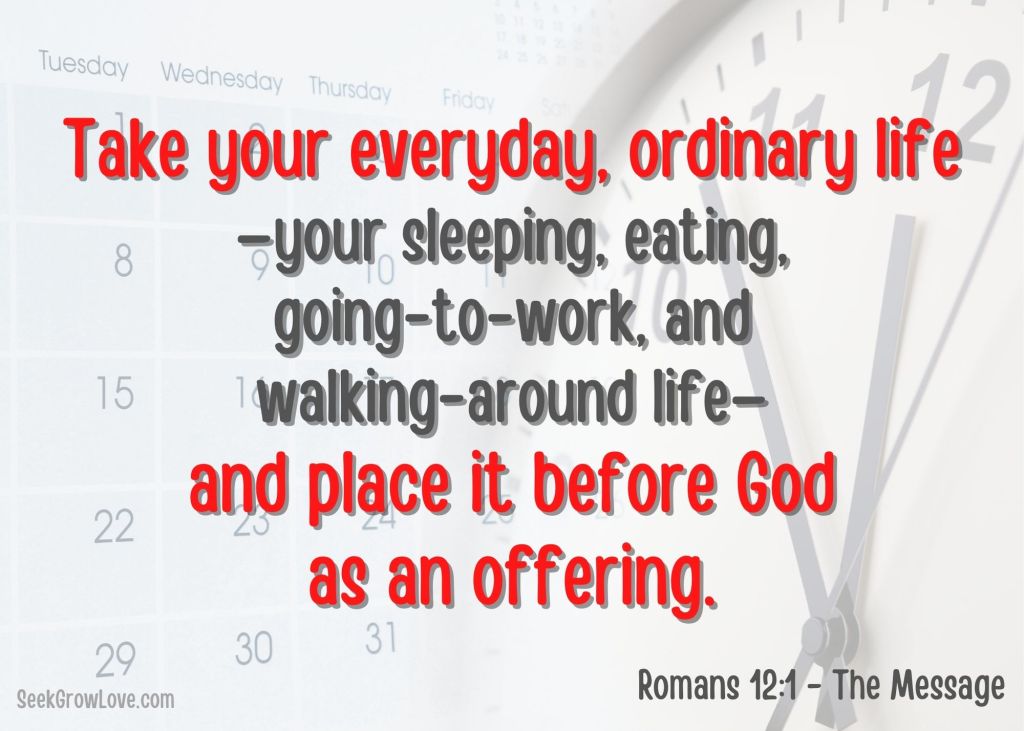
Around that time, God showed me Romans 12 in a new light, through The Message paraphrase. The first verse, which was revolutionary to me, goes like this: “Take your everyday, ordinary, life – your sleeping, eating, going-to-work and walking-around life, and place it before God as an offering.” For decades now, I have had that scripture posted around my home so I am always reminded of the value of the humdrum rhythms of life, the chance to make a difference in even the most unremarkable situations. Because most of life is without pomp and circumstance, we must learn to live each day with purpose, as all of our interactions with others have a kingdom impact. We should consider ourselves missionaries in the midst of our own school, job, and life.
Intrigued by the Danish lifestyle of hygge that represents a more simplistic and intentional way of living, I picked up the book “Holy Hygge” by Jamie Erickson. Have you heard of hygge (pronounced “HYOO-guh”)? Hygge is a word with complex meaning that is not directly translatable to English, but I believe that it goes along well with realizing that every moment of our lives is an offering to God. Simply put, “Hygge is a mindset – a way of making the mundane and necessary tasks of life more meaningful and beautiful… [hygge] helps us see that the whole of our lives is greater than the sum total of all the individual moments. The cup of coffee we sip with our roommate at the breakfast table each morning, the quick chat with the coworker as we share an elevator on our way into the office, the smile-and-wave we offer to the playground supervisor each afternoon while sitting in the pickup line – these all become a daily liturgy. We no longer grudge the monotony of a routine because hygge compels us to find the extra of each ordinary moment. In the words of author Annie Dillard, ‘How we spend our days, is, of course, how we spend our lives.’ ” (Holy Hygge, p. 15, 79-80).
Therefore, as followers of Jesus, it behooves us to realize the eternal importance of each action and interaction. To quote Brennan Manning, “In every encounter, we either give life or we drain it. There is no neutral exchange.” Everything we do – or don’t do – makes an impression for the good or the bad. Every interaction is a chance to point to – or away from – Jesus through our actions. Every moment of our lives is meant to be an offering to God.
Romans 12 goes on to share a lot about standing out from the world rather than blending into it (verses 1-2) and recognizing our gifts of grace from God and sharing our gifts with the right attitudes (verses 3-8). The rest of the chapter is almost like “popcorn proverbs” – little tidbits of reminders about how we should handle life’s challenges. In The Message version, each piece of advice has a second part to either reinforce the concept, show cause and effect, or suggest what NOT to do. I’ve put them into a chart below so you can see how they go together:
Love from who you are;
Don’t fake it.
Run for dear life from evil;
Hold on for dear life to good.
Be good friends who love deeply;
Practice playing second fiddle.
Don’t burn out;
Keep yourselves fueled and aflame.
Be alert servants of the Master,
cheerfully expectant.
Don’t quit in hard times;
Pray all the harder.
Help needy Christians;
Be inventive in hospitality.
Bless your enemies;
No cursing under your breath.
Laugh with your happy friends when they’re happy;
Share tears when they’re down.
Get along with each other;
Don’t be stuck up.
Make friends with nobodies;
Don’t be the great somebody.
Don’t hit back;
Discover beauty in everyone.
If you’ve got it in you, get along with everybody.
Don’t insist on getting even; that’s not for you to do. “I’ll do the judging,” says God. “I’ll take care of it.”
Our Scriptures tell us that if you see your enemy hungry…
go buy that person lunch.
if he’s thirsty…
get him a drink.
Your generosity
will surprise him with goodness.
Don’t let evil get the best of you;
get the best of evil by doing good.
This is a great list of things we can practice in the midst of our ordinary moments, and doing so will help shine the light of Jesus to the world around us, helping them see him in the monotony of life, too.
-Rachel Cain
Rachel is the wife to Pastor Dan Cain and homeschooling mama to four children.
Reflection questions:
Choose one or two of the “popcorn proverbs” in the chart that are a struggle for you. How and when will you apply them to the monotony of your days?
Romans 12:2 (MSG) says, “Don’t become so well-adjusted to your culture that you fit into it without even thinking.” What are some ways that you have fit in with the culture, but God is calling you to stand out for Him?
Think about the most monotonous part of your day. How can you redirect to focus on God during those times? (Listen to the Bible on audio while driving, pray while doing dishes, etc).
What has God shown about Himself in your reading of His words today?
It is important to see the connection between David and Jesus, both are messiahs! Many Christians today misunderstand who Jesus is because they never understood about the messiah David. In fact, “Christian” has messiah in it. In Israel, they are called Messianics (which has also been twisted). God chose David to shepherd the people Israel and be ruler over them. (17:7) God told him through the prophet Nathan, “When your days are fulfilled, when you must go to be with your fathers, that I will set up your seed after you, who will be of your sons; and I will establish his kingdom. He shall build Me a house, and I will establish his throne forever. I will be his Father, and he shall be My son; and I will not take My mercy away from him, as I took it from him who was before you. And I will establish him in My house and in My kingdom forever; and his throne shall be established forever.” (17:11-14) What promises God made to David that through his seed would be an everlasting kingdom, AND that he would call God his FATHER and he would be God’s son. David was also a son of God, and we know that ultimately, Jesus is the Son of God. Even though sometimes the Old Testament books may seem “drier” or have lots of lists of names and cities, they’re so valuable for understanding as we’ve been seeing this week. Sometimes I tell my kids reading the Bible is as important as eating food. One often can’t remember what they read or ate several days ago, but we needed them for our survival!!
David’s response is exalting, “O LORD, there is none like You, nor is there any God besides You, … and who is like Your people Israel, the one nation on the earth whom God went to redeem for Himself as a people—to make for Yourself a name by great and awesome deeds, by driving out nations from before Your people whom You redeemed from Egypt? For You have made Your people Israel Your very own people forever; and You, LORD have become their God.” (17:20-22) Little Israel, the size of New Jersey, yet God chose them as a people to make His name known.
The first six verses of Proverbs 25 deal with the king, so it’s very fitting with our chapters from Chronicles. If you read Proverbs 25 today take note of that timely match up. 😊 Here’s one of them. “Take away the wicked from before the king, and his throne will be established in righteousness.” (25:5) That makes me think of the future kingdom of God. Once the wicked are removed before King Jesus; his throne will be forever est. Oh, how we long for that day when righteousness will be established on this earth, and the wicked will be taken away.
Today’s picture is when we left Israel 3 years ago. Our 9-year-old daughter is looking longingly out the window of the airplane as we left. She didn’t want to leave it as it was home to her where she was born and raised. She looked at Israel the whole time, until she couldn’t see it anymore. So far, we have not been back, because of covid restrictions, but others in our family long to go back. And 1 of our 2 sons there plans on coming this week, God willing, after almost not seeing him for 2 years. “The LORD of hosts, the God of Israel, is Israel’s God.” (1 Chronicles 17:24)









 Seek Grow Love