Pay Attention

Ezekiel 40-42

Devotion by Rebeca Dauksas (South Carolina)

The Israelites have been in exile for twenty-five years and it has been about fourteen years since the fall of Jerusalem. The prophet Ezekiel is in Babylon when he experiences visions of God. He is taken to a very high mountain in Israel and from the south side he sees buildings that look like a city. He is visited by a man whose appearance was like bronze, an angel. He is holding a measuring tool. He told Ezekiel to closely pay attention to everything he would show him and he was to tell the people of Israel everything he saw.

He was shown a temple complex. It was given with detailed and specific measurements and dimensions including outside walls, gates, alcoves, thresholds, porches, outer courts, rooms, etc. Some say this vision symbolizes an ideal temple where God’s presence resides and God is glorified. Others believe that it is a literal future temple that will exist in the Millennium. There is much discussion on this vision. For instance, if it is a literal temple in the 1,000 year reign of Christ, why are there offerings there? Are these only memorial offerings remembering the ultimate sacrifice that Jesus provided? Though we may not understand everything about the vision, we know that it showed the people of Israel that there would be restoration and reconciliation with the LORD. This vision gave the people hope. They viewed the temple as a place to worship and praise the LORD. They had the same desire that we do. We want to be in the presence of God. We want to experience Him. After all, He is amazing and we love Him. He desires to be with us as well. How blessed we are to know that the LORD is with us. As the apostle Paul states, “Don’t you know that you yourselves are God’s temple and that God’s Spirit dwells in your midst? And God’s temple is sacred, together you are that temple.” (1 Cor. 3:16&17b) How blessed we are to be so connected to the LORD. 

(As editor, I had been concerned that we had a few weeks with no one signed up to write devotions – so I sent out several emails and God answered with not just one writer for today – but two! So, with no apologies, but many thanks to God and to both Rebecca and Daniel, here is your second for the day…)

Devotion by Daniel Smead (Minnesota)

Today’s text is the start of another of Ezekiel’s visions, in which he again visits his homeland of Israel. It takes place on a mountain by a city, which is presumably a way of referring to Jerusalem, and Ezekiel observes a new Temple. His guide in that building is a shining figure, who sounds something like the figures that moved God’s throne-chariot back in chapter one. This figure measures the Temple and declares the dimensions for Ezekiel to record, having calculated them using a stick a bit over ten feet long.

Interestingly, this vision is one of only two places where Ezekiel states the exact date an event took place, the tenth of Nisan, near the start of the Hebrew year that went from 573-572 B.C. The vision is twenty-five years after Ezekiel was taken from Jerusalem and Solomon’s Temple, and about thirteen years after the Temple’s destruction.

In its essence this vision allowed the exiles to look forward to a time when God’s people, again in the promised land, would have a renewed opportunity to worship God at a temple. The passage did not take shortcuts to describe this but went into minute detail. Rather than simply refer to the existence of a temple, we are told about its size and decorations as though the importance of fulfilling every detail is being emphasized. Using some effort, readers could put themselves in the scene alongside Ezekiel.

The building described in this text is quite large, and it is not a prophetic description of the Temple built in the time of Zerubbabel, after the Babylonian exile. Nor, apparently, did the returnees of that generation attempt to follow this design even when doing so would simplify their work. For example, 40:28-37 describes having three gates to the inner courts, and a Jewish Midrash says the second Temple had seven gates. In fact, the small number of gates, and the emphasis on large square rooms, raises the issue of the practicality of the design, and whether this was ever intended as a literal image of a building or just as a symbolic representation – the architectural equivalent of a parable, perhaps.

Ezekiel, as a priest who had ministered at Solomon’s Temple, would have a particular interest in the description this passage provides, whether it was symbolic or a future reality. But Ezekiel was not the High Priest, and even in his vision it seems that he does not enter the Holy of Holies, though he reports its dimensions (41:4). We hear nothing about the contents of that area.

I have written before about John’s measuring of the Temple in the book of Revelation, and how simple it can be for us when reading the figures in that passage to miss the time it would have taken to measure those distances. The same issue applies here. The long period when Ezekiel watched the shining figure go about this task, announcing number after number, can only have felt surreal. Obviously, this scene was leading somewhere, though learning what awaits tomorrow’s text. In the meantime, Ezekiel moved through a nearly empty building, large enough to hold thousands of people, simply recording its dimensions.

How often do you find yourself caught in a moment, feeling incomplete, unsure what comes next? At that time the exiles in Babylon were probably wondering what their next steps would be, and this vision was part of how God laid out expectations for them. Ezekiel, in his vision, must have found it obvious that what he saw was building toward a larger point, although he could have been recording measurements for hours. It may not always seem as obvious to us when God is at work in our lives, or how. But it is to be hoped that we can maintain trust that God is working. I don’t know how often we learn quickly or plainly what our next steps need to be. Sometimes Ezekiel waited years between his visions, visions that we can simply turn pages to link together. And the fulfillment of all that he saw in his visions waited far longer than a few years.

Regardless of all that Ezekiel went through, and how long it took, if the Bible revealed that somewhere along the way he decided not to pay attention to what God was doing with him, that it was not all worth it, we would consider him foolish. From our perspective in history such a choice would appear absurd. But sometimes we, and indeed sometimes I, need to be reminded of this same principle for ourselves. My trust, and my attentiveness for what interests God, need firming up. I can’t expect to maintain the same focus always and in every situation; no one can. Humans don’t have that kind of attention span and focus. I, and maybe you, need to be reoriented when necessary. At times we also need to realize that God still cares about us, continuing to be open and accepting despite our failings. The people God was telling about a new temple had their old one destroyed just 13 years earlier. God is open to offering forgiveness and acceptance, but more than being open to that, God strongly desires to provide it to us, in love.

Reflection Questions

  1. What thoughts and feelings might Ezekiel’s original audience have had before Ezekiel’s temple vision – as they have been stuck in a foreign land far from God with no clear way to worship Him and even no temple to try to return to? Have you ever felt similarly?
  2. What thoughts and feelings might Ezekiel have had as he was getting a tour of this temple? As he was sharing his vision? How might the people have responded?
  3. In what ways might God be asking you to pay attention to what He has done, is doing and will do? Is there anything in your past that you didn’t understand at the time but you can see now how God was using it in preparation for your future?
  4. When do you find yourself needing hope? What gives you hope?

New Heart – New Life

Ezekiel 36-39

Devotion by Rebecca Dauksas (South Carolina)

Ezekiel brings a message of future redemption for Israel. How does their redemption happen? By truly connecting with the LORD. “I will give you a new heart and put a new spirit in you; I will remove from you your heart of stone and give you a heart of flesh. And I will put my Spirit in you and move you to follow my decrees and be careful to keep my laws. Then you will live in the land I gave your ancestors; you will be my people, and I will be your God.” (36:26-28) What a beautiful picture of living in a loving relationship with God!

In our passage the LORD is providing everything that is needed to be with Him. Just as we look to our Heavenly Father every day for all that we need to truly be His obedient children. We need the heart that the LORD creates for us and we need the power of His Spirit to transform us. Our circumstances can often weigh us down, so we also need the encouragement that the LORD provides through His message. The people of Israel needed that encouragement from the LORD. They were discouraged – they were disconnected from the LORD and spiritually dry. But God promises restoration and life.

In chapter 37, the valley of dry bones illustrates that God will bring individual and national resurrection. His promise gives hope. The Sovereign Lord says: My people, I am going to open your graves and bring you up from them; I will bring you back to the land of Israel. Then you, my people, will know that I am the Lord, when I open your graves and bring you up from them. I will put my Spirit in you and you will live, and I will settle you in your own land. Then you will know that I the Lord have spoken, and I have done it, declares the Lord. (37:12b-14) God shows compassion on His nation and He will never forget His people. In the same way, He will never forget His children. When He is “proved holy through them in the sight of many nations,” may we also praise our Holy God.

Reflection Questions

  1. In what ways did Ezekiel’s audience have a heart of stone? In what ways do you? What would be different with a heart of flesh given by the LORD?
  2. What else does God say He will do for His people in today’s reading?
  3. When have you felt like you were spiritually dry – in a valley of dry bones? When have you felt spiritually alive? What life has God given you now? What life will God give in the future?

An Offer of Life

Ezekiel 32-35

Devotion by Rebecca Dauksas (South Carolina)

The LORD explains so much of His perfect character in Ezekiel. He is merciful, loving, caring and He is just. We continue to see that each person is judged by their conduct and actions. The LORD declares that He takes no pleasure in the death of the wicked, but wants the wicked to turn from their evil ways and live. He warns to “turn back, turn from your evil ways!” The LORD offers life. The LORD sends the message that true repentance brings forgiveness. Ezekiel gives good news to the one that repents and lives for God. “None of his sins that he has committed will be remembered against him. He has practiced justice and righteousness; he shall surely live” (33:16).

Not only does the LORD offer life, but life with Him.  In chapter 34, He gives us this beautiful description of a caring shepherd. The LORD cares for and gathers His sheep. “I will feed them in a good pasture, and their grazing ground will be on the mountain heights of Israel. There they will lie down on good grazing ground and feed in rich pasture on the mountains of Israel. I will feed My flock and I will lead them to rest,” declares the Lord God. “I will seek the lost, bring back the scattered, bind up the broken and strengthen the sick” (verses 14-16a). What a wonderful description of our Good Shepherd.

So why didn’t the people listen to their watchman, Ezekiel? He was giving them the warning against their evil practices and the instructions to turn to the LORD for life. Instead of hearing God’s message, they acted as if Ezekiel were some kind of entertainer. They encouraged each other to come and hear what God’s message was, but just showing up was not enough. The people heard the words, but they did not put them into practice. We are told that they did the lustful desires expressed by their mouth, and their hearts went after their own gain. The LORD told Ezekiel, “Indeed, to them you are nothing more than one who sings love songs with a beautiful voice and plays an instrument well, for they hear your words, but do not put them into practice.” (33:32)

I hope that is never said of us. We want to take in the LORD’s message. We will heed the watchman’s warnings and receive the blessings that God offers. The greatest is to always be in His presence. In the presence of our Good Shepherd there will be showers of blessing. (34:26)

Reflection Questions

  1. How have you responded to the LORD’s offer of life? Are you hearing the words but not putting them into practice?
  2. What warnings do you think Ezekiel (or any modern messenger for the LORD) would have for you today? What role does repentance play?
  3. Is there a time/place God is asking you to be a watchman?
  4. Do you spend time in the presence of the Good Shepherd? How? How could you remain in His presence more? What are some of the blessings found there?

The Pride Trap

Ezekiel 28-31

Devotion by Rebecca Dauksas (South Carolina)

God is once again reaching out to the nations. He is sending messages through the prophet Ezekiel. He wants them to know that “He is the LORD their God.” Yet, they have fallen into the trap of pride. We see this in the way the ruler of Tyre is described in Ezekiel 28:2. In the pride of your heart you say, “I am a god; I sit on the throne of a god in the heart of the seas.” When we are prideful we may elevate ourselves over God. Our self-importance becomes inflated. Self-sufficiency guides our behavior rather than a dependance on God’s grace and strength. Our pride can also blind us to the value of others. We may forget that human beings are created in the image of God and therefore have invaluable worth. God’s children, His image bearers, live lives that show love for God and others. Our worth is found in the LORD. A righteous understanding of the love that God demonstrates to the world (John 3:16) is a source of self-esteem and should produce grateful hearts in us.

Unfortunately, the nations being addressed by Ezekiel have adopted selfish prideful ideas and behaviors. They rely on their natural resources, militaries, trading abilities, treasuries, allies, …but God is sending a message through Ezekiel. Many times God states to these countries, “then they will know that I am the Lord.” These countries needed to acknowledge that God is above all and truly know Him. That should be one of our daily goals, too. We love You Lord! You are the LORD our God!

Reflection Questions

  1. Where else in Scripture do you find God warning about pride? Why does God dislike human pride?
  2. What do you see as the dangers of pride? In what ways have you seen prideful attitudes come between you and God?
  3. The world often tells us to take pride in ourselves, our family, what we have accomplished, etc.. How might you reply?

Clean the Pot

Ezekiel 24-27

Devotion by Rebecca Dauksas (South Carolina)

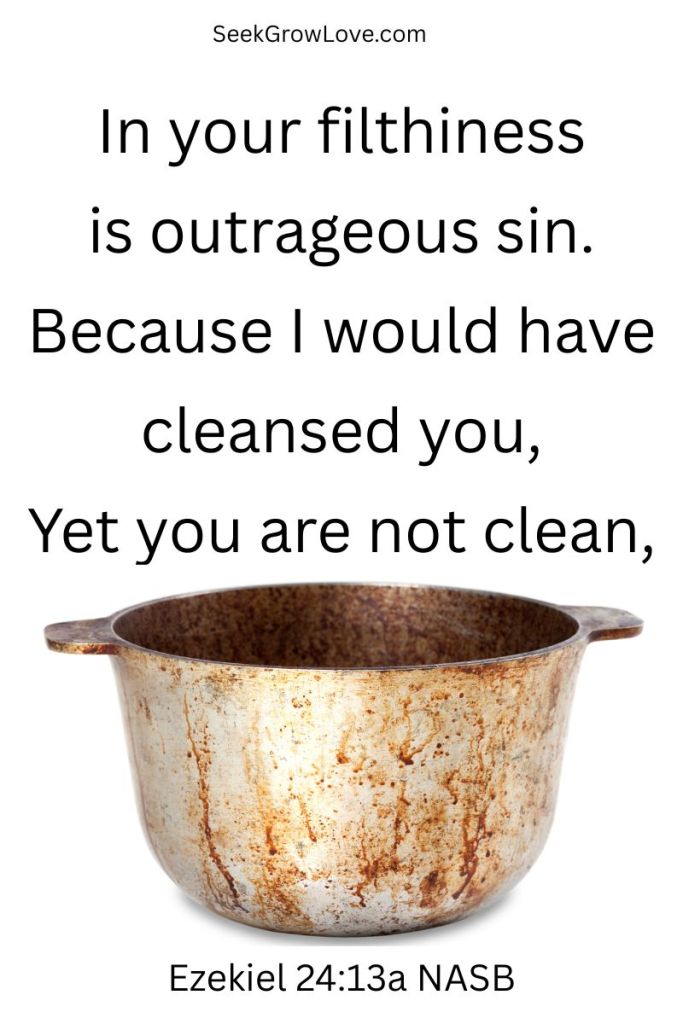
Today I scrubbed out our cast iron skillet. It would have been easier the night before, but I put this task off until today. It reminded me of our reading from Ezekiel 24. The parable for the Israelites contains a dirty, rusted boiling meat pot destined for cleansing by destruction. The pot was symbolic of Jerusalem. Ezekiel once again shares what the Sovereign LORD has said by telling his people this parable. The king of Babylon has laid siege to Jerusalem. The LORD shows the people what will happen if they continue in their evil practices. The LORD refers to Jerusalem as the city of bloodshed. When faced with a warning that severe negative consequences including death for many will follow their actions, we would think that they would stop sinning. We want the people to repent, to turn to God and accept His deliverance and His salvation. Unfortunately, they do not. 

That nasty stuff in the pot should have been removed long ago, but the people continued in their sins. We could compare the rust of the pot to the bloodshed that had taken place in Jerusalem. God had seen the killing and wounding of others in this city of blood. All the actions of the people were in full view for God. He also states that their impurity was lewdness. They did detestable acts and committed adultery. They chose indecent, obscene behaviors rather than allowing God to clean out all that crud.  They should have been filled with shame and repentance, but they openly committed their sins. The scripture tells us that the LORD tried to cleanse them, but they would not be cleansed. They were told, “You will be judged according to your conduct and your actions,” declares the LORD. 

The people of Jerusalem would not turn from their sin, but we can. We can recognize when we fall short and confess our sin. After all, He is faithful and just and will forgive us our sins and purify us from all unrighteousness. So God can make us a “vessel for honor, sanctified, useful to the Master, prepared for every good work.”

Reflection Questions

  1. What sins has Ezekiel mentioned in his book? What does God not like about them?
  2. Why do you think God is giving warnings before the punishment comes?
  3. What sins do you think God sees today – in you – that he would (or is) sending you a warning about? And what sins in the world around you?
  4. What would the cleansing process look like if we turn to God? What would the cleansing process look like if we don’t?

Seek, God Sees and a No-Brainer

Psalm 7, 27, 31, 34, 52

This week we are choosing past devotions to repost, but I had a hard time choosing just one – so here are 3 for you! SeekGrowLove today!

ON PSALM 27 –

(from 2021) You may have noticed that the SeekGrowLove blog features a key verse: “You will seek me and find me when you seek me with all your heart” from Jeremiah 29:13. The LORD confirms that our seeking is worth it, because ultimately, we will find Him. However, there is an important requirement; we need to seek with all our heart. What does this phrase “with all our heart” really look like? How can we seek “with all our heart”? Perhaps “with all our heart” seeking is completely and sincerely devoted. Maybe determined and enthusiastic. This type of seeking is relentless, full of passion for what is right. It can’t be stopped. Psalm 27:4 states, “The one thing I ask from the Lord, this only do I seek: that I may dwell in the house of the Lord all the days of my life, to gaze on the beauty of the Lord and to seek him in his temple.” Verse 8 continues, “My heart says of you, ‘Seek His face!’ Your face, Lord, I will seek.’” You can hear the determination in that statement. The writer wants to be in the presence of the LORD. They are completely and sincerely devoted. Enthusiastic for the presence of the LORD. They are pursuing him ‘with all their heart.’

This is what the LORD desires for us. “The Lord looks down from heaven on all mankind to see if there are any who understand, any who seek God.” (Psalm 14:2) He wants us to seek him wholeheartedly. Passionately. Relentlessly. In life, we can be distracted with many pursuits, desires, and distractions. However, we can choose to refocus on the one who matters. We can choose to seek “with all our heart.” The benefits of this type of “with all our heart” seeking is great. Matthew 6:33 says, “Seek first the kingdom of God and His righteousness.” This desire to be close to God will be rewarded.  We are rewarded today with our close loving relationship with God and later when we see Him face to face. So, if you start to feel discouraged or distracted, remember who our seeking will lead to: “Look! God’s dwelling place is now among the people, and he will dwell with them. They will be his people, and God himself will be with them and be their God. He will wipe every tear from their eyes. There will be no more death or mourning or crying or pain, for the old order of things has passed away.” (Revelation 21:3,4)

-Rebecca Dauksas (originally posted February 25, 2021 for SeekGrowLove)

ON PSALM 34 –

In yesterday’s lesson, I neglected to point out a story from 1 Samuel 21 that is relevant to today’s reading.  When David ran away from Saul, he escaped to Gath (enemy territory) so Saul wouldn’t keep chasing him. The king’s servants pointed out that David was the man about which they sang, “Saul has slain his thousands, and David his tens of thousands.”

David took these words to heart and was very much afraid, so he pretended he was insane –  scratching on the doors, and letting his saliva run down his beard. When the king saw this, he thought David was crazy, and sent him away.

David wrote Psalm 34 after this experience.  Here are some verses that stand out to me.

V 3, “Glorify the Lord with me; let us exalt his name together.”

V 4, “I sought the Lord, and he answered me; he delivered me from all my fears.”

V 6, “This poor man called, and the Lord heard him; he saved him out of all his troubles.”

V 7, “The angel of the Lord encamps around those who fear him, and he delivers them.”

V 8, “Taste and see that the Lord is good; blessed is the man who takes refuge in him.”

V 12-14, “Whoever of you loves life and desires to see many good days, keep your tongue from evil and your lips from speaking lies.  Turn from evil and do good; seek peace and pursue it.”

V 15, “The eyes of the Lord are on the righteous and his ears are attentive to their cry;”

V 19, “A righteous man may have many troubles, but the Lord delivers him from them all’

We need to be quick to praise God for whatever he does for us, just like David did.  It’s easy to cry out to God when times are tough, but sometimes it’s harder to remember to praise Him and let others know what He has done for us.  This is important too.

What I really like about this chapter are the multiple times that David points out that we will experience difficult times, but God sees us through those times.  I like the image conveyed by verse 7. When I’m going through a hard time, it’s comforting to imagine God sending an angel to protect me. This doesn’t mean I won’t have difficulties, but God sees me through.  God is attentive to the righteous.

In verse 8, I picture David saying, “I’ve been through some hard times, but I’ve remained faithful to God, and God has pulled me through.  I want to encourage you to develop a close relationship with the Lord. Once you experience that relationship and experience His helping you through those difficulties, then you too can understand how good God is.”

I have to echo David’s words, because I’ve been there.  So I encourage you too, “Taste and see that the Lord is good; blessed is the man who takes refuge in him.”

–Steve Mattison (originally posted April 14, 2020 for SeekGrowLove)

ON PSALM 52 –

For the Christian it is considered a “no brainer” that our trust is supposed to be found in God. But so often the stresses and worries of the world come against us, and we may forget that we serve a mighty God who cares deeply for us. 

Here in Psalm 52 we are shown a great contrast between David here and his enemy. David wrote this Psalm during the time when he was constantly on the run from Saul, who was chasing him down to kill him, out of jealousy. David lost many years of his life running from Saul but he never lost his trust in God. At this time David had amassed a group of strong men who were ready to fight for him, but Saul, having the armies of Israel behind him, had the greater strength. David had support from people who gave him food and supplies as he ran from place to place, but Saul had all the riches of Israel behind him. But the important thing is that David had God with him, and God had promised him the throne of Israel that Saul currently sat on. 

David was able to stay strong in his faith because he had seen God help him against overwhelming odds again and again, the most notable time was when he took on the nine foot tall giant, Goliath all on his own. There were actually two times during David’s years of running, that we are told about, where David had the chance to rely on his own strength to defeat Saul. Once was when Saul went to relieve himself in a cave, not knowing that David was hiding in the cave. The other time, the Bible says that God caused the entire army that was with Saul to go into a deep sleep and David was able to sneak right up next to Saul. Both times the man who was with David encouraged him to kill Saul and take the throne. But each time David refused, saying that he would not harm the Lord’s anointed. It would have been so easy for David to trust in his own strength in that moment, and no longer have to keep running for his life, but just like when David faced Goliath, David put his trust in God and not in himself. And because David did trust God, he never had to draw his sword against Saul or anyone in his family. In one single battle, Saul and all of his sons were taken out by the Philistines. God provided David the throne without David having to shed blood. David’s faith in what probably seemed like the hopeless situation of being relentlessly chased down by King Saul, paid off in the end. Years later after David had become king, he penned another Psalm, in which he said, “Some trust in chariots and some in horses but we trust in the name of the Lord our God.” I hope and pray each day to have the kind of faith and trust in God like David had, and I hope you do as well.

-Jonny Smith (originally posted February 22, 2023 for SeekGrowLove)

Reflection Questions

  1. Is there a time you have trusted in God through a tough situation? What was the result? Who have you seen trust God through a tough situation and emerge with an even stronger faith in God?
  2. What do you sometimes put your trust in instead? How does that work? Why?
  3. What has God shown about Himself in your reading today?

Handling Hardship

Numbers 11:23 NIV for SGL

Old Testament: Numbers 11

Poetry: Job 10

New Testament: Acts 24

Ok, we know that things are not going to go well when we read, Now the people complained about their hardships in the hearing of the Lord, … (Numbers 11:1)

Why would they do that? The Israelites grumbled, argued and complained, but this never works out for them. Honestly, if we look at our own lives, are we guilty of this too?  Do we show God that we are thankful for our life and the provisions that He gives us?  If I may quote Madame Blueberry: “A thankful heart is a happy heart.”  But, the Israelites are not thankful, and they are not happy.  In Numbers 11, they complained about their hardships in the hearing of the Lord, and when he heard them his anger was aroused. Then fire from the Lord burned among them and consumed some of the outskirts of the camp.

So, surely they adopted a new way of doing things, a new way to react to the situations that arose. Nope.

“The rabble with them began to crave other food, and again the Israelites started wailing and said, “If only we had meat to eat!  We remember the fish we ate in Egypt at no cost—also the cucumbers, melons, leeks, onions and garlic. But now we have lost our appetite; we never see anything but this manna!” (verses 4-6)

Wow. Yep that slavery, that was the good life. Sure, they lived lives of servitude, but they had cucumbers.

Unfortunately, this complaining spread until Moses heard the people of every family wailing at the entrance to their tents. The LORD became angry and Moses was troubled. This is where I think we can learn from the way Moses responds.  He asked the LORD.  He is troubled because he is in a situation that is impossible for him to handle alone.  He just has an honest conversation with the LORD. We see him react in the same way that he did in chapter 9 when he is asked a question about the Passover feast.  He told the people to wait until he found out what the LORD commanded concerning them. I think that is how all of us should handle hardships.  We should talk with God about what ever is troubling us. If we are in a continual conversation with the LORD, we bring him our praises and requests continually too.

Moses told Him that he could not carry all those people by himself; the burden was too heavy. The LORD had a solution for him. The LORD would take some of the power of the Spirit that was on Moses and put it on seventy of Israel’s elders.  They shared the burden of the people so Moses did not have to carry it alone. As far as the request for meat, the quail arrived when the LORD said it would.  Even Moses did not know how God could do it, but again he talks with God about it. I wonder how things would have gone for the Israelites if they had humbly thanked God for their manna and asked for meat.  The LORD could even have thrown in cucumbers if He wanted to.  From today’s reading lets be encouraged to pray continually sharing our hardships and praises with God.

-Rebecca Dauksas

(first posted for SeekGrowLove on September 3, 2016)

Reflection Questions

  1. When hardships hit do you spend more time complaining or praying?
  2. If you were a pastor/youth leader or spiritual counselor for the Israelites what issues or problems would you address with them? Which of these problems do you have as well? What could they – and what can you – do to work towards fixing these problems?
  3. What do you learn about the Lord God in Numbers 11?

Abounding in Love

*Old Testament: Exodus 33 &34

Poetry: Psalm 33

New Testament: Matthew 28

As a child, I remember making an emergency run to the neighborhood store with my Mom for a box of cereal. It was the night before Valentine’s Day. Our teacher had told us to decorate a cereal box to transform it into our personal Valentine’s Day mail box. Of course, I had forgotten all about this class project until the night before it was due. Everyone in our class would buy a pack of cards. I liked opening my box of cards and reading through each one as I addressed and signed them. I was so excited to drop the cards in the other boxes for my classmates. The class card exchange has been a long-standing tradition and a fun way for kids to express fondness for classmates. Expressing fondness, admiration or appreciation for others is definitely a skill that I want to pass on to the next generation. And more importantly, I want all of us to be able to express our love to God and show the love of God to others. In fact, Jesus taught us that the greatest commandment is to love the Lord our God with all our heart, soul, mind and strength and the second commandment is to love our neighbor as ourselves.(Mark 12:29-31)

The LORD has always shown human beings His love. He created us, cares for us, provides for us, sustains us…His interactions show His love because God is Love. The love that God shows us is perfect love, agape love. You know that perfect love of God: love that is patient, kind, not envious, not boastful, not proud. Love that doesn’t dishonor others, is not self-seeking, is not easily angered, and doesn’t keep a record of wrongs. This love doesn’t delight in evil, but rejoices with the truth. (1 Corinthians 13) You know. That kind of love. The love that never fails.

Moses had many opportunities to experience the LORD’s love through his own life and through the LORD’s interaction with the Hebrew people. But leading this rebellious group had Moses seeking God more than ever. He pleaded for His presence to go with them on their journey and he asked to see God’s glory. God grants his request. Early in the morning, Moses heads up Mount Sinai with the new stone tablets in his hands. We see Moses being rewarded for seeking a close, loving relationship with the LORD. The LORD came down in the cloud and stood there with him. He passed in front of Moses, proclaiming, “The LORD, the LORD, the compassionate and gracious God, slow to anger, abounding in love and faithfulness, maintaining love to thousands, and forgiving wickedness, rebellion and sin.”  (Exodus 34:6 & 7)

Just like Moses, we are so thankful for who the LORD is-abounding in love and maintaining love to thousands. But the LORD also states that He is just. He does not leave the guilty unpunished. That is the part that might scare us. After all, every one of us has sinned and come short of the glory of God. But the fear of the LORD is the beginning of wisdom and it is wise to realize that God is bigger than we are and has our lives in his hands. But as we grow closer to God, we realize that He wants all people to be saved and to come to a knowledge of the truth. He truly wants only the best for us. What Jesus called abundant life. Our fear of the Lord should motivate us to repentance and acceptance of His Son.  As 1 John 4:18 states, “There is no fear in love. But perfect love drives out fear, because fear has to do with punishment. The one who fears is not made perfect in love.” His amazing love for the world was so great that He gave us His only begotten Son, our Lord Jesus Christ. In love God offers us the opportunity to believe in Jesus and receive eternal life. (John 3:16) So it is time to walk closely with the LORD allowing Him to fill us with His perfect love.

-Rebecca Dauksas

Reflection Questions

  1. How would you describe God’s abounding love? 
  2. How did Moses experience it?
  3. How have you experienced it?
  4. How can you express your love for God today?
  5. How can you show the love of God to others today?

Homemade Idols

*Old Testament: Exodus 31 & 32

Poetry: Psalm 32

New Testament: Matthew 27

I grew up on a farm and was around cows a lot. Never once did I find qualities to be worshipped in our cows. Sure, sometimes they did something cute or funny, but to lift a calf into idol worship seems ridiculous to me. Yet many ancient cultures worshipped the bull. Apparently, the Hebrew people were aware of this practice, too. So while Moses is receiving the Law of the Lord on the mountain, Aaron is left in charge. The people told him to make them gods who would go before them. And amazingly he does it. He creates the idol from their jewelry. Aaron goes on to build an altar in front of it. He announces that they will have a festival to the Lord with burnt offerings and fellowship offerings. The LORD is writing instructions for Moses of who He is and how they can worship Him, but they decide to create their own idol and practice their own form of worship. Along with these bad decisions, they eat, drink and indulge in revelry.

The golden calf should illustrate the ridiculousness of placing anything or anyone in a position of worship. The LORD is the only One who should be there.

I wonder if we had our modern-day idols put out on public display with altars in front of them, what would we find? Things that represent power, relationships, careers, educational degrees, wealth, fame…What offerings are being given for these idols? Are we offering most of our energy, time, focus or money?

Even good things can become idols when we make someone or something else the highest priority in our lives. Material possessions can be viewed as blessings from the LORD. We can thank Him for them and use them to help others. When we do this, we are using God’s blessings for good, but if we become consumed in our material possessions, they become an obstacle to fully loving and serving the LORD.

We should ask ourselves, “Does anything or anyone hold a higher priority in my life than the LORD?”  In Colossians 3:5 we are told to “Put to death, therefore, whatever belongs to your earthly nature: sexual immorality, impurity, lust, evil desires and greed, which is idolatry”.
So we see here that evil things need to be eliminated from our life before we find that they have become idols.

The Hebrews show us the seriousness of putting idols in the place of the LORD. They made themselves a laughingstock to the other nations and they broke a blood covenant with the LORD. (Ex. 24:7-8) How much better it would have been if Aaron had refused? Even when leadership falters, we should stand for the LORD. Let’s move out any idols and make the LORD the center of our world by loving Him with all our heart, soul, mind and strength.

-Rebecca Dauksas

Reflection Questions

  1. Does anything or anyone hold a higher priority in your life than the LORD? What or who? 
  2. What offerings are being given for these idols? Are you offering most of your energy, time, focus or money to anything or anyone who is not the LORD God?
  3. What will you do to put God first (either again, or for the first time in your life)? What changes need to be made? What habits need to be broken? What habits need to be started? What will you do today to make it so? 

The Priests

Old Testament: Exodus 29 & 30

Poetry: Psalm 31

New Testament: Matthew 26

I am struck by the stark contrast of the priests of God in our reading today. In Exodus we are shown the beginning of the priesthood. The LORD sets apart Aaron and his sons. They were called, consecrated and ordained to serve Him. These men were anointed to serve the Lord and their anointing was to be a priesthood that could have continued “throughout their generations.” 

But as we travel forward through the centuries to the time of Christ in Matthew 26, we see the high priest, chief priests and elders scheming to secretly arrest and kill Jesus. They are counting out the 30 pieces of silver to be given to his betrayer. The chief priests and the whole Sanhedrin were looking for false evidence to condemn Jesus to death. Rather than leading his people in the observance and the true meaning of Passover the high priest is interrogating Jesus. The high priest commands, “I charge you under oath by the living God: Tell us if you are the Messiah, the Son of God.” Jesus replied, “You have said so. But I say to all of you: From now on you will see the Son of Man sitting at the right hand of the Mighty One and coming on the clouds of heaven.” This truthful statement is met with the high priest tearing his clothes and pronouncing Jesus as a blasphemer. The leaders declare that he is worthy of death. They even go as far as slapping him, striking him with their fists, mocking him, and spitting in his face. How could these religious leaders fall so far from God? They were prideful of their positions and were so filled with jealousy, and hatred that they could not recognize the Son of God.

But praise God that we know our Lord Jesus is the Son of God and we know that God called him to serve as our High Priest. The book of Hebrews explains, Christ did not take on himself the glory of becoming a high priest. But God said to him, “You are my Son; today I have become your Father.” “Therefore, since we have a great high priest who has ascended into heaven, Jesus the Son of God, let us hold firmly to the faith we profess.”(Hebrews 4:14) As Jesus offered himself as a sacrifice, we should offer our lives to God. We will follow the example of our High Priest, Jesus Christ so we may be known as “a chosen people, a royal priesthood, a holy nation and God’s special possession.”

-Rebecca Dauksas

Reflection Questions

  1. What was the job of the priests, and specifically the high priest? 
  2. How is Jesus the perfect high priest? 
  3. In what ways can you now serve as a chosen people, a royal priesthood, a holy nation and God’s special possession?