Choosing to be Last

Matthew 19 & Mark 10

Devotion by Paula Kirkpatrick (Minnesota)

When I taught a primary Sunday School class many years ago, there were three eager learners in the class: a brother and sister, and another young boy who was their cousin.  The brother and sister were blond and blue-eyed, a sharp contrast to their cousin’s thick dark hair and brown eyes, but each one was bright and engaging, and so fun to teach.  They were also quite competitive.

“Who’s going to pass out the crayons?” I asked.  “I will,” declared one student, only to be challenged by another voice chiming in, “No, I will!”  Inevitably, the remaining student would declare, “I want to do it!  It’s my turn!” 

For several weeks, this vocal battle ensued each time a new task presented itself during our classtime.  We tried to keep track of “turns,” but it still didn’t seem to quiet the noise, or the challenge of, “No, it’s my turn!  He did it last week.”  Our precious learning time was being shortened by these weekly squabbles.

I needed a solution and Scripture provided the answer.  Matt. 19:30 says, “But many who are first will be last; and the last, first.”  Mark 10:19 repeats the same sentence. 

In Matt. 19:16-30 and Mark 10:17-31 we find the story of Jesus’ encounter with the rich, young ruler. 

One day, as Jesus was walking along the road, a rich young man came up to him. “Teacher,” the man said, “what good thing should I do to have eternal life?”

Jesus answered, “You know the commandments.” Jesus then began to list several of them.

“I have obeyed all the commandments since I was young,” the rich young man replied.

Jesus looked at the young man and loved him.  Then, he said to him, “You lack only one thing. Sell all you have and give the money to the poor so that you will have treasure in heaven. Then come, follow me.” When the young man heard those words, he turned and walked away because he had many possessions.

As the rich young man sadly departed, Jesus declared to his disciples, “How hard it will be for those who are wealthy to enter the kingdom of God.”  Jesus’ words amazed the disciples.  Then he repeated again, “Children, how hard it is to enter the kingdom of God.  It is easier for a camel to go through the eye of a needle than for a rich man to enter the kingdom of God.” 

Jesus’ statement astonished the disciples.  We can imagine them with eyes wide open, jaws dropped, and simply speechless for a few moments.  Finally, they asked, “Then who can be saved?”  Jesus responded, “with men it is impossible, but not with God; for all things are possible with God.”

The rich young ruler had followed the law.  Yet Jesus wanted him to sell everything he owned.  Jesus saw what the disciples could not see—the young ruler’s heart.  His status, his possessions, were more important than following the example of Jesus, who came to serve mankind and ultimately sacrifice his life for all. 

Peter, still trying to understand the meaning of his teacher’s words, exclaimed, “Behold we have left everything and followed you.” 

Jesus’ loving response brought assurance. 

The disciples’ present sacrifices would be rewarded in the age to come.  They had left family and livelihood to follow their beloved Master and assist him in his ministry.  To others, they appeared as common laborers, poor and at the bottom of society.  But in the coming kingdom, their status would be undisputed. 

Paul says it well in I Timothy 4:7-8.  “I have fought the good fight, I have finished the course, I have kept the faith;in the future there is reserved for me the crown of righteousness, which the Lord, the righteous Judge, will award to me on that day; and not only to me, but also to all who have loved His appearing.”

When I shared this story with my students, a change happened.  As we began our class the next Sunday, I asked, “Who’s going to pass out the crayons?” 

I received these responses.  “You go ahead and do it;” “No, you can go first;” “I want to be last!”  Attitudes had changed!

All three children now wanted to be LAST each and every time!

“But many who are first, will be last; and the last first.”

Reflection Questions

  1.  Why is it hard for wealthy people to follow Jesus? 
  2. What “riches” do you have in your life that make it difficult to live for Jesus?
  3. How can you be “last” as you interact with others this week?    

Those Dangerous Excuses

OLD TESTAMENT: EXODUS 3-4

POETRY: PSALM 23

NEW TESTAMENT: MATTHEW 19

My son is fully in his threenager stage of life. Our days go something like this: 

“Jonah, go wash your hands. It’s time for dinner.” 

To which he responds, “Mama, I’ve already told you three [pronounced like tree] times. I’ve already washed my hands, and I’ll eat when I’m done playin’.” 

You can imagine my response to this. Let’s just say I have plenty of opportunities for correction and discipline throughout the day. 

Many times, I can recognize my own voice in what he says. What I say, he repeats in his cute toddler-growing-up way. In the conversation I mentioned before, his main goal was to keep playing, so he was just saying whatever he thought would lead to that outcome. He has a tendency to want to keep doing whatever he is currently doing. So if he’s playing, he wants to keep playing. If he’s at church, he wants to stay at church. If he’s at home, he wants to stay at home. This means starting the next activity involves a lot of excuses as to why he can’t quit what he’s doing and move on to the next thing, even if there are good things in store for him when he does. 

In today’s passages, we read about several excuses given as to why someone couldn’t follow through with what they were asked to do. In each case, the excuses were made because the person didn’t want to leave their comfort zone and change their life. 

In Exodus 3-4, Moses was leaving his flock to go find the lost sheep. On the way, he saw a burning bush. The LORD spoke to him there, calling him to go shepherd the Israelite people as they left Egypt and traveled to the Promised Land of Canaan. Moses gives a series of three excuses. He first asked what he should do if the Egyptians didn’t listen to him – probably thinking that it was a lost cause to go and try to ask the Egyptians to give up their unpaid labor. Then, he says that he is not a good speaker, calling himself “slow of speech and tongue.” Finally, he just comes right out and says, “Lord, please send someone else.” 

To each of these excuses, God responds with a resounding, “Go, I will be with you!” God doesn’t point to what Moses was capable of. Instead, he draws Moses’ attention to what he – God – can do through Moses. For the first excuse, God shows how Moses will be able to do wonders through God’s power. In the case of the second excuse, God points to how he is the creator. He will teach Moses what to say. In the last pleading excuse, God gives a helper to Moses in Aaron to be a mouthpiece for him. 

To each of Moses’ excuses, God gives a clear path forward, showing how he in his might and power will make what he has said come to pass. 

Our passage in Matthew 19 repeats this theme of excuses. The rich young ruler had attempted to live righteously, following the law. Jesus told him that he lacked one thing: He needed to sell his wealth and give to the poor. The rich young ruler went away sad, probably full of excuses. He didn’t want his life to change. 

We have been called ourselves. When we hear the gospel, we must change. When we hear God’s leading in our life, we must act. But, all too often, we are filled with excuses. We don’t want to leave our comfort zone, and we think of a million reasons why this is the case. 

Today, don’t focus on why you think you cannot accomplish something for God, or why you think you cannot move forward in faith. Instead, focus on what God has done and will do for you. Trust that he will lead you to “green pastures” and “quiet waters.”

~ Cayce Fletcher

Cayce writes about discipleship, productivity, and homemaking at her blog https://amorebeautifullifecollective. You can find her latest post on biblical ideas creating an ideal schedule here. You can also listen to A More Beautiful Life Collective Podcast on Apple Podcasts, Spotify, YouTube, or wherever you listen to podcasts. 

REFLECTION QUESTIONS

  1. Moses was asked to go down to Egypt, but he didn’t want to go because he felt inadequate. Have you ever felt inadequate when you have been asked to do something for God? How can you overcome those inadequacies and act in faith? 
  2. What excuses have you given when it comes to following Jesus in faith? 
  3. Psalm 23 focuses on how God, as a good shepherd, leads to good things. What are some good things to which God has led you in your life? 

SGLCalendar2024DOWNLOAD

How to Get Eternal Life

Matthew 19

January 19

“And looking at them Jesus said to them, “With people this is impossible, but with God all things are possible.”(Matt.19:26)

This is a verse we hear as encouragement incredibly often. From hearing someone reference it, to seeing it posted on social media. But until recently, I hadn’t dug into the meaning behind this verse. 

This verse comes from the story of the rich young ruler- a story I had heard before, but never knew it’s correlation to Matt. 19:26. A young man approached Jesus and asked him what he must do to be saved. Jesus responds with, “Keep the Commandments”. After this, he asked Jesus which ones are the most important and Jesus responds with, “You shall not commit murder; You shall not commit adultery; You shall not steal; You shall not bear false witness. Honor your father and mother and you shall love your neighbor as yourself”(Matt.19:18, 19)

The man says he’s done all these things but he is still lacking, and asks what he must do, and Jesus responds to him by saying, “Give up your wealth.”

The man is much grieved by this, and Jesus tell his disciples that it is nearly impossible for a rich man to enter the kingdom. They ask, “Then how can one enter?”  To which Jesus responded,

  “With people this is impossible, but with God all things are possible.”

I believe this deeper understanding in context gives the verse a completely different connotation. It is that we are sinners, we are broken , and we are not worthy of the kingdom; but with God, and his amazing glory, we may enter.

-Julia Simon

Questions for Reflection and Discussion

  1. How does wealth and material possessions get in the way of our relationship with God and even our salvation, or entrance into eternal life? What did the rich young ruler love most? What does Jesus say we ought to love? (in this passage and any others)
  2. Besides wealth and things money buys, what else can get in the way? Is there anything you are holding onto too tightly, making it more important to you than entering the Kingdom of God?
  3. What is impossible for people? Does this mean we should give up and not try to follow the commandments? What is possible for God? Does this mean everyone will enter eternal life regardless of what they have loved? Why or why not?
  4. The disciples had given up much to follow Jesus and Jesus said they would be rewarded. What have you already given up? What might God be asking you to give up?

Possessions or Jesus?

Text: Luke 18.15-19.48

At the time this devotion is being written, the release of the new iPhone 12 will be announced tomorrow. Many people, as usual, will drool over this fresh piece of technology and feel compelled to get it even though they probably don’t need it. And my oh my how this is true with so many other material items in our life. We don’t really need them but feel as though we do. This is the world we live in as 21st century Americans. However, though having material possessions IS NOT BAD, as disciples of Jesus we MUST be aware of the ever lurking sin of greed and ungodly consumption. 

In today’s text we read about two rich men who respond to Jesus in complete opposite ways. The two rich men are the Young Rich Ruler and Zacchaeus. The reality is both of these men represent two groups of people. One group who says they want to follow Jesus but do not want to give up their supreme desire for possessions/wealth and the other group are those who equally love money and wealth but repent of it and replace the greatest desire of their life (wealth) with Jesus. 

In the account of the rich young ruler, Jesus plainly tells us it is impossible for a rich man to enter the kingdom of God. Worldly riches and treasures and possessions mean absolutely nothing to the sovereign creator of the universe. It is ok to have money, it is absolutely not ok to love money (and what you get with it) more than God. The former is God’s gift to us, the latter is idolatry. Love the giver not the gift. 

In the account of Zacchaeus we learn that it is never too late to repent of our sin (in this case greed) and come to Jesus and receive salvation. Zacchaeus was likely a career tax collector who made a living stealing from his own Jewish people. He shows us the way to repent from greed. He gives away many of his possessions and repays four times what he stole from people. Zacchaeus’ heart changed therefore his actions and lifestyle changed. True repentance is always evidenced in life change. 

Who are you? Do you say you love Jesus but really wealth and consumerism has your heart? Or do you recognize greed has no place in the life of a believer. Our greatest treasure is Christ not the Iphone 12. 

Other passages on greed and wealth:

.Luke 8.14

.Luke 12.16-21

.Luke 16.19-31

.Proverbs 11.4

.Proverbs 11.28

.Matthew 6.19-21

-Jacob Rohrer

P.S. The next 2 weeks of devotions will be authored by me. All my scriptural citations will come from the New American Standard Bible (NASB).

Today’s Bible reading passage can be read or listened to at BibleGateway here – Luke 18.15-19.48

Tomorrow we will read Mark 11 & John 12.

Transformed

Ephesians 4 24
My guilty pleasure shows, the ones I watch on those rare occasions when I am home by myself and have nothing to do (or at least would like to put off what I am suppose to do), are restaurant makeover shows.  It doesn’t matter the title, the host, or the characters.  I am sucked into the identical plot over and over again. A failing entrepreneur invites a celebrity chef into their restaurant to help them become more successful.  Initially, they admit that minor changes are in order, but don’t see any major cause for concern.  The business owner’s management is flawless. The food is great.  The decor could be updated. Just a tweak here and there and efforts will move from futile to flourishing.  And then celebrity chef gives the reality check (in a varyingly dramatic way).  He/she tells them the decor is dismal, the food is frightful, and by far the most monstrous piece that brings each element together is the mismanagement.  Yet the owners who willingly invited the chef into their restaurant, who have seen this play out on different channels, seasons, and time slots, express shock.  They shake their heads and fingers.  “Not us!” they say. “We are different!” they say. “We only invited you here because we thought we only needed small changes!” they say.

It is hard to accept the jarring reality that we’re terrible. That the entirety of everything we have accomplished for ourselves is considered a heap of filthy rags (Isa 64:6).  Our corrupted (Eph 4:22) business-as-usual model is rubbish, garbage, doo doo.  You don’t need to drop a couple items off the menu; you need a new menu.  You don’t need to gloss over the interior with a new color; you need some serious demolition work.  Most of all, you are not one or two adjustments away from being an excellent entrepreneur; you need a new manager. A major overhaul is in order, not a minor adjustment.  In order to do this Christian life, you must face there is a thread that tethers most of your issues:  you making the decisions.  Conversely, there is a simple solution to overcome challenges and have meaningful and lasting change: follow the model of Christ.  Less us, more Christ until we are gone, and there is only Christ.

“I have been crucified with Christ, and I no longer live, but Christ lives in me. The life I live in the body, I live by faith in the Son of God, who loved me and gave Himself up for me.” – Galatians 2:20

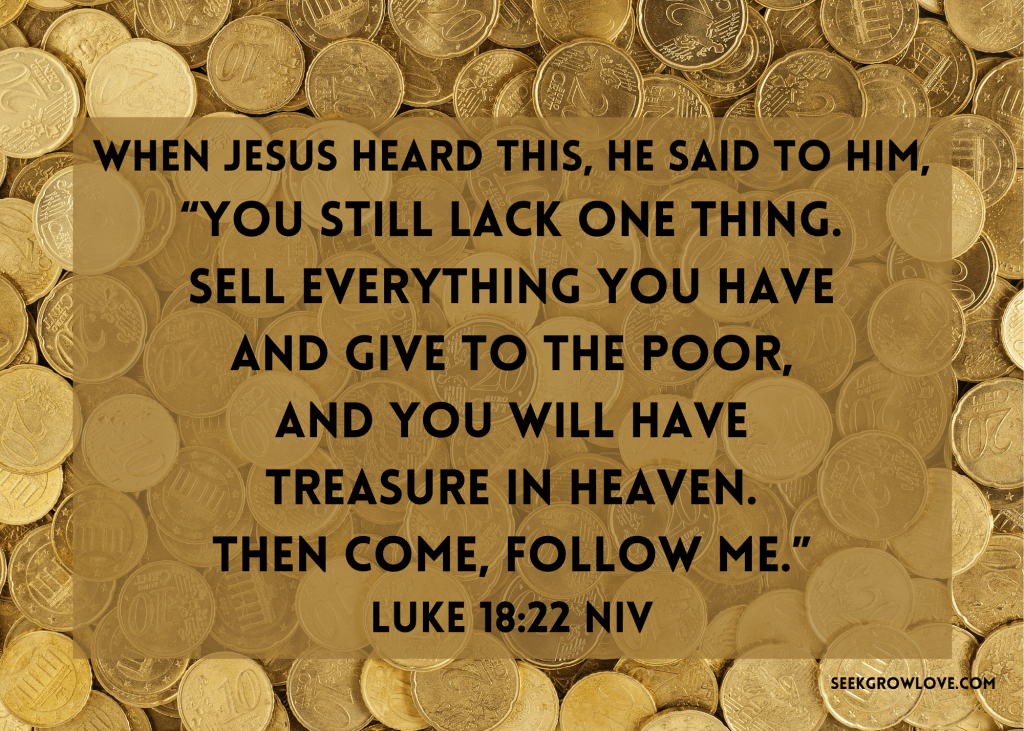
The Rich Young Ruler (Luke 18). Man, oh man – it is so hard to read his story because it hits so close to home. He invited Christ into his life to look at what He had accomplished because he had a pretty good thing going.  He thought he only needed a quick makeover. Then Jesus delivered some nauseating news to this guy: “You still lack one thing: Sell everything you own and give to the poor, and you will have treasure in heaven. Then come, follow Me.”  “Not me!” he thought. “I am different!” he thought. “I only invited you here because we thought we only needed small changes!” he sadly thought and walked away from Christ.  Had he not heard this requirement from Jesus already?  Matt 6:19-24 Luke 12:23; Or read about them in the law he kept? Deuteronomy 8:8-10; Psalm 62:10; Proverbs 11:28

Christ doesn’t call us to a simple makeover or even a renovation.  Our response cannot be accomplished by purchasing a new Bible, hitting up church camp, signing up for a mission trip, going to a Bible college, following commandments, or doing good works.  All of those things are beneficial, but they will not lead to lasting, permanent change – said by someone who has done ALL of those things.  TRANSFORMATION is literally changing (trans-) our very form (uh, form).  Tearing down the structure, ripping the very foundation from the earth, and then replacing it with a new foundation – our Cornerstone, Jesus Christ. THEN we seek our Chef, Architect, and Father for the new plan for our life.  For some of us, God may have used His infinite plan to provide us with the tools to build with for His glory or repurpose some pieces from the rubble, but more likely than not, we may be called to do something completely new, difficult, and can only be accomplished with a new creation.

“Therefore, if anyone is in Christ, the new creation has come:The old has gone, the new is here! Do not conform to this world, but be transformed by the renewing of your mind. Then you will be able to test and approve what God’s will is—his good, pleasing and perfect will.” 1 Corinthians 5:17; Romans 12:2

TRANSFORMATION is not ours in a single day.  It begins with the decision to demo, but is a lifelong, day-by-day challenge to change not only the way we act, but our very mindset that allows us to test and approve what God’s will is for our lives. When we transform our thinking, health, sickness, wealth, poverty, where we live, what college we attend, our occupation, our family, persecution, what we eat or drink, and even death are not our simple circumstance but tools at the disposal of our God.  Every moment, every action becomes an opportunity to spread His good news of a coming Kingdom to begin the radical change in the hearts of others.  Ultimately, we have a great hope in the struggle of living a transformed life now.  Our lives will be transformed once-and-for-all, not over the course of a lifetime, but in a single instance – In a moment, in the twinkling of an eye, at the last trump: for the trumpet shall sound, and the dead shall be raised incorruptible, and we shall be changed.  For this corruptible must put on incorruption, and this mortal must put on immortality (1 Cor 15:52,53).  It all begins today with listening and looking to the one who has already accomplished it.

-Aaron Winner