
The Tragedy of Saul, the first King of Israel

1 Chronicles 10-11 

Psalm 71

Galatians 4

~ Devotion by Cayce Fletcher (SC)

Cayce Fletcher is a wife and homeschool mom of three. She writes and podcasts at amorebeautifullifecollective.com where she helps women grow in grace, build with purpose, and live beautifully. Read the latest post in the Systematic Theology series here

Last week, as I was working on writing our summer camp journals, I turned on David for my kids to watch. It was the first time that I had seen the movie myself, but with The Prince of Egypt being one of my favorite movies as a kid, I had high expectations. 

Of course, there were things that I wish they had done differently, but overall, I was pleasantly surprised. I so appreciated how they didn’t just stop at the Sunday School version of David’s life (just covering the story of David and Goliath), but instead told his story up until he received the kingship after Saul’s death. 

Saul is such a tragic figure. He was so earnest in the beginning. If you remember in 1 Samuel 9, when Saul was first anointed, he responded to the kingship with humility. In verse 21, Saul responds to Samuel, “But am I not a Benjamite, from the smallest tribe of Israel, and is not my clan the least of all the clans of the tribe of Benjamin? Why do you say such a thing to me?” 

As the years went on, this humility began to wane, and it was replaced by pride and self-focus. He is so scared to lose the kingdom, to do something wrong, that he ultimately loses it anyway. In Saul’s story, we see an example of someone who holds the ‘good’ so tightly that it becomes an enemy of the ‘great’ – a deep relationship with and dependence on God.

Over and over, Saul chooses to do ‘little sins’ in order to bring honor and fame to himself. He tries to manipulate the outcomes of battles. He’s willing to kill Jonathan (multiple times). He tries to keep the spoils of war and hides them from Samuel. By the end, he even turns to witchcraft to get answers because he feels like God has left him. 

Like Macbeth and other power-hungry characters, Saul’s downfall was his lack of awareness that God can just as easily take away the responsibilities that he gave if the holder is found lacking. If Saul had depended on God completely, we would have read a different ending to his story than what we read today in 1 Chronicles 10. 

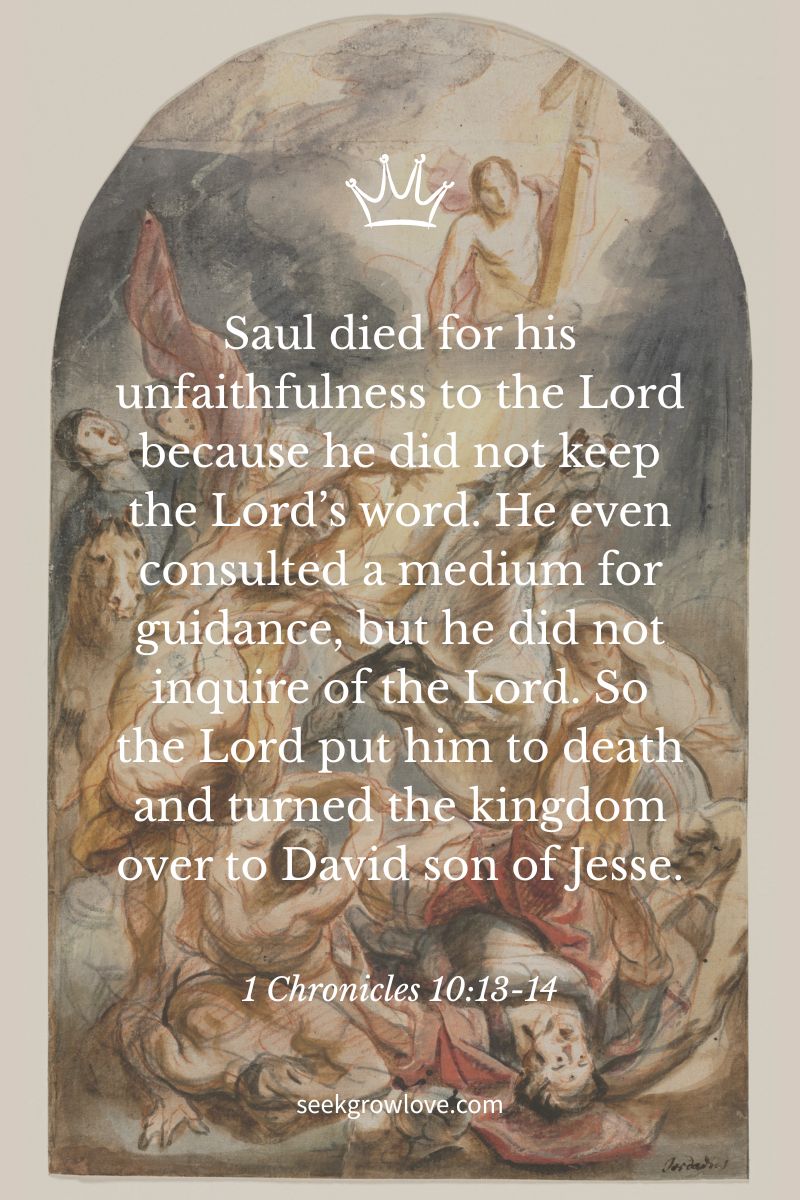
1 Chronicles 10:13-14 sums up Saul’s life: “Saul died for his unfaithfulness to the Lord because he did not keep the Lord’s word. He even consulted a medium for guidance, but he did not inquire of the Lord. So the Lord put him to death and turned the kingdom over to David, son of Jesse.”

The tragedy of Saul affected more than just him. All of his sons fell in the doomed battle against the Philistines – an entire house extinguished. 

Writing this just after Father’s Day, this makes me think about the responsibility we have as leaders. Saul was so concerned with his own pride and recognition that he ultimately sacrificed not only himself but also his family on that altar. As a leader of the people, we were supposed to steadfastly point them to God. Instead, he foolishly acted in ways that ‘seemed right in his own eyes’ but were contrary to God’s law. 

Wherever you are leading – whether in your own homes, your church, or your community – you have a great responsibility to be steadfast. You cannot fall prey to the temptation of allowing the lines between right and wrong to blur in the service of your own desires. You cannot hold the good you feel like you deserve too tightly, ultimately rejecting wholehearted obedience to God. 

Saul’s life is a reminder to look at our own lives and the gravity of our actions. How are they measuring up? May our lives always be characterized by faithfulness, not unfaithfulness like Saul. 

Reflection Questions

  1. Saul’s life is a tragedy, and tragedy is often characterized by a central character flaw that leads to their doom. What do you think is the core sin of Saul’s life? 
  2. As Saul began to grow in influence and power, that tainted his relationship with God. How do you handle influence rightly so that it brings glory to God – not yourself? 
  3. When we think of Saul, we often think of Saul the King, not Saul the Father. How did Saul’s actions affect his family? What lessons can we learn from this about parenting?

Prayer

Lord, 

Help me hold my responsibilities rightly so that they bring glory to you. May I not fall prey to the dangers of pride, but instead lead with humility. Help me to guide those who are following after me to a better relationship with you. 

In Jesus’ name,

Amen.

SGL.2026.CalendarDownload

Faith That Moves…or Fear That Rushes

1 Samuel 13-14Psalm 48Romans 2

-Devotion by Brian K Froehlich – posted on his facebook page on April 11, 2026, where he has been writing and sharing his thoughts as he is reading through the Bible chronologically this year.

There are moments in life where everything seems to hang in the balance. The pressure builds. The clock is ticking. The outcome feels uncertain. And in those moments, what we believe about God is revealed—not by what we say, but by what we do.

That is exactly where we find Saul and Jonathan in these chapters. Two men. Two responses. Two very different outcomes.

Let’s walk through the story together.

Saul has been made king. The people have what they asked for. But almost immediately, we see the tension. The Philistines are gathering. Their army is overwhelming—chariots, soldiers, numbers beyond counting. Meanwhile, Israel is afraid. People are hiding in caves, in holes, anywhere they can find safety.

And Saul is waiting.

He was told to wait for Samuel. Seven days. Wait for God’s instruction. Wait for the offering. Wait for the moment when God would act.

But waiting is hard when fear is loud.

The people are scattering. The pressure is rising. And Saul makes a decision: “Bring me the offering.”

He steps into a role that was not his. He offers the sacrifice himself.

And just as he finishes… Samuel arrives.

The timing is almost painful. If Saul had just waited a little longer.

Samuel’s words cut straight to the heart: “You have done a foolish thing.”

Not because Saul didn’t care. Not because he didn’t want victory. But because he did not trust God enough to wait.

There is a difference between acting in leadership and acting out of fear. Saul’s decision was not rooted in faith—it was rooted in panic.

And here is the lesson for us:

Impatience often looks like responsibility. It feels like we are doing something necessary. But if it steps outside of what God has said, it is not faith—it is fear in motion.

Saul explains himself. “The men were scattering… the Philistines were assembling… I felt compelled.”

“I felt compelled.”

How often do we make decisions based on what we feel in the moment instead of what we know to be true about God?

Saul had clear instruction. But pressure made him rewrite it.

And Samuel tells him something sobering: his kingdom will not endure. God is seeking a man after His own heart.

Now the story shifts.

If chapter 13 shows us fear-driven leadership, chapter 14 shows us faith in action.

Jonathan, Saul’s son, quietly tells his armor-bearer, “Come, let’s go over to the outpost of those uncircumcised men. Perhaps the Lord will act on our behalf.”

Listen to that carefully.

“Perhaps the Lord will act.”

This is not doubt. This is humility. Jonathan is not presuming on God—but he is also not paralyzed by uncertainty.

He continues: “Nothing can hinder the Lord from saving, whether by many or by few.”

That is faith.

Faith is not having all the answers. Faith is knowing who God is, even when the outcome is unclear.

Jonathan doesn’t wait for perfect conditions. He steps forward based on what he knows about God’s character.

And his armor-bearer responds with one of the most beautiful lines in Scripture: “Do all that you have in mind… I am with you heart and soul.”

Faith has a way of spreading. Courage invites courage.

Jonathan proposes a sign. If the Philistines call them up, they will go—trusting that God has given them victory.

And that is exactly what happens.

Two men climb up a cliff, exposed, vulnerable, outnumbered.

And God moves.

They strike down about twenty men. Panic spreads through the camp. The ground shakes. Confusion overtakes the enemy. What began as a small act of faith becomes a sweeping victory.

Here is the contrast:

Saul had the army, the position, the authority—and acted in fear.

Jonathan had none of those things—and acted in faith.

One rushed ahead without God.

The other stepped forward trusting God.

But the story doesn’t end there.

Saul, seeing the confusion in the Philistine camp, joins the battle. Victory is within reach. But then Saul makes another rash decision.

He puts the army under an oath: no one is to eat until evening, until he has avenged himself on his enemies.

Notice the wording—“until I have avenged myself.”

This is no longer about God’s victory. It has become personal.

The result? The army grows weak. They are exhausted. They cannot fully pursue the enemy.

Jonathan, who did not hear the oath, tastes some honey. His strength returns. And he says plainly, “My father has made trouble for the country.”

It is a powerful moment. The one who acted in faith sees clearly. The one who acted in fear continues to complicate the situation.

Later, the people are so famished that they begin to sin by eating meat with the blood still in it—something God had clearly forbidden.

Fear leads to impatience. Impatience leads to poor decisions. Poor decisions lead others into trouble.

And Saul almost puts Jonathan to death for breaking the oath—until the people intervene and save him.

So what do we take from all of this?

First, waiting on God is not weakness. It is trust. Saul’s failure was not a lack of action—it was a lack of trust in God’s timing.

Second, faith does not require certainty—it requires confidence in who God is. Jonathan did not know exactly what would happen, but he knew God was able.

Third, leadership that is driven by fear will always create burdens. Leadership that is grounded in faith will bring clarity and life.

And finally, small acts of faith can change everything.

Jonathan did not have a large army. He did not have a perfect plan. He simply stepped forward in trust.

And God used that.

There may be areas in life right now where the pressure feels overwhelming. Where the timing feels uncertain. Where the temptation is to act quickly just to relieve the tension.

But these chapters remind us:

Do not let fear make your decisions for you.

Wait when God says wait.

Move when faith calls you forward.

Trust that the God who saves “by many or by few” is still at work.

And remember—He is not limited by your resources, your position, or your circumstances.

He is looking for hearts that trust Him.

Reflection Questions

  1. Brian wrote, “Impatience often looks like responsibility. It feels like we are doing something necessary. But if it steps outside of what God has said, it is not faith—it is fear in motion.” Can you think of a time when you were acting with fear in motion? What was the outcome? What might have been better?
  2. “How often do we make decisions based on what we feel in the moment instead of what we know to be true about God?” What do you know to be true about God regardless of your feelings?
  3. What can you do during the difficult waiting times?
  4. What might God be calling you to do to move forward in faith? Is there another person who could help add courage and faith to this forward, God-honoring movement? Pray about it. Find out what God thinks.

Prayer

Dear Heavenly Father, You are a God of power, righteousness, and perfect timing and direction. Help me wait well in waiting seasons and courageously move in faith to follow Your lead and help me know the difference. I confess the times my fear, impatience, and lack of faith have led me away from You and what You have said is best. Help me honor You in my waiting and in my moving.