In today’s passage in Galatians, 5:23, we read of the rest of the fruits of the spirit: gentleness, self-control; against such things there is no law. (NASB 1995) The spirit of self-control is a quality that would have served David well in today’s passage in 2 Samuel 11. What can we learn from the story of David? Sin can have a domino effect. One sin can easily lead to another. David’s first sin was probably just looking at Bathsheba longingly while she was bathing. Jesus tells us that for a married person to even look upon someone else with lust is equivalent to adultery. Ideally, David should have looked away immediately once he realized she was not clothed. We can probably safely assume his self-control did not kick in at that moment to prompt him to quickly avert his gaze, which then led to feelings of lust multiplying in him. Then, as the story goes on, we see David actively pursuing her, impregnating her and then frantically trying to figure out how to clean up his mess. David’s struggle with temptation is obviously not unique. We only have to look around to see we have many temptations competing for our attention. Pornography is more accessible than it has ever been and has been named as a major public health crisis due to the impact on individuals and their marriages and families.
Abiding in the living vine is our best defense against the onslaught of temptation that we face on a daily basis. Self-control is not easy to come by naturally because temptations are considered to be temptations because they are powerful and tap into our carnal desires and stimulate our senses. Whether it’s overindulging in alcohol or food, taking drugs that aren’t prescribed to us or abusing prescription drugs, sexual sin, etc., temptation comes in many forms. Thankfully we don’t have to rely on our own strength to resist them. Abiding in Christ helps us to cultivate that fruit of the spirit that includes self-control. Of course, like any plant, a vine must be tended to. We cannot ignore it and expect it to thrive. It is a choice that must be made daily, sometimes hourly, at times even minute by minute, to abide in Christ.
-Kristy Cisneros
Reflection Questions
Besides in this chapter, where else have you seen sin’s domino effect in action?
What temptation grabs your attention and pulls you away from where you should be? Where does it lead to next?
What does it look like when your temptation wins over your lack of self-control? What does it look like when your self-control wins over temptation? How do you feel in each instance? How are others affected in each case? What do you imagine God is thinking or feeling in each scenario?
What specific actions can you take this week to abide in Christ more and more? What will it cost you? What will the benefits be?
Proverbs chapter 12 has some very interesting proverbs that can walk us deeper into understanding the wisdom and knowledge that begins with the fear of Yahweh (cf. 1:7; 9:10). One of those proverbs is 12:16, which says, “The anger of a fool is known at once, but a prudent person conceals dishonor.”
Picking up on the conjunction “but” that connects the two lines together, this suggests that the parallelism in this proverb is likely antithetic, meaning the two lines are expressing opposing ideas. In the first line, the main idea is that the “anger of a fool” is readily apparent (i.e., “known at once”). The question we always need to ask ourselves when reading wisdom literature, especially Proverbs, is, “How is this proverb true?” In other words, “What circumstance could this proverb be accurately describing?”
Have you ever known someone who had a short temper? And what was the characteristic behavior of this individual that earned them this reputation? Probably they got angry easily, right? The first line is identifying that a fool is someone who has no control over their temper and quickly erupts at the smallest provocation. They are a “hot head” just waiting to blow. Given the wrong remark or facial expression from others, their attitude can turn sour in an instant and their anger flares up like a barrel fire.
On the contrary to this foolish behavior, the “prudent person,” who exercises self-control and discipline and has a “cool head” about them, “conceals dishonor.” Thus, unlike the fool that vents their anger immediately, unable to rule their emotions but makes an open show of their contempt, the “prudent person” covers over, overlooks, or does not give attention to the dishonorable actions of others. They do not respond in a like manner with unrestrained, emotionally charged reactions.
Thus, the point of the proverb is that a wise person recognizes the best way to handle criticisms or insults and does not react impulsively or irrationally by stooping to meet the fool at their level.
Have you ever just wanted to let someone have a “piece of your mind”? I sure have, and I bet you have too. But the self-restraint required to not vent one’s frustration or anger is part of living with wisdom. Did you know that learning how to rule over your emotions was exercising godly wisdom? It may not “feel” as good in the moment as it would if you yelled at the other person, but wisdom is not about what “feels” good—it is about what is good and right to do that glorifies Yahweh and aligns with his intention for how life is best lived. Therefore, the wise person must deny the temptation to give in to destructive emotions, like uncontrolled anger, that would inflict harm on others. Wisdom teaches how to build strong, healthy relationships and ways of interacting that promote peace and godliness. And that entails being able to keep one’s emotions in check.
-Jerry Wierwille
Reflection Questions:
Give some examples of how temper can interfere with living a life that glorifies Yahweh. Any come to mind when you were the one with the hot head? How could it have played out differently with more self-control?
How can you work on more self-control and discipline? Ask Yahweh, too.
These are the words of Johnny Cash in his iconic song, Ring of Fire, that hold true for many, as many people have a desire for some form of romantic love that can lead to sexual intimacy. Our society has a pretty wide range of views on what practices are acceptable or not to fulfill that desire for sexual intimacy. Paul states that, “It is because of the temptation to sexual immorality that a man should have his own wife, and each woman her own husband,” (1 Corinthians 7:2 ESV). Marriage is the solution to the desire of sexual intimacy in Paul’s eyes.
Throughout scripture, it is a very constant concept that sexual intimacy is to be experienced between a husband and wife – nothing more, nothing less. Paul urges married couples not to deprive each other, so that our lack of self-control doesn’t lead to sexual immorality. I encourage both husbands and wives to fulfill their spouses’ sexual desires to help steer them clear of sexual immorality. If you need some extra inspiration and motivation, you can read through Song of Solomon.
For those who are not married but burn with passion, I pray that you are able to exhibit self-control. Remember the words of Paul in the previous chapter as well: “Flee from sexual immorality,” (1 Corinthians 6:18). Paul does not encourage you to stand firm in the fight against the temptation to sexual immorality. Rather, Paul encourages you to FLEE! Be aware of your triggers and run away from them!
For those who are not married and aren’t “bound by wild desire”, I encourage you with the words of Paul: “To the unmarried and the widows I say that it is good for them to remain single as I am,” (1 Corinthians 7:8 ESV). The unmarried person does not need to fret about how to please their spouse. They can spend all of this attention that many spend on pleasing their spouses, and the unmarried can devote it all to God. What a blessing!
Whatever camp you find yourself in, whether you are married, single with passion, or single with no passion, I hope you are able to dig nuggets of invaluable information from this chapter about marriage. When in doubt, you can turn to 1 Corinthians 7 for questions about biblical principles regarding marriage and the absence of marriage.
-Kyle McClain
Reflection Questions
What is your current situation? What can you do now to make the most of your situation? How will you strive to please God in your situation?
Married or unmarried, how can you flee from sexual immorality?
What do we learn about God in our Bible reading today?
“His divine power has granted to us all things that pertain to life and godliness, through the knowledge of him who called us to his own glory and excellence, by which he has granted to us his precious and very great promises, so that through them you may become partakers of the divine nature, having escaped from the corruption that is in the world because of sinful desire. For this very reason, make every effort to supplement your faith with virtue, and virtue with knowledge, and knowledge with self-control, and self-control with steadfastness, and steadfastness with godliness, and godliness with brotherly affection, and brotherly affection with love. For if these qualities are yours and are increasing, they keep you from being ineffective or unfruitful in the knowledge of our Lord Jesus Christ. For whoever lacks these qualities is so nearsighted that he is blind, having forgotten that he was cleansed from his former sins. Therefore, brothers, be all the more diligent to confirm your calling and election, for if you practice these qualities, you will never fall. For in this way there will be richly provided for you an entrance into the eternal kingdom of our Lord and Savior Jesus Christ.” (2 Peter 1:3–11 ESV)
We have great and precious promises that have been made that will enable us to become partakers of the divine nature! As Jesus put on a new nature in his resurrection from the dead, so shall we when through faith, we endure through life’s many challenges and inherit the promise of the coming Kingdom of God.
Hebrews 11:1 says that “…faith is the assurance of things hoped for, the conviction of things not seen.” As we have faith that God will restore all things (Acts 3:21), upon our faith we must add virtue: meaning good quality of life or uprightness – not simply believing but living out our lives as something that reflects the nature of God’s goodness, justness, and righteousness. After believing and living a changed life, we are to add knowledge to that; we should always be striving to learn from God’s inspired word and learn from his spirit as it is active in us… And more than that, seek after his spirit that we might become more in line with his will and come to a greater understanding of its importance and how beneficial it is to us to walk in his ways.
Following the call to add knowledge, we encounter again the call to be self-controlled! It really does seem that much of what we read in scripture hinges on self-control and that circles back to our need to not stifle the spirit in our lives. If one of the elements that the fruit of the spirit brings forth in our lives is self-control, then we ought to do whatever it takes to drive away any behaviors that might cause God’s spirit to depart from us (Judges 16, 1 Samuel 16). Self-control allows us to endure – to stay on the course – as Paul might say, “to run the race”. We have to endure through all of the challenges and temptations that life throws at us, and we must allow the motivation of our hope, our uprightness, and the self-control that we are enabled to have through God’s spirit carry us through.
As we endure, we ought to have a reverential feeling or devotion to God, that’s what the Greek work translated godliness indicates. As we experience God’s goodness and see how His spirit works in us, we should feel more and more awe and reverence to our creator… After all, He put the plan into place that leads us into a life that transcends the brokenness that sin imparts on our lives – even though we sin and are affected by sin, God’s directives lead us onto a path that (through Jesus) casts that sin aside and draws us into community with him.
And as all these things are ingrained into our life, the part that affects others the most is the cherry on top… We are to have brotherly affection (love) as a defining characteristic in our lives! Love and care for one another as believers will lead us to speak into one another’s lives and help us when we hit rough patches. Even the most spiritually minded people hit dark periods in their lives (google the dark night of the soul). If we love our brothers and sisters in Christ, we will take the time to come alongside them, to care for them, to call them out, to admonish and encourage – brotherly affection means being intimately involved in the lives of our faith family – not being apathetic or half-hearted. We need to invest in each other as Christ has invested in us through his sacrifice (sometimes we must be self-sacrificial).
These qualities keep us from being ineffective witnesses and fruitless workers. We must be bearing the fruit of the word implanted in us (James 1) and strive to be effective ministers to the lives of those who are hurting and struggling. Peter says that whoever lacks these qualities is so nearsighted that he is blind! Yikes… lacking these qualities as I read this means that we cannot see beyond ourselves, and that it a tremendous problem when one of our chief goals is to preach the gospel to all creation.
If we take these qualities to head and practice them diligently it says we confirm our election (or being chosen out) into beneficiaries of the grace of God. Also, it says if we practice these things we will never fall. So, practice these things so that you may have entrance into the eternal kingdom of our Lord and Savior Jesus Christ (v11).
-J.J. Fletcher
Reflection:
1. Think about how Jesus exemplified all these characteristics listed in verses 5-7. If he had not exemplified all these things, would he have had the wherewithal to endure through his father’s plan of salvation through him? How can we expect to live exemplary lives if we do not take these characteristics to heart.
2. Think about the first 6 items listed (faith, virtue, knowledge, self-control, steadfastness, and godliness) and the final one: brotherly affection/love. What do the first 6 produce without the 7th? We’re designed (as individuals and as a church body) to be in community, how might we be rendered fruitless and ineffective if we excel at the 6, but lack the 7th?
At the beginning of chapter four Peter says to “arm yourself with the same way of thinking” aligning this directive with Jesus suffering in the flesh. While Jesus’ suffering was likely to exceed what these Christians endured, they were still facing a culture that might ostracize, if not outright persecute or kill them.
Peter points out distinctions in how the gentiles live according to the flesh (perverting many things that God intended for good), and how we as believers are to pursue the will of God – this means among other things giving up things that might feel good or make us feel like we belong.
We’ll home in on what Peter writes in verses 7-11:
“The end of all things is at hand; therefore be self-controlled and sober-minded for the sake of your prayers. Above all, keep loving one another earnestly, since love covers a multitude of sins. Show hospitality to one another without grumbling. As each has received a gift, use it to serve one another, as good stewards of God’s varied grace: whoever speaks, as one who speaks oracles of God; whoever serves, as one who serves by the strength that God supplies—in order that in everything God may be glorified through Jesus Christ. To him belong glory and dominion forever and ever. Amen.” (1 Peter 4:7–11 ESV)
Considering the coming kingdom (which is immanent, but we don’t know when it will come): Exert Self-Control! Many times, we see this attribute called for in the life of believers (at least 18 times in the ESV). Looking in the letter of James (which I preached from yesterday), lack of self-control can lead to self-deception. When we allow our thoughts to be clouded by worldly things or self-centered behaviors, we are going to miss what God would have us do. By being sober (or clear) minded we can think critically, and we need to think clearly so that we can be effective in our prayers. Jesus gave us a model by which to structure our prayers, but our prayers are not meant to be mindless or rote… We need to be looking at things through the lens of God’s spirit, which allows us to see things that our physical eyes cannot see. Think back to 1 Peter 3 where it says a man should live with his wife in an understanding way as not to have his prayers hindered – the way that we think, live, and act has a direct impact on how we pray and the effectiveness of our prayers.
We’re instructed to love one another earnestly, because love covers a multitude of sins. (Greater love has no one than this, that someone lay down his life for his friends. John 15:13). “…in the face of extreme social hostility, love will be necessary for spiritual survival. For Peter the primacy of love is accompanied by a qualification, and this qualification is a partial citation of Proverbs 10:12 similar to James 5:20—’love covers over a multitude of sins,’ rather than magnifying the faults of others. After all, love is patient and doesn’t keep a record of wrongs (1 Corinthians 13:4, 5)” (J. Daryl Charles, “1 Peter,” in Hebrews–Revelation, vol. 13 of The Expositor’s Bible Commentary Revised Edition).
How does the Church expect to thrive if we let piddly little things (or even larger disagreements) get in the way of caring for each other? How are we to expect to overcome the world through Jesus if we don’t exercise with others the grace that we have been shown (we all kind of stink at times, to put it mildly)?
We need to show hospitality in a world that that is oft inhospitable to Jesus’ way of living. If we’re inhospitable to other believers, they might find hospitality in places that will draw them away from the grace of God. We shouldn’t grumble when we have an opportunity to be hospitable, but rather see it as an opportunity to be the hands and feet of Jesus (Genesis 12 says Abraham was blessed to be a blessing, and through grace and mercy we’ve also been blessed to be a blessing as well).
In everything we do we need to do so viewing ourselves as representatives of God, as ambassadors of the kingdom, and imitators of Christ Jesus (Philippians 2:3-8).
-JJ Fletcher
Reflection Questions
How does my life look like the life of Jesus and how does it look different?
How does hospitality with fellow believers prime me to be hospitable to those who I disagree with?
Am I doing well at being self-controlled? What are my biggest obstacles to living in this way? Who can I ask for help or be accountable to help me in this endeavor?
A few years ago the term YOLO became popular and used as a reason to partake in some very reckless behavior. If you’re not familiar with the acronym, it is an abbreviation for You Only Live Once. It drives me bananas when I observe others taking unnecessary risks because of this attitude.
I admit that I tend to be cautious. I’m not a huge risk-taker. I prefer to know possible outcomes before making a decision. I have the mindset that it’s because I only live once (this side of God’s Kingdom) that I want to be prudicious with my choices.
As I approach the half-way mark of life, I am even more aware of how precious my time, energy, resources and relationships really are. Knowing and respecting my priorities helps me make decisions that align with the kind of life that I believe God is calling me to live.
As we continue through the letter to the Ephesians, Paul is instructing the new believers in the local church to evaluate their life choices. The way that they used to live is no longer in alignment with a holy lifestyle. To live carelessly and without regard to the purpose for which they were saved is a waste of time.
We too need to be self-controlled and alert. We need to know who we are in Christ and make decisions accordingly. Living in these times requires us to use our resources of time and energy wisely so that we can make an impact and a difference for the Kingdom of God.
Sometimes, this way of living does mean that we will take risks and might look foolish to the world’s way of thinking. But if we are obedient to God, those risks will pay huge dividends because others will have an eternal benefit.
So as you go about your day, your week, your month, and even the rest of this year, be strategic; be careful; be wise about how you live your life in Christ.
Once again, I’ll ask:
What should you continue doing?
What should you stop doing?
What should you start doing?
-Bethany Ligon
Questions for Reflection and Discussion
Do you consider yourself to be living life wisely? What adjustments might Paul suggest to you?
What should you continue doing? What should you stop doing? What should you start doing?
The Smokey Bear Wildfire Prevention campaign started in 1944, and in 1947 the slogan that is familiar to many came to fruition; Only You Can Prevent Forest Fires (updated in 2001 to Wildfires). It is the longest public service campaign in the United States’ history. A campaign was derived to help the prevention of forest fires. Years of education gave the ownership to the general public to be more careful and to care for the world around you. The catchphrase reflects your responsibility.
Our family does not do “traditional” camping (unless a cabin with running water or hotel room is traditional camping to you). This doesn’t mean that we don’t love a good campfire. This summer we spent some time in the Upper Peninsula of Michigan at our family cabin. The week was filled with cleaning out the overgrowth of trees and brush on the property, which meant a BIG campfire. Our burn pit is close to the lake, but is really in the middle of the woods (like most campfires). Being in the heart of the woods means being surrounded by a plethora of “fuel” if a fire is left to its own devices. So, before we left the cabin or went to bed, we had to make sure that the fire was out.
The wisdom from Proverbs 26:20 resonated with me. It says, “Without wood a fire goes out; without a gossip a quarrel dies down.” You see, a fire is only going to burn if it is fed. Our tongue is the fire and when you remove gossip or the “fuel,” it dies down. The best way to end (avoid) a quarrel? Keep your mouth shut! Don’t get involved in what doesn’t concern you. Don’t take up offenses of others and don’t be easily offended. Don’t talk about what you don’t know and be very slow to talk about what you do know. Practice self-control in the moment and show Christ-like love at all times. Don’t be the fuel for the fire and the fight!
James 3:5-6 says “Likewise, the tongue is a small part of the body, but it makes great boasts. Consider what a great forest is set on fire by a small spark. The tongue also is a fire, a world of evil among the parts of the body. It corrupts the whole body, sets the whole course of one’s life on fire and is itself set on fire by hell.” This just reinforces that our small tongue can do big damage.
Don’t fuel the flame of gossip and cause fights, only you can prevent wildfires of your mouth!
Have you ever heard young boys arguing? It may begin as an argument about which is faster but many times it will end up with the two boys shouting something to the effect of, “My dad is stronger than your dad!” Often times we see our fathers as a symbol of strength, but what does strength look like? Is it a bodybuilder with bulging muscles? Is it a sprinter with unbelievable speed? These can be measures of physical strength but the strength that we are called to display is more than just strength of body.
The world tells us that a strong person should “get mad and fight like a man” God tells us through James to control our speech and even to control our anger. In chapter one he said, “Be quick to hear, slow to speak, and slow to become angry”. James 1:26 tells us “If anyone thinks himself to be religious, and yet does not bridle his tongue but deceives his own heart, this man’s religion is worthless” In Chapter 3 he says that anyone who does not stumble in what he says is a perfect man, I can tell you I am far from perfect. He goes on to explain how such a small part of our bodies can control and lead so much of our life. When I take a flight I often sit near the wing and will watch the flaps as the pilot makes adjustments to control the aircraft. It always amazes me to see that such a small change, in a relatively small piece of the plane, can determine the altitude of such a massive machine as it carries me through the air at hundreds of miles per hour. James 3:5-8 says
5 So also the tongue is a small part of the body, and yet it boasts of great things. See how great a forest is set aflame by such a small fire! 6 And the tongue is a fire, the very world of iniquity; the tongue is set among our members as that which defiles the entire body, and sets on fire the course of our life, and is set on fire by hell. 7 For every species of beasts and birds, of reptiles and creatures of the sea, is tamed and has been tamed by the human race. 8 But no one can tame the tongue; it is a restless evil and full of deadly poison.
Although the tongue is such a small part of our body it is what we use to express our thoughts and emotions to those around us. Jesus even said that our words are the overflow of our heart. Does that mean when we are sarcastic and disrespectful to those around us that is what is truly in our heart? That can be a disturbing thought sometimes. Perhaps we should use our words to view the contents of our heart.
When I lived in the South I would hear someone say something inappropriate and another person would ask, (insert your best southern accent) “You kiss yo momma with that mouth?” James says something similar but with even more force. He says, “With it we bless our Lord and Father; and with it we curse men, … these things ought not to be this way.” We should seek to honor both God and people with our words.
We should be consistent with our thoughts and actions.
We should be consistent in the strength of self-control.
There is a particular “truth” that is extremely pervasive in our culture, the news, social media, etc. This “truth” is that you are the sole determiner in what you decide to do with your body and that no one else has the right to tell you what you can or can’t do with it. If you want to tattoo your whole body do it. If you want to fill your body with botox and recreate your image through plastic surgery have at it. If a woman wants to get an abortion, how dare anyone tell her she cannot. If you want to sleep around with different people in the name of finding yourself and wanting non-committal sex, more power to you. We are bombarded with messages everyday about how the individual is the authority of their body. There’s a problem though; this is a lie.
The truth is that humans are not the sole authority over their bodies, God is. The reason he is the authority is because he is the creator of our bodies (Psalm 139) and as disciples of Jesus we are to honor and glorify God and Jesus in our body. We are to subject our bodies to the Lordship of Jesus Christ and use our body for the glory of God and Jesus. Now there are many ways we can do this but for today we will look at two ways in which we can worship God in our body.
Food
Sex
Food is a particular problem in America. We can eat food whenever we want and eat however much we like. The problem with this is that many Christians, along with Americans, are overweight and unhealthy. God created food to be good and for us to enjoy. The problem is when we indulge too much in food and we hurt our bodies with disease and premature death. The Bible warns against gluttony (Prov. 23.21, Philippians 3.19). When our bodies are slowed down by being overweight, too tired, and fighting disease the ministry God has given us is hindered. The remedy to being in control of food and honoring God with your body is self-control. Self-control is a fruit of the spirit (Gal. 5.22-23). Let us pursue self-control when it comes to eating. Let us pursue self-control when it comes to the quantity and quality of the food we eat. When we do this we honor and love God with our body. Your body is for more than just to take pleasure in food it is to worship God and minister to others.
A second way to love and honor God with our body is to obey God in his design of sex. Again God created sex to be good but only within the parameters that he set up. These parameters are the marriage union between a husband and wife. Whether you are married or single, any person can use sex outside of God’s will. Instead of listing activities that fall outside of God’s design for sex, I’ll speak positively to God’s will for sex. It really only comes down to two things:
A husband and wife are to be sexually fidelitous
A single person is to be abstinent in their body and mind until marriage
God states plainly in I Thessalonians 4.3, that his will for his people is to abstain from sexual immorality. Participating in sex the right way results in us loving and worshipping God with our body. As Paul states in his letter to the Corinthians:
“Do you not know that your body is a temple of the holy spirit which is in you, which you have from God, and that you are not your own? For you have been bought with a price: therefore glorify God in your body” – I Corinthians 6.19-20
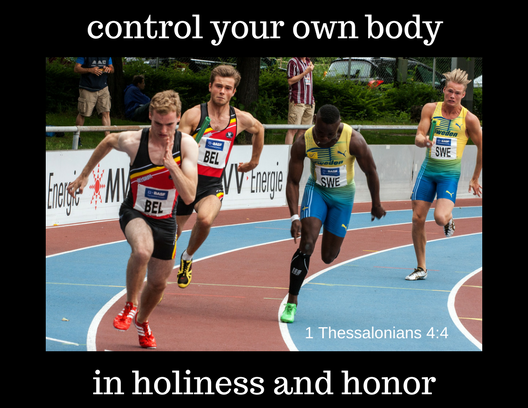
1Th. 4:4 that each one of you know how to control your own body in holiness and honor, 5 not with lustful passion, like the Gentiles who do not know God;
We wrote yesterday that the most important thing in making moral decisions is to know what God has said. The second most important is to exercise self-control. The first has an external source — what has God said? The second is internal — What does it mean to have self control?
Not everyone agrees with me, but I believe that in life, after being true to God, we must be true to self. That’s more important than anything else. That doesn’t mean, “if it feels good, do it.” the mantra of my generation, but rather, what is best for me as a one of God’s creation. Paul writes about moral decisions in these terms in 1 Corinthians:
1Cor. 10:23 “All things are lawful,” but not all things are beneficial. “All things are lawful,” but not all things build up.
This world says that we can do anything. Can we stop and ask, “What is actually good for me?”
I have worked with many people who have practiced the world’s view of sexuality, i.e., “I can do anything I want to do.” I truly love people who have been caught up in sexual sin, still see them as people for whom Jesus died, but I cannot say that their life choices have been good for them. Their choices have made them miserable, sometimes have even shortened their lives.
Making good moral decisions includes respecting ourselves and not hurting ourselves through bad choices.






 Seek Grow Love