A Vibrant Conversation with the Living God

Jeremiah 29-13

Closing (Saturday)


It’s been another fun week of digging through scripture to hear the word that God is speaking to us today. When we dive into the Word and start investigating the trail of inspiration and hope that it has left throughout the years, we are engaging in a vibrant conversation with the living God. We are engaging the One who is alive and active still. This week, our look at Mark 9-16 has brought out a number of themes that I’d like to just tie together quickly for us.

First, the gospels are texts that were written to be heard and to be engaged with as a whole – much like a novel. Like any good author, Mark is weaving together numerous strands of thought and repeating patterns for us to pick up on as we engage with the story of Jesus’s life. Knowing this, we can bring together the various things that Mark is trying to teach us.

In Mark 9, we are encouraged to acknowledge and embrace the places where we question and have doubt. It’s a part of the life of faith. We are pushed to not just accept our unbelief, but to express it and call out for a grace that will see us through it. In Mark 10, the request for help is answered. With the end of the messianic secret, Jesus restores sight and illuminates the darkness (the darkness of unbelief). In Mark 11 & 12, Jesus starts turning over tables. He challenges injustice and urges us to do the same. We are called to use our new sight to break the cycles of brokenness in the world and give all that we have to aid those who are in need. In Mark 13 & 14, we are urged to be on the alert. To remain vigilant in our new sight and be prepared for the suffering that will come our way. In Mark 16, Mark urges us to new life beyond suffering and tells us to go out into the world to find where Jesus has already gone and is currently waiting.

Mark’s gospel lays out a call to life that is tangible, realistic, and filled with hope for believers. My hope for you is that your life is filled with as much grace and love as this gospel commands.

-Graysen Pack

Still Seeking the Next Big Thing?

PROVERBS 30

Proverbs 30-8

Before writing this post, I did some research about other commentaries and devotionals from Proverbs 30.  Many writers have speculated about the author of this passage, whether Agur is a pseudonym for a known author or what wisdom this author may possess.  Most of the devotionals focus on verses 5-6: “Every word of God is flawless, he is a shield to those who take refuge in him.  Do not add to his words or he will rebuke you and prove you a liar.”  These verses tell us that we can confidently put our faith in the Lord and warn against tampering with His Word, the Bible.  2 Timothy 3:16-17, Numbers 23:19, Deuteronomy 12:32, and Revelation 22: 18-19 all reinforce these 2 verses in Proverbs 30.


When I read this chapter, however, I did not latch onto those 2 verses like most of the commentaries and devotionals I read.  I was drawn to verse 8.  “Keep falsehood and lies far from me; give me neither poverty nor riches, but give me only my daily bread.”  As a whole, our society is never satisfied.  We are always seeking something more.  I remember talking about marriage in a psychology class, and the professor was explaining how studies have shown that one reason marriages tend to fail more often now than they used to is often because one of the spouses is seeking something more, whether that be a more attractive partner or a partner who makes more money or whatever qualifications are deemed important, rather than being content and wholly loving the current husband/wife.  We are never satisfied, always looking for the next-best thing.  Verse 8 asks the Lord for neither poverty nor riches, only what is needed for the day.  The writer isn’t seeking more.  He’s seeking to be satisfied in the Lord.  We’ve all read that it is easier for a camel to pass through the eye of a needle than for a rich man to enter the Kingdom of God (Mark 10:25), and verse 9 reinforces that someone who is “full” is quick to deny the Lord.

Proverbs 30-9a

Though society tells us that we always need the newest and next-best thing, the newest iPhone, the bigger tv, the prettier woman or more handsome man—the Bible teaches us to be content with what we are given.  Our daily bread is enough.

-Megan Bryant

Converse with the Almighty

bible

Saturday’s Weekly Recap with Graysen Pack

This week we’ve walked through another six chapters of Proverbs and found words that, although written thousands of years ago, still speak to the persistent struggles of human existence.  Answers to guide us seek the wealth that God promises, to join God’s work as he defends the orphaned and poor, to earnestly engage in honest community, to be aware of the emotional strife of ourselves and others, and to use our words to build a church of sincerity.


It can be easy to forget that even when we read the oldest parts of the Bible, the words are still alive and active.  And we don’t really read Scripture, but instead engage in a conversation with it.  It isn’t a professor lecturing at us from the front of a large classroom.  Instead, it is a dialogue that speaks to who, where, and when we are.  The words of God are both alive in the history of Israel and the church as well as our lives today.


As you continue to read through the Word of God this year, remember that you are entering a conversation that will speak to your life and the life of the world today.

What a Powerful Tongue You Have!

Tuesday

prov 18 21

Today’s reading is Proverbs 18.

The tongue has the power of life and death, and those who love it will eat its fruit. Proverbs 18:21

Have you ever thought about your words bringing life to someone else? Yet, we see this throughout the scriptures. God uses human beings to communicate who He is. God used human beings to speak and record His commandments and instructions. The Jews were entrusted with the very words of God (Romans 3:2).

Sometimes we may not realize how important our words can be. We certainly don’t want our conversations to make us gossips, quarrelsome, and fools (We don’t want our mouths to invite a beating.) But, as the children of God, it goes beyond avoiding bad conversations and sharing God’s message. God has entrusted us with the Gospel Message.  Good News of who He is, Good News of His Son Christ Jesus and Good News of the Coming Kingdom. We are given the opportunity to communicate that message so we can connect others to God through His Son.  God entrusted Jesus with the message that everyone needs to hear.

Christ said to his disciples in John 6:67-68, “You do not want to leave too, do you?” Jesus asked the Twelve. Simon Peter answered him, “Lord, to whom shall we go? You have the words of eternal life.”

We sometimes forget that our study of the scriptures is important because we are receiving a message from God, a message that we can share with others.  I want to make sure that I get the message straight and the story right because this message “has the power of life”.

By Rebecca Dauksas

(Photo Credit: http://puttingonthenew.com/2013/11/10/proverbs-1821/)

Just Start – Proverbs 15

Proverbs_15-3

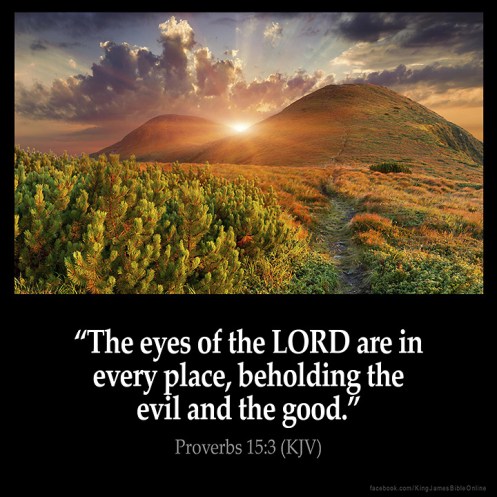
Today’s devotion is on Proverbs 15.  When I look through all of these verses I think wow this chapter has a lot of verses (33 to be exact).  Sometimes our ‘want to’ apply wisdom is met with an overwhelming fear of where do I start?  What do I do?  If you are reading this devotion you have started in a good place.  its always good to start with the word of God.  You can’t go wrong with Proverbs (the book of wisdom). 

But do these verses apply to you today?  They do.  Here’s how you can get the most out of Proverbs.

1.  There is the setting in which they were spoken; this is largely the context of the young men in the royal court of the king.

2.  There is the setting of the book as a whole and how its teachings are to be understood in light of the rest of Scripture. For example, there is much to be gained by comparing the wisdom Solomon taught with the wisdom Christ personified.

3.  There is the historical context in which the principles and truths draw on illustrations from their own day.

A final area of challenge comes in understanding that proverbs are divine guidelines and wise observations, i.e., teaching underlying principles (15:27) which are not always inflexible laws or absolute promises. These expressions of general truth (15:22) generally do have “exceptions,” due to the uncertainty of life and unpredictable behavior of fallen men. God does not guarantee uniform outcome or application for each proverb, but in studying them and applying them, one comes to contemplate the mind of God, His character, His attributes, His works, and His blessings. All of the treasures of wisdom and knowledge expressed in Proverbs are hidden in Christ (Col.2:3).

When you study the proverbs in this way it really helps you understand just what God is trying to say to you.  But more than that which verses resonate with you?  Where are you lacking?  Remember a timely word is delightful (15:23).  I hope these verses meet you where you are at this week.  God bless and I am praying for you.

Pastor Andy

Who Are You Walking With?

Proverbs 13

He who walkswith the wisegrows wise,but a companionof foolssuffers harm.Proverbs 13-20

The recurring promise of Proverbs is that generally the wise (the righteous who obey God) live longer (9:11), prosper (2:20–22), experience joy (3:13–18) and the goodness of God temporally (12:21), while fools suffer shame (3:35) and death (10:21). On the other hand, it must be remembered that this general principle is balanced by the reality that the wicked sometimes prosper (Ps. 73:312), though only temporarily (Ps. 73:17–19). Job illustrates that there are occasions when the godly wise are struck with disaster and suffering.
So if the two major themes which are interwoven and overlapping throughout Proverbs are wisdom and folly. Wisdom, which includes knowledge, understanding, instruction, discretion, and obedience, is built on the fear of the Lord and the Word of God. Then folly is everything opposite to wisdom.

The portrait of the fool emerges as a contrast to the one who seeks the wisdom of YHWH.

  • In everything the prudent acts with knowledge, but a fool flaunts his folly. 13.16

The fool is an undisciplined scoffer of God and His wisdom. The fool in his folly is reckless in his anger — worse than a Momma bear on the prowl for her cubs! Even worse, he is proud of his foolishness, wearing it as a badge of honor, unaware that the cycle of folly is destroying him each time he returns to it.

Contrast this with the 60+ references to “the wise” in Proverbs alone. Again, this is far from an exhaustive list, but the character of the wise emerges with even a quick look from Proverbs 13.  When you read Proverbs 13 you will see fools and wise in the context of money, parenting, friends, the list goes on like a warning sign or a blaring horn warning you of danger.  Take a look at some of the examples:

  • 11 Wealth obtained by fraud dwindles,
    But the one who gathers by labor increases it.
  • A wise son accepts his father’s discipline,
    But a scoffer does not listen to rebuke.
  • 20 He who walks with wise men will be wise,
    But the companion of fools will suffer harm.
  • 14 The teaching of the wise is a fountain of life,
    To turn aside from the snares of death.
    15 Good understanding produces favor,
    But the way of the treacherous is hard.

The wise man exercises discernment and self-control, a distinct alternative to the reckless behavior of the fool. Wisdom is also the measured way of life, guarding against impulsiveness by counting the cost of one’s actions. He who is wise seeks counsel, is quick to listen, and is thoughful in his speech.

Which one are you?

Read Proverbs 13 and decide for yourself who you are walking with.

-Andy Cisneros

The Fruit of Deception

Hosea 10-14

hosea 10

Tuesday, April 11

But you have planted wickedness,
    you have reaped evil,
    you have eaten the fruit of deception.
Because you have depended on your own strength
    and on your many warriors.     (Hosea 10:13)


I don’t have a lot of upper body strength.  Never have.  The rope climbing unit in gym class was the worst.  I had one teacher who thought it might help me to start higher up the rope, so he lifted me onto his shoulders and had me grab on.  There I hung.  (And not for very long.)  Same weak arms, just higher up.  So depending on my own strength isn’t going to happen.

I also do not have any soldiers at my disposal, warriors to send out to do my bidding.  Would be cool, but I imagine none of you do, either.  So I guess we can overlook this verse, yes?

Unless….

Unless there are other things that we might be tempted to depend on.  Things we might rely on above God and His word.

A professor, maybe?

Scientists?

A boyfriend or girlfriend?

Your feelings?

Who is wise? Let them realize these things.
    Who is discerning? Let them understand.
The ways of the Lord are right;
    the righteous walk in them,
    but the rebellious stumble in them.  (Hosea 14:9)

Are you stumbling on the Word of God?  Do you have trouble reconciling it with what you are being told or what you “know”?

Maybe you have “eaten the fruit of deception”?

I pray regularly that if my understanding is wrong, that God would correct me.  I ask Him to show me where I’m wrong.  Sadly, though my arms are weak, my ego is strong, and it’s been hard to admit that at times I’ve been mistaken.

Make that your prayer today.  Ask God to show you if you’ve been deceived.  And be willing to act on what He shows you.

-Susan Landry


3 Steps

Isaiah 17-21

isa-19

Friday, February 10

In today’s reading, we have pretty much just oracles against other nations.  An oracle in the Old Testament is simply the Word of God.  Therefore, the different oracles about the separate nations are just the words of God, and the audience of the book of Isaiah is the people of Judah.  That means that these oracles are words from God to Judah concerning other nations.

As we have been reading, these oracles concerning other nations are usually more of a judgmental tone.  Often, God states that he will take action against these nations.  This may lead to the people turning to God, and that is present in Isaiah chapter 19.  Chapter 19 contains the oracle concerning Egypt.  In this oracle, God states he will take action for their poor behavior.  As a result of God’s action, “the LORD will make himself known to the Egyptians, and the Egyptians will know the LORD in that day and worship with sacrifice and offering,” (Isaiah 19:21).  Basically there are three steps happening here: The Egyptians sin against God, God punishes the Egyptians, and the Egyptians turn to God because of their fear.

We can learn a lesson from this.  We are inevitably all going to sin in our lives.  We all have sinned, and we all will make more mistakes in the future, similar to what the Egyptians were doing.  The punishment for sin is found in Romans 6:23: “The wages of sin is death.”  Death is what we all deserve.  God is not afraid to punish us if we don’t seek Him.  Similar to the Egyptians, we should then fear God and live a life that is pleasing to Him.  When we do this, we can receive eternal salvation through Jesus Christ, and God will indeed bless us.

-Kyle McClain

(Photo credit: http://w3ace.com/stardust/scripture/book/isaiah/13)