Passion for God’s Word

Acts 13-14

Today, we pick back up with Paul, and we have yet to mention his main companion that shows up in chapters 13 and 14 – Barnabas.  Barnabas means “Son of Encouragement”, as he was an encourager to those around him.  Barnabas travelled with Paul frequently when Paul would go to a different region to share the gospel message.  They mostly got along great and accomplished a lot, but they did reach a disagreement down the road.  Barnabas wanted to take his cousin, Mark, with them during one of their missionary journeys, but Paul did not since Mark abandoned them on a previous trip.  We are getting ahead of ourselves a bit here though, so let’s rewind to chapter 13.

            In chapter 13 of Acts, Paul and Barnabas set sail and visited a couple of places, most notably Cyprus and Antioch.  It was at these different locations that they took advantage of their opportunity to share God’s message with others.  It’s important to note that some places that they traveled to the gospel message already was presented and spread a bit, as they weren’t the only ones around spreading this gospel message.  However, they were certainly instrumental in furthering the spread.

            In verses 16-41 of chapter 13, Paul delivers a message to the people on the Sabbath.  At the conclusion of this message that he presented, “the people begged that these things might be told them the next Sabbath,” (Acts 13:42).  From a preacher’s perspective, this would be a dream come true!  The people were so eager to hear the gospel message that they BEGGED!  They didn’t just ask or hope or want, but they BEGGED to hear the gospel message.  When was the last time that you were so eager to hear God’s message being shared?  For most of us, it probably has been a while.  Somehow, someway we need to find that passion again for God’s Word.  Pray to God today, that he would fill your heart with a passion and desire to dig deeper into His Word.  That would be a great place to start.

            We fast forward a week from Paul’s message in verses 16-41, and we arrive at the next Sabbath in verse 44.  Verse 44 reads, “The next Sabbath almost the whole city gathered to hear the word of the Lord,” (Acts 13:44).  How awesome would that be?!  The week prior, the people begged to hear more of God’s word being spoken, as they had so much excitement.  It is evident that they didn’t contain their excitement to themselves.  Apparently, their passion for God’s Word drove them to share with their friends and family about the word of God that they just listened to.

            It’s a general notion that word of mouth is the best mode of advertisement.  The group who listened to Paul’s first message did a great job of advertising to others by word of mouth.  This proved to be extremely effective, as almost the whole city showed up the following week.  This serves as a good reminder for us to advertise God’s Word by word of mouth with our friends and family.  When was the last time that you shared a bit of God’s Word with someone who is not an active believer?

            Paul continued to gain a following in the different locations that he traveled to.  On the other hand, though, his adversaries were continuing to grow.  In chapter 14, Paul was stoned nearly to death for his faith and his part in spreading the gospel message.  My mind cannot stop thinking about the differences in how the early Christians were persecuted versus how we are persecuted (or the lack thereof) today in America.  I’m grateful that we don’t have to experience some of the trials and tribulations that the likes of Paul went through.  However, I can only imagine how much more serious we would take our faith if we had to physically risk our lives in order to share the gospel message with others.  Something for you to ponder.

            We continue to see the great works of some of the heroes of our faith in Acts.  I hope that these great heroes, such as Paul and Barnabas, serve as an encouragement and lesson for all of us.  God bless.

-Kyle McClain

Today’s Bible passage can be read or listened to at BibleGateway here – Acts 13-14.

Tomorrow we will read James 1-5.

God’s Work & Way

Acts 11-12

The past couple of days we have really focused on Saul/Paul, and for very good reason!  Today, we get to highlight another very important figure in the New Testament – Peter.  Peter was seen as one of the pillars of this new Christian movement in the city of Jerusalem.  Jerusalem served as the central hub for the Jews.  Therefore, it served as a central hub for the Christians as well, as many of the Jesus followers were simply Jews who believed that Jesus was the Messiah they had been looking forward to for so long.  Peter was instrumental to share this news with other Jews.

            In chapter 11, Peter went up to Jerusalem.  When he arrived to Jerusalem, he received a lot of flak for eating with and associating with the uncircumcised.  Jews were circumcised, as they followed the law of Moses.  Therefore, Jews did not want to be seen around those who were uncircumcised, but Peter ate with them regardless.  Sounds like Peter learned some lessons from his teacher – Jesus.  Peter shared how the uncircumcised Gentiles received the gift of the Holy Spirit, so who was he to stand in God’s way?

            While Jerusalem was the central hub, we see in chapter 11 that many people who believed in Jesus as the Messiah dispersed because of the persecution.  This was quite common as the early Jesus followers received persecution from non-believing Jews and from the Roman Empire.  Some of the Jesus followers escaped to Antioch, and it was there that the disciples were first called “Christians”.

            In chapter 12, we see more persecution of this Christian movement.  This time, the persecution was directed against two key leaders and figures – James and Peter.  James (the brother of John, not Jesus) was killed at the hands of the treacherous King Herod.  While Herod was at it, he decided to arrest Peter because the Jews were pleased with Herod’s persecution of the Christians.  Evil!  Herod wasn’t able to persecute the Christians for much longer though, as God struck him down and killed him.

            Peter, fortunately, did not spend too much time in prison, as he broke out.  God sent an angel of the Lord to help Peter break out.  This was a semi-common theme in the New Testament of early Christians breaking out of prison, thanks to God.  After breaking out, he was then able to go meet with John, and the mother of John.  What an emotional instance that must have been.

            Praise God for leaders like Peter and James who were willing to suffer for the sake of God and his Son Jesus.  We could see more of this attitude today in 2020.  There is certainly much to take away from their relentless attitude of spreading the gospel message.  

-Kyle McClain


Today’s Bible reading passage can be read or listened to at BibleGateway here – Acts 11-12

Tomorrow we will continue with Acts 13-14.

Say Bye to Your Friends and Family; Say Hi to God

Acts 9-10

            Yesterday, we took a look at how Saul, the author of nearly half of the books of the New Testament, was introduced to the scriptures.  We were introduced to a devout Jew who was persecuting the Jesus followers.  Today, we get a taste of redemption, as Saul dramatically turns his life around.

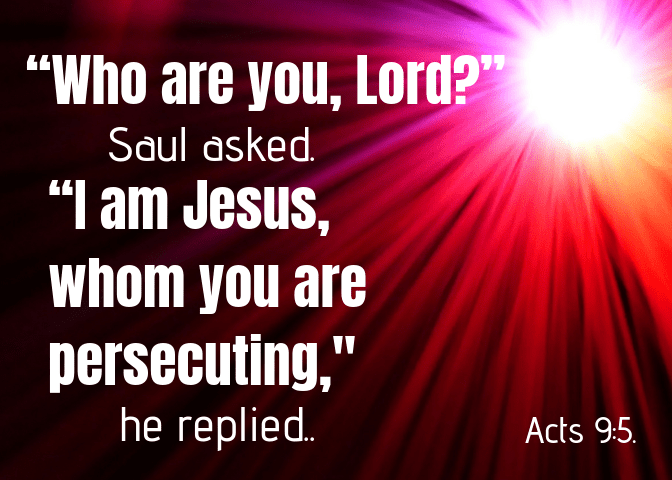
            Before we get that taste of redemption though, we open up chapter nine with Saul still breathing out threats to the Jesus followers.  Saul went on a bit of a scavenger hunt trying to find anyone who belongs to “the Way”.  “the Way” is just another “way” (ha, pun intended), to refer to the group of people who followed Jesus, as the term “Christian” was not a thing at that point in time.

            On Saul’s diligent scavenger hunt to persecute the group of Jews who followed Jesus, he went to the city of Damascus.  On his way to Damascus, Saul has a vision of none other than Jesus himself.  Again, this is the kind of stuff that the movies are made out of!  He ended up being blinded by the vision, and he didn’t eat or drink for three days.  Then a man named Ananias came and restored Saul’s sight through the power of God, and Ananias confirmed to Saul what had taken place.  Saul is also baptized and received the Holy Spirit.

As a result of this vision that Saul has of Jesus, he performs a complete 180 in his life.  He went from being a man who hunted Jesus followers to becoming a man who tried to create as many Jesus followers as possible.  He repented of his sins immediately and started proclaiming this message of Jesus in the synagogues.  This obviously created some confusion and amazement from the people, as just a couple of days ago he was seeking to have these same types of people killed and imprisoned!  Saul was so on fire for Jesus, that now nonbelieving Jews were seeking to put Saul to death.  What a crazy, dramatic turn of events.

Chapter nine then goes straight from Saul leaving Damascus to arriving in Jerusalem.  Luke, the author of Acts, chose to leave out a three-year gap.  Yep, you read that right.  There was a three-year gap between Saul leaving Damascus and arriving in Jerusalem.  We get this notion from Galatians 1:16-18.  After Saul left Damascus and before Saul arrived to Jerusalem, he spent about three years in “Arabia”.  N.T Wright talks about this three-year gap in his biography on Paul.  If you are an avid reader, then I would strongly suggest this book.

It is very possible that Saul spent a chunk of this three-year gap at Mt. Sinai getting ready for his upcoming ministry.  It’s pretty cool when you consider Moses and Elijah spent valuable time with God on Mt. Sinai as well.  I’m sure this time for Saul was extremely valuable, as he prepared to do so many good works for God and his Son Jesus.

It’s important that we find that quiet, alone time with God to prepare for our ministries as well.  I find that as a husband, dad, pastor, son, friend, and more, that it can be difficult to find that quiet, alone time with God.  Truth be told, it does not happen unless I am very intentional about it.  I’m guessing the same could be said for you as well.  I strongly encourage you to intentionally find and make that quiet, alone time with God.  Sometimes the best thing for us is to step away from our spouses, children, parents, friends, and coworkers, and have a close, intimate encounter with God.  I find that the best spot for me to do this is out by myself at our nearby park.  I’m guessing the experiences that I have with God out in his creation, by myself, are similar to the experiences that Moses, Elijah, Saul, and Jesus had with God.  So, get out there and say bye to your friends and family for a bit, and say hello to God.  Trust me, you won’t regret it.

We haven’t even touched on Peter at all yet.  Peter did a number of awesome things for the LORD in chapter nine and ten, these include: healing a paralyzed man, raising a woman from the dead (Yeah, Jesus isn’t the only one who was resurrected in the New Testament), and sharing the gospel message with a group of gentiles.  We could discuss these great acts of Peter for quite some time.  Instead, I’d rather us conclude and focus on this aspect of Saul spending that alone time with God for three years and preparing for his revolutionary ministry.

Please, please, please, find and make that quiet, alone time with God.  You can spend time reading God’s word, praying, meditating, and reflecting on all that God has done and will continue to do in your life.  For our southern friends who aren’t freezing outside, go find a park and spend that quiet time with God.  For our northern friends who live in the cold, shut yourself in a room by yourself with a cup of hot cocoa and spend that quiet, alone time with God.  Or, you can buckle down and spend a couple hours in the cold at the park with a jacket and blanket.  I mean Jesus spent 40 days without food; surely, we can spend a couple hours outside even if it is a little cold.

Get on out there!  Say bye to your friends and family; say hi to God.

-Kyle McClain

Today’s Bible passage can be read or listened to at BibleGateway here – Acts 9-10.

Tomorrow we continue with Acts 11-12.

Hero of our Faith

Acts 7-8

            Stephen is a great hero of our faith who does not get a lot of limelight, as he is only covered at the end of chapter six and chapter seven.  He is an honorable man we can all learn a lot from, as he was willing to lay it all on the line.

            At the end of chapter six, Stephen was seized for preaching about Jesus of Nazareth.  Some false witnesses ensured that he would get into trouble with the high priest and other Jewish officials.  The high priest had Stephen speak for himself, and that is the majority of the content in chapter seven.  In the first 50 verses of Acts chapter seven, Stephen provides a pretty nice summary from Abraham to King David.  At the conclusion of this summary, he begins to rip into the Jews for being a “stiff-necked people, uncircumcised in hearts and ears,” (Acts 7:51).

            The Jews did not take too kindly to the words of Stephen, so they decided to stone Stephen.  I can’t even imagine the level of pain Stephen would have been going through, as he was being stoned to death.  If it were me, I would have been so riled up in anger, and I would have wanted to retaliate.  However, that is not the course of action that Stephen took.  Just moments before Stephen’s death, he fell “to his knees he cried out with a loud voice, ‘Lord, do not hold this sin against them.’  And when he had said this, he fell asleep,’” (Acts 7:60).  What a way to go out!

            Stephen followed the example set by his Lord and Savior, Jesus of Nazareth, as Jesus prayed for the forgiveness of the people who crucified him.  There is so much to be learned in this short recording of the life of Stephen, a lesson of strength and grace.

            At the same time that Stephen’s life comes to an end, we are introduced to the man who wrote nearly half of the books of the New Testament.  It is an introduction that is only made for the movies (and, well, the Bible).  This man proved to be a foundational piece in the spreading of the gospel message.  He would go by the name of Saul.

            Saul is introduced in the scriptures as approving the execution of Stephen, a hero of our Christian faith.  Not only did Saul approve the execution of one man, but he “ravaged” the church.  Saul went from house to house finding people who claimed to believe in Jesus.  Once he found these people, he would send them to prison.  Surely, this led to many of them having to die for their faith.

            What an awful start to one’s life!  Thank the LORD that Saul did not follow this course of action for much longer, as we will see in the coming chapters.  We can learn from Saul that God is willing, able, and wanting to use anybody, no matter what someone has committed in their past. 

Let this serve as an encouragement to you, as you may struggle with some choices you have made in your past.  Don’t let decisions you made in your past prevent you from being an instrument of God’s work, as God was even willing, wanting, and able to use the likes of Saul, a man who persecuted many Christians.  Praise God that we serve a forgiving God.

There’s a lot to learn here, as we take a look at the life of Stephen and the introduction of Saul.  It’s my prayer that we all learn to have the strength and grace of Stephen, and we don’t let our past stop us from serving God like Saul.

-Kyle McClain

Today’s Bible passage can be read or listened to at BibleGateway here – Acts 7-8

Tomorrow we continue the story of Saul with chapters 9-10. Don’t miss it!

Share Jesus – at all costs

Acts 4-6

            Earlier this year, in June, I experienced a first.  Let me walk you through the moment.  I was preaching at the North Hills Church of God in Springfield, Ohio, as I do every Sunday.  At this point in time, our church chose to worship outside because there were a lot of unknowns of the Coronavirus.  There were very strict rules in place to help prohibit the spread of the virus.  During my message, a police officer slowly pulled through our long driveway and checked what was taking place.  For a split second, I thought that I was maybe going to get in trouble for hosting a large group gathering.  I thought I could get in trouble for preaching to a group of people.  It was the first time in my life that I ever wondered whether or not I would get in trouble with preaching God’s Word.

            To say that we have it pretty easy in the United States is quite the understatement.  I praise God that we have the freedom to share God’s Word with others without even having the fear of being persecuted.  I have spent all of maybe 5 seconds in my life thinking that I could get in trouble/persecuted for sharing God’s word.  If I had to guess, I would say that most people reading this would have a similar experience to myself.  There are people today who do not have this luxury, and this was especially true in the book of Acts

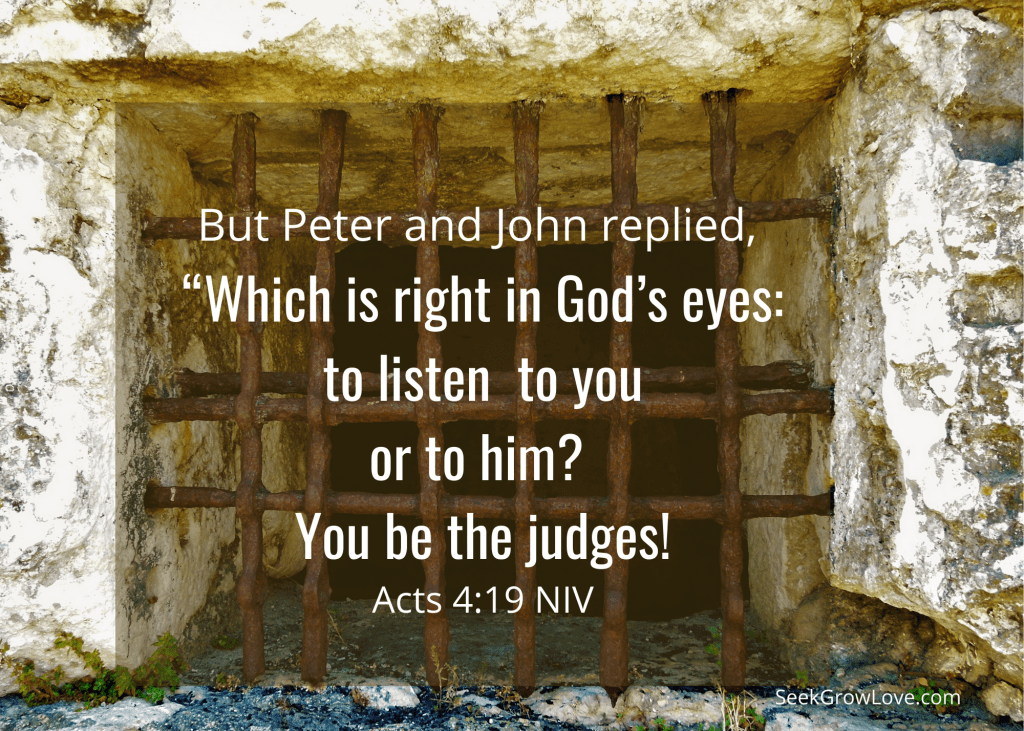
            In Acts chapter 4, our heroes, Peter and John, were sharing God’s Word with others.  When they did this, they were arrested and presented before the Jewish council.  The council questioned Peter and John, and the council commanded them to no longer share the good news about Jesus and remain silent.

            I absolutely love Peter and John’s reply to this command to remain silent: “Whether it is right in the sight of God to listen to you rather than to God, you must judge, for we cannot but speak of what we have seen and heard,” (Acts 4:19,20).  Burn baby to you, council!  Peter and John made it obvious to the council, that they must listen to the voice of God over the voice of men.  They had to preach the good news of Jesus, for that is what God wanted them to do, not the council.  Peter and John did not care what the consequences would be for preaching about Jesus.

            Peter and John were eventually released after receiving more threats from the council.  Word got out of what had taken place to Peter and John.  The Christ followers responded by praying to God for boldness.  The early Christ followers did not succumb to the external pressures of the world.  Rather, they prayed to God and came together as one to share this radical message of the Messiah.

            These Jesus followers gave their all to further spread this message.  They were even willing to contribute all of their possessions to spread the knowledge of Jesus the Messiah, and that is literally what they did.  They pooled all of their possessions together for the good of the gospel message (outside of a few greedy people *cough* Ananias and Sapphira *cough*).

            My oh my!  Imagine what good we could accomplish today if we had the same mindset of the Jesus followers in Acts.  These people had no cares in the world what would happen to them for sharing the gospel message, even though the threat was very real and evident.  All they did was pray for more boldness, and it didn’t stop with just their voices either.  They were willing to give all of their possessions to help spread this gospel message.

            What great examples these early Jesus followers provide for us today.  In comparison, today, we seem to be a whole lot more reserved in our approach to spread this gospel message.  Maybe we should take a note from the early church and take some more extreme measures in our life to spread the gospel message.  If we do, God can work so many wonderful wonders in and through us. 

            Be bold and give it all to God!

-Kyle McClain

Today’s Bible passage can be read or listened to at BibleGateway here – Acts 4-6

Tomorrow we continue the exciting, inspiring historical account of the early church with Acts 7-8. Come read along!

Be A Witness

Acts 1-3

If you have been following along with the SeekGrowLove devotions for the past 1.5 months, we have been able to take a look at the life and ministry of Jesus through the four gospels.  What a crazy, action-packed time during Jesus’ ministry on earth.  Today, we transition into the book of Acts, and we get to see how Jesus’ disciples will respond to these couple crazy years with Jesus.  As we near the end of 2020, we are all too familiar of what it looks like to live through some crazy events.  As we read through the book of Acts, we can take some notes of how Peter, Paul, and others responded to the crazy events revolving around Jesus.

Before Jesus ever ascended to heaven (yep, not even Jesus went to heaven right after his death), he spent 40 days preaching about the Kingdom of God.  Right before Jesus’ ascension, he told his disciples to, “Witness in Jerusalem and in all Judea and Samaria, and to the end of the earth,” (Acts 1:8). 

The order of locations that Jesus provides is important.  He starts off with Jerusalem; Jerusalem was basically the home base for the Jews and early Christians.  They first needed to witness to their home base of Jerusalem.  Then, they needed to witness in Judea and Samaria; that consists of the land surrounding the city of Jerusalem.  After they have witnessed to the surrounding area, then they had a calling to witness to the ends of the earth.  The book of Acts follows this exact blueprint, which I find to be so fascinating.  Chapters 1-7 are all witnessing in Jerusalem.  Chapters 8-9 consists of them witnessing in Judea and Samaria.  Then, chapters 10-28 cover the disciples, Paul, and others witnessing to the ends of the earth: Caesarea, Antioch, Asia Minor, Greece, and Rome.

We can learn a lot from this blueprint that Jesus provided for his disciples.  We have a calling to witness to those right around us, whether that be your family, friends, coworkers, etc.  Studies show that the most effective mode of evangelism is relational evangelism.  We are best able to spread the news to people we have a relationship with.  Are you using your relationships with nonbelievers, as an instrument to spread the gospel message of the Kingdom?  When you have spread the gospel message to those around you, are you helping that message be spread throughout the ends of the earth?  We have better capabilities now than ever to spread the gospel message to the ends of the earth.  Let’s take advantage of those capabilities.

We can’t go through Acts 1-3 and not mention Peter’s killer sermon in chapter 2.  It is truly one of my favorite sermons ever recorded.  Peter absolutely brings it to the Jews.  You can feel his passion for his Lord and Savior in this message, and he shares this passion with the Jews, the same people who had him crucified (as Peter so gracefully informs them)!  If you want to see someone who is on fire for God and his son, Jesus, then look no further than Peter’s message here in Acts chapter 2.  I hope and pray that we can reflect this passion in our lives today.

I look forward to covering the first half of Acts with you all.  It’s my prayer that we can all learn from the wonderful examples of Peter, Paul, and others throughout this wonderful book.  Witness to those around you, and then help spread that message to the ends of the earth!

-Kyle McClain

Today’s Bible reading passage can be read or listened to at BibleGateway here – Acts 1-3.

Tomorrow we continue this exciting book, with Acts 4-6. Now’s a great time to jump on board and finish 2020 strong with a daily reading of God’s Word as we watch to see how the world responds to the life, teaching, death and resurrection of God’s Son, Jesus. Let’s get ready for his return!

All the Scriptures Point to Christ

Luke 24 & John 20-21

The closing sections of Luke and John’s gospel are rife with personal encounters and dialogues with the risen Jesus. These interactions with Jesus and Peter, the two men on the Emmaus road, the women at the tomb, and the various other interactions show the personality and humanity of Jesus. Jesus shows his sense of humor on the Emmaus road, he eats a meal with his disciples, and restores and forgives Peter.

In the midst of these interactions Jesus, as he always does, teaches. I’d like to draw our focus to what Jesus tells the two men on the Emmaus road in Luke 24.27. Luke writes, “Then beginning with Moses and with all the prophets, he explained to them the things concerning himself in all the scriptures”. This verse is pregnant with meaning and significance! This verse states very clearly that Jesus is the centerpiece of scripture. All roads in the Bible lead to Jesus Christ. Notice that the verse says, “Starting with Moses and the prophets.”. Moses represents the writings of the Pentateuch and the prophets represent all the major and minor prophets. Starting from those two places Jesus taught the men that the entirety of the Old Testament points toward to himself. 

This teaches us that the whole of the Bible is beneficial and needed for believers. A whole Bible makes a whole Christian. For Jesus, the disciples, Paul, and the early church the Old Testament was their Bible. The New Testament is built off of the foundation of the Old Testament. Not only do we learn about Jesus in the gospels and the New Testament but in light of the New Testament we see Jesus in the Old Testament. That’s why I love and encourage Bible reading plans that take you through the whole of scripture. Jesus is the crowning Jewel of scripture. From Genesis to Lamentations to Obadiah a road to Christ can be found. Now I would warn against over reading Jesus into texts but this is where interpreting correctly is important.

The take away is Jesus can be found in all the scriptures, therefore, let us read the whole of scripture and learn of Jesus. 

-Jacob Rohrer

Today’s Bible reading passages can be read or listened to at BibleGateway here – Luke 24 and John 20-21

Tomorrow we begin the exciting book of Acts to see what happens after Jesus’ resurrection – Acts 1-3

The Promise of Jesus’ Presence

Matthew 28 & Mark 16

Praise God that Jesus was raised from the dead and lives forevermore! Today we close out the gospel of Matthew and Mark with reading about Jesus’ resurrection from the dead. I want to focus in on the last phrase of Matthew 28 and the closing phrase of the gospel where Jesus says, “Lo, I am with you always, even to the end of the age” (Matthew 28:20 NASB)

Just a few lines earlier Jesus declared that all authority in heaven and on earth has been given to him and then charges his disciples to make disciples. Concluding his final words he promises them he will always be with them and never leave them. Not only did Jesus promise to always be with his original disciples but he promises to always be with all who follow him. What a comforting truth especially during this season of life all of us are living. Life in general is tough but living as a Christian, a true follower of Jesus, can be even tougher at times. Take heart and remember that you are never alone. The resurrected all-powerful living Christ abides with his people! 

-Jacob Rohrer

Today’s Bible passages can be read or listened to at BibleGateway here – Matthew 28 & Mark 16

Tomorrow we will finish the other two gospel accounts – Luke 24 and John 20-21 as we continue on our chronological Bible reading plan through 2020.

A Kingdom Not of this World

Luke 23 & John 18-19

At the time this devotion is being written the election for the president of the United States will take place in five days. As American Christians the realities of democracy, patriotism, and freedom run deep in our veins. The way Jesus describes his kingdom to Pilate in John 18 is something not only each American Christian needs to be reminded of but each Christian wherever they live needs to be reminded of. As Christians our primary citizenship is not the country we currently reside in, it is the kingdom of God. 

Jesus says to Pilate in John 18.36, “My kingdom is not of this world”. “Not of this world” means, not of this present world system. The kingdom Jesus presides over operates in a totally different realm than the kingdoms of this present evil age do. And because we belong to God this means we are citizens of a different kingdom (Phil. 3.20). We are citizens of the kingdom of God first then citizens of our natural country second. 

While all of us are saturated with the current country and culture we live in, we should remember, our citizenship is with the kingdom of God primarily and we are to live out the kingdom life in whatever context we live in. As followers of Christ our lives are to be lived against the grain of the current ways of life, just like how Jesus said his servants wouldn’t fight over him because they belonged to a kingdom that was not of this world

-Jacob Rohrer

Today’s Bible passages can be read at BibleGateway here – Luke 23 & John 18-19

Tomorrow we will read Matthew 28 and Mark 16.

What Does Jesus’ Death Mean?

Matthew 27 & Mark 15

Why is this devotion being written? Why are you reading this devotion? Why have you experienced supernatural life change in the name of Jesus? It’s all because of what we read in today’s section of Matthew and Mark, the crucifixion of our Lord Jesus Christ. The gospel accounts give us a point of view perspective of the final moments of the Messiah’s life. Why did Jesus die? According to Jesus it’s because it was the purpose of his life (Mk. 10.33-34), Judas betrayed him, and the Jewish leadership sought out his execution. 

But when we leave the gospels and enter Acts, the epistles, and the apocalypse (Revelation) new light is shed upon old truths about what happened at the cross of Christ. The rest of the New Testament, if you will, tills the soil of what we read in the gospels to reveal truths and realities bound in the death of Jesus. The cross is like a diamond when held up to the light. Depending on which way you hold the diamond the light will refract differently and reveal different aspects of the diamond. The cross is a multi-dimensional event with a number of faith-building, worship-inducing, Christ-glorifying truths and realities for the believer to soak up in the scriptures and to be consumed by the love of Jesus and the Father. 

This morning we will look at three meanings of the cross:

1. Jesus died to demonstrate the righteousness of God (Romans 3.25)

According to Paul in Romans 3.25 Jesus’ death demonstrated or put on display the righteousness of God. What is the righteousness of God? The righteousness of God is God’s own holy, perfect, blameless, and just character and being. Sin is a capital offense against God. Because he is holy, just, and good he cannot allow sin and rebellion to go unpunished. If he did this, he would then be unjust and not good. When Jesus died his blood covered every past, present, and future sin. Jesus’ death satisfied the wrath of God. When we look at the cross it tells us not only how much God loves us, it also shows us how much God hates sin and the penalty for sin. The death of Jesus demonstrates God’s perfect judgement and character. The cross says God will not let sin go unpunished. 

2. Jesus died to disarm the powers of Satan and darkness (Col.2.13-15)

When Jesus’ blood was shed the power that satan and darkness had over humanity was relinquished. The biggest weapon Satan and spiritual darkness can have against you is your own sin and from that, guilt, shame, and other consequences of sin. But when Jesus’ blood was shed the power and slavery that sin held over humanity was broken. The blood cancelled out our certificate of debt (list and penalty of sins) therefore, the power Satan once had was taken away. This is similar to Jesus’ teaching in Mark 3.22-27. The way Jesus conquered victoriously over the power of satan and spiritual darkness is through his death. Paul says in I Corinthians 2, that had the “the rulers of this age” (spiritual powers of darkness) had known what would have happened after Jesus died they “would not have crucified the Lord of Glory”. The death of Jesus breaks the yoke of slavery and oppression over our lives, we are rescued from the power of satan. 

3. Jesus died to provide us an example to follow in our own Christian walks (I Pet. 2.21)

Jesus, though he was tried and executed unjustly, still endured the cross to save his sheep (John 10). He surrendered his privileges and his rights and humbled himself for the eternal benefit of others. Likewise, we as Christians should consider the plight of Jesus and imitate him. When we are treated unjustly and unfairly we should not return evil with evil but instead love. When we suffer for doing the right thing we ought to entrust ourselves to God as Jesus did to his Father. 

When you read Matthew 27 and Mark 15 these three realities among others are present when Jesus breathed his last on the cross.

-Jacob Rohrer

Today’s Bible reading passages can be read or listened to at BibleGateway here –Matthew 27 & Mark 15

Tomorrow’s reading will be Luke 23 and John 18-19.