Belt of Truth Buckled

Old Testament: 1 Kings 3 & 4

Poetry: Proverbs 10

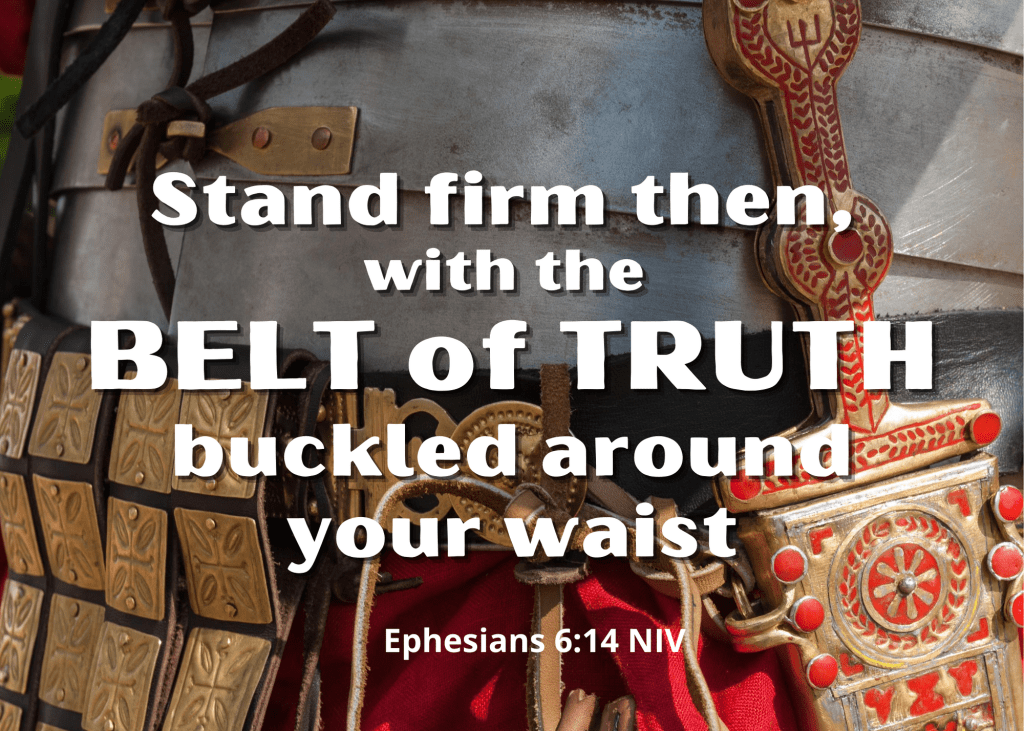
New Testament: Ephesians 6:14a

Heads up! This devotion is going to take you in a mini dive into the history of the buckle of all things! But first…

Many of us have read our key verse more than a handful of times in our lives. And we’ve even been taught about the belt of truth in our Sunday School lessons. It’s been explained that in ancient times, before a foot race or prior to battle, runners and warriors would tuck their long garments into their cloth belt, in order to provide free movement for the legs. 

As I considered this first half of this verse, the word buckle stuck out to me. My thoughts went a little something like this:

“Wait a minute…a buckle in ancient Roman times? This doesn’t make sense. The earliest I’ve ever seen buckles in history books is on the Pilgrims. Did Roman soldiers wear buckles?”

A few clicks in my web browser confirms that indeed, buckles were part of the Roman body armor. Depending on the type of armor, there could be one main buckle, or in segmented forms of armor, many mini buckles to hold all the pieces together. What’s more, the more elite soldiers had super fancy buckles, whereas those that served in the infantry had simpler and more practical buckles. 

Who knew???

With this new knowledge, our key verse today starts to take on an expanded meaning. Without the buckled belt of truth, the breastplate won’t stay in place and the protective plates on the shoulders wouldn’t be able to stay attached. Also, the tunic part of the armor which protected the groin wouldn’t have anything to attach to if it weren’t for the buckle. 

It all starts with the buckle on the belt. Just like it all starts with Truth. 

  • John 14:6 – “I am the way, the truth, and the life.”
  • John 8:32 – “Then you will know the truth, and the truth will set you free.”
  • 2 Timothy – “Do your best to present yourself to God as one approved, a worker who does not need to be ashamed and who correctly handles the word of truth.”
  • Psalm 25:5 – “Guide me in your truth and teach me, for you are God my Savior, and my hope is in you all day long.”
  • Ephesians 1:13 – “And you also were included in Christ when you heard the word of truth, the gospel of your salvation…”

The start of our key verse in Ephesians chapter 6 begins with “Stand firm then…”. If we are ignorant of the Truth, there is no way that we can stand firm. We must know the Truth of YAHWEH, and His Son, Jesus. We must know the Truth of salvation and the coming Kingdom. If we fail to know these truths, then our efforts to stand firm against the attacks of our opposition will be for nothing. 

So buckle up and stand firm in Truth.

-Bethany Ligon

Reflection Questions

  1. What would happen if you went into battle but couldn’t keep your pants up, or were restricted by your long garments? How important is truth? How do the other components of the armor rely on truth? What happens if we try to stand firm without truth?
  2. What truths do you believe about YAHWEH, His Son, Jesus, salvation and the coming Kingdom? Are there any that you are unsure about and need to study more? How do these specific truths affect other pieces of your armor: salvation, righteousness, faith, and gospel of peace?
  3. What can you do today to be better buckled into the truth?
Be STRONG in the LORD

Old Testament: 1 Kings 1-2

Poetry: Proverbs 9

New Testament: Ephesians 6:10-13

Ephesians 6:10-13 – “…Finally, be strong in the Lord and in his mighty power…”

If you were to look at the different video playlists I have curated in my Youtube profile, you’d see that a majority of them are workout exercise videos. I have playlists for upper body strength, lower body strength, pilates and barre workouts, HIIT and stretching videos. What can I say, I need variety in my life if I’m going to pursue a lifestyle that includes regular exercise. 

But physical strength and endurance is not what the apostle Paul is talking about in the sixth chapter in his letter to the Ephesian church.

Nor is Paul referring to mental toughness. The kind of fortitude that prisoners of war or persecuted believers must endure when they are held captive in inhumane environments. 

Paul writes the words, “be strong in the Lord and in his mighty power”. These words are almost identical to what we read in Joshua 1, verse 9, “Have I not commanded you? Be strong and courageous. Do not be terrified; do not be discouraged, for the LORD your God will be with you wherever you go.”

Joshua was preparing for a physical battle that had spiritual consequences. We probably are not preparing for a physical battle; however, if we are actively pursuing a life centered on the Gospel message, we are indeed engaging in a battle that has spiritual consequences. 

So what does it mean to be “strong in the Lord and in his mighty power”?   

First, I think it means that we must recognize that if we are going to do anything in the name of Jesus, we are stepping into battle against the devil’s schemes. We become a threat that must be neutralized. A soldier prepares for battle by donning on their tactical gear. We need to do likewise.

Second, “be(ing) strong in the Lord and in his mighty power” means that our own efforts, our intelligence, our will power, our connections, our resources are insufficient protection for what we are up against. If it were up to only us, then our efforts would be whooped before we even really got started.

Once we acknowledge that we are in a battle and we are without adequate protection, what are we left with? We will only be successful in spiritual warfare with our faith. A faith that says:

We believe that God is who He says He is.

We believe that nothing is impossible for God.

We believe that God is faithful to His people.

We believe that God will fight for us. 

We believe that God has already won the ultimate battle.

When we cling to these truths, we are “strong in the Lord and in his mighty power” and we can withstand any kind of opposition that we are tasked to face and endure. And we will be victorious. 

For whatever battle you might be facing today, remember that you are not alone. You serve a God who loves you and has empowered you with His Holy Spirit to stand firm and do great things. Keep the faith and believe.

-Bethany Ligon

Reflection Questions

  1. How strong are you – physically, mentally, and spiritually? Of these three areas in which do you spend more workout time developing? How does one go about strengthening spiritual muscles? Why are spiritual muscles important?
  2. What do you believe about God and His Son Jesus and how does believing each statement help prepare you for spiritual battle?
  3. What do the devil’s schemes look like? When does he win battles? What can you do to stand against him in God’s power?

Seeking God & Standing Firm

Old Testament: 2 Samuel 23-24

Poetry: Proverbs 8

New Testament: Ephesians 6:1-9

The world’s most powerful navigational tool, the compass, has been around in some form for over 2000 years.  Originally used in divination, it found its way to navigation a few centuries before the age of exploration. When blinded by snow, when tossed at sea, when wandering through a dense forest, it works without fail for all who seek direction. When unobstructed by friction or gravity, the magnetized metal responds in the same true way to of the Earth’s gravitational field, aligning with poles of the Earth.  This means that a compass is actually influenced by two directions at once, polar opposites. It seems silly to say, but you cannot travel in the direction of north and south at the same time. All of these elements ring true in our faith.

“To fear the Lord is to hate evil; I [Wisdom] hate pride and arrogance, evil behavior and perverse speech. Counsel and sound judgment are mine;  I have insight, I have power.” – Proverbs 8:13-14

It is equally foolish to say that we can move in the direction of God and evil and be on the same course. They are truly polar opposites.  To love God is to hate evil (Psa 97:10).  To honor God is to give up pride (Jam 4:6). To pursue God makes the pursuit of anything else secondary (Matt 6:24).  We can acknowledge the fact that our journey will not be perfect, but the direction we are pointed is true, faithful, and unchanging.  It doesn’t adjust with time or relativism (Isa 40:8).  Be conscious of the friction and the pull that is in the present evil age that will skew your target.  Chart a course from God’s word and prepare yourself because there is more than one force at work.

“Finally, be strong in the Lord and in his mighty power. Put on the full armor of God, so that you can take your stand against the devil’s schemes. For our struggle is not against flesh and blood, but against the rulers, against the authorities, against the powers of this dark world and against the spiritual forces of evil in the heavenly realms.” Ephesians 6:10-12

The military command of “standing firm” is far from passive (Eph 6:13). In 2 Samuel 23, we see a captivating glimpse of David’s mighty warriors. Many of them, like Eleazar (v. 10), are not commended for their brilliant offensives, but holding their ground to the very end to eliminate enemy forces. Likewise, the grace we accept from God is through faith, not deed (Eph 2:8-9), and by seeking and finding Him, we have already arrived at the destination in some sense (Eph 2:19-20). Therefore, we cannot rest our laurels because there are all-out assaults coming. It is not a battle of mortality, flesh and blood, but a battle against rulers, authorities, powers of darkness, and even spiritual forces for the spoils of eternity. We are to armor ourselves with truth, peace, faith, salvation, righteousness, holding close to the Spirit and ready to wage war until the end.


In conclusion, today’s lesson is two-fold.  First, make sure that you are allowing God’s direction to guide you as you move.  Know that when you are moving towards God, you are fleeing from evil influence, relative morality, and sin and towards a loving God and restored perfection (2 Tim 2:22).  Second, once we arrive in grace, our job is to stand our ground.  We are to set a fortress around our hearts (Pro 4:23), as both a guard and a vigil, petitioning for God to intercede and help us withstand the battle.  Like Paul, our prayer should be for fearlessness (Eph 6:20), eyes-locked on the prize , so we can stand firm in the truth of the Coming Kingdom.

-Aaron Winner

Reflection Questions

  1. Towards God or towards evil? What does each path look like? What is at the end of each path? Which direction are you pointed?
  2. What or who has turned you around before, pointing you in the wrong direction? What are you leaving behind you when you move towards God?
  3. What acts as your compass? How valuable is your compass to you? Have you ever been lost without it?

Photoreceptors

Old Testament: 2 Samuel 22

Poetry: Proverbs 7

New Testament: Ephesians 5

A few weeks back my children were very excited to have me read a new book they checked-out from the library.  Not yet mastering the alphabet, their choices are often from the featured book table, typically the flashiest cover; however, the book they chose did not meet my expectation. Their choice: The Worm.  The title wasn’t a metaphor. Not a how-to on dance moves. Not a fictional story of a kid-turned-wrestler.  It was literally a picture book just about worms, and so we began to learn everything I never wanted to know about these three phylums of the animal kingdom.  Did you know that worms can be over 100 feet long? And there are people around the world who eat worms? Or that worms are hermaphrodites? Probably the most relevant fact to today’s devotion is that most worms, including the earthworm, don’t have eyes. This doesn’t stop them from knowing when they are exposed to light. Built into the skin of earthworms are photoreceptors which work as light detectors. These creatures of darkness cannot exist in the light. Being caught above the surface trying to do your same wormy thing equals starvation, dehydration, or becoming prey.

Looking at today’s Proverb, we can see that the speaker is specifically warning his son about infidelity and adultery.  If we use a broader brush with this wisdom, and extend the metaphors and figures of these proverbs as is often done, we can bring our own struggle with sin into the picture.  “Do not let your heart turn to her ways or stray into her paths.  Many are the victims she has brought down; her slain are a mighty throng. Her house is a highway to the grave, leading down to the chambers of death. (Prov. 7:25-27).” Don’t stray into the path of lust, pride, greed,or being obscene (Eph 5:1-3).  A knock on the door soon becomes a visit. A visit becomes a stay.  When you stay long enough, it is where you live (James 1:14-15). Like a worm, deeper and deeper you dig yourself into the ground, making your bed and lying in the grave.

You may not have heeded the warning up to this point, so here is the wake-up call to all of us worms trying to hide from the light, whether it be for a day or decades,“But everything exposed by the light becomes visible—and everything that is illuminated becomes a light.  This is why it is said, “Wake up, sleeper, rise from the dead, and Christ will shine on you (Eph 5:13-14).’” When we are exposed by the light of God, we shrivel up and die.  This can be tremendous or tragic. Waking up today means we die unto ourselves and become a new creation in Christ.  We are covered, cleansed, and made pure through God’s grace given to us through the blood of the Lamb.  If our dry bones do not rattle and we die in our darkness, there is no rebirth. Only an eternal separation, a scorching from the Light, because, “For of this you can be sure: No immoral, impure or greedy person—such a person is an idolater—has any inheritance in the kingdom of Christ and of God.  Let no one deceive you with empty words, for because of such things God’s wrath comes on those who are disobedient. Therefore do not be partners with them (Eph 5:5-7).” 

You may have fallen victim to a snare, directly disobeying the commands of God. Don’t sleep on this. Restore your relationship with the One True God, and in the midst of the distress, ask for help and He will answer, not letting you become a victim to the grave (2 Sam 22:5-7). God has given us a path to repentance and an amazing grace. It is time to put your photoreceptors to work, find the surface, and enter again into His marvelous light.

-Aaron Winner

Reflection Questions

  1. What sins have seduced you? What was enticing about this sin? Have you gone in for a visit, or a stay, or is that where you live now?
  2. What do you know about God’s wrath? What do you know about God’s grace? How does God decide which worm gets the grace and which worm gets the wrath? Which worm are you right now?
  3. How active have your photoreceptors been? Do you recognize the difference between light and dark? Unlike the worm, do you seek the light? How?

Unity

Old Testament: 2 Samuel 20-21

Poetry: Proverbs 6

New Testament: Ephesians 4

After the attacks on September 11, 2001, President George W. Bush spoke to the emergency workers in Ground Zero through a megaphone, finding a response that resonated with the entire country and even more, the world, “I can hear you. The rest of the world hears you. And the people who knocked down these buildings will hear all of it soon.” A historical 92% of the country approved of the job he was doing, bringing together a country that was fraying at the seams in the previous election cycle. It is hard to imagine something similar happening today; no matter who is the president-elect in November, half of the country will be instantly dissatisfied with the results.  These are typical terms we accept in our government, but also this “majority rules” culture has historically found its way into boardrooms and even churches. Let me quickly lower the tension by stating that today’s devotion is not about politics or presidents.  It does not upend or chastise any church form of government. Its sole purpose is to examine the expectation of unity laid out for the church body, as it might be equally unimaginable. 

This spirit of unity was on the mind of Jesus before being arrested in the garden of Gethsemane. He prays for his disciples and all believers when he leaves us the following words, “Holy Father, protect them by the power of your name, the name you gave me, so that they may be one as we are one. (John 17:11b)” Jesus knew his departure to the cross would scatter His apostles, create infighting, and feed doubt. Fortunately, with the exception of Judas, each of them found their way back to a unified front. Having seen Jesus Christ raised to life, they each waited for the Holy Spirit at Pentecost.  They each dedicated their lives to sharing the Good News of the Kingdom of God. They each shared in martyrdom or exile for the sake of Christ.

In the same manner, I have seen churches unite during revival, when facing tragedy, or during persecution from the outside. It is easy for the dross to fall away when the metal is hot, but what about when the metal starts to cool? What does unity look like in maintenance mode? Within the day-to-day routine of uniting relationships, mulling through ministries, and discerning what is best for a body of believers? In Ephesians 4, Paul describes this as “walk[ing] in a manner worthy of the calling, with all humility and gentleness, with patience, bearing with one another in love, eager to maintain the unity of the Spirit in the bond of peace.”

While there could be a devotion on each of the elements of this verse, let’s quickly unpack the key points given to Ephesus. First, walking implies that it is not a quick process, but instead requires some dedication to go the distance (Eph 2:10). Next, humility is the acknowledgement that self-reflection should be the first step in the process, making adjustments and amendments when necessary (Matt 7:3-5; Phil 2:3), and gentleness is the grace that is extended to my brother and sisters during this same process, as imperfect people try to discern the will of God (Col 4:6). Additionally, we are required to commit to patience and love, easily spoken but in reality, conflict makes us more unbearable to one another (Col 3:12-14; Matt 18:15-20). In the body of believers, this is similar to taking the last rep of weight training, it burns the most, but it is the one that produces the result. Finally, eagerness to maintain unity means we stay focused on what unites us (Rom 14:19), defending against the six things the Lord hates (Prov. 6:16-19), and keep our mission far away from doctrinal nuances or extra-biblical preferences.

Unity takes far more work than building a majority.  It isn’t a compromise or consensus because there are no losers. We grow as one together. We move towards one another as we move towards our Heavenly Father. Today, let us be extra mindful in our prayer time to dwell on the topic of unity and ask God to reveal our vision and repair divisions that may exist.  May we live out the prayer of Jesus and the petitions of Paul to become one like our God and His Son, Jesus Christ.

-Aaron Winner

Reflection Questions

  1. Where and when have you experienced or seen the beauty of a united church body?
  2. Dedication, humility, gentleness/grace, patience, love, focused on what unites. How can you exhibit these qualities today? How can you use them to increase the unity of your church? What can happen when just one is missing?

Leading Through Hardship

Old Testament: 2 Samuel 18 & 19

Poetry: Proverbs 5

New Testament: Ephesians 3

As President of the United States, Abraham Lincoln is uniquely positioned in American history as the only leader of a broken country.  No matter who he chose to serve in his cabinet, how empathetic his staff was to his role, how much they helped to shoulder the load or strengthened his areas of weakness,  no one can truly understand the weight borne by the Commander-in-Chief, whose presidency was the bookends to rebellion. A great example of this can be seen in Vicksburg, a Union siege took out the Confederate stronghold on the Mississippi which was a key route for reinforcement and supplies.   While this battle represented a great public triumph for Lincoln’s side, it also held personal tragedy.  Lincoln received the report that his brother-in-law, a Confederate general, was killed in battle.  It was stated by those surrounding him they never saw the president more moved during the war than when he received this news.

Likewise, David’s emotions in victory are complex. Tens of thousands of men look to their king to champion their victory, no doubt hearing stories of how he famously danced in the streets as the Ark made its way into the city.  Instead, they see the lament of a father’s cry.  Great leaders, more than anything else, are human; however, the weight of leadership will undoubtedly tip the scales in favor of fostering commitment, vision, and hope for followers, rather than abandonment trials and tragedy. Joab’s words seem insensitive, “You love those who hate you and hate those who love you. You have made it clear today that the commanders and their men mean nothing to you. I see that you would be pleased if Absalom were alive today and all of us were dead. (2 Sam 19:6) ” but they are actually encouragement to a leader who has made a personal sacrifice to acknowledge that tens of thousands of others had done the same.

The words of Jesus could be thought equally cutting and unfeeling, “Let the dead bury their own dead, but you go and proclaim the kingdom of God. (Luke 9:60).” Our ministries do not stop because we face conflict or personal tragedy.  Conversely, I would say this is when our ministry and testimony are spotlighted. By the standards of the world, this conflict provides permission to act selfishly, but when we bear our burdens with the Kingdom of God at the forefront, we lean on God and lead others to the Good News.  Paul makes mention of this in Ephesians 3.  He tells the church at Ephesus not to worry about his suffering, because it is for their sake and to the glory of God.  The same circumstance is both a victory yet a personal hardship. Paul instead lifts those he leads in prayer, asking for the strength of the Holy Spirit to guide those for whom the letter was intended, and likewise, encourage us today.   No matter what scale Paul used, no matter what was placed in the balance, the weight of the Kingdom of God far outweighed any loss. This sentiment is again echoed from his prison cell to the church at Philippi when he states:

“What is more, I consider everything a loss because of the surpassing worth of knowing Christ Jesus my Lord, for whose sake I have lost all things.  I want to know Christ—yes, to know the power of his resurrection and participation in his sufferings, becoming like him in his death, and so, somehow, attaining to the resurrection from the dead.” –  Phil. 3:8,10

While we may not be ready to ask for suffering like Paul, tragic circumstances are the nature of this world. It may be an unfamiliar posture, but our grief, our battle, and our dire circumstance is an opportunity to demonstrate the assurances we have, to revel in the joy and love of God. We must look for opportunities to pray for and encourage others who may be participating in the same battle, asking God to give them the strength to see the victory too.  Yes, we must bear, and even welcome, hardship for the sake of the Kingdom of God because, with the help of God, we can lead within it, bringing others to the saving knowledge of Christ Jesus.

-Aaron Winner

Reflection Questions

  1. What do you learn about leadership from David? From Paul?
  2. What do you think of the statement: “No matter what scale Paul used, no matter what was placed in the balance, the weight of the Kingdom of God far outweighed any loss.” Do you see this in Paul’s life? Do you see this in your own life?
  3. Who will you pray for strength to see the victory?

Unwavering Integrity

Old Testament: 2 Samuel 16 & 17

Poetry: Proverbs 4

New Testament: Ephesians 2

As someone who recently dipped my toe in the job pool for the first time in roughly a decade, my curiosity led me to search for job traits of the highly-sought after employees.  I wanted to know what to stress in order to make me the most marketable candidate to separate myself from the pack. I have a number of traits which I feel are valued in the workplace.  I am creative, a troubleshooter, I work well with others, I am honest, a great listener, a quick learner, have pretty good credentials, and can feign intelligence.  While many of the attributes showed up on the Family Feud board, they were not the number one answer.  So what is the most highly sought after trait? Dependability. A CEO, an administrator, a middle-manager are all looking for predictable actions from their employees in order to make schedules, projections, or take calculated risk. I really had to reflect on my dependability. What would be my Vegas odds? For showing up on time?  Seeing things through? Using my work time ethically? Giving my best effort on all aspects of my job?  Are stress, weather, or home field advantage influential factors?

It is not just employers looking for our dependability, or more accurately, unwavering integrity.  Proverbs 4 insists that seeking wisdom and counsel in the word of God is a critical aspect. When we are guided by God’s wisdom, no matter the circumstance, we are found along a straight path and we do not stumble. (4:11,12)  On any other path we find ourselves arriving late, giving up when the situation becomes pressed or less advantageous, we may steal time for ourselves, or phoning in the work of God.

In a continuation of the challenge to the throne of the king that occurs in 2 Samuel, David is cursed by Shimei, who is ready to watch David receive his just desserts for the damage done to the house of Saul. David doesn’t defend himself and halts a rushed retribution ready to be delivered by Abashai. A quick note about the irony here, Saul impulsively chucked literal spears at David, a far less-measured approach.  David. however, acts in faith, knowing that the words may be from God, and he might need to heed them, and if not, God will deliver justice and redemption in His time.  David proves again to be a level-headed leader, but furthermore, a dependable agent of God.

Likewise, in the moments we are called out or we are tossed by a rough crosswind, (Mark 4) our true measure of our dependability is on display. Do we really continue walking on a straight path when it seems like each step becomes more rocky, the ground shifts, or we hear the thunder clapping above? It is easy to become reactive, volatile, and abandon our posts. Ephesians 2 speaks of the origin of grace, but far too often we forget to continue to read on to understand why the grace of God is extended: “For we are His workmanship, created in Christ Jesus for good works, which God prepared beforehand, that we should walk in them.”  We should continue to take faithful steps because our works, our way, and our walk have been prepared beforehand by our God.  This is the only integrous act if we have accepted the grace of God and the anointing (chosen by God) knowledge of Jesus Christ (1 John 2:20).

When your name makes a run through the mud, be dependable.  When someone uses their power to persecute you, be dependable. When it seems you are deserving of fairer weather, be dependable. When you are called to move on faith alone, be dependable. Ultimately, God will have an answer waiting in the wisdom’s walk.  Better yet, God has promised to reward those who live with this integrity to the good work they are called to, giving eternity to those who depend on the Lord for their steps today. 

-Aaron Winner

Reflection Questions

  1. If you were applying for a job doing the good works God has prepared for you to do, could you truthfully list “dependable” on your resume? In what instances have you been less than dependable? Have there been times when your integrity wavered? What got in the way?
  2. How can you work towards boosting your unwavering integrity score? What could/should you add in to your life? What could/should you take away? What do you think helped build David’s integrity at this point in his life? Are there any attitude shifts you might want to work on?
  3. What good works do you think God has prepared for you to do? Are you doing them – dependably?

Utter Betrayal

Old Testament: 2 Samuel 15

Poetry: Proverbs 3

New Testament: Ephesians 1

We have had a particularly rough week with our four year old son. He has been pushing hard on the boundaries of our well-established routines. One more episode. One more toy. One more minute. One more game. One more snack. One more destination. Seemingly an infinite amount of times my wife and I have offered correction in punitive, redirective, and rehabilitative forms.  In particular, these insistences led to an implosion at bedtime a few days ago.   In that moment, his unrelenting barrage was a challenge to my authority as a parent, and down swung the hammer. I know this is only the beginning. Each of the remaining years of my life as his father, both his will and his physical strength will increase, and it will be well within his power to usurp me when there is more at stake than a night of rest.

This is where David finds himself with his son, Absalom. This prince wanted just one more thing, the kingship for himself. He was skipped in favor of Solomon, leading him down a path of familial betrayal, worthy of a primetime drama. Furthermore, this act of mutiny runs even deeper.  Absalom was pitting himself against God’s anointed. This leads to deep emotional turmoil for David. A king who wishes to remain in power should squash any hint of rebellion; however, David submits to his role as a father and more importantly, trusting God to provide him with an answer and response which can be found in 2 Samuel 15:25: “Carry the ark of God back into the city. If I find favor in the eyes of the Lord, He will bring me back and let me see both it and His dwelling place.  But if he says, ‘I have no pleasure in you,’ behold, here I am, let Him do to me what seems good to Him.’”

When faced with betrayal David did not respond with bitterness nor retaliation. He tested his methods in the fires of the Heavenly Father, trusting in the sovereignty of God over the product of pride.  Did this put David in a strategically weak position?  Absolutely, but David’s goal was not to snuff out an insurrection, but to ultimately realign himself with Absalom and restore him back into his presence. When I see David in this moment, I see a father I want to be, but I also see the actions of someone who mimics the attributes of God. Proverbs 3:5-6 beckons our battle with betrayal with this well-known wisdom “Trust in the Lord with all your heart, and do not lean on your own understanding. In all your ways acknowledge Him, and He will make straight your paths.” While we cannot test with the presence of God existing in an ark, we do have the Holy Spirit living in us. We don’t bring the hammer first, but are merciful, gracious, compassionate, faithful,  slow to anger, and abounding in love and forgiveness (Psa. 86:15)

Let us never forget that we are, first, the ones that have trespassed against God and have spilled the blood of Christ. Yet those in Ephesus in the first century and those across the world today who put their trust in Jesus have the same greeting:“[God] has blessed us in Christ with every spiritual blessing in the heavenly places, even as He chose us in Him before the foundation of the world, that we should be holy and blameless before Him.” (Eph. 1:3b-4) In our betrayal there is a sovereign and loving plan that brings restoration, so that none might perish but all may have everlasting life (John 3:17). Stephen, whose stoning is attributed to the action of Ephesians’s author, might tell you to trust the process, taking action and direction from God and choosing his goodness over vengeance.

From time to time, a good Father will bring down the hammer, and in fact, Our Sovereign God’s final attribute is not leaving the guilty unpunished. Nevertheless, when feeling there is a knife in our back or heart, our first and foremost reaction should be to lean on the Heavenly Father not on our hubris.  In this way, we go beyond obedience and restoration to an earthly parent or monarch. We become an example of our Creator, bringing obedience and restoration to Him that provides an eternal answer to utter betrayal, restoring us to His family line and an enduring rest.

-Aaron Winner

Reflection Questions

  1. What is your experience with betrayal? Were you the betrayer or the betrayed? Was bitterness and/or retaliation involved? What can you learn from David in 2 Samuel 15?
  2. If you are a parent or you know a parent, how can parents mirror God’s mercy, grace, compassion, faithfulness,  slowness to anger, and abounding in love and forgiveness ? Why are those attributes important to establish? What role does the hammer, justice and judgment play?
  3. When did you trust in God by not following what human nature says is right? How can this be helpful in a situation that you face today?

Ramifications & Restorations

Old Testament: 2 Samuel 13 & 14

Poetry: Proverbs 2

New Testament: Galatians 6

The second day of school has traditionally been my rule day. In the midst of hearing about respect, responsibility and best efforts, students are surprisingly invited to leave the classroom.  “Did you know you don’t have to sit here and listen to me speak another word? In fact, you can leave. You can walk out right now…” Typically someone who I will get to know better as my class clown playfully walks to the door, and then I say, “but you have to deal with the consequences.” Then I lead students down the timeline of possible outcomes that lead to suspension, loss of friendships, poorer relationships at home, less opportunity in the future, and finally, on their deathbed alone, all because they chose to walk out of my class.  Thankfully, no one has ever walked out.

Amnon’s actions are far more sinister than walking out on his teacher.  Acting on his lust, he rapes his half-sister, both a violation and grievous sin against God’s law.  This comes with its own un-hyperbolic chain of tragic ramifications. For two years, his half-brother, Absalom, becomes consumed with calculating revenge. There is discord in the family tree designed after God’s own heart. Ultimately, Amnon’s disregard for divine laws leads to an untimely death. This is the havoc that sin can wreak, even in a single choice.

It is safe to say that most of our choices fall between leaving a classroom without permission and Amnon’s sin. Likewise, the vast majority of time, the immediate consequence lies somewhere between a phone call home and death (although, quick note: all sin leads to death. Rom 3:23)  So how do we stay away from the edge of the slippery slope? Proverbs 2:1-5 gives us an insight:

“My son, if you receive my words and treasure up my commandments with you, making your ear attentive to wisdom and inclining your heart to understanding; yes, if you call out for insight and raise your voice for understanding, if you seek it like silver and search for it as for hidden treasures, then you will understand the fear of the Lord and find the knowledge of God.” 

The pursuit of wisdom from God is portrayed as a protective measure against the consequence of sin, serving as a shield and guide against temptation. It leads us far and away from destructive patterns or downfalls and moves us closer to our good intentions, but better yet, our good God.  

Furthermore, we do not have to fight sin or seek wisdom alone.  Paul beckons the family of God to be on the watch for one another. In Galatian 6 he states, “Brothers, if anyone is caught in any transgression, you who are spiritual should restore him in a spirit of gentleness. Keep watch on yourself, lest you too be tempted.” This means that offering wisdom to one another in the form of correction and accountability may halt the tragic dominos from falling or make a path forward to clean up the mess, “bearing one another’s burden.” In this way, Joab advises Absalom to deal with his own ramifications, temporarily restoring the rift in the line of David.

We must be diligent to seek God’s wisdom, especially when navigating temptation.  If the chips have already fallen, let the consequence be a sobering reminder that there is opportunity for restoration in God through Jesus Christ. Though it may still hurt in the present, be reminded that the sting and tears are conditions of mortality and not life eternal.  Likewise, let us pull alongside others who are battling, being gracious because of our own shortcomings, running to their defense and offering correction. In this way, we may avoid the siege that comes with a breached wall of will and choose the power of restoration through God’s wisdom and grace.

-Aaron Winner

Reflection Questions

  1. Are you more intent upon seeking after wisdom or your own will? What can you do to pursue wisdom more?
  2. How can you be a part of someone else’s battle against temptation and their own will? How can you help, offering restoration with God, to one who is caught in their sin? Give specifics – name who, and your actions to free them from their deadly trap.

In the Spirit – OR – in the Flesh

Old Testament: 2 Samuel 12

Poetry: Proverbs 1

New Testament: Galatians 5:24-26

In 2 Samuel 12 we read all about how King David is rebuked for his sinful ways and the real consequences he would suffer as a result of his sin. 

9 Why have you despised the word of the Lord by doing evil in His sight? You have struck down Uriah the Hittite with the sword, have taken his wife to be your wife, and have killed him with the sword of the sons of Ammon. 10 Now therefore, the sword shall never depart from your house, because you have despised Me and have taken the wife of Uriah the Hittite to be your wife.’ 11 Thus says the Lord, ‘Behold, I will raise up evil against you from your own household; I will even take your wives before your eyes and give them to your companion, and he will lie with your wives in broad daylight. 

Proverbs 1:31 from today’s reading gives us a sobering reminder of what happens when we choose to be ruled by the flesh rather than by the Spirit.


“So they shall eat of the fruit of their own way

And be satiated with their own devices. (NASB 1995)

If we want to avoid disastrous consequences brought on by sin, Galatians 5 gives us some sound advice:

24 Now those who belong to Christ Jesus have crucified the flesh with its passions and desires. 25 If we live by the Spirit, let us also walk by the Spirit. 

Proverbs 1:7 further instructs us on how to live wisely:

The fear of the Lord is the beginning of knowledge;

Fools despise wisdom and instruction. (NASB 1995)

The Bible is full of examples from which we can learn. Sometimes I read the story of David and think how on earth could he do those things, but then I quickly remember that saying, “As soon as you point a finger at someone, you have four fingers pointing right back at you.” God’s word is a mirror for our hearts. If we are left to our own devices and follow the ways of our flesh, disastrous consequences inevitably ensue. We must make a conscious choice to live and walk by the Spirit. The good news is that we are not irredeemable if we have been led astray by our flesh at one point. The story wasn’t over for David and it doesn’t have to be over for us. We can make that choice to reconcile with God and we can be assured by the parables of the prodigal son and the lost sheep that He will welcome us with open arms. Your story is not over while you still have breath. If you’ve walked away from God, please know His heart yearns for you to return to Him and He will welcome you back with loving arms. The choice is up to you.

Romans 8:37 No, in all these things we are more than conquerors through him who loved us. 38 For I am convinced that neither death nor life, neither angels nor demons, neither the present nor the future, nor any powers, 39 neither height nor depth, nor anything else in all creation, will be able to separate us from the love of God that is in Christ Jesus our Lord.

Did you notice that nothing can cause God not to love us? God forgave King David and He can certainly forgive you.

-Kristy Cisneros

Reflection Questions

  1. What consequences for sin have you experienced or are you still experiencing? What would you recommend to someone (including yourself) contemplating the sin which brought the consequences?
  2. What role did Nathan play in 2 Samuel 12? Who sent him to David and why? As uncomfortable as it may seem, is there someone God wants to send you to?
  3. Living by the flesh or living by the Spirit – what are the pros and cons of each? Which will win in your life?
  4. What does reconciliation with God look like in your life? What blessings did David receive after his sin and reconciliation? What blessings have you received after sin and reconciliation? How would you describe God’s love?