The Truth Will Set You Free

John 7-8

Devotion by JJ Fletcher (Minnesota)

Freedom. An idea. A goal. A buzzword? During election cycles, we hear candidates speak about freedoms that the other side of the political spectrum is trampling or encroaching on. Those of us who live in the United States enjoy many freedoms that are not experienced in other parts of the world. While there are some exceptions, we enjoy freedom of speech and expression. We enjoy the freedom of expressing our beliefs and following whichever faith tradition we choose (or we can choose not to believe in anything in particular). 

We have to follow the laws of the land, but we don’t typically have to worry about occupying forces that try to control our populace. On the flip side, the incarceration rate in the U.S. is the highest of any independent country with democratic ideals, and it has the most incarcerated people of any nation. While the U.S. has eliminated slavery, there is still an issue with human trafficking, and there are nations that still have forms of forced labor practices.

The Israelites had a history of slavery and occupation. They were in Egypt for over 400 years, around half of that being enslaved to the Egyptians. Throughout their history, there were other occupations, including the Roman occupation that existed at the time of Jesus’ ministry.

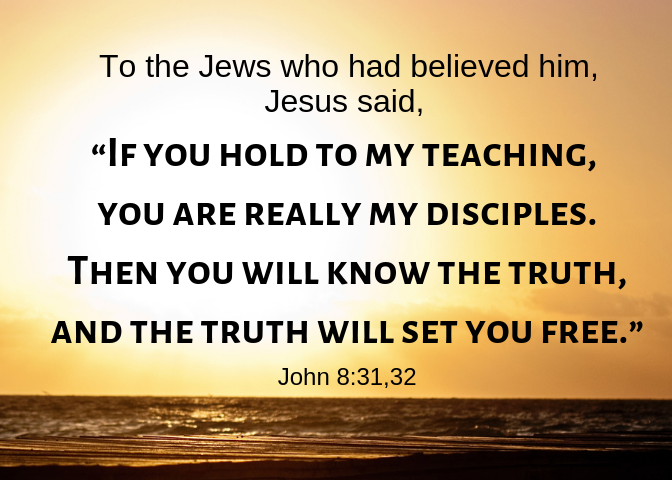
In John 8:32, Jesus said to those who believed in him, “You will know the truth, and the truth will set you free”.  Though they lived under occupation, the Jews were not enslaved, and this pronouncement from Jesus befuddled them. They didn’t know slavery, so how or why would they need to be set free?

Jesus is, of course, speaking of the enslaving forces of sin. Whoever practices sin is a slave to it. The Apostle Paul writes that the wages of sin are death. So, this enslavement that Jesus speaks of is that sin that leads to death. The Mosaic Law highlighted sin, made sin apparent in the lives of those under it, but the law did not eliminate sin. The law did not remove temptation and the desire to sin. Jesus, on the other hand, suggests that his teaching holds the keys to throwing off the shackles of sin and death. “If you abide in my word, you are truly my disciples and you will know the truth, and the truth will set you free”. In verse 36, Jesus says, “If the Son has set you free, then you are free indeed”. Jesus’ teachings were/are powerful and are important to follow, but we also need to remember his place as the lamb who was slain to liberate the captives of sin. Our ability to obey Jesus doesn’t free us from sin, but our allegiance to Jesus and his words can give us victory in our daily battles with sin. Jesus paid the price and gives us victory over sin through the New Covenant that is sealed by his blood. While we suffer and struggle with sin, we should not feel enslaved to it because Jesus has already liberated us from the penalty of sin. A great reminder from John later in chapter 14: Jesus is the way, the truth, and the life. 

Reflection Questions:

1.        Do you ever feel enslaved to sin? Do you question why you still feel inclined to sin, even though Jesus has brought forgiveness to you? 

2.        What can you do to deal with temptation? Do we sometimes set ourselves up to sin by not being careful about the situations we allow ourselves to be in? 

3.        Is it encouraging to know that Jesus has given liberation from sin and death, even if we are still experiencing the effects of them? How does this frame how you approach sin? We don’t need to defeat sin; we need to submit to the one who did. How can you take that approach day by day? 

Lost and Found

Matthew 18

Devotion by J.J. Fletcher (Minnesota)

Yesterday, we read Mark 9, and today we see some of its parallels in Matthew 18. The idea of causing “a little one” to sin is here, as well as dealing with one who sins against you, and addressing our own sinful actions. Sandwiched in between these teachings, we read the parable of the lost sheep.

The image of Israel as a flock of sheep is prevalent in the Old Testament. Leaders are viewed like shepherds, but God is the ultimate shepherd. When Israel loses its way, God sends a messenger or “shepherd” to seek out the lost and bring them back to the fold, to the path that they should be walking on.

Sheep get a bad rap. They are often characterized as dumb, but they are far from it. Sheep can remember human faces and differentiate between them. Sheep are herd animals, and the fact that they rely on following the herd, or the sheep in front of them, contributes to the mischaracterization of their lack of intelligence.

You have probably followed someone whom you had a level of trust in, but at some point, you realized that you had followed them the wrong way. Was it easy to course correct, or did you wander for a while? Did someone have to come and find you to bring you back to where you were supposed to be?

There’s a saying that not all who wander are lost, but many who wander are in fact lost. We follow the wrong crowd or come under the teaching of someone who is guiding us in the wrong direction. Those of us who are parents are acutely aware of how challenging it is to raise our “flock” in a culture that embraces self-gratification and relative truth (my truth as opposed to objective truth). Maybe we have become devotees to tradition rather than God’s commands (see the Unwritten Rules devotion from Tuesday). 

We probably all have friends or family members who have gone astray, and we desperately hope to get them back to the flock. We see that God has that same desire, for the lost to be found, to be reunited with his flock. There is much joy when someone returns. The rejoicing over the one who returns over those who remained is not a statement of value; all the sheep are valuable. The celebration is that the one who has been saved from death is now safe, like the 99. 

There are powerful testimonies from people who have lived problematic lifestyles, who walked in a way that was destructive or even dangerous. Many of us have boring testimonies. What a joy to have not had to be saved from a life of trauma, addiction, or danger! We celebrate those powerful testimonies not because those who have struggled are better, but because we can see in their stories the power of the one who went out and found them.

Reflection Questions:

1.        Think about ways that you were lost and how God brought you back. What methods did he use? How can you see His handiwork in your faith story?

2.        How has God used you to seek out his lost sheep? When you feel God’s prompting, do you embrace it, or have you struggled and responded in some other way (Jonah, anyone?)? 

3.        What ways can we work to keep the flock together and avoid having that one sheep split off that we may need to go searching for?

Three Areas to Consider Your Conduct

Matthew 17
Mark 9
Luke 9:28-62

Devotion by JJ Fletcher (Minnesota)

Several sections in part of our text today (Mk 9:33-50) stand out to me as timely. The wisdom of Jesus is always timely, but these jumped off the page (screen, really). Contending with our brothers and sisters (think humility), contending with those that are not in our tribe (think bridge building), and our example to those who come up behind us in the faith (think training and discipleship).

Jesus, likely already knowing the answer to his question, asks his disciples what they were discussing on the road to their next stop. The subtext indicates that they were embarrassed, for they were arguing about who was greatest, or who would have the highest standing in the hierarchy under Jesus.  Jesus’ teachings place a lot of value on humility and submission to God. When looking at the Pharisees, we see that they valued their status and relied on that status to give them advantages in their lives. Jesus says in verse 35 that “if anyone would be first, they must be last and a servant of all”. This reminds me a little bit of John F. Kennedy’s line, “Ask not what your country can do for you, but what you can do for your country”. Being a good citizen means that you are not just looking out for your own needs but looking out for the welfare of those around you. How can you help build others up, and how can you protect and advocate for others? Those are questions a good citizen might ask. One might also ask how they can hold themselves accountable as they try to make a difference. 

The disciples clearly cared about what Jesus was doing and teaching, but they seemed to have too much focus on what the benefit of their relationship to Jesus might mean for them and their status. Living as a follower of Jesus has some similarities to living as a citizen in our own contexts, but it has a greater scope and reach. As future citizens of the Kingdom of God, we need to be looking at how to build up other Kingdom citizens. This means that we shouldn’t be squabbling or striving to have the most prominence, status, or influence. We should be striving to do good. In doing good, we may perhaps become influential and be respected, but that should not be our primary goal. We need to work to please God, not to please or appease men. We should not be working to satisfy the needs of our ego, but rather let ourselves decrease, so that Jesus might increase.

We next jump to the disciples telling Jesus that someone who was not in their group was casting out demons in Jesus’ name. This bothered them because they somehow thought it was improper for someone to be doing good works, but not be officially affiliated with Jesus. Good is good, whatever the motivation might be. Unbelievers can do good things. Does that mean we should stop them? There is an opportunity to form coalitions with people that we might not otherwise align with, and in doing so, we might create more opportunities to speak into their lives and influence their thinking. Now, sometimes someone might represent something that we can’t in good conscience join with, but that is not what appears to be happening here. Perhaps the disciples see this as Jesus not getting credit, but that would be a weird take since they were calling out the name of Jesus. Perhaps it ties into their ego thing a little bit; if those who are not with Jesus can do this, it diminishes what we are doing with Jesus. Jesus makes this point that we should take to heart: “the one who is not against us is for us”. We can stand alongside, or leave alone, those who are doing good things that go along with the works that we should be doing, even if they have a different motivation for doing them. We can work with other Christian groups to serve, even if we don’t agree on everything doctrinally. You can take the stand of not sharing in communion over certain differences while still trying to meet the needs of others.

Finally, we get this idea from Jesus: If you become a stumbling block for others, specifically, it seems young believers, it’s a travesty. Essentially, we get the idea that you’d be better off dead than to cause someone to sin. It’s a good reminder that eyes are always watching you. When you serve in public and when you live in your private life…your church is watching. Your kids are watching. Your friends are watching. What are you communicating with your actions? Are you living on the up and up? Are you abusive in some way that might drive someone away from the gospel? Your example or your direct action toward an individual or group can have a lot of influence on how someone grows and lives. You can be salt and flavor the world for the kingdom, or you can be like expired milk and be good for nothing. 

We always need to be mindful of our ego, our behavior, and our influence. We should be examining these things in light of the gospel and the life and teaching of Jesus, and see how we’re doing and where we might need help. We should always aim to learn from mistakes, whether they are our own or made by another.

Reflection Questions:

1.        Do you ever find yourself in the same kind of spot as the disciples, concerned with your status in the church or in another group? What drives that, and how can you combat that trait?

2.        Do you sometimes get the urge to dismiss a person or group that is doing something good simply because they don’t share your motives or affiliations? What is the danger here, and what cautions might one need to take when trying to make inroads with groups that might not share motivations, but do share similar convictions and goals?

3.        What do you think of Jesus’ saying that it would be better to have a millstone tied around your neck and be cast into the sea than to cause one of these little ones to sin? What kind of perspective should that give us when evaluating our conduct and behavior? 

The Big Picture

Matthew 16, Mark 8, Luke 9:18-27

Devotion by JJ Fletcher (Minnesota)

It can be easy to get into the weeds when discussing and debating theology. There are many years behind us of writing and interpretation of the scriptures, and we can easily lose focus on the big picture when we’re bogged down in the minutiae. One could simply read scripture and take away that Jesus died for the sins of the world and that whoever believes in him will be saved. On the flip side, books have been written digging into how Jesus’ death and resurrection functionally deal with sin. Atonement theories such as Penal Substitution, Christus Victor, and Scapegoat Theory (among others) are ways to try to understand exactly the process through which God forgives through Jesus. The main thing we should remember is that the blood of Jesus brings forgiveness, regardless of the thoughts that we might have about how exactly God reconciles everything through Jesus.

The Pharisees were very much concerned with the letter of the law. Now I believe we should strive to understand scripture, but sometimes I can allow my views on specific doctrines or practices to overshadow others. We need to be striving to see the big picture and get to the spirit behind the words of scripture.

In today’s text, we see Jesus’ warning against the leaven of the Pharisees. This calls out things like false doctrine and hypocrisy that were present in the lives of the Pharisees that clashed with Jesus. This bad leaven will corrupt the “bread” that comes from it.

Jesus recognizes that there are key things that the disciples need to know and understand, specifically relating to his death and resurrection. But also, the big picture needs to be in view. Jesus asks Peter, who do people think that Jesus is, and he spits off a few theories, but then Jesus asks Peter who he thinks Jesus is, and he answers: You are the Christ, the Son of the living God.

Big Picture. None of the things that Jesus shows and teaches Peter and the disciples will be impactful without this pig picture. Jesus is the Son of God. Jesus is the Messiah. This confession is the foundation of the Church. We’re not always going to agree on everything, but we must agree on this primary fact: Jesus is the Savior, and in Him we must put our faith and hope. 

Reflection Questions:

1.        What distracts you from the big picture?

2.        Does your need to know how sometimes distract you from simply accepting what you read in scripture?

3.        Have ingrained habits or false things that you have been taught stood in your way of implementing your faith in every aspect of your life? Take a step back and look at the big picture in scripture and weigh your thoughts against what you see in the Bible.

The Unwritten Rules

Matthew 15, Mark 7

Devotion by J.J. Fletcher (Minnesota)

I’ve been following baseball for around 30 years. My dad was (and still is) a Baltimore Orioles fan, but when the time came for me to pick my team, I pledged my allegiance to the Atlanta Braves. In the late 90s, one of my most despised teams was the Montreal Expos. In 2005, the aforementioned villains moved to Washington, DC and became the Nationals. My dad was also a Senators fan when he was a kid, growing up just outside of DC, so he also began rooting for them after the move brought the nostalgia of baseball back to the nation’s capital. My dad has always given a couple of my brothers guff for being Yankees fans, but I felt similar betrayal.

Baseball is known for its “unwritten rules”. Though these rules are waning as younger players enter the league and the stalwarts retire, they still exist to some degree. Your best player gets hit by a pitch? The next guy up in the opposing lineup is taking one in the ear or back. You don’t celebrate home runs, or you get hit the next time up. You don’t walk over the pitcher’s mound or bring up the fact that a perfect game is going on. The list goes on and on, but you won’t find them written down anywhere official. They have not been codified in the official MLB rule book. But the players expect each other to abide by these traditions that have become known as the Unwritten Rules.

We see some Pharisees confronting Jesus about his disciples not conforming to the “Traditions of the Elders”. Specifically, the disciples are not washing their hands before they eat. Now, there are some regulations in the Torah about washing hands, but they are very specific. They have nothing to do with washing hands before eating. Over time, new “rules” or traditions morphed from the written law into behaviors that were expected, perhaps even viewed as equally important to the codified text of the Torah.

Think of your time attending church. Growing up, there were probably some things you were told not to do (running in the sanctuary) that don’t appear anywhere in scripture, but people were passionate about it (you’d better dress up for church). Some churches have certain ways of doing things: Do you take the Lord’s Supper weekly, monthly, or quarterly? Do you use grape juice or wine? Who can pass out or pray over the emblems? Is it sacrilegious to have a guitar on stage? Maybe you’ve moved from your childhood church, or maybe you’re like me and have moved many times. Things are different at your current church, right? So, who is right and who is wrong? Or are different ways of doing church equally proper? 

Sometimes the way we do things is perfectly fine, but it’s not necessarily “the right way”. We sometimes run into obstacles when someone tries to serve in their church, and the status quo gets in the way. There are times and seasons for various ministries. Often, the reason that something is done a certain way is because the first person who served in a role or started a ministry did things that way. It was a fine way to do it, but was it the right way? Was it the only way? Maybe there’s a better way? Or maybe it just comes down to being a different way, because a different person is leading a ministry or function of the church. It’s ok to have preferences, and it’s ok to do things WAY differently from other churches. The main thing is to make sure that what we are doing is furthering the Kingdom of God and benefiting the body of Christ. Sometimes it will be necessary to restrict things or do things in a particular way because scripture instructs it. The Bible and our faith should never be weaponized to keep us comfortable, but rather our sword and shield should be wielded to fight spiritual battles. We are to fight against darkness, not dwell in or create a new kind of darkness, but I’m afraid that can sometimes happen when we cling to traditions the same way that we cling to the hope of the Risen Savior.  

Back to the Pharisees. They were calling out the disciples for violating the unwritten rules, which had no true basis in the Law, and treating them like lawbreakers. Jesus points out the irony of them making these accusations. By following the tradition of the elders that allows one to declare something as “corban”, to be set apart for use in the temple, they are violating the Law of Moses. By setting aside money that might be used to support their elderly parents to instead go to the temple (where they may then benefit from it due to their roles) they are not honoring their parents, which by the Law is punishable by death. 

Jesus quotes Isaiah 29:13 “This people honors me with their lips, but their heart is far from me; in vain do they worship me, teaching as doctrines the commandments of men.”

Traditions can be valuable. They can be invaluable. They cannot equal or trample the law or instruction that comes from God. 

Reflection Questions

  1. What traditions do you hold dear? How would you approach someone who wanted to do something differently?
  2. How might you deal with a person in a loving way who is clinging to tradition to the detriment of another, to the body at large, or even to themselves?
  3.  Is there an evaluation process in place to think about how and why your church does certain things and considers how things may need to change over time?

Bread: Not Just a Comfort Food

John 6

Devotion by J.J. Fletcher (Minnesota)

Hunger is a powerful thing. It can affect your mood, and it can cause you to make poor decisions. There’s the old saying, “never go shopping on an empty stomach”. You will buy stuff that you don’t really need because your mind is affected by hunger. I can relate to that. Once upon a time, while I was at the Bible college, a friend and I decided to go on a green tea fast. On the day that we broke the fast, I went grocery shopping and spent way more money than I should have on food, and I’m pretty sure most of it went to waste. I was buying out of hunger, not necessity. I’m sure you can relate to my bad habit of stopping and getting horribly unhealthy food because you were hungry, and it was quick and convenient. Maybe you decided to stop because it was a cheap option?

We see the miracle of Jesus feeding 5000. There were a lot of extra people around because Passover was coming up soon. They find themselves in the conundrum of not having enough food for all these people who are gathered to hear Jesus. They could perhaps go buy food, but that would take a lot of time, not to mention money. And how do you source food quickly for this many people? How many people would be required to carry it back? I don’t really think there’s an avenue for coordinating food for this gathering.

Jesus ends up telling the disciples to gather up all the food that the group has collectively. What they end up with is a boy who has five loaves of bread and two fish. This is a laughable amount of food for a group of 5000 plus. Jesus prays over the food, and they start passing it out, and they pass and they pass, and they pass and they end up having leftover food after everyone has eaten their fill. What a miracle. Jesus perceives that the people being moved by this miraculous action are going to try to grab him and make him king forcibly. It is not the proper time, nor is this the proper motivation. Jesus is king because God declares it himself, not because of this miraculous meal.

Jesus withdraws to be by himself. The disciples set sail across the sea without Jesus, but encountered him walking on the water. They are freaked out, but they’re glad when they see it’s him, and once he’s on the boat, all is well. But the crowds are hungry for more and start to search for Jesus.

The people want to see more miracles, but that is not the purpose of Jesus’ ministry; rather, an attestation of the power behind him. Jesus’ message of the Kingdom of God is truly powerful. Jesus says that the crowds are not seeking him, not even after the power behind the signs that they saw, but because they had been well fed. 

The people bring up the desire to see miraculous signs and recall that their fathers ate manna in the wilderness. Jesus, comparing his role to that of Moses, says that it was not Moses who fed the Israelites in the wilderness, but that it was God. He warns them of seeking temporal comforts and satiety; rather, they should seek after the true life-changing and life-saving power of God. Jesus’ claim that he is the “bread of life” or “bread come down from heaven” is a claim that God has ordained, empowered, and approved his Kingdom ministry and his standing as the savior. 

It is a long and winding road that leads to the cross. Many will reject the bread of life for the bread of satiety or comfort, or maybe bread leavened with the yeast of the Pharisees, but many do take Jesus up on his “the bread of life” offer and are the beneficiaries of God’s amazing power that was and is at work in the hearts of the redeemed.

Reflection Questions

  1. What significance do you see in the contrast of Jesus’ miracle, the manna of the Exodus, and the Bread of Life that Jesus speaks of?
  2. Does the metaphor of food effectively drive home Jesus’ emphasis on the importance of the Gospel for true life?
  3. In what ways can you take Jesus’ words from John 6 and apply them you your life in a way that strengthens your personal ministry?

Fruit over Frustration

Matthew 14, Mark 6, Luke 9:1-17

Devotion by J.J. Fletcher (Minnesota)

John the Baptist was a prominent figure in Judea in the time leading up to the ministry of Jesus. We see John as a forerunner to Jesus, preparing his hearers for the one who was to come, who was greater than him. John had a strong following and his own disciples that followed and supported him, not unlike Jesus. John’s following meant that on the day of Jesus’ baptism, there was likely a fair-sized crowd. While we don’t get much backstory on any interactions between  John and Jesus prior to the baptism, we know that they were cousins. John had his enemies as he was unafraid to speak truth to power, and this led to his demise at the hands of Herod. Perhaps Herod was paranoid after what was an unpopular execution of John, but we see a bit of a “conspiracy theory” as Herod attributes or considers the possibility that the power at work in Jesus’ ministry was potentially a resurrected John the Baptist.

We see throughout Jesus’ ministry a habit of going off to spend time in solitude. When Jesus hears the disappointing news of John’s death, this is where Jesus retreats. To solitude and time spent in communion with his father.

As we see Jesus dealing with this news in our reading today, we are shown a window into some of the grief and disappointment that Jesus experiences. Some time later, we’ll see Jesus’ grief and struggle as he begs God for another way to achieve God’s purposes, that doesn’t include his death and abuse. Here, we can see some more relatable moments.

John’s death probably puts a stark focus on the path before Jesus. As a prophet and teacher who will be walking a similar path, he becomes acutely aware of the reality that he is facing. He knows the path ahead, but knowing in theory and seeing in real-time are very different. 

We know through scripture that there will be those who hate us because of Jesus’ name, actually experiencing it or seeing others you know suffer for his name’s sake, stand in contrast to being aware of the possibility. Jesus sees the carnage of wicked men play out early on in his ministry. 

The death of John is not the only discouraging and disappointing thing that Jesus experiences. 

Jesus returns to his hometown of Nazareth. Now, when there are rumblings of a hometown kid making powerful impressions, there can often be a rallying of excitement. Local kid makes it to the big leagues or finds success in the music scene. There can be a sense of excitement, but that is not what is experienced by Jesus. While those who come to hear him in the synagogue recognize that there is wisdom in his words and that there have been powerful works done by his hands, they resent him rather than embrace him. It’s that son of Joseph and Mary… How is a tradesman going to come in here and teach us about the Law and Prophets? That line about a prophet having no honor among his people communicates a reality that I’m sure was stinging and disappointing. No support from your family or the community that helped raise you.

Jesus, I’d assume disappointed and discouraged, presses on and continues his ministry elsewhere, where people would receive him, and mighty works could be done.

Jesus does not allow discouragement and disappointment to stand in the way of his calling and ministry of the Gospel, and neither should we. When we are called, it is not to a life or ministry of ease. There will he highs and lows. There will be good times and bad times. There is a season for everything, as the Byrds sing (er, as Solomon writes). We need to recognize that the same power that Jesus relied on to support and sustain him (and that ultimately raised him from the grave) lives in us, and that that Spirit of God is capable of far more than we can imagine. Discouragement should not equal defeat, but rather create an opportunity to overcome difficulty and live lives of obedience in the face of discouragement or fear. Victory can be found through reliance on God when our own mettle runs low.

Reflection Questions

  1. What was a difficulty or discouragement that you have faced, and how did you respond? What lessons did you learn from the way that you handled the situation?
  2. How does a glimpse into Jesus’ responses help you? What can we glean from these small, yet powerful details?
  3. Are there things that we can do now to prepare ourselves to respond or cope with disappointment in the future?

It Was Just a Touch

Matthew 9-10

Devotion by Shelly Millard (Nebraska)

Yet another day filled with nonstop demands.  Coming off of the Sermon on the Mount, Jesus was besieged by disciple gathering, teaching, preaching, casting out demons, raising the dead, calming the sea and continually surrounded by crowds with physical and spiritual needs.    As people were clamoring for his attention, he was able to pivot toward the need, to be present in the moment and respond to the need whether it was physical, emotional or spiritual..  He was taking a quick break to eat when Jairus, a leader of the local synagogue came to Jesus with a big request.  His daughter had just died and he was asking Jesus to come to his house to raise her back to life.  Understanding the urgency, Jesus got up from his meal and started walking toward Jairus’ home. 

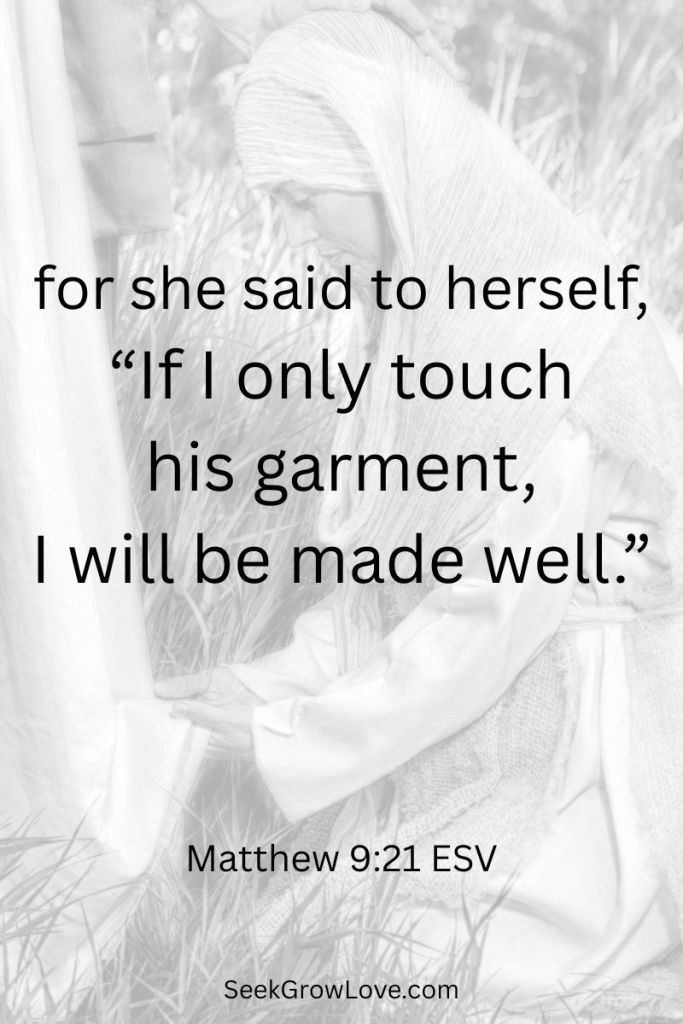
The crowds were pressing in on him, jostling as he tried to move forward.  But he suddenly stopped and said, “Who just touched me”?  The version of this story in Luke indicates that his disciples thought this was a ridiculous question as many in the crowd had been touching him.  Yet, this touch was different because Jesus immediately felt power surge from him.  He turned and identified the one who touched him as a woman who had been hemorrhaging for 12 years and was hanging on by a thread.  She had searched for help, but because she was bleeding was considered unclean with no one allowed to touch or help her.  She had heard about Jesus and knew that he was her only chance.  Being desperate and determined, she fought her way through the crowd with the belief that if she could only touch the hem of his robe, she would be healed.  In Jewish culture, the hem or fringe of a garment, known as the “tzitzit,” held religious significance as a reminder of the commandments of God. The act of the woman reaching out to touch the hem of Jesus’ garment can be seen as an expression of her faith in His divine authority and power to heal. Her belief that merely touching His garment would result in healing underscores the depth of her faith and the recognition of Jesus’ messianic identity.  She was very deliberate in her action, one that was fueled by her faith. He looked at her with compassion. He saw so much more than she saw, so much more than others saw. He saw a woman who had enough faith to reach out despite her unclean condition. He saw great faith from one who was marginalized, a woman who was bleeding. 

In that moment, she was not only healed of her physical problem, but she was also healed spiritually and emotionally as Jesus addressed her as daughter.  No longer was she unclean or an outcast, she was included in his family and found a place where she could now belong.  Jesus saw in her a great faith and knew that she had come to him out of desperation, with determination and with her intentional act of faith, received her healing. It was a small, seemingly insignificant act, that resulted in her transformation, both physically and spiritually.  This woman, who acted with the courage, deliberate action and with the intention to connect with the Son of God was transformed from an outcast to a daughter and one who has traveled through history to reveal to us an example of great faith. 

Questions for reflection

Imagine yourself in the crowd that day.  People were pushing and jostling Jesus, perhaps wanting to see what he was going to do with the daughter of Jairus.  How do you think the crowd reacted when he stopped to look at this woman who was unclean?

What characteristic of this woman in the story do you find most intriguing?

Why do you think she was focused on touching his garment rather than addressing him directly?

Have you ever had a time where you felt on the “outside” or marginalized like this woman? How do you think she reacted when he called her “daughter”? 

What insights about faith demonstrated by this woman can we gain about our own faith?

How determined and intentional are you about your own faith?

Calming the Sea

Matthew 8:14-34
Mark 4-5

Devotion by Shelly Millard (Nebraska)

It had been a flurry of activity and much of it miraculous.  Following the Sermon on the Mount we see the healing of the Centurion’s servant, healing Peter’s mother-in-law, and then crowds overwhelming him for healing of the sick and casting out spirits.  He was exhausted and knew he needed rest, so moved onto gathering his disciples in a boat and set out on the Sea of Galilee with his disciples to escape the pressure of the crowds. He quickly fell asleep, oblivious to a building storm.  The boat was buffeted about in the wind and waves; the storm so strong that it was described as cataclysmic or a mega storm.  The disciples, several of whom were fishermen and used to life on the sea, became frightened, fearing they were going to die.  In their fear, they woke Jesus, crying that they were about to perish.  His first response was to respond, “Why are you fearful, you of little faith?” He then gave the command for the wind to abate and the waves to calm, a remarkable illustration of power over the elements.  Jesus often used that phrase “little faith” to challenge his followers.  He is saying just look at me and see what I can do. . . that is what a mature faith looks like.  A big faith, one that is developed, is one where eyes and heart are fixed on the master of the wind even in the midst of the storm.

Fear is something that we are well acquainted with.  Our brains are wired to look for threats to help ensure our survival.  If we are walking through the woods and a bear jumps out, it triggers a fight or flight response to help us react in a way to help us survive—either fight the bear or hope we can run faster than our companions.  The disciples, in the midst of this storm, feared for their life—they were in a fight or flight response.  Jesus, however, took this opportunity to teach a lesson about faith.  These disciples had just been witnesses to incredible miracles; yet in their immature faith, were afraid for themselves.  We’ve all been there, finding ourselves in the midst of life’s storms and being battered by circumstances beyond our control or even by our brain’s proclivity at conjuring up imagined threats to our wellbeing.  Consequently, it is easy to get caught up in a cycle of fear and anxiety about our lives.  A loved one becomes ill, someone loses a job, financial problems hang over our heads, and in addition, we are caught up in a myriad of “what ifs”.  What if I fail? What if my relationship falls apart?  What if I disappoint others? And the list goes on and on in our weary brains.  Jesus speaks to us as he did to his disciples. . . what about faith?  Where does your faith impact your fears in your life?  How would it feel to have some freedom from the fears that seem to plague us?  Faith does not pretend that a storm does not exist. It does not exempt us from efforts to take care of ourselves and others. Faith ensures that we are not overcome with anxiety, stress and worry.  Faith allows us to focus on Jesus who provides the calm in the midst of our storms.

Questions for reflection

What are some of the storms you are experiencing right now? 

Imagine yourself in the boat with the disciples.  How overwhelming does that fear feel?   How would you respond to Jesus commanding the storm to abate?

Jesus uses the phrase, “little faith”.  Where are you in your faith journey?  Do you feel like your faith is growing and developing into a more mature faith?

How is your faith impacting some of the fears you are experiencing in your life?  How do you think you can find the peace within the midst of your storms?

Storytime in the Gospels

Matthew 13 & Luke 8

Devotion by Shelly Millard (Nebraska)

Storytime when putting the grandchildren to bed is the best.  One of my favorite books is called “Tale of Two Beasts”.  In the story, a little girl is walking through the forest and finds a small beast hanging upside down from a branch.  She decides to take this little one home and turn him into a pet.  The book first tells the story from the perspective of the little girl.  The second part of the book tells the story from the perspective of the little beast.  Gradually, the two tales come together in a happy ending as they learn to appreciate one another despite their differing perspectives.   I love the book because it teaches something I think is important and that is to step back and consider the perspectives of others throughout life.  Many, if not most, children’s books attempt to teach a lesson through storytelling.  In Matthew 13, we see that Jesus knew the power of stories in teaching abstract principles through parables.   He knew that using parables was an effective way to communicate profound truths about faith and life.  He merely looked around him and identified familiar elements and characters like farmers, fishermen, bread making, and harvesting crops that could be used to help his listeners understand deeper spiritual truth.  Using learning principles that we’ve identified today, he uses metaphors and similes to draw comparisons of the everyday to deeper spiritual truths. These stories stay with us and help us to understand and remember what Jesus wanted us to know. The stories told over 2000 years ago still have relevance to us today.

The beautiful thing about parables is it teaches a truth that at first glance seems simple yet allowing for increasing layers of understanding.  Like the layers of an onion, a parable provides layers of depth and nuance that with reflection and application can reveal increasing insights while challenging individuals to grapple with the truths and grow from them.  Jesus is using these stories to turn the listener into a participant rather than just the audience—the best way to learn. Parables Jesus shared are sprinkled throughout the gospels;  Matthew 13 contains several significant ones teaching about faith and the Kingdom of God.

Parable of the Sower: A sower scatters seeds on different types of soil; the path, rocky ground, thorn and good soil with each type of soil representing different responses to the message of the Kingdom of Heaven.  It asks, “How do you receive the message of the kingdom?”

Tares and the Wheat: The combination of tares and wheat together teach lessons about the coexistence of good and evil in the world, emphasizing the importance of discernment and patient waiting. It asks, “How do you understand and identify between good and evil?”

The Mustard Seed: Just as a tiny mustard seed can grow into a large plant, even the smallest amount of faith can be transformative.  It asks, “How does your faith, even if it is found in small belief and actions, lead to significant outcomes?”

The Leaven: A woman mixes leaven into the dough causing it to rise and transform into a delicious loaf of bread just as the message of the Kingdom of Heaven can gradually and irreversibly alter the world.  It asks, “How can you be influential by sharing the message of the Kingdom of Heaven?

Hidden Treasures: A man discovers a treasure and recognizes its value, selling everything to buy the field where the treasure is hidden. The discovery of the message of the Kingdom of Heaven is a remarkable treasure that is worth sacrificing everything to obtain it.  It asks, “What are you willing to sacrifice to pursue the incomparable value of the Kingdom of Heaven?”

Costly Pearl: A merchant is actively searching for fine pearls and when he finds one of great value, sells everything he has to purchase it just as a person searches for truth and spiritual connection.  It asks, “How are you diligent in your search for truth and are you willing to give up everything to make it yours?”

The Dragnet: The fisherman casts out a net that gathers in all kinds of fish, just as the message of the kingdom will gather in all types who will eventually be subjected to God’s judgment.  It asks, “How do you respond to the “all types” gathered together by the gospel message”?

As you engage in these stories, immerse yourself in the “world” that Jesus is creating for us.  If it is the Parable of the Sower, imagine yourself walking through the field and seeing where the seeds you scatter are landing.  If it is “The Leaven”, imagine that you are the one making the bread and leaven to make it rise.  Becoming a part of the story will allow you to deeply engage with the lesson Jesus is teaching.  Approach them with an open heart and mind, asking, “What can I learn and take away from this story”.  Reflect on the story and connect the teachings with your own life asking, “How is what I am learning impacting my faith, my relationships and my behavior”?  The ultimate test is to begin to apply what you have learned and allow those insights to change how you live. 

Questions for reflection

Which of these parables resonate most closely with you?  

Focus on one parable.  Imagine yourself in the context of the story and immerse yourself for a moment in the action.   How does that impact your understanding of the parable?

If Jesus was walking through your world today, what might he choose to build a parable around?

How do you think a parable might increase your faith?