The Power of His Resurrection

2 Chronicles 3-4

Psalm 77

Philippians 3

-devotion written by Pastor Jeff Fletcher and posted for SeekGrowLove on August 23, 2023 – Pastor Fletcher died last November and is awaiting the return of his Lord Jesus Christ and the amazing resurrection of the dead – what a day that will be!

            “There Ain’t no grave, gonna hold my body down. There ain’t no grave, gonna hold my body down.  When I hear that trumpet sound, gonna rise right outta the ground. There Ain’t no grave gonna hold my body down.”  I love hearing Johnny Cash sing that song with his old, gravelly voice.  He recorded it not long before he died.  I imagine he was thinking a lot about death at that point in his life.  Most old people do think about death.  And most young people I know don’t think much about death.  We all know vaguely that we are mortal and that one day, somewhere far down the road we will have to face our own death, but we usually try to distract ourselves from the reality of death by thinking about other things.  In his Pulitzer Prize-winning book The Denial of Death, Ernest Becker wrote: “Modern man is drinking and drugging himself out of awareness…”. I think that’s pretty accurate.

            Personally, I never thought much about my own death until I was diagnosed with cancer 7 years ago (I’m still here).  Cancer doesn’t automatically mean you are going to die, in fact, the majority of people with cancer do not die from cancer, at least not right away.  There are many treatments to delay or send many cancers into remission.  But I can tell you from experience when you hear the word cancer it does make you at least think about death, not just as a remote possibility but as something that you will actually have to experience someday.  I imagine an accident or other near-death experience will do the same thing.  PTSD (Post-Traumatic Stress Disorder) can be caused by exposure to death or fear of dying.

            People deal with the fear of death in a variety of ways. One approach goes back to the time of Epicurus 300 BC who taught that there was no judgment or afterlife.  When you die you simply cease to exist.  There is no future reward beyond this life, and there is no fear of future punishment.  Modern day atheism has embraced this approach to death.  Another common approach to dealing with death is the denial of death by believing in the natural immortality of the soul.  We are all immortal by nature.  Our bodies die but our souls are immortal and when our bodies die our souls live on in another place like heaven or hell or come back in another form, reincarnation.

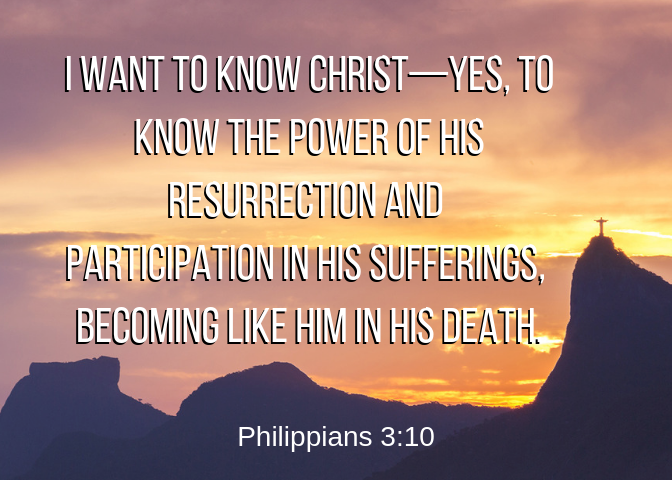
            The Apostle Paul offers a third, biblically consistent, and hope-filled understanding of death.  We are mortal by nature, not immortal.  Death is a reality, but it does not have to be the final reality.  In Christ there is the hope of the resurrection from the dead.  Just as Christ died and went to the grave and on the third day was raised from the dead (in the same way that Jesus had previously raised Lazarus from the dead) Paul hoped that in Christ he too might attain the “resurrection from the dead.” (Philippians 3:11 NRSV). 

            Paul’s hope was that his savior, the Lord Jesus Christ who is currently in heaven will come and transform “the body of our humiliation” (Phil 3:21) into a glorious body like Jesus is today.  Paul’s term “the body of our humiliation” can also be translated as “of low estate” or even “vile”.  In my work at a hospital chaplain, I am daily acquainted with how our bodies suffer decay and corruption.  When people are sick the fragility of their bodies is exposed.  The fragility of Jesus’ body was also exposed in his crucifixion.  Ultimately, our fragile bodies will suffer disease, injury, and slow decay and we will die.  But our hope in Jesus Christ is that he will come again and raise our bodies up in glory, in bodies that are no longer corrupt and subject to death.   This is our blessed hope.

            For Paul there was a daily awareness that he had not yet arrived at the fullness of the resurrected body, that will only happen when Christ comes at the end of this age.  So for now Paul’s focus was to “press on” (Philippians 3:12) or “strain forward” (3:13).  It gives us the image of a runner keeping his eye on the finish line.  Paul is saying “keep your eye on the prize”.

            Paul contrasts this way of being with those whom he says live as though they were “the enemies of Christ”.  Their gods are earthly things (their belly or human appetites- 3:19).  Paul makes their end clear – destruction (3:19).  For Paul, humans are mortal, death is a reality that we will all face one day. For those who make themselves an enemy of Christ by rejecting him and making their own appetites their gods, the end is final destruction.  But for those who put their hope in Jesus Christ, whom God raised from the dead, their hope is to be raised up from among the dead to be transformed into a glorious body like Jesus has been transformed into at his resurrection.  A body that is not corruptible and cannot die.  They will be clothed in immortality by Jesus upon his return from heaven.

            I hope that you, like Paul and like me and countless other believers, trust in Jesus Christ and keep pressing on to follow him.  Keep your eye on the prize.

            “There Ain’t no grave, gonna hold my body down. There ain’t no grave, gonna hold my body down.  When I hear that trumpet sound, gonna rise right outta the ground. There Ain’t no grave gonna hold my body down.”

-Jeff Fletcher

Reflection Questions:

  1.  What value can you see in understanding the reality of death and the hope of bodily resurrection at the return of Christ as opposed to the no hope of life after death or the natural immortality of the soul?
  2. Paul named those who were doomed for destruction as those whose gods were their belly/appetites.  What might you name as other appetites/gods of people today?  In what ways do pursuing those gods lead to destruction?
  3. What does the promise of resurrection from the dead reveal to us about God’s character and plan for the world?  What difference does that make in your life?

Prayer

Dear God Almighty, I praise You for Your power and Your plan. What a good God You are! I thank You for Your Son Jesus who teaches us still today, who provided a way for us to draw near to You, who died for us, and You rose from the dead. Thank you for those like Paul, and Jeff, and so many others who have and are faithfully speaking Your words and preparing others for life, death, resurrection and a coming perfect Kingdom with You. Help me, too, to press on, to be ready and to actively share the good news with others. In Your Son’s name I pray.

I Am NOT More Significant

2 Chronicles 1-2

Psalm 76

Philippians 2

-Devotion by JJ Fletcher (MN)

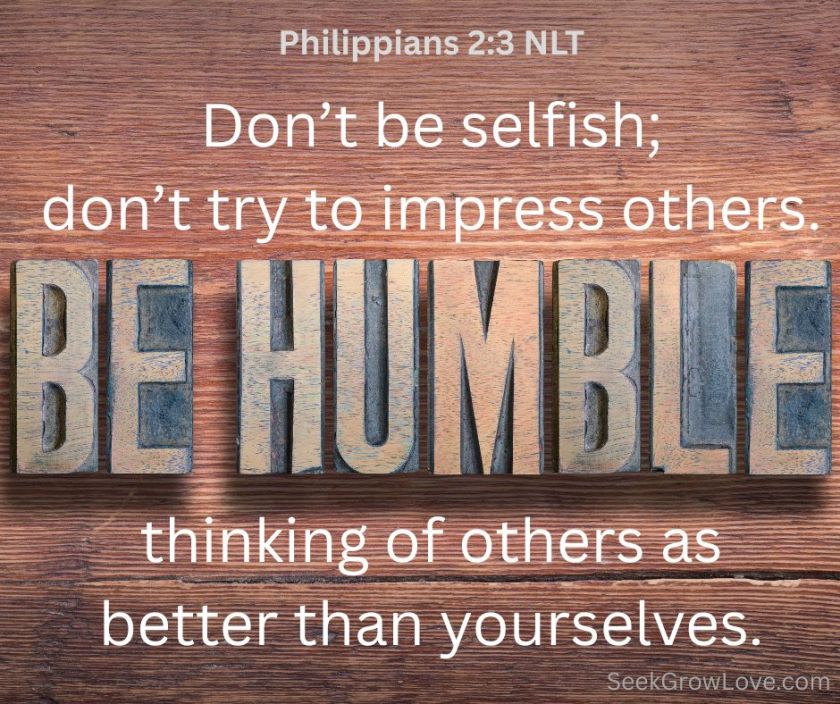
Do nothing from selfish ambition or conceit, but in humility count others more significant than yourselves.

(Philippians 2:3 ESV)

Be humble. Paul says to count others as more important than yourselves. Selfish ambition and conceit have no place in a life of faith. Jesus doesn’t try to bypass God’s will and establish the Kingdom in his own timing; rather, he understands God’s redemption plan and the need for his sacrifice. He puts the lives of his friends and the future of the church ahead of his desire to escape pain. Succinctly put, he counted others as more important than himself. Contemplate what putting this into practice looks like day by day.

Don’t grumble. This may be hard to grasp, but grumbling and complaining are not spiritual gifts. I jest (kind of…), but if you have been around people for any length of time, even in the church, you have heard someone complain. Some people seemingly enjoy complaining or feel like it is their duty to point out everything that is “wrong” (maybe they were never taught how to channel those thoughts in a constructive way).

Sometimes we grumble and complain when things are tough and unpleasant, but other times we complain because we don’t like the way something is done. Maybe it’s due to our preferences, or maybe it’s because we think we could have done better (i.e., pride). Whatever the case may be, we should not be going through life with our default being set to complain about everything that does not go our way.  

There are tons of things that I don’t like. I don’t like Mondays; I don’t like it to be over 72 degrees outside, and I am not enamored by the chorus “As the Deer”. Whether it is the weather, the way we feel about starting our work week (also, what is a weekend?), or our worship preferences, we are responsible for how we conduct ourselves: our attitudes, our actions, our responses to all stimuli. I can choose to roll my eyes or be grumpy, or I can choose to have a good attitude. 

One mind. Paul’s desire is for the body to be of one mind. Being of one mind, Paul wants us to have the same mindset as Jesus. As we strive to work, worship, and live in unity, we should be following his examples of humility and conduct.

Fear and trembling. Paul says to work out your salvation with fear and trembling. All parts of our lives should be evaluated under this primary question: “Does this honor and glorify God?” This should impact our theology, our church structure, and our conduct toward others. There are lots of ways to live out our faith; some ways are correct, and some are not, but some are just flat out different than others and are equally useful for bringing God glory. 

Reflection Questions:

How does my behavior reflect my faith?

What message does grumbling and complaining send?

How can we effectively navigate disagreements in churches and in other areas of our lives?

What does having one mind look like in practical terms?

Prayer

Dear God – You have so much You could complain about me. Forgive me for the times I am proud, selfish and complaining. I want to have the mind of Christ. Help me see myself and others as You want me to. Help me catch when I am going in the wrong direction and make the changes necessary to be pleasing to You in my attitude, words and actions.

Courage and Community

1 Chronicles 28-29

Psalm 76

Philippians 1

-Devotion by Kyle Shull (MN)

Since June just ended, the grad party season is starting to wind down for everyone. As a recent graduate from high school, it has been fun to host my own grad party and invite my family and friends to join the celebration. Beyond all the gifts, great food, and endless photos, one question always comes up. “What’s next?” For some, it’s college at a university, trade school, starting/joining a business, or even taking time to reflect on one’s next steps. Regardless, the level of responsibility increases substantially for many young people across America.

In 1 Chronicles 28-29, we see a young Solomon having his responsibilities skyrocket, as he officially takes his father’s place as King. His task from the Lord: build a house worthy of God through the plans that David possessed. This wasn’t a simple task, as v. 11-18 describe exactly everything that he had in mind for the Lord’s house. These verses describe divisions of the priests, the chambers, the treasuries, and detail the exact weight of every lampstand, table, gold dish, silver bowl, and many more items! I can’t imagine the feelings that Solomon would have as his father put his trust in him for one of the most sacred structures in the Bible.

However, David says to Solomon in verse 20-21, “Be strong and courageous, and do the work. Don’t be afraid or discouraged, for the LORD God, my God, is with you. He won’t leave you or abandon you until all the work for the service of the LORD’S house is finished. Here are the divisions of the priests and the Levites for all the service of God’s house. Every willing person of any skill will be at your disposal for the work, and the leaders and all the people are at your every command (CSB).” Later, in chapter 29, David also prays for Solomon to give him an undivided heart for the work ahead.

David knew the task God had granted to Solomon was challenging. However, David’s words echo the need to trust in the LORD and to rely on one’s community. Today, we aren’t the kings of nations, but we are faced with increasing responsibilities and freedoms each day we live. My relevant example was for graduates, but that isn’t the only limitation. Maybe it’s something that we want to do, like take an extraordinary trip with our family. Our responsibilities might be difficult to fulfill, such as taking care of someone in your neighborhood who is experiencing a long-term illness. 

Whatever your next task is, I pray you will ask God for guidance as you navigate the path you must follow. He might not answer everything instantly, but still trust our Father up above, even when your path is narrow. God can also reveal guidance through the people we interact with. David gave all his leaders to Solomon to help with any task that needed to be accomplished. For many of us, that group of people is our church community. Whatever your next step in life is, ask your pastors, teachers, and people inside the church body. The Holy Spirit can work in mysterious ways through people we don’t even expect. 

We can see this sense of community also in Philippians 1. Here, Paul gives gratitude to the Philippian church for their support in spreading the gospel (especially during his imprisonment in Acts 16). Even the Bible’s greatest evangelicals needed support from fellow believers. This emphasizes the need to reinforce our fellow community members on the right steps or the right people to seek help.

Paul ends Chapter One with a wish to the church: “Only let your manner of life be worthy of the gospel of Christ, so that whether I come and see you or am absent, I may hear of you that you are standing firm in one spirit, one mind striving side by side for the faith of the gospel (v. 27 ESV).” Whatever the next chapter is for you, do it while still living with Christ as the center of action.

Reflection Questions:

  1.  The ideas of strength and courage are found in many Biblical leaders in power. Who are some of the people who stand out to you? In what ways can we live with the same biblical courage that these leaders had in our everyday tasks?
  1. In both passages, we see leaders, citizens, and early church members supporting people doing hard tasks through prayer, giving, and service. How can we support our church leaders, missionaries, and young people through our own experience and skills?
  1. How do you put Christ first in a new world where life is changing on all sides? What sustainable disciplines could you add to make the good news at the center of your heart?

Prayer:

Great and Mighty God, 

Thank you for being our Father and for always letting us put our trust in you when we do difficult things. Please keep our hearts aligned with Christ in the center, wherever our next step is. Help us to be strong and courageous with you and our community supporting us.

In Jesus’ Name, 

Amen.