Christ Jesus and Thanksgiving

Theme Week – Thanks: 1 Timothy 1

Old Testament: Daniel Introduction found below

Poetry: Psalm 113

Thanksgiving is a cultural institution; something like 85% of Americans typically partake in the holiday, and in 2022 we spent $1.27billion on Turkeys. Just. Turkeys. 

But when we celebrate thanksgiving, that means we give thanks *to someone*. It *might* be possible to just have a thankful attitude generally, but that’s not thanksgiving. Thanksgiving is giving thanks. And when 85% of Americans celebrate and only 81% believe in God, our culture tends to treat thanksgiving as a time to give thanks to our loved ones, or to be thankful generally. 

As Christians, however, we give thanks to someone. Or someones?

During this week, most of our focus and attention was given to giving thanks to God. 

Giving thanks because it is our duty to the God who gives us all things. 

Giving thanks because it allows our eyes to be open and our minds to be holy toward God.

Giving thanks for our generous blessings during our every time of prayer and to give thanks in every circumstance. 

But when we give thanks, there are times that our thanks should spill out to God’s Son as well. 

In 1 Timothy, Paul says, “I thank him who has given me strength, Christ Jesus our Lord.” (1:12) When we look to Jesus, he sends the Spirit in Acts, he provides wisdom to his people, he provides the Revelation to John. Our Lord Jesus Christ is STILL the empowering, teaching, revealing King of God’s Kingdom. Christ appointed Paul to service (1:12). It is the grace of Jesus, our Lord, that overflowed onto Paul. (1:14) The one who looked upon those who were crucifying him and said “Father, forgive them” is the one who looks upon us, the blasphemer, the persecutors, the insolent opponents to his grace, and still forgives, still gives grace so that faith and love overflow. 

Today give thanks to God, of course. But think about the mercy, grace, love, forgiveness and sacrifice of Jesus, and thank him for his grace. His intercession on your behalf in heaven will be honored when we recognize what he has done for us. 

-Jake Ballard

Reflection and Application

  1. Accurate Thanksgiving : When you give thanks to God and Jesus, it is helpful to distinguish the way they bless you individually. While Jesus empowers Paul and calls him to service, he ends this section in 1 Timothy with “to the King of the ages, immortal, invisible, the only God, be honor and glory forever and ever. Amen.” That is CLEARLY not speaking about Christ, but about his Father, God. Today, for what can you thank God? (Maybe, creation) For what can you thank Jesus? (Maybe, his sacrifice.)
  2. Giving thanks for forgiveness : Christ Jesus came into the world to save sinners, of whom I am the foremost. My friends, we should all say this in unison with Paul. We should see our sin as the most grievous, as the worst. We should consider ourselves as the chief of sinners. Even then, God is saving you through Jesus. Take the time to consider that salvation and give God and his Son thanks today. 

Daniel Introduction

The book of Daniel was written by the prophet Daniel (whose name means “God is my judge”) while in exile in Babylon from 605 BC until 536 BC.  Daniel was among the group of “Israelites from the royal family and the nobility – young men without any physical defect, handsome, showing aptitude for every kind of learning, well informed, quick to understand, and qualified to serve in the king’s palace”.

The Book of Daniel is a fascinating and exciting mix of history (chapters 1-6) and prophecy (chapters 7-12).  Chapter 1 starts by giving Daniel’s example of how to live a Godly life while surrounded by evil influences.  Chapter 3 is Shadrach, Meshach, and Abednego’s example of Godliness despite persecution.  

Daniel contains some well known stories, including:

Chapter 3 – the fiery furnace

Chapter 5 – the writing on the wall

Chapter 6 – Daniel in the lion’s den

Daniel chapters 7-12 are prophetic, prophesying about the rise of world powers after Babylon, including: Medo Persia, Greece, …, and eventually prophesying about the Great Tribulation, and ultimately the resurrection of the dead and the Kingdom of God. 

The book of Daniel highlights the fact that God is in charge.  2:21 says, “He [God] changes times and seasons; he sets up kings and deposes them.”  4:34-35 says, “…His [God’s] dominion is an eternal dominion; his kingdom endures from generation to generation.  All the peoples of the earth are regarded as nothing.  He does as he pleases with the powers of heaven and the peoples of the earth.  No one can hold back his hand or say to him: ‘What have you done?’“

It’s important to remember that in the end, God wins.  This will be particularly important as persecution arises, as we see in 11:33-35, “Those who are wise will instruct many, though for a time they will fall by the sword or be burned or captured or plundered.  When they fall, they will receive a little help, and many who are not sincere will join them.  Some of the wise will stumble, so that they may be refined, purified and made spotless until the time of the end, for it will still come at the appointed time.”

-Steve Mattison
Everythings and Thanksgiving

Theme Week – Thanks: 1 Thessalonians 5

Old Testament: Ezekiel 47 & 48

Poetry: Psalm 112

Today is thanksgiving! It’s THE day of giving thanks, for everything in life!

For everything…

For everything? Is that what the Bible says?

Think about what you have done and been through this year. 

Yes, you moved out. 

You started your job. 

You brought your grades up. 

You had the courage to tell him you liked him, or even just sit next to her. 

But, you lost the game. 

Your best friend betrayed you. 

Your grandpa died. 

You saw war continue across the world and breakout in Israel and Gaza. 

For everything?

“Rejoice always, pray without ceasing, give thanks in all circumstances; for this is the will of God in Christ Jesus for you.” 1 Thessalonians 5:16-18 

“In.” Not “for.” 

Luckily, my version does have “in all circumstances”, not simply “in everything.” The translators and editors want to focus on the fact that “in every circumstance” we are to give thanks to God. 

We are not commanded to give thanks to God for the pain we endure, the loss we experience, or the death of a loved one. God is on a mission to destroy pain, mourning, and death; Revelation 21 makes it clear he doesn’t like that any more than you or I do, and in fact hates it far more than we could. 

We ARE commanded to give thanks to God for the good things even in the middle of the pain. In the middle of the loss. In the death of a loved one. 

I am not claiming it’s easy; I am saying it is possible. It is God’s will for you and I to give thanks in all circumstance. When we are living in the spirit and not quenching it, this is much more easy to achieve. The entire section of Thessalonians is how to live in response to the spirit. 

May you be at peace around your dinner tables today. 

May you encourage, help, and be patient with your family and friends who gather. 

May you always seek to do good to one another. 

May you rejoice. 

May you pray. 

And may you give thanks, in all circumstances. 

Amen. 

_________________________________

(Note : For full disclosure, Ephesians 5:20 does say, in English “give thanks all the time for everything”. According to multiple scholars and commentaries, the word for “everything” (panton in the Greek) doesn’t have to mean “everything there is” but is determined by the context; Ephesians is consistent about the blessings of God coming upon people. There are many who would say this is not about pain, loss, death, or sin, but about the blessings of God. Others would say something like : “we should thank God for even evil things, because God will ultimately use even those circumstances and pains for our good, in spite of the hurt they cause.” While this is true and should be the goal of the mature Christian, the point stands for us still: God is against our pain and suffering needlessly, but he can take the pain and suffering of this world and make it good, and for his blessings, we should give thanks.) 

-Jake Ballard

Reflection Questions

  1. What great blessings have you seen and enjoyed this year? How will you give thanks for them?
  2. What difficult times have you been through this year, or are in right now? Even in those difficulties what did you, or can you, find to give thanks to God for?
  3. By choosing to be thankful to God even in the midst of pain and suffering what other feelings and thoughts do you diminish?
  4. Who do you think gains the most from your thankfulness?

Prayer and Thanksgiving

Theme Week – Thanks: Philippians 4

Old Testament: Ezekiel 45 & 46

Poetry: Psalm 111

Some laws we have make very little sense. 

In Los Angeles, you can’t use silly string on Halloween. 

In the UK, you can’t “handle salmon in a suspicious manner.”

In Barbados, you can’t wear camouflage. (Sorry, hunting fans!)

However, once you know the context, these laws begin to make sense. 

In LA, it cost the city nearly $200,000 to clean up the silly string every year from just Halloween. 

In the UK, they were trying to stop illegal salmon fishing, and it’s a crime to take fish that you suspect to have been illegally fished. 

In Barbados, the government has decided that the Defense Force are the only people who can wear camouflage (like a uniform) and wearing camo might be seen as an attempt to impersonate an officer. 

In Philippians 4, Paul gives a couple commands that, on the surface, seems to make very little sense. 

“Rejoice in the Lord always; again I will say, rejoice!” (4:4)

And 

“Do not be anxious about anything.” (4:6)

It’s almost like Paul doesn’t know what it is like to be human! We can’t control our emotions. I don’t choose when to be happy, or when to be anxious. Nor does anyone else, though we try ; over 12% of the US population over age twelve take antidepressants and 6% of the population is on anti-anxiety medication. What a strange command that makes very little sense. 

Until we add context. 

To “rejoice” is not “feel happy” but “find joy in”. Joy is not the ephemeral, fleeting happiness that comes and goes based on what happens to us moment by moment, but the unshakeable reality that God’s desire for us is to be blessed by him forever. Will we have pain, heartache, grief and mourning in this world? Yes, because it is fallen. However, we don’t rejoice because of those things, but in the midst of those things, we are commanded and encouraged to find our joy in God. God’s grace, his gifts, and his promises will always outweigh our pain in the grand scheme of the universe. One day, all will be made new, and the old things will pass away and only the new and eternal will remain. 

Similarly, God does not expect us to overcome our worries and cares for the future through sheer willpower ; instead he says “do not be anxious about anything, but in everything by prayer and supplication with thanksgiving let your requests be made known to God.” The command is more than not being anxious, but about being in relationship with the one who overcomes our anxiety, and who overcomes our depression. 

I hope this week, as you have been spending 5, 10, or 15 minutes thanking God for the good things in your life, that you begin to recognize that God appreciates your thanksgiving, but also cares about your prayers and supplications. He hears it all and he is always working for your sanctification, your salvation, and your life to be abundant. He is working to bring joy in your life, joy found in what Christ has and will do in you, and to meet your needs so you will not need to be anxious. 

APPlication & Reflection

Today, instead of having questions to answer, take the time to 

Pray to God. 

Give him thanks.  

Let him know all that is on your heart that makes joy seem so far away, and all that is on your mind that makes anxiety close at hand. 

As you do, may “the peace of God, which surpasses all understanding, … guard your hearts and your minds in Christ Jesus.” (4:7)

-Jake Ballard

Generosity and Thanksgiving

Theme Week – Thanks: 2 Corinthians 9

Old Testament: Ezekiel 43 & 44

Poetry: Psalm 110

When Abraham (still Abram at the time) was called by God to set off for unknown lands, to seek adventure in going to the place that God would show him, we see that God not only tells him what he is doing, but WHY he is doing it. Genesis 12:1-3 reads this way :

“Now the Lord said to Abram, “Go from your country and your kindred and your father’s house to the land that I will show you. And I will make of you a great nation, and I will bless you and make your name great, so that you will be a blessing. I will bless those who bless you, and him who dishonors you I will curse, and in you all the families of the earth shall be blessed.””

So that you will be a blessing. 

In you all the families of the earth shall be blessed. 

Interesting, isn’t it? Abraham is blessed to be a blessing. When we use that terminology, blessed to be a blessing, we begin to understand that is what happened with every person God used. 

God blessed Abraham with a family so that there will be those who follow God.

He blessed Moses with the Law so that that Israel might walk in his ways. 

And he blessed the prophets with his Word so that the people could be drawn back to God. 

Again he blessed the Kings with success so that there might be peace. 

Ultimately, he blessed Jesus with his Spirit so that the world might be saved. 

But don’t hear Abraham, Moses, Prophets, Kings, and Jesus and think these blessing are out of your reach!

In the time of Paul, Jerusalem was undergoing a severe famine and the church in Jerusalem were rather poor. In contrast, Corinth would have been an extravagantly wealthy region ; a port city with a major trading lane would cause riches to flow in. Paul, in his missionary journeys, encourages the Gentile churches to share in the needs of the poor in Jerusalem. Paul encourages the Corinthians to give generously and cheerfully. He lets them know that they “will be enriched in every way to be generous in every way.” Blessed to be a blessing. 

Often, human look at life as a zero-sum game: if I give what I have to someone else, then I lose and they win. But Paul reminds the Corinthians that this world is not a battle of wealth between the haves and the have-nots. “God is able to make all grace abound to you, so that having all sufficiency in all things at all times, you may abound in every good work.” (2 Corinthians 9:8) If God owns the cattle on a thousand hills (Psalm 50:10), do you think he is unable to meet your needs, even when you give “until it pinches a little.” C. S. Lewis speaks about the amount one “ought” to give and he writes “I am afraid the only safe rule is to give more than we can spare.” We might be afraid to give generously, but only in giving generously will we receive generously, just like the farmer can only reap bountifully when he sows bountifully. 

I want to be very clear : when Jesus prayed for his care from the Father, he asked for bread (“daily bread”) and water, rather than steak and Starbucks. This is not a lack of the provision of God, but the reality that giving extravagantly and full of joy does not mean that we will receive a sudden windfall, or be able to buy the nice car. God is not concerned with your riches or wealth in this life but with your obedience. God promises to care for your needs, not necessarily your wants. Obedience does produce something infinitely valuable though : the ability to do more good. ”So that you may abound in every good work.” “You will be enriched in every way to be generous in every way.” Your generosity will “produce thanksgiving to God… overflowing in many thanksgivings to God.” And we have seen how important thanksgiving is. In fact, that is what Paul ends this encouragement to give with, thanksgiving!

 We see that God wants us to give cheerfully and generously, and he will continue to bless us to be a blessing. Our giving is done because we know that every blessing given is already a gift, and everything we own belongs to the God who owns everything. As we give, we can remember that God has already given the greatest gift of all, and our generosity can and will result in thanksgiving to God for his inexpressible gift!

-Jake Ballard

Questions and Application

  1. “Blessed to be a blessing.” :  Have you thought about how this description defined so much of the interaction of God’s people with the world? What are some of the blessings you have been thanking God for this week? How can you use those blessings to bless the world around you?
  2. “Trusting God with Generosity” : Lewis’ call to give more than we can spare requires that we trust that God will meet our needs even when budgets seem to say we can’t. Not everyone is called to sell everything they have and give to the poor, but some were (and maybe are). How much is the right amount to give for you? Who around you needs to be blessed?
  3. “Supplying the needs of the saints” : I have tried to be very clear that Paul was talking about giving money. We should give money to make sure we meet the needs of those around us who lack funds. There are three important points to remember. First, if we are young and don’t have a job, it is very hard to give money. A way to help is to give what you can ; your time or your talents, for example. Second, however, if you give of your time and talents, that doesn’t excuse you from giving money if you can. You should be willing to give everything to God, time, talent and treasure (money). Third, and the opposite of the last points, if you give money to a ministry, that is not a substitute for volunteering your time and abilities. All three, the time you are given, the talents (abilities) you have and the treasure (money) you own, are blessings from God, and are given so you can bless others. 

Holiness and Thanksgiving

Theme Week – Thanks: Romans 1

Old Testament: Ezekiel 41 & 42

Poetry: Psalm 109

Yesterday, we learned that giving thanks to God is a part of our duty as those saved by grace through faith in Jesus. Today in Romans we see what happens to our souls when we don’t give thanks to God. 

In the magnum opus that is Romans, Paul lays out the case that Jews and gentiles both are redeemed by grace through faith in Jesus, that we are all members of Israel made new and we all can be grafted into the people of God. But to get to that point, Paul has let us know there is some bad news ; people are unrighteous. To be clear, God is angry at sin and those things that oppose his good will upon the Earth. God’s desire for humanity has been “made clear” by his creative action and people are without excuse to worship him. (Rom. 1:18-20)

Then we get to the point : “For although they knew God, they did not honor him as God or give thanks to him, but they became futile in their thinking, and their foolish hearts were darkened.” (Rom. 1:21)

Read that again : Paul seems to be connecting what they did not do and what happened to them. When people who could know God do not honor him or give thanks to him, they THEREFORE become futile in thinking and have darkened hearts. Which could also mean that if we want to not become futile in our thinking, if we do not want our hearts to remain in the dark, we need to honor God as God and give thanks to him. 

Now, let’s be clear about Paul’s point : we are not going to give thanks to God enough to be saved. Romans presents a powerful case that we can’t save ourselves! “We have all sinned and fallen short of the glory of God” (Rom. 3:23) and “the wages of sin is death.” (Rom. 6:23) However, we also remember what God gave: “the free gift of God is eternal life through Jesus Christ our Lord.” (Rom. 6:23) 

Rather than simply “being thankful”, today give thanks to God for Jesus Christ our Lord, through and in whom we have salvation : “Thanks be to God through Jesus Christ our Lord… There is therefore now no condemnation for those who are in Christ Jesus.” (Rom. 7:25-8:1)

Application and Reflection

Paul gives us a number of different ideas of what to be thankful for today : 

  1. Paul gives thanks to God for the church in Rome. (Rom. 1:8) When was the last time you gave thanks to God for your local church? Your local youth group or youth pastor or pastor? Take a moment to give thanks to God for that today.
  2. Paul gives thanks to God for the salvation of others! (Rom. 6:17) Look around at your mom, dad, brothers, sisters, and other family. Think about those people around you who know the salvation of God found in Jesus. Thank God for those who know Jesus around you. If you have some people who need to know more about Jesus and God, how can you share the gospel message of salvation by grace through faith with them?
  3. Paul says that we should give thanks for our food (Rom. 14:6) Will you take the time before every bite of food today to remember that God has given you this food? Will you make sure that God is honored by your thanks today?

-Jake Ballard

Unworthy Servants and Thanksgiving

Theme Week – THANKS: Luke 17

Old Testament: Ezekiel 39 & 40

Poetry: Psalm 108

By Luke 17, Jesus has set his face to go to Jerusalem (Luke 9:51), and every step he takes is taking him one step closer to his ultimate act in this world : his death for sin upon a cross. 

With that in mind, he knows the days of ministry are limited. On the way to Jerusalem, he entered a village, and he sees ten lepers (people who suffer from various skin diseases) who are unable to participate in community life due to laws in the Torah. In a culture like Judea in the time of Rome, family, community and tribe were not just important; they were what gave life connection, purpose, meaning. To get a skin disease which banished you from community was akin to a living death. These suffering people look to Jesus the one who can heal them, as their “Master”. 

Interestingly, the last words Jesus said before speaking to these men, in Luke’s narrative, were of masters and servants. Specifically, masters do have authority over their servants or slaves. They have the authority to command them to work and rest only when the master’s wishes are fulfilled. To post-chattel-slavery-American ears, we recoil in horror about how masters might have treated their slaves. But Jesus’ point isn’t about the actual institution of slavery but about how his disciples should consider their own responsibility when following him : “When you have done all that you were commanded, say, “We are unworthy servants; we have only done what was our duty.”” Jesus wants his disciples (that’s us) to recognize that the God who owns all things owns us, and the savior who saves all people saved us. Therefore, God and Christ deserve all things, and when we give them our all, we are not going above and beyond the call of duty, we are giving God and Christ exactly what they deserve. 

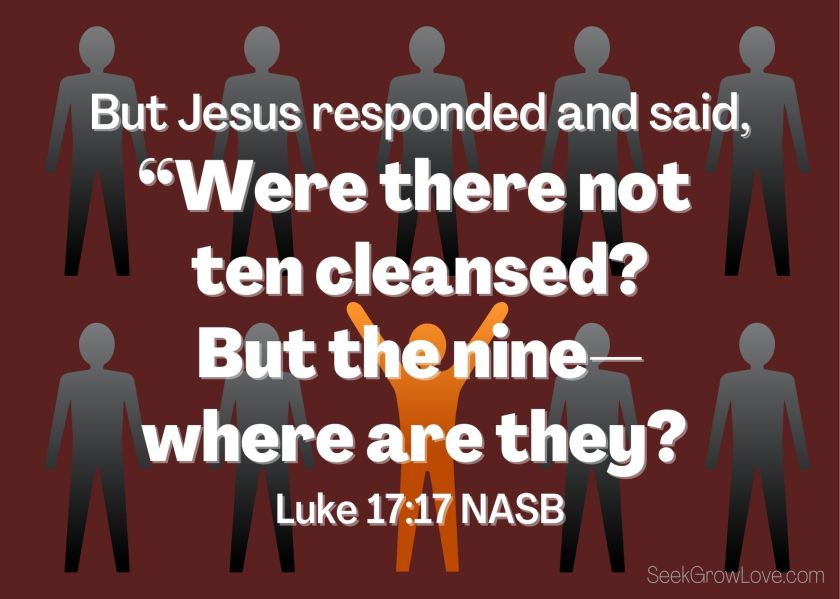
Jesus tells the lepers to go and show themselves to the priest. This is a reference to a priest being able to see if they are “clean” in order to fulfill Torah and allow the unclean to return to community. Note: he does not heal them. He says “go” and “as they went they were cleansed.” It was in the going, it was in the action, the trusting, the faith that they were cleansed, made whole, restored. 

But one stopped. 

One turned around. 

One praised God in a loud voice. 

One fell at the feet of the Master Jesus. 

One gave thanks. 

Jesus seems to expect the other nine, inquires into there whereabouts, but looks with grace at this Samaritan leper-no-more, and says “your faith has made you well.”

Giving thanks is not an element of the Christian faith that moves us from normal to turbo-charged-Christianity

Giving thanks is a vital part of understanding that God, who owns all things, has given us all things. (Rom. 8:32) Giving thanks is a vital part of understanding that Christ, our Master and Savior, gave himself to save us upon the cross, and by his wounds we are healed. (Isa. 53:5-6) Giving thanks is a vital part of the Christian faith, because God and Christ deserve all things, and to give them thanks and to shout loudly the praise of God and fall at the feet of Christ is the most common, natural, expected response to those who have been saved by grace through faith. 

When we give thanks, we are not being amazing, super Christians, wonderful and worthy of praise ourselves. 

When you give thanks and give it all to God, then say, “We are unworthy servants; we have only done our duty.”

-Jake Ballard

Reflection Questions

  1. When we consider our position as Christians, we are slaves, bought from one master (sin, death, the devil) to serve another (God through Christ). Do you bristle at the thought of being a slave or a servant? We are being adopted, heirs of God and coheirs with Christ (Rom. 8:17), but one image doesn’t completely negate the other. Why do you and I feel uncomfortable with being own by the God who already owns everything?
  2. “Your faith has made you well.” I find it interesting that Jesus, who seemed to be very necessary in the completion of the miracle, implies that the man was cleansed by his own faith, as if Jesus didn’t have anything to do with it. Why is this phrase used here and in other miracles? Is Jesus implying that he was not needed or is this humility? How should we understand this phrase to a man who was healed “as he went”?
  3. When was the last time you gave God thanks for everything in your life that you could remember? Try it this week. Everyday, after devotions, spend 5, 10, 15 minutes in prayer, thanking God for everything good in your life, in your family, in the world. Let this week be a week of giving thanks, and still realize that this is our appropriate response to the God who gives every good and perfect gift. (James 1:17)

Paradise

Old Testament: Ezekiel 37 & 38

Poetry: Psalm 107

New Testament: Revelation 22

     Revelation 22 begins with a few more verses describing New Jerusalem, a topic which began in chapter 21. It is full of life. I go back and forth on how to visualize this from the details we have. The city is described with one street, paved in gold like glass. The street leads to the throne of God and Christ – it is the most important destination. Perhaps the street spirals up to them, and the clarity of the gold helps the light from the throne reach everywhere. The river of the water of life passes down the center of the street, and the tree of life is on either side (v. 2). So perhaps the water goes through a tunnel carved in the thick trunk of the tree of life, which has grown quite large since being transplanted from the Garden of Eden. The design does not concern me greatly, the key is the offer of life and blessings. This is a place of contentment and worship – it has no temple because it needs none, all within it are constantly in the presence of God and Christ, bathed in their glory.

     Rather than design, I am interested in the idea that things have, at last, moved beyond the stage where God considers them “very good” (Genesis 1:31). After each of the first five days of creation God declared the work “good”; after day six it was “very good” – notably with the addition of humans. It may be that things didn’t remain at “very good” for long before they slid into distress and pain due to the addition of sin, but that isn’t the point in this chapter. God has restored matters. The curse is gone! But I think God more than restored things and passed “very good” to “perfect.” I suspect the needed element for that to take place involves free will – God would not force Adam and Eve to love and accept Him, it was to be our choice if we would seek companionship with Him.

     Well, talking about this sort of thing with God can wait, and by the time we enter those kinds of conversations with God we will be better equipped to do so. For now, we know the challenges we face, and the Spirit we have been entrusted with to face them. Let us continue toward the paradise God has planned for us.

     The Greek word for “paradise,” by the way (Luke 23:43; Revelation 2:7), from which we get our English word “paradise,” comes from a Persian word for a pleasure garden. It seems like we are striving to get back to a garden, where we could eat from the tree of life and perhaps even walk with God.

     With understanding and acceptance of each other.

     Loving and loved.

     Forever.

     These are goals worth having.

     Lord, the book says a blessing is on those who read and hear the words of this prophecy and heed the things written in it, for the time is near. Help us be attentive to these words, and all that you direct for our lives. Thank you for the gift of your words. Do not let us be drawn astray from you, your message, or your work. You are a gracious God. In Jesus’ name I pray to you, Amen.

-Daniel Smead

Reflection Questions

  1. We are repeatedly told there will be no night in the time of the New Jerusalem – what do you associate with night that you will be pleased to have end?
  2. How do you find the curse affecting your life this week? How is knowing Jesus, and believers, helping you to deal with the curse now?
  3. Looking back over Revelation, what directions stand out to you for your life? How is it going? Do you think you should call on someone to help you be accountable for what you feel called to do?

A Glimpse of Coming Glory

Old Testament: Ezekiel 35 & 36

Poetry: Psalm 106

New Testament: Revelation 21

     In Revelation 21 we have come to the climax of events. In the Garden of Eden God set out to undo the separation between Himself and us, and that goal is at last complete. Humans may have been short sighted during history and at times tied themselves in knots over other issues, but God wanted to return to our sides. With “the first things” passed away there will be no more pain. Evil is removed from the scene and God is changing the universe, making everything new. He intends to freely give the water of life to those who overcome (John 4:14).

     God lists some of those who will not receive what He offers, addressing several issues that were raised in the book, murder, sorcery, idolatry – but it begins with the cowardly (v. 8). I wonder if that is directed at early readers, facing persecution in the Roman Empire and possibly hesitant to commit. But it extends to later readers, who might question if they wish to stand up for Jesus’ name and his authority and risk conflict, or if it would be simpler and safer not to, even to appear to be unsaved. Some of God’s servants, like Gideon, were called to serve while not eager to act on their own. That may seem to give a basis for seeing hiding as credible. But I think God chose from the reluctant to make a point, and to stir the hearts of others. And those were not Christ’s disciples, already gifted with the Spirit. He expects something else from us. Not that I am saying we are to be abrasive and offensive in an eagerness to act, there are proper and wise moments and ways to stand up, and we are not always the right people to do so in a situation. Like I said, the appearance of that word first in the list strikes me. It convicts me, all too often, of taking an easier route. But I work for Jesus, and I’ve never heard of anyone braver than him. I leave it to you how it makes you feel. 

     John is taken to a tall mountain by an angel to see “the bride, the wife of the Lamb” and arrives at “the holy city, Jerusalem” (v. 9, 10). It is reminiscent of Ezekiel being shown the new temple, which was on a mountain (Ezekiel 40). I have taught about Revelation 21 numerous times. I have considered taping a cardboard mockup on a globe of the world to show the size of New Jerusalem. I didn’t end up attaching it, and I wasn’t sure if it should be a cube or a ziggurat, or a pyramid (we are told its base is square, and the height). Just describing my idea to the students got the gist across. New Jerusalem is large.

     Earth’s breathable atmosphere extends out for about eleven miles at the equator. Perhaps you have heard the idea about being able to see the Great Wall of China from orbit. You can’t. You could bump into New Jerusalem in orbit. We aren’t totally sure of the size of the city, it depends on how you understand twelve thousand stadia, the 1995 NASB says 1,380 miles and some other versions say 1,500 miles. The International Space Station orbits about 250 miles from Earth. The Hubble telescope is 340 miles out. The upper range of what are known as “low Earth orbit” satellites is 1,243 miles, so the city would tower above all of them, if they were still around. (Which they won’t be.) But the geostationary satellites are much further out, at 22,236 miles. And the Moon is 238,900 miles away, which is nowhere near it. Speaking of the Moon, it has a diameter of 2,159 miles. Earth is 7,917.5 miles in diameter. Under the smaller estimate for the city (1,380 miles) it is 15.69% of the width of Earth, and my cardboard mockup needed to be 1.88 inches wide for a standard 12-inch globe.

     We are told that with God’s new heaven and new Earth there is no longer a sea (v. 1). If that refers to the Mediterranean Sea it seems like a necessary removal, to give New Jerusalem ground space to fit. If it was centered on the location of Jerusalem it would extend about halfway through Greece, assuming it was aligned square with the equator. It also couldn’t be flat on the bottom since the Earth curves, which matters at this size.

     I think this raises some questions. When God replaces the Earth, will it be the same size as the old one? What is being described here sounds like God planned on expansion. The millennium just took place, a thousand years without plagues, famine, and war. It didn’t start off with very many mortal people, but I think the population had a good opportunity for growth. It may be that the number saved during human history leading up to Christ’s return will be just a fraction of those who will ultimately be saved, guided in part by the priests we are being prepared to be. Oh, may it be so.

     My questions are skipping over a rather obvious point. The angel who volunteers to show New Jerusalem to John does so under the description of “the bride, the wife of the Lamb” (v. 9). It isn’t clear to me whether that is because the bride (the population) is inside the city, or because the city is simply a symbol of those who have been accepted as Christ’s bride. The names inscribed on it, of the twelve tribes and the twelve apostles, may not simply be honoring those figures but symbolizing all who came from the lineage of those figures. Consider the description of its size and splendor, and the statements that none with bad character will enter. It says that God and the Lamb provide it with temple and light and lamp. All of this fits the idea that New Jerusalem is the people of God. Now, perhaps the language here presents people and city in another of the Bible’s double fulfillments and both cases are true. Whatever God intends it will be wonderful, and the beautiful description given in this chapter leaves me in awe and anticipation. I say, rejoice in your Lord!

     Thank you, Father, for giving us this glimpse of the glory that lies ahead. Thank you for your commitment to us, that you did not give up on the work of Your hands, but took such care and effort to restore what had been damaged. Please help us to value what you value, to seek what you desire. There are so many lost sheep, so many hurting hearts, that you desire to be blessed by the love of your son. Please shape me into who you desire me to be, until I am complete. Thank you, in the name of Jesus, Amen.

-Daniel Smead

Reflection Questions

  1. What does God’s commitment to fixing what was broken tell you about Him? What does it say about how God sees us?
  2. What are some of the “first things” that will have passed away when the events of Revelation 21 have come to be?
  3. If (when) you are tempted to hide, what helps you overcome that temptation and stand up?

Judgment: The Positive and The Negative

Old Testament: Ezekiel 33 & 34

Poetry: Psalm 105

New Testament: Revelation 20

     Revelation 20 involves God’s judgment, and it may make sense to put 19:20-21 in your mental image of the passage so the beast, the false prophet and their armies are in there. Verse ten reiterates the judgment of the beast and the false prophet, pairing them with the devil they had served. I see the passage with alternating sections of negative and positive references to judgment (19:20–20:3, 7-10, 15) and (20:4-6; 11-14). Grouped this way the text has every use of “lake of fire” (a different phrase appears in 21:8).

     After 19:20-21 establishes the punishment of those who served the dragon, chapter 20 opens with very satisfying language about the serpent not being able to deceive the nations. He is chained and sealed away for a thousand years.

     The description of the saints’ resurrection which follows in verses four to six may seem notably out of sequence. The first resurrection takes place at the last trumpet, in the twinkling of an eye (meaning in the time it takes to blink; 1 Corinthians 15:52). At Christ’s return the dead in Christ rise first, at the sound of the trumpet, and his servants who remain alive rise to meet him just afterward (1 Thessalonians 4:14‑17). That happens before Jesus fights the armies of the antichrist. It seems that the first resurrection was skipped over in Revelation 19. It also seems questionable for there to be an evaluation of the martyrs like is described in the vision. God knows all about them – they are raised because of who they are. It seems that the evaluation was described just for the sake of the vision, and what this passage presents as “judgment” clearly would need to be a fully positive judgment.

     Recognizing all of that, I think God wanted this text here, after a description of what happened to the devil. It contrasts what happened with those who accepted the mark of the beast (dead) and the leaders of the conspiracy (burning) and the one who inspired that conspiracy (imprisoned for a thousand years) to those who stood firm against it (they come to life and reign with Christ for a thousand years). Considering what these martyrs suffered, God wants to emphasize their acceptance and glorification, although that called for it being addressed out of sequence.

     In verses seven to nine Satan is again free, for a short time. Perhaps this represents a winnowing of the nations before God makes the next big change in the status of earth. Satan again deceives the nations who are willing to be deceived and assembles them for judgment (even if he doesn’t understand that is what he is doing). And this time judgment comes on him as well. God is closing out the books, after this there won’t be anyone else around able to be tempted. God could have left this entire story unmentioned, but He wanted us to know this part of the future, to be aware that our enemy will be permanently dealt with. (Not that Genesis 3:15 didn’t already indicate it.)

     I like the imagery in verse 11, as though perhaps God’s majesty surges up, and all that is nearby is not holy enough to remain. “Earth and heaven fled away, and no place was found for them” (v. 11). We continue to be reminded that this is a vision, as the lake of fire is still present for the later part of the vision and did not flee away. Maybe this is looking toward the next part of the story, that God is in the process of replacing heaven and earth (2 Peter 3:12). The description of death and Hades being thrown into the lake of fire is very positive (v. 14), but also serves as another reminder that we are reading about a vision (as it is hard to figure how John knew this happened except by being made aware of it).

     Elements of both the positive judgment scenes (v. 4-6, 11-14) can be found in Daniel 7:9ff, with the thrones, the books, and the fire, but they are mixed. It is a common statement that prophets of the Old Testament saw future events like we might see a distant mountain range, unable to tell very well how large a valley was between the peaks. Events from Christ’s first coming and second coming could be discussed right next to each other in a passage. With Daniel 7, making distinctions relevant to the existence of multiple resurrections wasn’t purposeful. And with Revelation John could not see and appreciate all the things happening in fully accurate order.

     I questioned whether to think of the judgment in Revelation 20:11-15 as neutral, or to break it between a positive first four verses and a ‘negative’ verse 15, because it raises the idea of someone’s name not being found in the book of life. It is interesting to think that verse 15 involves a resurrection too late in history to be relevant for the reader and so may not be intended as a warning for us. But I suppose it will be a warning to people during the millennium.

     Lord, your judgments are true. Thank you for offering your mercy. Please open my heart to accept your gracious offer, for myself, and for others. Don’t allow me to remain burdened with the past. Don’t let me be held back by refusing to forgive. Lord, let me listen so well to you now that I will not be deceived by the evil one or accept any of his lies. Let me seek your truth, and love it. In the name of your beloved son, Amen.

-Daniel Smead

Reflection Questions

  1. What do you think it will be like for people in the millennium to read the Bible?
  2. How does it make you feel to think that God is eager to praise those who have faithfully served Christ?
  3. The text refers to “priests of God and of Christ” who will “reign with Him for a thousand years” (v. 6) – have you given much thought to what that might involve?

The Marriage Supper of the Lamb AND The Great Supper of God

Old Testament: Ezekiel 31-32

Poetry: Psalm 104

New Testament: Revelation 19

     At the start of Revelation 19 heaven rejoices over God’s actions regarding Babylon the great. Soon we hear about the coming of the marriage supper of the lamb, and John is informed that the bride is clothed in fine linen which “is the righteous acts of the saints” (v. 8). He is also told to write that those who are invited to the wedding supper are blessed. This feels a bit like when Jesus commented in 16:15 “I am coming like a thief,” drawing our attention forward to coming attractions rather than remaining in sequence with events.

     The voice which spoke about the marriage supper came from God’s throne, and hearing it speak caused John to fall and want to offer worship. John is corrected for this and told that only God is to be worshipped (v. 10). But it seems like in this case he made an understandable error. Throughout Revelation voices come from a variety of exalted sources, among them angels, strong angels, mighty angels, an angel standing in the sun, the Temple, the altar, and the horns of the altar. For John it may have been like experiencing holy surround sound, never knowing where the next proclamation would emerge from. Maybe degrees of grandeur are indicated by who spoke from where, giving different impacts to their statements. It wasn’t always clear to John what the intention was.

     The message of the chapter proceeds, announcing the arrival of Christ, and of the armies of the world gathered for Armageddon. In fact, the word “Armageddon” is only named back in 16:16 where its origin is explained. Here the battle is previewed as “the great supper of God” – a supper for the birds, to eat the carrion it will provide, in contrast to the wedding supper of the lamb (v. 17‑18). With Jesus on the move there is no contest (2 Thessalonians 2:8). Jesus seems to be given credit for the entire victory: the gathered forces “were killed with the sword which came from the mouth of Him who sat on the horse.” That is, except for the beast and the false prophet. Those two are removed from the scene and dropped into the lake of fire, receiving their punishment for serving the dragon and for deceiving the nations.

     The description of Christ includes having “a name written on Him which no one knows except Himself” (v. 12). Note that this mirrors part of Christ’s letter to the third church, Pergamum. There Christ said he would give overcomers a white stone with a new name written on it, which only the recipient would know (2:17). (That same letter identifies Christ with the sharp two-edged sword, shown in John’s opening vision sticking from Christ’s mouth, much as in chapter 19; 1:16; 2:12.) I like the idea of these names which are known only to oneself. I wonder if I am being fanciful in thinking this new name involves having a sense of your own identity. You won’t need to share that with anyone else. There will be no need to. There will no longer be self-doubt, rivalry, jealousy, any of the potential bitterness that plagues our current lives. It will be a wonderful time. I hope to see you then.

     Lord, I look forward to the day when your kingdom has come on earth as you now reign in heaven. You have been waiting for a long time, allowing more people to be saved through the grace of your son. May your glory and your majesty be shown in my life while I wait for that day. Let me be empowered and enthused to perform righteous actions that will please you. Let me set my mind on the things of the Spirit, live as your humble servant, and exalt you. Let my light so shine before men that they will glorify you. Let me present my body as a living and holy sacrifice, acceptable to you. Renew my mind, so I may prove what your will is. Thank you, my God. In Jesus’ name I pray these things, Amen.

-Daniel Smead

Reflection Questions

  1. Do you ever think about the fact that it is our opportunity, and honor, to clothe the bride of Christ in righteous acts?
  2. Who are some of the people you want to sit with at the wedding supper of the lamb? What do you think you will talk about there?