Chosen – for Something

Be Strong and Do It!

1 Chronicles 26-29 & Psalm 127

Have you ever had an idea, or plans for something that you spent time putting together, but were not able to actually carry it out?

It might be because you don’t have the means, the talent, the time, but whatever the case, it can be disheartening, so I appreciate David’s example here on not being downtrodden about it but instead taking an opportunity to guide the nation and his son, directing them to serve God.

I also think it is pretty cool that despite David not being allowed to build the temple, we see an example of God’s Spirit working in David to come up with the plans.  Just because he wasn’t allowed to build, didn’t mean that he wasn’t able to still do something for the LORD.

In this case, David wasn’t allowed to build because of being a warrior who had killed others, but it is also a reminder to me that there isn’t just one thing to do.  God may call us differently or gift us differently to accomplish more things.  God didn’t use David to build the temple because of David’s actions over the past. But in other cases, God is just using people in different ways – not because one thing is better than the other (thinking of Paul describing the body – each part needs the others to properly function), but because multiple things need to be done.  We might sometimes feel saddened by being unable to do what we want, but that shouldn’t stop us from doing something.  We are all able to serve, but that service might look different from how others serve depending on our skills, or physical abilities, or God-given direction.

And then as we continue reading, we see how things are generously donated to the building of the temple, and to keep us all in check, David offers this in 29:14 “But who am I, and who are my people, that we should be able to give as generously as this? Everything comes from you, and we have given you only what comes from your hand.”

In a world/culture that is heavily focused on earning what we have, sometimes we need that reminder that the only reason we have is because God has given us things.  And that can fill us with gratefulness and love and inspire us to give as well.

~Stephanie Fletcher

Reflection Questions

  1. Is there a job that you have wished God would chose you for, but He has not? What can you learn from David? What other jobs do you think God IS asking you to do? In what ways are God’s plans better than ours?
  2. What has God given to you that you can use to serve Him?
  3. Our Psalm today was written by Solomon and he wrote: “Unless the Lord builds the house, those who build it labor in vain.” (Psalm 127:1 ESV). What did Solomon learn from his dad? How can you apply these words to how you are building your house/life/family and how you are building/supporting/growing God’s house/church?
Wrong Place, Wrong Time

2 Samuel 11-12
1 Chronicles 20

And in the spring of the year, at the time when kings go out to battle, David sent Joab, and his servants with him, and all Israel, and they laid waste the children of Ammon and besieged Rabbah, but David stayed at Jerusalem. – 2 Samuel 11:1 (REV)

                  In today’s reading, we see two realities. Both happened, but at different times and represent different things. In 2nd Samuel, we see David, king of Israel. Where do we see David? At home. Sitting on his keister and not doing what a king would normally be doing: overseeing his generals as they go out to battle.

                  David is not where he is supposed to be. He should be meeting with his generals. He should be motivating his armies. He should be praying and fasting and seeking out God’s direction for the safety and prosperity of Israel, but he’s back in Jerusalem. Twiddling his thumbs? Playing his harp? We don’t know what he was doing at all hours of the day when he held up in his palace.  We do, however, know what he was doing on one specific evening.

                  David is out walking on the roof, where he shouldn’t be, and he sees Bathsheba bathing. David does not turn away from seeing the nakedness of this woman whom he is not married to. He stares. He dwells. He obsesses. She’s beautiful. He needs to meet her. To be with her.

                  David ends up having her come into his home, and he has sex with her and gets her pregnant. We may have seen this story happen in the lives of some people we know, but this is high profile. This is a problem. A bunch of people are going to know what has happened, and this is going to be hard to explain to Bathsheba’s husband, Uriah, who is out at war, where he is supposed to be: fighting for the armies of the people of Yahweh. While the king is out preying upon the wife of his soldier.

                  David finds himself in a sticky situation, so he sends for Uriah and does his best to get Uriah to go have sex with his wife and cover his… keister. Uriah, however, cannot fathom such a thing while his comrades are off fighting a war. He refuses to even go visit his wife. This poses a major problem. People are going to know that Bathsheba is expecting, and they are going to know that Uriah hasn’t been with her in months, maybe longer. David tries multiple times, but no dice. Uriah is a man of honor and conviction, and that is not going to fly in this situation. David needs an out. David essentially puts out a hit job on Uriah. David cannot control his urges, so a good man dies.

The story unfolds. Uriah is dead. David marries his baby mama, and then the baby dies. Nathan the prophet comes to confront David and gets David worked up with a parable. David wants vengeance for the perpetrator in the story, but then the tables are turned when David is revealed to be the bad guy in the tale. David grieves, David repents, but the baby does not survive. It’s rough.

In 1 Chronicles 20, we see that it is the time when kings go out to war. And David goes out to war. And his armies thrive. He gets an awesome new crown. God blesses the armies of a king who acts in good faith. David is more than capable of doing the right thing, but even a man after God’s own heart can allow himself to fall off the rails.

Here’s the rub: Sometimes we get complacent. Sometimes we get lazy. Sometimes we do things, go places, consume content that we know we shouldn’t, but we’ve allowed ourselves to be in the wrong place at the wrong time, and we fall victim to the allure of the temptations of sin around us.

We’ve all allowed ourselves to be in bad situations that we could have avoided. Sometimes we may come out on top, but given enough opportunities to sin in the situations we create, we are bound to fall. We play with fire… and you know the cliché, but it’s true, we get burned.

-JJ Fletcher

Reflection Questions

  1. Can you recall some times you allowed yourself to be in a place you shouldn’t have been? What was the outcome? How could you have avoided putting yourself in that situation? What did you learn from it?
  2. What do you think of Nathan’s tactics of getting David to see the gravity of the wickedness that he had perpetrated?
  3. What does the story of David and Bathsheba teach us about grace, repentance, and forgiveness?
  4. If David can be forgiven for this travesty, who can you forgive that may have done much less harm in the way that they have wronged you?
  5. How does the contrast of 2 Samuel 11-12 and 1 Chronicles 20 sit with you? Does it give you any insight or change the way you perceive David’s sin?

Remember & Trust Yahweh our God

Psalm 20

1 Chronicles 19

2 Samuel 10

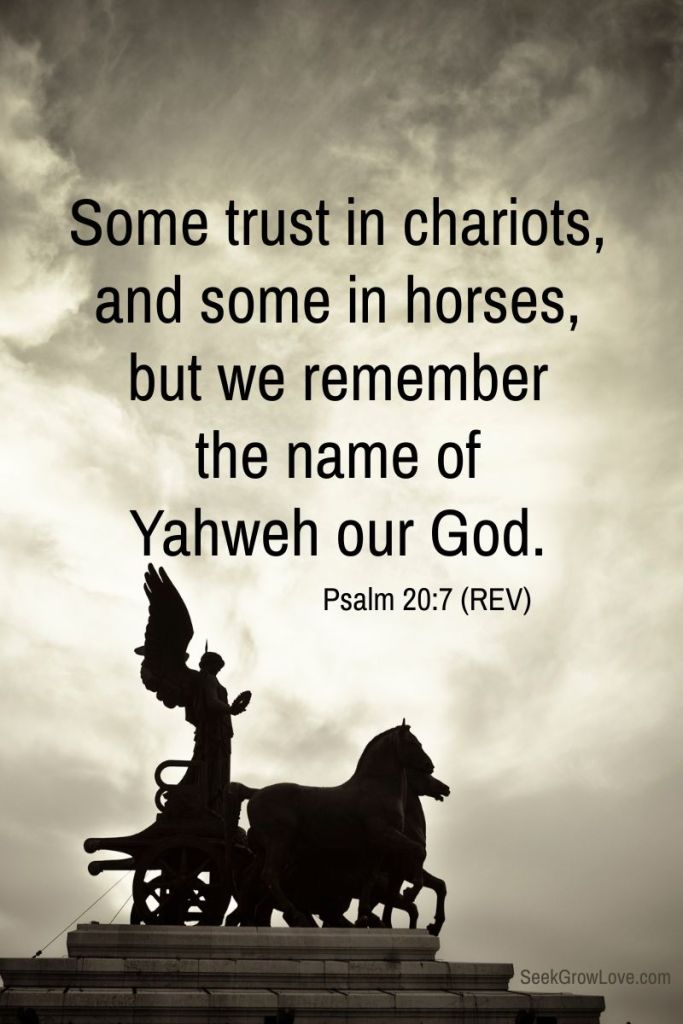
Some trust in chariots, and some in horses, but we remember the name of Yahweh our God.  – Psalm 20:7 (REV)

It is very easy to rely on our modern technologies for help. The United States spent around 1 trillion dollars on defense last year, and it is easy to look at that high spending and have some confidence that the US would have an upper hand in any conflicts that it is engaged in, and that soldiers might enjoy a higher level of safety. We can look at medical technologies and pharmaceuticals and have confidence that something out there can diagnose and treat our potential maladies.

Yet despite these great resources, soldiers still die, and people still get sick and do not receive the diagnosis or treatment that they want or need. Confidence can lead to letdowns when placed in earthly things.

In 1 Chronicles 19, we see King David extend kindness to his potential foes, only for it to be repaid with treachery and opposition. When the Ammonites realize that they have put themselves at odds with David, they amass a significant force of chariots to fend off any attacks. They put confidence in the technology of the day to help deliver them from the potential conflict with Israel.

As Psalm 20:7 says, some people put their trust in chariots and horses, but we remember – or put our trust in – Yahweh. David trusted his God to deliver him and his armies from whatever his enemies devised as a means of attack or defense strategy. David recognized God as sovereign and that God is capable of anything. Historically and personally, David knew that God used underdogs and laughably small forces to conquer the enemies of his chosen people.

We do not have promises from God that we will never suffer or experience pain, death, or illness. God does promise us redemption through the blood of his son Jesus. We have a promise of restoration for the earth, which is something that has never been accomplished by human effort, whether governmental or environmental.

-JJ Fletcher

Reflection Questions

  1. What will you put your trust in?
  2. Who will you put your trust in?
  3. Why is God’s provision so much more powerful than earthly promises?

Power & Pride OR Loyalty & Compassion

2 Samuel 8-9

1 Chronicles 18

I bet we all have experience with someone who is prideful.  We’ve heard stories of wildly successful people, and in their triumph, they forget the people who helped them get there.  

In 2 Samuel 8, we hear about some of David’s great victories in battle- he’s at the top of his game- a picture of power and achievement.

Then, in stark contrast, chapter 9 gives us a glimpse at a softer and more compassionate side of David where he actively looks for someone “from the house of Saul to whom I can show God’s kindness?”  David remembers the promises that he made to Jonathan and, in his moment of power, chooses kindness over vengeance. David easily could’ve broken his promise and basked in his victories- instead, he extended grace to a man who could offer him nothing in return.

This act of unexpected mercy shines a light on David’s character, revealing a heart that prioritizes loyalty and compassion over pride and power.

-Hope Fletcher

Reflection Questions

  1. When have you been tempted toward the power and pride side – or deep into its territory? Have you found a good way to resist pridefulness?
  2. Who do you admire for their loyalty and compassion?
  3. Whom can you (will you) seek out to show a bit of God’s kindness to?

Enduring Faithfulness

2 Samuel 7

1 Chronicles 17

When was the last time you made a truly eternal promise? If you’re married, hopefully, you’ve made an eternal promise of love and commitment. I’m sure if you have children, you’ve vowed to love and cherish them always. Even something as seemingly simple as getting a tattoo is a promise to yourself that you’ll carry that image on your body for the rest of your life.

Today’s scripture, 2 Samuel 7, reveals the profound truth of God’s eternal promises. This passage contains the Davidic Covenant, where God promises that David’s house will rule forever. We know this promise will be fully realized when Jesus returns to establish God’s Kingdom on earth. Think about it: God has been keeping this promise for over 3,000 years! Despite Israel’s occasional disappointments and frustrations, God remains steadfast.

While our most sincere promises can falter due to betrayal, anger, misunderstanding, or irreconcilable differences, a promise from God is unwavering. That’s a reason for a true celebration! 

David’s response to this incredible promise is one of humility and awe: “How great you are, Sovereign Lord! There is no one like you, and there is no God but you, as we have heard with our own ears.” Today, may we find ways to celebrate God’s faithfulness that has endured all this time and will continue long past us.

-Hope Fletcher

Reflection Questions

  1. When have you witnessed or experienced God’s enduring faithfulness?
  2. When have you responded to God with humility and awe saying (similar): ““How great you are, Sovereign Lord! There is no one like you…”?
  3. How are you at keeping your promises? Can your word be trusted?

Lists

These are the sons of Israel: Reuben, Simeon, Levi, Judah, Issachar, Zebulun, Dan, Joseph, Benjamin, Naphtali, Gad, and Asher.         -1 Chronicles 2:1-2 (ESV)

1 Chronicles 2

Psalm 16, 19, 21

If you’ve been reading along with me this week, you may have noticed I like lists.  In fact, it’s kind of an obsession of mine.  I have lists for pretty much everything – grocery lists, daily to-do lists, lists for upcoming birthdays and anniversaries, to-do lists of projects (for me and for my husband), packing lists for trips, lists of nursery helpers and teachers at church, so many lists. 

Lists can be great as reminders.  Yesterday and today we have read through the first two chapters in 1 Chronicles.  I know the headings aren’t actually “Biblical”, but they are helpful.  1 Chronicles 1:1-24 is the genealogy from Adam to Abraham.  Verses 28 – 34 is the genealogy from Abraham to Jacob (Israel).  1 Chronicles 2:1-15 is the genealogy of David.  Now, I don’t particularly like to read the genealogies in the Bible, or anywhere, really.  I usually skim through them and pause at the names of characters in the Bible I recognize. 

But God wanted them in the Bible, in His Word, so they must have a purpose.  I know God had special tasks for different tribes.  I know that prophecies that tell of Jesus’ lineage rely on genealogies to prove he was the Messiah.  So, don’t write them off too quickly, even if you don’t read every name. 

A short devotion to make up for the long list of names you just waded through!

Amy Blanchard

Reflection Questions

  1. Consider your own genealogy.  There are people in your lineage who have shaped your life and your faith.  Is there anyone you want to thank?  Or thank God for?
  2. I encourage you to read the Psalms for today as well.  A great prayer for every moment of every day is Psalm 19:14, “May these words of my mouth and this meditation of my heart be pleasing in your sight, Lord, my Rock and my Redeemer.”   In looking back over your day, at what time would you have been happy to say this prayer?  When would you have wanted to hide your words and thoughts (meditation) from God?  Praise God for His forgiveness! 

Tips for Doing God’s Work

Old Testament: 1 Chronicles 27-29

Poetry: Psalm 90

New Testament: Colossians 4:2-18

Scripture:
“David assembled all the leaders of Israel and all the leaders of the tribes and the commanders of the divisions that served the king and the commanders of the thousands and the commanders of the hundreds and the officials in charge of all the property and livestock of the king and his sons, together with the officials and the mighty men, and all the seasoned warriors, at Jerusalem.” — 1 Chronicles 28:1 (LEB)
“So teach us to number our days that we may gain a heart of wisdom.” — Psalm 90:12 (LEB)
“Devote yourselves to prayer, being watchful in it with thanksgiving.” — Colossians 4:2 (LEB)


In 1 Chronicles 27, we see David’s meticulous organization of the military and administrative divisions of Israel. This structure ensured that the kingdom functioned smoothly and effectively. David’s leadership shows the importance of planning and preparation in carrying out God’s work.


Chapters 28 and 29 highlight David’s preparations for the construction of the temple. Although David was not permitted to build the temple himself, he gathered materials, made plans, and charged Solomon and the people to carry out the task. David’s forward-thinking mindset underscores the value of preparing for the future and investing in God’s work, even when we may not see the final outcome.


Psalm 90:12 calls us to live with an awareness of the brevity of life: “So teach us to number our days that we may gain a heart of wisdom.” David’s actions in these chapters reflect this wisdom, as he uses his final days to ensure that Israel is prepared for the future and that God’s temple will be built.


Colossians 4:2-18 emphasizes the importance of prayer and watchfulness. Paul encourages the Colossians to be devoted to prayer and to be thankful. This devotion to prayer is essential for effective leadership and preparation, as seen in David’s reliance on God throughout his life.


David’s detailed organization of Israel’s military and administrative divisions highlights the importance of structure and planning in achieving God’s purposes. David’s preparation for the temple, even though he would not build it, teaches us the value of investing in God’s work for future generations.Psalm 90’s call to number our days encourages us to live wisely and make the most of our time, as David did in his final acts. Colossians 4:2 reminds us to be devoted to prayer, a crucial aspect of effective leadership and preparation. 


Like David, we do not always see the results of our work. Our Lord teaches us, though, to number our days and live with wisdom, making the most of our time for His purposes. Serve the Lord with a heart of wisdom and a spirit of prayer, investing in His work for future generations.

-Jeff Ransom

Reflection Questions:

  1. How can you apply the principles of organization and planning in your own life and service to God?
  2. In what ways can you prepare for the future and invest in God’s work, even if you may not see the final outcome?
  3. How can Psalm 90’s call to number our days inspire you to live more wisely and purposefully?
  4. What steps can you take to deepen your devotion to prayer, as encouraged in Colossians 4:2?

Working for the Lord

Old Testament: 1 Chronicles 25-26

Poetry: Psalm 90

New Testament: Colossians 3:18-4:1

Scripture:
“David and the chiefs of the service also set apart for the service the sons of Asaph, Heman, and Jeduthun, who prophesied with lyres, with harps, and with cymbals.” — 1 Chronicles 25:1 (LEB)


“Whatever you do, work at it with your whole being, for the Lord and not for people, because you know that from the Lord you will receive the reward of the inheritance. Serve the Lord Christ.” — Colossians 3:23-24 (LEB)


“Blessed be the Lord, the God of Israel, from everlasting to everlasting! Amen and Amen.” — Psalm 90:2 (LEB)


In 1 Chronicles 25, David and the leaders set apart the sons of Asaph, Heman, and Jeduthun to prophesy with musical instruments. Their dedication to worship through music is a powerful example of using one’s talents for the glory of God. This act of worship was not just about playing instruments; it was about prophesying and communicating God’s messages through music. Through music, they made Him known!


1 Chronicles 26 outlines the responsibilities of the gatekeepers. Their role was crucial for maintaining the sanctity and order of the temple. These gatekeepers demonstrate that every role in God’s house, whether seen or unseen, is significant and valuable. These chapters highlight the importance of worship and service in the life of God’s people. They remind us that every task, whether musical, administrative, or protective, no matter how menial or mundane, is an act of worship when done for the Lord.


Colossians 3:23-24 continues this message as it encourages us to work heartily for the Lord, not for human masters. This perspective transforms our daily tasks into acts of worship. Whether we are serving in the church, at home, or in our workplaces, doing our work for the Lord gives it eternal significance.


Psalm 90 reminds us of God’s eternal nature: “Blessed be the Lord, the God of Israel, from everlasting to everlasting! Amen and Amen.” In our worship and service, we acknowledge the everlasting nature of God and our place in His eternal plan.


The organization of musicians and gatekeepers in 1 Chronicles shows that both worship and practical service are vital in God’s kingdom. Every role, whether public or behind the scenes, is important. Colossians 3:23-24 reminds us to do everything wholeheartedly for the Lord. This attitude turns everyday tasks into meaningful acts of worship. Psalm 90’s focus on God’s eternal nature encourages us to see our service and worship in light of eternity. Our actions have lasting value when done for God.


These are great examples of dedication and service to God. Through them, perhaps, we will all be more inclined to use our talents for His glory and to see every task as an act of worship, to live with an eternal perspective, acknowledging His everlasting nature. 

-Jeff Ransom


Reflection Questions:

  1. How can you use your talents and skills to worship and serve God in your daily life?
  2. In what ways can you adopt an eternal perspective in your work and service?
  3. How does understanding that you are working for the Lord, not just for human recognition, change your attitude toward your daily tasks?

Embrace Life

Old Testament: 1 Chronicles 17 & 18

Poetry: Ecclesiastes 9

New Testament: Colossians 1:1-14

One of life’s great paradoxes is that it is predictably unpredictable. Life never seems to go the way we think. Solomon reflects on the inevitability of mortality where death is the great equalizer, the advantage of being alive, and encourages the reader to relish and enjoy life on the way to death, because that is what awaits everyone in the end.

There is a common “fate” that awaits every person: death. And regardless of a person’s righteousness or wickedness, the same end is waiting for them. Solomon says, “people do not know whether it is love or hatred; everything is ahead of them.” “Love or hatred” refers to divine favor or judgment. No one knows what their work will produce because it lies in the future. According to Solomon’s method of investigation, no one can say whether they will receive “love” or “hatred” in the future.

Solomon describes the common denominator of life—death—as an “evil” that is done under the sun. No one can predict when it will happen, and no one can escape it. There is “one event” that happens to all. After death, a person has no further reward or enjoyment of things done under the sun.

But for those who have not joined the ranks of the dead, Solomon says “there is still hope!” There is “hope” that while being alive a person can acknowledge the reality of death and thereby embrace the joys in life that they can, because no possibility exists for the dead as their life has ended and there is no going back.

In Solomon’s perspective, life is better than death. Period! Even a measly, no good dog (the ancient world did not have a high view of dogs) is better than a dead lion (viewed as one of the strongest and greatest of all animals in the ancient world). He brings the “hope” of the living into plain view by bluntly stating the obvious, “the living know they will die, but the dead do not know anything.”

Solomon’s point is for the reader to embrace life and all its blessings and joys. We only have a certain amount of time to do this, and then it is over, and we can’t have more.  When a person dies “their hatred, and their envy” all perish with them. And so, while we are living, Solomon advises that we pursue life to the fullest and to engage in every activity with all that we are. Soon enough, we won’t be able to. So live it up, Solomon says, “Let your garments be always white, and do not let oil be lacking from your head. Enjoy life with the wife whom you have loved.” He is using very festive language here about wearing white garments and applying oil on one’s head.

But it is important to note that as part of the life that Solomon suggests one should live, he includes dedicating the time to work hard. That is part of the fullness of life, and the food and drink from one’s labor is part of the essential joys one can partake of in life.

Solomon turns to address the uncertainty of life as something perplexing and which he finds unsatisfying. Everything he lists seems to be disordered. The race should be won by the fastest racer, the battle should be won by the strongest soldier, wise people should have food to eat, foolish people shouldn’t have money, people who are skilled should be preferred (i.e., have favor), etc. But Solomon identifies that “time and chance happen to them all.” The point is misfortune and disaster are not selective about who they happen to fall on any given day. Everyone is susceptible to the chance of bad things happening to them. To prove his point, Solomon draws upon two negative images—fish in a net and birds in a snare—to illustrate the horror of the human condition where people find themselves encountering adversity when they least expect it.

In the final section of the chapter, Solomon tells a parable of a small city that is saved by the wisdom of a poor man, but in time, the poor man was forgotten about. So, Solomon affirms traditional wisdom that says, “Wisdom is better than strength.” But people did not recognize the poor man’s wisdom as such and soon forgot about it and him.

While traditional wisdom says that “wisdom is better than strength,” Solomon’s observations seem to complicate that conclusion because things are not always that way in reality. According to the narrative in his parable, it only takes one sinner to destroy (i.e., neglect) what wisdom says. And so, Solomon is asserting that as powerful and valuable as wisdom is, it has its limits. It is certainly preferrable to foolishness, but it is not immune to the destructive effects of a little foolishness. A small bit of foolishness can spoil the greatness of wisdom. This then begs the question, “What real value is wisdom if it can be overthrown so easily by a single fool?”

-Jerry Wierwille

Reflection Questions

  1. How has the unpredictability of life ever caught you by surprise?
  2. What do you enjoy about life? How do you embrace it? Does this include your labor?
  3. Can you give an example of when or how, “A small bit of foolishness can spoil the greatness of wisdom”?

A House for God

*Old Testament: 1 Chronicles 28 & 29

Poetry: Psalm 149

New Testament: 1 Thessalonians 4

     First Chronicles 28 and 29 relates the end of David’s time as king. Mostly it discusses an assembly where David laid out responsibilities his son Solomon would have for building God a temple and encouraged the people to join in that work with him. By gathering that assembly David was also making it clear that Solomon was the chosen heir – chosen by God. The line of succession had been contested before, and David called on all present to commit their loyalty to both God and Solomon (28:5; 29:24).

     David had desired to build God a dwelling place but was denied that role because he had shed blood. Joyfully for David, the time when he learned of his rejection was paired with learning about the promise of a special covenant with God. In the years that followed David stockpiled resources in preparation for the Temple to be constructed by his promised son. In 22:14 we read of huge amounts of gold and silver David stored up. In 29:4 we are told of additional sums he provided near the end of his reign. That was followed by him encouraging the people to offer their own commitments (6-9). They gave tons of gold and silver and brass and iron, along with precious stones. And “the people rejoiced because they had offered so willingly, for they made their offering to the Lord with a whole heart, and king David also rejoiced greatly.” (9). As David had said, this was not a temple “for man, but for the Lord God” and they were able to rejoice in the idea of giving to the project (1).

     I read some years ago about a study in which people of varying incomes were asked what they considered would be enough money for them to be content. There was a remarkable similarity in the answers given to the researchers, from those who made fairly little, on through those who made far more. People tended to want 15% more income than they currently had. Knowing this, of course, we can guess that very few people whose income increases become content – instead they adjust to their new circumstances and change their target for “contentment.” Of course we are not to view the world in that way, though we can all too easily become caught up in the distractions of worldly thinking. If we are seeking to store up for ourselves treasure in heaven, rather than on earth, we are less susceptible to such errors.

     I find it a matter of joy that the people of Israel in David’s time chose to join in setting up the Temple. They could have hesitated to give, and left matters to David and Solomon. They could have suggested that the vast amounts David had already collected would be enough for the task. (To try to put some numbers to this, we are told in 22:14 that David had collected 100,000 talents of gold. One calculation puts a talent at about 75 pounds, which would mean David had collected about 3,000 tons of gold. By a useful coincidence it is estimated that 750,000 pounds of gold were collected during the California Gold Rush, so a tenth of what David had gathered.) But the people still wanted to be involved with honoring God by contributing from their own wealth, which had itself come from God’s blessings (29:14, 16).

     (I find it interesting, as well, how God’s intentions may have been set up across the generations. David being a man of war could tie in with the extent of the nation’s wealth and how he prepared the way for Solomon. David was not accepted to build God a Temple, but he was freed to go forward in fighting against the enemies of God’s people and to help prepare a time of peace for Solomon. At the same time David’s victories brought in wealth that would enable the Temple to be funded to an incredible degree.)

        While David thought of the promises he had received in terms of Solomon, and prepared for his reign, we recognize a greater fulfillment in terms of another son, Jesus. Even in the text of these chapters there are hints at that, statements that “if” Solomon will serve God “with a whole heart” his descendants will continue to possess the land forever (28:8, 9). That kind of obedience was not available from Solomon, or any of the kings in David’s line who lived in Old Testament times. So while Solomon was able to fulfill the prophecy in one sense, building a house for God, it was destroyed after only a few hundred years. Another house waited to be built by a son yet to come.

     Lord, please help me not to be caught up in material concerns to the detriment of spiritual calls. Please let me have my daily bread so that I will not be distracted by wants, but please help me not let desires for more than I actually need get in the way of things that truly matter, like other people, and worshipping you. Help me to recognize how truly kind you are to me, and to give you credit and praise for your blessings to me and my family. Help me be willing to go out of my way for things that are important to you. Thank you for your care, Amen.

-Daniel Smead

Reflection Questions

  1. David and Solomon approached worship very grandly, perhaps more so than anyone today. What lessons might we be meant to take from the stories of the Temple?
  2. It may seem like an absurd amount of gold and silver was collected for use with the Temple construction, and we aren’t sure how all of it was used, but what impression do you think it would give to worship at a Temple where the walls were coated with gold? What if you knew that you, or your ancestor, contributed to building that Temple?
  3. Do you think it is harder to see yourself as receiving blessings from God when your income is from wages instead of through farming or spoils of battle?