In the letter of 1 Corinthians, Paul is writing to the church in Corinth. Corinth is in modern day Greece, so it was at the heart of Greek influence. This would have meant that the church in Corinth would have been surrounded by people who put their faith and hope in the Greek gods. The worship of idols was not just an aspect of the Greek culture, it was the heart of Greek culture. I’m sure many in the church at Corinth would have come from this background of worshipping the Greek gods. For some, that would not have been a big deal; they could separate themselves from the worship of idols. For others, it would have been difficult to separate themselves from the worship of idols. For those who had troubles separating themselves from the worship of idols, they would have had a conflicting conscience eating food that was originally offered as a sacrifice to these idols. Was it sinful to do so?
Paul explains that we are not better or worse off if we eat the food originally offered to idols. At the same time, Paul urges those who aren’t conflicted by eating food originally offered to idols to withhold from eating this food in front of those whose conscience was conflicted.
There are two key takeaways that I would like to mention here:
1) Everybody is susceptible to different temptations. One path may be safe for someone to travel down; however, that same path may lead to danger for someone else. For the church at Corinth, some could eat the food offered to idols and stay away from the temptation to commit idolatry while others could not. One person may be fine having social media and be safe from the temptation to covet, while another person may not be safe from this temptation. One person may be fine having a drink of alcohol and be safe from the temptation to get drunk, while another person may not be safe from this temptation. One person may be safe to have digital media on their phone and be safe from the temptation to lust, while another person may not be safe from this temptation. You catch the drift.
As we alluded to in yesterday’s devotion, you must be acutely aware of what triggers you to commit sin. It is different for everybody. Being self-aware of your triggers is key to your recovery from a sinful habit and key to keep you away from a sinful habit.
2) If something is safe for you to indulge in but not for those around you, then don’t take part in it. Paul urged the Christians at Corinth to not serve as a stumbling block for those around them by eating the food originally offered to idols in front of others who may struggle with this. Therefore, do we not only need to be aware of what triggers may lead us to sin, it’s imperative that we understand what triggers those around us to sin. When we act as a stumbling block to those around us, we are sinning ourselves. In one of my favorite teachings, Jesus explains the severity of causing others to stumble in Matthew 18:6 – check it out.
All in all, be cognizant that God made us all different, and we are all tempted by different things. Be aware of what tempts you while also being aware of what tempts those around you.
-Kyle McClain
Reflection Questions
What are your temptation triggers? What boundaries can you create to help keep yourself from sin?
How can your actions lead your family members and Christian brothers and sisters who might have different temptations and consciences to sin? What can you do instead to support them and strengthen them in their stand (or flight) against temptation?
What does your Bible reading today tell you about the One who inspired these words? Who is He and what is His desire?
These are the words of Johnny Cash in his iconic song, Ring of Fire, that hold true for many, as many people have a desire for some form of romantic love that can lead to sexual intimacy. Our society has a pretty wide range of views on what practices are acceptable or not to fulfill that desire for sexual intimacy. Paul states that, “It is because of the temptation to sexual immorality that a man should have his own wife, and each woman her own husband,” (1 Corinthians 7:2 ESV). Marriage is the solution to the desire of sexual intimacy in Paul’s eyes.
Throughout scripture, it is a very constant concept that sexual intimacy is to be experienced between a husband and wife – nothing more, nothing less. Paul urges married couples not to deprive each other, so that our lack of self-control doesn’t lead to sexual immorality. I encourage both husbands and wives to fulfill their spouses’ sexual desires to help steer them clear of sexual immorality. If you need some extra inspiration and motivation, you can read through Song of Solomon.
For those who are not married but burn with passion, I pray that you are able to exhibit self-control. Remember the words of Paul in the previous chapter as well: “Flee from sexual immorality,” (1 Corinthians 6:18). Paul does not encourage you to stand firm in the fight against the temptation to sexual immorality. Rather, Paul encourages you to FLEE! Be aware of your triggers and run away from them!
For those who are not married and aren’t “bound by wild desire”, I encourage you with the words of Paul: “To the unmarried and the widows I say that it is good for them to remain single as I am,” (1 Corinthians 7:8 ESV). The unmarried person does not need to fret about how to please their spouse. They can spend all of this attention that many spend on pleasing their spouses, and the unmarried can devote it all to God. What a blessing!
Whatever camp you find yourself in, whether you are married, single with passion, or single with no passion, I hope you are able to dig nuggets of invaluable information from this chapter about marriage. When in doubt, you can turn to 1 Corinthians 7 for questions about biblical principles regarding marriage and the absence of marriage.
-Kyle McClain
Reflection Questions
What is your current situation? What can you do now to make the most of your situation? How will you strive to please God in your situation?
Married or unmarried, how can you flee from sexual immorality?
What do we learn about God in our Bible reading today?
Like most human beings I have encountered, I enjoy being right, and I like others to know when I am right. Oftentimes, I would be willing to go the distance to ensure that others are aware of the fact that I am right. This includes both people inside and outside of church. If I shared a belief in the risen Christ with someone, that would not stop me from getting into a long argument… erm… I mean debate about who the greatest athlete of all time is. Unfortunately, I am quite sure that I’m not the only one who has been there before.
Evidently, this was an issue with the church in Corinth as well, as they even took it to another level. Christian brothers and sisters were hiring third parties to determine who was in the wrong and who wasn’t, as they were filing lawsuits against each other. What sort of image were they giving of the church to outsiders? This was humiliating for the church to have to hire a third party to settle a dispute between two people who were called to love one another. Paul brings this issue to light and shames them for doing such a thing.
Although many of us have probably never filed an official lawsuit with our fellow brothers and sisters in Christ, how often do we quarrel with our brothers and sisters in Christ? What sort of image are we giving of the church to outsiders when we quarrel with each other? Often, when it comes to disagreements between two people, it is a matter of preference: Who’s the greatest athlete? What color carpet is the best? How loud should the music be? Don’t let simple preferences like these cause a division among yourselves – there is no need for that. On the other hand, we are called to judge our Christian brothers and sisters when it comes to an objective right or wrong, as Paul states in chapter 5 of 1 Corinthians. However, more often than not, I have seen Christians quarreling over preferences rather than an objective right or wrong. Don’t let that be you.
Therefore, I encourage you to not let a division of opinions get in the way of your relationship with your fellow brothers and sisters in Christ. Don’t let these small differences of opinion snowball into quarreling amongst each other. When we digress into these small differences of opinions, we lose sight of the big picture. What is the big picture, you may ask? Paul highlights this in verse 11, “And such were some of you. But you were washed, you were sanctified, you were justified in the name of the Lord Jesus Christ and by the Spirit of our God,” (1 Corinthians 6:11 ESV). We were all sinners, but now we are a new creation. We have been washed and forgiven of our sin, set apart from the world, and made right in the eyes of God.
Let our life be a demonstration of the forgiveness, sanctification, and justification that we have received rather than divulging and arguing about our differences of opinion. When this successfully takes place, we will give a much better picture of what church looks like to outsiders.
-Kyle McClain
Reflection Questions
When has your desire to be right gotten you into trouble – or led you into disagreements that Paul would not approve of? What could you have done instead?
How does 1 Corinthians 6:11 change your outlook on disputes and the “need” to be right?
What do you learn about God in your reading of His Word today?
For the Corinthians and Greek culture in general, wisdom and knowledge were extremely important. This is why Paul spends 1 Corinthians 1 emphasizing that it is through faith in Christ that we are saved, not through the wisdom they have worked towards their whole lives. Then in 1 Corinthians 2 Paul says that wisdom is important for the Christian, but it is Godly wisdom that is very different from what they have learned, and it cannot be taught, but is given by the holy spirit. Now in chapter 3 Paul is clearing up any last confusion in case they were not understanding up until now. He very clearly says that they need this Godly wisdom, but do not have it at all. They have been seeking an elevated status in their congregation because of their high learning and deep understandings. Paul wants to set the record straight, living a Christian life is not about sitting in your plush study and writing treatises and books and musings, and becoming revered for your knowledge. It is about getting your hands dirty. He likens the Christians to farmers and builders who have work to do, and he is a worker right there with them. This would have been a very shocking thing to the aristocratically minded members of the Corinthian Church who would have read this.
So let me be as clear as Paul was. If you decide to follow Jesus and serve him, then you will be a servant. Your life will not be a vacation, but a construction project. It will take work, but in the end you will hopefully do something valuable with your life and “the fire will test the quality of each person’s work. If what has been built survives, the builder will receive a reward.” 1 Corinthians 3:13-14. That reward is everlasting life in God’s kingdom, and is worth so much more than a high position in society, or being revered for your earthly wisdom.
Your fellow servant – Chris Mattison
(Posted here first in 2019)
Reflection Questions
What is your favorite verse in today’s reading? Why?
Is your work ready to be tested by fire? What might God be calling you to do as a part of His field or building?
What can you learn about Almighty God in your reading today?
Let’s play a quick game together, shall we? I’m going to give you two separate lists to study, each with a dozen synonymic adjectives, and then ask you questions about them.
Who is the first person to pop into your head when you see each respective list?
Which list best describes you currently?
Which list would you rather have read about you at your funeral?
The first set of words contains synonyms for the word “foolish”, and the second one lists synonyms for “wise”. The end of I Corinthians 1 is contrasting foolishness and wisdom as it relates to God vs. man, and how God empowers us to do His work. Paul writes beginning in verse 25 (ESV), “For the foolishness of God is wiser than men, and the weakness of God is stronger than men. For consider your calling, brothers; not many of you were wise according to worldly standards, not many were powerful, not many were of noble birth. But God chose what is foolish in the world to shame the wise; God chose what is weak in the world to shame the strong; God chose what is low and despised in the world, even things that are not, to bring to nothing things that are, so that no human being might boast in the presence of God. And because of him you are in Christ Jesus, who became to us wisdom from God, righteousness and sanctification and redemption, so that, as it is written, ‘Let the one who boasts, boast in the Lord.'”
This verse causes me to bubble over with inspiration and gratitude every time I read it! I take great joy in reading accounts of the underdogs in the Bible whom God used to do great things, and in believing that He can do the same with me. Moses had a speech impediment, but God used him to speak with Pharoah and deliver the Isaelites from slavery. Rahab was a prostitute, but God designated her to save His spies and she was then in the lineage of Jesus. David was only a grungy, petite shepherd, but God used him to defeat Goliath. (David later served God as a great King of Israel, despite being a murderer and adulterer.) Gideon, who was the least important of his family (which was the weakest of his tribe), was hiding when an angel sent from God called him “Mighty Warrior”, but God led him to defeat the Midianite army with nothing but a miniscule army and God’s power.
BUT GOD.
BUT GOD.
BUT GOD throughout history has called people to do great things through his power. Most of them were not already rich or famous or powerful, but when God gave them His power, He did mighty things through them! Even in the New Testament, we read in Acts 4:13 that people were amazed that Peter and John were “unschooled, ordinary men.”
God is still active and working today. He wants us to strive for wisdom and seek Him. God wants to use you to do great things for Him! God is still using his people in big ways to impact their communities and the world. No matter your history, education level, age, job, or any other excuse you might share for why God can’t use you, remember… He loves to use imperfect people for His glory.
-Rachel Cain
Reflection:
*What is your excuse for why God shouldn’t use you? Pray for Him to show you the way He sees you and give you His power.
*What is God calling you to do that might be scary or out of your comfort zone? Pray about that situation and ask Him to fill you with His power!
1 Corinthians Chapter 16 begins with Paul directing the Corinthians to set aside some money on the first day of the week. He wants them to budget their charitable donations before they spend their money on other things during the week . From this chapter alone it may not be immediately clear what the fundraiser was for. Through supplemental materials we can see that the common consensus was that Paul was raising funds for the Christian Jews living in Jerusalem. They were being persecuted for their Christianity and there were many impoverished widows to support. Paul was collecting donations from many of the Gentile churches he had helped to establish, including the church in Corinth. (Partially sourced from Bibleref.com). Paul does not want to handle the money directly but plans to write letters of reference or maybe even personally accompany delegates to deliver the money to Jerusalem so that the recipients know they can trust the source.
The chapter also talks about several people that will be visiting the Corinthians. The Corinthians are instructed to trust and accept these visitors as ministers officially recognized by Paul himself.
Finally Paul closes his lengthy letter with well wishes and invites the Corinthians to authenticate his handwriting.
As I read this chapter, it seems to me that the Corinthians may have had trust issues. Paul seems to be challenging them to trust in God’s provision through the week even though they give charitably at the beginning of the week. He directs them to trust the visitors he sends their way and finally he invites them to verify that the letter is really from him in case they don’t trust its content.
-Brian Froehlich
Questions for Reflection and Discussion
Do you ever distrust someone’s motives?
Was there a reason that person lost your trust?
Do you ever struggle to fully trust God?
Is there a reason God has given you to not trust him?
What is God calling you to trust him with in your life today?
When I was a kid, I amassed a pretty good collection of action figures. I had a lot of He-Man and Teenage Mutant Ninja Turtle toys. I even had a few from the lesser known franchise Silverhawks. Transformer toys (the cars and trucks that convert to robots and visa versa) were popular then, too. I didn’t have many officially licensed Transformers, but several of the toys I did have, could be rapidly changed from one configuration to another in some way. With just a squeeze of the figures legs, a flip of a switch or a dip in hot or icy cold water and the figure’s costume or facial expression might change.
It seemed easier to tell the difference between heros and villains in the 80’s than it is now. For example, The evil Skeletor was He-Man’s enemy. You could tell just by looking at Skeletor, “he was a bad dude”. He had a face like a skeleton and always dressed in all dark clothing. In the cartoons on Saturday mornings, he would cackle with delight at the misfortune of others while I ate Cap’n Crunch.
I still have most of my toys from when I was a kid, but especially those action figures. I didn’t destroy stuff like some kids do; like MY KIDS do. (Remember a few days ago, “puddles” and “Whacko”.) At this point I figure I’d better save those old toys just in case I don’t ever find that savings bond, or my pension fails to keep up with inflation. Sometimes old toys have a lot of value. Sometimes the value isn’t monetary.
My toys helped me explore the differences between good and evil and imagine epic battles. They helped me envision how just when the world seems to be at its darkest possible moment and we feel powerless to the evil closing in around us, our Messiah will return and save the day.
1 Corinthians 15 is one of my three favorite Chapters of the whole Bible. It paints a vivid picture of a war story more intense and dramatic than any Hollywood blockbuster. The chapter is chocked full of memorable quotes such as:
“The last enemy to be destroyed is death.”
1 Corinthians 15:26 NIV
“Listen, I tell you a mystery: We will not all sleep, but we will all be changed—in a flash, in the twinkling of an eye, at the last trumpet. For the trumpet will sound, the dead will be raised imperishable, and we will be changed.
1 Corinthians 15:52 NIV
“Where, O death, is your victory? Where, O death, is your sting?””
1 Corinthians 15:55 NIV
So often, people seem to forget that the Bible calls death the enemy, not the reward. It is in fact the LASTENEMY to be destroyed. It is like the “boss” at the end of a video game.
My favorite restaurant in my hometown, DeKalb, Illinois is Pizza Villa.
In the basement of Pizza Villa there is a small arcade. Some of their video games have changed over the years but for as long as I can remember two have been the same.
They have always had a plastic egg dispenser that has a Fred Flinstone inside that spins around slowly when you put a quarter in it. Fred says “Yab ah Dab Ah doo. Yab ah Dab Ah doo” twice and a little plastic “Dino egg” falls out with some cheap prize inside. Maybe it’s a plastic spider ring or an old tootsie roll. The prizes aren’t worth a quarter but the nostalgia of the experience is priceless. Then there is a four player Teenage Mutant Ninja “Turtles in Time” game. It’s pretty much a “must play” every time I’m there. As you may already know, the Ninja Turtle’s final enemy is “Shredder”. Before you get to face Shredder in the video game though, you have to beat several other opponents that gradually increase in formidability. Among them, is a huge fly character that I’ve never known the name of, a giant humanoid hippo named Bebop and a rhinoceros named Rocksteady.
I can’t tell you how many quarters my Dad, my buddies and I have plunked into that machine over the years trying to beat Rocksteady. We could definitely get that horn nosed beast blinking and jumping around faster (a sign that he was taking on damage). We feverishly thrashed the joy stick and hit “A B B A A B” over and over, desperately trying to deliver just the right combination of bow staff blows and ninja kicks. I would bargain for more quarters as a kid. Now, when my kids get to that spot in the game, they will beg me for “just one more quarter?!” as they watch the final seconds tick away. There never seems to be enough “pizza power” or pocket change to finish him off. I’ve never seen anyone beat the game.
Some people seem to think that Satan is God’s final enemy and death is just one of his attack moves. They act like we can put on some kind of invincibility shield by saying the promise of eternal life means we don’t really even die, that we just go somewhere else, maybe even “a better place” immediately. (Remember the Bingo card I wish I had?).
Satan’s first lie was that Adam and Eve would not really die. He tried to put a positive spin on sin. He made it appear as though sin was a pathway to a higher consciousness of some kind; an avenue to special powers or secret knowledge; a way to become almost an equal with God.
What Satan was actually doing was setting up an ambush by the enemy of death. In the Garden of Eden, Adam and Eve had access to the tree of life. As long as they ate from it, they would continue to live. They were protected from death. Satan knew he needed to get them out on their own and away from the tree of life for them to be vulnerable to death. The plan worked.
Separation from God and the life sustaining properties of the tree of life was the wage of their disobedience (sin). That separation resulted in death. Their flesh decayed and they returned to the dust from which they were made. Absolutely predictable, scientifically repeatable decay takes place when a human body dies. The changes a dead body goes through are EXACTLY what God said they would be. Every time.
Without obedience to God we cannot be in his presence. Without being in his presence we do not have access to the tree of life. Without access to the tree of life our bodies will grow tired and weak and we are vulnerable to be overcome by the enemy of death. We spend our lives fighting off gradually more formidable foot soldiers of death that attack when we are isolated by our disobedience. You know the ones: loneliness, poverty, obesity…when we get to the end we have no energy left to fight off the final enemy- death. I can’t tell you how much money people have spent trying to keep fighting off death. Sometimes we make bargains with our father at the last minute for just a little longer. Nobody beats the game. Death wins every time.
It stings to realize that.
I vividly remember my first bee sting. I was about 6 years old. I was helping my dad clean out a little ski boat we had on a trailer in our driveway. I moved a pile of life jackets and disturbed a bee. It was like life switched to slow motion for a minute. I saw the little thing wiggle it’s bottom against my arm as it deposited its dagger. I felt the pain pulsing up my arm. I cried and gnashed my teeth. I flailed my arm, but the damage was already done. It stung me. My dad removed the stinger and I held an ice cube against the spot to numb it. Eventually the sting was gone, but the memory wasn’t. Every time I hear the word “sting” I think of that incident. As a Funeral Director and a Deputy Coroner, when I meet with a grieving family, I often see the sting of death in their eyes. I can almost feel it. Death stings. The enemy of death has not been destroyed.
1 Corinthians 15 tells us there is a day coming when things will be changed faster than a transforming action figure. We will be made imperishable and the sting from the enemy of death will be no more. Death itself, the final enemy, will be defeated.
Let us cherish these truths more than our most beloved childhood toys. Like a box of favorite action figures, let us pass these promises on to our children and their children. When their savings bonds and pension plans fall short may their hope in Christ sustain them.
-Brian Froehlich
Application questions:
What was your favorite Saturday morning Cartoon? Did you ever have any of the corresponding toys? Do you still have them?
Besides a bee sting, or the sting of death what are some other things that “sting”?
What comes to your mind when you hear the word “enemy”?
How do you define the word “destroy”?
What will it mean for the enemy of death to be destroyed?
“for God is not a God of confusion, but of peace. As in all the churches of the saints,” 1 Corinthians 14:33 NASB
In our house, we narrate the dog’s thoughts. Somebody will see Zippers make a funny expression and they’ll say “She’s like: “Umm guys I’d like to go to the park too. Is that okay? Or if not, I guess I’ll just stay here.” Then somebody else will chime in… “No, Zippers is like I really like to ride in the car…” and it goes on like that for a while. Then somebody will miss-hear what one of the previous dog interpreters said and will ask “Did you just say, ‘She said she wants to use a fork too?’” And everyone will bust out laughing. It’s not quite the same as speaking in tongues or sharing a revelation of prophecy, but it helps me imagine what it may be like to be in a church where more than one person is trying to do those things at once. With a family of six people plus a big dog, when everybody wants to talk at once, it gets a little overwhelming.
We have grown accustomed to our kids’ speech patterns and can usually understand what they are saying. For quite a while EmmaGrace could only say “ahhhhhh” with subtly different inflections to indicate if she was asking a question or affirming that she wanted milk to drink. As she got a little older she would tell you her favorite color was “lello”- which most people can probably figure out by context. But if she was just pointing out something that was yellow, you might need an interpreter.
When Weston was smaller he drooled more than our English Mastiff. So much so that he earned the nick names “Puddles” and “Weston the wet one”. When he spoke with a mouth full of slobber he sounded a lot like Sylvester from the Bugs Bunny Cartoons. When we make smoothies, they are “poovees” to him. When he had a little tummy bug, he told my mom that he had “buffered in the hall way.” That needed a little interpretation. (It’s the word that rhymes with scarf and when kids did it in school the janitor had to get those funny smelling wood chips).
Carter is all about airplanes. So he loves to talk in acronyms that he learned in his ground school for pilot training. From time to time he talks about MSL, VNO or VNE. I went to most of the classes with him but my 40 year old brain has less RAM (Random Access Memory) than his does. So I can get MSL- Mean Sea Level. I can remember that VNE is one that varies from plane to plane but basically it is the speed at which your wings will probably fall off if you continue to accelerate or hit any kind of turbulence. It is the Velocity to Never Exceed. Sometimes I have to ask him though “What does VNO stand for again? Oh yeah, velocity of normal operation.”
Communication is a two way street. When speaking we have to use words that the audience can understand. We also have to listen to the person that is speaking. I fear I am developing the multigenerational genetic gift of hearing loss, so sometimes I wish life had closed captioning.
1 Corinthians 14 tells us that these unique abilities to receive and deliver messages from God are pretty cool but they really only work if we have some order in the church. We can’t have everybody talking at once.
-Brian Froehlich
Application questions:
Paul seems to assume that the Corinthian church will have more than one person at a time that wants to speak in a tongue or deliver a prophetic word. It is almost like how he assumed they would be practicing communion. Are these gifts practiced in your church today?
If not, should they be?
If so, are they practiced as directed by Paul in this chapter?
“Now these three remain: faith, hope and love. But the greatest of these is love.”
“They” call 1 Corinthians 13 “the love chapter”. It’s quoted from at most weddings. So what is it talking about? I don’t think it is a coincidence that Paul discusses love and speaking in tongues (a gift involving the ability to speak unique languages), in the same chapter. Love is difficult to put into words.
In my work as a Funeral Director and Deputy Coroner, I am often at a loss for words. I frequently have opportunity to speak with families when there is nothing to say. Nothing that should be said, anyway. That certainly doesn’t stop some people from trying. I’ve heard people say all kinds of stuff to try to comfort the grieving. Most of it, frankly, has no basis in scripture or reality. Sometimes I wish I had a platitude and cliché bingo card I could pull out of my pocket and shout “BINGO!”. About the only right thing to do in that situation is nothing at all.
My father-in-law is a pastor and has served as Chaplain for a local fire department for a number of years and he recently commented during a sermon about how in most situations when the fire department is needed, if the crew showed up and just stood there people would say “Don’t just stand there, DO SOMETHING!” But when it comes to the work of a fire chaplain, the best approach is “Don’t do something, JUST STAND THERE!” I liked that line. I have stolen it and shared it with coworkers several times. When a person has lost everything they don’t need a preacher, they need a presence. To be able to just be present, is a gift. (Do you see what I did there?).
As Christians, being confronted with a sudden and unexpected death is like being the pilot in charge of an airplane when the engines stall. All that is really left at that point is faith, hope and love. What words of comfort can you give when you know that a person did not have faith in Jesus Christ? What chapter of systematic theology will you turn to for the family who has no hope in The coming Kingdom?
I said before, our dog is named Zippers due to her urge to chew on our coat zippers. If we named our children using that method, one of my sons might have been named “Whacko”. He has always liked to “whack” things with sticks. When he was two years old we bought him a Sesame Street drum set for Christmas.
It was a pretty cool toy. It came with a little stool to sit on. It had a pedal for the bass drum. It is hard to see in this picture, but there was even a tiny metal cymbal. Man, did he love to whack that thing!
I honestly don’t know what ever happened to that drum set but I have a feeling it found its way to “a better place”. The place where all the noisy toys end up. You know the toys I’m talking about- the Jack in the boxes, the little microphones with the spring inside that toddlers yell…I mean sing into, the Fisher Price Pop “Corn Poppers” that aunts and uncles buy for their nephews as revenge for the year you wrapped up too many candy canes… We’ve all had noisy toys like that.
Those noisy toys are exactly what I picture when I read 1 Corinthians Chapter 13. To paraphrase, Paul says all of those gifts of the spirit we just talked about in the last chapter are great. I’d really like for you to have ‘em, but in the end all that really matters is faith, hope and love. Of those three qualities, if you only have room for one, choose love because when the rubber hits the road, what people need to know is that God loves them more than anyone has ever loved them. All the rest is just noise.
-Brian Froehlich
Application questions:
What is the noisiest toy you had as a child?
What is the “noisiest” thing in your life right now?
Have you ever had a friend who was just silently present with you when you needed them?
The luxury automotive company, Lexus, advertises the “December to Remember” event every year. The commercials show someone waking up on Christmas morning and looking out in the driveway to see a brand new car with a huge bow on top. What a gift that would be! I don’t personally know anyone in the tax bracket that could afford to buy a brand new car and surprise their spouse with it for Christmas. It would certainly be a December to remember. Ironically, I had to google which car company did the “December to Remember” campaign because I couldn’t remember.
My birthday is in January, it is less than 30 days after Christmas. Growing up, the majority of the gifts I received for the year tended to be within a month of each other. During the winter of 1988-1989 a lot was going on in my world (that’s the topic for another time). It was in many ways a winter to remember. I distinctly remember some of the gifts I received that year. My dad made me a really neat wooden puppet stage with real working stage curtains and lights I could turn on with a switch. I received a magic set, an Alphie the robot toy and I received a savings bond. Yeah, a savings bond.
I can still perform some of the tricks from the magic set. The puppet stage went through a couple “revamps” as my dad called them over the years, but I still have it. I think my kids might still play with that Alphie robot when we are over at my parents’ house sometimes. Who knows what happened to that savings bond? I’m probably a millionaire and don’t even know it. If I ever find that thing, it will certainly be a December to remember when Hannah finds that new Lexus in the Driveway.
I started “dating” Hannah when I was 16 and she was 15. On her 16th birthday she told me that her grandparents, in Arizona, bought her a new, blue, Volkswagen Beetle. I kinda believed her. She kept adding details to the story over the next few days. The more she went on about it, the more I actually believed she had received a real car for her birthday. I was more than a little disappointed when the truth came out, the car she had received was a toy the size of a matchbox car.
My brother, Evan, is 13 years younger than me. When I was in college in Atlanta and came home for Christmas I had the opportunity to be a really cool big brother. I went to a hobby shop and bought an “Air Hogs” brand remote controlled airplane. I thought he would love it. If not, I kinda wanted it myself. In an attempt to be funny, I also bought him several boxes of candy canes at the dollar store and wrapped them up for him as a gag gift. I also wrapped up the airplane but hid it. It was just the 20 boxes or so of candy canes under the tree. When it was Evan’s turn to open presents he was excited to see what he got from me. He tore into the paper and saw the candy canes. He started crying. Through his tears he loudly asked “What am I going to do with 100 candy canes?!” That’s the part we all remember at family get togethers now. Nobody even remembers the airplane.
Around Valentine’s Day, when my son Carter was 5 years old he asked me to help him make a heart out of Crayola Model Magic (a substance similar to play dough, except it drys into a soft foam rubber kind of material). Knowing full well that he was talking about the simple geometric heart shape like chocolates come in, I carefully sculpted my best replica of an anatomically correct heart and handed it to him. I took a picture of his disapproving scowl. When I showed my wife, she reminded me that the Bible teaches fathers should not exasperate their children.
The first part of 1 Corinthians Chapter 12 talks about “gifts of the Spirit”. Paul writes:
“There are different kinds of gifts, but the same Spirit distributes them. There are different kinds of service, but the same Lord. There are different kinds of working, but in all of them and in everyone it is the same God at work. Now to each one the manifestation of the Spirit is given for the common good. To one there is given through the Spirit a message of wisdom, to another a message of knowledge by means of the same Spirit, to another faith by the same Spirit, to another gifts of healing by that one Spirit, to another miraculous powers, to another prophecy, to another distinguishing between spirits, to another speaking in different kinds of tongues, and to still another the interpretation of tongues. All these are the work of one and the same Spirit, and he distributes them to each one, just as he determines.”
I have known some people that have said they had the gift of speaking in tongues but I certainly couldn’t understand or appreciate what they were saying. I have known people who desperately wanted or maybe even thought they would receive the gift of healing when someone they loved was very sick, but despite fervent prayers the healing did not come. It would be awesome to have “miraculous powers”. I would love to be able to raise the dead or cause the sun to stand still in the sky. (I do have questions about the physics about how all that worked.). So far I don’t think I have been given those gifts. Even my ability to deliver a message of wisdom or knowledge are iffy at best. There are certainly far better preachers and teachers than me. So where does that leave me? Do I even have any spiritual gifts? Is have a “gift of the spirit” as important as exhibiting the fruit of the spirit? Is this the complete list of gifts?
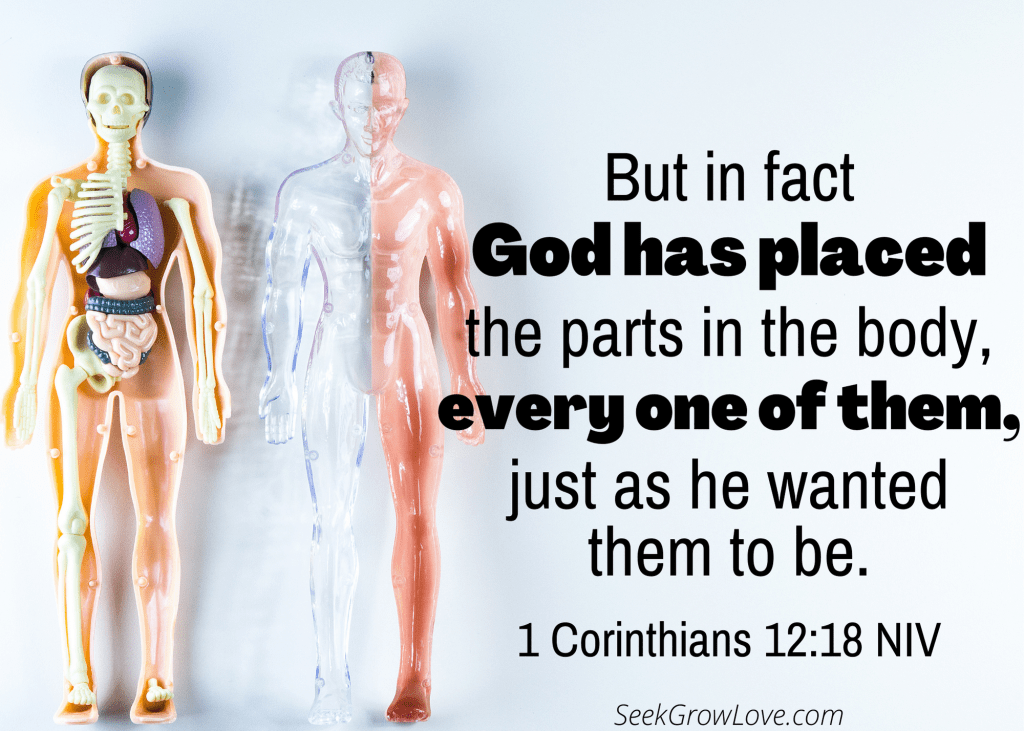
Paul addresses some of those questions in the second part of 1 Corinthians Chapter 12. He compares the church to a human body. He says “Just as a body, though one, has many parts, but all its many parts form one body, so it is with Christ. For we were all baptized by one Spirit so as to form one body—whether Jews or Gentiles, slave or free—and we were all given the one Spirit to drink. Even so the body is not made up of one part but of many. Now if the foot should say, “Because I am not a hand, I do not belong to the body,” it would not for that reason stop being part of the body. And if the ear should say, “Because I am not an eye, I do not belong to the body,” it would not for that reason stop being part of the body. If the whole body were an eye, where would the sense of hearing be? If the whole body were an ear, where would the sense of smell be? But in fact God has placed the parts in the body, every one of them, just as he wanted them to be. If they were all one part, where would the body be? As it is, there are many parts, but one body. The eye cannot say to the hand, “I don’t need you!” And the head cannot say to the feet, “I don’t need you!” On the contrary, those parts of the body that seem to be weaker are indispensable, and the parts that we think are less honorable we treat with special honor. And the parts that are unpresentable are treated with special modesty, while our presentable parts need no special treatment. But God has put the body together, giving greater honor to the parts that lacked it, so that there should be no division in the body, but that its parts should have equal concern for each other. If one part suffers, every part suffers with it; if one part is honored, every part rejoices with it. Now you are the body of Christ, and each one of you is a part of it. And God has placed in the church first of all apostles, second prophets, third teachers, then miracles, then gifts of healing, of helping, of guidance, and of different kinds of tongues. Are all apostles? Are all prophets? Are all teachers? Do all work miracles? Do all have gifts of healing? Do all speak in tongues? Do all interpret? Now eagerly desire the greater gifts. And yet I will show you the most excellent way.”
-Brian Froehlich
Application questions:
1. What is the first gift you remember receiving?
2. How about the most unusual gift you have ever received?
3. Was there ever a gift you had on your wish list that you asked for or hoped to receive, maybe even thought you would get but did not?
4. Have you ever received a gift that the giver thought you would like but you totally did not have any desire to use?
5. Have you ever received a gift without knowing its value till much later in life?
6. What gift(s) of the spirit have you been given.
7. When thinking of Paul’s imagery of us all being parts of the body, what body part do you think you are? An eye? An ear? Maybe an appendix or a tonsil?